Adhyaya 178
भीष्म–जामदग्न्यसंवादः (Amba-prasaṅga and Kurukṣetra Dvandva Declaration) / Bhishma–Jamadagnya Dialogue
Upa-parva: Bhīṣma–Jāmadagnya (Paraśurāma) Saṃvāda / Kurukṣetra Dvandva-niścaya Episode
Bhīṣma narrates that Jāmadagnya (Paraśurāma) arrives and is received with full royal-ritual honors, including brāhmaṇas, ṛtviks, and purohitas. Paraśurāma censures Bhīṣma regarding the Kāśī princess: she was brought without consent and later released, and—having been rejected by Śālva—Paraśurāma orders Bhīṣma to accept her to restore her social standing. Bhīṣma refuses, arguing that she had already declared herself Śālva’s and was permitted to depart; he asserts that he will not abandon kṣatra-dharma from fear, pity, greed, or desire. Paraśurāma responds with escalating anger and threatens lethal enforcement. Bhīṣma attempts conciliatory speech, appeals to guru-status, and questions the rationale for combat. He then articulates a principled boundary: he will not kill a brāhmaṇa-guru, yet dharma permits force against a brāhmaṇa who fights “like a kṣatriya,” and role-based duty follows conduct. Citing a traditional maxim (attributed to Marutta) about disciplining an arrogant or misguided guru, Bhīṣma concludes that a duel is justified; he invites Paraśurāma to Kurukṣetra for single combat and asserts confidence in his martial capacity, framing the encounter as a test of dharma under contested authority.
Chapter Arc: भीष्म स्मित-सा लिए रणभूमि में परशुराम को ललकारते हैं—यदि युद्ध की इच्छा है तो कवच बाँधकर रथ पर आरूढ़ हों; कुरुक्षेत्र में दो युग-पुरुष आमने-सामने खड़े हैं। → परशुराम भी मुसकराते हुए अपने रथ और दिव्य साधनों का गर्वोक्त परिचय देते हैं; भीष्म उन्हें रथस्थ, सर्वश्रेष्ठ आयुधों से दीप्त देखते हैं और दोनों के बीच वाक्य-शर और शर-प्रहार साथ-साथ बढ़ते जाते हैं। → भीष्म तीक्ष्ण भल्ल से परशुराम के धनुष की कोटि काटकर उसे भूमिपात कर देते हैं—क्षण भर को युद्ध का पलड़ा भीष्म की ओर झुकता है और गुरु-शिष्य संघर्ष अपनी चरम सीमा छूता है। → भीष्म के भीतर करुणा उमड़ती है; वे स्वयं को धैर्य देकर भी ‘धिग् धिग्’ कहकर क्षत्रधर्म की कठोरता को धिक्कारते हैं और फिर परशुराम पर आगे प्रहार नहीं करते—युद्ध-नीति पर दया का अंकुश लग जाता है। → दिन ढलने/सूर्य के तपने के साथ युद्ध का वेग थमता है, पर द्वंद्व का निर्णय शेष रहता है—अगले अध्याय में यह संघर्ष किस दिशा में मुड़ेगा, यही उत्कंठा बनी रहती है।
Shlokas
Verse 1
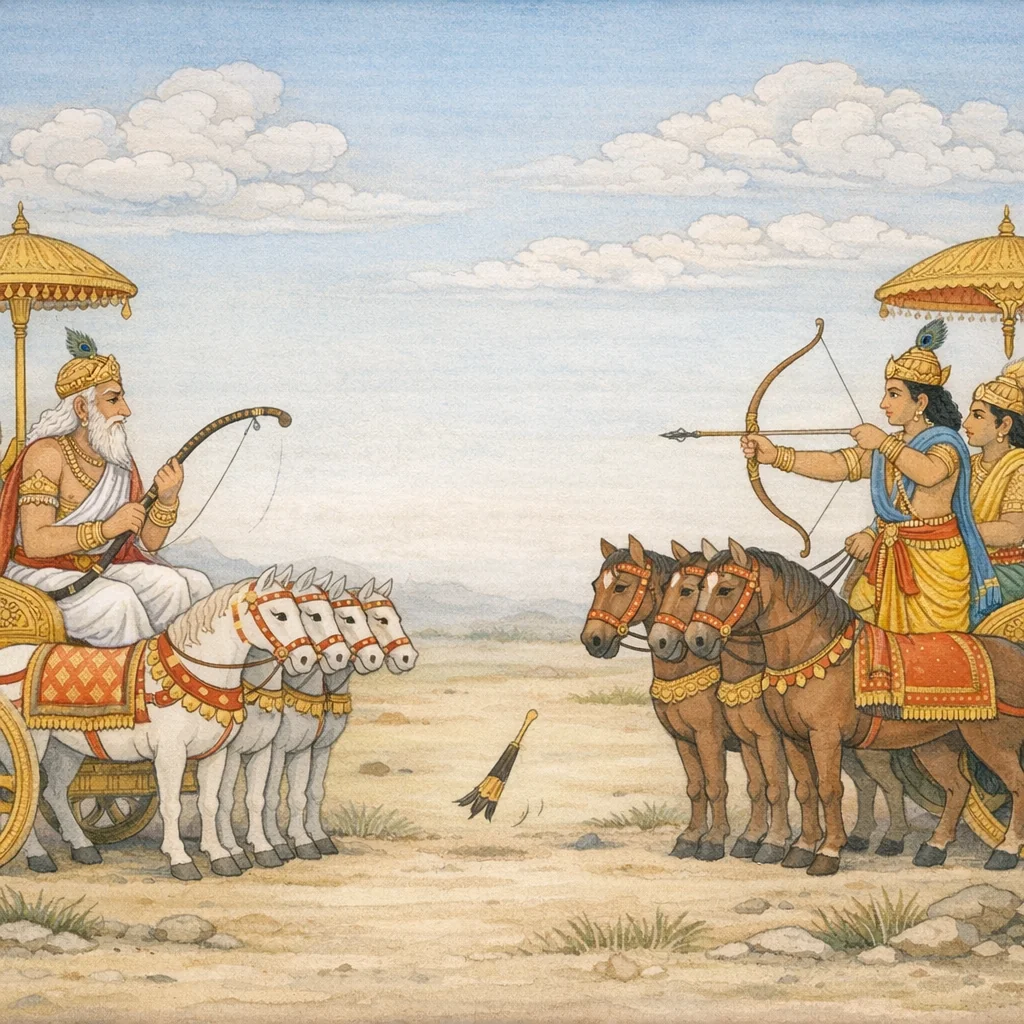
भीकम (2 अमान एकोनाशीरत्याधिेकशततमो<् ध्याय: संकल्पनिर्मित रथपर आरूढ़ परशुरामजीके साथ भीष्मका युद्ध प्रारम्भ करना भीष्म उवाच तमहं स्मयन्निव रणे प्रत्यभाषं व्यवस्थितम् । भूमिष्ठं नोत्सहे योद्धुं भवन्तं रथमास्थित:,भीष्मजी कहते हैं--राजन्! तब मैं युद्धके लिये खड़े हुए परशुरामजीसे मुसकराता हुआ-सा बोला--'ब्रह्मन! मैं रथपर बैठा हूँ और आप भूमिपर खड़े हैं। ऐसी दशामें मैं आपके साथ युद्ध नहीं कर सकता
Bhīṣma said: “O King, then—seeing Paraśurāma standing ready in the battlefield—I addressed him with a faint, almost smiling composure: ‘O Brāhmaṇa, I am mounted on a chariot while you stand on the ground. In such a situation, I do not deem it proper to fight you.’”
Verse 2
आरोह स्यन्दनं वीर कवचं च महाभुज । बधान समरे राम यदि योद्धुं मयेच्छसि,“महाबाहो! वीरवर राम! यदि आप समरभूमिमें मेरे साथ युद्ध करना चाहते हैं तो रथपर आरूढ़ होइये और कवच भी बाँध लीजिये
Bhīṣma addresses Rāma with warriorly courtesy and firm resolve: “O hero, mighty-armed one—mount your chariot and fasten your armor. If you truly wish to fight me on the battlefield, prepare yourself.” The line frames combat as a regulated, face-to-face contest governed by kṣatriya discipline, where readiness and proper equipment are part of honorable conduct.
Verse 3
ततो मामब्रवीद् राम: स्मयमानो रणाजिरे | रथो मे मेदिनी भीष्म वाहा वेदा: सदश्ववत्,तब परशुरामजी समरांगणमें किंचित् मुसकराते हुए मुझसे बोले--“कुरुनन्दन भीष्म! मेरे लिये तो पृथ्वी ही रथ है, चारों वेद ही उत्तम अश्वोंके समान मेरे वाहन हैं, वायुदेव ही सारथि हैं और वेदमाताएँ (गायत्री, सावित्री और सरस्वती) ही कवच हैं। इन सबसे आवृत एवं सुरक्षित होकर मैं रणक्षेत्रमें युद्ध करूँगा”
Then Rāma (Paraśurāma), smiling slightly on the battlefield, spoke to me: “Bhīṣma, for me the earth itself is my chariot; the four Vedas are my excellent steeds.”
Verse 4
सूतश्न मातरिश्वा वै कवचं वेदमातर: । सुसंवीतो रणे ताभिरय्योत्स्ये5हं कुरुनन्दन,तब परशुरामजी समरांगणमें किंचित् मुसकराते हुए मुझसे बोले--“कुरुनन्दन भीष्म! मेरे लिये तो पृथ्वी ही रथ है, चारों वेद ही उत्तम अश्वोंके समान मेरे वाहन हैं, वायुदेव ही सारथि हैं और वेदमाताएँ (गायत्री, सावित्री और सरस्वती) ही कवच हैं। इन सबसे आवृत एवं सुरक्षित होकर मैं रणक्षेत्रमें युद्ध करूँगा”
“Mātariśvan (the Wind-god) is my charioteer; the Veda-mothers (Gāyatrī, Sāvitrī, and Sarasvatī) are my armor. Thus well-covered and protected by them in battle, I shall fight—O delight of the Kurus.”
Verse 5
एवं ब्रुवाणो गान्धारे रामो मां सत्यविक्रम: । शरब्रातेन महता सर्वतः प्रत्यवारयत्,गान्धारीनन्दन! ऐसा कहते हुए सत्यपराक्रमी परशुरामजीने मुझे सब ओरसे अपने बाणोंके महान् समुदायद्वारा आवृत कर लिया
O son of Gāndhārī, as Rāma (Paraśurāma)—a hero of unfailing prowess—spoke thus, he hemmed me in on every side with a vast mass of arrows.
Verse 6
ततो<पश्यं जामदग्न्यं रथमध्ये व्यवस्थितम् । सर्वायुधवरे श्रीमत्यद्भुतोपमदर्शने,उस समय मैंने देखा, जमदग्निनन्दन परशुराम सम्पूर्ण श्रेष्ठ आयुधोंसे सुशोभित, तेजस्वी एवं अद्भुत दिखायी देनेवाले रथमें बैठे हैं
Then I beheld Jāmadagnya (Paraśurāma) stationed in the midst of his chariot—resplendent, equipped with the finest of weapons, and of a wondrous, incomparable appearance.
Verse 7
मनसा विहिते पुण्ये विस्तीर्णे नगरोपमे । दिव्याश्वयुजि संनद्धे काड्चनेन विभूषिते,उसका विस्तार एक नगरके समान था। उस पुण्यरथका निर्माण उन्होंने अपने मानसिक संकल्पसे किया था। उसमें दिव्य अश्व जुते हुए थे। वह स्वर्णभूषित रथ सब प्रकारसे सुसज्जित था
That meritorious chariot—fashioned by sheer mental resolve—was vast, like a city in its expanse. Yoked with divine horses and adorned with gold, it stood fully equipped in every respect.
Verse 8
कवचेन महाबाहो सोमार्ककृतलक्ष्मणा | धनुर्धरो बद्धतूणो बद्धगोधाड्गुलित्रवान्,महाबाहो! परशुरामजीने एक सुन्दर कवच धारण कर रखा था, जिसमें चन्द्रमा और सूर्यके चिह्न बने हुए थे। उन्होंने हाथमें धनुष लेकर पीठपर तरकस बाँध रखा था और अंगुलियोंकी रक्षाके लिये गोहके चर्मके बने हुए दस्ताने पहन रखे थे
Bhīṣma said: “O mighty-armed one, he wore a fine coat of mail marked with the emblems of the moon and the sun. Bearing his bow, with his quiver fastened on his back, he had also bound on finger-guards made of iguana-hide for the protection of his hand.”
Verse 9
सारथ्यं कृतवांस्तत्र युयुत्सोरकृतव्रण: । सखा वेदविदत्यन्तं दयितो भार्गवस्य ह,उस समय युद्धके इच्छुक परशुरामजीके प्रिय सखा वेदवेत्ता अकृतव्रणने उनके सारथिका कार्य सम्पन्न किया
There, Akṛtavraṇa—an accomplished knower of the Vedas and the dearly beloved friend of the Bhārgava (Paraśurāma)—served as his charioteer when he was eager to fight.
Verse 10
आह्वयान: स मां युद्धे मनो हर्षयतीव मे । पुन: पुनरभिक्रोशन्नभियाहीति भार्गव:,भुगुनन्दन राम “आओ, आओ” कहकर बार-बार मुझे पुकारते और युद्धके लिये मेरा आह्वान करते हुए मेरे मनको हर्ष और उत्साह-सा प्रदान कर रहे थे
Bhīṣma said: “Calling out to me for battle, Rāma of the Bhṛgu line—again and again shouting ‘Come on! Come on!’—kept summoning me to fight, filling my mind with a surge of joy and martial ardor.”
Verse 11
तमादित्यमिवोद्यन्तमनाधृष्यं महाबलम् | क्षत्रियान्तकरं राममेकमेक: समासदम्,उदयकालीन सूर्यके समान तेजस्वी, अजेय, महाबली और क्षत्रियविनाशक परशुराम अकेले ही युद्धके लिये खड़े थे। अतः मैं भी अकेला ही उनका सामना करनेके लिये गया
Bhīṣma said: “I saw Rāma (Paraśurāma) standing alone for battle—radiant like the rising sun, unassailable, of immense might, and famed as the destroyer of kṣatriyas. Therefore I too, alone, went forth to confront him.”
Verse 12
ततो<हं बाणपातेषु त्रिषु वाहान् निगृहा वै । अवतीर्य धर्नु्न्यस्य पदातिर्रषिसत्तमम्,जब वे तीन बार मेरे ऊपर बाणोंका प्रहार कर चुके, तब मैं घोड़ोंकी रोककर और धनुष रखकर रथसे उतर गया और उन ब्राह्मणशिरोमणि मुनिप्रवर परशुरामजीका समादर करनेके लिये पैदल ही उनके पास गया। जाकर विधिपूर्वक उन्हें प्रणाम करनेके पश्चात् यह उत्तम वचन बोला--
Bhīṣma said: “Then, after three volleys of arrows had been discharged, I checked the horses, descended from the chariot, laid aside my bow, and—on foot—approached that foremost of sages, Paraśurāma, to honor him. Having duly bowed to him according to rule, I then spoke these fitting words.”
Verse 13
अभ्यागच्छं तदा राममर्चिष्यन् द्विजसत्तमम् । अभिवाद्य चैनं विधिवदब्रुवं वाक्यमुत्तमम्,जब वे तीन बार मेरे ऊपर बाणोंका प्रहार कर चुके, तब मैं घोड़ोंकी रोककर और धनुष रखकर रथसे उतर गया और उन ब्राह्मणशिरोमणि मुनिप्रवर परशुरामजीका समादर करनेके लिये पैदल ही उनके पास गया। जाकर विधिपूर्वक उन्हें प्रणाम करनेके पश्चात् यह उत्तम वचन बोला--
Bhishma said: “Then I approached Rama (Parashurama), wishing to honor that foremost of Brahmins. Having duly saluted him according to proper rite, I addressed him with fitting and noble words.”
Verse 14
योत्स्ये त्वया रणे राम सदृशेनाधिकेन वा । गुरुणा धर्मशीलेन जयमाशास्व मे विभो,“भगवन् परशुराम! आप मेरे समान अथवा मुझसे भी अधिक शक्तिशाली हैं। मेरे धर्मात्मा गुरु हैं। मैं इस रणक्षेत्रमें आपके साथ युद्ध करूँगा; अत: आप मुझे विजयके लिये आशीर्वाद दें”
Bhīṣma said: “O Rāma (Paraśurāma), whether you are equal to me in battle or even superior, you are my revered teacher, steadfast in dharma. I will fight with you on this battlefield; therefore, O mighty one, grant me your blessing for victory.”
Verse 15
राम उवाच एवमेतत् कुरुश्रेष्ठ कर्तव्यं भूतिमिच्छता । धर्मो होष महाबाहो विशिष्टे: सह युध्यताम्,परशुरामजीने कहा--कुरुश्रेष्ठ! अपनी उन्नतिके चाहनेवाले प्रत्येक योद्धाको ऐसा ही करना चाहिये। महाबाहो! अपनेसे विशिष्ट गुरुजनोंके साथ युद्ध करनेवाले राजाओंका यही धर्म है
Rāma (Paraśurāma) said: “So it is, O best of the Kurus. Any warrior who seeks advancement should act in this very way. O mighty-armed one, this is the dharma of kings who do battle with teachers superior to themselves.”
Verse 16
शपेयं त्वां न चेदेवमागच्छेथा विशाम्पते । युध्यस्व त्वं रणे यत्तो धैर्यमालम्ब्य कौरव,प्रजानाथ! यदि तुम इस प्रकार मेरे समीप नहीं आते तो मैं तुम्हें शाप दे देता। कुरुनन्दन! तुम धैर्य धारण करके इस रफक्षेत्रमें प्रयत्नपूर्वक युद्ध करो
Rāma said: “Had you not come to me in this very manner, O lord of the people, I would have laid a curse upon you. Therefore, O Kaurava, take hold of steadfast courage and fight with full effort on the battlefield.”
Verse 17
न तु ते जयमाशासे त्वां विजेतुमहं स्थित: । गच्छ युध्यस्व धर्मेण प्रीतो5स्मि चरितेन ते,मैं तो तुम्हें विजयसूचक आशीर्वाद नहीं दे सकता; क्योंकि इस समय मैं तुम्हें पराजित करनेके लिये खड़ा हूँ। जाओ, धर्मपूर्वक युद्ध करो। तुम्हारे इस शिष्टाचारसे मैं बहुत प्रसन्न हूँ
Rāma said: “Yet I cannot bless you for victory, for at this moment I stand resolved to defeat you. Go, and fight in accordance with dharma. I am greatly pleased by your courteous conduct.”
Verse 18
ततो<हं तं नमस्कृत्य रथमारुहय सत्वर: । प्राध्मापयं रणे शड्खं पुनर्हेमपरिष्कृतम्,तब मैं उन्हें नमस्कार करके शीघ्र ही रथपर जा बैठा और उस युद्धभूमिमें मैंने पुनः अपने सुवर्णजटित शंखको बजाया
Then, having bowed to him in reverence, I swiftly mounted the chariot. There on the battlefield I once again sounded my conch, newly adorned with gold—an act that proclaims readiness for righteous combat and the resolve to act after paying due respect.
Verse 19
ततो युद्ध समभवन्मम तस्य च भारत | दिवसान् सुबहून् राजन् परस्परजिगीषया,राजन! भरतनन्दन! तदनन्तर एक-दूसरेको जीतनेकी इच्छासे मेरा तथा परशुरामजीका युद्ध बहुत दिनोंतक चलता रहा
Then a battle arose between me and him, O descendant of Bharata. For many days, O King, driven by the mutual desire to conquer one another, my combat with Paraśurāma continued without respite—each striving for victory over the other.
Verse 20
स मे तस्मिन् रणे पूर्व प्राहरत् कड्कपत्रिभि: | षष्ट्या शतैश्ष नवभि: शराणां नतपर्वणाम्,उस रणभूमिमें उन्होंने ही पहले मेरे ऊपर गीधकी पाँखोंसे सुशोभित तथा मुड़े हुए पर्ववाले नौ सौ साठ बाणोंद्वारा प्रहार किया
Rama said: In that battle, he was the first to strike at me, showering me with nine hundred and sixty arrows—adorned with vulture-feathers and fitted with bent joints. Thus he initiated the assault, setting the tone of open warfare where initiative and restraint alike become tests of a warrior’s dharma.
Verse 21
राजन! उन्होंने मेरे चारों घोड़ों तथा सारथिको भी अवरुद्ध कर दिया तो भी मैं पूर्ववत् कवच धारण किये उस समरभूमिमें डटा रहा
O King, even when they hemmed in my four horses and my charioteer, I did not yield. As before, wearing my armor, I stood firm on that battlefield—holding to a warrior’s resolve and refusing to abandon my duty under pressure.
Verse 22
नमस्कृत्य च देवेभ्यो ब्राह्म॒णेभ्यो विशेषत: । तमहं स्मयन्निव रणे प्रत्यभाषं व्यवस्थितम्,तत्पश्चात् देवताओं और विशेषत:ः ब्राह्मणोंको नमस्कार कर मैं रणभूमिमें खड़े हुए परशुरामजीसे मुसकराता हुआ-सा बोला--
Having first offered reverent salutations to the gods—and especially to the brāhmaṇas—I then addressed Paraśurāma, who stood poised on the battlefield, speaking as though with a faint smile. The moment frames a warrior’s restraint: even amid impending combat, reverence for the sacred and for learned authority is upheld as an ethical prerequisite to speech and action.
Verse 23
चत्वारस्तेन मे वाहा: सूतश्वचैव विशाम्पते | प्रतिरुद्धास्तथैवाहं समरे दंशित: स्थित:,आचार्यता मानिता मे निर्मयदि हापि त्वयि । भूयश्व शृणु मे ब्रह्मन् सम्पदं धर्मसंग्रहे “ब्रह्मन! यद्यपि आप अपनी मर्यादा छोड़े बैठे हैं तो भी मैंने सदा आपके आचार्यत्वका सम्मान किया है। धर्मसंग्रहके विषयमें मेरा जो दृढ़ विचार है, उसे आप पुनः सुन लीजिये
Therefore I have four steeds, O lord of the people, and my charioteer and horses stand checked in the press of battle while I remain poised and armed. Even though you have cast aside restraint, I have always honored you as my teacher. Now, O Brahmin, listen once more to my settled conviction regarding the true “wealth” that lies in the keeping and consolidation of dharma.
Verse 24
ये ते वेदा: शरीरस्था ब्राह्माण्यं यच्च ते महत् । तपश्च ते महत् तप्तं न तेभ्य: प्रहराम्यहम्,“विप्रवर! आपके शरीरमें जो वेद हैं, जो आपका महान् ब्राह्मणत्व है तथा आपने जो बड़ी भारी तपस्या की है, उन सबके ऊपर मैं बाणोंका प्रहार नहीं करता हूँ
Rāma said: “The Vedas that abide in your very person, your great status of brahminhood, and the mighty austerity you have performed—against these I do not direct my arrows. Out of reverence for sacred learning and ascetic merit, I will not strike you in a way that violates the honor due to a foremost brāhmaṇa.”
Verse 25
प्रहरे क्षत्रधर्मस्य यं राम त्वं समाश्रित: । ब्राह्मण: क्षत्रियत्वं हि याति शस्त्रसमुद्यमात्,“राम! आपने जिस क्षत्रियधर्मका आश्रय लिया है, मैं उसीपर प्रहार करूँगा; क्योंकि ब्राह्मण हथियार उठाते ही क्षत्रियभावको प्राप्त कर लेता है
Rama said: “Rama, the very kṣatriya-duty you have taken refuge in—I will strike at that. For a brāhmaṇa, the moment he takes up weapons, truly assumes the stance and status of a kṣatriya.”
Verse 26
पश्य मे धनुषो वीर्य पश्य बाद्दोर्बलं मम । एष ते कार्मुकं वीर छिनझि निशितेषुणा,“अब आप मेरे धनुषकी शक्ति और मेरी भुजाओंका बल देखिये। वीर! मैं अपने बाणसे आपके धनुषको अभी काट देता हूँ
Rama said: “Behold the power of my bow; behold the strength of my arms. O hero, I shall this very moment cut your bow with a keen arrow.”
Verse 27
तस्याहं निशितं भल्ल्लं चिक्षेप भरतर्षभ । तेनास्य धनुष: कोटिं छित्त्वा भूमावपातयम्,भरतश्रेष्ठ! ऐसा कहकर मैंने उनके ऊपर तेज धारवाले एक भलल नामक बाणका प्रहार किया और उसके द्वारा उनके धनुषकी कोटि (अग्रभाग)-को काटकर पृथ्वीपर गिरा दिया
Then, O bull among the Bharatas, I hurled a sharp bhalla-arrow at him. With it I severed the tip of his bow and made it fall to the ground—an act meant to disable his weapon rather than strike him down, showing controlled force within the demands of combat.
Verse 28
तथैव च पृषत्कानां शतानि नतपर्वणाम् । चिक्षेप कड़कपत्राणां जामदग्न्यरथं प्रति,इसी प्रकार परशुरामजीके रथकी ओर मैंने गीधकी पाँख और झुकी हुई गाँठवाले सौ बाण चलाये
Rāma said: “In the same manner, I hurled hundreds of arrows—some with bent joints and others feathered like a vulture’s wing—straight toward the chariot of Jāmadagnya (Paraśurāma).”
Verse 29
काये विषक्तास्तु तदा वायुना समुदीरिता: । चेलु: क्षरन्तो रुधिरं नागा इव च ते शरा:
Then those arrows, embedded fast in the bodies, were stirred and set quivering by the wind; and as they moved, they oozed blood—like serpents writhing.
Verse 30
वे बाण वायुद्वारा उड़ाये हुए सर्पोकी भाँति परशुरामजीके शरीरमें धँसकर खून बहाते हुए चल दिये ।। क्षतजोक्षितसर्वाड़: क्षरन् स रुधिरं रणे । बभौ रामस्तदा राजन मेरुर्धातुमिवोत्सूजन्,राजन्! उस समय उनके सारे अंग लहूलुहान हो गये। जैसे मेरु पर्वत वर्षाकालमें गेरु आदि धातुओंसे मिश्रित जलकी धार बहाता है, उसी प्रकार उस रणभूमिमें अपने अंगोंसे रक्तकी धारा बहाते हुए परशुरामजी शोभा पाने लगे
Those arrows, stirred by the wind like writhing serpents, sank into Paraśurāma’s body and made blood flow. O King, then Rāma (Paraśurāma), wounded in every limb and drenched in gore, shone upon the battlefield—like Mount Meru in the rainy season, pouring forth rivulets tinged with mineral ores—so did blood stream from his limbs.
Verse 31
हेमन्तान्ते5डशोक इव रक्तस्तबकमण्डित: । बभौ रामस्तथा राजन् प्रफुल्ल इव किंशुक:,राजन! जैसे वसनन््त-ऋतुमें लाल फूलोंके गुच्छोंस अलंकृत अशोक और खिला हुआ पलाश सुशोभित होता है, परशुरामजीकी भी वैसी ही शोभा हुई
O King, just as an aśoka tree at the end of winter shines adorned with clusters of red blossoms, and as a kiṃśuka (flame-of-the-forest) stands radiant in full bloom, so too did Rāma (Paraśurāma) appear—resplendent and striking.
Verse 32
ततो<न्यद् धनुरादाय राम: क्रोधसमन्वितः । हेमपुड्खान् सुनिशिताअ्शरांस्तान् हि ववर्ष सः,तब क्रोधमें भरे हुए परशुरामजीने दूसरा धनुष लेकर सोनेकी पाँखोंसे सुशोभित अत्यन्त तीखे बाणोंकी वर्षा आरम्भ की
Then Rāma (Paraśurāma), filled with anger, took up another bow and began to shower those arrows—keenly sharpened and adorned with golden fletching.
Verse 33
ते समासाद्य मां रौद्रा बहुधा मर्मभेदिन: । अकम्पयन् महावेगा: सर्पानलविषोपमा:,वे नाना प्रकारके भयंकर बाण मुझपर चोट करके मेरे मर्मस्थानोंका भेदन करने लगे। उनका वेग महान् था। वे सर्प, अग्नि और विषके समान जान पड़ते थे। उन्होंने मुझे कम्पित कर दिया
Closing in upon me, those fierce missiles—many in number and aimed to pierce vital points—struck repeatedly. Their rush was tremendous; they seemed like serpents, like fire, like poison. By their impact they made my body tremble, as the battle’s cruelty pressed in on every side.
Verse 34
तमहं समवष्टभ्य पुनरात्मानमाहवे । शतसंख्यै: शरै: क्रुद्धस्तदा राममवाकिरम्
Steadying myself again in the midst of battle, I regained my composure; then, in anger, I showered Rāma with arrows numbering in the hundreds.
Verse 35
तब मैंने पुन: अपने-आपको स्थिर करके कुपित हो उस युद्धमें परशुरामजीपर सैकड़ों बाण बरसाये ।। स तैरग्न्यर्कसंकाशै: शरैराशीविषोपमै: । शितैरभ्यर्दितो रामो मन्दचेता इवाभवत्,वे बाण अग्नि, सूर्य तथा विषधर सर्पोके समान भयंकर एवं तीक्ष्ण थे। उनसे पीड़ित होकर परशुरामजी अचेत-से हो गये
Steadying myself once more, I rained hundreds of arrows upon Rāma Paraśurāma in that battle. Those shafts—blazing like fire and the sun, dreadful as venomous serpents, and keen-edged—struck him again and again; and under their torment Rāma seemed as though his senses had grown dull.
Verse 36
ततो<हं कृपया5<विष्टो विष्टभ्यात्मानमात्मना । धिग्धिगित्यब्रुव॑ युद्ध क्षत्रधर्मं च भारत,भारत! तब मैं दयासे द्रवित हो स्वयं ही अपने-आपमें धैर्य लाकर युद्ध और क्षत्रियधर्मको धिक्कार देने लगा
Then, overcome by compassion, I steadied my own mind by my own resolve; and crying, “Shame! Shame!”, I began to denounce war and even the kṣatriya’s code of duty, O Bhārata.
Verse 37
असकृच्चाब्रुवं राजन् शोकवेगपरिप्लुत: । अहो बत कृतं पापं मेयदं क्षत्रधर्मणा
Again and again I spoke, O King, overwhelmed by the surge of grief: “Alas! What a sin this is that I have committed—done in the name of kṣatriya duty.”
Verse 38
ततो न प्राहरं भूयो जामदग्न्याय भारत,भारत! उसके बादसे मैंने परशुरामजीपर फिर प्रहार नहीं किया। इधर सहस्र किरणोंवाले भगवान् सूर्य इस पृथ्वीको तपाकर दिनका अन्त होनेपर अस्त हो गये; इसलिये वह युद्ध बंद हो गया
Then, O Bhārata, I did not strike Jamadagni’s son (Paraśurāma) again. Meanwhile the thousand-rayed Sun scorched the earth and set at the close of day; therefore that combat came to a halt.
Verse 39
अथावताप्य पृथिवीं पूषा दिवससंक्षये । जगामास्तं सहस्रांशुस्ततो युद्धमुपारमत्,भारत! उसके बादसे मैंने परशुरामजीपर फिर प्रहार नहीं किया। इधर सहस्र किरणोंवाले भगवान् सूर्य इस पृथ्वीको तपाकर दिनका अन्त होनेपर अस्त हो गये; इसलिये वह युद्ध बंद हो गया
After scorching the earth, Pūṣan—the thousand-rayed Sun—went to his setting at the close of day. Therefore the combat came to a halt, for nightfall brought the fighting to an end.
Verse 178
इस प्रकार श्रीमहाभारत उद्योगपर्वके अन्तर्गत अग्बोपाख्यानपर्वमें परशुराम और भीष्मका कुरुक्षेत्रमें युद्धके लिये अवतरणविषयक एक सौ अठद्ठत्तरवाँ अध्याय पूरा हुआ
Vaiśaṃpāyana said: Thus ends the one hundred and seventy-eighth chapter of the Udyoga Parva of the Śrī Mahābhārata, within the Ambopākhyāna section, describing Paraśurāma and Bhīṣma’s descent to Kurukṣetra for battle.
Verse 179
इति श्रीमहाभारते उद्योगपर्वणि अम्बोपाख्यानपर्वणि रामभीष्मयुद्धे एकोनाशीत्यधिकशततमो< ध्याय:,इस प्रकार श्रीमहाभारत उद्योगपर्वके अन्तर्गत अग्बोपाख्यानपर्वमें परशुराम और भीष्यका युद्धविषयक एक सौ उन्यासीवाँ अध्याय पूरा हुआ
Thus ends, in the Śrī Mahābhārata, within the Udyoga Parva, the Ambopākhyāna section, the one-hundred-and-seventy-ninth chapter concerning the battle between Rāma (Paraśurāma) and Bhīṣma.
Verse 376
गरुद्धिजातिर्धर्मात्मा यदेवं पीडित: शरै: । राजन! उस समय शोकके वेगसे व्याकुल हो मैं बार-बार इस प्रकार कहने लगा --'अहो! मुझ क्षत्रियने यह बड़ा भारी पाप कर डाला, जो कि धर्मात्मा एवं ब्राह्मण गुरुको इस प्रकार बाणोंसे पीड़ित किया”
Rāma said: “When that righteous one—born of Garuḍa’s line—was thus tormented by arrows, O King, I was overwhelmed by a surge of grief and kept repeating again and again: ‘Alas! I, though a kṣatriya, have committed a grievous sin, in that I have so wounded with arrows a righteous brāhmaṇa who was also my teacher.’”
Frequently Asked Questions
Whether Bhīṣma is ethically obligated to accept the Kāśī princess to repair perceived harm to her social standing, despite his prior release of her by consent and his vow-based commitment to procedural propriety and kṣatriya-dharma.
Authority is relational and conditioned by conduct: reverence for a guru is normative, but dharma reasoning evaluates actions by role, context, and justice; when coercion replaces counsel, duty may require principled resistance while still articulating moral limits on harm.
No explicit phalaśruti is stated; instead, the chapter embeds meta-commentary through a cited traditional maxim on disciplining a misguided guru and through Bhīṣma’s explicit dharma-justification for when combat becomes procedurally permissible.