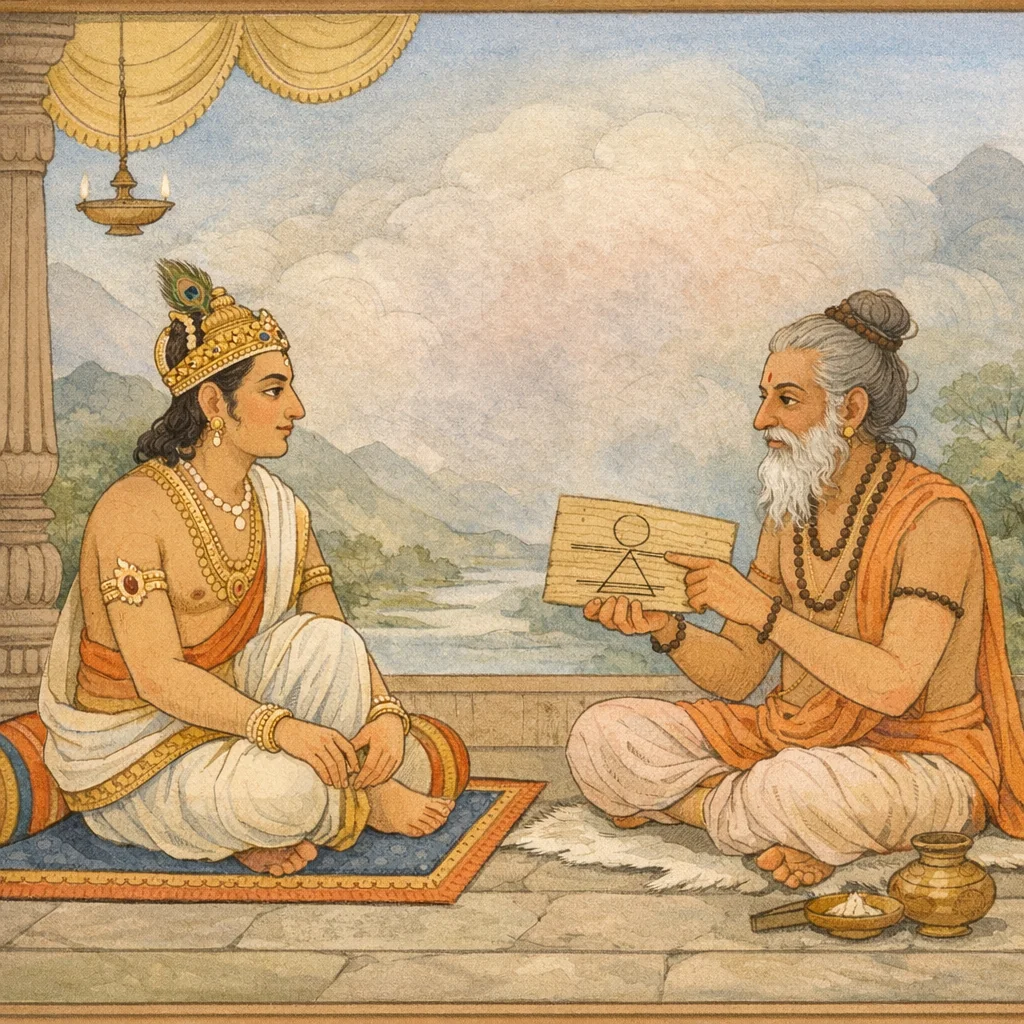
Adhyaya 308
जनक–सुलभा संवादः (Janaka–Sulabhā Dialogue on Mokṣa and Non-attachment)
Upa-parva: Mokṣa-dharma (Liberation Teachings) — Janaka–Sulabhā Saṃvāda Arc
Yudhiṣṭhira asks Bhīṣma how one may attain mokṣa with discernment while not abandoning householdership, and requests clarification on the nature of renunciation and the highest principle of liberation. Bhīṣma answers by citing an ancient narrative: King Janaka of Mithilā, learned in Veda and mokṣa-śāstra, rules with restrained senses and is celebrated by sages. The wandering yoginī-bhikṣukī Sulabhā hears discussions of Janaka’s liberation, doubts their finality, and resolves to test him. By yogic power she assumes an extraordinary form, travels swiftly to Mithilā under the pretext of alms, and is received with hospitality. Sulabhā then enters Janaka’s consciousness through yogic linkage; Janaka responds and a dialogue begins between a king claimed to be free from ‘umbrella and insignia’ (sovereign trappings) and a renunciant associated with the tridaṇḍa tradition. Janaka presents a doctrinal self-description: he learned mokṣa from Pañcaśikha, emphasizes vairāgya born of knowledge, and argues that liberation is compatible with ruling when attachment is cut like a bond severed by a sharp instrument. He critiques external renunciant marks as non-causal for mokṣa, asserting knowledge alone liberates, whether one possesses or lacks ‘something’ (ākiṃcanya/kaiṃcanya). He then challenges Sulabhā on identity and propriety using categories of varṇa, āśrama, gotra, and marital status, alleging potential ‘saṅkara’ (confusion/mixing) and questioning her motives. Sulabhā remains unshaken and replies with a formal theory of good discourse, enumerating qualities such as subtlety (saukṣmya), orderly enumeration (saṃkhyā), sequence (krama), determination (vinirṇaya), and purpose (prayojana), and rejecting speech corrupted by passion, fear, or contempt. She then answers Janaka’s ‘who/whose/whence’ by analyzing embodied existence as a contingent assemblage of sense-objects, senses, mind, intellect, and further constituents, denying intrinsic ownership and undercutting identity-claims rooted in dualities. She argues that if Janaka were truly detached, he would not reify social labels or experience agitation at her non-contact yogic entry; she critiques the king’s residual attachment to sovereignty and social distinctions, and illustrates the constraints and anxieties of kingship (dependence, demands, fear, loss). Finally, she clarifies her lineage and intent: she came to examine his mokṣa-claim, not to violate ethical order, and will depart after resting. Janaka, having heard her reasoned statements, offers no further rebuttal.
Chapter Arc: जनक के समक्ष वसिष्ठ-कराल का उपदेश क्षर-अक्षर, अव्यक्त और परमात्म-तत्त्व की सीमा पर पहुँचता है—जहाँ ‘जानते हुए भी न जानना’ और प्रकृति-संसर्ग का रहस्य प्रश्न बनकर खड़ा होता है। → जीवात्मा के नानात्व-एकत्व के दृष्टान्तों के साथ यह उलझन तीव्र होती है कि बुद्धिमान होकर भी जीव गुणों को कैसे धारण करता, सृष्टि-प्रवृत्ति में कैसे फँसता और फिर उसी से कैसे छूटता है; साथ ही यह भी कि उपदेश का अधिकारी कौन है और कौन नहीं। → तत्त्व-गणना के शिखर पर ‘षड्विंश’—अजन्मा, सर्वव्यापी, संगदोष-रहित परमात्मा—का प्रतिपादन होता है; अव्यक्त ब्रह्म को दृश्य-अदृश्य में व्याप्त बताकर यह निर्णायक बोध दिया जाता है कि मुक्ति का द्वार उसी शरणागति और साक्षात्कार से खुलता है। → वसिष्ठ-कराल ईर्ष्या-द्वेष-रहित, अमत्सर भाव और विशुद्ध सनातन ब्रह्म के ज्ञान को ‘यथार्थतत्त्व’ कहकर समेटते हैं; जीव के देव-मनुष्य-तिर्यक्-गमन को अज्ञान-सागर से शुद्धि द्वारा पार होने वाली यात्रा बताकर मोक्ष-मार्ग स्थिर करते हैं।
Shlokas
Verse 1
अप्-#-रू- अष्टाधिकांत्रेशततमो< ध्याय: क्षर-अक्षर और परमात्म-तत्त्वका वर्णन, जीवके नानात्व और एकत्वका दृष्टान्त, उपदेशके अधिकारी और अनधिकारी तथा इस ज्ञानकी परम्पराको बताते हुए वसिष्ठ-करालजनक-संवादका उपसंहार वसिष्ठ उवाच अथ बुद्धमथाबुद्धमिमं गुणविधिं शृणु । आत्मानं बहुधा कृत्वा तान्येव प्रविचक्षते,वसिष्ठजी कहते हैं--राजन्! अब बुद्ध (परमात्मा), अबुद्ध (जीवात्मा) और इस गुणमयी सृष्टि (प्राकृत प्रपंच) का वर्णन सुनो। जीवात्मा अपने-आपको अनेक रूपोंमें प्रकट करके उन रूपोंको सत्य मानकर देखता रहता है
Vasiṣṭha said: “Now listen, O king, to an account of the awakened (the Supreme Self), the unawakened (the individual self), and this order of manifestation constituted by the guṇas. The individual self, having fashioned itself into many forms, keeps regarding those very forms as real.”
Verse 2
एतदेवं विकुर्वाणो बुध्यमानो न बुध्यते । गुणान् धारयते होष सृजत्याक्षिपते तदा,वास्तवमें ज्ञानसम्पन्न होनेपर भी इस प्रकार प्रकृतिके संसर्गसे विकारको प्राप्त हुआ जीवात्मा ब्रह्मको नहीं जान पाता। वह गुणोंको धारण करता है; अतः कर्तृत्वका अभिमान लेकर रचना और संहार किया करता है
Vasiṣṭha said: Even while undergoing such transformations through contact with Nature (Prakṛti), the embodied self—though capable of understanding—fails to truly know Brahman. It upholds the guṇas; and then, seized by the sense of doership, it engages in creation and withdrawal (destruction).
Verse 3
अजसं त्विह क्रीडार्थ विकरोति जनाधिप । अव्यक्तबोधनाच्चैव बुध्यमानं वदन्त्यपि,जनेश्वर! जीवात्मा इस जगतमें सदा क्रीड़ा करनेके लिये ही विकारको प्राप्त होता है। वह अव्यक्त प्रकृतिको जानता है, इसलिये ऋषि-मुनि उसे “बुध्यमान' कहते हैं
Vasiṣṭha said: “O lord of men, the jīva here, by its own natural impulse, undergoes modification for the sake of play (līlā). And because it has an awareness of the Unmanifest (prakṛti), the sages also describe it as ‘budhyamāna’—the one that is in the act of knowing/awakening.”
Verse 4
न त्वेव बुध्यतेडव्यक्तं सगुणं तात निर्गुणम् कदाचित् त्वेव खल्वेतदाहुरप्रतिबुद्धकम्,तात! परब्रह्म परमात्मा सगुण हो या निर्मुण, उसे प्रकृति कभी नहीं जानती (क्योंकि वह जड है), अतः सांख्यवादी विद्वान् इस प्रकृतिको अप्रतिबुद्ध (ज्ञानशून्य) कहते हैं
Vasiṣṭha said: “But indeed, dear one, Prakṛti never truly apprehends that Supreme—whether spoken of as unmanifest, as possessed of qualities, or as beyond qualities. Therefore the Sāṅkhya-knowing sages describe this Prakṛti as ‘unawakened’ (without consciousness).”
Verse 5
बुध्यते यदि वाव्यक्तमेतद् वै पजचविंशकम् । बुध्यमानो भवत्येव सज्भात्मक इति श्रुति: । अनेनाप्रतिबुद्धेति वदन्त्यव्यक्तमच्युतम्,यदि यह मान लिया जाय कि प्रकृति भी जानती है तो यह केवल पचीसवें तत्त्व-- पुरुषको ही उससे संयुक्त होकर जान पाती है, प्रकृतिके साथ संयुक्त होनेके कारण ही जीव संगात्मक (संगी) होता है; ऐसा श्रुतिका कथन है। इस संगदोषके कारण ही अव्यक्त एवं अविकारी जीवात्माको लोग '"मूढ़” कह दिया करते हैं
Vasiṣṭha said: If one were to suppose that Prakṛti (the Unmanifest) ‘knows’, then that knowing is possible only through the twenty-fifth principle—the Puruṣa—when conjoined with it. Because of association with Prakṛti, the individual self becomes ‘bound up with aggregates’ (saṅghātmaka), so declares the Śruti. And owing to this very fault of association, people describe the unmanifest, unchanging Self as ‘unawakened’ or ‘deluded’, though it is in truth immutable.
Verse 6
अव्यक्तबोधनाच्चापि बुध्यमानं वदन्त्युत । पज्चविंशं महात्मानं न चासावपि बुध्यते,पचीसवाँ तत्त्वरूप महान् आत्मा अव्यक्त प्रकृतिको जानता है, इसलिये उसे 'बुध्यमान' कहते हैं; परंतु वह भी छब्बीसवें तत्त्वरूप निर्मल नित्य शुद्ध बुद्ध अप्रमेय सनातन परमात्माको नहीं जानता है; किंतु वह सनातन परमात्मा उस पचीसतवें तत्त्वरूप जीवात्माको तथा चौबीसवीं प्रकृतिको भी भलीभाँति जानता है
Vasiṣṭha said: Because it apprehends the Unmanifest (prakṛti), they call the great twenty-fifth principle—the individual self—“the one who is being awakened/knowing.” Yet even that self does not truly know the twenty-sixth principle, the stainless, eternal, ever-pure, intelligent, immeasurable, primeval Supreme Self. But that eternal Supreme Self fully knows both the twenty-fifth principle (the individual self) and the twenty-fourth (prakṛti).
Verse 7
षड्विंशं विमल॑ बुद्धमप्रमेयं सनातनम् । सतुतंपज्चविंशं च चतुर्विशं च बुध्यते,पचीसवाँ तत्त्वरूप महान् आत्मा अव्यक्त प्रकृतिको जानता है, इसलिये उसे 'बुध्यमान' कहते हैं; परंतु वह भी छब्बीसवें तत्त्वरूप निर्मल नित्य शुद्ध बुद्ध अप्रमेय सनातन परमात्माको नहीं जानता है; किंतु वह सनातन परमात्मा उस पचीसतवें तत्त्वरूप जीवात्माको तथा चौबीसवीं प्रकृतिको भी भलीभाँति जानता है
Vasiṣṭha said: The twenty-sixth principle is the stainless, ever-pure, awakened, immeasurable, eternal Supreme Self. It fully knows the twenty-fifth principle (the individual self) and the twenty-fourth (unmanifest Prakṛti). Yet the individual self, though called “the knower” because it apprehends Prakṛti, does not truly comprehend that eternal Supreme Reality.
Verse 8
दृश्यादृश्ये हानुगतं स्वभावेन महाद्युते । अव्यक्तमत्र तद् ब्रह्म बुध्यते तात केवलम्,तात! महातेजस्वी नरेश! वह अव्यक्त एवं द्वितीय ब्रह्म यहाँ दृश्य और अदृश्य सभी वस्तुओंमें स्वभावसे ही व्याप्त है; अत: वह सबको जानता है
Vasiṣṭha said: “O radiant one, that which pervades both the seen and the unseen by its very nature is here understood to be Brahman in its unmanifest aspect alone. Because it is intrinsically present in all that is perceptible and imperceptible, it is the all-knowing ground of experience.”
Verse 9
केवलं पज्चविंशं च चतुर्विशं न पश्यति । बुध्यमानो यदा55त्मानमन्यो5हमिति मन्यते
Vasiṣṭha said: When a person begins to awaken to understanding, he no longer truly perceives the twenty-four and the twenty-fifth principles as they are; instead, he falls into the notion, “I am someone other (than the Self).” In this way, misidentification arises, and ethical clarity is lost because the knower mistakes the Self for an alien or separate identity.
Verse 10
बुध्यते च परां बुद्धि विशुद्धाममलां यदा,नृपश्रेष्ठट जब जीवात्मा शुद्ध ब्रह्मविषयिणी, निर्मल एवं सर्वोत्कृष्ट बुद्धिको प्राप्त कर लेता है, तब वह छब्बीसवें तत्त्वरूप परब्रह्मका साक्षात्कार करके तद्भूप हो जाता है। उस स्थितिमें वह नित्य शुद्ध-बुद्ध ब्रह्मभावमें ही प्रतिष्ठित होता है। फिर तो वह सृष्टि और प्रलयरूप धर्मवाली अव्यक्त प्रकृतिसे सर्वधा अतीत हो जाता है
Vasiṣṭha says: When a person’s highest intellect awakens—utterly pure and stainless—fixed solely on Brahman, he directly realizes the Supreme Brahman (spoken of as the twenty-sixth principle) and becomes of its very nature. Established then in the ever-pure, ever-conscious state of Brahman, he transcends entirely the unmanifest Prakṛti whose function is creation and dissolution.
Verse 11
षड्विंशो राजशार्दूल तथा बुद्धत्वमाव्रजेत् ततस्त्यजति सोडव्यक्तं सर्गप्रलयधर्मि वै,नृपश्रेष्ठट जब जीवात्मा शुद्ध ब्रह्मविषयिणी, निर्मल एवं सर्वोत्कृष्ट बुद्धिको प्राप्त कर लेता है, तब वह छब्बीसवें तत्त्वरूप परब्रह्मका साक्षात्कार करके तद्भूप हो जाता है। उस स्थितिमें वह नित्य शुद्ध-बुद्ध ब्रह्मभावमें ही प्रतिष्ठित होता है। फिर तो वह सृष्टि और प्रलयरूप धर्मवाली अव्यक्त प्रकृतिसे सर्वधा अतीत हो जाता है
Vasiṣṭha said: “O tiger among kings, when one attains the state of perfect awakening, he then abandons the Unmanifest—whose nature is creation and dissolution. At that time, O best of rulers, the individual self, having gained a stainless and supremely excellent intellect fixed upon the pure Brahman, realizes the Supreme Brahman as the twenty-sixth principle and becomes of its very nature. Established there, he remains ever grounded in the pure, luminous state of Brahman; and thus he wholly transcends the unmanifest Prakṛti, whose law is the cycle of manifestation and reabsorption.”
Verse 12
निर्गुण: प्रकृतिं वेद गुणयुक्तामचेतनाम् | ततः केवलधर्मासौ भवत्यव्यक्तदर्शनात्,वह गुणोंसे अतीत होकर त्रिगुणमयी प्रकृतिको जडरूपमें जान लेता है, इस प्रकार प्रकृतिको अपनेसे सर्वथा अभिन्न देखनेके कारण वह कैवल्यको प्राप्त हो जाता है
Vasiṣṭha said: One who has gone beyond the guṇas comes to know Prakṛti—though constituted of the guṇas—as insentient. Then, through the vision of the Unmanifest, he becomes established in the law of aloneness (kaivalya): seeing Prakṛti as wholly non-different from the Self, he attains liberation.
Verse 13
केवलेन समागम्य विमुक्तो$5त्मानमाप्नुयात् । एतत् तु तत्त्वमित्याहुर्निस्तत््वमजरामरम्,केवल (अद्वितीय) ब्रह्मयेमे मिलकर सब प्रकारके बन्धनोंसे मुक्त हुआ अपने परमार्थस्वरूप परमात्माको प्राप्त हो जाता है। इसीको परमार्थतत्त्व कहते हैं। यह सब तत्त्वोंसे अतीत तथा जरा-मरणसे रहित है
Vasiṣṭha said: By coming into union with the One alone, a person—freed from every bond—attains the Self in its highest reality. This, they declare, is the true Reality: beyond all categories and principles, and untouched by decay and death.
Verse 14
तत्त्वसंश्रयणादेतत् तत्त्ववन्न च मानद | पज्चविंशति तत्त्वानि प्रवदन्ति मनीषिण:
Vasiṣṭha said: “Because this teaching rests upon the principles of reality (tattva), it is grounded in truth and not merely a matter of honorific opinion. Therefore, O bestower of respect, the wise declare that there are twenty-five fundamental principles.”
Verse 15
सबको मान देनेवाले नरेश! जीवात्मा तत्त्वोंका आश्रय लेनेसे ही तत्त्व-सदृश प्रतीत होता है। वास्तवमें वह तत्त्वोंका द्रष्टामात्र होनेके कारण तत्त्व नहीं है--तत्त्वोंसे सर्वथा भिन्न ही है। इस प्रकार मनीषी पुरुष (प्रकृतिके चौबीस तत्त्वोंके साथ) जीवात्माको भी एक तत्त्व मानकर कुल पचीस तत्त्वोंका प्रतिपादन करते हैं ।। न चैष तत्त्ववांस्तात निस्तत्त्वस्त्वेष बुद्धिमान् एष मुज्चति तच््व॑ हि क्षिप्रं बुद्धस्य लक्षणम्,तात! यह जीवात्मा वास्तवमें तत्त्वोंसे अतीत है, अतः तद्गूप नहीं होता है; अपितु ज्ञानवान् होनेके कारण ब्रह्मज्ञानका उदय होनेपर यह शीघ्र ही प्राकृत तत्त्वोंका त्याग कर देता है और उसमें नित्य शुद्ध-बुद्ध ब्रह्मके लक्षण प्रकट हो जाते हैं
Vasiṣṭha said: “Dear one, this self is not truly constituted of the material principles, nor is it a mere void without principle. Being intelligent, it quickly casts off the material constituents—this swift relinquishing of the tattvas is the mark of one who has awakened. When knowledge arises, the self is recognized as the witness distinct from nature, and the signs of ever-pure, ever-conscious Brahman become manifest.”
Verse 16
षड्विंशो5हमिति प्राज्ञो गृहमाणो5जरामर: । केवलेन बलेनैव समतां यात्यसंशयम्,“मैं पचीस तत्त्वोंसे भिन्न छब्बीसवाँ परमात्मा हूँ। नित्य ज्ञानसम्पन्न और जाननेके योग्य अजर-अमरस्वरूप हूँ,” इस प्रकार विचार करते-करते जीवात्मा केवल विवेक-बलसे ही ब्रह्मभावको प्राप्त हो जाता है, इसमें संशय नहीं है
Vasiṣṭha said: “I am the twenty-sixth—distinct from the twenty-five principles; I am the imperishable, deathless Self, ever endowed with knowledge and fit to be known.” When the individual self steadily takes hold of this discernment, it attains identity with Brahman through the strength of discrimination alone—of this there is no doubt.
Verse 17
षड्विंशेन प्रबुद्धेन बुध्यमानो>प्यबुद्धिमान् । एतन्नानात्वमित्युक्त सांख्यश्रुतिनिदर्शनात्,जीव छब्बीसवें तत्त्व ज्ञानस्वरूप परमात्माके प्रकाशसे ही जडवर्गको जानता है; परंतु उसे जानकर भी परमात्माको न जाननेके कारण वह अज्ञानी ही रह जाता है। यह अज्ञान ही जीवके नानात्वरूप बन्धनका कारण बताया जाता है। जैसा कि सांख्यशास्त्र और श्रुतियोंद्वारा दिग्दर्शन कराया गया है
Vasiṣṭha said: Even though the individual self is awakened by the twenty-sixth principle and thereby comes to know the inert aggregate, it still remains unwise—because, despite knowing the field of matter, it does not know the Supreme Self. This very ignorance is declared to be the cause of the soul’s bondage in the form of multiplicity, as is indicated by Sāṅkhya teaching and by the testimony of the Upaniṣadic tradition.
Verse 18
चेतनेन समेतस्य पञ्चविंशतिकस्य ह । एकत्वं वै भवत्यस्य यदा बुद्धा न बुध्यते,जब जीवात्मा बुद्धिके द्वारा जडवर्गको अपना नहीं समझता अर्थात् उससे सम्बन्ध नहीं जोड़ता, तब नित्य चेतन परमात्मासे संयुक्त हुए उस जीवात्माकी परमात्माके साथ एकता हो जाती है
Vasiṣṭha said: When the individual self—counted among the twenty-five principles and conjoined with pure consciousness—no longer ‘knows’ through the intellect, that is, when it ceases to appropriate the inert aggregate as ‘I’ or ‘mine’, then its oneness with the Supreme, ever-conscious Reality is realized.
Verse 19
बुध्यमानो5प्रबुद्धेन समतां याति मैथिल । सड्रधर्मा भवत्येष नि:सज़्भात्मा नराधिप,मिथिलानरेश! जबतक जीवात्मा जडवर्गको अपना समझता है, तबतक उस जडवर्गकी ही समताको वह प्राप्त होता है। यद्यपि वह स्वरूपसे असंग है तो भी प्रकृतिके सम्पर्कसे आसक्तिरूप धर्मवाला हो जाता है
Vasiṣṭha said: O king of Mithilā, so long as the individual self takes the inert aggregate to be its own, it attains conformity with that aggregate. Though in its true nature it is unattached, through contact with prakṛti it comes to bear the dharma of attachment.
Verse 20
निःसड्भरात्मानमासाद्य षड्विंशकमजं विभुम् | विभुस्त्यजति चाव्यक्तं यदा त्वेतद् विबुद्धाते
Vasiṣṭha said: “When one reaches that self which is free from the sixfold burden and realizes the unborn, all-pervading principle known as the twenty-sixth, then the sovereign Spirit, having truly understood this, relinquishes even the unmanifest (prakṛti).”
Verse 21
एष हाप्रतिबुद्धश्च बुध्यमानश्न॒ तेडनघ,निष्पाप नरेश! इस प्रकार मैंने तुमसे अप्रतिबुद्ध (क्षर), बुध्यमान (अक्षर जीवात्मा) और बुद्ध (ज्ञानस्वरूप परमात्मा)--इन तीनोंका श्रुतिके निर्देशके अनुसार यथार्थरूपसे प्रतिपादन किया है। शास्त्रीय दृष्टिके अनुसार जीवात्माके नानात्व और एकत्वको इसी तरह समझना चाहिये
Vasiṣṭha said: O sinless king, I have now explained to you—exactly as the Vedas indicate—the three: the unawakened (the perishable), the one in the process of awakening (the imperishable individual self), and the fully awakened (the Supreme Self whose nature is pure knowledge). From the standpoint of the scriptures, the soul’s plurality and its unity are to be understood in precisely this way.
Verse 22
प्रोक्तो बुद्धश्न तत््वेन यथाश्रुतिनिदर्शनात् । नानात्वैकत्वमेतावद् द्रष्टव्यं शास्त्रदर्शनात्,निष्पाप नरेश! इस प्रकार मैंने तुमसे अप्रतिबुद्ध (क्षर), बुध्यमान (अक्षर जीवात्मा) और बुद्ध (ज्ञानस्वरूप परमात्मा)--इन तीनोंका श्रुतिके निर्देशके अनुसार यथार्थरूपसे प्रतिपादन किया है। शास्त्रीय दृष्टिके अनुसार जीवात्माके नानात्व और एकत्वको इसी तरह समझना चाहिये
Vasiṣṭha said: “In accordance with the indications of the Vedic revelation, I have explained the ‘Awakened’ (buddha) in his true nature, just as it is heard in scripture. From the standpoint of the śāstras, this much is to be understood: the soul’s diversity and its unity are both to be seen in this very way. O sinless king, grasp this teaching as the scriptural lens for reconciling multiplicity and oneness without confusion.”
Verse 23
मशकोदुम्बरे यद्वदन्यत्वं तद्धदेतयो: । मत्स्योदके यथा तद्वदन्यत्वमुपलभ्यते,जैसे गूलर और उसके कीड़े एक साथ रहते हुए भी परस्पर भिन्न हैं, उसी प्रकार प्रकृति और पुरुषमें भी भिन्नता है। जैसे मछली और जल एक-दूसरेसे भिन्न हैं, उसी प्रकार प्रकृति और पुरुषमें भी भेद उपलब्ध होता है
Vasiṣṭha said: “Just as the gnat and the udumbara fig, though found together, are nonetheless distinct from one another, and just as a fish and water are distinct, so too the difference between Prakṛti (material nature) and Puruṣa (the conscious self) is to be discerned. Nearness or coexistence does not erase their separate realities.”
Verse 24
एवमेवावगन्तव्यं नानात्वैकत्वमेतयो: । एतद्धि मोक्ष इत्युक्तमव्यक्तज्ञानसंहितम्
Thus it should be understood: with regard to these two—diversity and unity—both are to be rightly comprehended. For this, indeed, is called liberation: a realization joined with knowledge of the Unmanifest, in which the many is seen without losing sight of the One.
Verse 25
इसी प्रकार प्रकृति और पुरुषकी एकता और अनेकताको समझना चाहिये। अव्यक्त प्रकृतिका पुरुषसे जो नित्य भेद है, उसके यथार्थज्ञानसे पुरुष उसके बन्धनसे मुक्त हो जाता है। इसीको मोक्ष कहा गया है ।। पज्चविंशतिकस्यास्य यो<यं देहेषु वर्तते । एष मोक्षयितव्येति प्राहुरव्यक्तगोचरात्,इस शरीरमें जो पचीसवाँ तत्त्व अन्तर्यामी पुरुष विद्यमान है, उसे अव्यक्तके कार्यभूत महत्तत्त्वादिके बन्धनसे मुक्त करना आवश्यक है, ऐसा विद्वान् पुरुष कहते हैं
Vasiṣṭha said: One should rightly understand both the unity and the plurality of Prakṛti and Puruṣa. When the true knowledge arises that the unmanifest Prakṛti is eternally distinct from Puruṣa, the Puruṣa is released from her bondage—this is what is called liberation. The wise declare that the indwelling Puruṣa, the twenty-fifth principle present within bodies, must be freed from the binding effects of the unmanifest—namely the evolutes such as Mahat and the rest.
Verse 26
सोथयमेवं विमुच्येत नान्यथेति विनिश्चय: । परेण परधर्मा च भवत्येष समेत्य वै
Vasiṣṭha said: “Thus alone can one be released; there is no other way—this is my settled conviction. And when one comes into accord with the Supreme, this very course becomes the highest dharma.”
Verse 27
वह यह जीवात्मा पूर्वोक्त प्रकारसे ही मुक्त हो सकता है, अन्यथा नहीं। यही विद्वानोंका निश्चय है। यह दूसरेसे मिलकर उसीका समानधर्मी हो जाता है ।। विशुद्धधर्मा शुद्धेन बुद्धेन च स बुद्धिमान । विमुक्तधर्मा मुक्तेन समेत्य पुरुषर्षभ
Vasiṣṭha said: O bull among men, this wise self, whose conduct is purified, becomes akin in nature to the pure and awakened one with whom it associates. Likewise, one whose disposition is freed becomes united with the liberated; thus liberation is attained in the manner already described, and not otherwise—this is the settled conclusion of the learned.
Verse 28
पुरुषप्रवर! जीवात्मा शुद्ध पुरुषका संग करके विशुद्ध धर्मवाला होता है। किसी ज्ञानी या बुद्धिमानका संग करनेसे बुद्धिमान् होता है। किसी मुक्तसे मिलनेपर उसमें मुक्तके-से ही धर्म या लक्षण प्रकट होते हैं ।। वियोगधर्मिणा चैव विमुक्तात्मा भवत्यथ । विमोक्षिणा विमोक्षश्न समेत्येह तथा भवेत्
Vasiṣṭha said: O best of men, the individual self becomes possessed of purified conduct by keeping company with a pure person. By associating with one who is wise or discerning, one becomes wise. And upon meeting one who is liberated, the qualities and marks akin to liberation manifest in oneself. Likewise, through association with one whose nature is detachment, one becomes freed in spirit; and by joining with one who leads to release, release itself is attained here in this very life.
Verse 29
जिसका प्रकृतिसे सम्बन्ध हट गया है, ऐसे पुरुषसे मिलनेपर वह विमुक्तात्मा होता है। जो मोक्षधर्मसे युक्त है, उसका साथ करनेसे जीवको मोक्ष प्राप्त होता है ।। शुचिकर्मा शुचिश्वैव भवत्यमितदीप्तिमान् । विमलात्मा च भवति समेत्य विमलात्मना,जिसके आचार-विचार शुद्ध हैं, उससे मिलनेपर वह पवित्रकर्मा एवं पवित्र होता है। जिसका अन्तःकरण निर्मल है, उसके सम्पर्कमें जानेपर वह भी निर्मलात्मा और अमिततेजस्वी होता है
Vasiṣṭha said: When one meets a person whose bond with primal nature (prakṛti) has fallen away, one’s own self becomes liberated. By keeping company with one who is established in the dharma of liberation, the embodied being attains release. Likewise, by associating with one whose conduct is pure, a person becomes pure in action and pure in character, radiant with immeasurable splendor. By coming into contact with one whose inner being is stainless, one too becomes stainless in soul.
Verse 30
केवलात्मा तथा चैव केवलेन समेत्य वै | स्वतन्त्रश्न स्वतन्त्रेण स्वतन्त्रत्वमवाप्तुते,अद्वितीय परमात्मासे सम्बन्ध स्थापित करके वह तद्रूपताको प्राप्त हो जाता है अर्थात् अद्वितीय परमात्माको प्राप्त हो जाता है। स्वतन्त्र परमेश्वरसे सम्बन्ध रखनेके कारण वह वास्तवमें स्वतन्त्र होकर वास्तविक स्वतन्त्रता प्राप्त कर लेता है
Vasiṣṭha said: When the individual self, standing in its own pure nature, unites with the One who is absolutely independent, it attains that very state of independence. By establishing relation with the non-dual Supreme Self, it becomes conformed to Him—indeed, it reaches the incomparable Supreme Reality—and thus gains true freedom.
Verse 31
एतावदेतत् कथितं मया ते तथ्यं महाराज यथार्थतत्त्वम् । अमत्सरत्वं परिगृहा[ चार्थ सनातन ब्रह्म विशुद्धमाद्यम्,महाराज! मैंने ईर्ष्या-द्रेषसे रहित भावको स्वीकार करके और तुम्हारे प्रयोजनको समझकर तुमसे प्रेमपूर्वक इस शुद्ध सनातन एवं सबके आदिभूत सत्यस्वरूप ब्रह्मके यथार्थ तत्त्वका इस रूपमें वर्णन किया है
Vasiṣṭha said: “So much have I told you, O great king—truthfully and in accordance with reality. Setting aside envy and grasping your purpose, I have described to you, with goodwill, that pure, eternal Brahman—the primal ground of all—as it truly is.”
Verse 32
नावेदनिष्ठस्थ जनस्य राजन् प्रदेयमेतत् परमं त्वया भवेत् | विधित्समानाय विबोधकारण प्रबोधहेतो: प्रणतस्य शासनम्,राजन! जो मनुष्य वेदमें श्रद्धा रखनेवाला न हो, उसे इस उत्तम ज्ञानका उपदेश तुम्हें नहीं करना चाहिये। जिसे बोधके लिये अधिक प्यास हो तथा जो जिज्ञासुभावसे शरणमें आया हो, वही इस उपदेशको सुननेका अधिकारी है
Vasiṣṭha said: “O King, you should not impart this supreme instruction to a person who is not grounded in reverence for the Veda. This teaching is to be given to one who seeks awakening, who longs for understanding, and who has approached with sincere humility for the sake of being enlightened.”
Verse 33
न देयमेतच्च तथानृतात्मने शठाय क्लीबाय न जिद्दाबुद्धये । न पण्डितज्ञानपरोपतापिने देयं तु देयं च निबोध यादृशे,असत्यवादी, शठ, नीच, कपटी, अपनेको पण्डित माननेवाले और दूसरेको कष्ट पहुँचानेवाले मनुष्यको भी इसका उपदेश नहीं देना चाहिये। कैसे पुरुषको इस ज्ञानका उपदेश देना और अवश्य देना चाहिये--यह भी सुन लो
Vasiṣṭha said: This teaching should not be given to one whose inner nature is false, nor to a deceitful person, nor to one who is impotent in resolve, nor to one whose understanding is perverted. It should not be given to one who parades as a learned knower while causing suffering to others. But it should indeed be given—listen now to what kind of person is fit to receive it.
Verse 34
श्रद्धान्वितायाथ गुणान्विताय परापवादाद् विरताय नित्यम् | विशुद्धयोगाय बुधाय नित्यं क्रियावते च क्षमिणे हिताय
Vasiṣṭha said: (This teaching is to be given) to one who is endowed with faith and good qualities, who constantly refrains from censuring others, who is wise and ever established in pure yoga; and also to one who is devoted to right conduct, patient in forgiveness, and intent on the welfare of all.
Verse 35
विविक्तशीलाय विधिप्रियाय विवादहीनाय बहुश्रुताय । विजानते चैव न चाहिततक्षमे दमे च शक्ताय शमे च देयम्
Vasiṣṭha said: “A gift should be given to one whose conduct is secluded and disciplined, who delights in right procedure, who is free from contentiousness, and who is deeply learned—one who truly understands, who does not tolerate what is improper, and who is capable both of self-restraint and inner tranquility.”
Verse 36
श्रद्धालु, गुणवान्, परनिन्दासे सदा दूर रहनेवाले, विशुद्ध योगी, विद्वान, सदा शास्त्रोक्त कर्म करनेवाले, क्षमाशील, सबके हितैषी, एकान्तवासी, शास्त्रविधिका आदर करनेवाले, विवादहीन, बहुज्ञ, विज्ञ किसीका अहित न करनेवाले तथा इन्द्रियसंयम एवं मनोनिग्रहमें समर्थ पुरुषको ही इस ज्ञानका उपदेश देना चाहिये ।। एतैर्गुणैहीनतमे न देय- मेतत् परं ब्रह्म विशुद्धमाहु: । न श्रेयसा योक्ष्यति तादुशे कृतं धर्मप्रवक्तारमपात्रदानात्,जो इन सदगुणोंसे अत्यन्त हीन हो, उसे इसका उपदेश नहीं देना चाहिये। यह ज्ञान विशुद्ध परब्रह्मस्वरूप बताया गया है। वैसे गुणहीन पुरुषको दिया हुआ यह ज्ञान उसके लिये कल्याणकारी नहीं होगा तथा कुपात्रको उपदेश देनेसे वह वक्ताका भी कल्याण नहीं करेगा
Vasiṣṭha said: This teaching should be imparted only to a person who is faithful, virtuous, always distant from disparaging others, a purified yogin, learned, constantly engaged in scripturally enjoined duties, patient, devoted to the welfare of all, inclined to solitude, respectful of scriptural injunctions, free from contentiousness, broadly knowledgeable and discerning, one who harms no one, and who is capable of restraining the senses and mastering the mind. To one who is utterly devoid of these qualities, it should not be given. This knowledge is declared to be the pure Supreme Brahman. Given to an unqualified person, it will not lead to that person’s true good; and by giving instruction to an unfit recipient, the teacher too does not attain welfare.
Verse 37
पृथ्वीमिमां यद्यपि रत्नपूर्णा दद्यान्न देयं त्विदमव्रताय । जितेन्द्रियायैतदसंशयं ते भवेत् प्रदेयं परम नरेन्द्र,नरेन्द्र! जिसने व्रत और नियमोंका पालन न किया हो, वह यदि रत्नोंसे भरी हुई इस सारी पृथ्वीका राज्य दे तो भी उसे इस ज्ञानका उपदेश नहीं देना चाहिये। परंतु जितेन्द्रिय पुरुषको निस्संदेह इस परम उत्तम ज्ञानका उपदेश देना तुझे उचित है
Vasiṣṭha said: “Even if a man were to offer this entire earth filled with jewels, this teaching should not be given to one who is without vows and disciplined observances. But to a self-controlled person, O king, it should certainly be imparted—indeed, it is right for you to bestow this supreme knowledge upon him.”
Verse 38
कराल मा ते भयमस्तु किज्चि- देतच्छुतं ब्रह्म परं त्वयाद्य । यथादवदुक्त परम पवित्र विशोकमत्यन्तमनादिमध्यम्,कराल! तुमने मुझसे आज परब्रह्मका ज्ञान सुना है; अतः तुम्हारे मनमें तनिक भी भय नहीं होना चाहिये। वह परब्रह्म परम पवित्र, शोकरहित, आदि, मध्य और अनन््तसे शून्य, जन्म-मृत्युसे बचानेवाला, निरामय, निर्भय तथा कल्याणमय है। राजन्! उसका मैंने यथावत्रूपसे प्रतिपादन किया है। वही सम्पूर्ण ज्ञानोंका तात््विक अर्थ है। ऐसा जानकर उसका ज्ञान प्राप्त करके आज मोहका परित्याग कर दो
Vasiṣṭha said: “Karāla, let there be no fear in you at all. Today you have heard from me the supreme Brahman. I have described it correctly: it is utterly pure, free from sorrow, and beyond all limiting points such as beginning and middle. Knowing this, gain firm understanding of it and abandon delusion this very day.”
Verse 39
अगाधजन्मामरणं च राजन् निरामयं वीतभयं शिवं च । समीक्ष्य मोहं त्यज वाद्य सर्व- ज्ञानस्य तत्त्वार्थमिदं विदित्वा,कराल! तुमने मुझसे आज परब्रह्मका ज्ञान सुना है; अतः तुम्हारे मनमें तनिक भी भय नहीं होना चाहिये। वह परब्रह्म परम पवित्र, शोकरहित, आदि, मध्य और अनन््तसे शून्य, जन्म-मृत्युसे बचानेवाला, निरामय, निर्भय तथा कल्याणमय है। राजन्! उसका मैंने यथावत्रूपसे प्रतिपादन किया है। वही सम्पूर्ण ज्ञानोंका तात््विक अर्थ है। ऐसा जानकर उसका ज्ञान प्राप्त करके आज मोहका परित्याग कर दो
Vasiṣṭha said: “O King, having understood that Supreme Reality—unfathomable with respect to birth and death, free from disease, devoid of fear, and wholly auspicious—cast off delusion. I have described it to you as it truly is. This is the essential, inner meaning of all forms of knowledge; knowing this, let your mind be without fear and abandon confusion today.”
Verse 40
अवाप्तमेतद्धि मया सनातना- द्विरण्यगर्भाद् गदतो नराधिप । प्रसाद्य यत्नेन तमुग्रचेतसं सनातन ब्रह्म यथाद्य वै त्वया,नरेश्वरर जिस प्रकार आज तुमने मुझसे सनातन ब्रह्मका ज्ञान प्राप्त किया है; इसी प्रकार मैंने भी हिरण्यगर्भ नामसे प्रसिद्ध सनातन उग्रचेता ब्रह्माजीके मुखसे, उन्हें बड़े यत्नसे प्रसन्न करके इसे प्राप्त किया था
Vasiṣṭha said: “O king, I too received this eternal teaching from the Ancient One—Hiraṇyagarbha—when he was expounding it. By earnest effort I won the favor of that fierce-minded, primeval Brahmā, and thus obtained this timeless knowledge—just as you have now received the knowledge of the eternal Brahman from me.”
Verse 41
पृष्टस्त्वया चास्मि यथा नरेन्द्र यथा मयेदं त्वयि चोक्तमद्य । तथावापंतं ब्रह्मणो मे नरेन्द्र महाज्ञानं मोक्षविदां परायणम्,नरेन्द्र! जैसे तुमने मुझसे पूछा है और जैसे मैंने तुम्हारे प्रति आज इस ज्ञानका उपदेश किया है, उसी प्रकार मैंने भी ब्रह्माजीसे प्रश्न करके उनके मुखसे इस महान् ज्ञानको प्राप्त किया है। यह मोक्ष ज्ञानियोंका परम आश्रय है
Vasiṣṭha said: “O king, just as you have questioned me, and just as I have today taught this knowledge to you, so too did I once question Brahmā and receive it from his own mouth. This is the great wisdom—the highest refuge of those who know liberation.”
Verse 42
भीष्म उवाच एतदुक्तं परं ब्रह्म यस्मान्नावर्तते पुनः । पज्चविंशो महाराज परमर्षिनिदर्शनात्
Bhishma said: “This has been declared as the Supreme Brahman—having reached which one does not return again. O great king, this is the twenty-fifth principle, as shown in the vision and teaching of the highest seers.”
Verse 43
भीष्मजी कहते हैं--महाराज! महर्षि वसिष्ठके बताये अनुसार यह परब्रह्मका स्वरूप मैंने तुम्हें बताया है, जिसे पाकर जीवात्मा फिर इस संसारमें नहीं लौटता ।। पुनरावत्तिमाप्रोति परं ज्ञानमवाप्य च | नावबुध्यति तत्त्वेन बुध्यमानो$डजरामरम्,जो इस उत्तम ज्ञानको गुरुके मुखसे पाकर भी भलीभाँति समझता नहीं है, वह पुनरावृत्ति (बारंबार आवागमन) को प्राप्त होता है और जो इसे तत्त्वतः समझ लेता है, वह जरा-मृत्युसे रहित परब्रह्म परमात्माको प्राप्त होता है
Bhishma said: “O King, I have explained to you—just as the great sage Vasiṣṭha taught—the nature of the Supreme Brahman. Having attained That, the individual self does not return again to this worldly cycle. Even after obtaining the highest knowledge, one who fails to grasp it in its true essence falls back into repeated return; but one who understands it as it really is attains the Supreme Self, Brahman, beyond aging and death.”
Verse 44
एततन्नि:श्रेयसकरं ज्ञानं ते परमं मया । कथित तत्त्वतस्तात श्रुत्वा देवर्षितो नूप,तात! नरेश्वर! यह परम कल्याणकारी उत्तम ज्ञान मैंने देवर्षि नारदजीके मुँहसे सुना था। जिसे यथार्थरूपसे तुम्हें भी बताया है
Bhishma said: “This supreme knowledge, which leads to the highest good, I have explained to you in accordance with the truth, dear one. O king, I had heard it from the divine seer; having received it thus, I have now conveyed it to you as it truly is.”
Verse 45
हिरण्यगर्भादृषिणा वसिष्ठेन महात्मना । वसिष्ठादृषिशार्दूलान्नारदो5वाप्तवानिदम्,ब्रह्माजीसे महात्मा वसिष्ठ मुनिने यह ज्ञान प्राप्त किया था। मुनिश्रेष्ठ वसिष्ठसे यह नारदजीको उपलब्ध हुआ और नारदजीसे मुझे यह सनातन ब्रह्मका उपदेश प्राप्त हुआ है। कौरवनरेश! यह ज्ञान परमपद है। इसे सुनकर अब तुम शोकका त्याग कर दो
Bhishma said: “This teaching was received by the great sage Vasiṣṭha, who learned it from Hiraṇyagarbha. From Vasiṣṭha, the tiger among seers, Nārada obtained it. Thus this eternal instruction concerning Brahman has come down to me through that lineage. O king of the Kurus, this knowledge leads to the highest state; having heard it, abandon grief.”
Verse 46
नारदाद् विदितं महामेतद् ब्रह्म सनातनम् | मा शुच: कौरवेन्द्र त्वं श्रुव्वैतत् परमं पदम्,ब्रह्माजीसे महात्मा वसिष्ठ मुनिने यह ज्ञान प्राप्त किया था। मुनिश्रेष्ठ वसिष्ठसे यह नारदजीको उपलब्ध हुआ और नारदजीसे मुझे यह सनातन ब्रह्मका उपदेश प्राप्त हुआ है। कौरवनरेश! यह ज्ञान परमपद है। इसे सुनकर अब तुम शोकका त्याग कर दो
Bhishma said: “This great, eternal Brahman has become known to me through Narada. Do not grieve, O lord of the Kurus. Listen to this teaching, for it is the supreme state.” In ethical intent, Bhishma frames the doctrine as a consoling, liberating knowledge transmitted through a revered lineage, meant to dissolve sorrow by directing the mind from loss and conflict toward the highest spiritual goal.
Verse 47
येन क्षराक्षरे वित्ते भयं तस्य न विद्यते । विद्यते तु भयं तस्य यो नैतदू वेत्ति पार्थिव,पृथ्वीनाथ! जिसने क्षर और अक्षरके तत्त्वको जान लिया है, उसमें किसी प्रकारका भी भय नहीं होता। जो इसे नहीं जानता, उसीमें भय रहता है
Bhīṣma said: “For one who has truly understood the perishable and the imperishable, fear does not exist. But fear remains for the one who does not know this—O king, lord of the earth.”
Verse 48
अविज्ञानाच्च मूढात्मा पुन: पुनरुपाद्रवत् । प्रेत्य जातिसहस्राणि मरणान्तान्युपाश्ुते,मूर्ख मनुष्य इस तत्त्वको न जाननेके कारण बारंबार संसारमें आता है और हजारों योनियोंमें जन्म-मरणके कष्टका अनुभव करता है
Bhīṣma said: “Through lack of true knowledge, the deluded self rushes again and again into worldly existence. After death, it undergoes the end of life again and again—experiencing the suffering of birth and death across thousands of forms of life.”
Verse 49
देवलोकं तथा तिर्यड्मनुष्यमपि चाश्रुते । यदि शुध्यति कालेन तस्मादज्ञानसागरात्,(उत्तीर्णोउस्मादगाधात् स परमाप्रोति शो भनम् ।) वह देव, मनुष्य और पशु-पक्षी आदिकी योनिमें भटकता रहता है। यदि कभी समयके अनुसार शुद्ध हो गया तो उस अगाध अज्ञानसमुद्रसे पार होकर परम कल्याणका भागी होता है
Bhishma explains that a being, driven by ignorance, repeatedly takes birth among the gods, humans, and the animal realm. If, in due course, it becomes purified with time—through the ripening of experience and the gradual cleansing of inner faults—then it crosses that unfathomable ocean of ignorance and attains the highest good.
Verse 50
अज्ञानसागरो घोरो हाव्यक्तोड्गाध उच्यते । अहन्यहनि मज्जन्ति यत्र भूतानि भारत,भरतनन्दन! अज्ञानरूपी समुद्र अव्यक्त, अगाध और भयंकर बताया जाता है। इसमें असंख्य प्राणी प्रतिदिन गोते खाते रहते हैं
Bhishma said: “The ocean of ignorance is described as dreadful—unmanifest and unfathomably deep. In it, O Bharata, living beings plunge and sink day after day.”
Verse 51
यस्मादगाधादव्यक्तादुत्तीर्णस्त्वं सनातनात् । तस्मात् त्वं विरजाश्वैव वितमस्कश्न पार्थिव,राजन! तुम मेरा उपदेश पाकर इस अव्यक्त, अगाध एवं प्रवाहरूपमें सदा रहनेवाले भवसागरसे पार हो गये हो, इसलिये अब तुम रजोगुण और तमोगुणसे भी रहित हो गये हो
Bhishma said: “Since you have crossed beyond the unfathomable, unmanifest, beginningless ocean of becoming, therefore, O king, you have now become free from rajas and free from tamas as well.”
Verse 96
तदा प्रकृतिमानेष भवत्यव्यक्तलोचन: । चौबीसवीं अव्यक्त प्रकृति न तो अद्वितीय ब्रह्मको देख पाती है और न पचीसतवें तत्त्वरूप जीवात्माको। जब जीवात्मा अव्यक्त ब्रह्मकी ओर दृष्टि रखकर अपनेको प्रकृतिसे भिन्न मानता है, तब यह प्रकृतिका अधिपति हो जाता है
Vasiṣṭha said: Then this being, whose vision is turned toward the Unmanifest, does not truly perceive the twenty‑fourth principle—the unmanifest Prakṛti—nor the twenty‑fifth principle, the individual Self in its essential reality, nor the non-dual Brahman. But when the individual self fixes its gaze upon the unmanifest Brahman and understands itself to be distinct from Prakṛti, it becomes the master of Prakṛti rather than its servant.
Verse 203
चतुर्विशमसारं च षड्विंशस्य प्रबोधनात् । छब्बीसवाँ तत्त्व परमात्मा अजन्मा, सर्वव्यापी और संगदोषसे रहित है। उसकी शरण लेकर जब जीवात्मा उसके स्वरूपका साक्षात्कार कर लेता है, तब परमात्म-ज्ञानके प्रभावसे स्वयं भी सर्वव्यापी हो जाता है तथा चौबीस तत्त्वोंसे युक्त प्रकृतिको असार समझकर त्याग देता है
Vasiṣṭha teaches that, through awakening to the twenty-sixth principle—the Supreme Self, unborn, all-pervading, and untouched by the taint of association—the individual self, taking refuge in That and directly realizing Its nature, becomes (as it were) all-pervading by the power of supreme knowledge. Seeing the twenty-four principles that constitute Prakṛti as insubstantial, it renounces attachment to them.
Verse 307
इस प्रकार श्रीमहाभारत शान्तिपर्वके अन्तर्गत मोक्षधर्मपर्वमें वसिष्ठकरालजनकसंवादविषयक तीन सौ सातवाँ अध्याय पूरा हुआ
Thus ends the three hundred and seventh chapter of the Mokṣadharma section within the Śānti Parva of the Śrī Mahābhārata, dealing with the dialogue among Vasiṣṭha, Karāla, and King Janaka.
Verse 308
इति श्रीमहाभारते शान्तिपर्वणि मोक्षधर्मपर्वणि वसिष्ठकरालजनकसंवादसमाप्तौ अष्टाधिकत्रिशततमो< ध्याय:,इस प्रकार श्रीमहाभारत शान्तिपर्वके अन्तर्गत गोक्षधर्मपर्वमें वायिष्ठ-करालजनक-संवादकी समाप्तिविषयक तीन सौ आठवाँ अध्याय पूरा हुआ
Thus, in the Śrī Mahābhārata, within the Śānti Parva and specifically the Mokṣa-dharma section, the dialogue involving Vasiṣṭha, Karāla, and King Janaka comes to its conclusion; this marks the completion of the three-hundred-and-eighth chapter.
Frequently Asked Questions
The chapter tests whether liberation can be credibly claimed within kingship and household life, or whether residual attachment appears through identity-assertion (varṇa/āśrama/gotra) and defensiveness when challenged by a renunciant interlocutor.
Mokṣa is grounded in knowledge that yields non-attachment and equanimity; external insignia and social labels are not sufficient indicators. A liberated stance is evidenced by freedom from dualities, agitation, and possessive claims, and by disciplined, non-contemptuous discourse.
No explicit phalaśruti is stated; the meta-commentary operates through Bhīṣma’s framing exemplum and Sulabhā’s discourse-criteria, positioning the chapter as a diagnostic text for assessing mokṣa-claims within social roles.