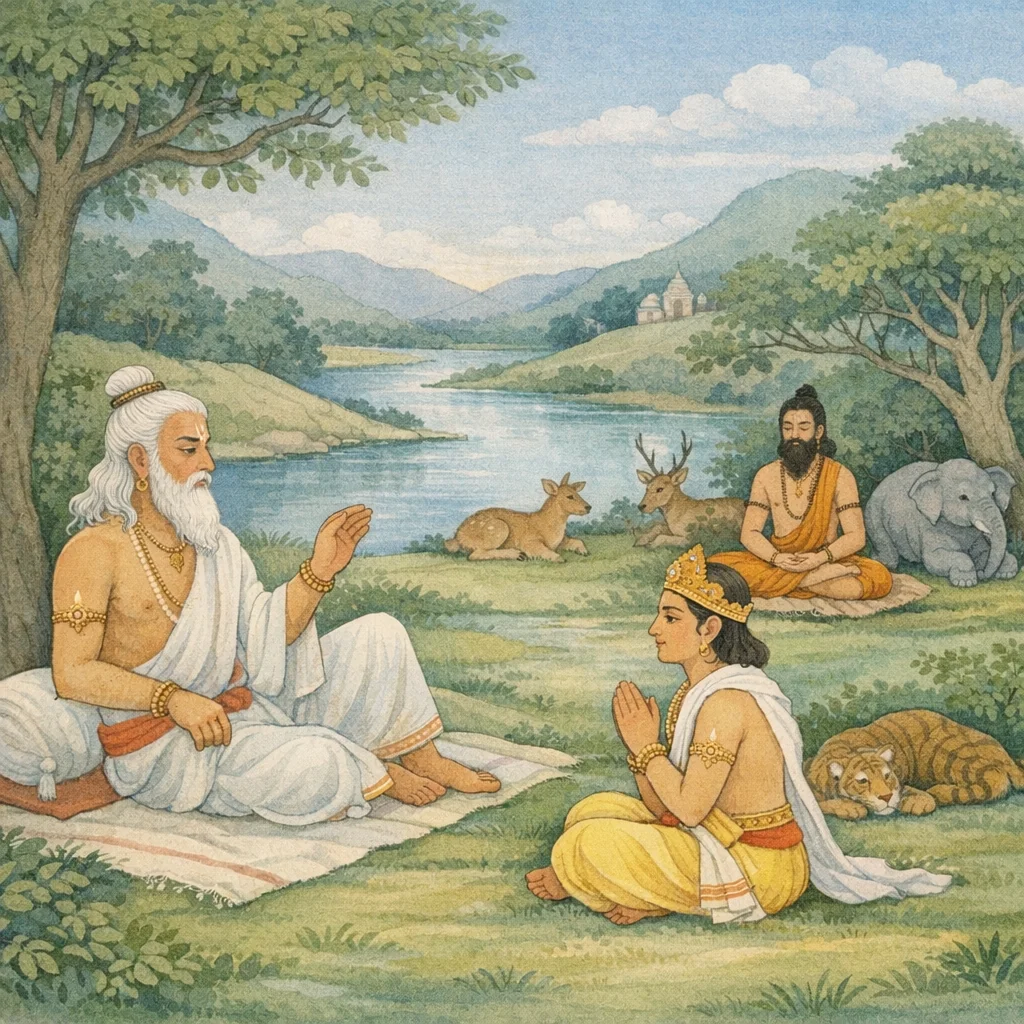
Adhyaya 300
Saṃhāra-krama (The Sequence of Cosmic Dissolution) — Yājñavalkya’s Discourse
Upa-parva: Mokṣa-dharma (Liberation Discourse) — Cosmology of Dissolution (Saṃhāra)
Yājñavalkya continues a systematic account of categories (tattva) and time-measures by outlining dissolution (saṃhāra) in an ordered chain. The chapter depicts cyclical creation-and-withdrawal under an eternal, imperishable principle. A solar agency, described as dividing into twelve forms, rapidly desiccates the four modes of embodied life (jarāyuja, aṇḍaja, svedaja, udbhijja), reducing the world to a leveled surface. Waters then inundate the remaining earth, but are themselves consumed by a ‘time-fire’ (kālāgni), after which a great conflagration intensifies. Wind, characterized in eightfold form, consumes fire; space absorbs wind; mind absorbs space; ahaṃkāra (ego-principle), identified with prajāpati, absorbs mind; and a higher comprehensive principle (mahat/śambhu/īśāna imagery) subsumes ahaṃkāra, described via omniform and all-pervasive attributes. The chapter closes by stating that dissolution has been explained ‘as it is’ and transitions to the triadic analytic teaching of adhyātma, adhibhūta, and adhidaiva.
Chapter Arc: युधिष्ठिर, धर्म-शोक से थके हुए, भीष्म से पूछते हैं—तात! सांख्य और योग में वास्तविक अन्तर क्या है, और मुक्ति का मार्ग कौन-सा है? → भीष्म बताते हैं कि विद्वान अपने-अपने पक्ष की श्रेष्ठता सिद्ध करते हैं—कोई सांख्य की प्रशंसा करता है, कोई योग की; पर दोनों का लक्ष्य एक ही है: अनीश्वर (अहंकार-ग्रस्त) जीव कैसे छूटे। वे योग की साधना-रेखा खींचते हैं—धारणा, समाधि, इन्द्रिय-निग्रह, और तप-नियम; साथ ही चेतावनी देते हैं कि दुर्बल योगी जाल में फँसी मछलियों की तरह विषयों में फँसकर विनाश को जाते हैं। → भीष्म योग-सिद्धि की ऊँचाई का चित्र खींचते हैं—योगी काम-क्रोध, शीत-उष्ण, भय-शोक, तृष्णा, निद्रा आदि द्वन्द्वों को जीतकर सूक्ष्म धारणा से आत्म-समाधि में स्थित होता है; तब वह नाग, पर्वत, यक्ष, दिशाएँ, गन्धर्व-समूह, स्त्री-पुरुष—समस्त लोक-व्यवहार को अतिक्रमित कर शीघ्र विमुक्ति की ओर बढ़ता है, और ‘नारायणात्मा’ होकर मनुष्यों पर विजय पाता है। → अध्याय का निष्कर्ष यह है कि योग-विधि का सार इन्द्रिय-जय, मन-स्थैर्य और आत्म-समाधि है; बाह्य आडम्बर नहीं, बल्कि दीर्घकालीन संयम (जैसे एकाहार, रूक्ष यव-आहार का उदाहरण) और भीतर की शुद्धि ही बल और मुक्ति का कारण बनती है। → भीष्म की वाणी योग की सिद्धि तक पहुँचा देती है, पर युधिष्ठिर के मन में अगला प्रश्न उभरता है—इस सिद्धि का स्थायी आधार क्या है: ज्ञान (सांख्य) या अभ्यास (योग), और गृहस्थ-धर्म में रहते हुए यह कैसे साध्य है?
Shlokas
Verse 1
युधिष्ठिरने पूछा--तात! धर्मज्ञ कुरुश्रेष्ठ! सांख्य और योगमें कया अन्तर है? यह बतानेकी कृपा करें; क्योंकि आपको सब बातोंका ज्ञान है
Yudhiṣṭhira said: “Revered sir—O knower of dharma, best among the Kurus—what is the difference between Sāṅkhya and Yoga? Please be gracious to explain it, for you possess understanding in all matters.”
Verse 2
भीष्म उवाच सांख्या: सांख्य॑ प्रशंसन्ति योगा योगं द्विजातय: । वदन्ति कारण श्रेष्ठ स्वपक्षोद्धावनाय वै,भीष्मजीने कहा--युधिष्छिर! सांख्यके विद्वान् सांख्यकी और योगके ज्ञाता द्विज योगकी प्रशंसा करते हैं। दोनों ही अपने-अपने पक्षकी उत्कृष्टता सूचित करनेके लिये उत्तमोत्तम युक्तियोंका प्रतिपादन करते हैं
Bhishma said: “The followers of Sāṅkhya praise Sāṅkhya, and the practitioners of Yoga—O best of causes—praise Yoga. Each side, intent on elevating its own standpoint, puts forward the finest arguments to establish its superiority.”
Verse 3
अनीथ्चवर:ः कथं मुच्येदित्येवं शत्रुकर्शन । वदन्ति कारणै: श्रैष्ठ्यं योगा: सम्पड्मनीषिण:,शत्रुसूदन! योगके मनीषी विद्वान् अपने मतकी श्रेष्ठता बताते हुए यह युक्ति उपस्थित करते हैं कि ईश्वरका अस्तित्व स्वीकार किये बिना किसीकी भी मुक्ति कैसे हो सकती है? (अतः मोक्षदाता ईश्वरकी सत्ता अवश्य स्वीकार करनी चाहिये)
Bhishma said: “O subduer of foes, they argue thus: ‘How could one who denies the Lord ever attain liberation?’ In this way, discerning thinkers—skilled in reasoning—set forth the superiority of their yogic doctrine, insisting that acceptance of the Lord’s reality is necessary for moksha.”
Verse 4
वदन्ति कारण चेदं सांख्या: सम्यग् द्विजातय: । विज्ञायेह गतीः सर्वा विरक्तो विषयेषु यः,सांख्यमतके माननेवाले महाज्ञानी द्विज मोक्षका युक्तियुक्त कारण इस प्रकार बताते हैं --सब प्रकारकी गतियोंको जानकर जो विषयोंसे विरक्त हो जाता है, वही देहत्यागके अनन्तर मुक्त होता है। यह बात स्पष्टरूपसे सबकी समझमें आ सकती है। दूसरे किसी उपायसे मोक्ष मिलना असम्भव है। इस प्रकार वे सांख्यको ही मोक्षदर्शन कहते हैं
Bhīṣma said: “The Sāṅkhyas—those twice-born who understand rightly—declare this to be the true causal principle: in this world, one who has discerned all the courses of beings and becomes detached from sense-objects, that person alone attains liberation after casting off the body. This, they say, is plainly intelligible; by no other means is liberation possible. Therefore they call Sāṅkhya itself the vision that leads to mokṣa.”
Verse 5
ऊर्ध्व॑ स देहात् सूव्यक्त विमुच्येदिति नान्यथा । एठदाहुर्महाप्राज्ञा: सांख्ये वै मोक्षदर्शनम्,सांख्यमतके माननेवाले महाज्ञानी द्विज मोक्षका युक्तियुक्त कारण इस प्रकार बताते हैं --सब प्रकारकी गतियोंको जानकर जो विषयोंसे विरक्त हो जाता है, वही देहत्यागके अनन्तर मुक्त होता है। यह बात स्पष्टरूपसे सबकी समझमें आ सकती है। दूसरे किसी उपायसे मोक्ष मिलना असम्भव है। इस प्रकार वे सांख्यको ही मोक्षदर्शन कहते हैं
Bhīṣma said: “It is clearly understood that one is released upward (to liberation) only after casting off the body—there is no other way. The great wise ones declare that Sāṅkhya is indeed the ‘vision of liberation’: by discerning the courses of worldly experience and becoming dispassionate toward sense-objects, a person attains freedom after death; no alternative method can truly grant mokṣa.”
Verse 6
स्वपक्षे कारण ग्राह्मूं समये वचन हितम् । शिष्टानां हि मत ग्राहां त्वद्विधै: शिष्टसम्मतै:
Bhīṣma said: “In one’s own cause, one should accept what is reasonable; and at the proper time one should speak what is beneficial. For the opinion of the cultured is indeed to be accepted—especially by people like you, who are themselves approved by the wise.”
Verse 7
अपने-अपने पक्षमें युक्तियुक्त कारण ग्राह्म होता है तथा सिद्धान्तके अनुकूल हितकारक वचन मानने योग्य समझा जाता है। शिष्ट पुरुषोंद्वारा सम्मानित तुम-जैसे लोगोंको श्रेष्ठ पुरुषोंका ही मत ग्रहण करना चाहिये ।। प्रत्यक्षेतवों योगा: सांख्या: शास्त्रविनिश्चया: । उभे चैते मते तत्त्वे मम तात युधिष्ठिर,योगके दविद्दान् प्रधानतया प्रत्यक्ष प्रमाणको ही माननेवाले होते हैं और सांख्यमतानुयायी शास्त्र-प्रमाणपर ही विश्वास करते हैं। तात युधिष्ठिर! ये दोनों ही मत मुझे तात्विक जान पड़ते हैं
Bhishma said: In matters of direct experience, the Yogins rely chiefly on perception as their means of knowing; the followers of Sāṅkhya place their trust in the authority of scripture and settled doctrine. Dear Yudhiṣṭhira, to me both of these standpoints appear grounded in truth. Therefore, one should accept what is well-reasoned, beneficial, and in harmony with established principles—especially the views honored by the wise and disciplined.
Verse 8
उभे चैते मते ज्ञाते नूपते शिष्टसम्मते । अनुषछिते यथाशास्त्र नयेतां परमां गतिम्,नरेश्वर! इन दोनों मतोंका श्रेष्ठ पुरुषोंने आदर किया है। इन दोनों ही मतोंको जानकर शास्त्रके अनुसार उनका आचरण किया जाय तो वे परमगतिकी प्राप्ति करा सकते हैं
Bhishma said: “O king, these two doctrines are both well known and are honored by the refined and learned. When one understands them and practices them in accordance with the scriptures, they can lead a person to the highest goal—final liberation.”
Verse 9
तुल्यं शौचं तपोयुक्तं दया भूतेषु चानघ । व्रतानां धारणं तुल्यं दर्शनं॑ न समं तयो:,बाहर-भीतरकी पवित्रता, तप, प्राणियोंपर दया और व्रतोंका पालन आदि नियम दोनों मतोंमें समान रूपसे स्वीकार किये गये हैं। केवल उनके दर्शनोंमें अर्थात् पद्धतियोंमें समानता नहीं है
Outer and inner purity, austerity joined with discipline, compassion toward all beings—O blameless one—and the keeping of vows: these observances are accepted as equal in both views. Only their darśanas—their methods and philosophical standpoints—are not the same.
Verse 10
युधिछिर उवाच यदि तुल्य॑ व्रतं शौच॑ दया चात्र फलं तथा । न तुल्य॑ दर्शनं कस्मात् तन्मे ब्रूहि पितामह,युधिष्ठिरने पूछा--पितामह! यदि इन दोनों मतोंमें उत्तम व्रत, बाहर-भीतरकी पवित्रता और दया समान है एवं दोनोंका परिणाम भी एक ही है तो इनके दर्शनमें समानता क्यों नहीं है, यह मुझे बताइये
Yudhiṣṭhira said: “Grandfather, if in these two viewpoints the excellence of vows, inner and outer purity, and compassion are equal—and their result is likewise the same—then why are their philosophical standpoints not identical? Please explain this to me.”
Verse 11
भीष्म उवाच रागं मोहं तथा स्नेहं काम॑ क्रोधं च केवलम् | योगाच्छित्त्वा ततो दोषान् पज्चैतानू् प्राप्रुवन्ति तत्,भीष्मजीने कहा--युधिष्ठटिर! योगी पुरुष केवल योगबलसे राग, मोह, स्नेह, काम और क्रोध--इन पाँच दोषोंका मूलोच्छेद करके परमपदको प्राप्त कर लेते हैं
Bhishma said: “By the discipline of yoga, a yogin cuts off at the root these five faults—attachment, delusion, clinging affection, desire, and anger—and, having thus removed them, attains that highest state.”
Verse 12
यथा चानिमिषा: स्थूला जाल छित्त्वा पुनर्जलम् । प्राप्रुवन्ति तथा योगास्तत् पं वीतकल्मषा:,जैसे बड़े-बड़े और मोटे मत्स्य जालको काटकर फिर जलमें समा जाते हैं, उसी प्रकार योगी अपने पापोंका नाश करके परमात्मपदको प्राप्त करते हैं
Bhīṣma said: “Just as large, unblinking fish cut through a net and then merge back into the water, so do yogins—having cast off the stain of sin—break through the bonds that confine them and attain that supreme state.”
Verse 13
तथैव वागुरां छिक्त्वा बलवन्तो यथा मृगा: । प्राप्तुयुर्विमलं मार्ग विमुक्ता: सर्वबन्धनै:,राजन! इसी प्रकार जैसे बलवान् मृग जाल तोड़कर सारे बन्धनोंसे मुक्त हो निर्विघ्न मार्गपर चले जाते हैं, वैसे ही योगबलसे सम्पन्न योगी पुरुष लोभजनित सब बन्धनोंको तोड़कर परम निर्मल कल्याणमय मार्गको प्राप्त कर लेते हैं
Bhishma said: “Just as strong deer, having torn apart the hunter’s net, become free from every restraint and proceed along an unobstructed path, so too do yogins endowed with the power of yoga break the bonds born of greed and attain the supremely pure, auspicious path.”
Verse 14
लोभजानि तथा राजन् बन्धनानि बलान्विता: । छित्त्वा योगा: परं मार्ग गच्छन्ति विमलं शिवम्,राजन! इसी प्रकार जैसे बलवान् मृग जाल तोड़कर सारे बन्धनोंसे मुक्त हो निर्विघ्न मार्गपर चले जाते हैं, वैसे ही योगबलसे सम्पन्न योगी पुरुष लोभजनित सब बन्धनोंको तोड़कर परम निर्मल कल्याणमय मार्गको प्राप्त कर लेते हैं
Bhishma said: “O King, just as strong animals tear through a net and, freed from every restraint, proceed unhindered along their path, so too yogins endowed with the power of yoga cut through all bonds born of greed and attain the supreme path—spotless and auspicious.”
Verse 15
अबलाश्च मृगा राजन् वागुरासु तथा परे | विनश्यन्ति न संदेहस्तद्वद् योगबलादृते,नरेश्वर! जैसे निर्बल मृग तथा दूसरे पशु जालमें पड़कर निस्सन्देह नष्ट हो जाते हैं, उसी प्रकार योगबलसे रहित मनुष्यकी भी दशा होती है
Bhishma said: “O king, just as weak deer and other animals, once caught in nets, perish without doubt, so too does a man who is devoid of the strength born of yoga.”
Verse 16
बलहीनाश्न कौन्तेय यथा जाल॑ गता झषा: । वधं गच्छन्ति राजेन्द्र योगास्तद्वत् सुदुर्बला:,कुन्तीनन्दन राजेन्द्र! जैसे निर्बल मत्स्य जालमें फँसकर वधको प्राप्त होते हैं, वही दशा योगबलसे सर्वथा रहित मनुष्योंकी भी होती है
Bhishma said: “O son of Kunti, just as weak fish, once caught in a net, go to their slaughter, so too do those who are utterly without the strength born of yoga meet the same fate.”
Verse 17
यथा च शकुना: सूक्ष्मं प्राप्प जालमरिंदम । तत्र सक्ता विपद्यन्ते मुच्यन्ते च बलान्विता:
Bhīṣma said: “Just as birds, O subduer of foes, having come upon a finely made net—those that get entangled in it meet with ruin, while those endowed with strength break free and escape.”
Verse 18
कर्मजैर्बन्धनैर्बद्धास्तद्वद् योगा: परंतप । अबला वै विनश्यन्ति मुच्यन्ते च बलान्विता:
Bhīṣma said: “Those who are bound by the fetters born of their own actions are, in the same way, constrained by their disciplines as well, O scorcher of foes. The weak indeed perish, while those endowed with strength are released.”
Verse 19
शत्रुदमन! जैसे निर्बल पक्षी सूक्ष्म जालमें फँसकर बन्धनको प्राप्त हो अपने प्राण खो देते हैं और बलवान् पक्षी जाल तोड़कर उसके बन्धनसे मुक्त हो जाते हैं, उसी प्रकार कर्मजनित बन्धनोंसे बँधे हुए निर्बल योगी सर्वथा नष्ट हो जाते हैं, किंतु परंतप! योगबलसे सम्पन्न योगी सब प्रकारके बन्धनोंसे छुटकारा पा जाते हैं ।। अल्पकश्न यथा राजन वदह्लि: शाम्यति दुर्बल: । आक्रान्त इन्धनै: स्थूलैस्तद्वद् योगोडबल: प्रभो,राजन! जैसे अल्प होनेके कारण दुर्बल अग्निपर बड़े-बड़े मोटे ईँधन रख देनेसे वह जलनेके बजाय बुझ जाती है, प्रभो! उसी प्रकार निर्बल योगी महान् योगके भारसे दबकर नष्ट हो जाता है
Bhishma said: “O tamer of foes! Just as a weak bird, caught in a fine net, falls into bondage and loses its life, while a strong bird breaks the net and escapes its bonds, so too weak yogins—bound by fetters born of their own actions—are utterly ruined. But, O scorcher of enemies, yogins endowed with the strength of Yoga win release from every kind of bondage. O king, a small and feeble fire is quenched when heavy, thick logs are heaped upon it; in the same way, O lord, a weak practitioner, crushed under the weight of great Yoga, perishes rather than attaining its fruit.”
Verse 20
स एव च यदा राजन् वल्निर्जातबल: पुनः । समीरणगत।: क्षिप्रं दहेत् कृत्स्नां महीमपि,राजन्! वही आग जब हवाका सहारा पाकर प्रबल हो जाती है, तब सम्पूर्ण पृथ्वीको भी तत्काल भस्म कर सकती है
Bhīṣma said: “O King, that very fire, once it has regained its strength, and when it is carried and fanned by the wind, can swiftly burn even the entire earth. So too, a force that is small when unsupported becomes overwhelmingly destructive when it finds a powerful aid—therefore a ruler must restrain the conditions that amplify harm.”
Verse 21
तद्धज्जातबलो योगी दीप्ततेजा महाबल: । अन्तकाल इवादित्य: कृत्स्नं संशोषयेज्जगत्,इसी तरह योगीका भी योगबल बढ़ जानेसे जब वह उद्दीप्त तेजसे सम्पन्न और महान् शक्तिशाली हो जाता है, तब वह जैसे प्रलयकालीन सूर्य समस्त जगत्को सुखा डालता है, वैसे ही समस्त रागादि दोषोंका नाश कर देता है
Bhīṣma said: When a yogin’s power has thus arisen and grown, he becomes endowed with blazing spiritual radiance and great strength. Then, like the sun at the time of cosmic dissolution that dries up the whole world, he dries up and destroys all faults such as passion and attachment—burning away the roots of inner bondage.
Verse 22
दुर्बलश्ष यथा राजन् स्रोतसा हियते नर: । बलहीनस्तथा योगो विषयैह्ियतेडवश:,राजन! जैसे दुर्बल मनुष्य पानीके वेगसे बह जाता है, उसी तरह दुर्बल योगी विवश होकर विषयोंकी ओर खिंच जाता है
Bhishma said: “O King, just as a weak man is swept away by the force of a current, so too a yoga-practice that lacks strength is helplessly dragged toward sense-objects.”
Verse 23
तदेव च महास्रोतो विष्टम्भयति वारण: । तद्धद् योगबलं लब्ध्वा व्यूहते विषयान् बहून्,परंतु जलके उसी महान् स्रोतको जैसे गजराज रोक देता है अर्थात् उसमें नहीं बहता, उसी प्रकार योगका महान् बल पाकर योगी भी उन सभी बहुसंख्यक विषयोंको अवरुद्ध कर देता है अर्थात् उनके प्रवाहमें नहीं बहता
Just as an elephant can block even a mighty current and prevent it from flowing onward, so too, having gained the great strength born of yoga, the yogin restrains the many sense-objects and does not get carried away by their stream.
Verse 24
विशन्ति चावशा: पार्थ योगाद् योगबलान्विता: । प्रजापतीनृषीन् देवान् महाभूतानि चेश्वरा:,कुन्तीनन्दन! योगशक्तिसम्पन्न पुरुष स्वतन्त्रता-पूर्वक प्रजापति, ऋषि, देवता और पञ्चमहाभूतोंमें प्रवेश कर जाते हैं। उनमें ऐसा करनेकी सामर्थ्य आ जाती है
Bhīṣma said: “O Pārtha, endowed with the power born of Yoga, such masters—acting at will—can, through Yoga, enter into Prajāpatis, seers, gods, and even the great elements. O son of Kuntī, Yoga grants them the capacity to pervade and assume these higher modes of being.”
Verse 25
न यमो नान्तक: क्रुद्धो न मृत्युर्भीमविक्रम: । ईशते नृपते सर्वे योगस्यामिततेजस:,नरेश्वर! अमित तेजस्वी योगीपर क्रोधमें भरे हुए यमराज, अन्तक और भयंकर पराक्रम दिखानेवाली मृत्युका भी शासन नहीं चलता है
Bhīṣma said: “O king, over the yogin of immeasurable spiritual radiance, even Yama, the wrathful Ender (Antaka), and Death herself of terrible might hold no dominion. Established in yoga, such a one rises beyond the ordinary reach of fear, fate, and coercive powers.”
Verse 26
आत्मनां च सहस्राणि बहूनि भरतर्षभ । योग: कुर्याद् बल प्राप्य तैश्न सर्वेर्महीं चरेत्,भरतश्रेष्ठ) योगी योगबल पाकर अपने हजारों रूप बना सकता है और उन सबके द्वारा इस पृथ्वीपर विचर सकता है
Bhīṣma said: “O bull among the Bharatas, having attained the power born of Yoga, a yogin can fashion many thousands of selves (manifest forms) and, through all of them, move about upon this earth.”
Verse 27
प्राप्तुयाद् विषयांश्वैव पुनश्चोग्रं तपश्चरेत् । संक्षिपेच्च पुनस्तात सूर्यस्तेजोगुणानिव,तात! वह उन शरीरोंद्वारा विषयोंका सेवन और उग्र तपस्या भी करता है। तदनन्तर अपनी तेजोमयी किरणोंको समेट लेनेवाले सूर्यकी भाँति सभी रूपोंको अपनेमें लीन कर लेता है
Bhīṣma said: “My child, through those bodies he may partake of sense-objects and also perform fierce austerities. Thereafter, like the sun drawing back its radiant rays, he gathers all those forms and dissolves them into himself.”
Verse 28
बलस्थस्य हि योगस्य बन्धनेशस्य पार्थिव । विमोक्षप्रभविष्णुत्वमुपपन्नमसंशयम्
Bhīṣma said: “O king, when Yoga is firmly established in strength and steadiness, it becomes the very lord of bondage; and, without doubt, it is also fully capable of bringing about liberation. In other words, the same disciplined power that can bind the mind to worldly entanglement, when rightly directed, becomes the sure means of release.”
Verse 29
पृथ्वीनाथ! बलवान् योगी बन्धनोंको तोड़नेमें समर्थ होता है, उसमें अपनेको मुक्त करनेकी पूर्ण शक्ति आ जाती है, इसमें तनिक भी संशय नहीं है ।। बलानि योगप्राप्तानि मयैतानि विशाम्पते | निदर्शनार्थ सूक्ष्माणि वक्ष्यामि च पुनस्तव,प्रजापालक नरेश! मैं दृष्टान्तके लिये योगसे प्राप्त होनेवाली कुछ सूक्ष्म शक्तियोंका पुनः तुमसे वर्णन करूँगा
Bhishma said: “O lord of the earth, a powerful yogin can break the bonds that bind him; within him arises complete power to liberate himself—there is not the slightest doubt of this. O protector of the people, I shall again describe to you, by way of illustration, certain subtle powers attained through yoga.”
Verse 30
आत्मनश्न समाधाने धारणां प्रति वा विभो । निदर्शनानि सूक्ष्माणि शूणु मे भरतर्षभ,प्रभो! भरतश्रेष्ठू आत्मसमाधिके लिये जो धारणा की जाती है, उसके विषयमें भी कुछ सूक्ष्म दृष्टान्त बतलाता हूँ, सुनो
Bhishma said: “O mighty one, O bull among the Bharatas, listen to me. With regard to gathering the self in samādhi—and also to the practice of dhāraṇā that leads toward it—I shall explain subtle illustrative examples, so that the mind may be steadied upon the inner Self.”
Verse 31
अप्रमत्तो तथा धन्वी लक्ष्यं हन्ति समाहित: । युक्त: सम्यक् तथा योगी मोक्ष॑ प्राप्नोत्यसंशयम्,जैसे सदा सावधान रहनेवाला धनुर्धर वीर चित्तको एकाग्र करके बाण चलानेपर लक्ष्यको अवश्य बींध डालता है, उसी प्रकार जो योगी मनको परमात्माके ध्यानमें लगा देता है, वह निस्संदेह मोक्षको प्राप्त कर लेता है
Bhishma said: “Just as a vigilant archer, with his mind fully collected, surely strikes the target, so too a yogin—properly disciplined and rightly united in yoga—attains liberation without doubt by fixing the mind in the Supreme Self.”
Verse 32
स्नेहपूर्णे यथा पात्रे मन आधाय निश्चलम् । पुरुषो युक्त आरोहेत् सोपानं युक्तमानस:,पृथ्वीनाथ! जैसे सिरपर रखे हुए तेलसे भरे पात्रकी ओर मनको स्थिरभावसे लगाये रखनेवाला पुरुष एकाग्रचित्त हो सीढ़ियोंपर चढ़ जाता है और जरा भी तेल नहीं छलकता, उसी तरह योगी भी योगयुक्त होकर जब आत्माको परमात्मामें स्थिर करता है, उस समय उसका आत्मा अत्यन्त निर्मल तथा अचल सूर्यके समान तेजस्वी हो जाता है
Bhishma said: “O lord of the earth, just as a man, fixing his mind steadily upon a vessel filled with oil balanced upon his head, climbs a flight of steps with one-pointed attention and does not spill even a little, so too the yogin—disciplined in yoga—when he establishes the self in the Supreme Self, becomes inwardly purified and unwavering; his awareness shines with a sun-like brilliance.”
Verse 33
युक्तस्तथायमात्मानं योग: पार्थिव निश्चलम् । करोत्यमलमात्मानं भास्करोपमदर्शनम्,पृथ्वीनाथ! जैसे सिरपर रखे हुए तेलसे भरे पात्रकी ओर मनको स्थिरभावसे लगाये रखनेवाला पुरुष एकाग्रचित्त हो सीढ़ियोंपर चढ़ जाता है और जरा भी तेल नहीं छलकता, उसी तरह योगी भी योगयुक्त होकर जब आत्माको परमात्मामें स्थिर करता है, उस समय उसका आत्मा अत्यन्त निर्मल तथा अचल सूर्यके समान तेजस्वी हो जाता है
Bhishma said: “O king, when this Yoga is properly practiced, it makes the self steady and unmoving. It purifies the inner being, and the yogin’s awareness becomes radiant—like the sun—clear in vision and free from stain.”
Verse 34
यथा च नावं कौन्तेय कर्णधार: समाहित: । महार्णवगतां शीघ्र॑ नयेत् पार्थिवसत्तम,कुन्तीकुमार! नृपश्रेष्ठ! जैसे सावधान नाविक समुद्रमें पड़ी हुई नौकाको शीघ्र ही किनारेपर लगा देता है, उसी प्रकार योगके अनुसार तत्त्वको जाननेवाला पुरुष समाधिके द्वारा मनको परमात्मामें लगाकर इस देहका त्याग करनेके अनन्तर दुर्गम स्थान (परमधाम) को प्राप्त होता है
Bhīṣma said: “O son of Kuntī, best among kings: just as a steady, attentive helmsman swiftly brings a boat that has entered the great ocean to its destination, so too a man who knows reality in accordance with yoga—fixing his mind in the Supreme Self through samādhi—after relinquishing this body, attains the hard-to-reach highest state.”
Verse 35
तद्वदात्मसमाधानं युक्त्वा योगेन तत्त्ववित् । दुर्गमें स्थानमाप्नोति हित्वा देहमिमं नूप,कुन्तीकुमार! नृपश्रेष्ठ! जैसे सावधान नाविक समुद्रमें पड़ी हुई नौकाको शीघ्र ही किनारेपर लगा देता है, उसी प्रकार योगके अनुसार तत्त्वको जाननेवाला पुरुष समाधिके द्वारा मनको परमात्मामें लगाकर इस देहका त्याग करनेके अनन्तर दुर्गम स्थान (परमधाम) को प्राप्त होता है
Bhishma said: “In the same way, the knower of reality, having yoked the self to steady absorption through Yoga, attains the hard-to-reach state. After abandoning this body, O king—O son of Kunti, best of rulers—he reaches that supreme, inaccessible abode.”
Verse 36
सारथिश्न यथा युकत्वा सदश्चान् सुसमाहितः । देशमिष्टं नयत्याशु धन्विनं पुरुषर्षभ,पुरुषप्रवर! राजन! जिस तरह अत्यन्त सावधान रहनेवाला सारथि अच्छे घोड़ोंको रथमें जोतकर धनुर्धर योद्धाको तुरंत ही अभीष्ट स्थानपर पहुँचा देता है, वैसे ही धारणाओंमें एकाग्रचित हुआ योगी लक्ष्यकी ओर छोड़े हुए बाणकी भाँति शीघ्र परम पदको प्राप्त हो जाता है
Bhishma said: “O best of men! Just as a vigilant charioteer, having properly yoked fine horses and remaining fully attentive, swiftly brings a bow-bearing warrior to the desired destination, so too a yogin whose mind is gathered into one-pointed concentration upon his inner supports (dhāraṇās) quickly attains the supreme state—like an arrow released toward its mark.”
Verse 37
तथैव नृपते योगी धारणासु समाहित: । प्राप्नोत्याशु परं स्थान लक्ष॑ मुक्त इवाशुग:,पुरुषप्रवर! राजन! जिस तरह अत्यन्त सावधान रहनेवाला सारथि अच्छे घोड़ोंको रथमें जोतकर धनुर्धर योद्धाको तुरंत ही अभीष्ट स्थानपर पहुँचा देता है, वैसे ही धारणाओंमें एकाग्रचित हुआ योगी लक्ष्यकी ओर छोड़े हुए बाणकी भाँति शीघ्र परम पदको प्राप्त हो जाता है
Bhīṣma said: “So too, O king: a yogin whose mind is steadily collected in the practices of dhāraṇā attains swiftly the supreme state—like a fast arrow, once released, that flies straight to its mark. The teaching is that disciplined concentration makes the highest goal reachable with the same inevitability and speed as a well-aimed shot.”
Verse 38
प्रवेश्यात्मनि चात्मानं योगी तिष्तति योडचल: । पापं हन्ति पुनीतानां पदमाप्रोति सोडजरम्,जो योगी समाधिके द्वारा आत्माको परमात्मामें स्थिर करके अचल हो जाता है, वह अपने पापको नष्ट कर देता है और पवित्र पुरुषोंको प्राप्त होनेवाले अविनाशी पदको पा लेता है
Bhishma said: The yogin who, by inner absorption, establishes the self within the Self and becomes unwavering destroys his sins and attains the imperishable state that is reached by the purified. Ethically, the verse presents steadiness of mind and inward integration as the means to moral cleansing and the highest, deathless good.
Verse 39
नाभ्यां कण्ठे च शीर्ष च हृदि वक्षसि पार्श्चयो: । दर्शने श्रवणे चापि घ्राणे चामितविक्रम,अमित पराक्रमी नरेश! योगके महान् व्रतमें एकाग्रचित्त रहनेवाला जो योगी नाभि, कण्ठ, मस्तक, हृदय, वक्षःस्थल, पार्श्रभाग, नेत्र, कान और नासिका आदि स्थानोंमें धारणाके द्वारा सूक्ष्म आत्माको परमात्माके साथ भलीभाँति संयुक्त करता है, वह यदि इच्छा करे तो अपने पर्वताकार विशाल शुभाशुभ कर्मोंको शीघ्र ही भस्म करके उत्तम योगका आश्रय लेकर मुक्त हो जाता है
Bhīṣma said: “O king of immeasurable prowess, the yogin who keeps his mind one-pointed in the great vow of Yoga, and who—by the practice of concentration—unites the subtle Self with the Supreme Self at the navel, the throat, the head, the heart, the chest, the sides, and also in the faculties of sight, hearing, and smell: if he so wills, he quickly burns away his mountain-like masses of auspicious and inauspicious deeds, and, taking refuge in the highest Yoga, attains liberation.”
Verse 40
स्थानेष्वेतेषु यो योगी महाव्रतसमाहित: । आत्मना सूक्ष्ममात्मानं युद्धक्ते सम्यग्विशाम्पते,अमित पराक्रमी नरेश! योगके महान् व्रतमें एकाग्रचित्त रहनेवाला जो योगी नाभि, कण्ठ, मस्तक, हृदय, वक्षःस्थल, पार्श्रभाग, नेत्र, कान और नासिका आदि स्थानोंमें धारणाके द्वारा सूक्ष्म आत्माको परमात्माके साथ भलीभाँति संयुक्त करता है, वह यदि इच्छा करे तो अपने पर्वताकार विशाल शुभाशुभ कर्मोंको शीघ्र ही भस्म करके उत्तम योगका आश्रय लेकर मुक्त हो जाता है
Bhishma said: “O lord of the people, a yogin who is steadfast in the great vow and firmly collected in mind, unites the subtle self with the Supreme Self by sustained concentration at these bodily stations (such as the navel, throat, head, heart, chest, sides, eyes, ears, and nose). If he so wills, he can swiftly burn up his vast, mountain-like accumulations of auspicious and inauspicious deeds; taking refuge in the highest yoga, he attains liberation.”
Verse 41
स शीघ्रमचलप्रख्यं कर्म दग्ध्वा शुभाशुभम् । उत्तमं योगमास्थाय यदीच्छति विमुच्यते,अमित पराक्रमी नरेश! योगके महान् व्रतमें एकाग्रचित्त रहनेवाला जो योगी नाभि, कण्ठ, मस्तक, हृदय, वक्षःस्थल, पार्श्रभाग, नेत्र, कान और नासिका आदि स्थानोंमें धारणाके द्वारा सूक्ष्म आत्माको परमात्माके साथ भलीभाँति संयुक्त करता है, वह यदि इच्छा करे तो अपने पर्वताकार विशाल शुभाशुभ कर्मोंको शीघ्र ही भस्म करके उत्तम योगका आश्रय लेकर मुक्त हो जाता है
Bhishma said: O king of immeasurable valor, when a yogin—steady in one-pointed concentration—unites the subtle Self with the Supreme Self through disciplined inner fixation at the bodily centers (such as the navel, throat, head, heart, chest, sides, eyes, ears, and nose), then, if he so wills, he swiftly burns up his mountain-like accumulation of both meritorious and sinful deeds. Taking refuge in the highest Yoga, he becomes liberated.
Verse 42
युधिछिर उवाच आहारान् कीदृशान् कृत्वा कानि जित्वा च भारत । योगी बलमवाप्रोति तद् भवान् वक्तुमहसि,युधिष्ठिरने पूछा--भरतनन्दन! योगी कैसे आहार करके और किन-किनको जीतकर योगशक्ति प्राप्त कर लेता है, यह आप मुझे बतानेकी कृपा करें
Yudhiṣṭhira said: “O Bhārata, by adopting what kind of diet, and by conquering which inner obstacles, does a yogin attain spiritual strength? Please explain this to me.”
Verse 43
भीष्म उवाच कणानां भक्षणे युक्त: पिण्याकस्य च भारत | स्नेहानां वर्जने युक्तो योगी बलमवाप्लुयात्,भीष्मजीने कहा--भारत! जो धानकी खुददी और तिलकी खली खाता तथा घी- तेलका परित्याग कर देता है, उसी योगीको योगबलकी प्राप्ति होती है
Bhishma said: O Bharata, a yogin who is disciplined in eating simple grains and oil-cake, and who is committed to renouncing rich fats and unctuous foods, attains yogic strength. The teaching emphasizes austerity and restraint in diet as a practical support for inner power and steadiness.
Verse 44
भुज्जानो यावकं रूक्ष॑ दीर्घकालमरिंदम । एकाहारो विशुद्धात्मा योगी बलमवाप्नुयात्,शत्रुदमन नरेश! जो दीर्घकालतक एक समय जौका रूखा दलिया खाता है, वह योगी शुद्धचित होकर योगबलकी प्राप्ति कर सकता है
Bhishma said: “O subduer of foes, if a man for a long time lives on a single daily meal of coarse barley-gruel, keeping his inner being pure and restrained, then as a yogin he may attain strength born of disciplined practice.”
Verse 45
पक्षान् मासानृतूंश्चैतान् संवत्सरानहस्तथा । अप: पीत्वा पयोमिश्रा योगी बलमवाप्नुयात्,जो योगी दुग्धमिश्रित जलको दिनमें एक बार पीता है; फिर पंद्रह दिनोंमें एक बार पीता है। तत्पश्चात् एक महीनेमें, एक ऋतुमें और एक वर्षमें एक बार उसे ग्रहण करता है, उसको योगशक्ति प्राप्त होती है
Bhīṣma said: “By regulating his intake through these successive measures—fortnights, months, seasons, and even years—and by drinking water mixed with milk at the prescribed intervals, a yogin gradually gains strength.”
Verse 46
अखण्डमपि वा मांसं सततं मनुजेश्वर । उपोष्य सम्यक् शुद्धात्मा योगी बलमवाप्रुयात्,नरेश्वरर जो लगातार जीवनभरके लिये मांस नहीं खाता है और विधिपूर्वक उत्तम व्रतका पालन करके अपने अन्त:ःकरणको शुद्ध बना लेता है, वह योगी भी योगशक्ति प्राप्त कर लेता है
Bhishma said: “O lord of men, even if a person abstains from meat continuously and, by observing fasting and vows in the proper manner, purifies the inner self, that yogin can indeed attain spiritual power.”
Verse 47
काम जित्वा तथा क्रोधं शीतोष्णे वर्षमेव च । भयं शोकं तथा श्वासं पौरुषान् विषयांस्तथा
Bhīṣma said: “Having conquered desire and anger, and having endured cold and heat and even the rains, one should likewise master fear and grief, regulate the breath, and restrain the impulses of manliness and the pull of sense-objects.”
Verse 48
अरतिं दुर्जयां चैव घोरां तृष्णां च पार्थिव । स्पर्श निद्रां तथा तन्द्रीं दुर्जयां नृपसत्तम
Bhīṣma said: “O king, there are forces exceedingly hard to conquer—restlessness, dreadful craving, the lure of sensual touch, sleep, and lethargy. They overpower even the best of rulers unless they are restrained.”
Verse 49
दीपयन्ति महात्मान: सूक्ष्ममात्मानमात्मना | वीतरागा महाप्राज्ञा ध्यानाध्यपनसम्पदा
Bhīṣma said: The great-souled, by the power of their own inner self, illumine the subtle Self within. Free from attachment and endowed with great wisdom, they attain this clarity through the riches of meditation and disciplined study.
Verse 50
पृथ्वीनाथ! नृपश्रेष्ठ) काम, क्रोध, सर्दी, गर्मी, वर्षा, भय, शोक, श्वास, मनुष्योंको प्रिय लगनेवाले विषय, दुर्जय असंतोष, घोर तृष्णा, स्पर्श, निद्रा तथा दुर्जय आलस्यको जीतकर वीतराग, महान् एवं उत्तम बुद्धिसे युक्त महात्मा योगी स्वाध्याय तथा ध्यानका सम्पादन करके बुद्धिके द्वारा सूक्ष्म आत्माका साक्षात्कार कर लेते हैं ।। दुर्गस्त्वेष मतः पन्था ब्राह्मणानां विपश्चिताम् । यः कश्रनिद् व्रजति हास्मिन् क्षेमेण भरतर्षभ,भरतमश्रेष्ठ! विद्वान् ब्राह्मणोंने योगके इस मार्गको दुर्गम माना है। कोई बिरला ही इस मार्गको कुशलपूर्वक तै कर सकता है
Bhishma said: O lord of the earth, best of kings—having conquered desire and anger; cold and heat; rain; fear and grief; the restless breath; the sense-objects that appear dear to human beings; hard-to-overcome discontent; fierce craving; the lure of touch; sleep; and stubborn sloth—one becomes free from attachment. Such a great-souled yogin, endowed with a lofty and refined intellect, accomplishes self-study and meditation, and by the power of discernment directly realizes the subtle Self. Yet, O bull of the Bharatas, the wise Brahmanas have judged this path of yoga to be difficult like a fortress; only a rare person traverses it safely and successfully.
Verse 51
यथा कश्रिद् वन॑ घोरं बहुसर्पसरीसूपम् । श्वभ्रवत् तोयहीनं च दुर्गमें बहुकण्टकम्,जैसे कोई-कोई बिरला नवयुवक ही अनेकानेक सर्पों तथा विच्छू आदिसे भरे हुए गड़्ढ़ों और बहुत-से काँटोंवाले, जलशून्य, दुर्गम एवं घोर वनमें सकुशल यात्रा कर सकता है तथा जहाँ भोजन मिलना असम्भव है, जिसमें प्रायः जंगल-ही-जंगल पड़ता है, जहाँके वृक्ष दावानलसे जलकर भस्म हो गये हैं तथा जो चोर-डाकुओंसे भरा हुआ है, ऐसे मार्गको सकुशल तै कर सकता है; उसी प्रकार योगमार्गका आश्रय लेकर कोई बिरला ही द्विज उसपर कुशलपूर्वक चल पाता है, क्योंकि वह बहुत-से दोषों (कठिनाइयों)-से भरा हुआ बताया गया है
Bhishma said: Just as only some rare person can safely pass through a terrifying forest—like a waterless ravine—infested with many snakes and creeping creatures, hard to traverse and full of thorns, where sustenance is scarcely found and danger abounds; so too, only a rare twice-born, taking refuge in the path of Yoga, is able to proceed on it successfully, for that path is said to be filled with many faults and hardships.
Verse 52
अभक्तमटवीप्रायं दावदग्धमहीरुहम् । पन्थानं तस्कराकीर्ण क्षेमेणाभिपतेद् युवा,जैसे कोई-कोई बिरला नवयुवक ही अनेकानेक सर्पों तथा विच्छू आदिसे भरे हुए गड़्ढ़ों और बहुत-से काँटोंवाले, जलशून्य, दुर्गम एवं घोर वनमें सकुशल यात्रा कर सकता है तथा जहाँ भोजन मिलना असम्भव है, जिसमें प्रायः जंगल-ही-जंगल पड़ता है, जहाँके वृक्ष दावानलसे जलकर भस्म हो गये हैं तथा जो चोर-डाकुओंसे भरा हुआ है, ऐसे मार्गको सकुशल तै कर सकता है; उसी प्रकार योगमार्गका आश्रय लेकर कोई बिरला ही द्विज उसपर कुशलपूर्वक चल पाता है, क्योंकि वह बहुत-से दोषों (कठिनाइयों)-से भरा हुआ बताया गया है
Bhishma said: A rare young man might pass safely along a road that is like an uninhabited wilderness—its trees scorched by forest-fire, its way infested with robbers—where food is unattainable and the journey is harsh and perilous. In the same way, only a rare twice-born can proceed skillfully on the path of Yoga, for it is declared to be filled with many obstacles and faults.
Verse 53
योगमार्ग तथा55साद्य यः वक्रिद् व्रजते द्विज: । क्षेमेणोपरमेन्मार्गाद् बहुदोषो हि स स्मृतः,जैसे कोई-कोई बिरला नवयुवक ही अनेकानेक सर्पों तथा विच्छू आदिसे भरे हुए गड़्ढ़ों और बहुत-से काँटोंवाले, जलशून्य, दुर्गम एवं घोर वनमें सकुशल यात्रा कर सकता है तथा जहाँ भोजन मिलना असम्भव है, जिसमें प्रायः जंगल-ही-जंगल पड़ता है, जहाँके वृक्ष दावानलसे जलकर भस्म हो गये हैं तथा जो चोर-डाकुओंसे भरा हुआ है, ऐसे मार्गको सकुशल तै कर सकता है; उसी प्रकार योगमार्गका आश्रय लेकर कोई बिरला ही द्विज उसपर कुशलपूर्वक चल पाता है, क्योंकि वह बहुत-से दोषों (कठिनाइयों)-से भरा हुआ बताया गया है
Bhīṣma said: “Having taken up the path of Yoga, only some rare twice-born person is able to proceed upon it; and even then, he may withdraw from that path safely. For this path is remembered as one filled with many faults—many hardships and dangers.”
Verse 54
सुस्थेयं क्षुधधारासु निशितासु महीपते । धारणासु तु योगस्य दुःस्थेयमकृतात्मभि:,पृथ्वीपते! छुरेकी तीखी धारपर कोई सुखपूर्वक खड़ा रह सकता है; किंतु जिनका चित्त शुद्ध नहीं है, ऐसे मनुष्योंका योगकी धारणाओंमें स्थिर रहना नितान्त कठिन है
Bhīṣma said: “O king, one may stand with ease even upon the sharp edge of a blade; but for those whose inner self is unrefined and undisciplined, to remain steady in the practices of yogic concentration (dhāraṇā) is exceedingly difficult.”
Verse 55
विपन्ना धारणास्तात नयन्ति न शुभां गतिम् । नेतृहीना यथा नाव: पुरुषानर्णवे नूप,तात! नरेश्वर! जैसे समुद्रमें बिना नाविककी नाव मनुष्योंको पार नहीं लगा सकती, उसी प्रकार यदि योगकी धारणाएँ सिद्ध न हुईं तो वे शुभगतिकी प्राप्ति नहीं करा सकतीं
Bhishma said: “O dear one, failed or imperfect disciplines of yogic concentration (dhāraṇā) do not lead a person to an auspicious end. Just as a boat without a helmsman cannot carry people across the ocean, so too, when the practices of dhāraṇā are not properly established, they cannot bring one to the good path or higher attainment.”
Verse 56
यस्तु तिक्ठतति कौन्तेय धारणासु यथाविधि । मरणं जन्म दु:खं च सुखं च स विमुज्चति,कुन्तीनन्दन! जो विधिपूर्वक योगकी धारणाओंमें स्थिर रहता है, वह जन्म, मृत्यु, दुःख और सुखके बन्धनोंसे छुटकारा पा जाता है
Bhishma said: “O son of Kunti, the one who, in the prescribed manner, remains steady in the yogic practices of concentration (dhāraṇā) becomes freed from the binding cycle of birth and death, and from the compulsions of sorrow and pleasure.”
Verse 57
नानाशास्त्रेषु निष्पन्नं योगेष्विदमुदाह्तम् । परं योगस्य यत् कृत्यं निश्चितं तद् द्विजातिषु,यह मैंने तुम्हें योगविषयक नाना शास्त्रोंका सिद्धान्त बतलाया है। योग-साधनाका जो- जो कृत्य है, वह द्विजातियोंके लिये ही निश्चित किया गया है अर्थात् उन्हींका उसमें अधिकार है
Bhishma said: “What has been established through many treatises has been stated here regarding the disciplines of yoga. The highest duties of yoga—those practices that are decisively prescribed—are ordained for the twice-born (dvija); that is, they are held to have the rightful qualification for them.”
Verse 58
परं हि तद् ब्रह्म महन्महात्मन् ब्रह्माणमीशं वरदं च विष्णुम् भवं च धर्म च षडाननं च यद् ब्रह्मपुत्रांश्व महानुभावान्,महात्मन्! योगसिद्ध महात्मा पुरुष यदि चाहे तो तुरंत ही मुक्त होकर महान् परब्रह्मके स्वरूपको प्राप्त कर लेता है अथवा वह अपने योगबलसे भगवान् ब्रह्मा, वरदायक विष्णु, महादेवजी, धर्म, छः मुखोंवाले कार्त्तिकेय, ब्रह्माजीके महानुभाव पुत्र सनकादि, कष्ट-दायक तमोगुण, महान् रजोगुण, विशुद्ध सत्त्वगुण, मूल प्रकृति, वरुणपत्नी सिद्धिदेवी, सम्पूर्ण तेज, महान् धैर्य, ताराओंसहित आकाशमें प्रकाशित होनेवाले निर्मल तारापति चन्द्रमा, विश्वेदेव, नाग, पितर, सम्पूर्ण पर्वत, भयंकर समुद्र, सम्पूर्ण नदी-समुदाय, वन, मेघ, नाग, वृक्ष, यक्ष, दिशा, गन्धर्वगण, समस्त पुरुष और स्त्री--इनमेंसे प्रत्येकके पास पहुँचकर उसके भीतर प्रवेश कर सकता है
Bhīṣma said: “O great-souled one, that Supreme Brahman is indeed the highest. By the power of yoga, a perfected sage may, if he so wills, attain immediate liberation and realize the nature of the Supreme. Or, by that same yogic mastery, he may reach and enter into the presence of exalted divine powers—Brahmā the Lord, Viṣṇu the boon-giver, Bhava (Śiva), Dharma, and Ṣaḍānana (Kārttikeya), as well as the illustrious mind-born sons of Brahmā (such as the Sanakas). Yet the teaching makes clear that true accomplishment is not mere display of power: the highest aim is release into Brahman, while all other attainments remain secondary possibilities within the moral discipline of yoga.”
Verse 59
तमश्न कष्ट सुमहद् रजश्न सत्त्वं विशुद्ध प्रकृति परां च । सिद्धि च देवीं वरुणस्य पत्नीं तेजश्न कृत्स्नं सुमहच्च धैर्यम्,महात्मन्! योगसिद्ध महात्मा पुरुष यदि चाहे तो तुरंत ही मुक्त होकर महान् परब्रह्मके स्वरूपको प्राप्त कर लेता है अथवा वह अपने योगबलसे भगवान् ब्रह्मा, वरदायक विष्णु, महादेवजी, धर्म, छः मुखोंवाले कार्त्तिकेय, ब्रह्माजीके महानुभाव पुत्र सनकादि, कष्ट-दायक तमोगुण, महान् रजोगुण, विशुद्ध सत्त्वगुण, मूल प्रकृति, वरुणपत्नी सिद्धिदेवी, सम्पूर्ण तेज, महान् धैर्य, ताराओंसहित आकाशमें प्रकाशित होनेवाले निर्मल तारापति चन्द्रमा, विश्वेदेव, नाग, पितर, सम्पूर्ण पर्वत, भयंकर समुद्र, सम्पूर्ण नदी-समुदाय, वन, मेघ, नाग, वृक्ष, यक्ष, दिशा, गन्धर्वगण, समस्त पुरुष और स्त्री--इनमेंसे प्रत्येकके पास पहुँचकर उसके भीतर प्रवेश कर सकता है
Bhishma said: “(The yogin can enter) harsh, oppressive Darkness (tamas), the mighty Force of Passion (rajas), and pure Clarity (sattva); he can enter the supreme Prakriti itself; he can enter the goddess Siddhi, the consort of Varuna; and he can enter the entirety of radiance and great steadfastness. Thus, a great-souled person perfected in yoga, if he so wills, becomes liberated at once and attains the form of the supreme Brahman; or, by the power of yoga, he may reach each of these cosmic principles and divine stations and enter into them.”
Verse 60
ताराधिपं खे विमल॑ सतारं विश्वांश्व देवानुरगान् पितृश्च । शैलांश्व क॒त्स्नानुदधींश्व घोरान् नदीश्व॒ सर्वा: सवनान् घनांश्व,महात्मन्! योगसिद्ध महात्मा पुरुष यदि चाहे तो तुरंत ही मुक्त होकर महान् परब्रह्मके स्वरूपको प्राप्त कर लेता है अथवा वह अपने योगबलसे भगवान् ब्रह्मा, वरदायक विष्णु, महादेवजी, धर्म, छः मुखोंवाले कार्त्तिकेय, ब्रह्माजीके महानुभाव पुत्र सनकादि, कष्ट-दायक तमोगुण, महान् रजोगुण, विशुद्ध सत्त्वगुण, मूल प्रकृति, वरुणपत्नी सिद्धिदेवी, सम्पूर्ण तेज, महान् धैर्य, ताराओंसहित आकाशमें प्रकाशित होनेवाले निर्मल तारापति चन्द्रमा, विश्वेदेव, नाग, पितर, सम्पूर्ण पर्वत, भयंकर समुद्र, सम्पूर्ण नदी-समुदाय, वन, मेघ, नाग, वृक्ष, यक्ष, दिशा, गन्धर्वगण, समस्त पुरुष और स्त्री--इनमेंसे प्रत्येकके पास पहुँचकर उसके भीतर प्रवेश कर सकता है
Bhishma said: “The great-souled yogin, perfected in yoga, can—if he so wills—become liberated at once and attain the supreme Brahman. Or, by the power of yoga, he can reach any of these realms and beings and enter into them: the spotless moon, lord of stars, shining in the star-filled sky; the Viśvedevas; the serpentine beings (Nāgas); the Pitṛs (ancestors); all mountains; the dreadful oceans; all rivers; forests; and clouds.”
Verse 61
नागान् नगान् यक्षगणान् दिशश्व गन्धर्वसंघान् पुरुषान् स्त्रियश्न । परस्पर प्राप्प महान्महात्मा विशेत योगी न चिराद् विमुक्त:,महात्मन्! योगसिद्ध महात्मा पुरुष यदि चाहे तो तुरंत ही मुक्त होकर महान् परब्रह्मके स्वरूपको प्राप्त कर लेता है अथवा वह अपने योगबलसे भगवान् ब्रह्मा, वरदायक विष्णु, महादेवजी, धर्म, छः मुखोंवाले कार्त्तिकेय, ब्रह्माजीके महानुभाव पुत्र सनकादि, कष्ट-दायक तमोगुण, महान् रजोगुण, विशुद्ध सत्त्वगुण, मूल प्रकृति, वरुणपत्नी सिद्धिदेवी, सम्पूर्ण तेज, महान् धैर्य, ताराओंसहित आकाशमें प्रकाशित होनेवाले निर्मल तारापति चन्द्रमा, विश्वेदेव, नाग, पितर, सम्पूर्ण पर्वत, भयंकर समुद्र, सम्पूर्ण नदी-समुदाय, वन, मेघ, नाग, वृक्ष, यक्ष, दिशा, गन्धर्वगण, समस्त पुरुष और स्त्री--इनमेंसे प्रत्येकके पास पहुँचकर उसके भीतर प्रवेश कर सकता है
Bhishma said: “The great-souled yogin, having attained mastery, may swiftly become liberated. Or, moving from one order of beings to another, he can reach and enter into serpents, mountains, hosts of Yakshas, the directions, companies of Gandharvas, and even men and women—passing among them at will by the power of yoga.”
Verse 62
कथा च येयं नृपते प्रसक्ता देवे महावीर्यमतौ शुभेयम् । योगी स सर्वानिभिभूय मर्त्यान् नारायणात्मा कुरुते महात्मा,नरेश्वरर महान् बल और बुद्धिसे सम्पन्न परमात्मासे सम्बन्ध रखनेवाली यह कल्याणमयी वार्ता मैंने प्रसंगवश तुम्हें सुनायी है। योगसिद्ध महात्मा पुरुष सब मनुष्योंसे ऊपर उठकर नारायणस्वरूप हो जाता है और संकल्पमात्रसे सृष्टि करने लगता है
Bhishma said: “O king, I have, in due course of the discussion, related to you this auspicious account concerning the Divine of great heroism and wisdom. That great-souled yogin, having risen above all mortals, becomes one in essence with Nārāyaṇa; and, by mere resolve, he comes to exercise creative power over the world.”
Verse 300
इति श्रीमहाभारते शान्तिपर्वणि मोक्षधर्मपर्वणि योगविधौ त्रिशततमो5ध्याय: ।। ३०० || इस प्रकार श्रीमह्या भारत शान्तिपर्वके अन्तर्गत मोक्षधर्मपर्वमें योगविधिविषयक तीन सौवाँ अध्याय पूरा हुआ
Thus, in the Śrī Mahābhārata, within the Śānti Parvan, in the Mokṣadharma section, the three-hundredth chapter on the method of Yoga comes to an end. (Colophon indicating the completion of the chapter.)
Frequently Asked Questions
It frames impermanence and cyclical dissolution as a contemplative premise: understanding the withdrawal of the world and the hierarchy of faculties is presented as support for disidentification from transient forms and for liberation-oriented discernment.
The chapter teaches an ordered dependence: gross forms resolve into subtler principles, culminating in a comprehensive, all-pervasive reality; this hierarchy functions as a map for analyzing experience from material phenomena to mind, ego, and beyond.
No explicit phalaśruti is stated in the provided verses; instead, the text signals a curricular transition—having explained saṃhāra, it proceeds to adhyātma, adhibhūta, and adhidaiva—implying pedagogical value through systematic comprehension rather than promised merit.