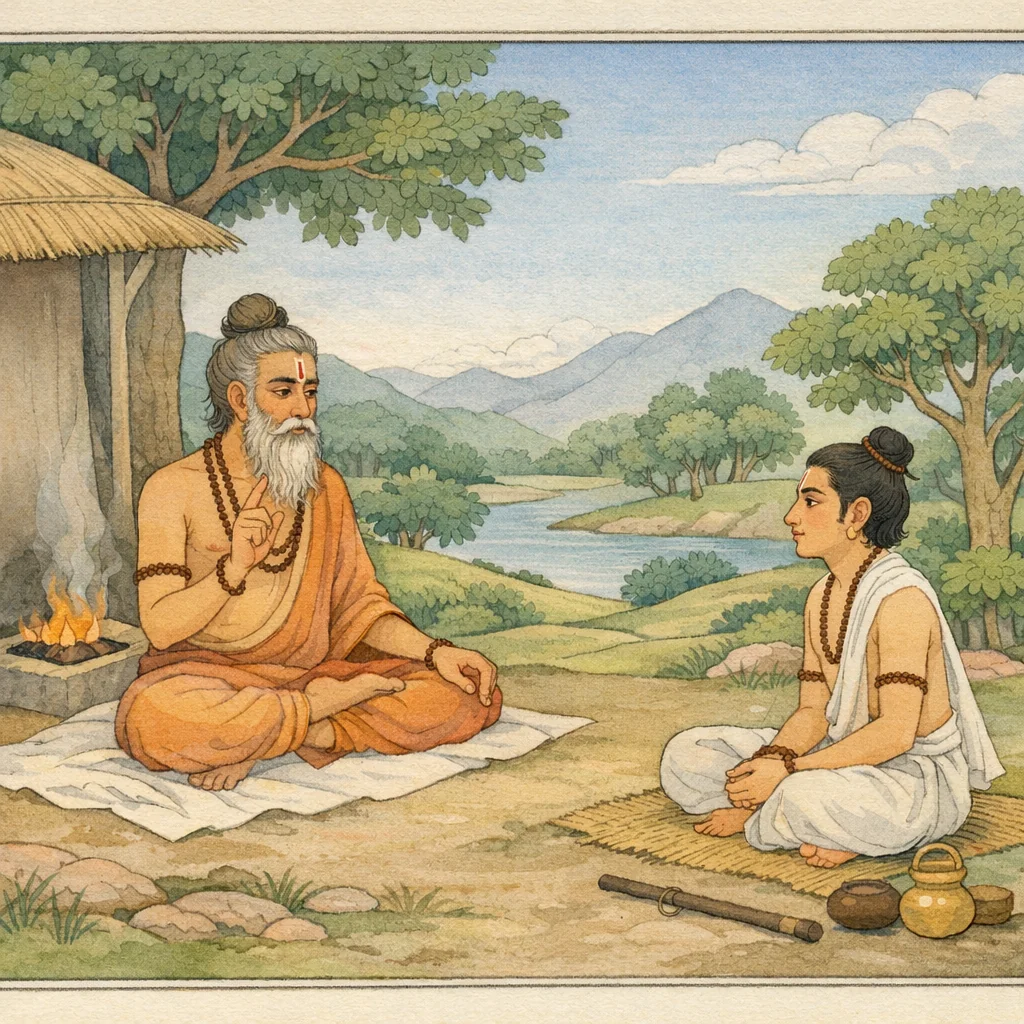
Adhyaya 268
तृष्णाक्षय-उपदेशः (Instruction on the Cessation of Craving)
Upa-parva: Mokṣa-dharma (Liberation-Oriented Instruction) — Tṛṣṇā-kṣaya Discourse (Chapter 268)
Yudhiṣṭhira opens by acknowledging that brothers, fathers, sons, kin, and allies were destroyed under harsh, morally compromised impulses driven by artha-hetu (wealth-motive). He asks Bhīṣma how to turn back the artha-born craving (tṛṣṇā) that has propelled harmful action. Bhīṣma responds by introducing a purātana itihāsa: a teaching utterance associated with the Videha king in dialogue-context with the ascetic Māṇḍavya. The chapter’s core aphorisms define non-possession as psychological immunity—"when Mithilā burns, nothing of mine burns"—and analyze how both abundance and lack can delude the undiscerning, while craving expands with increased wealth like a cow’s horn grows with time. Pleasure—worldly or even exalted—is declared inferior to the peace of craving’s extinction. The verses warn that imagined "mine-ness" becomes a source of grief upon loss; counsel moderation in the pursuit and use of artha under dharma; and describe the wise person as purified, relinquishing dualities (truth/falsehood as clung-to identities, joy/sorrow, fear/safety) to attain calm health. The teaching culminates by naming craving a life-ending disease that does not age even as beings age, and asserts that abandoning it yields happiness, reputation through dharmic conduct, and a liberation-oriented outcome; Māṇḍavya, pleased, honors the teaching and turns toward mokṣa.
Chapter Arc: सामगान के ‘स्तोभ’ (पूरक अक्षर) का संकेत देकर अध्याय प्रवृत्ति–निवृत्ति के द्वार पर पाठक को खड़ा करता है—क्या कर्म-प्रवृत्ति ही जीवन है, या निवृत्ति ही मुक्ति का मार्ग? → वैराग्य-स्थित बुद्धों का चित्र उभरता है—द्वन्द्वों से अचल, नमस्कार-आशा-बंधन से रहित, पापों से विमुक्त, शुचि-निर्मल। फिर साधना का कठोर मानदण्ड आता है: इन्द्रियों के ‘द्वार’ असुरक्षित हों तो तप, यज्ञ, आत्म-प्रयत्न सब निष्फल। इस कसौटी से साधक के भीतर भय और आत्म-परीक्षा दोनों जागते हैं। → परमात्म-दृष्टि का शिखर: जो सर्वभूतों में आत्मा-रूप से स्थित है और सबको आत्मभाव से देखता है—उसके मार्ग में देवता भी मोहित हो जाते हैं। यह घोषणा साधना को मानवीय उपलब्धि से उठाकर ब्रह्म-स्थिति की अतीन्द्रिय ऊँचाई पर रख देती है। → कपिल का उपदेश स्थिर होता है: शास्त्र का आचरण जिस-जिस प्रवृत्ति में, जिस-जिस स्थान पर हो—वहीं निरामय (कल्याणकारी) है; पर उसका सार निवृत्ति, संन्यास, अपवर्ग (मोक्ष) में बुद्धि का निश्चय है। ब्रह्म-निष्ठ, ब्रह्म-भूत, ब्रह्म में ही आलय करने वाले साधक का आदर्श—अल्प वस्त्र, अल्प शयन, बाहु-उपधान, शान्ति—मुक्ति-मार्ग का जीवित प्रतिमान बनता है। → शिष्य-भाव से जिज्ञासा तीव्र होती है—‘तत्त्वं वदस्व… यथा ते विदितो मोक्षः’—और अंत में ‘भयानक संशय’ का संकेत अगले संवाद के लिए प्रश्न-गाँठ बाँध देता है।
Shlokas
Verse 1
>> हु अीस-ॉ# > सामगानके जो 'हा55यि, हा5<वु” इत्यादि पूरक अक्षर हैं, उन्हें 'स्तोभ' कहते हैं। एकोनसप्तत्याधिकद्विशततमो< ध्याय: प्रवृत्ति एवं निवृत्तिमार्गके विषयमें स्यूमरश्मि-कपिल-संवाद कपिल उवाच एतावदनुपश्यन्ति यतयो यान्ति मार्गगा: । नैषां सर्वेषु लोकेषु कश्चिदस्ति व्यतिक्रम:,कपिलने कहा--यम-नियमोंका पालन करनेवाले संन्यासी ज्ञानमार्गका आश्रय लेकर परब्रह्म परमात्माको प्राप्त होते हैं। वे इस दृश्य प्रपंचको नश्वर समझते हैं। सम्पूर्ण लोकोंमें उनकी गतिका कहीं कोई अवरोध नहीं होता
Kapila said: “To this extent the ascetics perceive the truth: moving on the path, they proceed onward. For them, in all the worlds, there is no one and nothing that can obstruct or divert their course.”
Verse 2
निर्दन्द्धा निर्नमस्कारा निराशीर्बन्धना बुधा: । विमुक्ता: सर्वपापेभ्यश्षरन्ति शुचयो5$मला:,उन्हें सर्दी-गर्मी आदि द्वन्द्ध विचलित नहीं करते। वे न तो किसीको प्रणाम करते हैं और न आशीर्वाद ही देते हैं। इतना ही नहीं, वे विद्वान् पुरुष कामनाओंके बन्धनमें भी नहीं बँधते हैं। सम्पूर्ण पापोंसे मुक्त, पवित्र और निर्मल होकर सर्वत्र विचरते रहते हैं
Kapila said: The wise are unshaken by the pairs of opposites such as cold and heat. They neither bow to others nor offer blessings, and they are not bound by the fetters of desire. Freed from all sin, pure and stainless, they move about everywhere in inner freedom.
Verse 3
अपवर्गेडथ संत्यागे बुद्धी च कृतनिश्चया: । ब्रहिष्ठा ब्रह्मभूताश्च ब्रह्मण्येव कृतालया:
Kapila said: “Their understanding is firmly resolved in liberation and in renunciation. Established in the highest reality, having become one with Brahman, they make their dwelling in Brahman alone.”
Verse 4
वे मोक्षकी प्राप्ति और सर्वस्वके त्यागके लिये अपनी बुद्धिमें दृढ़ निश्चय रखते हैं। ब्रह्मके ध्यानमें तत्पर एवं ब्रह्मस्वरूप होकर ब्रह्ममें ही निवास करते हैं ।। विशोका नष्टरजसस्तेषां लोका: सनातना: । तेषां गतिं परां प्राप्य गार्हस्थ्ये कि प्रयोजनम्
Free from sorrow, with the dust of passion (rajas) destroyed, their realms are eternal. Having attained the supreme course and reached the highest state, what purpose would household life still serve?
Verse 5
उन्हें वे सनातन लोक प्राप्त होते हैं, जहाँ शोक और दुःखका सर्वथा अभाव है तथा जहाँ रजोगुण (काम-क्रोध आदि) का दर्शन नहीं होता। उस परम गतिको पाकर उन्हें गाहस्थ्य-आश्रममें रहने और यहाँके धर्मोके पालन करनेकी क्या आवश्यकता रह जाती है? ।। स्यूमरश्मिर्वाच यद्येषा परमा काष्ठा यद्येषा परमा गति: । गृहस्थानव्यपश्रित्य नाश्रमो<न्यः प्रवर्तते,स्यूमरश्मिने कहा--ज्ञान प्राप्त करके परब्रह्ममें स्थित हो जाना ही यदि पुरुषार्थकी चरम सीमा है, यदि वही उत्तम गति है, तब तो गृहस्थ-धर्मका महत्त्व और भी बढ़ जाता है; क्योंकि गृहस्थोंका सहारा लिये बिना कोई भी आश्रम न तो चल सकता है और न तो ज्ञानकी निष्ठा ही प्रदान कर सकता है
Syūmarśmi said: If this indeed is the highest culmination and the supreme goal—abiding in the Supreme through knowledge—then the importance of the householder’s way becomes even clearer. For without relying on householders, no other stage of life can properly function or be sustained; the other āśramas depend upon the support that the gṛhastha provides.
Verse 6
यथा मातरमश्रित्य सर्वे जीवन्ति जन्तव: । एवं गार्हस्थ्यमाश्रित्य वर्तन्त इतराश्रमा:,जैसे समस्त प्राणी माताकी गोदका सहारा पाकर ही जीवन धारण करते हैं, उसी प्रकार गृहस्थ-आश्रमका आश्रय लेकर ही दूसरे आश्रम टिके हुए हैं
Kapila teaches that just as all creatures live by taking refuge in their mother, so too the other stages of life endure only by relying upon the householder’s order. The household life is presented as the sustaining support of society and of the wider dharmic system, because it nourishes, protects, and provides for those who pursue other disciplines.
Verse 7
गृहस्थ एव यजते गृहस्थस्तप्यते तप: । गार्हस्थ्यमस्य धर्मस्य मूलं य्किंचिदेजते,गृहस्थ ही यज्ञ करता है, गृहस्थ ही तप करता है। मनुष्य जो कुछ भी चेष्टा करता है-- जिस किसी भी शुभ कर्मका आचरण करता है, उस धर्मका मूल कारण गार्हस्थ्य-आश्रम ही है
Kapila said: “It is the householder alone who performs sacrifice, and it is the householder who undertakes austerity. The householder’s way of life is the root of this entire dharma, for whatever wholesome effort a person makes in the world ultimately rests upon the support and stability provided by the gārhasthya-āśrama.”
Verse 8
प्रजनाद्यभिनिर्वत्ता: सर्वे प्राणभृतो जना: । प्रजनं चाप्युतान्यत्र न कथंचन विद्यते,समस्त प्राणधारी जीव संतानके उत्पादन आदिसे सुखका अनुभव करते हैं, परंतु संतान गार्हस्थ्य-आश्रमके सिवा अन्यत्र किसी तरह सुलभ नहीं है
Kapila said: All living beings that bear life arise from procreation and, from the very beginning of their lineage, experience the satisfactions connected with offspring. Yet the begetting of children is not truly attainable in any other way; it is properly secured only through the householder’s mode of life.
Verse 9
यास्तु स्युर्बर्हिरोषध्यो बहिरन्यास्तथाद्रिजा: । ओषधिभ्यो बहिर्यस्मात् प्राणात् वक्रिन्न दृश्यते,कुश-काश आदि तृण, धान-जौ आदि ओषधि, नगरके बाहर उत्पन्न होनेवाली दूसरी ओषधियाँ तथा पर्वतपर होनेवाली जो ओषधियाँ हैं, उन सबका मूल भी गार्हस्थ्य-आश्रम ही है (क्योंकि वहींके यज्ञसे पर्जन्य (मेघ) की उत्पत्ति होती है, जिससे वर्षा आदिके द्वारा तृण- लता, ओषधियाँ उत्पन्न होती हैं)। प्राणस्वरूप जो ओषधियाँ हैं; उससे बाहर कोई दिखायी नहीं देता
Kapila said: “Whether they are grasses and sacrificial plants, other herbs that grow outside settlements, or those that arise on mountains—whatever forms of vegetation exist, none is seen to stand apart from the life-breath that sustains them. For all herbs are rooted in prāṇa itself; beyond that vital principle, nothing living is found.”
Verse 10
कस्यैषा वाग् भवेत् सत्या मोक्षो नास्ति गृहादिति । अश्रद्दधानैरप्राज्ञै: सूक्ष्मदर्शनवर्जितै:,गृहस्थाश्रमके धर्मोंका पालन करनेसे मोक्ष नहीं होता है, ऐसी किसकी वाणी सत्य होगी। जो श्रद्धारहित, मूढ़ और सूक्ष्मदृष्टिसे वंचित हैं, अस्थिर, आलसी, श्रान्त और अपने पूर्वकृत कर्मोंसे संतप्त हैं, वे अज्ञानी पुरुष ही संन्यास-मार्गका आश्रय ले गृहस्थाश्रममें शान्तिका अभाव देखते हैं
Kapila said: “Whose statement could truly be valid that ‘there is no liberation from the householder’s life’? Such a claim is made by those who lack faith, who are unwise, and who are deprived of subtle insight. Mistaking their own inner restlessness and weariness for a defect in the householder path, they disparage disciplined household dharma and imagine renunciation alone to be the way to peace.”
Verse 11
निरासैरलसै: श्रान्तैस्तप्यमानै: स्वकर्मभि: । शमस्योपरमो दृष्ट: प्रत्रज्यायामपण्डितै:,गृहस्थाश्रमके धर्मोंका पालन करनेसे मोक्ष नहीं होता है, ऐसी किसकी वाणी सत्य होगी। जो श्रद्धारहित, मूढ़ और सूक्ष्मदृष्टिसे वंचित हैं, अस्थिर, आलसी, श्रान्त और अपने पूर्वकृत कर्मोंसे संतप्त हैं, वे अज्ञानी पुरुष ही संन्यास-मार्गका आश्रय ले गृहस्थाश्रममें शान्तिका अभाव देखते हैं
Kapila said: “It is the unwise who, being without faith and aspiration, indolent and exhausted, and tormented by the consequences of their own deeds, imagine that peace is found only by renunciation. Such people, taking refuge in the path of wandering mendicancy, declare that the householder’s discipline lacks tranquility—yet this judgment arises from their own weakness, not from the true nature of dharma.”
Verse 12
त्रैलोक्यस्यैव हेतुर्हि मर्यादा शाश्वती ध्रुवा । ब्राह्मणो नाम भगवान् जन्मप्रभूति पूज्यते,वैदिक धर्मकी सनातन मर्यादा तीनों लोकोंका हित करनेवाली एवं ध्रुव है। ब्राह्मण पूजनीय है और जन्म-कालसे ही उसका सबके द्वारा समादर होता है
Kapila said: “The eternal, steadfast boundary of Vedic dharma is itself the sustaining cause of the three worlds, working for their welfare. Therefore the Brāhmaṇa—revered as ‘bhagavān’—is to be honored from birth onward, receiving respect from all.”
Verse 13
प्रागगर्भाधानान्मन्त्रा हि प्रवर्तन्ते द्विजातिषु । अविश्रम्भेषु वर्तन्ते विश्रम्भेष्वप्पसंशयम्,ब्राह्मण, क्षत्रिय और वैश्य--तीनों वर्णोमें गर्भाधानसे पहले वेदमन्त्रोंका उच्चारण किया जाता है। फिर लौकिक और पारलौकिक सभी कार्योंमें निस्संदेह उन वेदमन्त्रोंकी प्रवृत्ति होती है
Kapila said: “Among the twice-born, the Vedic mantras are set in motion even before the rite of conception. They operate in formal, public acts, and they also operate in familiar, private contexts—without doubt.”
Verse 14
दाहे पुन: संश्रयणे संश्रिते पात्रभोजने । दाने गवां पशूनां वा पिण्डानामप्सु मज्जने,मृतकके दाह-संस्कारमें, पुनः: देह धारण करनेमें, देह धारण कर लेनेपर, मृत व्यक्तिकी तृप्तिके लिये प्रतिदिन तर्पण और श्राद्ध करनेमें, वैतरणीके निमित्त गौओं अथवा अन्य पशुओंका दान करनेमें तथा श्राद्धकर्ममें दिये हुए पिण्डोंका जलके भीतर विसर्जन करनेमें भी वैदिक मन्त्रोंका उपयोग होता है--इन सब कार्योंके मूल वेद-मन्त्र हैं
Kapila said: “In the funeral burning, in the subsequent rites of taking refuge (i.e., the post-death observances), in feeding those who are to be fed on behalf of the departed, in gifting cows or other animals, and in immersing the funeral rice-balls (piṇḍas) in water—Vedic mantras are employed. Thus, these acts are rooted in the Vedic mantras.”
Verse 15
आर्चिष्मन्तो बर्हिषद: कव्यादा: पितरस्तथा । मृतस्याप्यनुमन्यन्ते मन्त्रान् मन्त्राश्ष कारणम्,अर्चिष्मतू, बरहिषद् तथा कव्यवाह संज्ञक पितर भी मृत व्यक्तिके (सुख-शान्ति एवं प्रसन्नता) के लिये मन्त्र-पाठकी अनुमति देते हैं। मन्त्र ही सब धर्मोके कारण हैं
Kapila said: “The Fathers known as the Arcishmats, the Barhishads, and the Kavyādas likewise grant permission for the recitation of mantras even on behalf of one who has died, for mantras are the foundational cause that sustains religious duty and right order.”
Verse 16
एवं क्रोशत्सु वेदेषु कुतो मोक्षो5स्ति कस्यचित् | ऋणदवनन््तो यदा मर्त्या: पितृदेवद्विजातिषु,वे ही वेद-मन्त्र जब पुकार-पुकारकर कहते हैं कि मनुष्य देवताओं, पितरों और ऋषियोंके जन्मसे ही ऋणी होते हैं, तब गृहस्थाश्रममें रहकर उन ऋणोंको चुकाये बिना किसीका भी मोक्ष कैसे हो सकता है?
Kapila said: “When the Vedas themselves cry out again and again that human beings are born burdened with debts—to the gods, to the ancestors, and to the twice-born sages—how can anyone attain liberation at all, if one remains in the householder’s life without first repaying those obligations?”
Verse 17
श्रिया विहीनैरलसै: पण्डितै: सम्प्रवर्तितम् । वेदवादापरिज्ञानं सत्याभासमिवानृतम्
Kapila said: “This so-called understanding of Vedic discourse, set in motion by learned men who are devoid of true excellence and sunk in indolence, is in fact a counterfeit of truth—an untruth that merely looks like truth.”
Verse 18
श्रीहीन और आलसी पण्डितोंने कर्मोके त्यागसे मोक्ष मिलता है--ऐसा मत चलाया है। यह सुननेमें सत्य-सा आभासित होता है, परंतु है मिथ्या। इस मार्गमें किसीको वेदके सिद्धान्तोंका तनिक भी ज्ञान नहीं है ।। न वै पापैह्िियते कृष्यते वा यो ब्राह्म॒णो यजते वेदशास्तै: | ऊर्ध्व॑ यज्ञै: पशुभि: सार्थमेति संतर्पितस्तर्पयते च कामै:,जो ब्राह्मण वेद-शास्त्रोंके अनुसार यज्ञका अनुष्ठान करता है, उसपर पापोंका आक्रमण नहीं हो सकता और न पाप उसे अपनी ओर खींच ही सकते हैं। वह अपने किये हुए यज्ञों और उनमें उपयोगी पशुओंके साथ ऊपरके पुण्यलोकोंमें जाता है और स्वयं सब प्रकारके भोगोंसे तृप्त होकर दूसरोंको भी तृप्त करता है
Kapila says: Some impoverished and indolent scholars have spread the view that liberation is attained by abandoning action. It sounds plausible when heard, yet it is false; along that path there is not even a trace of understanding of the Vedic conclusions. By contrast, the Brahmin who performs sacrifice in accordance with the Veda and its disciplines cannot be overpowered or dragged down by sin. Having offered sacrifices, he ascends to higher worlds together with the sacrificial merits and the animals employed, and—himself satisfied by lawful enjoyments—he also satisfies others.
Verse 19
न वेदानां परिभवान्न शाठ्येन न मायया । महत प्राप्रोति पुरुषो ब्रह्मणि ब्रह्म विन्दति,वेदोंका अनादर करनेसे, शठतासे तथा छल-कपटसे कोई भी मनुष्य परब्रह्म परमात्माको नहीं पाता है। वेदों तथा उनमें बताये हुए कर्मोंका आश्रय लेनेपर ही उसे परब्रह्मकी प्राप्ति होती है
Kapila said: “Not by scorning the Vedas, nor by cunning, nor by deceit does a person attain the Supreme or come to know Brahman in Brahman. Only by taking refuge in the Vedas and in the actions they enjoin does one gain realization of the Parabrahman.”
Verse 20
कपिल उवाच दर्श च पौर्णमासं च अग्निहोत्रं च धीमत: । चातुर्मास्यानि चैवासंस्तेषु धर्म: सनातन:,कपिलजीने कहा--बुद्धिमान् पुरुषके लिये दर्श, पौर्णमास, अग्निहोत्र तथा चातुर्मास्य आदिके अनुष्ठानका विधान है; क्योंकि उनमें सनातनधर्मकी स्थिति है
Kapila said: For the wise person, the observances of the new-moon and full-moon rites, the daily Agnihotra, and the seasonal Cāturmāsya sacrifices are enjoined; for in these rites the eternal order of dharma is upheld and made manifest.
Verse 21
अनारम्भा: सुधृतय: शुचयो ब्रह्मसंज्ञिता: । ब्रह्मणैव सम ते देवांस्तर्पयन्त्यमृतेषिण:,परंतु जो संन्यास धर्म स्वीकार करके कर्मानुष्ठानसे निवृत्त हो गये हैं तथा धीर, पवित्र एवं ब्रह्मस्वरूपमें स्थित हैं, वे अविनाशी ब्रह्मको चाहनेवाले महात्मा पुरुष ब्रह्मज्ञानसे ही देवताओंको तृप्त करते हैं
Kapila said: Those who have renounced undertakings, are firmly self-controlled, pure, and established in the state called ‘Brahman’—seeking the deathless—satisfy the gods not by ritual action but by Brahman itself, that is, through realization of the Supreme.
Verse 22
सर्वभूतात्मभूतस्य सर्वभूतानि पश्यत: । देवा5पि मार्गे मुहान्ति अपदस्य पदैषिण:,जो सम्पूर्ण भूतोंके आत्मारूपसे स्थित हैं और सम्पूर्ण प्राणियोंको आत्मभावसे ही देखते हैं, जिनका कोई विशेष पद नहीं है, उन ज्ञानी पुरुषका पदचिह्न ढूँढ़नेवाले--उनकी गतिका पता लगानेवाले देवता भी मार्ममें मोहित हो जाते हैं
Even the gods lose their way when they try to trace the course of that knower who has become the very Self of all beings and who beholds all creatures in the light of the Self. For such a sage has no fixed ‘station’ to be marked out; those who hunt for his footprints—seeking to determine his destination—are confounded on the path.
Verse 23
चतुर्द्धारें पुरुषं चतुर्मुखं चतुर्धा चैनमुपयाति वाचा । बाहुभ्यां वाच उदरादुपस्थात् तेषां द्वारं द्वारपालो बुभूषेत्,मनुष्योंके हाथ-पैर, वाणी, उदर और उपस्थ--ये चार द्वार हैं। इनका द्वारपाल होनेकी इच्छा करे अर्थात् इनपर संयम रखे। वह शास्त्रवाक्योंके अनुसार इन चारों द्वारोंके संयमसे प्राप्प ऋक्, यजु:, साम, अथर्वरूप चार मुखोंसे युक्त परमपुरुषको भक्तियोग, ज्ञानयोग, कर्मयोग एवं अष्टाड़योग--इन चार उपायोंसे प्राप्त करता है
Kapila said: “The person is a being with four gates and four faces. One approaches him in four ways through disciplined speech: by the arms (deeds), by speech itself, by the belly (appetite), and by the generative organ (sexual impulse). Let a human being wish to become the gatekeeper of these gates—that is, let him restrain and govern them. In accordance with the teachings of the śāstras, by mastering these four gates one attains the Supreme Person—endowed with four ‘faces’ like the four Vedas—through four paths: devotion, knowledge, action, and the yoga of eight limbs.”
Verse 24
नाक्षै्दीव्येन्नाददीतान्यवित्तं न वायोनीयस्य शत प्रगृह्नात् | क्रुद्धो न चैव प्रहरेत धीमां- स्तथास्य तत्पाणिपादं सुगुप्तम्,बुद्धिमान् पुरुष जूआ न खेले, दूसरोंका धन न ले, नीच पुरुषका बनाया हुआ अन्न न ग्रहण करे और क्रोधमें आकर किसीको मार न बैठे--ऐसा करनेसे उसके हाथ-पैर सुरक्षित रहते हैं
Kapila said: “A wise person should not gamble with dice, should not take wealth that has not been given, should not accept even a hundred (gifts) from one of base conduct, and, when angered, should not strike anyone. By such restraint, his hands and feet remain well-guarded—kept from sinful action and its consequences.”
Verse 25
नाक्रोशमृच्छेन्न वृथा वदेच्च न पैशुनं जनवादं च कुर्यात् । सत्यव्रतो मितभाषो5प्रमत्त- स्तथास्य वाग्द्वारमथो सुगुप्तम्,किसीको गाली न दे, व्यर्थ न बोले, दूसरोंकी चुगली या निन््दा न करे, मितभाषी हो, सत्य वचन बोले तथा इसके लिये सदा सावधान रहे--ऐसा करनेसे वाक्-इन्द्रियरूप द्वारकी रक्षा होती है
Kapila teaches that one should not resort to abuse, should not speak pointlessly, and should not engage in slander or rumor-mongering. One should be devoted to truth, speak with restraint, and remain continually vigilant; by such discipline, the “gate” of speech—the faculty of speech—becomes well-guarded.
Verse 26
नानाशन:ः स्यान्न महाशन:ः स्या- दलोलुप: साधुभिरागत: स्यात् | यात्रार्थभाहारमिहाददीत तथास्यथ स्याज्जाठरी द्वारगुप्ति:,उपवास न करे, किंतु बहुत अधिक भी न खाय, सदा भोजनके लिये लालायित न रहे। सज्जनोंका संग करे और जीवननिर्वाहके लिये जितना आवश्यक हो, उतना ही अन्न पेटमें डाले--इससे उदरद्वारका संरक्षण होता है
Kapila teaches disciplined moderation: one should not eat in a scattered, indiscriminate way, nor should one overeat; one should be free from greed for food and keep company with the virtuous. Taking only as much nourishment as is needed for sustaining life, one safeguards the “gate of the belly”—the appetitive impulse—so that self-control and inner steadiness are preserved.
Verse 27
न वीर पत्नीं विहरेत नारीं न चापि नारीमनृतावाह्दयीत । भायब्रितं ह्यात्मनि धारयीत तथास्योपस्थद्वारगुप्तिर्भवेत,वीर युधिष्ठिर! अपनी धर्मपत्नीके साथ ही विहार करे, परायी स्त्रीके साथ नहीं, अपनी सत्रीको भी जबतक वह ऋतुस्नाता न हुई हो, समागमके लिये अपने पास न बुलाये और मनमें एकपत्नीव्रत धारण करे। ऐसा करनेसे उसके उपस्थ-द्वारकी रक्षा हो सकती है
Kapila said: “O hero, let a man take his pleasure only with his lawful wife, not with another’s woman. Even his own wife he should not summon for union when she is not in her proper season. Let him hold firmly within himself the vow of fidelity to one wife; thus will the ‘gate of his loins’ be guarded—O heroic Yudhiṣṭhira.”
Verse 28
द्वाराणि यस्य सर्वाणि सुगुप्तानि मनीषिण: । उपस्थमुदरं बाहू वाक् चतुर्थी स वै द्विज:,जिस मनीषी पुरुषके उपस्थ, उदर, हाथ-पैर और वाणी--ये सभी द्वार पूर्णतः रक्षित हैं, वही वास्तवमें ब्राह्मण है
Kapila said: The truly wise person is one whose gateways are all well-guarded—sexual impulse, the belly’s appetite, the arms (i.e., the power to act and seize), and speech as the fourth. Such a self-restrained one alone deserves to be called a “twice-born” (brāhmaṇa in the ethical sense), for his conduct is protected by discipline rather than driven by desire.
Verse 29
मोघान्यगुप्तद्वारस्य सर्वाण्येव भवन्त्युत । कि तस्य तपसा कार्य कि यज्ञेन किमात्मना,जिसके ये द्वार सुरक्षित नहीं हैं, उसके सारे शुभ-कर्म निष्फल होते हैं, ऐसे मनुष्यको तपस्या, यज्ञ तथा आत्मचिन्तनसे क्या लाभ हो सकता है?
Kapila says: For one whose “doors” are left unguarded, all virtuous efforts become fruitless. What purpose, then, is served by austerity, by sacrifice, or even by inward contemplation, if self-restraint is absent? The ethical point is that discipline of the senses is the foundation that gives spiritual practices their real efficacy.
Verse 30
अनुत्तरीयवसनमनुपस्तीर्णशायिनम् । बाहूपधान शाम्यन्तं त॑ देवा ब्राह्मणं विदु:,जिसके पास वस्त्रके नामपर एक लंगोटी मात्र है, ओढ़नेके लिये एक चादरतक नहीं है, जो बिना बिछौनेके ही सोता है, बाँहोंका ही तकिया लगाता है और सदा शान्तभावसे रहता है, उसीको देवता ब्राह्मण मानते हैं
Kapila said: The gods recognize as a true brāhmaṇa the one who owns no upper garment, who sleeps without any bedding, who uses his own arms as a pillow, and who remains continually pacified and self-controlled.
Verse 31
द्वद्धारामेषु सर्वेषु य एको रमते मुनि: । परेषामननुध्यायंस्तं देवा ब्राह्म॒णं विदु:,जो मुनि शीत-उष्ण आदि सम्पूर्ण द्वन्धरूपी उपवनोंमें अकेला ही आनन्दपूर्वक रहता है और दूसरोंका चिन्तन नहीं करता, उसे देवतालोग ब्राह्मण (ब्रह्मज्ञानी) समझते हैं
Kapila said: In all the pleasure-groves of the pairs of opposites—heat and cold and the rest—the sage who delights alone, without brooding over others, is recognized by the gods as a true brāhmaṇa, a knower of Brahman.
Verse 32
येन सर्वमिदं बुद्ध प्रकृतिर्विकृतिश्व या । गतिज्ञ: सर्वभूतानां त॑ देवा ब्राह्म॒णं विदु:,जिसको इस सम्पूर्ण जगत्की नश्वरताका ज्ञान है, जो प्रकृति और उसके विकारोंसे परिचित है तथा जिसे सम्पूर्ण भूतोंकी गतिका ज्ञान है, उसे देवतालोग ब्रह्मज्ञानी मानते हैं
O wise one, the gods regard as a true knower of Brahman that person who understands the perishable nature of this entire world, who is acquainted with Prakṛti and its transformations, and who knows the courses and destinies of all beings.
Verse 33
अभयं सर्वभूते भ्य: सर्वेषाम भयं यत: । सर्वभूतात्मभूतो यस्तं देवा ब्राह्म॒णं विदु:,जो सम्पूर्ण भूतोंसे निर्भय है, जिससे समस्त प्राणी भय नहीं मानते हैं तथा जो सब भूतोंका आत्मा है, उसीको देवता ब्रह्मज्ञानी मानते हैं
He who is fearless toward all beings, from whom all beings feel no fear, and who has become the very Self of all creatures—him the gods recognize as a true brāhmaṇa, a knower of Brahman.
Verse 34
नान्तरेणानुजानन्ति दानयज्ञक्रियाफलम् | अविज्ञाय च तत् सर्वमन्यद् रोचयते फलम्
Kapila said: Without inner understanding, people do not truly recognize the fruit of gifts, sacrifices, and ritual acts. And when they have not comprehended that whole truth, they come to prefer some other ‘result’—mistaking lesser, outward gains for the real spiritual outcome.
Verse 35
परंतु मूढ़ मानव दान और यज्ञ-कर्मके फलके सिवा योग आदिके फलका अनुमोदन नहीं करते। वे उन मोक्षप्रद समस्त साधनोंके महत्त्वको न जाननेके कारण स्वर्ग आदि अन्य फलोंमें ही रुचि रखते हैं ।। स्वकर्मभि: संश्रितानां तपो घोरत्वमागतम् | त॑ सदाचारमश्रित्य पुराणं शाश्व॒तं ध्रुवम्,किंतु उस पुराण, शाश्वत एवं ध्रुव यौगिक सदाचारका आश्रय लेकर अपने कर्तव्य कर्मोमें परायण रहनेवाले ज्ञानियोंका तप उत्तरोत्तर तीव्रताको प्राप्त होता है
Kapila says: Deluded people approve only the visible rewards of charity and sacrificial rites, and do not acknowledge the fruits of yoga and related disciplines. Because they do not understand the greatness of all the means that lead to liberation, their taste remains fixed on other rewards such as heaven. But for the wise—those who take refuge in the ancient, eternal, and unshakable yogic code of right conduct, and who remain devoted to their own duties—their austerity grows ever more intense and transformative, rising step by step toward liberation.
Verse 36
अशवनुवन्तश्नरितुं किंचिद् धर्मेषु सूत्रितम् । निरापद्धर्म आचारो हाप्रमादो5परा भव:,प्रवृत्तिमार्गी मनुष्य योगशास्त्रके सूत्रोंमें कथित यम-नियमादिका अनुष्ठान नहीं कर सकते। वह यौगिक आचार आपत्तिशून्य, प्रमादरहित है। वह कामादिसे पराभवको नहीं प्राप्त होता है
Kapila said: People who pursue the outward path of activity cannot carry out the yamas and niyamas and other observances set forth in the sūtras of the Yoga-śāstra. That yogic discipline is free from peril and free from heedlessness; it is not overcome by desire and the like.
Verse 37
फलवन्ति च कर्माणि व्युष्टिमन्ति ध्रुवाणि च । विगुणानि च पश्यन्ति तथानैकान्तिकानि च
Kapila said: They observe that actions bear results; that their consequences unfold in due course and are certain. Yet they also see that some actions are defective in quality, and that outcomes are not always absolute or uniform—often depending on conditions and context.
Verse 38
योगशास्त्रमें कथित कर्म श्रेष्ठ फल देनेवाले, उन्नति करनेवाले एवं स्थायी हैं; तो भी प्रवृत्तिमार्गी मनुष्य उनको गुणरहित (निष्फल) और अस्थिर समझते हैं ।। गुणाश्षात्र सुदुर्ज्ेया ज्ञाताश्नात्र सुदुष्करा: । अनुषछिताश्चान्तवन्त इति त्वमनुपश्यसि,गुणोंके कार्यभूत जो यज्ञ-यागादि हैं, उनके स्वरूप और विधि-विधानको समझना बहुत कठिन है। समझ लेनेपर भी उनका अनुष्ठान करना तो और भी कठिन है। यदि अनुष्ठान भी किया जाय तो भी उनसे नाशवान् फलकी ही प्राप्ति होती है। इन सब बातोंको तुम भी देखते और समझते हो
Kapila said: “The actions taught in the discipline of yoga are described as yielding the highest results, promoting true elevation, and being enduring. Yet people devoted to the outward path of activity take them to be devoid of real worth—fruitless and unstable. The principles concerning the guṇas are exceedingly hard to understand; and even when understood, they are difficult to put into practice. And even when performed, their results are seen to be finite and perishable—this too you yourself observe.”
Verse 39
स्यूमरश्मिरुवाच यथा च वेदप्रामाण्यं त्यागश्न सफलो यथा । तौ पन्थानावुभौ व्यक्तौ भगवंस्तद् वदस्व मे,स्यूमरश्मिने कहा--भगवन्! “कर्म करो” और “कर्म छोड़ो” ये जो परस्परविरुद्ध दो स्पष्ट मार्ग हैं, इनका उपदेश करनेवाले वेदकी प्रामाणिकताका निर्वाह कैसे हो? तथा त्याग कैसे सफल होता है? यह आप मुझको बताइये
Syūmarśmi said: “Revered one, explain this to me: how is the authority of the Veda to be upheld when it teaches two clearly distinct and seemingly opposed paths—one that enjoins action (‘do karma’) and another that enjoins renunciation (‘give up karma’)? And in what way does renunciation become truly fruitful?”
Verse 40
कपिल उवाच प्रत्यक्षमिह पश्यन्ति भवन्तः सत्पथे स्थिता: । प्रत्यक्ष तु किमत्रास्ति यद् भवन्त उपासते,कपिलने कहा--आपलोग सम्मार्गमें स्थित रहकर यहाँ योगमार्गके फलका प्रत्यक्ष दर्शन कर सकते हैं; परंतु कर्ममार्गमें रहकर आपलोग जिस यज्ञकी उपासना करते हैं, उससे यहाँ कौन-सा प्रत्यक्ष फल प्राप्त होता है?
Kapila said: “Here and now, you who stand on the true path can directly perceive the fruits of the yogic way. But tell me—what immediate, visible result is obtained here from the sacrificial worship you pursue while remaining on the path of ritual action?”
Verse 41
स्यूमराश्मिरुवाच स्यूमरश्मिरहं ब्रह्म॒न् जिज्ञासार्थमिहागत: । श्रेयस्काम: प्रत्यवोचमार्जवान्न विवक्षया,स्यूमरश्मिने कहा--ब्रह्मन्! मेरा नाम स्यूमरश्मि है। मैं ज्ञान-प्राप्तिकी इच्छासे यहाँ आया हूँ। मैंने कल्याणकी इच्छा रखकर सरल भावसे ही अपनी बातें आपकी सेवामें उपस्थित की हैं, वाद-विवादकी इच्छासे नहीं
Sūmarāśmi said: “O Brahman, my name is Sūmarāśmi. I have come here with the wish to know. Seeking what is truly beneficial, I have spoken plainly and straightforwardly, not with any desire to argue or contend.”
Verse 42
इमं च संशयं घोरं भगवान प्रब्रवीतु मे । प्रत्यक्षमिह पश्यन्तो भवन्तः सत्यथे स्थिता: । किमत्र प्रत्यक्षतमं भवन्तो यदुपासते
Kapila said: “And may the Blessed One resolve for me this dreadful doubt. You who see directly here and now, and who stand established in truth—what, in this matter, is the most immediate object of direct knowledge that you worship and rely upon?”
Verse 43
आगमो वेददवादास्तु तर्कशास्त्राणि चागम:,वेदमतका अनुसरण करनेवाले शास्त्र तो आगम हैं ही, तर्कशास्त्र (वेदोंके अर्थका निर्णय करनेवाले पूर्वोत्तर मीमांसा आदि) भी आगम हैं
Kapila said: The authoritative tradition (āgama) consists of the teachings grounded in the Veda; and the disciplines of reasoning as well—those treatises that determine and clarify the Veda’s meaning—are also to be regarded as āgama. Thus, both revealed testimony and disciplined inquiry are affirmed as valid supports for understanding dharma.
Verse 44
यथाश्रममुपासीत आगमस्तत्र सिध्यति । सिद्धि: प्रत्यक्षरूपा च दृश्यत्यागमनिश्चयात्,जिस-जिस आश्रममें जो-जो धर्म विहित है, वहाँ-वहाँ उसी-उसी धर्मकी उपासना करनी चाहिये। उस-उस स्थानपर उसी-उसी धर्मका आचरण करनेसे वहाँ आगम सफल होता है। एवं शास्त्रके निश्चयसे ही सिद्धिका प्रत्यक्ष दर्शन होता है
Kapila teaches that one should practice the discipline appropriate to one’s own stage of life (āśrama). When the duties prescribed for that āśrama are faithfully observed, the authority and purpose of the sacred teaching (āgama) are fulfilled there. And through firm certainty grounded in scripture, the fruit—spiritual accomplishment—becomes directly evident in lived experience.
Verse 45
नौर्नावीव निबद्धा हि स्रोतसा सनिबन्धना । ह्वियमाणा कथं विप्र कुबुद्धींस्तारयिष्यति । एतद् ब्रवीतु भगवानुपपन्नो<5स्म्यधीहि भो:,जैसे एक जगह जानेवाली नावमें दूसरी जगह जानेवाली नाव बाँध दी जाय तो वह जलके स्रोतससे अपहृत हो किसीको गन्तव्य स्थानतक नहीं पहुँचा सकती, उसी प्रकार पूर्वजन्मके कर्मोकी वासनासे बँधी हुई हमारी कर्ममयी नौका हम कुबुद्धि पुरुषोंको कैसे भवसागरसे पार उतारेगी? भगवन्! यह आप मुझे बताइये, मैं आपकी शरणमें आया हूँ, आप मुझे उपदेश दीजिये
A boat, if it is tied to another boat that is itself being carried off by the current, cannot take anyone to the intended shore. In the same way, our “boat” of action—bound by the latent impressions (vāsanā) of deeds from former births and swept along by the stream—how can it ferry us, men of misguided understanding, across the ocean of becoming (bhava-sāgara)? O Blessed One, tell me this: I have come to you for refuge; instruct me.
Verse 46
नैव त्यागी न संतुष्टो नाशोको न निरामय: । न निर्विधित्सो नावृत्तो नापवृत्तोडस्ति कश्नन,वास्तवमें इस जगत्के भीतर न कोई त्यागी है न संतुष्ट, न शोकहीन है न नीरोग। न तो कोई पुरुष कर्म करनेकी इच्छासे सर्वथा शून्य है, न आसक्तिसे रहित है और न सर्वथा कर्मका त्यागी ही है
In truth, within this world there is no one who is wholly renouncing, no one wholly content; no one without sorrow, no one entirely free from illness. No man is utterly devoid of the wish to act; none is without attachment; nor is there anyone who has abandoned action altogether.
Verse 47
भवन्तो5पि च हृष्यन्ति शोचन्ति च यथा वयम् । इन्द्रियार्थाश्ष भवतां समाना: सर्वजन्तुषु,आप भी हमलोगोंकी ही भाँति हर्ष और शोक प्रकट करते हैं। समस्त प्राणियोंके समान आपके समक्ष भी शब्द, स्पर्श आदि विषय उपस्थित और गृहीत होते हैं
Kapila said: “You too, just like us, experience joy and sorrow. The objects of the senses—sound, touch, and the rest—present themselves to you in the same way as they do to all living beings.”
Verse 48
एवं चतुर्णा वर्णानामाश्रमाण्ां प्रवृत्तिषु । एकमालम्बमानानां निर्णये कि निरामयम्,इस प्रकार चारों वर्णों और आश्रमोंके लोग सभी प्रवृत्तियोंमें एकमात्र सुखका ही आश्रय लेते हैं--उसीको अपना लक्ष्य बनाकर चलते हैं, अतः सिद्धान्तत: अक्षय सुख क्या है, यह बताइये
Thus, in the various pursuits of the four social orders and the stages of life, people take refuge in only one thing—happiness—making it their aim and moving accordingly. Therefore, tell me decisively: what is that unailing, imperishable happiness?
Verse 49
कपिल उवाच यद् यदाचरते शास्त्रमर्थ्य सर्वप्रवृत्तिषु । यस्य यत्र ह्ानुष्ठानं तत्र तत्र निरामयम्,कपिलने कहा--जो-जो शास्त्र जिस-जिस अर्थका आचरण--प्रतिपादन करता है, वह-वह सभी प्रवृत्तियोंमें सफल होता है। जिस साधनका जहाँ अनुष्ठान होता है, वहाँ-वहाँ अक्षय सुखकी प्राप्ति होती है
Kapila said: Whatever course of conduct the śāstra prescribes as appropriate for the various human pursuits, that very course bears fruit in those pursuits. Wherever a given discipline is duly undertaken, there—there arises well-being free from affliction, bringing enduring happiness.
Verse 50
ज्ञानं प्लावयते सर्व यो ज्ञान हानुवर्तते । ज्ञानादपेत्य या वृत्ति: सा विनाशयति प्रजा:,जो ज्ञानका अनुसरण करता है, ज्ञान उसके समस्त संसारबन्धनका नाश कर देता है। बिना ज्ञानकी जो प्रवृत्ति होती है, वह प्रजाको जन्म और मरणके चक््करमें डालकर उसका विनाश कर देती है
Knowledge carries one safely across all entanglements of worldly bondage when a person truly follows it. But any course of action that departs from knowledge drives beings into ruin, casting them again into the cycle of birth and death.
Verse 51
भवन्तो ज्ञानिनो व्यक्त सर्वतश्ष निरामया: । ऐकात्म्यं नाम कश्चिद्धि कदाचिदुपपद्यते,आपलोग ज्ञानी हैं, यह बात सर्वविदित है। आप सब ओरसे नीरोग भी हैं; परंतु क्या आपलोगोंमेंसे कोई भी किसी भी कालमें एकात्मताको प्राप्त हुआ है? (जब एकमात्र अद्वितीय आत्मा अर्थात् ब्रह्मकी ही सत्ताका सर्वत्र बोध होने लगे, तब उसे एकात्मताका ज्ञान कहते हैं)
Kapila said: “You are clearly people of knowledge, and it is well known; and you are also free from affliction on every side. Yet tell me—has any one among you, at any time, truly attained what is called ‘oneness of Self’, the realization in which the one, non-dual Self is discerned as the reality everywhere?”
Verse 52
शास्त्र हाबुद्ध्वा तत्त्वेन केचिद् वादबलाज्जना: । कामद्वेषाभि भूतत्वादहड्कारवशं गता:,शास्त्रको यथार्थरूपसे न जानकर कुछ लोग वितण्डावादके ही बलसे रागदद्वेषसे अभिभूत होनेके कारण अहंकारके अधीन हो गये हैं
Kapila said: Some people, without truly understanding the scriptures in their real essence, rely merely on the force of disputation. Overpowered by desire and hatred, they fall under the control of ego—turning learning into contention rather than a path to truth and self-mastery.
Verse 53
याथातथ्यमविज्ञाय शास्त्राणां शास्त्रदस्यव: । ब्रह्मस्तेना निरारम्भा दम्भभोहवशानुगा:,वे शास्त्रोंके यथार्थ तात्पर्यको न जाननेके कारण शास्त्रदस्यु (शास्त्रोंके अर्थपर डाका डालनेवाले लुटेरे) कहे जाते हैं। सर्वव्यापी ब्रह्मका भी अपलाप करनेके कारण ब्रह्मचोरकी पदवीसे विभूषित होते हैं। शम-दम आदि साधनोंका कभी अनुष्ठान नहीं करते हैं तथा दम्भ और मोहके वशमें पड़े रहते हैं
Kapila said: Those who fail to understand the true purport of the scriptures are called ‘robbers of scripture’, for they plunder its meaning. And because they deny or misappropriate the all-pervading Brahman, they are branded ‘thieves of Brahman’. They never undertake the disciplines such as tranquillity and self-restraint, and they live under the sway of hypocrisy and delusion.
Verse 54
नैर्गुण्यमेव पश्यन्ति न गुणाननुयुञ्जते । तेषां तम:शरीराणां तम एव परायणम्,वे शम-दम आदि साधनोंको सदा निष्फल ही देखते और समझते हैं। ज्ञान, ऐश्वर्य आदि सदगुणोंकी जिज्ञासा नहीं करते हैं। उन तमोमय शरीरवाले पुरुषोंका तमोगुण ही सबसे बड़ा अवलम्ब है
Kapila said: “They look only toward what is devoid of higher qualities and do not pursue the cultivation of virtues. For those whose very embodiment is steeped in darkness (tamas), darkness itself becomes their supreme refuge and final resort.”
Verse 55
यो यथाप्रकृतिर्जन्तु: प्रकृते: स्याद् वशानुग: । तस्य द्वेषश्व कामश्च क्रोधो दम्भो5नृतं मद: । नित्यमेवाभिवर्तन्ते गुणा: प्रकृतिसम्भवा:,जिस प्राणीकी जैसी प्रकृति होती है, उस प्रकृतिके वह अधीन होता है। उसके भीतर द्वेष, काम, क्रोध, दम्भ, असत्य और मद--ये प्रकृतिजनित गुण सदा ही विद्यमान रहते हैं
Kapila said: As is the innate constitution (prakṛti) of a living being, so does that being come under the sway of that very nature. In such a person, hatred and desire, anger, hypocrisy (dambha), falsehood, and intoxicated pride—these qualities born of nature—keep recurring and remain ever present.
Verse 56
एवं ध्यात्वानुपश्यन्त: संत्यजेयु: शुभाशुभम् | परां गतिमभीप्सन्तो यतय: संयमे रता:,परम गति प्राप्त करनेकी इच्छावाले संयमशील यति इस प्रकार सोच-विचारकर शुभ और अशुभ दोनोंका परित्याग कर देते हैं
Kapila said: Reflecting in this way and seeing clearly, self-restrained ascetics—intent on attaining the highest goal—renounce both the auspicious and the inauspicious.
Verse 57
स्यूमराश्मिरुवाच सर्वमेतन्मया ब्रह्मन् शास्त्रतः परिकीर्तितम् । न ह्विज्ञाय शान्त्रार्थ प्रवर्तन्ते प्रवृत्तय:,स्यूमरश्मिने कहा--ब्रह्मन! मैंने यहाँ जो कुछ कहा है, वह सब शास्त्रसे प्रतिपादित है; क्योंकि शास्त्रके अर्थको जाने बिना किसीकी किसी भी कार्यमें प्रवृत्ति नहीं होती
Syūmarāśmi said: “O Brahman, everything I have stated here has been set forth on the authority of the śāstras. For without understanding the meaning of the śāstra, no one’s impulses or undertakings truly proceed in a grounded way.”
Verse 58
यः वलश्चिन्न्याय्य आचार: सर्व शास्त्रमिति श्रुति: । यदन्याय्यमशास्त्र तदित्येषा श्रूयते श्रुति:,जो कोई भी न्यायोचित आचार है, वह सब शास्त्र है, ऐसा श्रुतिका कथन है। जो अन्यायपूर्ण बर्ताव है, वह अशास्त्रीय है, ऐसी श्रुति भी सुनी जाती है
Kapila said: “Whatever conduct is just and proper—this, the tradition (śruti) declares, is entirely ‘śāstra’ (authoritative teaching). And whatever is unjust—this is ‘aśāstra’ (non-authoritative, contrary to right teaching); such too is what the tradition is heard to proclaim.”
Verse 59
न प्रवृत्तिऋते शास्त्रात् काचिदस्तीति निश्चय: । यदन्यद् वेदवादेभ्यस्तदशास्त्रमिति श्रुति:,शास्त्रके बिना अर्थात् शास्त्रकी आज्ञाका उल्लंघन करके कोई प्रवृत्ति सफल नहीं हो सकती, यह दविद्दानोंका निश्चय है। जो वैदिक वचनोंके विरुद्ध है, वह सब अशास्त्रीय है, ऐसा श्रुतिका कथन है
Kapila said: “It is a settled conclusion that no course of action can be valid apart from the guidance of śāstra. Whatever stands opposed to the declarations of the Veda is, according to śruti, to be regarded as non-scriptural (aśāstra).”
Verse 60
शास्त्रादपेतं पश्यन्ति बहवो व्यक्तमानिन: । शास्त्रदोषान् न पश्यन्ति शोचन्ति च यथा वयम् | इन्द्रियार्थाश्न भवतां समाना: सर्वजन्तुषु,बहुत-से मनुष्य प्रत्यक्षको ही माननेवाले हैं। वे शास्त्रसे पृथक् इहलोकपर ही दृष्टि रखते हैं। शास्त्रोक्त दोषोंको नहीं देखते हैं और जैसे हमलोग शोक करते हैं, वैसे ही वे भी अवैदिकमतका आश्रय लेकर शोक किया करते हैं। आप-जैसे ज्ञानियोंको भी सब जन्तुओंके समान ही इन्द्रियोंक विषयोंका अनुभव होता है
Kapila said: Many, proud of relying only on what is manifest to the senses, turn away from the śāstras and fix their gaze on this world alone. They do not perceive the faults the śāstras point out; taking refuge in non‑Vedic views, they grieve, just as we grieve. And as for sense‑objects: their force is the same for you as for all creatures; even the wise encounter the field of the senses, though they must discern it rightly.
Verse 61
एवं चतुर्णा वर्णानामाश्रमाणां प्रवृत्तिषु । एकमालम्बमानानां निर्णये सर्वतोदिशम्,इस प्रकार चारों वर्णों और आश्रमोंकी जो प्रवृत्तियाँ हैं, उनमें लगे हुए मनुष्य एकमात्र सुखका ही आश्रय लेते हैं--उसे ही प्राप्त करना चाहते हैं। उनमेंसे हम-जैसे लोग अज्ञानसे हतबुद्धि, तुच्छ विषयोंमें मन लगानेवाले तथा तमोगुणसे आवृत हैं। आप ऊहापोह करनमेमें समर्थ-कुशल हैं, अतः सार्वदेशिक सिद्धान्तके रूपमें मोक्षसुखकी अनन्तता बताकर आपने मनसे हमें शान्ति पहुँचायी है
Kapila said: “Thus, in the various pursuits followed within the four social orders and the stages of life, people take refuge in a single aim—seeking happiness alone. Yet among them are persons like us, whose understanding is struck down by ignorance, who fasten the mind on petty objects, and who are veiled by the quality of darkness. You are skilled in discerning and weighing alternatives; therefore, by declaring—as a universally valid conclusion—the boundlessness of the bliss of liberation, you have brought peace to our minds.”
Verse 62
आनन्त्यं वदमानेन शक्तेनावर्जितात्मना । अविज्ञानहतप्रज्ञा हीनप्रज्ञास्तमोवृता:,इस प्रकार चारों वर्णों और आश्रमोंकी जो प्रवृत्तियाँ हैं, उनमें लगे हुए मनुष्य एकमात्र सुखका ही आश्रय लेते हैं--उसे ही प्राप्त करना चाहते हैं। उनमेंसे हम-जैसे लोग अज्ञानसे हतबुद्धि, तुच्छ विषयोंमें मन लगानेवाले तथा तमोगुणसे आवृत हैं। आप ऊहापोह करनमेमें समर्थ-कुशल हैं, अतः सार्वदेशिक सिद्धान्तके रूपमें मोक्षसुखकी अनन्तता बताकर आपने मनसे हमें शान्ति पहुँचायी है
Kapila said: “By you—competent in discernment and with a mind not turned aside—speaking of the boundless nature (of liberation), peace has been brought to our hearts. For we are people whose understanding is struck down by ignorance, whose insight is meagre, and who are veiled by darkness (tamas).”
Verse 63
शक््यं त्वेकेन युक्तेन कृतकृत्येन सर्वश: । पिण्डमात्र व्यपाश्रित्य चरितुं विजितात्मना,जो आपके समान एकाकी, योगयुक्त, कृतकृत्य और मनपर विजय पानेवाला है तथा जो केवल शरीरका अथवा उसकी रक्षाके लिये स्वल्प भिक्षान्नमात्रका सहारा लेकर सम्पूर्ण दिशाओंमें विचरण कर सकता है, जिसने न्यायशास्त्रका परित्याग कर दिया है तथा जो सम्पूर्ण संसारको नाशवान् होनेके कारण गर्हित समझता है, ऐसा पुरुष ही वेद-वाक्योंका आश्रय लेकर "मोक्ष है' यह साधिकार कह सकता है
Kapila said: It is indeed possible for a solitary person—disciplined in yoga, having fulfilled life’s aims, and having conquered the mind—to wander freely in every direction, relying only on the bare minimum of alms for the body’s maintenance. Such a one, having set aside contentious legalistic disputation and seeing the whole world as perishable and therefore not worth clinging to, alone is truly entitled to invoke the Vedic word and affirm with authority: “There is liberation.”
Verse 64
वेदवादं व्यपाश्रित्य मोक्षो5स्तीति प्रभाषितुम् । अपेतन्यायशास्त्रेण सर्वलोकविगर्हिणा,जो आपके समान एकाकी, योगयुक्त, कृतकृत्य और मनपर विजय पानेवाला है तथा जो केवल शरीरका अथवा उसकी रक्षाके लिये स्वल्प भिक्षान्नमात्रका सहारा लेकर सम्पूर्ण दिशाओंमें विचरण कर सकता है, जिसने न्यायशास्त्रका परित्याग कर दिया है तथा जो सम्पूर्ण संसारको नाशवान् होनेके कारण गर्हित समझता है, ऐसा पुरुष ही वेद-वाक्योंका आश्रय लेकर "मोक्ष है' यह साधिकार कह सकता है
Kapila said: Only that person is truly entitled to declare, on the authority of the Vedic word, that liberation exists—one who has become free from dependence on the disciplines of disputation and legalistic reasoning, and who, seeing the entire world as blameworthy because it is perishable, has turned away from it. Such a renunciant—solitary, disciplined in yoga, having fulfilled life’s aims, master of the mind, and wandering in all directions supported only by a little alms-food for the body’s bare maintenance—alone can speak of moksha with rightful authority.
Verse 65
इदं तु दुष्करं कर्म कुटुम्बमभिसंश्रितम् । दानमध्ययनं यज्ञ: प्रजासंतानमार्जवम्,गृहस्थाश्रमके अनुसार जो यह कुट॒म्बके भरण-पोषणसे सम्बन्ध रखनेवाला कार्य है तथा दान, स्वाध्याय, यज्ञ, संतानोत्पादन एवं सदा सरल और कोमल भावसे बर्ताव करना रूप जो कर्म है, यह सब मनुष्यके लिये अत्यन्त दुष्कर है
Kapila said: “This, however, is a difficult discipline—life anchored in a household. The duties of giving, self-study, sacrifice, begetting and sustaining offspring, and maintaining straightforwardness (gentle integrity) in one’s conduct—these are exceedingly hard for a person to carry out.”
Verse 66
यद्येतदेवं कृत्वापि न विमोक्षो5स्ति कस्यचित् | धिक् कर्तरें च कार्य च श्रमश्नायं निरर्थक:,यदि यह सब दुष्कर कर्म करके भी किसीको मोक्ष नहीं प्राप्त हुआ तो कर्ताको धिक््कार है। उसके उस कार्यको धिक्कार है। और इसमें जो परिश्रम हुआ, वह व्यर्थ हो गया
Kapila said: “If, even after performing all this in the prescribed manner, liberation is not attained by anyone, then shame upon the doer and shame upon the deed itself; the exertion spent here would be pointless.”
Verse 67
नास्तिक्यमन्यथा च स्याद् वेदानां पृष्ठत: क्रिया । एतस्यानन्त्यमिच्छामि भगवन् श्रोतुमञण्जसा,यदि कर्मकाण्डको व्यर्थ समझकर छोड़ दिया जाय तो यह नास्तिकता और वेदोंकी अवहेलना होगी; अतः भगवन्! मैं यह सुनना चाहता हूँ कि कर्मकाण्ड किस प्रकार सुगमतापूर्वक मोक्षका साधक होगा?
“Otherwise, it would amount to unbelief, and ritual action would stand as something ‘behind’ (i.e., disregarded in relation to) the Vedas. Therefore, O Blessed One, I wish to hear clearly and directly about the boundless scope of this—how the ritual discipline taught in the Vedas is not to be dismissed as futile, but can be understood as a genuine means toward liberation.”
Verse 68
तत्त्वं वदस्व मे ब्रह्मुन्नुपसन्नो 5स्म्यधीहि भो: । यथा ते विदितो मोक्षस्तथेच्छाम्युपशिक्षितुम्,ब्रह्म! आप मुझे तत्त्वकी बात बताइये। मैं शिष्यभावसे आपकी शरणमें आया हूँ। गुरुदेव! मुझे उपदेश कीजिये। आपको मोक्षके स्वरूपका जैसा ज्ञान है, वैसा ही मैं भी सीखना और जानना चाहता हूँ
Kapila said: “O Brahman, tell me the truth of reality. I have approached you in the spirit of a disciple—please instruct me. As you have understood the nature of liberation, so do I wish to be taught and to know it.”
Verse 269
इति श्रीमहाभारते शान्तिपर्वणि मोक्षधर्मपर्वणि गोकपिलीये एकोनसप्तत्यधिकद्वधिशततमो<5 ध्याय:,इस प्रकार श्रीमह्याभारत शान्तिपर्वके अन्तर्गत मोक्षधर्मपर्वमें गोकापिलीयोपाख्यानविषयक दो सौ उनहत्तरवाँ अध्याय पूरा हुआ
Thus, in the Śrī Mahābhārata, within the Śānti Parva and specifically the Mokṣa-dharma section, the chapter known as the Gokapilīya concludes—this being the two-hundred-and-sixty-ninth chapter. (This is a colophon marking the end of the chapter rather than a spoken doctrinal verse.)
Verse 426
अन्यत्र तर्कशास्त्रेभ्य आगमार्थ यथागमम् । मेरे मनमें एक भयानक संशय उठ खड़ा हुआ है, इसे आप ही मिटा सकते हैं। आपने कहा था कि तुम सन्मार्ममें स्थित रहकर यहाँ योगमार्गके फलका प्रत्यक्ष दर्शन कर सकते हो। मैं पूछता हूँ कि आप जिसकी उपासना करते हैं, यहाँ उसका अत्यन्त प्रत्यक्ष फल क्या है? आप उसका तर्कका सहारा न लेकर प्रतिपादन कीजिये, जिससे मैं आगमके अर्थको जान सकूँ
Kapila said: “Set aside the treatises of mere dialectic, and explain the meaning of the Āgama in accordance with the Āgama itself. A dreadful doubt has arisen in my mind, and you alone can dispel it. You said that, abiding in the true path, one can here and now directly behold the fruit of the yogic way. I ask: of the object you worship, what is its most manifest, directly perceptible fruit in this very life? Establish it without leaning on argumentative reasoning, so that I may truly understand the intent of the Āgama.”
Frequently Asked Questions
Yudhiṣṭhira confronts the ethical causality of artha-driven craving—recognizing it as a driver of harmful outcomes—and seeks a practicable method to reverse that inner impulse without collapsing the responsibilities of rulership.
Craving is self-amplifying and structurally unsatisfied; therefore, well-being is better secured by reducing mamatva (the sense of "mine") and cultivating equanimity, since the peace of craving-extinction exceeds sensory and status-based pleasures.
A results-claim is stated: abandoning tṛṣṇā—described as a persistent, life-threatening disease—yields sukha (well-being), kīrti (reputation through dharmic conduct), and a mokṣa-aligned orientation, illustrated by Māṇḍavya’s turn toward liberation after honoring the teaching.