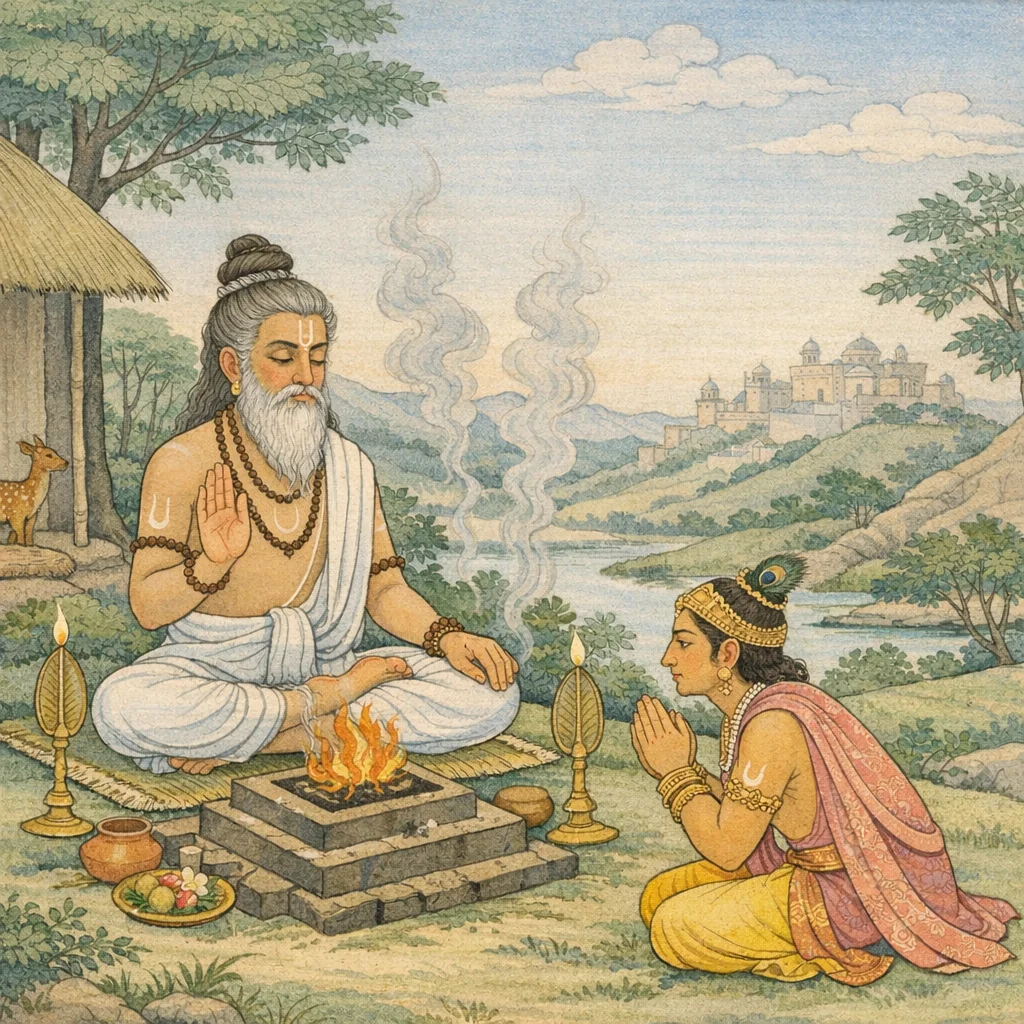
Adhyaya 41
Vasiṣṭhāpavāha: Sarasvatī’s Diversion and Viśvāmitra’s Curse (वसिष्ठापवाहः)
Upa-parva: Vasiṣṭhāpavāha (Sarasvatī–Viśvāmitra–Vasiṣṭha Episode)
Janamejaya asks how the river Sarasvatī came to be known for the “apavāha” (diverting/carrying away) of Vasiṣṭha and what enmity caused it. Vaiśaṃpāyana explains the intense tapas-based rivalry between Viśvāmitra and Vasiṣṭha, whose āśramas lay near Sthāṇutīrtha, a site associated with divine rites and consecrations. Viśvāmitra, perceiving Vasiṣṭha’s radiance as superior, forms an intent to harm him and summons Sarasvatī in anger, commanding her to bring Vasiṣṭha quickly. Sarasvatī arrives distressed, fearing the consequences of disobeying either sage. She approaches Vasiṣṭha, who advises her to protect herself by carrying him swiftly, warning that Viśvāmitra may curse her. Seizing an opportunity, Sarasvatī causes a bank-eroding surge that lifts and carries Vasiṣṭha; Vasiṣṭha praises the river’s cosmic functions and she delivers him toward Viśvāmitra’s vicinity. When Viśvāmitra reaches for a weapon, Sarasvatī, fearing the sin of brahmin-killing, diverts Vasiṣṭha eastward, effectively deceiving Viśvāmitra to prevent harm. Enraged, Viśvāmitra curses Sarasvatī to carry blood-mixed water for a year. Sages and divine beings grieve at this condition, and the account concludes by noting the fame of the Vasiṣṭhāpavāha and Sarasvatī’s eventual return to her natural course.
Chapter Arc: वैशम्पायन जनमेजय से कहते हैं—बलदेव की तीर्थयात्रा के प्रसंग में अब ‘अवाकीर्ण’ तीर्थ की महिमा सुनो, जहाँ क्रोध और तप के संयोग से एक ब्राह्मण का यज्ञ लोक-व्यवस्था को हिला देता है। → दाल्भ्य (बक दाल्भ्य) कठोर नियम में स्थित होकर धृतराष्ट्र के राष्ट्र पर क्रोधवश एक भयानक सत्र-यज्ञ आरम्भ करता है। यज्ञ विधिवत् चलता है, पर उसका फल ‘क्षय’ बनकर उतरता है—धृतराष्ट्र का राज्य क्रमशः क्षीण होने लगता है, मानो कुल्हाड़ी से वन कट रहा हो। भय और विस्मय फैलता है; यह तप-तेज धर्म का आवरण लिए हुए भी विनाश का उपकरण बनता दिखता है। → जब राज्य-क्षय असह्य हो उठता है और संकट में फँसा ‘अवाकीर्ण’ (व्यवकीर्ण) विवेकहीन-सा पड़ जाता है, तब दीनता से झुके हुए लोग/राजा ब्राह्मण के चरणों में गिरकर कहते हैं—“मैं दीन, लुब्ध, मूर्ख; आप ही मेरी गति, आप ही नाथ—प्रसाद कीजिए।” यही क्षण क्रोध-यज्ञ और करुणा-याचना का टकराव बनकर चरम पर पहुँचता है। → प्रसंग आगे ययाति की ओर मुड़ता है—ययाति के यज्ञ का वर्णन आता है, जहाँ दान की पराकाष्ठा से देव-गन्धर्व प्रसन्न होते हैं और मनुष्य विस्मित। ययाति ब्राह्मणों को मनोवांछित कामनाएँ/दान देता है; यज्ञ ‘क्षय’ नहीं, ‘सम्पदा’ और लोक-कल्याण का प्रतीक बनता है—यह तुलना बताती है कि यज्ञ का नैतिक स्वरूप कर्ता के भाव पर निर्भर है। → बलदेव की तीर्थयात्रा में ‘सारस्वतोपाख्यान’ की धारा आगे किन-किन तीर्थों और कथाओं से होकर गुज़रेगी—यह जिज्ञासा बनी रहती है।
Shlokas
Verse 1
०: ड-शक्ाझ एकचत्वारिशो< ध्याय: अवाकीर्ण और यायात तीर्थकी महिमाके प्रसंगमें दाल्भ्यकी कथा और ययातिके यज्ञका वर्णन वैशम्पायन उवाच ब्रह्मययोनेरवाकीर्ण जगाम यदुनन्दन: । यत्र दाल्भ्यो बको राजन्नाश्रमस्थो महातपा:,क्रोधेन महता5<विष्टो धर्मात्मा वै प्रतापवान् | वैशम्पायनजी कहते हैं--राजन! ब्राह्मणत्वकी प्राप्ति करानेवाले उस तीर्थसे प्रस्थित होकर यदुनन्दन बलरामजी “अवाकीर्ण' तीर्थमें गये, जहाँ आश्रममें रहते हुए महातपस्वी धर्मात्मा एवं प्रतापी दलभपुत्र बकने महान् क्रोधमें भरकर घोर तपस्याद्वारा अपने शरीरको सुखाते हुए विचित्रवीर्यकुमार राजा धृतराष्ट्रके राष्ट्रका होम कर दिया था
Vaiśaṃpāyana said: O King, the delight of the Yadus (Balarāma), having departed from the sacred ford that bestows Brahminhood, went on to the tīrtha called Avākīrṇa. There, in his hermitage, lived the great ascetic Baka, son of Dālbhi—righteous and powerful—who, seized by intense anger, had performed a fierce rite that brought ruin upon Dhṛtarāṣṭra’s realm.
Verse 2
जुहाव धृतराष्ट्रस्य राष्ट्र वैचित्रवीर्यिण: । तपसा घोररूपेण कर्षयन् देहमात्मन:,क्रोधेन महता5<विष्टो धर्मात्मा वै प्रतापवान् | वैशम्पायनजी कहते हैं--राजन! ब्राह्मणत्वकी प्राप्ति करानेवाले उस तीर्थसे प्रस्थित होकर यदुनन्दन बलरामजी “अवाकीर्ण' तीर्थमें गये, जहाँ आश्रममें रहते हुए महातपस्वी धर्मात्मा एवं प्रतापी दलभपुत्र बकने महान् क्रोधमें भरकर घोर तपस्याद्वारा अपने शरीरको सुखाते हुए विचित्रवीर्यकुमार राजा धृतराष्ट्रके राष्ट्रका होम कर दिया था
Vaiśampāyana said: Overwhelmed by intense wrath, that righteous and mighty ascetic, emaciating his own body through dreadful austerities, performed a sacrificial oblation that consumed the kingdom of Dhṛtarāṣṭra, the son of Vicitravīrya. The verse underscores how anger, even when joined to ascetic power, can become a destructive force with far-reaching moral and political consequences.
Verse 3
पुरा हि नैमिषीयाणां सत्रे द्वादशवार्षिके,क्रोधेन महता5<विष्टो धर्मात्मा वै प्रतापवान् | वैशम्पायनजी कहते हैं--राजन! ब्राह्मणत्वकी प्राप्ति करानेवाले उस तीर्थसे प्रस्थित होकर यदुनन्दन बलरामजी “अवाकीर्ण' तीर्थमें गये, जहाँ आश्रममें रहते हुए महातपस्वी धर्मात्मा एवं प्रतापी दलभपुत्र बकने महान् क्रोधमें भरकर घोर तपस्याद्वारा अपने शरीरको सुखाते हुए विचित्रवीर्यकुमार राजा धृतराष्ट्रके राष्ट्रका होम कर दिया था
Vaiśaṃpāyana said: Long ago, at the twelve-year sacrificial session of the sages of Naimiṣa, a righteous and mighty ascetic, seized by intense anger, acted in a way that shows how even great spiritual power, when joined to wrath, can become destructive and morally consequential.
Verse 4
वृत्ते विश्वजितो<न्ते वै पज्चालानृषयो5गमन् । तत्रेश्वरमयाचन्त दक्षिणार्थ मनस्विन:,क्रोधेन महता5<विष्टो धर्मात्मा वै प्रतापवान् | वैशम्पायनजी कहते हैं--राजन! ब्राह्मणत्वकी प्राप्ति करानेवाले उस तीर्थसे प्रस्थित होकर यदुनन्दन बलरामजी “अवाकीर्ण' तीर्थमें गये, जहाँ आश्रममें रहते हुए महातपस्वी धर्मात्मा एवं प्रतापी दलभपुत्र बकने महान् क्रोधमें भरकर घोर तपस्याद्वारा अपने शरीरको सुखाते हुए विचित्रवीर्यकुमार राजा धृतराष्ट्रके राष्ट्रका होम कर दिया था
Vaiśampāyana said: When the sacrifice of Viśvajit had concluded, sages from the land of the Pāñcālas arrived. There, with resolute minds, they requested the lord for a sacrificial gift (dakṣiṇā). But a righteous and mighty ascetic, seized by intense anger, became the pivotal presence in that setting—signaling how even religious contexts can be morally tested when passions like wrath intrude upon dharma.
Verse 5
पूर्वकालमें नैमिषारण्यनिवासी ऋषियोंने बारह वर्षोतक चालू रहनेवाले एक सत्रका आरम्भ किया था। जब वह पूरा हो गया, तब वे सब ऋषि विश्वजित् नामक यज्ञके अन्तमें पांचाल देशमें गये। वहाँ जाकर उन मनस्वी मुनियोंने उस देशके राजासे दक्षिणाके लिये धनकी याचना की ।। (तत्र ते लेभिरे राजन् पञ्चाले भ्यो महर्षयः) बलान्वितान् वत्सतरान् निर्व्याधीनेकविंशतिम् । तानब्रवीद् बको दाल्भ्यो विभजध्वं पशूनिति,क्रोधेन महता5<विष्टो धर्मात्मा वै प्रतापवान् | वैशम्पायनजी कहते हैं--राजन! ब्राह्मणत्वकी प्राप्ति करानेवाले उस तीर्थसे प्रस्थित होकर यदुनन्दन बलरामजी “अवाकीर्ण' तीर्थमें गये, जहाँ आश्रममें रहते हुए महातपस्वी धर्मात्मा एवं प्रतापी दलभपुत्र बकने महान् क्रोधमें भरकर घोर तपस्याद्वारा अपने शरीरको सुखाते हुए विचित्रवीर्यकुमार राजा धृतराष्ट्रके राष्ट्रका होम कर दिया था
Vaiśampāyana said: Long ago, the sages dwelling in Naimiṣāraṇya began a sacrificial session that continued for twelve years. When it was completed, they all went to Pāñcāla at the conclusion of a sacrifice called Viśvajit. There those high-minded seers asked the king of that land for wealth as the sacrificial fee. The Pāñcālas gave them twenty-one strong, healthy yearling calves. Then Baka, the son of Dālbhi—righteous and renowned, yet seized by great anger—said to them, “Divide these cattle among yourselves.” Vaiśampāyana continued: O king, after departing from that sacred ford which bestows the status of a brāhmaṇa, Balarāma, the delight of the Yadus, went to the Avākīrṇa Tīrtha. There, in an āśrama, the great ascetic Baka, son of Dālbhi—virtuous and powerful—overcome by fierce wrath, dried up his body through severe austerity and, as it were, ‘offered into the fire’ the realm of King Dhṛtarāṣṭra, the son of Vicitravīrya. The passage underscores how anger, even in the righteous, can become a destructive force, while sacred places and vows are portrayed as morally potent in shaping worldly outcomes.
Verse 6
एवमुकत्वा ततो राजन्नूषीन् सर्वान् प्रतापवान्,क्रोधेन महता5<विष्टो धर्मात्मा वै प्रतापवान् | वैशम्पायनजी कहते हैं--राजन! ब्राह्मणत्वकी प्राप्ति करानेवाले उस तीर्थसे प्रस्थित होकर यदुनन्दन बलरामजी “अवाकीर्ण' तीर्थमें गये, जहाँ आश्रममें रहते हुए महातपस्वी धर्मात्मा एवं प्रतापी दलभपुत्र बकने महान् क्रोधमें भरकर घोर तपस्याद्वारा अपने शरीरको सुखाते हुए विचित्रवीर्यकुमार राजा धृतराष्ट्रके राष्ट्रका होम कर दिया था
Vaiśampāyana said: “O King, having spoken thus, that mighty and radiant one then addressed all the sages. Overcome by intense anger—though righteous at heart and formidable in power—he spoke and acted under the force of that great wrath.”
Verse 7
स समीपगतो भूत्वा धृतराष्ट्रं जनेश्वरम्,क्रोधेन महता5<विष्टो धर्मात्मा वै प्रतापवान् | वैशम्पायनजी कहते हैं--राजन! ब्राह्मणत्वकी प्राप्ति करानेवाले उस तीर्थसे प्रस्थित होकर यदुनन्दन बलरामजी “अवाकीर्ण' तीर्थमें गये, जहाँ आश्रममें रहते हुए महातपस्वी धर्मात्मा एवं प्रतापी दलभपुत्र बकने महान् क्रोधमें भरकर घोर तपस्याद्वारा अपने शरीरको सुखाते हुए विचित्रवीर्यकुमार राजा धृतराष्ट्रके राष्ट्रका होम कर दिया था
Vaiśampāyana said: Drawing near to King Dhṛtarāṣṭra, lord of men, that righteous and mighty one—overwhelmed by fierce anger—approached him. The verse suggests that even a disciplined follower of dharma, when provoked, may be driven to forceful action, setting righteous restraint against wrathful resolve.
Verse 8
अयाचत पशाून् दाल्भ्य: स चैनं रुषितो5ब्रवीत् । यदृच्छया मृता दृष्टवा गास्तदा नृपसत्तम:,क्रोधेन महता5<विष्टो धर्मात्मा वै प्रतापवान् | वैशम्पायनजी कहते हैं--राजन! ब्राह्मणत्वकी प्राप्ति करानेवाले उस तीर्थसे प्रस्थित होकर यदुनन्दन बलरामजी “अवाकीर्ण' तीर्थमें गये, जहाँ आश्रममें रहते हुए महातपस्वी धर्मात्मा एवं प्रतापी दलभपुत्र बकने महान् क्रोधमें भरकर घोर तपस्याद्वारा अपने शरीरको सुखाते हुए विचित्रवीर्यकुमार राजा धृतराष्ट्रके राष्ट्रका होम कर दिया था
Vaiśampāyana said: Dālbya asked for cattle; but the other, angered, spoke to him. When the finest of kings saw that the cows had died by mere chance, that righteous and powerful ascetic was seized by great wrath. The passage shows how anger can drive even a dharmic person toward harsh speech and destructive resolve, foreshadowing grave consequences.
Verse 9
एतान् पशून् नय क्षिप्रं ब्रह्मबन्धो यदीच्छसि । निकट जाकर दल्भ्यने कौरवनरेश धृतराष्ट्रसे पशुओंकी याचना की। यह सुनकर नृपश्रेष्ठ धृतराष्ट्र कुृपित हो उठे। उनके यहाँ कुछ गौएँ दैवेच्छासे मर गयी थीं। उन्हींको लक्ष्य करके राजाने क्रोधपूर्वक कहा--'ब्रह्मबन्धो! यदि पशु चाहते हो तो इन मरे हुए पशुओंको ही शीघ्र ले जाओ' || ७-८ $ ।। ऋषिस्तथा वच: श्रुत्वा चिन्तयामास धर्मवित्,क्रोधेन महता5<विष्टो धर्मात्मा वै प्रतापवान् | वैशम्पायनजी कहते हैं--राजन! ब्राह्मणत्वकी प्राप्ति करानेवाले उस तीर्थसे प्रस्थित होकर यदुनन्दन बलरामजी “अवाकीर्ण' तीर्थमें गये, जहाँ आश्रममें रहते हुए महातपस्वी धर्मात्मा एवं प्रतापी दलभपुत्र बकने महान् क्रोधमें भरकर घोर तपस्याद्वारा अपने शरीरको सुखाते हुए विचित्रवीर्यकुमार राजा धृतराष्ट्रके राष्ट्रका होम कर दिया था
Vaiśaṃpāyana said: “If you truly desire cattle, O ‘brahma-bandhu’—one who bears the name of a Brahmin but lacks Brahmin conduct—then take these animals away at once.” The line casts the king’s anger as a cutting insult, turning a request into humiliation and exposing the ethical fault of harsh speech toward a supplicant, especially one tied to sacred status.
Verse 10
चिन्तयित्वा मुहूर्तेन रोषाविष्टो द्विजोत्तम:,क्रोधेन महता5<विष्टो धर्मात्मा वै प्रतापवान् | वैशम्पायनजी कहते हैं--राजन! ब्राह्मणत्वकी प्राप्ति करानेवाले उस तीर्थसे प्रस्थित होकर यदुनन्दन बलरामजी “अवाकीर्ण' तीर्थमें गये, जहाँ आश्रममें रहते हुए महातपस्वी धर्मात्मा एवं प्रतापी दलभपुत्र बकने महान् क्रोधमें भरकर घोर तपस्याद्वारा अपने शरीरको सुखाते हुए विचित्रवीर्यकुमार राजा धृतराष्ट्रके राष्ट्रका होम कर दिया था
Vaiśampāyana said: After reflecting for a moment, that foremost of Brahmins was seized by indignation. Overwhelmed by great anger—though righteous at heart and mighty in austerity and power—he was driven to a fierce resolve, an anger that in the wider tale culminates in destructive ritual action against a kingdom.
Verse 11
स तूत्कृत्य मृतानां वै मांसानि मुनिसत्तम:,क्रोधेन महता5<विष्टो धर्मात्मा वै प्रतापवान् | वैशम्पायनजी कहते हैं--राजन! ब्राह्मणत्वकी प्राप्ति करानेवाले उस तीर्थसे प्रस्थित होकर यदुनन्दन बलरामजी “अवाकीर्ण' तीर्थमें गये, जहाँ आश्रममें रहते हुए महातपस्वी धर्मात्मा एवं प्रतापी दलभपुत्र बकने महान् क्रोधमें भरकर घोर तपस्याद्वारा अपने शरीरको सुखाते हुए विचित्रवीर्यकुमार राजा धृतराष्ट्रके राष्ट्रका होम कर दिया था
Vaiśampāyana said: “O best of sages, that righteous and mighty ascetic, seized by intense anger, tore apart the flesh of the dead.”
Verse 12
अवाकीर्णे सरस्वत्यास्तीर्थे प्रज्वजाल्य पावकम्,क्रोधेन महता5<विष्टो धर्मात्मा वै प्रतापवान् | वैशम्पायनजी कहते हैं--राजन! ब्राह्मणत्वकी प्राप्ति करानेवाले उस तीर्थसे प्रस्थित होकर यदुनन्दन बलरामजी “अवाकीर्ण' तीर्थमें गये, जहाँ आश्रममें रहते हुए महातपस्वी धर्मात्मा एवं प्रतापी दलभपुत्र बकने महान् क्रोधमें भरकर घोर तपस्याद्वारा अपने शरीरको सुखाते हुए विचित्रवीर्यकुमार राजा धृतराष्ट्रके राष्ट्रका होम कर दिया था महाराज! सरस्वतीके अवाकीर्णतीर्थमें अग्नि प्रजलित करके महातपस्वी दल्भपुत्र बक उत्तम नियमका आश्रय ले उन मृत पशुओंके मांसोंद्वारा ही उनके राष्ट्रका हवन करने लगे
Vaiśampāyana said: At the Sarasvatī’s sacred ford called Avākīrṇa, that righteous and mighty ascetic—seized by immense wrath—kindled the sacrificial fire. There the tale recalls how a sage of severe austerities, inflamed with anger, performed a fierce rite that symbolically “offered” (consumed) a kingdom in the fire, showing how tapas and ritual power, when driven by krodha, can become ethically perilous and socially destructive.
Verse 13
बको दाल्भ्यो महाराज नियमं परमं स्थित: । स तैरेव जुहावास्य राष्ट्र मांसैर्महातपा:,क्रोधेन महता5<विष्टो धर्मात्मा वै प्रतापवान् | वैशम्पायनजी कहते हैं--राजन! ब्राह्मणत्वकी प्राप्ति करानेवाले उस तीर्थसे प्रस्थित होकर यदुनन्दन बलरामजी “अवाकीर्ण' तीर्थमें गये, जहाँ आश्रममें रहते हुए महातपस्वी धर्मात्मा एवं प्रतापी दलभपुत्र बकने महान् क्रोधमें भरकर घोर तपस्याद्वारा अपने शरीरको सुखाते हुए विचित्रवीर्यकुमार राजा धृतराष्ट्रके राष्ट्रका होम कर दिया था महाराज! सरस्वतीके अवाकीर्णतीर्थमें अग्नि प्रजलित करके महातपस्वी दल्भपुत्र बक उत्तम नियमका आश्रय ले उन मृत पशुओंके मांसोंद्वारा ही उनके राष्ट्रका हवन करने लगे
Vaiśampāyana said: O king, Baka, Dālbhyā’s son, firmly established in a supreme vow, was a great ascetic—righteous and powerful. Seized by immense anger, he kindled the sacrificial fire and made an oblation of that very kingdom, using only the flesh of dead animals as his offering. The passage highlights the moral tension between tapas (spiritual discipline) and krodha (wrath), when ascetic power is turned toward destruction.
Verse 14
तस्मिंस्तु विधिवत् सत्रे सम्प्रवृत्ते सुदारुणे । अक्षीयत ततो राष्ट्र धृतराष्ट्रस्य पार्थिव,क्रोधेन महता5<विष्टो धर्मात्मा वै प्रतापवान् | वैशम्पायनजी कहते हैं--राजन! ब्राह्मणत्वकी प्राप्ति करानेवाले उस तीर्थसे प्रस्थित होकर यदुनन्दन बलरामजी “अवाकीर्ण' तीर्थमें गये, जहाँ आश्रममें रहते हुए महातपस्वी धर्मात्मा एवं प्रतापी दलभपुत्र बकने महान् क्रोधमें भरकर घोर तपस्याद्वारा अपने शरीरको सुखाते हुए विचित्रवीर्यकुमार राजा धृतराष्ट्रके राष्ट्रका होम कर दिया था राजन्! वह भयंकर यज्ञ जब विधिपूर्वक आरम्भ हुआ, तबसे धृतराष्ट्रका राष्ट्र क्षीण होने लगा
Vaiśampāyana said: “O king, when that dreadfully fierce sacrificial session began in due ritual order, from that very time Dhṛtarāṣṭra’s kingdom started to waste away. For the righteous and mighty ascetic—seized by great wrath—set in motion a rite whose power consumed the realm.”
Verse 15
ततः प्रक्षीयमाणं तद् राज्यं तस्य महीपते: । छिद्यमानं यथानन्तं वनं परशुना विभो,क्रोधेन महता5<विष्टो धर्मात्मा वै प्रतापवान् | वैशम्पायनजी कहते हैं--राजन! ब्राह्मणत्वकी प्राप्ति करानेवाले उस तीर्थसे प्रस्थित होकर यदुनन्दन बलरामजी “अवाकीर्ण' तीर्थमें गये, जहाँ आश्रममें रहते हुए महातपस्वी धर्मात्मा एवं प्रतापी दलभपुत्र बकने महान् क्रोधमें भरकर घोर तपस्याद्वारा अपने शरीरको सुखाते हुए विचित्रवीर्यकुमार राजा धृतराष्ट्रके राष्ट्रका होम कर दिया था
Vaiśaṃpāyana said: Then that king’s realm began to waste away—being cut down, as though an endless forest were being hewn with an axe. Overwhelmed by great wrath, that righteous and mighty ascetic brought ruin upon the kingdom, showing how uncontrolled anger, even when born in a dharmic person, can become a force that consumes an entire polity.
Verse 16
दृष्टवा तथावकीर्ण तु राष्ट्र स मनुजाधिप:,क्रोधेन महता5<विष्टो धर्मात्मा वै प्रतापवान् | वैशम्पायनजी कहते हैं--राजन! ब्राह्मणत्वकी प्राप्ति करानेवाले उस तीर्थसे प्रस्थित होकर यदुनन्दन बलरामजी “अवाकीर्ण' तीर्थमें गये, जहाँ आश्रममें रहते हुए महातपस्वी धर्मात्मा एवं प्रतापी दलभपुत्र बकने महान् क्रोधमें भरकर घोर तपस्याद्वारा अपने शरीरको सुखाते हुए विचित्रवीर्यकुमार राजा धृतराष्ट्रके राष्ट्रका होम कर दिया था राजन! अपने राष्ट्रको इस प्रकार संकटमग्न हुआ देख वे नरेश मन-ही-मन बहुत दुःखी हुए और गहरी चिन्तामें डूब गये। फिर ब्राह्मणोंक साथ अपने देशको संकटसे बचानेका प्रयत्न करने लगे
Vaiśampāyana said: Seeing his kingdom thus cast into ruin and confusion, that lord of men grieved deeply within and sank into anxious thought. Then, together with the brāhmaṇas, he strove to save the realm from that calamity.
Verse 17
बभूव दुर्मना राजंश्विन्तयामास च प्रभु: । मोक्षार्थमकरोद्ू यत्नं ब्राह्मणैः सहित: पुरा,क्रोधेन महता5<विष्टो धर्मात्मा वै प्रतापवान् | वैशम्पायनजी कहते हैं--राजन! ब्राह्मणत्वकी प्राप्ति करानेवाले उस तीर्थसे प्रस्थित होकर यदुनन्दन बलरामजी “अवाकीर्ण' तीर्थमें गये, जहाँ आश्रममें रहते हुए महातपस्वी धर्मात्मा एवं प्रतापी दलभपुत्र बकने महान् क्रोधमें भरकर घोर तपस्याद्वारा अपने शरीरको सुखाते हुए विचित्रवीर्यकुमार राजा धृतराष्ट्रके राष्ट्रका होम कर दिया था राजन! अपने राष्ट्रको इस प्रकार संकटमग्न हुआ देख वे नरेश मन-ही-मन बहुत दुःखी हुए और गहरी चिन्तामें डूब गये। फिर ब्राह्मणोंक साथ अपने देशको संकटसे बचानेका प्रयत्न करने लगे
Vaiśampāyana said: “O King, the lord grew downcast and sank into anxious reflection. Formerly, seeking deliverance (mokṣa), he undertook an effort together with the brāhmaṇas. Though righteous at heart and mighty in prowess, he was seized by a great wrath—setting in motion deeds of grave moral weight and dire consequence.”
Verse 18
न च श्रेयो5 ध्यगच्छत्तु क्षीयते राष्ट्रमेव च । यदा स पार्थिव: खिन्नस्ते च विप्रास्तदानघ,क्रोधेन महता5<विष्टो धर्मात्मा वै प्रतापवान् | वैशम्पायनजी कहते हैं--राजन! ब्राह्मणत्वकी प्राप्ति करानेवाले उस तीर्थसे प्रस्थित होकर यदुनन्दन बलरामजी “अवाकीर्ण' तीर्थमें गये, जहाँ आश्रममें रहते हुए महातपस्वी धर्मात्मा एवं प्रतापी दलभपुत्र बकने महान् क्रोधमें भरकर घोर तपस्याद्वारा अपने शरीरको सुखाते हुए विचित्रवीर्यकुमार राजा धृतराष्ट्रके राष्ट्रका होम कर दिया था अनघ! जब किसी प्रकार भी वे भूपाल अपने राष्ट्रका कल्याण-साधन न कर सके और वह दिन-प्रतिदिन क्षीण होता ही चला गया, तब राजा और उन ब्राह्मणोंको बड़ा खेद हुआ
Vaiśampāyana said: “And yet no true good was attained; the kingdom itself kept wasting away day by day. When that king grew dispirited—and those brāhmaṇas too, O sinless one—the righteous and mighty man, seized by a great wrath, acted in a way that brought ruin upon the realm.”
Verse 19
यदा चापि न शवक्नोति राष्ट्र मोक्षयितुं नृप अथ वै प्राश्निकांस्तत्र पप्रच्छ जनमेजय,क्रोधेन महता5<विष्टो धर्मात्मा वै प्रतापवान् | वैशम्पायनजी कहते हैं--राजन! ब्राह्मणत्वकी प्राप्ति करानेवाले उस तीर्थसे प्रस्थित होकर यदुनन्दन बलरामजी “अवाकीर्ण' तीर्थमें गये, जहाँ आश्रममें रहते हुए महातपस्वी धर्मात्मा एवं प्रतापी दलभपुत्र बकने महान् क्रोधमें भरकर घोर तपस्याद्वारा अपने शरीरको सुखाते हुए विचित्रवीर्यकुमार राजा धृतराष्ट्रके राष्ट्रका होम कर दिया था नरेश्वर जनमेजय! जब धृतराष्ट्र अपने राष्ट्रको उस विपत्तिसे छुटकारा दिलानेमें समर्थ न हो सके, तब उन्होंने प्राश्निकों (प्रश्न पूछनेपर भूत, वर्तमान और भविष्यकी बातें बतानेवालों)-को बुलाकर उनसे इसका कारण पूछा
Vaiśampāyana said: “O king Janamejaya, when Dhṛtarāṣṭra found himself unable to rescue his kingdom from that calamity, he summoned the prāśnikas—those who answer questions by revealing matters of past, present, and future—and asked them the cause. In that context, the narrative recalls a righteous and powerful ascetic, seized by great anger, whose severe austerity (tapas) brought ruin upon the realm—showing how wrath, even in one devoted to dharma, can become a force of destruction when unrestrained.”
Verse 20
ततो वै प्राश्निकाः प्राहुः पशोर्विप्रकृतस्त्वया । मांसैरभिजुहोतीदं तव राष्ट्र मुनिर्बक:,क्रोधेन महता5<विष्टो धर्मात्मा वै प्रतापवान् | वैशम्पायनजी कहते हैं--राजन! ब्राह्मणत्वकी प्राप्ति करानेवाले उस तीर्थसे प्रस्थित होकर यदुनन्दन बलरामजी “अवाकीर्ण' तीर्थमें गये, जहाँ आश्रममें रहते हुए महातपस्वी धर्मात्मा एवं प्रतापी दलभपुत्र बकने महान् क्रोधमें भरकर घोर तपस्याद्वारा अपने शरीरको सुखाते हुए विचित्रवीर्यकुमार राजा धृतराष्ट्रके राष्ट्रका होम कर दिया था तब उन प्राश्चिकोंने कहा--'आपने पशुके लिये याचना करनेवाले बक मुनिका तिरस्कार किया है; इसलिये वे मृत पशुओंके मांसोंद्वारा आपके इस राष्ट्रका विनाश करनेकी इच्छासे होम कर रहे हैं
Vaiśampāyana said: “Then the prāśnikas declared, ‘You have wronged the sage Baka, who had asked for an animal. Therefore that righteous and powerful ascetic—seized by intense anger—now performs homa oblations with flesh, intending the destruction of your realm.’”
Verse 21
तेन ते हूयमानस्य राष्ट्रस्यास्य क्षयो महान् । तस्यैतत् तपस: कर्म येन तेडद्य लयो महान्,क्रोधेन महता5<विष्टो धर्मात्मा वै प्रतापवान् | वैशम्पायनजी कहते हैं--राजन! ब्राह्मणत्वकी प्राप्ति करानेवाले उस तीर्थसे प्रस्थित होकर यदुनन्दन बलरामजी “अवाकीर्ण' तीर्थमें गये, जहाँ आश्रममें रहते हुए महातपस्वी धर्मात्मा एवं प्रतापी दलभपुत्र बकने महान् क्रोधमें भरकर घोर तपस्याद्वारा अपने शरीरको सुखाते हुए विचित्रवीर्यकुमार राजा धृतराष्ट्रके राष्ट्रका होम कर दिया था “उनके द्वारा आपके राष्ट्रकी आहुति दी जा रही है; इसलिये इसका महान् विनाश हो रहा है। यह सब उनकी तपस्याका प्रभाव है, जिससे आपके इस देशका इस समय महान् विलय होने लगा है
Vaiśaṃpāyana said: “Because your kingdom is, as it were, being offered into the fire by him, a great destruction has come upon this realm. This is the working of his austerity (tapas)—by which, today, a great dissolution has begun for you. Possessed by mighty wrath, that righteous and powerful ascetic has brought about this ruin through the force of his tapas.”
Verse 22
अपां कुज्जे सरस्वत्यास्तं प्रसादय पार्थिव । सरस्वतीं ततो गत्वा स राजा बकमब्रवीत्,क्रोधेन महता5<विष्टो धर्मात्मा वै प्रतापवान् | वैशम्पायनजी कहते हैं--राजन! ब्राह्मणत्वकी प्राप्ति करानेवाले उस तीर्थसे प्रस्थित होकर यदुनन्दन बलरामजी “अवाकीर्ण' तीर्थमें गये, जहाँ आश्रममें रहते हुए महातपस्वी धर्मात्मा एवं प्रतापी दलभपुत्र बकने महान् क्रोधमें भरकर घोर तपस्याद्वारा अपने शरीरको सुखाते हुए विचित्रवीर्यकुमार राजा धृतराष्ट्रके राष्ट्रका होम कर दिया था 'भूपाल! सरस्वतीके कुंजमें जलके समीप वे मुनि विराजमान हैं, आप उन्हें प्रसन्न कीजिये।” तब राजाने सरस्वतीके तटपर जाकर बक मुनिसे इस प्रकार कहा
Vaiśampāyana said: “O king, in the grove of the Sarasvatī, near the waters, that sage is seated—go and win his favor.” Thereupon the king went to the Sarasvatī and addressed the sage Baka. Baka, a righteous and powerful ascetic, was seized by great anger—an episode that frames the moral tension between ascetic force, wrath, and the need for respectful conciliation when approaching a holy person.
Verse 23
निपत्य शिरसा भूमौ प्राउ्जलिर्भरतर्षभ । प्रसादये त्वां भगवन्नपराध॑ क्षमस्व मे,क्रोधेन महता5<विष्टो धर्मात्मा वै प्रतापवान् | वैशम्पायनजी कहते हैं--राजन! ब्राह्मणत्वकी प्राप्ति करानेवाले उस तीर्थसे प्रस्थित होकर यदुनन्दन बलरामजी “अवाकीर्ण' तीर्थमें गये, जहाँ आश्रममें रहते हुए महातपस्वी धर्मात्मा एवं प्रतापी दलभपुत्र बकने महान् क्रोधमें भरकर घोर तपस्याद्वारा अपने शरीरको सुखाते हुए विचित्रवीर्यकुमार राजा धृतराष्ट्रके राष्ट्रका होम कर दिया था भरतश्रेष्ठ! वे पृथ्वीपर माथा टेक हाथ जोड़कर बोले--“भगवन्! मैं आपको प्रसन्न करना चाहता हूँ। आप मुझ दीन, लोभी और मूर्खतासे हतबुद्धि हुए अपराधीके अपराधको क्षमा कर दें। आप ही मेरी गति हैं। आप ही मेरे रक्षक हैं। आप मुझपर अवश्य कृपा करें!
Vaiśampāyana said: “O bull among the Bharatas, having fallen with his head to the ground and with hands joined in reverence, he spoke: ‘O Blessed Lord, I seek to propitiate you. Forgive my offence…’”
Verse 24
मम दीनस्य लुब्धस्य मौख्येण हतचेतस: । त्वं गतिस्त्वं च मे नाथ: प्रसादं कर्तुमहसि,भरतश्रेष्ठ! वे पृथ्वीपर माथा टेक हाथ जोड़कर बोले--“भगवन्! मैं आपको प्रसन्न करना चाहता हूँ। आप मुझ दीन, लोभी और मूर्खतासे हतबुद्धि हुए अपराधीके अपराधको क्षमा कर दें। आप ही मेरी गति हैं। आप ही मेरे रक्षक हैं। आप मुझपर अवश्य कृपा करें!
“I am wretched, greedy, and my mind has been ruined by folly. You are my only refuge; you are my lord and protector. You ought to show me grace.”
Verse 25
तं तथा विलपन्तं तु शोकोपहतचेतसम् | दृष्टवा तस्य कृपा जज्ञे राष्ट्र तस्थ व्यमोचयत्,राजा धृतराष्ट्रको इस प्रकार शोकसे अचेत होकर विलाप करते देख उनके मनमें दया आ गयी और उन्होंने राजाके राज्यको संकटसे मुक्त कर दिया
Seeing him lamenting in that manner, his mind overwhelmed by grief, compassion arose. The king then relieved the realm from its distress, granting release from the crisis that had befallen it.
Verse 26
ऋषि: प्रसन्नस्तस्याभूत् संरम्भं च विहाय सः । मोक्षार्थ तस्य राज्यस्य जुहाव पुनराहुतिम्
Vaiśaṃpāyana said: The sage became pleased with him; abandoning all agitation and anger, he again offered an oblation—seeking the liberation of that king and his realm.
Verse 27
ऋषि क्रोध छोड़कर राजापर प्रसन्न हुए और पुनः उनके राज्यको संकटसे बचानेके लिये आहुति देने लगे ।। मोक्षयित्वा ततो राष्ट्र प्रतिगृह्य पशून् बहून् । हृष्टात्मा नैमिषारण्यं जगाम पुनरेव सः,इस प्रकार राज्यको विपत्तिसे छुड़ाकर राजासे बहुत-से पशु ले प्रसन्नचित्त हुए महर्षि दाल्भ्य पुनः नैमिषारण्यको ही चले गये
Having thus delivered the kingdom from peril, the sage accepted many cattle from the king as a gift. With a heart made glad—his anger set aside and his purpose fulfilled—he departed once again for Naimiṣāraṇya.
Verse 28
धृतराष्ट्रोडपि धर्मात्मा स्वस्थचेता महामना: । स्वमेव नगरं राजन् प्रतिपेदे महर्द्धिमत्
Vaiśampāyana said: Dhṛtarāṣṭra too—righteous at heart, composed in mind, and great-souled—returned, O King, to his own splendid and prosperous city.
Verse 29
राजन्! फिर महामनस्वी धर्मात्मा धृतराष्ट्र भी स्वस्थचित्त हो अपने समृद्धिशाली नगरको ही लौट आये ।। तत्र तीर्थे महाराज बृहस्पतिरुदारधी: । असुराणामभावाय भवाय च दिवौकसाम्,महाराज! उसी तीर्थमें उदारबुद्धि बृहस्पतिजीने असुरोंके विनाश और देवताओंकी उन्नतिके लिये मांसोंद्वारा आभिचारिक यज्ञका अनुष्ठान किया था। इससे वे असुर क्षीण हो गये और युद्धमें विजयसे सुशोभित होनेवाले देवताओंने उन्हें मार भगाया
Vaiśaṃpāyana said: “O King, the high-minded and righteous Dhṛtarāṣṭra, his mind now composed, returned again to his own prosperous city. In that sacred ford, O great king, the noble-minded Bṛhaspati once performed an ābhicārika sacrifice—an act of hostile rite with offerings of flesh—to bring about the ruin of the Asuras and the flourishing of the gods. By that act the Asuras were weakened, and the gods, radiant with victory in battle, struck them down and drove them away.”
Verse 30
मांसैरभिजुहावेष्टिमक्षीयन्त ततो<$सुरा: । दैवतैरपि सम्भग्ना जितकाशिभिराहवे,महाराज! उसी तीर्थमें उदारबुद्धि बृहस्पतिजीने असुरोंके विनाश और देवताओंकी उन्नतिके लिये मांसोंद्वारा आभिचारिक यज्ञका अनुष्ठान किया था। इससे वे असुर क्षीण हो गये और युद्धमें विजयसे सुशोभित होनेवाले देवताओंने उन्हें मार भगाया
Vaiśampāyana said: Then, by means of an abhichāra (hostile, destructive) rite performed with offerings of flesh, the Asuras began to waste away. Broken and routed by the gods—resplendent with victory in battle—they were driven off and destroyed, O king.
Verse 31
तत्रापि विधिवद् दत्त्वा ब्राह्मणेभ्यो महायशा: । वाजिन: कुग्जरांश्वैव रथांश्चाश्चतरीयुतान्,पृथ्वीनाथ! महायशस्वी महाबाहु बलरामजी उस तीर्थमें भी ब्राह्मणोंको विधिपूर्वक हाथी, घोड़े, खच्चरियोंसे जुते हुए रथ, बहुमूल्य रत्न तथा प्रचुर धन-धान्यका दान करके वहाँसे यायात तीर्थमें गये
There too, the greatly renowned (Balarāma) made gifts to the brāhmaṇas in due ritual form—horses, elephants, and chariots yoked with teams of four.
Verse 32
रत्नानि च महाहाणि धन धान्यं च पुष्कलम् | ययौ तीर्थ महाबाहुर्यायातं पृथिवीपते,पृथ्वीनाथ! महायशस्वी महाबाहु बलरामजी उस तीर्थमें भी ब्राह्मणोंको विधिपूर्वक हाथी, घोड़े, खच्चरियोंसे जुते हुए रथ, बहुमूल्य रत्न तथा प्रचुर धन-धान्यका दान करके वहाँसे यायात तीर्थमें गये
Vaiśampāyana said: The mighty-armed Balarāma, O lord of the earth, having duly bestowed upon the brāhmaṇas at that sacred ford elephants, horses, mule-yoked chariots, precious gems, and abundant wealth and grain, then departed for the holy place known as Yāyāta-tīrtha.
Verse 33
तत्र यज्ञे ययातेश्षन महाराज सरस्वती । सर्पि: पयश्च सुस्राव नाहुषस्य महात्मन:,महाराज! वहाँ पूर्वकालमें नहुषनन्दन महात्मा ययातिने यज्ञ किया था, जिसमें सरस्वतीने उनके लिये दूध और घीका स्रोत बहाया था
Vaiśampāyana said: “O king, at that sacrifice of the noble Yayāti, son of Nahuṣa, the river Sarasvatī caused streams of milk and clarified butter to flow forth for him.”
Verse 34
तत्रेष्टवा पुरुषव्याप्रो ययाति: पृथिवीपति: । अक्रामदूर्ध्व मुदितो लेभे लोकांश्व पुष्कलान्,पुरुषसिंह भूपाल ययाति वहाँ यज्ञ करके प्रसन्नतापूर्वक ऊर्ध्वलोकमें चले गये और वहाँ उन्हें बहुत-से पुण्यलोक प्राप्त हुए
Vaiśaṃpāyana said: There, King Yayāti—energetic in manly endeavor and lord of the earth—performed the prescribed sacrifice. Rejoicing, he ascended to the higher worlds and attained abundant realms of merit.
Verse 35
पुनस्तत्र च राज्ञस्तु ययातेर्यजत: प्रभो: । औदार्य परम कृत्वा भक्ति चात्मनि शाश्वतीम्
And again, there, the Lord spoke of King Yayāti while he was performing sacrifice—how, having made generosity his highest principle, he also established an enduring devotion within himself.
Verse 36
यो यत्र स्थित एवेह आहूतो यज्ञसंस्तरे,राजाके यज्ञमण्डपमें बुलाकर आया हुआ जो ब्राह्मण जहाँ कहीं ठहर गया, वहीं उसके लिये सरिताओंमें श्रेष्ठ सरस्वतीने पृथक्-पृथक् गृह, शय्या, आसन, षड्रस भोजन तथा नाना प्रकारके दानकी व्यवस्था की
Vaiśampāyana said: In that sacrificial enclosure, whichever Brahmin had been invited and had come to the king’s yajña—wherever he happened to settle down—right there the Sarasvatī, foremost among rivers, arranged for him individually a dwelling, a bed, a seat, food of the six tastes, and many kinds of gifts.
Verse 37
तस्य तस्य सरिच्छेष्ठा गुहादिशयनादिकम् । षड़सं भोजन चैव दानं नानाविधं तथा,राजाके यज्ञमण्डपमें बुलाकर आया हुआ जो ब्राह्मण जहाँ कहीं ठहर गया, वहीं उसके लिये सरिताओंमें श्रेष्ठ सरस्वतीने पृथक्-पृथक् गृह, शय्या, आसन, षड्रस भोजन तथा नाना प्रकारके दानकी व्यवस्था की
Vaiśampāyana said: Wherever each invited brāhmaṇa happened to stay—whether in a cave-like shelter or any other lodging—the river Sarasvatī, foremost among rivers, arranged for him separately a dwelling, bed, and seat, along with food of all six tastes and many kinds of gifts.
Verse 38
ते मन्यमाना राज्ञस्तु सम्प्रदानमनुत्तमम् । राजानं तुष्टवुः प्रीता दत्त्वा चैवाशिष: शुभा:,उन ब्राह्मणोंने यह समझकर कि राजाने ही वह उत्तम दान दिया है, अत्यन्त प्रसन्न होकर राजा ययातिको शुभाशीर्वाद दे उनकी भूरि-भूरि प्रशंसा की
Thinking that the king himself had bestowed that unsurpassed gift, the Brahmins—delighted and satisfied—praised the king and, having offered him auspicious blessings, extolled him greatly.
Verse 39
तत्र देवा: सगन्धर्वा: प्रीता यज्ञस्य सम्पदा । विस्मिता मानुषाश्चासन् दृष्टवा तां यज्ञसम्पदम्,उस यज्ञकी सम्पत्तिसे देवता और गन्धर्व भी बड़े प्रसन्न हुए थे। मनुष्योंको तो वह यज्ञ- वैभव देखकर महान् आश्चर्य हुआ था
There, the gods—along with the Gandharvas—were delighted by the splendid prosperity of the sacrifice. The human onlookers too stood amazed upon witnessing that magnificent sacrificial grandeur.
Verse 40
इस प्रकार श्रीमहाभारत शल्यपर्वके अन्तर्गत गदापव॑में बलदेवजीकी तीर्थयात्राके प्रसंगमें सारस्वतोपाख्यानविषयक चालीसवाँ अध्याय पूरा हुआ,ततस्तालकेतुर्महा धर्मकेतु- महात्मा कृतात्मा महादाननित्य: । वसिष्ठापवाहं महा भीमवेगं धृतात्मा जितात्मा समभ्याजगाम तदनन्तर महान् धर्म ही जिनकी ध्वजा है और जिनकी पताकापर ताड़का चिह्न सुशोभित है, वे महात्मा, कृतात्मा, धृतात्मा तथा जितात्मा बलरामजी, जो प्रतिदिन बड़े- बड़े दान किया करते थे, वहाँसे वसिष्ठापवाह नामक तीर्थमें गये, जहाँ सरस्वतीका वेग बड़ा भयंकर है
Vaiśaṃpāyana said: Thus ends the fortieth chapter of the Sārasvata episode, occurring within the Gadā section of the Śalya Parva of the Mahābhārata, in the context of Baladeva’s pilgrimage. Thereafter Baladeva—whose banner proclaims great dharma, whose standard bears the emblem of the palmyra, a great-souled man, self-mastered and steadfast, ever devoted to generous giving—went on to the sacred ford called Vasiṣṭhāpavāha, where the Sarasvatī rushes with a terrifying force.
Verse 56
पशूनेतानहं त्यक्त्वा भिक्षिष्ये राजसत्तमम् | राजन! वहाँ महर्षियोंने पांचालोंसे इक्कीस बलवान् और नीरोग बछड़े प्राप्त किये। तब उनमेंसे दल्भपुत्र बकने अन्य सब ऋषियोंसे कहा--“आपलोग इन पशुओंको बाँट लें। मैं इन्हें छोड़कर किसी श्रेष्ठ राजासे दूसरे पशु माँग लूँगा'
Vaiśampāyana said: “Leaving these animals aside, I shall go and beg from the best of kings.” O King, there the great seers obtained from the Pāñcālas twenty-one calves—strong and free from disease. Then Baka, the son of Dalbha, said to all the other sages: “You divide these animals among yourselves. I will relinquish them and, approaching some excellent king, ask for other cattle.”
Verse 66
जगाम धृतराष्ट्रस्य भवन ब्राह्मणोत्तम: । नरेश्वर! उन सब ऋषियोंसे ऐसा कहकर वे प्रतापी उत्तम ब्राह्मण राजा धृतराष्ट्रके घरपर गये
Vaiśaṃpāyana said: Having spoken thus to all those sages, the illustrious foremost Brāhmaṇa proceeded to the residence of King Dhṛtarāṣṭra.
Verse 96
अहो बत नृशंसं वै वाक्यमुक्तो5स्मि संसदि । उनकी वैसी बात सुनकर धर्मज्ञ ऋषिने चिन्तामग्न होकर सोचा--“अहो! बड़े खेदकी बात है कि इस राजाने भरी सभामें मुझसे ऐसा कठोर वचन कहा है”
Vaiśampāyana said: “Alas! In the royal assembly I have been addressed with a truly cruel and heartless remark.” Hearing such words, the dharma-knowing sage, sinking into anxious reflection, lamented that a king could speak so harshly in a public court.
Verse 103
मतिं चक्रे विनाशाय धृतराष्ट्रस्य भूपते: । दो घड़ीतक इस प्रकार चिन्ता करके रोषमें भरे हुए द्विजश्रेष्ठ दाल्भ्यने राजा धृतराष्ट्रके विनाशका विचार किया
Vaiśampāyana said: The eminent brāhmaṇa Dālbhyā, after reflecting for a time and filled with indignation, formed the resolve to bring about the destruction of King Dhṛtarāṣṭra.
Verse 116
जुहाव धृतराष्ट्रस्य राष्ट्र नरपते: पुरा । वे मुनिश्रेष्ठ उन मृत पशुओंके ही मांस काट-काटकर उनके द्वारा राजा धृतराष्ट्रके राष्ट्रकी ही आहुति देने लगे
Vaiśampāyana said: Formerly, in a rite performed for King Dhṛtarāṣṭra’s realm, the foremost sages began offering oblations for the very kingdom of Dhṛtarāṣṭra—using only the flesh of dead animals, cut into pieces.
Verse 156
बभूवापद्गतं तच्च व्यवकीर्णमचेतनम् । प्रभो! जैसे बड़ा भारी वन कुल्हाड़ीसे काटा जा रहा हो, उसी प्रकार उस राजाका राज्य क्षीण होता हुआ भारी आफतमें फँस गया, वह संकटग्रस्त होकर अचेत हो गया
Vaiśampāyana said: That kingdom fell into calamity; it was scattered and left senseless—like a great forest being hewn down by an axe. Thus the king’s realm, steadily wasting away, became trapped in a grave disaster, and he, overwhelmed by distress, lost consciousness.
Verse 353
ददौ कामान् ब्राह्मुणेभ्यो यान् यान् यो मनसेच्छति । शक्तिशाली राजा ययाति जब वहाँ यज्ञ कर रहे थे, उस समय उनकी उत्कृष्ट उदारताको दृष्टिमें रखकर और अपने प्रति उनकी सनातन भक्ति देख सरस्वतीने उस यज्ञमें आये हुए ब्राह्मणोंको, जिसने अपने मनसे जिन-जिन भोगोंको चाहा, वे सभी मनोवांछित भोग प्रदान किये
Vaiśampāyana said: Considering King Yayāti’s exceptional generosity while he was performing a sacrifice, and seeing his enduring devotion, Sarasvatī granted to the Brahmins who had come to that rite whatever enjoyments each one desired in his mind—bestowing all wished-for boons.
Verse 412
इति श्रीमहाभारते शल्यपर्वणि गदापर्वणि बलदेवतीर्थयात्रायां सारस्वतोपाख्याने एकचत्वारिंशो5ध्याय
Thus ends the forty-first chapter in the Śalya Parva of the Śrī Mahābhārata—within the section concerning the mace (Gadāparvan), in the account of Baladeva’s pilgrimage to sacred fords, specifically in the episode known as the Sārasvata narrative. The colophon marks the close of a unit of teaching and remembrance: it frames the preceding narration as part of a larger ethical and ritual landscape, where pilgrimage, sacred geography, and exemplary stories are used to interpret the moral weight of the war and its aftermath.
Frequently Asked Questions
Sarasvatī is compelled by Viśvāmitra’s command yet seeks to prevent an act that would incur brahmahatyā; she must choose an action that minimizes irreversible harm while managing the threat of competing curses.
Anger-driven intent distorts judgment and propagates secondary harms; by contrast, harm-prevention—even through tactical redirection—can be framed as a dharmic priority when the alternative is an extreme transgression.
No explicit phalaśruti formula appears in the provided verses; the meta-function is etiological—explaining the well-known “Vasiṣṭhāpavāha” designation and embedding moral causality into tīrtha memory.