Adhyaya 65
Dhṛtarāṣṭra’s Counsel on Restraint and the Pāṇḍavas’ Authorized Return (धृतराष्ट्र-उपदेशः)
Upa-parva: Dyūta-anumati and Nīti-upadeśa (Post-dice permission and counsel episode)
Yudhiṣṭhira addresses Dhṛtarāṣṭra as sovereign and asks what course of action should be taken, affirming his wish to remain under Kuru governance (1). Dhṛtarāṣṭra replies with auspicious benediction, grants leave, and instructs the Pāṇḍavas—accompanied by their wealth—to administer their own kingdom (2). He frames his words as the considered instruction of an elder, presented as beneficial and oriented to long-term welfare (3). He praises Yudhiṣṭhira’s subtle understanding of dharma, his discipline, and service to elders (4). The counsel emphasizes that peace follows from sound judgment; weapons do not advance where calm prevails, and conflict is to be set down rather than carried forward (5). Exemplary persons are described as perceiving virtues rather than faults, not recognizing enmities, and not pursuing antagonism (6). A typology of speech follows: the ignoble speak harshly; the middling respond in kind; the steadfast do not engage in harmful, harsh speech whether provoked or unprovoked (7–8). The virtuous remember good deeds rather than hostilities, grounded in self-verified confidence (9). Dhṛtarāṣṭra urges Yudhiṣṭhira not to lodge Duryodhana’s harshness in his heart, and invokes the presence of elders—Gāndhārī and the blind aged father—seeking regard (10–11). He adds a retrospective note that he had permitted the dice match to observe allies and assess the strengths and weaknesses of his sons (12). He points to Vidura as a learned minister and indicates the distribution of virtues among the Pāṇḍavas—dharma in Yudhiṣṭhira, valor in Arjuna, strength in Bhīma, and devotion to teachers in the twins (13–14). He concludes by directing Yudhiṣṭhira to enter Khāṇḍavaprastha, maintain brotherly concord, and keep the mind established in dharma (15). Vaiśaṃpāyana closes the unit: Yudhiṣṭhira, having completed proper courtesies, departs with his brothers and Kṛṣṇā (Draupadī) toward Indraprastha in cloud-like chariots, with uplifted spirits (16–17).
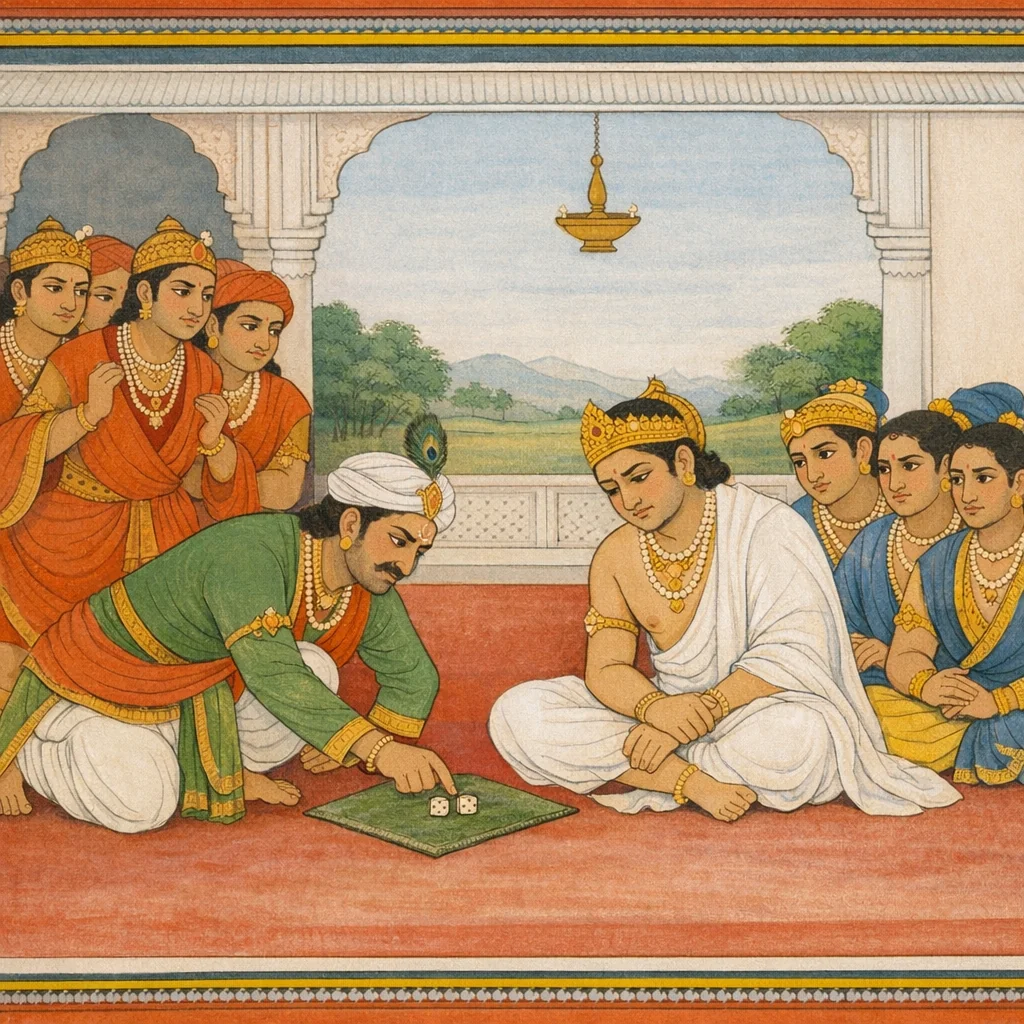
Chapter Arc: सभा में पासों की खनक के बीच शकुनि युधिष्ठिर को उकसाता है—“बहु वित्त पराजैषी” कहकर याद दिलाता है कि वे धन, राज्य और भाइयों तक हार चुके हैं; अब पूछता है कि क्या कुछ ‘अवशिष्ट’ बचा है। → युधिष्ठिर अपने असंख्य वैभव का उल्लेख करते हुए (अयुत, प्रयुत, शंकु, पद्म… कोटि तक) यह जताते हैं कि धन की कमी नहीं; पर शकुनि का लक्ष्य धन नहीं, पतन है। युधिष्ठिर शकुनि को ‘अधर्मचारी’ कहकर चेताते हैं कि वह भाइयों में फूट डालना चाहता है, फिर भी खेल की मर्यादा और अपनी प्रतिज्ञा-जैसी जकड़न से पीछे नहीं हटते। शकुनि छल-नीति (निकृति) का आश्रय लेकर बार-बार “जितम्” कहता हुआ पासे फिर उठाता है और दांव को आगे धकेलता है। → शकुनि अंतिम सीमा तक दांव बढ़वाता है और द्रौपदी को भी दांव पर लगवाकर जीत लेता है—अध्याय का केंद्र ‘द्रौपदी-पराजय’ है, जहाँ स्त्री को वस्तु की तरह दांव में रखे जाने का अधर्म चरम पर पहुँचता है। → युधिष्ठिर की हार पूर्णता को छूती है—धन, राज्य, स्वयं, भाई और अंततः द्रौपदी तक। सभा में ‘जीत’ का उद्घोष तो होता है, पर नैतिक पराजय कौरव-पक्ष की छाया बनकर फैल जाती है; धर्म का स्वर दबता नहीं, केवल क्षण भर के लिए कुचला जाता है। → द्रौपदी अब किस अधिकार से किसकी है—और उसे सभा में कैसे बुलाया/घसीटा जाएगा? अगले प्रसंग में यही प्रश्न विस्फोट बनकर उठने को है।
Shlokas
Verse 1
ऑपन- माल बछ। अकाल पजञज्चषष्टितमो< ध्याय: युधिष्ठटिरका धन, राज्य, भाइयों तथा द्रौपदीसहित अपनेको भी हारना शकुनिरुवाच बहु वित्त पराजैषी: पाण्डवानां युधिष्ठिर । आचक्ष्व वित्त कौन्तेय यदि ते5स्त्यपराजितम्,शकुनि बोला--कुन्तीनन्दन युधिष्ठिर![ आप अबतक पाण्डवोंका बहुत-सा धन हार चुके। यदि आपके पास बिना हारा हुआ कोई धन शेष हो तो बताइये
Śakuni said: “Yudhiṣṭhira, you have already lost a great deal of the Pāṇḍavas’ wealth. O son of Kuntī, if you still possess any property that has not yet been staked and lost, declare it.”
Verse 2
युधिछिर उवाच मम वित्तमसंख्येयं यदहं वेद सौबल । अथ त्वं शकुने कस्माद् वित्तं समनुपृच्छसि,युधिष्ठटिर बोले--सुबलपुत्र! मेरे पास असंख्य धन है, जिसे मैं जानता हूँ। शकुने! तुम मेरे धनका परिमाण क्यों पूछते हो?
Yudhiṣṭhira said: “O son of Subala, I know my wealth to be beyond counting. Tell me, Śakuni—why do you ask after the measure of my riches?”
Verse 3
अयुतं प्रयुतं चैव शड्कुं पद्म तथार्बुदम् खर्व शड्खं निखर्व च महापद्मं च कोटय:,अयुत, प्रयुत, शंकु, पद्म, अर्बुद, खर्व, शंख, निखर्व, महापद्म, कोटि, मध्य, परार्ध और पर इतना धन मेरे पास है। राजन! खेलो, मैं इसीको दाँवपर रखकर तुम्हारे साथ खेलता हूँ
Yudhiṣṭhira said: “I possess wealth in every vast measure—ayuta, prayuta, śaṅku, padma, arbuda, kharva, śaṅkha, nikhārva, mahāpadma, and even crores. O King, play: staking this very wealth, I will gamble with you.”
Verse 4
मध्यं चैव परार्थ च सपरं चात्र पण्यताम् | एतन्मम धन राजंस्तेन दीव्याम्यहं त्वया,अयुत, प्रयुत, शंकु, पद्म, अर्बुद, खर्व, शंख, निखर्व, महापद्म, कोटि, मध्य, परार्ध और पर इतना धन मेरे पास है। राजन! खेलो, मैं इसीको दाँवपर रखकर तुम्हारे साथ खेलता हूँ
Yudhiṣṭhira said: “Let the stake here be my wealth—up to the measure called ‘madhya’, ‘parārdha’, and even beyond. O King, this is my treasure; with this I will gamble with you.”
Verse 5
वैशम्पायन उवाच पक पाक निकृतिं समुपाश्रित: । शकुनिर्युधिष्ठिरमभाषत,वैशम्पायनजी कहते हैं--जनमेजय! यह सुनकर शकुनिने छलका आश्रय ले पुनः इसी निश्चयके साथ युधिष्ठिरसे कहा--'लो, यह धन भी मैंने जीत लिया”
Vaiśampāyana said: Having taken refuge in deceitful contrivance and trickery, Śakuni addressed Yudhiṣṭhira again with the same resolve: “Look—this wealth too has been won by me.”
Verse 6
युधिछिर उवाच गवाश्चव॑ं बहुधेनूकमसंख्येयमजाविकम् । यत् किंचिदनुपर्णाशां प्राक् सिन्धोरपि सौबल । एतन्मम धन सर्व तेन दीव्याम्यहं त्वया,युधिष्ठिर बोले--सुबलपुत्र! मेरे पास सिन्धु नदीके पूर्वी तटसे लेकर पर्णाशा नदीके किनारेतक जो भी बैल, घोड़े, गाय, भेड़ एवं बकरी आदि पशुधन हैं, वह असंख्य है। उनमें भी दूध देनेवाली गौओंकी संख्या अधिक है। यह सारा मेरा धन है, जिसे मैं दाँवपर रखकर तुम्हारे साथ खेलता हूँ
Yudhiṣṭhira said: “O son of Subala, whatever cattle and horses I possess—countless herds of goats and sheep as well—extending up to the Parṇāśā region and even east of the Sindhu: all of that is my wealth. With that entire property I stake myself in play against you.”
Verse 7
वैशम्पायन उवाच 52: 20/4864828 निकृतिं समुपाश्रित: । शकुनिर्युधिष्ठिरमभाषत,वैशम्पायनजी कहते हैं--जनमेजय! यह सुनकर शठताके आश्रित हुए शकुनिने अपनी ही जीत घोषित करते हुए युधिष्ठिस्से कहा--'लो, यह दाँव भी मैंने ही जीता”
Vaiśampāyana said: Resorting to deceit, Śakuni addressed Yudhiṣṭhira, proclaiming his own victory—implying that this stake too had been won by him.
Verse 8
युधिछिर उवाच पुरं जनपदो भूमिरब्राह्मणधनै: सह । अब्राह्मणाश्व पुरुषा राजज्छिष्टं धनं मम । एतदू राजन् मम धन तेन दीव्याम्यहं त्वया,युधिष्ठिर बोले--राजन्! ब्राह्मणोंको जीविकारूपमें जो ग्रामादि दिये गये हैं, उन्हें छोड़कर शेष जो नगर, जनपद तथा भूमि मेरे अधिकारमें है तथा जो ब्राह्मणेतर मनुष्य मेरे यहाँ रहते हैं, वे सब मेरे शेष धन हैं। शकुने! मैं इसी धनको दाँवपर रखकर तुम्हारे साथ जूआ खेलता हूँ
Yudhiṣṭhira said: “O King, apart from the villages and wealth assigned to the Brahmins for their livelihood, the city, the countryside, and the land under my rule—and the non-Brahmin people who dwell within my realm—these are what remain of my possessions. O Śakuni, with this remaining wealth I will gamble with you.”
Verse 9
वैशम्पायन उवाच > आ/उकलक क निकृतिं समुपाश्रित: । शकुनिर्युधिष्ठिरमभाषत,वैशम्पायनजी कहते हैं--जनमेजय! यह सुनकर कपटका आश्रय ग्रहण करके शकुनिने पुन: अपनी ही जीतका निश्चय करके युधिष्ठिरसे कहा--“इस दाँवपर भी मेरी ही विजय हुई”
Vaiśampāyana said: Taking refuge in deceit, Śakuni addressed Yudhiṣṭhira—confident again of his own victory in the wager—implying that even on this stake the win would be his.
Verse 10
युधिछिर उवाच राजपुत्रा इमे राजज्छोभन्ते यैर्विभूषिता: । कुण्डलानि च निष्काश्च सर्व राजविभूषणम् । एतन्मम धन राजंस्तेन दीव्याम्यहं त्वया,युधिष्ठिर बोले--राजन्! ये राजपुत्र जिन आभूषणोंसे विभूषित होकर शोभित हो रहे हैं, वे कुण्डल और गलेके स्वर्णभूषण आदि समस्त राजकीय आभूषण मेरे धन हैं। इन्हें दाँवपर लगाकर मैं तुम्हारे साथ खेलता हूँ
Yudhiṣṭhira said: “O King, these princes shine adorned with the ornaments they wear—earrings and golden neck-ornaments, indeed the whole array of royal decorations. This is my wealth, O King; staking it, I will gamble with you.”
Verse 11
वैशम्पायनजी कहते हैं-जनमेजय! यह सुनकर छल-कपटका आश्रय लेनेवाले शकुनिने युधिष्ठिरसे निश्चयपूर्वक कहा--“लो, यह भी मैंने जीता”
Vaiśampāyana said: “O Janamejaya, hearing this, Śakuni—who had taken refuge in deceit and trickery—spoke to Yudhiṣṭhira with deliberate certainty: ‘Look, this too I have won.’”
Verse 12
युधिछिर उवाच श्यामो युवा लोहिताक्ष: सिंहस्कन्धो महाभुज: । नकुलो ग्लह एवैको विद्धयेतन्मम तद्धनम्,युधिष्ठिर बोले--श्यामवर्ण, तरुण, लाल नेत्रों और सिंहके समान कंधोंवाले महाबाहु नकुलको ही इस समय मैं दाँवपर रखता हूँ, इन्हींको मेरे दाँवका धन समझो
Yudhiṣṭhira said: “Dark-complexioned, youthful, red-eyed, broad-shouldered like a lion, and mighty-armed—Nakula alone is the stake in this wager. Know him to be the wealth I place on the line.”
Verse 13
शकुनिरुवाच प्रियस्ते नकुलो राजन् राजपुत्रो युधिष्ठिर । अस्माकं वशतां प्राप्तो भूय: केनेह दीव्यसे,शकुनि बोला--धर्मराज युधिष्ठिर![ आपके परमप्रिय राजकुमार नकुल तो हमारे अधीन हो गये, अब किस धनसे आप यहाँ खेल रहे हैं?
Śakuni said: “O king Yudhiṣṭhira, Nakula—your beloved royal son—has now fallen under our control. With what stake will you gamble here again?”
Verse 14
वैशम्पायन उवाच एवमुकक््त्वा तु तानक्षाउ्छकुनि: प्रत्यदीव्यत । जितमित्येव शकुनिर्युधिष्ठिरमभाषत,वैशम्पायनजी कहते हैं--जनमेजय! ऐसा कहकर शकुनिने पासे फेंके और युधिष्ठिससे कहा--'लो, इस दाँवपर भी मेरी ही विजय हुई”
Vaiśampāyana said: Having spoken thus, Śakuni cast those dice again and played on. Declaring, “I have won,” Śakuni addressed Yudhiṣṭhira.
Verse 15
युधिछिर उवाच अयं धर्मान् सहदेवोडनुशास्ति लोके हास्मिन् पण्डिताख्यां गतश्न । अनर्हता राजपुत्रेण तेन दीव्याम्यहं चाप्रियवत् प्रियेण,युधिष्ठिर बोले--ये सहदेव धर्मोंका उपदेश करते हैं। संसारमें पण्डितके रूपमें इनकी ख्याति है। मेरे प्रिय राजकुमार सहदेव यद्यपि दाँवपर लगानेके योग्य नहीं हैं, तो भी मैं अप्रिय वस्तुकी भाँति इन्हें दाँवपर रखकर खेलता हूँ
Yudhiṣṭhira said: “This Sahadeva instructs the world in matters of dharma, and in this very world he has attained the reputation of a learned man. Yet, though that prince is not fit to be staked, I—treating my beloved as though he were an unwelcome object—wager him and continue the game.”
Verse 16
वैशम्पायन उवाच एतच्छुत्वा व्यवसितो निकृतिं समुपाश्रित: । जितमित्येव शकुनिर्युधिष्ठिरमभाषत,वैशम्पायनजी कहते हैं--जनमेजय! यह सुनकर छली शकुनिने उसी निश्चयके साथ युधिष्ठिससे कहा--“'यह दाँव भी मैंने ही जीता”
Vaiśampāyana said: Hearing this, Śakuni—firm in his resolve and having resorted to deceit—addressed Yudhiṣṭhira, saying, “I have won.”
Verse 17
शकुनिरुवाच माद्रीपुत्रौ प्रियौ राजंस्तवेमौ विजितौ मया । गरीयांसौ तु ते मन्ये भीमसेनधनंजयौ,शकुनि बोला--राजन्! आपके ये दोनों प्रिय भाई माद्रीके पुत्र नकुल-सहदेव तो मेरे द्वारा जीत लिये गये, अब रहे भीमसेन और अर्जुन। मैं समझता हूँ, ये दोनों आपके लिये अधिक गौरवकी वस्तु हैं (इसीलिये आप इन्हें दाँवपर नहीं लगाते)
Śakuni said: “O King, these two beloved sons of Mādrī—yours—have been won by me. But I consider Bhīmasena and Dhanaṃjaya to be of greater weight and honor for you; that is why you do not stake them in the wager.”
Verse 18
युधिछिर उवाच अधर्म चरसे नून॑ यो नावेक्षसि वै नयम् | यो नः सुमनसां मूढ विभेदं कर्तुमिच्छसि
Yudhiṣṭhira said: “Surely you are acting in unrighteousness, since you do not at all consider what is proper conduct and sound policy. O deluded one, you seek to create a split among us who are of one good mind and united in purpose.”
Verse 19
युधिष्ठिर बोले--ओ मूढ़! तू निश्चय ही अधर्मका आचरण कर रहा है, जो न्यायकी ओर नहीं देखता। तू शुद्ध हृदयवाले हमारे भाइयोंमें फ़ूट डालना चाहता है ।। शकुनिरुवाच गर्ते मत्त: प्रपतते प्रमत्त: स्थाणुमृच्छति । ज्येष्टो राजन् वरिष्ठोडसि नमस्ते भरतर्षभ
Yudhiṣṭhira said: “O fool! You are certainly acting in unrighteousness, for you do not look toward justice. You seek to sow division among us brothers whose hearts are pure.” Śakuni said: “The intoxicated man falls into a pit; the heedless one runs into a post. O King, you are the eldest and the best; salutations to you, bull among the Bharatas.”
Verse 20
शकुनि बोला--राजन्! धनके लोभसे अधर्म करनेवाला मतवाला मनुष्य नरककुण्डमें सरिता है। अधिक उन्मत्त हुआ ढूँठा काठ हो जाता है। आप तो आयुमें बड़े और गुणोंमें श्रेष्ठ हैं। भरतवंशविभूषण! आपको नमस्कार है ।। स्वप्ले तानि न दृश्यन्ते जाग्रतो वा युधिष्ठिर । कितवा यानि दीव्यन्त: प्रलपन्त्युत्कटा इव,धर्मराज युधिष्ठिर! जुआरी जूआ खेलते समय पागल होकर जो अनाप-शनाप बातें बक जाया करते हैं, वे न कभी स्वप्नमें दिखायी देती हैं और न जाग्रत्कालमें ही
Śakuni said: “O Yudhiṣṭhira, the wild and reckless words that gamblers blurt out when they are intoxicated by play are not to be treated as real or binding: they do not appear as true either in dream or in waking life.”
Verse 21
युधिछिर उवाच यो नः संख्ये नौरिव पारनेता जेता रिपूणां राजपुत्रस्तरस्वी । अनर्हता लोकवीरेण तेन दीव्याम्यहं शकुने फाल्गुनेन,युधिष्ठिरने कहा--शकुने! जो युद्धरूपी समुद्रमें हमलोगोंको नौकाकी भाँति पार लगानेवाले हैं तथा शत्रुओंपर विजय पाते हैं, वे लोकविख्यात वेगशाली वीर राजकुमार अर्जुन यद्यपि दाँवपर लगानेयोग्य नहीं हैं, तो भी उनको दाँवपर लगाकर मैं तुम्हारे साथ खेलता हूँ
Yudhiṣṭhira said: “Śakuni, though he is not fit to be staked, I will nevertheless gamble with you by staking Phālguna (Arjuna)—that world-renowned, swift and mighty prince who, in the battle-line, would carry us across like a boatman over the sea of war and who is a conqueror of enemies.”
Verse 22
वैशम्पायन उवाच ८ अा 408 निकृतिं समुपाश्रित: । शकुनिर्युधिष्ठटिरमभाषत,वैशम्पायनजी कहते हैं--जनमेजय! यह सुनकर कपटी शकुनिने पूर्ववत् विजयका निश्चय करके युधिष्ठिरसे कहा--“यह भी मैंने ही जीता”
Vaiśampāyana said: Taking refuge in deceit, Śakuni addressed Yudhiṣṭhira with the same calculated certainty of victory as before, and claimed, “This stake too I have won.”
Verse 23
शकुनिरुवाच अयं मया पाण्डवानां धनुर्धर: पराजित: पाण्डव: सव्यसाची । भीमेन राजन् दयितेन दीव्य यत् कैतवं पाण्डव तेडवशिष्टम्,शकुनि फिर बोला--राजन्! ये पाण्डवोंमें धनुर्धर वीर सव्यसाची अर्जुन मेरे द्वारा जीत लिये गये। पाण्डुनन्दन! अब आपके पास भीमसेन ही जुआरियोंको प्राप्त होनेवाले धनके रूपमें शेष हैं, अतः उन्हींको दाँवपर रखकर खेलिये
Śakuni said: “O King, I have defeated this Pāṇḍava—Savyasācī Arjuna, the great archer among the Pāṇḍavas. Now, O Pāṇḍava, only Bhīma, your beloved, remains to you as the stake that gamblers claim as winnings; therefore, wager him and continue the play.”
Verse 24
युधिछिर उवाच यो नो नेता युधि नः प्रणेता यथा वज्री दानवशत्रुरेक: । तिर्यक्प्रेक्षी संनत भ्रूर्महात्मा सिंहस्कन्धो यश्नू सदात्यमर्षी,युधिष्ठिरने कहा--राजन्! जो युद्धमें हमारे सेनापति और दानवशत्रु वज्रधारी इन्द्रके समान अकेले ही आगे बढ़नेवाले हैं; जो तिरछी दृष्टिसे देखते हैं, जिनकी भौंहें धनुषकी भाँति झुकी हुई हैं, जिनका हृदय विशाल और कंधे सिंहके समान हैं, जो सदा अत्यन्त अमर्षमें भरे रहते हैं, बलमें जिनकी समानता करनेवाला कोई पुरुष नहीं है, जो गदाधारियोंमें अग्रगण्य तथा अपने शत्रुओंको कुचल डालनेवाले हैं, उन्हीं राजकुमार भीमसेनको दाँवपर लगाकर मैं जूआ खेलता हूँ। यद्यपि वे इसके योग्य नहीं हैं
Yudhiṣṭhira said: “O King, he who is our leader in battle, our foremost commander—like Indra who bears the thunderbolt, the lone foe of the Dānavas—he whose glance is sidelong, whose brows are arched, whose spirit is great, whose shoulders are like a lion’s, who is ever filled with fierce indignation and cannot be matched in strength—him, Prince Bhīmasena, I stake in this game of dice, though he is not fit to be wagered.”
Verse 25
बलेन तुल्यो यस्य पुमान् न विद्यते गदाभूतामग्रय इहारिमर्दन: । अनर्हता राजपुत्रेण तेन दीव्याम्यहं भीमसेनेन राजन्,युधिष्ठिरने कहा--राजन्! जो युद्धमें हमारे सेनापति और दानवशत्रु वज्रधारी इन्द्रके समान अकेले ही आगे बढ़नेवाले हैं; जो तिरछी दृष्टिसे देखते हैं, जिनकी भौंहें धनुषकी भाँति झुकी हुई हैं, जिनका हृदय विशाल और कंधे सिंहके समान हैं, जो सदा अत्यन्त अमर्षमें भरे रहते हैं, बलमें जिनकी समानता करनेवाला कोई पुरुष नहीं है, जो गदाधारियोंमें अग्रगण्य तथा अपने शत्रुओंको कुचल डालनेवाले हैं, उन्हीं राजकुमार भीमसेनको दाँवपर लगाकर मैं जूआ खेलता हूँ। यद्यपि वे इसके योग्य नहीं हैं
Yudhiṣṭhira said: “O King, I stake Bhīmasena in this game—Bhīma, the prince who is without equal in strength, foremost among mace-bearers, and a crusher of enemies. Yet he is not fit to be wagered.”
Verse 26
वैशम्पायन उवाच 6 सकल निकृतिं समुपाश्रित: । शकुनिर्युधिष्ठटिरमभाषत,वैशम्पायनजी कहते हैं--जनमेजय! यह सुनकर शठताका आश्रय लेकर शकुनिने उसी निश्चयके साथ युधिष्ठिरसे कहा, “यह दाँव भी मैंने ही जीता”
Vaiśampāyana said: Taking full refuge in deceit, Śakuni addressed Yudhiṣṭhira with calculated certainty and declared, “This stake too I have won.”
Verse 27
शकुनिरुवाच बहु वित्त पराजैषी र्भ्रातृंश्व सहयद्विपान् । आचक्ष्व वित्त कौन्तेय यदि ते5स्त्यपराजितम्
Śakuni said: “You have won much wealth, O son of Kuntī—along with your brothers and even elephants. Declare now, O Kaunteya, what wealth you still possess that has not yet been lost.”
Verse 28
शकुनि बोला--कुन्तीनन्दन! आप अपने भाइयों और हाथी-घोड़ोंसहित बहुत धन हार चुके, अब आपके पास बिना हारा हुआ धन कोई अवशिष्ट हो, तो बतलाइये ।। युधिछिर उवाच अहं विशिष्ट: सर्वेषां भ्रातृणां दयितस्तथा । कुर्यामहं जित: कर्म स्वयमात्मन्युपप्लुते,युधिष्ठिरने कहा--मैं अपने सब भाइयोंमें बड़ा और सबका प्रिय हूँ; अतः अपनेको ही दाँवपर लगाता हूँ। यदि मैं हार गया तो पराजित दासकी भाँति सब कार्य करूँगा
Yudhiṣṭhira said: “I am the eldest among all my brothers and dear to them. Therefore I stake myself. If I am defeated, then, like a conquered slave, I shall perform whatever work is imposed upon me.”
Verse 29
वैशम्पायन उवाच 488 अर निकृतिं समुपाश्रित: । शकुनिर्युधिष्ठटिरमभाषत,वैशम्पायनजी कहते हैं--जनमेजय! यह सुनकर कपटी शकुनिने निश्चयपूर्वक अपनी जीत घोषित करते हुए युधिष्ठिससे कहा--'ये दाँव भी मैंने ही जीता”
Vaiśampāyana said: Having resorted to deceit against his opponent, Śakuni addressed Yudhiṣṭhira, declaring with calculated certainty that he had won.
Verse 30
शकुनिरुवाच एतत् पापिष्ठमकरोर्यदात्मानमहारय: । शिष्टे सति धने राजन् पाप आत्मपराजय:,शकुनि फिर बोला--राजन्! आप अपनेको दाँवपर लगाकर जो हार गये, यह आपके द्वारा बड़ा अधर्म-कार्य हुआ। धनके शेष रहते हुए अपने-आपको हार जाना महान् पाप है
Śakuni said: “O King, you committed a most sinful act in staking your own person and then losing. While wealth still remained, to suffer defeat of oneself—to lose one’s very self in the game—is a grave wrongdoing.”
Verse 31
वैशम्पायन उवाच एवमुकक््त्वा मताक्षस्तान् ग्लहे सर्वानवस्थितान् । पराजयं लोकवीरानुकत्वा राज्ञां पृूथक्ू-पृथक्,वैशम्पायनजी कहते हैं--जनमेजय! पासा फेंकनेकी विद्यामें निपुण शकुनिने राजा युधिष्ठिससे दाँव लगानेके विषयमें उक्त बातें कहकर सभामें बैठे हुए लोक-प्रसिद्ध वीर राजाओंको पृथक्-पृथक् पाण्डवोंकी पराजय सूचित की
Vaiśampāyana said: Having spoken thus, Śakuni—skilled in the art of casting dice—addressed the renowned heroic kings assembled in the hall, declaring, one by one, the defeat of the Pāṇḍavas in the proposed game.
Verse 32
शकुनिरुवाच अस्ति ते वै प्रिया राजन् ग्लह एको5पराजित: । पणस्व कृष्णां पाञ्चालीं तया$5त्मानं पुनर्जय,तत्पश्चात् शकुनिने फिर कहा--राजन्! आपकी प्रियतमा द्रौपदी एक ऐसा दाँव है, जिसे आप अबतक नहीं हारे हैं; अत: पांचालराजकुमारी कृष्णाको आप दाँवपर रखिये और उसके द्वारा फिर अपनेको जीत लीजिये
Śakuni said: “O King, you still have one stake not yet lost—your beloved Draupadī. Wager Kṛṣṇā of Pāñcāla; by staking her, win yourself back again.”
Verse 33
युधिछिर उवाच नैव हस्वा न महती न कृष्णा नातिरोहिणी । नीलकुज्चितकेशी च तया दीव्याम्यहं त्वया,युधिष्ठिरे कहा--जो न नाटी है न लंबी, न कृष्णवर्णा है न अधिक रक्तवर्णा तथा जिसके केश नीले और घूँघराले हैं, उस द्रौपदीको दाँवपर लगाकर मैं तुम्हारे साथ जूआ खेलता हूँ
Yudhiṣṭhira said: “She is neither short nor tall; neither dark-complexioned nor excessively ruddy; her hair is dark-blue-black and curly. With her—Draupadī—as the stake, I will gamble with you.”
Verse 34
शारदोत्पलपत्राक्ष्या शारदोत्पलगन्धया । शारदोत्पलसेविन्या रूपेण श्रीसमानया,उसके नेत्र शरद्ू-ऋतुके प्रफुल्ल कमलदलके समान सुन्दर एवं विशाल हैं। उसके शरीरसे शारदीय कमलके समान सुगन्ध फैलती रहती है। वह शरद्-ऋतुके कमलोंका सेवन करती है तथा रूपमें साक्षात् लक्ष्मीके समान है
Yudhiṣṭhira said: “Her eyes are beautiful and wide like the petals of a lotus in the autumn season. From her body there spreads a fragrance like that of autumn lotuses. She delights in autumn lotuses, and in beauty she is comparable to Śrī (Lakṣmī) herself.”
Verse 35
तथैव स्यादानृशंस्यात् तथा स्यथाद् रूपसम्पदा । तथा स्याच्छीलसम्पत्त्या यामिच्छेत् पुरुष: स्त्रियम्,पुरुष जैसी स्त्री प्राप्त करनेकी अभिलाषा रखता है, उसमें वैसा ही दयाभाव है, वैसी ही रूपसम्पत्ति है तथा वैसे ही शील-स्वभाव हैं
Yudhiṣṭhira said: “A man obtains the kind of woman he desires: she will be correspondingly endowed with compassion, with beauty, and with excellence of conduct and character.”
Verse 36
सर्वैगुणैर्हि सम्पन्नामनुकूलां प्रियंवदाम् । यादृशीं धर्मकामार्थसिद्धिमिच्छेन्नर: स्त्रियम्,वह समस्त सदगुणोंसे सम्पन्न तथा मनके अनुकूल और प्रिय वचन बोलनेवाली है। मनुष्य धर्म, काम और अर्थकी सिद्धिके लिये जैसी पत्नीकी इच्छा रखता है, द्रौपदी वैसी ही है
“She is endowed with every virtue—pleasing to the heart and sweet of speech. Whatever kind of wife a man desires for the fulfillment of dharma, kāma, and artha, Draupadī is just so.”
Verse 37
चरम॑ संविशति या प्रथम प्रतिबुध्यते । आगोपालाविपालेभ्य: सर्व वेद कृताकृतम्,वह ग्वालों और भेड़ोंके चरवाहोंसे भी पीछे सोती और सबसे पहले जागती है। कौन- सा कार्य हुआ और कौन-सा नहीं हुआ, इन सबकी वह जानकारी रखती है
Yudhiṣṭhira said: “She lies down last and rises first—later even than the cowherds and shepherds. She keeps account of everything: what has been done and what remains undone.”
Verse 38
आभाति पद्मवद् वक्त्र॑ सस्वेदं मल्लिकेव च । वेदिमध्या दीर्घकेशी ताम्रास्था नातिलोमशा,उसका स्वेदबिन्दुओंसे विभूषित मुख कमलके समान सुन्दर और मल्लिकाके समान सुगन्धित है। उसका मध्यभाग वेदीके समान कृश दिखायी देता है। उसके सिरके केश बड़े- बड़े हैं, मुख और ओछ्ठ अरुणवर्णके हैं तथा उसके अंगोंमें अधिक रोमावलियाँ नहीं हैं
Yudhiṣṭhira said: “Her face shines like a lotus, adorned with beads of perspiration, and it is fragrant like jasmine. Her waist is slender like the middle of a sacrificial altar; her hair is long; her lips are coppery-red; and her limbs are not overly hairy.”
Verse 39
तयैवंविधया राजन् पाज्चाल्याहं सुमध्यया । ग्लहं दीव्यामि चार्वड़या द्रौपद्या हन्त सौबल,सुबलपुत्र! ऐसी सर्वांगसुन्दरी सुमध्यमा पांचाल-राजकुमारी द्रौपदीको दाँवपर रखकर मैं तुम्हारे साथ जूआ खेलता हूँ; यद्यपि ऐसा करते हुए मुझे महान् कष्ट हो रहा है
O King, with this very kind of stake—Pāñcālī, the slender-waisted Draupadī, fair-limbed and wholly beautiful—I now play this game of dice with you. Alas, O Saubala, son of Subala: even as I do so, I am seized by great anguish.
Verse 40
वैशम्पायन उवाच एवमुक्ते तु वचने धर्मराजेन धीमता । धिग्धिगित्येव वृद्धानां सभ्यानां नि:ःसृता गिर:,वैशम्पायनजी कहते हैं--जनमेजय! बुद्धिमान् धर्मराजके ऐसा कहते ही उस सभामें बैठे हुए बड़े-बूढ़े लोगोंके मुखसे “धिक्कार है, धिक््कार है” की आवाज आने लगी
Vaiśampāyana said: O King Janamejaya, when the wise Dharmarāja had spoken thus, from the mouths of the elders and the courtiers seated in the hall there burst forth the cry: “Shame! Shame!”
Verse 41
चुक्षुभे सा सभा राजन राज्ञां संजज्ञिरे शुच: | भीष्मद्रोणकृपादीनां स्वेदश्व समजायत,राजन्! उस समय सारी सभामें हलचल मच गयी। राजाओंको बड़ा शोक हुआ। भीष्म, द्रोण और कृपाचार्य आदिके शरीरसे पसीना छूटने लगा
Vaiśampāyana said: O King, the entire assembly was thrown into turmoil, and the gathered rulers were seized by grief. Even elders such as Bhīṣma, Droṇa, and Kṛpa began to perspire.
Verse 42
शिरो गृहीत्वा विदुरो गतसत्त्व इवाभवत् | आस्ते ध्यायन्नधोवक्त्रो नि:श्वसन्निव पन्नग:,विदुरजी तो दोनों हाथोंसे अपना सिर थामकर बेहोश-से हो गये। वे फुँफकारते हुए सर्पकी भाँति उच्छवास लेकर मुँह नीचे किये हुए गम्भीर चिन्तामें निमग्न हो बैठे रह गये
Vaiśampāyana said: Vidura, clasping his head with both hands, became as if bereft of strength and consciousness. With his face lowered, he sat absorbed in grave reflection, breathing heavily like a serpent—an outward sign of inner anguish at the collapse of dharma in the assembly.
Verse 43
(बाह्लीक: सोमदत्तश्न प्रातीपेय: ससंजय: । द्रौणिभूरिश्रवाश्वैव युयुत्सुर्धतराष्ट्रज: ।। हस्तौ पिंषन्नधोवक्त्रा नि:श्वसनन््त इवोरगा: ।।) बाह्लीक, प्रतीपके पौत्र सोमदत्त, भीष्म, संजय, अअश्वत्थामा, भूरिश्रवा तथा धृतराष्ट्रपुत्र युयुत्सु--ये सब मुँह नीचे किये सर्पोंके समान लंबी साँसें खींचते हुए अपने दोनों हाथ मलने लगे। धृतराष्ट्रस्तु तं हृष्ट: पर्यपृच्छत् पुन: पुनः । कि जित॑ कि जितमिति ह्याकारं नाभ्यरक्षत,धृतराष्ट्र मन-ही-मन प्रसन्न हो उनसे बार-बार पूछ रहे थे, “क्या हमारे पक्षकी जीत हो रही है?' वे अपनी प्रसन्नताकी आकृतिको न छिपा सके
Vaiśampāyana said: Bāhlīka, Somadatta the grandson of Pratīpa, Sañjaya, Droṇa’s son Aśvatthāman, Bhūriśravas, and Yuyutsu the son of Dhṛtarāṣṭra—these men, with faces cast downward, kept rubbing their hands, breathing long like serpents. But Dhṛtarāṣṭra, inwardly delighted, repeatedly questioned him again and again: “What has been won? What has been won?”—and he could not conceal the outward signs of his joy.
Verse 44
जहर्ष कर्णोडतिभूशं सह दुःशासनादिशभि: । इतरेषां तु सभ्यानां नेत्रेभ्य: प्रापतज्जलम्,दुःशासन आदिके साथ कर्णको तो बड़ा हर्ष हुआ; परंतु अन्य सभासदोंकी आँखोंसे आँसू गिरने लगे
Vaiśampāyana said: Karṇa, together with Duḥśāsana and the others, was greatly delighted; but from the eyes of the other members of the assembly tears fell.
Verse 45
सौबलस्त्वभिधायैवं जितकाशी मदोत्कट: । जितमित्येव तानक्षान् पुनरेवान्वपद्यत,सुबलपुत्र शकुनिने मैंने यह भी जीत लिया, ऐसा कहकर पासोंको पुनः उठा लिया। उस समय वह विजयोल्लाससे सुशोभित और मदोन्मत्त हो रहा था
Vaiśampāyana said: Having spoken thus, Śakuni—the son of Subala—exultant with the pride of victory and intoxicated by triumph, declared, “I have won,” and once again took up the dice.
Verse 65
इति श्रीमहाभारते सभापर्वणि द्यूतपर्वणि द्रौपदीपराजये पठचषष्टितमो5ध्याय: ।। ६५ | इस प्रकार श्रीमह्ाभारत सभापर्वके अन्तर्गत झ्टूतपर्वमें द्रौपदीपराजयविषयक पैंसठवाँ अध्याय पूरा हुआ
Thus, in the Śrī Mahābhārata, within the Sabhā Parvan—specifically in the Dyūta Parvan—ends the sixty-fifth chapter, dealing with the theme of Draupadī’s humiliation/defeat.
Verse 131
वैशम्पायन उवाच 52886: 4 २#44028 निकृतिं समुपाश्रित: । शकुनिर्युधिष्ठटिरमभाषत
Vaiśampāyana said: Having taken refuge in deceitful stratagems, Śakuni addressed Yudhiṣṭhira. In that moment the tale turns, by design, from fair dealing to manipulation, sharpening the moral tension: a righteous king is being drawn into a contest shaped by cunning rather than by dharma.
Frequently Asked Questions
The dilemma concerns how a wronged party should respond to provocation and humiliation: whether to preserve social order through restraint and disciplined speech, or to internalize grievance and escalate hostility.
Peace is treated as an outcome of cultivated judgment: the exemplary person refuses harmful speech, remembers beneficence over injury, and sets down conflict rather than carrying it forward—thereby protecting both polity and inner composure.
No explicit phalaśruti is stated; the meta-function is narrative-ethical closure: the counsel is framed as an elder’s welfare-oriented instruction, and the concluding departure scene marks a procedural transition back to lawful governance.