Adhyaya 51
Adhyāya 51: Kṛṣṇa’s Leave-Taking and Departure for Dvārakā (द्वारकागमनानुमति)
Upa-parva: Dvārikāgamanānumati (Permission for Kṛṣṇa’s departure to Dvārakā)
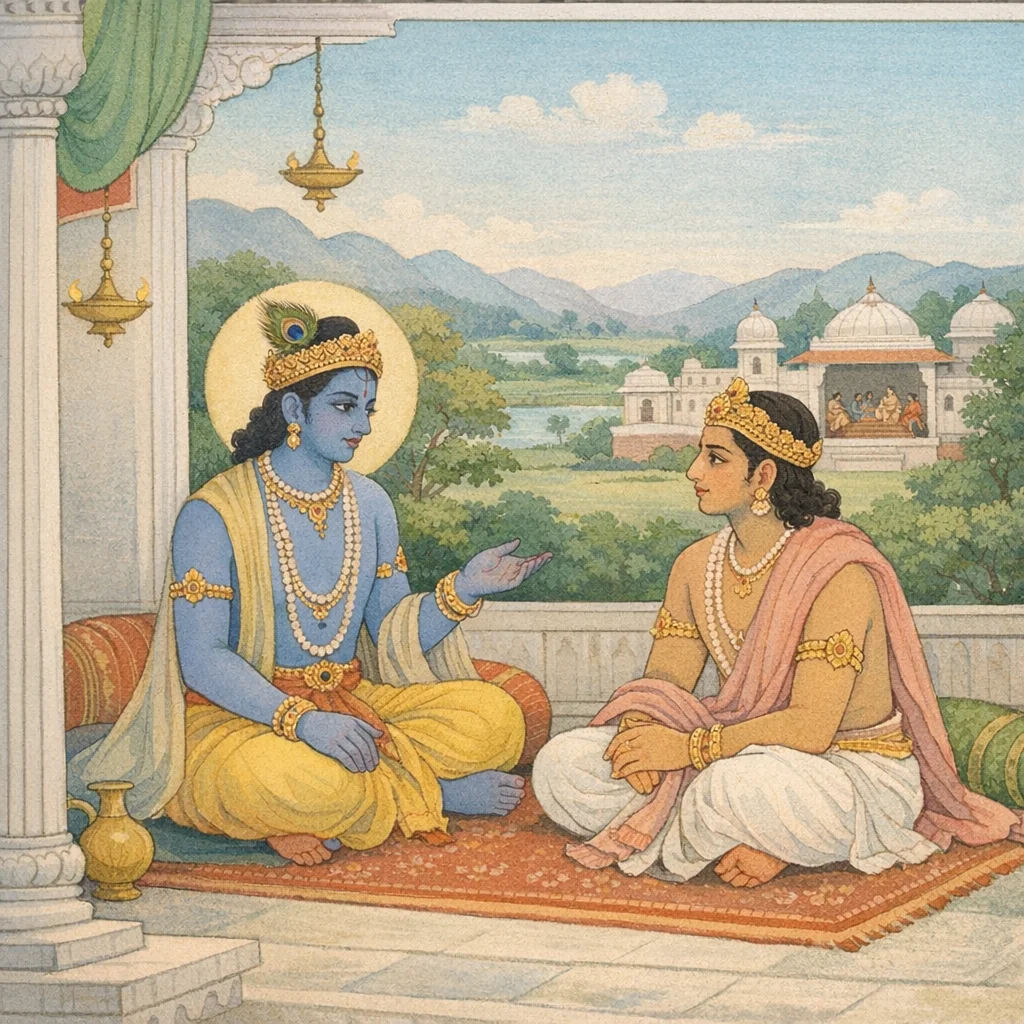
Vaiśaṃpāyana narrates that Kṛṣṇa instructs Dāruka to yoke the chariot; the Pāṇḍava side also orders the retinue to prepare for travel toward Hāstinapura (Gajasāhvaya / Vāraṇasāhvaya). Kṛṣṇa and Arjuna ride together, conversing; Arjuna then delivers an extended panegyric that frames Kṛṣṇa as cosmic ground and operative intelligence behind decisive wartime outcomes (including strategic guidance and the neutralization of key adversaries). Arriving at Dhṛtarāṣṭra’s residence, both offer formal respects to Dhṛtarāṣṭra, Gāndhārī, Kuntī, Yudhiṣṭhira, Bhīma, the twins, Vidura, and the assembled women of the house, then retire. At dawn they approach Yudhiṣṭhira; Arjuna requests permission for Kṛṣṇa to go to Dvārakā to see Vasudeva, Devakī, Balarāma, and the Vṛṣṇis. Yudhiṣṭhira consents, instructs Kṛṣṇa to convey honors and remembrance, and asks him to return for the horse sacrifice. Kṛṣṇa replies with deference, declining material gifts by affirming Yudhiṣṭhira’s lordship over wealth and land, then departs in a divine chariot, accompanied and ceremonially sent off by prominent allies and citizens.
Chapter Arc: ब्रह्म-वाणी में पंचमहाभूत, मन-बुद्धि और क्षेत्रज्ञ (आत्मा) का रहस्य खुलता है—जैसे भीतर का सारथि इन्द्रियों को साधता है। → सृष्टि-चक्र का आवर्तन (ऋषि-प्रजापति-तत्त्वों का बार-बार उद्भव और लय) और ‘दुराप’ सत्य तक पहुँचने की कठिनता सामने आती है—पर उपाय एक ही बताया जाता है: तप और संयम। → समस्त संस्कारों का शोधन कर आत्मा को आत्मा में संयमित करने वाला साधक उस ‘शुभ ब्रह्म’ को जान लेता है, जिसके आगे फिर कुछ शेष नहीं—अनुगीता का दार्शनिक शिखर यहीं है। → कृष्ण अर्जुन से कहते हैं—यदि मुझमें प्रीति है तो इस अध्यात्म को सुनकर सम्यक आचरण करो; फिर वे अपने पिता (वसुदेव) के दर्शन की इच्छा प्रकट करते हैं। अर्जुन सहमत होकर नगर चलने को कहता है और युधिष्ठिर से अनुमति लेकर अपनी पुरी जाने की योजना बनती है। → कृष्ण का पिता-दर्शन और अर्जुन का प्रस्थान—आगे नगर-गमन में कौन-सा भावनात्मक/राजनीतिक प्रसंग उभरेगा?
Shlokas
Verse 1
/ अपन का छा है >> >> एकपज्चाशत्तमो< ध्याय: तपस्याका प्रभाव, आत्माका स्वरूप और उसके ज्ञानकी महिमा तथा अनुगीताका उपसंहार ब्रह्मोवाच भूतानामथ पज्चानां यथैषामीश्वरं मनः । नियमे च विसर्गे च भूतात्मा मन एव च,ब्रह्माजीने कहा--महर्षियो! जिस प्रकार इन पाँचों महाभूतोंकी उत्पत्ति और नियमन करनेमें मन समर्थ है, उसी प्रकार स्थितिकालमें भी मन ही भूतोंका आत्मा है
Brahmā said: “O seers, just as the mind is capable of governing these five great elements in their origination and regulation, so too, during their continuance, the mind alone is spoken of as the inner self of beings.”
Verse 2
अधिष्ठाता मनो नित्यं भूतानां महतां तथा । बुद्धिरैश्वर्यमाचष्टे क्षेत्रज्ञक्ष स उच्यते,उन पज्चमहाभूतोंका नित्य आधार भी मन ही है। बुद्धि जिसके ऐश्वर्यको प्रकाशित करती है, वह क्षेत्रज्ञ कहा जाता है
Vāyu said: The mind is ever the governing support of beings, including the great elements. That principle in which intelligence reveals lordly power and mastery is called the Knower of the Field (kṣetrajña).
Verse 3
इन्द्रियाणि मनो युड्धक्ते सदश्चानिव सारथि: । इन्द्रियाणि मनो बुद्धि: क्षेत्रज्ञे युज्यते सदा,जैसे सारथि अच्छे घोड़ोंको अपने काबूमें रखता है, उसी प्रकार मन सम्पूर्ण इन्द्रियोंपर शासन करता है। इन्द्रिय, मन और बुद्धि--ये सदा क्षेत्रज्ञके साथ संयुक्त रहते हैं
As a skilled charioteer keeps fine horses under control, so the mind rules over all the senses. The senses, the mind, and the intellect (buddhi) are ever conjoined with the Knower of the Field (kṣetrajña).
Verse 4
महदश्वसमायुक्तं बुद्धिसंयमनं रथम् | समारुह् स भूतात्मा समन्तात् परिधावति,जिसमें इन्द्रियरूपी घोड़े जुते हुए हैं, जिसका बुद्धिरूपी सारथिके द्वारा नियन्त्रण हो रहा है, उस देहरूपी रथपर सवार होकर वह भूतात्मा (क्षेत्रज्ञ) चारों ओर दौड़ लगाता रहता है
Mounted upon the body as a great chariot, yoked with the horses of the senses and held in check by the reins of disciplined intellect, the indwelling Knower of the Field (the bhūtātman) ranges about in every direction.
Verse 5
इन्द्रियग्रामसंयुक्तो मनःसारथिरेव च | बुद्धिसंयमनो नित्यं महान् ब्रह्ममयो रथ:,ब्रह्ममय रथ सदा रहनेवाला और महान है, इन्द्रियाँ उसके घोड़े, मन सारथि और बुद्धि चाबुक है
Vāyu said: “This great chariot is ever of the nature of Brahman. Its horses are the host of senses; the mind serves as the charioteer; and the intellect (buddhi)—ever restraining and directing—functions as the reins/whip.”
Verse 6
एवं यो वेत्ति विद्वान् वै सदा ब्रह्ममयं रथम् | स धीर: सर्वभूतेषु न मोहमधिगच्छति,इस प्रकार जो विद्वान् इस ब्रह्ममय रथकी सदा जानकारी रखता है, वह समस्त प्राणियोंमें धीर है और कभी मोहमें नहीं पड़ता
Whoever, being truly learned, continually understands this chariot as pervaded by Brahman—such a steadfast person remains composed toward all beings and does not fall into delusion.
Verse 7
अव्यक्तादि विशेषान्तं सहस्थावरजड्रमम् । सूर्यचन्द्रप्रभालोकं ग्रहनक्षत्रमण्डितम्,यह जगत् एक ब्रह्मवन है। अव्यक्त प्रकृति इसका आदि है। पाँच महाभूत, दस इन्द्रियाँ और एक मन--इन सोलह विशेषोंतक इसका विस्तार है। यह चराचर प्राणियोंसे भरा हुआ है। सूर्य और चन्द्रमा आदिके प्रकाशसे प्रकाशित है। ग्रह और नक्षत्रोंसे सुशोभित है। नदियों और पर्वतोंके समूहसे सब ओर विभूषित है। नाना प्रकारके जलसे सदा ही अलंकृत है। यही सम्पूर्ण भूतोंका जीवन और सम्पूर्ण प्राणियोंकी गति है। इस ब्रह्मवनमें क्षेत्रज्ञ विचरण करता है
Vāyu said: “This universe is a single forest of Brahman. Its beginning is the unmanifest Prakṛti, and its expansion reaches up to the distinct principles—five great elements, ten senses, and the one mind—sixteen in all. It is filled with beings, moving and unmoving. It is illumined by the radiance of the sun and moon, adorned with planets and constellations, beautified on every side by clusters of rivers and mountains, and ever ornamented with waters of many kinds. This is the life of all beings and the course of all creatures. In this forest of Brahman, the Knower of the Field (kṣetrajña) wanders.”
Verse 8
नदीपर्वतजालै श्व सर्वतः परिभूषितम् । विविधाभिस्तथा चाद्धिः सततं समलंकृतम्,यह जगत् एक ब्रह्मवन है। अव्यक्त प्रकृति इसका आदि है। पाँच महाभूत, दस इन्द्रियाँ और एक मन--इन सोलह विशेषोंतक इसका विस्तार है। यह चराचर प्राणियोंसे भरा हुआ है। सूर्य और चन्द्रमा आदिके प्रकाशसे प्रकाशित है। ग्रह और नक्षत्रोंसे सुशोभित है। नदियों और पर्वतोंके समूहसे सब ओर विभूषित है। नाना प्रकारके जलसे सदा ही अलंकृत है। यही सम्पूर्ण भूतोंका जीवन और सम्पूर्ण प्राणियोंकी गति है। इस ब्रह्मवनमें क्षेत्रज्ञ विचरण करता है
Vāyu-deva said: “This whole world is a single forest of Brahman. Its beginning is unmanifest Nature. Its expanse unfolds through sixteen differentiating principles—five great elements, ten senses, and the one mind. It is filled with beings, moving and unmoving; illumined by the lights of the sun and moon; adorned with planets and constellations; beautified on every side by networks of rivers and ranges of mountains; and ever ornamented by waters of many kinds. This indeed is the life of all beings and the course of all creatures. In this forest of Brahman the Knower of the Field (kṣetrajña) wanders.”
Verse 9
आजीवं सर्वभूतानां सर्वप्राणभूतां गति: । एतद् ब्रह्मवनं नित्यं तस्समिं श्वरति क्षेत्रवित्,यह जगत् एक ब्रह्मवन है। अव्यक्त प्रकृति इसका आदि है। पाँच महाभूत, दस इन्द्रियाँ और एक मन--इन सोलह विशेषोंतक इसका विस्तार है। यह चराचर प्राणियोंसे भरा हुआ है। सूर्य और चन्द्रमा आदिके प्रकाशसे प्रकाशित है। ग्रह और नक्षत्रोंसे सुशोभित है। नदियों और पर्वतोंके समूहसे सब ओर विभूषित है। नाना प्रकारके जलसे सदा ही अलंकृत है। यही सम्पूर्ण भूतोंका जीवन और सम्पूर्ण प्राणियोंकी गति है। इस ब्रह्मवनमें क्षेत्रज्ञ विचरण करता है
Vāyu-deva said: “This is the very livelihood of all beings and the ultimate course of all that lives. This eternal universe is a ‘forest of Brahman’; within it the Knower of the Field (the conscious Self) moves about. Thus one should see the world as a vast, ordered whole sustained by the unmanifest source and pervaded by consciousness—so that attachment and fear give way to discernment.”
Verse 10
लोके5स्मिन् यानि सत्त्वानि त्रसानि स्थावराणि च । तान्येवाग्रे प्रलीयन्ते पश्चाद् भूतकृता गुणा: । गुणेभ्य: पञचभूतानि एष भूतसमुच्छूय:,इस लोकमें जो स्थावर-जंगम प्राणी हैं, वे ही पहले प्रकृतिमें विलीन होते हैं, उसके बाद पाँच भूतोंके कार्य लीन होते हैं और कार्यरूप गुणोंके बाद पाँच भूत लीन होते हैं। इस प्रकार यह भूतसमुदाय प्रकृतिमें लीन होता है
Vāyudeva said: “In this world, all beings—both the moving and the unmoving—are the first to dissolve back into Prakṛti. After them, the effects produced by the five elements dissolve; and after those effect-forms (the manifest qualities), the five great elements themselves dissolve. Thus the entire aggregate of elements returns into Prakṛti.”
Verse 11
देवा मनुष्या गन्धर्वा: पिशाचासुरराक्षसा: । सर्वे स्वभावत: सृष्टा न क्रियाभ्यो न कारणात्,देवता, मनुष्य, गन्धर्व, पिशाच, असुर, राक्षस सभी स्वभावसे रचे गये हैं; किसी क्रियासे या कारणसे इनकी रचना नहीं हुई है
Vāyu said: “Gods, humans, Gandharvas, Piśācas, Asuras, and Rākṣasas—all are brought forth according to their own inherent nature. Their existence is not the product of any particular action, nor does it arise from an external cause.”
Verse 12
एते विश्वसृजो विप्रा जायन्तीह पुन: पुनः । तेभ्य: प्रसूतास्तेष्वेव महाभूतेषु पडचसु । प्रलीयन्ते यथाकालमूर्मय: सागरे यथा,विश्वकी सृष्टि करनेवाले ये मरीचि आदि ब्राह्मण समुद्रकी लहरोंके समान बारंबार पञ्चमहाभूतोंसे उत्पन्न होते हैं। और उत्पन्न हुए वे फिर समयानुसार उन्हींमें लीन हो जाते हैं
Vāyu said: “These brahmin seers—creators of the worlds—are born here again and again. Born from the five great elements, they in due time dissolve back into those very elements, just as waves arise in the ocean and, in their season, subside into it again.”
Verse 13
विश्वसृग्भ्यस्तु भूते भ्यो महा भूतास्तु सर्वश: । भूतेभ्यश्चापि पञ्चभ्यो मुक्तो गच्छेत् परां गतिम्,इस विश्वकी रचना करनेवाले प्राणियोंसे पडच महाभूत सब प्रकार पर है। जो इन पठ्च महाभूतोंसे छूट जाता है, वह परम गतिको प्राप्त होता है
Vāyu said: From the created beings that fashion the world arise, in every way, the great elements. But one who becomes free from the five elements as well—no longer bound by their conditioning—attains the highest state.
Verse 14
प्रजापतिरिदं सर्व मनसैवासृजत् प्रभु: । तथैव देवानूषयस्तपसा प्रतिपेदिरे,शक्तिसम्पन्न प्रजापतिने अपने मनके ही द्वारा सम्पूर्ण जगत्की सृष्टि की है तथा ऋषि भी तपस्यासे ही देवत्वको प्राप्त हुए हैं
Vāyudeva said: “The Lord Prajāpati brought forth this entire universe by mind alone. In the same way, the seers—endowed with spiritual power—attained the state of the gods through austerity (tapas). Therefore, inner discipline and concentrated will are the true means of creation and elevation.”
Verse 15
तपसश्चानुपूव्येंण फलमूलाशिनस्तथा । त्रैलोक्यं तपसा सिद्धा: पश्यन्तीह समाहिता:,फल-मूलका भोजन करनेवाले सिद्ध महात्मा यहाँ तपस्याके प्रभावसे ही चित्तको एकाग्र करके तीनों लोकोंकी बातोंको क्रमश: प्रत्यक्ष अनुभव करते हैं
Vāyu said: “Likewise, by the gradual discipline of austerity, and by living on fruits and roots, accomplished sages—made perfect through tapas—remain here with concentrated minds and directly perceive, in due order, the realities of all the three worlds.”
Verse 16
ओऔषधान्यगदादीनि नानाविद्याशक्ष सर्वश: । तपसैव प्रसिद्धयन्ति तपोमूलं हि साधनम्,आरोग्यकी साधनभूत ओषधियाँ और नाना प्रकारकी विद्याएँ तपसे ही सिद्ध होती हैं। सारे साधनोंकी जड़ तपस्या ही है
Vāyu-deva said: “Medicinal herbs, antidotes and remedies, and every kind of knowledge attain their recognized efficacy only through tapas (austerity and disciplined effort). For tapas is the root from which all means of accomplishment arise.”
Verse 17
यददुरापं दुराम्नायं दुराधर्ष दुरन्वयम् | तत् सर्व तपसा साध्यं तपो हि दुरतिक्रमम्,जिसको पाना, जिसका अभ्यास करना, जिसे दबाना और जिसकी संगति लगाना नितान्त कठिन है, वह तपस्याके द्वारा साध्य हो जाता है; क्योंकि तपका प्रभाव दुर्लड्घ्य है
Vāyu said: Whatever is exceedingly hard to obtain, hard to master through instruction and practice, hard to subdue, and hard to keep company with or align oneself to—everything of that kind becomes attainable through austerity. For the power of tapas (disciplined ascetic effort) is itself difficult to overcome.
Verse 18
सुरापो ब्रह्महा स्तेयी भ्रूणहा गुरुतल्पग: । तपसैव सुतप्तेन मुच्यते किल्बिषात् ततः,शराबी, ब्रह्महत्यारा, चोर, गर्भ नष्ट करनेवाला और गुरुपत्नीकी शय्यापर सोनेवाला महापापी भी भलीभाँति तपस्या करके ही उस महान् पापसे छुटकारा पा सकता है
Vāyu said: “Even a drinker of liquor, a slayer of a brāhmaṇa, a thief, one who destroys an embryo, and one who violates the teacher’s bed—though burdened with grievous sin—can be released from that guilt through austerity alone, when it is truly and intensely undertaken.”
Verse 19
मनुष्या: पितरो देवा: पशवो मृगपक्षिण: । यानि चान्यानि भूतानि त्रसानि स्थावराणि च
Vāyu said: “Human beings, the ancestral spirits, the gods, cattle, beasts and birds—and whatever other beings there are, whether moving or unmoving.”
Verse 20
तपः:परायणा नित्यं सिद्धयन्ते तपसा सदा । तथैव तपसा देवा महामाया दिवं गता:
Vāyu said: “Those who are ever devoted to austerity attain success through austerity alone, always. In the same way, by austerity the gods—endowed with great divine power—have reached heaven.”
Verse 21
मनुष्य, पितर, देवता, पशु, मृग, पक्षी तथा अन्य जितने चराचर प्राणी हैं, वे सब नित्य तपस्यामें संलग्न होकर ही सदा सिद्धि प्राप्त करते हैं। तपस्याके बलसे ही महामायावी देवता स्वर्गमें निवास करते हैं ।। आशीर्युक्तानि कर्माणि कुर्वते ये त्वतन्द्रिता: । अहंकारसमायुक्तास्ते सकाशे प्रजापते:,जो लोग आलस्य त्यागकर अहंकारसे युक्त हो सकाम कर्मका अनुष्ठान करते हैं, वे प्रजापतिके लोकमें जाते हैं
Vāyu said: “All beings—humans, ancestors, gods, cattle, wild animals, birds, and whatever other moving and unmoving creatures there are—attain success only by being continually engaged in austerity. By the power of austerity, even the great, wondrous gods dwell in heaven. But those who, casting off laziness, perform desire-driven rites accompanied by blessings while remaining bound to ego, go to the realm of Prajāpati.”
Verse 22
ध्यानयोगेन शुद्धेन निर्ममा निरहंकृता: । आप्नुवन्ति महात्मानो महान्तं लोकमुत्तमम्,जो अहंता-ममतासे रहित हैं, वे महात्मा विशुद्ध ध्यानयोगके द्वारा महान् उत्तम लोकको प्राप्त करते हैं
Vāyu-deva said: “Great-souled persons—purified through the discipline of meditation, free from possessiveness and devoid of ego—attain the vast and highest realm.”
Verse 23
ध्यानयोगमुपागम्य प्रसन्नमतय: सदा । सुखोपचयमव्यक्तं प्रविशन्त्यात्मवित्तमा:,जो ध्यानयोगका आश्रय लेकर सदा प्रसन्नचित्त रहते हैं, वे आत्मवेत्ताओंमें श्रेष्ठ पुरुष सुखकी राशिभूत अव्यक्त परमात्मामें प्रवेश करते हैं
Having taken refuge in the discipline of meditation (dhyāna-yoga), those whose minds remain ever serene—foremost among the knowers of the Self—enter the Unmanifest (avyakta), a very treasury of bliss.
Verse 24
ध्यानयोगमादुपागम्य निर्ममा निरहंकृता: । अव्यक्तं प्रविशन््तीह महतां लोकमुत्तमम्,किंतु जो ध्यानयोगसे पीछे लौटकर अर्थात् ध्यानमें असफल होकर ममता और अहंकारसे रहित जीवन व्यतीत करता है, वह निष्काम पुरुष भी महापुरुषोंके उत्तम अव्यक्त लोकमें लीन होता है
But one who, having approached the discipline of meditation (dhyāna-yoga), turns back—failing in contemplation—yet lives free of possessiveness (mamatā) and egoism (ahaṃkāra), that desireless man too is absorbed into the highest Unmanifest realm of the great ones.
Verse 25
अव्यक्तादेव सम्भूत: समसंज्ञां गत: पुन: । तमोरजो भ्यां निर्मुक्त: सत्त्वमास्थाय केवलम्,फिर स्वयं भी उसकी समताको प्राप्त होकर अव्यक्तसे ही प्रकट होता है और केवल सत्त्वका आश्रय लेकर तमोगुण एवं रजोगुणके बन्धनसे छुटकारा पा जाता है
Vāyu-deva said: “Arising indeed from the Unmanifest (avyakta), it again attains the state of perfect equilibrium. Freed from the twin bonds of darkness (tamas) and agitation (rajas), it abides solely in purity (sattva).”
Verse 26
निर्मुक्त: सर्वपापेभ्य: सर्व सृजति निष्कलम् | क्षेत्रज्ञ इति तं विद्याद् यस्तं वेद स वेदवित्
Vāyu said: “Freed from all sins, he brings forth all things, remaining himself without any taint or defect. Know him as the ‘Knower of the Field’ (kṣetrajña); whoever truly knows him is a genuine knower of the Veda.”
Verse 27
जो सब पापोंसे मुक्त रहकर सबकी सृष्टि करता है, उस अखण्ड आत्माको क्षेत्रज्ञ समझना चाहिये। जो मनुष्य उसका ज्ञान प्राप्त कर लेता है, वही वेदवेत्ता है ।। चित्तं चित्तादुपागम्य मुनिरासीत संयत: । यच्चित्तं तन््मयो वश्यं गुह्ममेतत् सनातनम्,मुनिको उचित है कि चिन्तनके द्वारा चेतना (सम्यग्ज्ञान) पाकर मन और इन्द्रियोंको एकाग्र करके परमात्माके ध्यानमें स्थित हो जाय; क्योंकि जिसका चित्त जिसमें लगा होता है, वह निश्चय ही उसका स्वरूप हो जाता है--यह सनातन गोपनीय रहस्य है
Vāyu said: Therefore, one should recognize the stainless, undivided Self—the knower of the field (kṣetrajña), free from all sin and the source of all creation. The person who truly knows That alone is a genuine knower of the Veda. Having brought the mind back to its own source, the sage should remain self-restrained; for whatever the mind is absorbed in, it inevitably becomes conformed to that very reality—this is the ancient, secret principle.
Verse 28
अव्यक्तादिविशेषान्तमविद्यालक्षणं स्मृतम् । निबोधत तथा हीदं गुणैर्लक्षणमित्युत,अव्यक्तसे लेकर सोलह विशेषोंतक सभी अविद्याके लक्षण बताये गये हैं। ऐसा समझना चाहिये कि यह गुणोंका ही विस्तार है
Vāyu said: “From the Unmanifest up to the sixteen ‘particulars,’ this is remembered as the defining mark of ignorance (avidyā). Know also that what is described here is truly characterized by the guṇas—an expansion and play of their qualities.”
Verse 29
द्वयक्षरस्तु भवेन्मृत्युस्त्रयक्षरं ब्रह्म शाश्वतम् । ममेति च भवेन्मृत्युर्न ममेति च शाश्वतम्,दो अक्षरका पद “मम” (यह मेरा है--ऐसा भाव) मृत्युरूप है और तीन अक्षरका पद “न मम' (यह मेरा नहीं है--ऐसा भाव) सनातन ब्रह्मकी प्राप्ति करानेवाला है
Vāyu said: “The two-syllabled notion becomes death, while the three-syllabled utterance is the eternal Brahman. ‘Mine’ leads to death; ‘not mine’ leads to what is everlasting.”
Verse 30
कर्म केचित् प्रशंसन्ति मन्दबुद्धिरता नरा: । ये तु वृद्धा महात्मानो न प्रशंसन्ति कर्म ते,कुछ मन्द-बुद्धियुक्त पुरुष (स्वर्गादि फल प्रदान करनेवाले) काम्य-कर्मोंकी प्रशंसा करते हैं, किंतु वृद्ध महात्माजन उन कर्मोंको उत्तम नहीं बतलाते
Vāyu said: “Some men, attached to shallow understanding, praise ritual action—especially desire-driven rites that promise heaven and other rewards. But the aged and great-souled do not commend those actions as the highest good.”
Verse 31
कर्मणा जायते जन्तुर्मूर्तिमान्ू षोडशात्मक: । पुरुषं ग्रसते5विद्या तद् ग्राह्मममृताशिनाम्,क्योंकि सकाम कर्मके अनुष्ठानसे जीवको सोलह विकारोंसे निर्मित स्थूल शरीर धारण करके जन्म लेना पड़ता है और वह सदा अविद्याका ग्रास बना रहता है। इतना ही नहीं, कर्मठ पुरुष देवताओंके भी उपभोगका विषय होता है
Vāyu said: “Through action (especially desire-driven ritual action) a living being is born again, taking on a tangible body constituted of sixteen constituents. Ignorance continually devours the person; and such a person becomes an object to be ‘seized’—even by the immortals who feed on amṛta—meaning that one bound to works and ignorance is subject to higher powers and cannot attain true freedom.”
Verse 32
तस्मात् कर्मसु निःस्नेहा ये केचित् पारदर्शिन: । विद्यामयो<यं पुरुषो न तु कर्ममय: स्मृत:,इसलिये जो कोई पारदर्शी विद्वान होते हैं, वे कर्मोमें आसक्त नहीं होते; क्योंकि यह पुरुष (आत्मा) ज्ञानमय है, कर्ममय नहीं
Therefore, those discerning seers who truly see reality remain unattached to actions. For this self (puruṣa) is understood to be of the nature of knowledge, not a product of action; hence the wise do not cling to deeds as though they define the soul.
Verse 33
य एवममृतं नित्यमग्राहां शश्वदक्षरम् । वश्यात्मानमसंश्लटिष्टं यो वेद न मृतो भवेत्,जो इस प्रकार चेतन आत्माको अमृतस्वरूप, नित्य, इन्द्रियातीत, सनातन, अक्षर, जितात्मा एवं असंग समझता है, वह कभी मृत्युके बन्धनमें नहीं पड़ता
Vāyu said: Whoever truly knows the conscious Self in this way—as deathless, eternal, beyond the grasp of the senses, everlasting and imperishable; as one who has mastered oneself and remains unattached—such a person does not fall into the bondage of death.
Verse 34
अपूर्वमकृतं नित्यं य एनमविचारिणम् | य एवं विन्देदात्मानमग्राह्मममृताशनम् । अग्राह्मोड्मृतो भवति स एशभि: कारणैर्ध्ुव:,जिसकी दृष्टिमें आत्मा अपूर्व (अनादि), अकृत (अजन्मा), नित्य, अचल, अग्राह्म और अमृताशी है, वह इन गुणोंका चिन्तन करनेसे स्वयं भी अग्राह्म (इन्द्रियातीत), निश्चल एवं अमृतस्वरूप हो जाता है
Vāyu said: Whoever realizes the Self as unprecedented (beginningless), unmade (unborn), eternal, unmoving, beyond grasp, and nourished by immortality—by contemplating these very attributes—becomes himself beyond the reach of the senses, steady, and established in the deathless reality.
Verse 35
आयोज्य सर्वसंस्कारान् संयम्यात्मानमात्मनि | स तद् ब्रह्म शुभं वेत्ति यस्माद् भूयो न विद्यते,जो चित्तको शुद्ध करनेवाले सम्पूर्ण संस्कारोंका सम्पादन करके मनको आत्माके ध्यानमें लगा देता है, वही उस कल्याणमय ब्रह्मको प्राप्त करता है, जिससे बड़ा कोई नहीं है
Having set in order all purifying disciplines (saṃskāra), and restraining oneself by fixing the mind within the Self, one comes to know that auspicious Brahman, than which there is nothing higher.
Verse 36
प्रसादे चैव सत्त्वस्य प्रसादं समवाप्नुयात् लक्षणं हि प्रसादस्य यथा स्यात् स्वप्नदर्शनम्,सम्पूर्ण अन्त:करणके स्वच्छ हो जानेपर साधकको शुद्ध प्रसन्नता प्राप्त होती है। जैसे स्वप्नसे जगे हुए मनुष्यके लिये स्वप्न शान्त हो जाता है, उसी प्रकार चित्तशुद्धिका लक्षण है
Vāyu said: “When the inner being (sattva) becomes serene, one attains serenity itself. The mark of such serenity is this: just as, for a person who has awakened, the dream-vision becomes quiet and loses its hold, so too the sign of purification is the mind’s clear, undisturbed gladness.”
Verse 37
गतिरेषा तु मुक्तानां ये ज्ञानपरिनिषछिता: । प्रवृत्तयश्न या: सर्वा: पश्यन्ति परिणामजा:,ज्ञाननिष्ठ जीवन्मुक्त महात्माओंकी यही परम गति है; क्योंकि वे उन समस्त प्रवृत्तियोंको शुभाशुभ फल देनेवाली समझते हैं
Vāyu said: “This indeed is the highest course of those who are liberated—those firmly established in true knowledge. They behold all worldly impulses and undertakings as effects that ripen into consequences, understanding them as sources of auspicious and inauspicious results; thus they remain inwardly free even while living and acting.”
Verse 38
एषा गतिर्विरक्तानामेष धर्म: सनातन: । एषा ज्ञानवतां प्राप्तिरेतद् वृत्तमनिन्दितम्,यही विरक्त पुरुषोंकी गति है, यही सनातन धर्म है, यही ज्ञानियोंका प्राप्तव्य स्थान है और यही अनिन्दित सदाचार है
Vāyu said: “This is the destined course of those who are detached; this is the eternal Dharma. This is the attainment sought by the wise, and this is the blameless standard of conduct.”
Verse 39
समेन सर्वभूतेषु निःस्प्हेण निराशिषा | शक््या गतिरियं गन्तुं सर्वत्र समदर्शिना,जो सम्पूर्ण भूतोंमें समानभाव रखता है, लोभ और कामनासे रहित है तथा जिसकी सर्वत्र समान दृष्टि रहती है, वह ज्ञानी पुरुष ही इस परम गतिको प्राप्त कर सकता है
Vāyu said: Only that wise person can attain this highest course who maintains an equal attitude toward all beings, is free from craving and self-interest, and looks upon all situations with the same steady vision.
Verse 40
एतद् व: सर्वमाख्यातं मया विप्रर्षिसत्तमा: । एवमाचरत क्षिप्रं ततः सिद्धिमवाप्स्यथ,ब्रह्मर्षिपो! यह सब विषय मैंने विस्तारके साथ तुम लोगोंको बता दिया। इसीके अनुसार आचरण करो, इससे तुम्हें शीघ्र ही परम सिद्धि प्राप्त होगी
Vāyu said: “O foremost among the Brahmin seers, I have now fully explained all this to you. Practice exactly in this manner without delay; then you will swiftly attain the highest spiritual accomplishment.”
Verse 41
गुरुउ्वाच इत्युक्तास्ते तु मुनयो गुरुणा ब्रह्मणा तथा । कृतवन्तो महात्मानस्ततो लोकमवाप्नुवन्,गुरुने कहा--बेटा! ब्रह्माजीके इस प्रकार उपदेश देनेपर उन महात्मा मुनियोंने इसीके अनुसार आचरण किया। इससे उन्हें उत्तम लोककी प्राप्ति हुई
Vāyu said: Thus addressed by their teacher—Brahmā himself—those great-souled sages acted exactly in accordance with his instruction. By that faithful practice, they attained an excellent realm.
Verse 42
त्वमप्येतनन््महा भाग मयोक्तं ब्रह्मणो वच: । सम्यगाचर शुद्धात्मंस्तत: सिद्धिमवाप्स्यसि,महाभाग! तुम्हारा चित्त शुद्ध है, इसलिये तुम भी मेरे बताये हुए ब्रह्माजीके उत्तम उपदेशका भलीभाँति पालन करो। इससे तुम्हें भी सिद्धि प्राप्त होगी
Vāyu said: “O greatly fortunate one, you too—being pure in mind—should rightly practice this teaching of Brahmā that I have conveyed. By following it well, you will attain spiritual accomplishment (siddhi), O noble one.”
Verse 43
वायुदेव उवाच इत्युक्त: स तदा शिष्यो गुरुणा धर्ममुत्तमम् । चकार सर्व कौन्तेय ततो मोक्षमवाप्तवान्,श्रीकृष्णने कहा--अर्जुन! गुरुदेवके ऐसा कहनेपर उस शिष्यने समस्त उत्तम धर्मोंका पालन किया। इससे वह संसार-बन्धनसे मुक्त हो गया
Vāyudeva said: “Thus instructed by his teacher, that disciple then practiced the highest dharma in full. Therefore, O son of Kuntī, he attained liberation—freedom from the bondage of worldly existence.”
Verse 44
कृतकृत्यश्न स तदा शिष्य: कुरुकुलोदवह । तत् पद समनुप्राप्तो यत्र गत्वा न शोचति,कुरुकुलनन्दन! उस समय कृतार्थ होकर उस शिष्यने वह ब्रह्मपद प्राप्त किया, जहाँ जाकर शोक नहीं करना पड़ता
Vāyu said: “Then that disciple, having fulfilled his purpose and completed what was to be done, attained the supreme state (Brahman). O best of the Kuru line, having reached that abode, one does not grieve any more.”
Verse 45
अर्जुन उवाच को न्वसौ ब्राह्मण: कृष्ण कश्च शिष्यो जनार्दन । श्रोतव्यं चेन्मयैतद् वै तत्त्वमाचक्ष्व मे विभो,अर्जुनने पूछा--जनार्दन श्रीकृष्ण! वे ब्रह्मनिष्ठ गुरु कौन थे और शिष्य कौन थे? प्रभो! यदि मेरे सुननेयोग्य हो तो ठीक-ठीक बतानेकी कृपा कीजिये
Arjuna said: “O Krishna, O Janardana—who indeed was that Brahmin, and who was the disciple? O Lord, if this truth is fit for me to hear, then please explain it to me precisely.”
Verse 46
वायुदेव उवाच अहं गुरुर्महाबाहो मन: शिष्यं च विद्धि मे । त्वत्प्रीत्या गुह्ममेतच्च कथितं ते धनंजय,श्रीकृष्णने कहा--महाबाहो! मैं ही गुरु हूँ और मेरे मनको ही शिष्य समझो। धनंजय! तुम्हारे स्नेहवश मैंने इस गोपनीय रहस्यका वर्णन किया है
Vāyudeva said: “O mighty-armed one, know that I am the teacher, and that my own mind is the disciple. Out of affection for you, O Dhanañjaya, I have disclosed to you this secret teaching.”
Verse 47
मयि चेदस्ति ते प्रीतिर्नित्यं कुरुकुलोद्वह । अध्यात्ममेतच्छुत्वा त्वं सम्यगाचर सुव्रत,उत्तम व्रतका पालन करनेवाले कुरुकुलनन्दन! यदि मुझपर तुम्हारा प्रेम हो तो इस अध्यात्मज्ञानको सुनकर तुम नित्य इसका यथावत् पालन करो
Vāyu said: “O foremost bearer of the Kuru line, if you truly hold constant affection and reverence for me, then—having heard this teaching of the inner Self—practice it rightly and continually, with the steadfast discipline of one devoted to the highest vow.”
Verse 48
ततस्त्वं सम्यगाचीर्णे धर्मेडस्मिन्नरिकर्षण । सर्वपापविनिर्मुक्तो मोक्ष प्राप्स्पसि केवलम्,शत्रुदमन! इस धर्मका पूर्णतया आचरण करनेपर तुम समस्त पापोंसे छूटकर विशुद्ध मोक्षको प्राप्त कर लोगे
Then, O subduer of foes, when you have rightly and fully practiced this dharma, you will be freed from all sins and attain pure liberation alone. Thus Vāyu declares that sincere, complete observance of the prescribed righteous path culminates in moral purification and final release.
Verse 49
पूर्वमप्येतदेवोक्त युद्धकाल उपस्थिते । मया तव महाबाहो तस्मादत्र मन: कुरु,महाबाहो! पहले भी मैंने युद्धकाल उपस्थित होनेपर यही उपदेश तुमको सुनाया था। इसलिये तुम इसमें मन लगाओ
O mighty-armed one, I had already spoken this very counsel to you earlier, when the time of battle had arrived. Therefore, fix your mind upon this teaching now—take it to heart and act with steadiness.
Verse 50
मया तु भरतश्रेष्ठ चिरदृष्ट: पिता प्रभु: । तमहं द्रष्टमेच्छामि सम्मते तव फाल्गुन,भरतश्रेष्ठ अर्जुन! अब मैं पिताजीका दर्शन करना चाहता हूँ। उन्हें देखे बहुत दिन हो गये। यदि तुम्हारी राय हो तो मैं उनके दर्शनके लिये द्वारका जाऊँ
Vāyu said: “O best of the Bharatas, my revered father has not been seen by me for a long time. I wish to see him. If it meets with your approval, O Phālguna (Arjuna), I would go to Dvārakā to have his darśana.”
Verse 51
वैशम्पायन उवाच इत्युक्तवचन कृष्णं प्रत्युवाच धनंजय: । गच्छावो नगरं कृष्ण गजसाह्दयमद्य वै,वैशम्पायनजी कहते हैं--राजन्! भगवान् श्रीकृष्णकी बात सुनकर अर्जुनने कहा --'श्रीकृष्ण! अब हमलोग यहाँसे हस्तिनापुरको चलें। वहाँ धर्मात्मा राजा युधिष्ठिरसे मिलकर और उनकी आज्ञा लेकर आप अपनी पुरीको पधारें" इति श्रीमहा भारते आश्वमेधिके पर्वणि अनुगीतापर्वणि गुरुशिष्यसंवादे एकपज्चाशत्तमो5ध्याय:
Vaiśampāyana said: Hearing Kṛṣṇa’s words, Dhanañjaya (Arjuna) replied, “Kṛṣṇa, let us go today to the city called Gajasāhvaya (Hastināpura). There, after meeting the righteous king Yudhiṣṭhira and receiving his permission, you should proceed to your own city.”
Verse 52
समेत्य तत्र राजानं धर्मात्मानं युधिष्ठिरम् । समनुज्ञाप्य राजान स्वां पुरी यातुमहसि,वैशम्पायनजी कहते हैं--राजन्! भगवान् श्रीकृष्णकी बात सुनकर अर्जुनने कहा --'श्रीकृष्ण! अब हमलोग यहाँसे हस्तिनापुरको चलें। वहाँ धर्मात्मा राजा युधिष्ठिरसे मिलकर और उनकी आज्ञा लेकर आप अपनी पुरीको पधारें"
Vaiśampāyana said: “O King, having gone there and met the righteous-souled King Yudhiṣṭhira, and having obtained his permission, you should then depart for your own city.”
Frequently Asked Questions
The chapter balances personal devotion and gratitude toward Kṛṣṇa with institutional dharma: departures, honors, and resources are regulated through the king’s consent and court protocol, not private impulse.
Arjuna frames Kṛṣṇa as both transcendent ground and practical guide—suggesting that effective action and moral restoration require aligning human agency with a larger cosmological order and disciplined counsel.
No explicit phalaśruti is stated here; the chapter’s function is narrative and doctrinal—integrating post-war legitimacy, devotional theology, and courtly procedure within the broader Āśvamedhika arc.