Adhyaya 19
Prāṇeśvara Garuḍa-Mantra: Timing (Velā), Nāga-Grahas, Nyāsa, Haṃsa-Rite, and Viṣa-Cikitsā
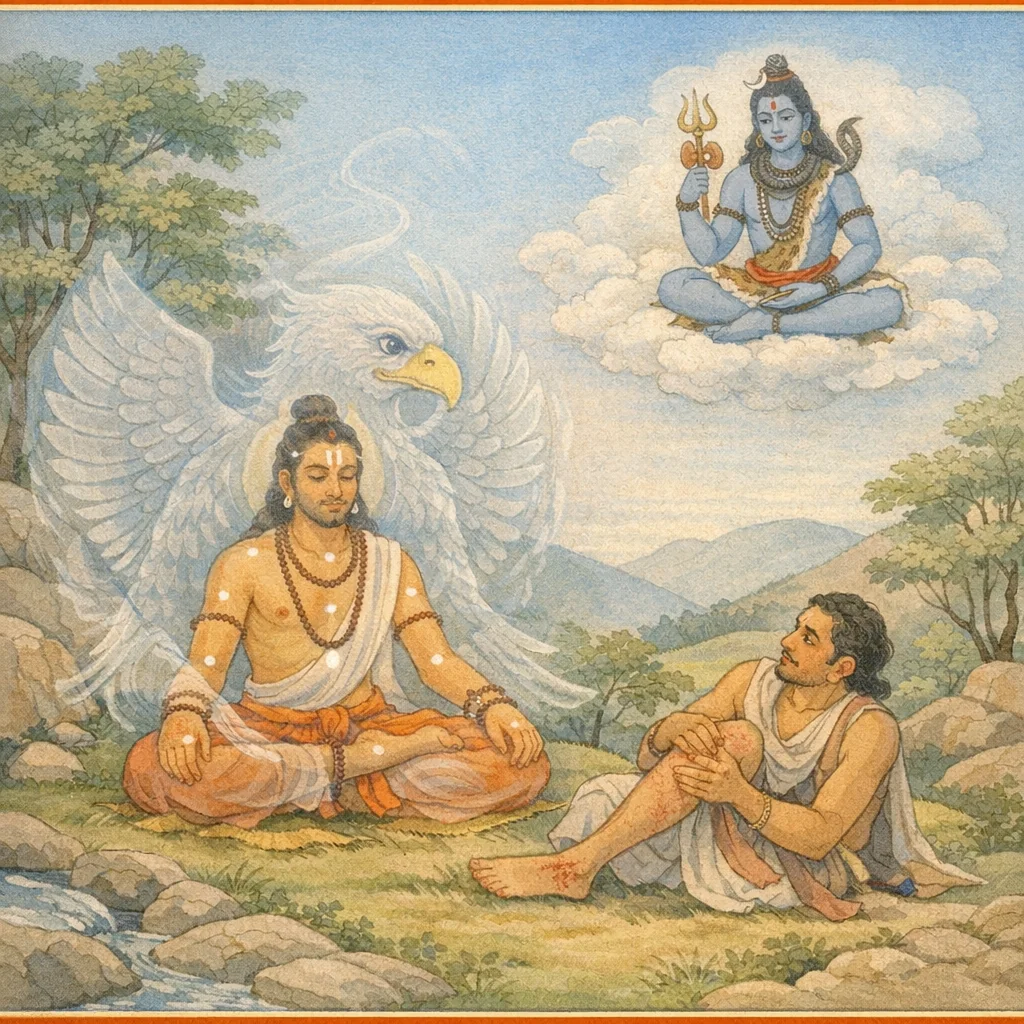
Continuing the Brahma Khanda’s practical ritual emphasis, Sūta presents a Garuḍa-mantra taught by Śiva for urgent protection from serpent venom. The chapter first lists situational and bodily signs for judging survival—bite locations, obscured bite-marks, and fatal sites—then turns to a time-science of day/night rulership, the “nāga-bhoga” sequence, and nāga deities treated as grahas, stressing junction periods (velā) for effective use. After locating when and where poison’s force manifests in the body, it teaches bīja formation and the explicit formula “Oṁ kuru kule svāhā,” with detailed nyāsa on throat, limbs, and feet, plus a vowel-to-body mapping culminating in Haṃsa integration. Protective rites (thread at the ear, lotus-petal writing, high-count japa) and operative methods (Garuḍa-identification, breath control to draw out poison, invocation of Nīlakaṇṭha) are given, and the chapter closes with herbal and ghee-based antidotes and a siddhi-oriented “Maṇi-vyāsa” claim, preparing later sections as applied dharma/vidyā instruction rather than mere narrative theology.
Shlokas
Verse 1
नामाष्टादशो ऽध्यायः सूत उवाच / प्राणेश्वरं गारुडं च शिवोक्तं प्रवदाम्यहम् / स्थानान्यादौ प्रवक्ष्यामि नागदष्टो न जीवति
Sūta said: “Now I shall expound the Prāṇeśvara (Lord of life) Garuḍa-mantra as spoken by Śiva. First I will declare the proper places for its recitation and application; one bitten by a serpent does not survive without it.”
Verse 2
चितावल्मीकशैलादौ कपे च विवरे तरोः / दंशे रेखात्रयं यस्य प्रच्छन्नं स न जीवति
He whose three lines (markings) at the site of the bite become obscured—whether near a funeral pyre, an anthill, a mountain, in a monkey’s hollow, or in a crevice of a tree—does not survive.
Verse 3
षष्ठ्यां च कर्कटे मेषे मूलाश्लेषामघादिषु / कक्षाश्रोणिगले सन्धौ शङ्खकर्णोदरादिषु
In the sixth division—in Cancer and Aries, and in the lunar mansions beginning with Mūlā, Āśleṣā, and Maghā—the affliction is said to manifest in the armpit, hip, throat, the joints, and in regions such as the temples, ears, and the abdomen.
Verse 4
दण्डी शस्त्रधरो भिक्षुर्न ग्नादिः कालदूतकः / बाहौ च वक्क्रे ग्रीवायां दष्टायां न हि जीवति
A staff-bearing mendicant, weapon in hand—an emissary of Kāla (Time, Death)—bites; and if one is bitten on the arm, the face, or the neck, one does not survive.
Verse 5
पूर्वं दिनपतिर्भुङ्क्ते अर्धयामं ततो ऽपरे / शेषा ग्रहाः प्रतिदिनं षट्संख्या परिवर्तनैः
First the Lord of the day, the Sun, presides for half a yāma; thereafter the others preside in turn. The remaining planets, day by day, rotate their turns in a cycle counted as six changes.
Verse 6
नागभोगः क्रमाञ्ज्ञेयो रात्रौ बाणविवर्तनैः / शेषोर्ऽकः फणिपश्चन्द्रस्तक्षको भौम ईरितः
At night, the sequence called “nāga-bhoga” is to be understood by the turning of the “arrows” (directional markers): Śeṣa is said to be the Sun, Phaṇipa the Moon, and Takṣaka is declared to be Mars.
Verse 7
कर्कोटो ज्ञो गुरुः पद्मो महापद्मश्च भार्गवः / शङ्खः शनैश्चरो राहुः कुलिकश्चाहयो ग्रहाः
Karkoṭa, Jña, Guru, Padma, Mahāpadma, Bhārgava, Śaṅkha, Śanaiścara, Rāhu, and Kulika—these are the serpent-deities who are also called ‘grahas’ (seizers and influencers).
Verse 8
रात्रौ दिवा सुरगुरोर्भागे स्यादमरान्तकः / पङ्गोः काले दिवा राहुः कुलिकेन सह स्थितः
By night and by day, in the portion belonging to the Deva-Guru (Bṛhaspati), Amarāntaka is present; and at the time of Paṅgu, by day, Rāhu is stationed together with Kulika.
Verse 9
यामार्धसन्धिसंस्थां च वेलां कालवतीं चरेत् / बाणद्विषड्वह्निवाजियुगभूरेकभागतः?
One should observe the time-periods that fall at the junctions of the half-yāmas—the prescribed velā (ritual time) endowed with its proper measure—reckoned by the traditional numerical code: arrow, enemy, six, fire, horse, pair, earth, one; each denoting a fractional part of the day.
Verse 10
दिवा षडेदनेत्राद्रिपञ्चत्रिमानुषांशकैः / पादाङ्गुष्ठे पादपृष्ठे पादपृष्ठे गुल्फे जानुनि लिङ्गके
In the daytime, (the pain/affliction) is measured in units amounting to six, and again in portions of thirty-five; it is felt in the big toe, on the top of the foot, (again) on the top of the foot, at the ankle, at the knee, and in the genital organ.
Verse 11
नाभौ हृदि स्तनतटे कण्ठे नासापुटे ऽक्षिणि / कर्णयोश्च भ्रुवोः शङ्खे मस्तके प्रतिपत्क्रमात्
Beginning from the first day onward, (the vital force/awareness) proceeds in order—at the navel, then the heart, the region of the breasts, the throat, the nostrils, the eyes, the ears, the eyebrows, the temples, and finally the crown of the head.
Verse 12
तिष्ठच्चन्द्रश्च जीवेच्च पुंसो दक्षिणभागके / कायस्य वामभागे तु स्त्रिया वायुवहात्करात्
For a man, the Moon abides and the life-breath continues in the right side of the body; but for a woman, it is in the left side of the body—so it is said—owing to the action of the life-carrying wind (vāyu).
Verse 13
अमृतस्तत्कृतो मोहो निवर्तेत च मर्दनात् / आत्मनः परमं बीजं हंसाख्यं स्फटिकामलम्
By that nectar, the delusion produced in the being is dispelled through churning/pressing; the supreme seed of the Self is the “Haṃsa,” stainless and crystal-clear.
Verse 14
दातव्यं विषपापघ्नं बीजं तस्य चतुर्विधम् / विन्दुपञ्चस्वरयुतमाद्यमुक्तं द्वितीयकम् / षष्ठारूढं तृतीयं स्यात्सविसर्गं चतुर्थकम् / ॐ कुरु कुले स्वाहा
One should bestow (or employ) the seed-mantra that destroys the sin of poison. That bīja is fourfold: the first is said to be joined with bindu and the five vowels; the second is declared; the third is to be mounted on the sixth vowel; and the fourth is with visarga. (Thus the mantra is:) “Oṁ kuru kule svāhā.”
Verse 15
विद्या त्रैलोक्यरक्षार्थं गरुडेन धृता पुरा / वधेप्सुर्नागनागानां मुखे ऽथ प्रणवं न्यसेत्
Formerly, Garuḍa upheld this sacred mantra for the protection of the three worlds. Therefore, one who seeks to subdue or slay the serpent-kings should place the Praṇava, “Oṁ,” upon their mouth.
Verse 16
गले कुरु न्यसेद्धीमान्कुले च गुल्फयोः स्मृतः / स्वाहा पादयुगे चैव युगहा न्यास ईरितः
The wise should place the mantra-nyāsa at the throat; it is also prescribed at the forearm and at the ankles. With the utterance “svāhā,” it should likewise be placed upon both feet—this is declared as the nyāsa for the pair of feet.
Verse 17
गृहे विविखिता यत्र तन्नागाः संत्यजन्ति च / सहस्रमन्त्रं जप्त्वा तु कर्णे सूत्रं धृतं तथा
In a house where such rites are properly performed, the nāgas depart. Having recited the “thousand-mantra” (a thousand repetitions), one should also wear the protective thread at the ear.
Verse 18
यद्रृहे शर्करा जप्ता क्षिप्ता नागास्त्यजन्ति तत् / सप्तलक्षस्य जप्याद्धि सिद्धिः प्राप्ता सुरासुरैः
In whichever house the “Śarkarā” mantra is recited and then cast forth as a charged rite, the nāgas abandon that place. Indeed, by repeating it seven lakṣas (700,000 times), its effective power has been attained—even by Devas and Asuras.
Verse 19
ॐ सुवर्णरेखे कुक्कुटविग्रहरूपिणि स्वाहा / एवञ्चाष्टदले पद्म दले वर्णयुगं लिखेत्
“Oṁ. O Suvarṇarekhā, who assumes the form of a rooster—svāhā.” Thus, on an eight-petalled lotus, one should write a pair of syllables (letters) upon each petal.
Verse 20
नामैतद्वारिधाराभिः स्नातो दष्टो विषं त्यजेत् / ॐ पक्षि स्वाहा
By bathing in flowing streams of water while reciting this sacred Name, one who has been bitten casts off the poison. (Mantra:) “Oṁ, O bird, svāhā.”
Verse 21
अङ्गुष्ठादि कनिष्ठान्तं करे न्यस्याथ देहके / के (कै) वक्क्रे हृदि लिङ्गे च पादयोर्गरुडस्य हि
Placing (the fingers) upon the body—from the thumb up to the little finger—one should perform the prescribed nyāsa, touching the face/mouth, the heart, the generative organ, and the feet; this indeed is the procedure connected with Garuḍa.
Verse 22
नाक्रामन्ति च तच्छायां स्वप्ने ऽपि विषपन्नगाः / यस्तु लक्षं जपेच्चास्याः स दृष्ट्वा(ष्ट्या) नाशयेद्विषम्
Even venomous serpents do not approach its very shadow—not even in a dream. And whoever recites this (mantra/hymn) a hundred thousand times can, merely by sight (or by touch), destroy poison.
Verse 23
ॐ ह्री ह्रौ ह्रीं भि(भी) रुण्डायै स्वाहा / कर्णे जप्ता त्वियं विद्या दष्टकस्य विषं हरेत्
“Oṁ hrī hrau hrīṁ bhī—to Ruṇḍā, svāhā.” This mantra, when whispered in japa into the ear, is a sacred vidyā that removes the poison of one who has been bitten.
Verse 24
अ आ न्यसेत्तु पादाग्रे इ ई गुलफे ऽथ जानुनि / उ ऊ ए ऐ कटितटे ओ नाभौ हृदि औ न्यसेत्
One should place (perform nyāsa of) the syllables ‘a’ and ‘ā’ at the front of the feet; ‘i’ and ‘ī’ at the ankles and then at the knees; ‘u’, ‘ū’, ‘e’, and ‘ai’ upon the region of the hips; ‘o’ at the navel; and ‘au’ upon the heart.
Verse 25
वक्क्रे अमुत्तमाङ्गे अः न्यसेद्वै हंससंयुताः / हंसो विषादि च हरेज्जप्तो ध्यातो ऽथ पूजितः
One should place (this nyāsa) upon the face and upon the crown of the head, duly accompanied by the sacred Haṃsa. The Haṃsa, when recited, meditated upon, and worshipped, removes poison and other afflictions.
Verse 26
गरुडो ऽहमिति ध्यात्वा कुर्याद्विषहरां (रीं) क्रियाम् / हंमन्त्रं गात्रविन्यस्तं विषादिहरमीरितम्
Meditating, “I am Garuḍa,” one should perform the poison-destroying rite (with the syllable rīṃ). The Haṃ-mantra, placed upon the limbs through nyāsa, is declared to remove poison and other afflictions.
Verse 27
न्यस्य हंसं वामकरे नासामुखनिरोधकृत् / मन्त्रो हरेद्दष्टकस्य त्वङ्मांसादिगतं विषम्
Placing the Haṃsa mudrā in the left hand and restraining the openings of the nose and mouth, the mantra should draw out the poison of the bitten person—even that which has entered the skin, flesh, and the rest of the tissues.
Verse 28
स वायुना समाकृष्य दष्टानां गरलं हरेत् / तनौ न्यसेद्दष्टकस्य नीलकण्ठादि संस्मरेत्
Drawing it out with the aid of wind (breath), he should remove the poison of those who have been bitten. He should apply (the remedy/nyāsa) upon the body of the bitten person and remember, invoking Nīlakaṇṭha and the other divine protectors.
Verse 29
पीतं प्रत्यङ्गिरामूलं तण्डुलद्भिर्विषापहम् / पुनर्नवाफलिनीनां मूलं वक्क्रजमीदृशम्
When the root of Pratyaṅgirā is drunk with rice-water, it destroys poison. Likewise, the root of the fruit-bearing Punarnavā—of the crooked-growing kind—acts in a similar way.
Verse 30
मूलं शुक्लबृहत्यास्तु कर्कोट्यागैरिकर्णिकम् / अद्भिर्घृष्टघृतोपेतलेपो ऽयं विषमर्दनः
Take the root of the white bṛhatī, together with karkoṭī and the red-ochre karṇikā; grind them with water and apply as a paste mixed with ghee. This plaster becomes a destroyer of poison.
Verse 31
विषमृद्धिं न व्रजेच्च उष्णं पिबति यो घृतम् / पञ्चाङ्गं तु शिरीषस्य मूलं गृञ्जनजं तथा
One who drinks warm ghee does not fall into harmful, irregular bodily imbalance. Likewise, the five parts of the śirīṣa tree and the root of the gṛñjana plant are prescribed as remedies.
Verse 32
सर्वाङ्गलेपतशचापि पानाद्वा विषहृद्भवेत् / ह्रीं गोनसादिविषहृत्
Whether by anointing the whole body with it or even by drinking it, one becomes a remover of poison. The mantra “hrīṃ” destroys poisons such as that of the gonasa viper and the like.
Verse 33
हृल्ललाटविसर्गान्तं ध्यातं वश्या दिकृद्भवेत् / न्यस्तं योनौ वशेत्कन्यां कुर्यान्मदजलाविलम्
Meditating on the seed-form that begins with “hṛ” and ends with visarga (ḥ) is said to generate a controlling influence in all directions. When applied to the yoni, it is claimed to bring a maiden under one’s power and to stir her into intoxicating passion.
Verse 34
जप्त्वा सप्ताष्टसाहस्रं गरुत्मानिव सर्वगः / कविः स्याच्छ्रुतिधरी च वश्याः स्त्रीश्चायुराप्नुयात् / विषहृत्स्यात्कथा तद्वन्मणिर्व्यासः स्मृतो ध्रुवम्
Having recited it seven or eight thousand times, one is said to become all-pervading like Garuḍa; one becomes a poet and a bearer of śruti, the sacred revelation. Women become compliant, and one attains longevity. One becomes a remover of poison—so the account is told. This practice is certainly remembered as “Maṇi-vyāsa.”
Frequently Asked Questions
Nyāsa functions as ritual installation of mantra-power onto specific body loci (throat, forearm, ankles, feet, and a vowel-mapped sequence across lower limbs to heart and head), culminating with Haṃsa placement; it is presented as the operative method by which the practitioner aligns speech (mantra) and body to counteract venom.
The chapter explicitly gives “Oṁ kuru kule svāhā,” a Suvarṇarekhā-related svāhā formula, “Oṁ, O bird, svāhā,” and “Oṁ hrī hrau hrīṁ bhī—to Ruṇḍā, svāhā,” alongside instructions emphasizing Praṇava placement and Haṃsa-based recitation and worship.
It frames poison-affliction and remedial success within junction-windows of the day’s watches (yāma-sandhi velā) and within rotating rulership cycles of luminaries/planets and nāga-grahas, implying that correct temporal alignment strengthens the ritual’s capacity to arrest or extract venom.