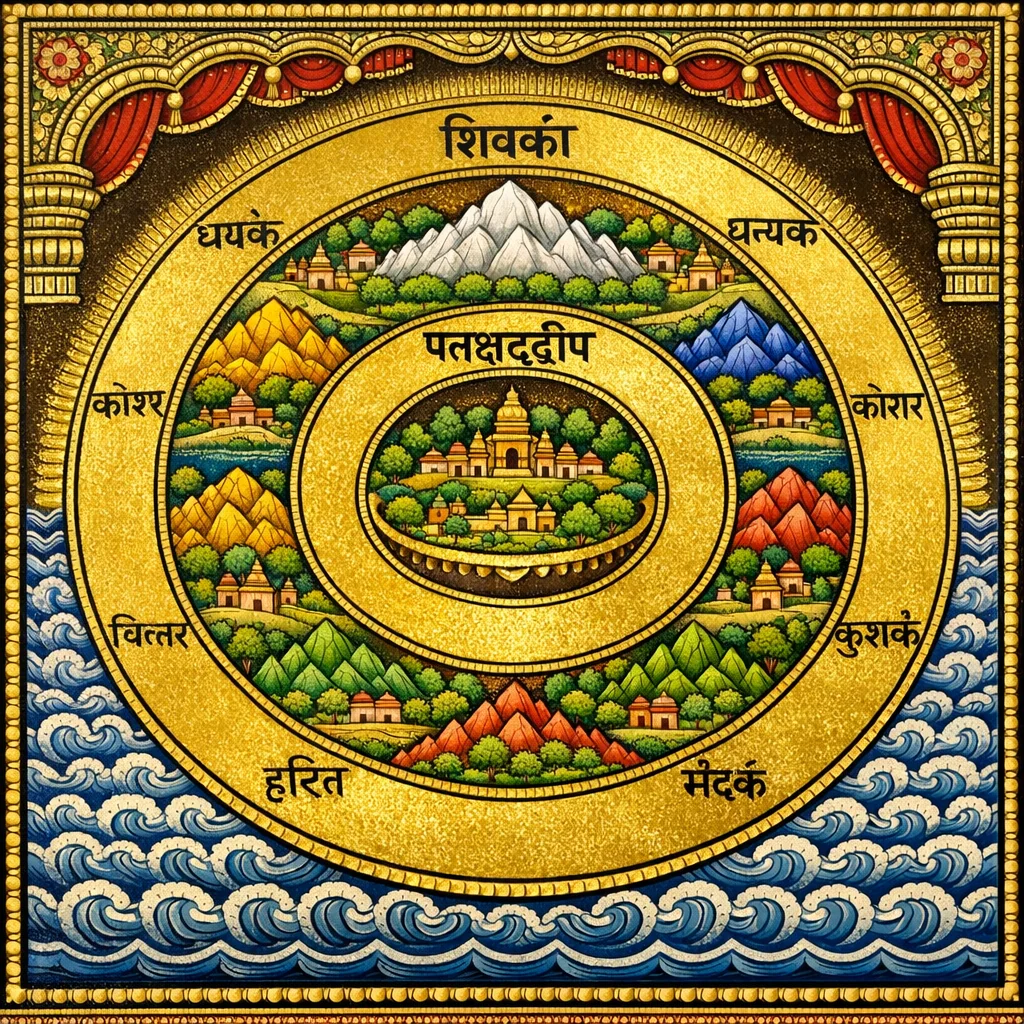
Adhyaya 19
प्लक्षद्वीपवर्णनम् (Description of Plakṣa-dvīpa)
This adhyāya continues the Purāṇic mapping of the bhuvana-kośa, moving from Jambūdvīpa to the next concentric continent, Plakṣa-dvīpa. In Sūta’s narrative voice to the assembled dvija elders, it gives a compact yet technical account of Plakṣa’s proportional extent relative to Jambū, the surrounding lavaṇodaka (salt ocean), and the ideal conditions of its janapadas—no famine and reduced fear of disease and aging. It then lists Plakṣa-dvīpa’s organizing features: seven principal mountains (varṣa-parvatas) with their associated regions (varṣas), along with brief etiological notes such as mythic links, herb-gathering sites, or past events tied to named peaks. Overall, the chapter serves as a data-dense geographic ledger, standardizing names, relative scales, and regional markers for cross-reference within Purāṇic cosmology.
Shlokas
Verse 1
इति श्रीब्रह्माण्डे महापुराणे वायुप्रोक्ते पूर्वभागे द्वितीये ऽनुषङ्गपादे जम्बूद्वीपवर्णनं नामाष्टादशो ऽध्यायः सूत उवाच प्लक्षद्वीपं प्रवक्ष्यामि यथावदिह संग्रहात् / शृणुतेमं यथातत्त्वं ब्रुवतो मे द्विजोत्तमाः
Thus, in the Śrī Brahmāṇḍa Mahāpurāṇa, in the former section spoken by Vāyu, in the second anuṣaṅga-pāda, is the eighteenth chapter called “The Description of Jambūdvīpa.” Sūta said: “O best of the twice-born, I shall now duly describe Plakṣadvīpa in brief; hear my words in accordance with the truth.”
Verse 2
जंबूद्वीपस्य विस्ताराद्द्विगुणास्तस्य विस्तरः / विस्तराद्द्विगुणश्चास्य परिणाहः समन्ततः
Measured against the breadth of Jambūdvīpa, its breadth is twice as great; and, measured against that breadth, its circumference (pariṇāha) all around is likewise twice as great.
Verse 3
तेनावृतः समुद्रो वै द्वीपेन लवणोदकः / तत्र पुण्या जनपदाश्चिरान्न म्रियते जनः
The salt-water ocean is encircled by that dvīpa. There are holy and meritorious realms, where people do not die quickly, but live for a long time.
Verse 4
कृत एव च दुर्भिक्षं जराव्याधिभयं कुतः / तत्रापि पर्वताः पुण्याः सप्तैव मणिभूषणाः
There, famine is as though it never occurs; whence could fear of old age and disease arise? There too are seven holy mountains, adorned with jewels.
Verse 5
रत्नाकरास्तथा नद्यस्तासां नामानि च बुवे / ब्लक्षद्वीपादिषु त्वेषु सप्त सप्त तु पञ्चसु
I shall also declare the names of the oceans and the rivers. In these five continents, beginning with Plakṣa-dvīpa, there are seven in each.
Verse 6
ऋज्वायताः प्रतिदिशं निविष्टा वर्षपर्वताः / प्लक्षद्वीपे तु वक्ष्यामि सप्तद्वीपान् महा बलान्
The mountains that mark the regions lie set, stretching straight toward every direction. Now, in Plakṣa-dvīpa, I shall describe the seven mighty continents.
Verse 7
गोमेदको ऽत्र प्रथमः पर्वतो मेघसन्निभः / ख्यायते यस्य नाम्ना तु वर्षं गोमेदसंज्ञितम्
Here the first mountain is Gomedaka, cloud-like in appearance. From its very name, the region is renowned as Gomeda-varṣa.
Verse 8
द्वितीयः पर्वतश्चन्द्रः सर्वौंष धिसमन्वितः / अश्विभ्याममृतस्यार्थमोषध्यो यत्र संभृताः
The second mountain is Candra, endowed with every healing herb. There the Aśvinī twins gathered medicinal plants for the sake of amṛta.
Verse 9
तृतीयो नारदो नाम दुर्गशैलो महोच्चयः / तत्राचले समुत्पन्नौ पूर्वं नारदपर्वतौ
The third is the mountain named Nārada, a formidable rocky height, lofty and hard to approach. Upon that mountain, in ancient times, arose peaks that bore the name Nārada.
Verse 10
चतुर्थस्तत्र वै शैलो दुदुंभिर्न्नाम नामतः / छन्दमृत्युः पुरा तस्मिन्दुन्दुभिः सादितः सुरैः
There the fourth mountain is famed by name as Dudumbhi. In ancient times, upon that very peak, Chandamṛtyu was subdued by the Devas through Dundubhi.
Verse 11
रज्जुदोलोरुकामं यः शाल्मलिश्चासुरान्तकृत् / पञ्चमः सोमको नाम देवैर्यत्रामृतं पुरा
The mountain that rises fair like a rope-swing, bearing the Śālmali tree that ends the Asuras—this is the fifth, named Somaka, where the Devas long ago placed the Amṛta.
Verse 12
संभृतं चाहृतं चैव मातुरर्थे गरुत्मता / षष्टस्तु सुमना नाम सप्तमर्षभ उच्यते
For his mother’s sake, Garuḍa both gathered and brought back the Amṛta. The sixth is named Sumanā, and the seventh is called Ṛṣabha.
Verse 13
हिरण्यक्षो वराहेण तस्मिञ्छैले निषूदितः / वैभ्राजः सप्तमस्तत्र भ्राजिष्णुः स्फाटिको महान्
Upon that mountain Varāha slew Hiraṇyākṣa. There the seventh is Vaibhrāja—radiant, mighty, and shining like pure crystal.
Verse 14
अर्चिर्भिर्भ्राजते यस्माद्वैभ्राजस्तेन संस्मृतः / तेषां वर्षाणि वक्ष्यामि नामतस्तु यथाक्रमम्
Because it shines with rays like tongues of flame, it is remembered as Vaibhrāja. Now I shall declare, in due order, the names of their varṣas.
Verse 15
गोमेदं प्रथमं वर्षं नाम्नाशान्तभयं स्मृतम् / चन्द्रस्य शिशिरं नाम नारदस्य सुखोदयम्
The first year, called Gomeda, is remembered by the name Śāntabhaya; Candra’s year is named Śiśira, and Nārada’s is Sukhodaya.
Verse 16
आनन्दं दुन्दुभेर्वर्षं सोमकस्यशिवं स्मृतम् / क्षेमकं वृषभस्यापि वैभ्राजस्य ध्रुवं तथा
Dundubhi’s year is called Ānanda, and Somaka’s is remembered as Śiva; Vṛṣabha’s is Kṣemaka, and likewise Vaibhrāja’s is Dhruva.
Verse 17
एतेषु देवगन्धर्वाः सिद्धाश्च सह चारणैः / विहरन्ति रमन्ते च दृश्यमानाश्च तैः सह
In those realms, the deva-gandharvas and the siddhas, together with the cāraṇas, roam and rejoice, and are seen manifest in their company.
Verse 18
तेषां नद्यस्तु सप्तैव प्रतिवर्षं समुद्रगाः / नामतस्ताः प्रवक्ष्यामि सप्तगङ्गास्तपोधनाः
Their rivers, in each varṣa, are only seven that flow to the ocean; O wealth of austerity, I shall now declare by name those seven Gaṅgās.
Verse 19
अनुतप्तासुखी चैव विपाशा त्रिदिवा क्रमुः / अमृता सुकृता चैव सप्तैताः सरितां वराः
Anutaptā, Sukhī, Vipāśā, Tridivā, Kramu, Amṛtā, and Sukṛtā—these seven are the finest among rivers.
Verse 20
अभिगच्छन्ति ता नद्यस्ताभ्यश्चान्याः सहस्रशः / बहूदका ह्योघवत्यो यतो वर्षति वासवः
Those rivers flow there and meet, and with them come thousands of other rivers. For when Vāsava (Indra) sends down rain, they become rich in waters and mighty in their rushing streams.
Verse 21
ताः पिबन्ति सदा हृष्टा नदीजनपदास्तु ते / शुभाः शान्तभयाश्चैव प्रमुदं शैशिराः शिवाः
The riverlands ever drink those waters in gladness. Those regions are auspicious, fear is stilled, they abound in delight—cool, gracious, and благebringing.
Verse 22
आनन्दाश्च सुखाश्चैव क्षेमकाश्च ध्रुवैः सह / वर्णाश्रमाचारयुता प्रजास्तेष्ववधिष्ठिताः
There the people are filled with joy and happiness, abiding in secure well-being together with Dhruva. Observant of the duties of varṇa and āśrama, the folk dwell there in ordered steadiness.
Verse 23
सर्वे त्वरोगाः सुबलाः प्रजाश्चामयव र्जिताः / अवसर्पिणी न तेष्वस्ति तथैवोत्सर्पिणी न च
There all are free from sudden ailments, strong of body, and untouched by disease. There is no avasarpiṇī (decline), and likewise no utsarpiṇī (rise).
Verse 24
न तत्रास्ति युगावस्था चतुर्युगकृता क्वचित् / त्रेतायुगसमः कालः सर्वदा तत्र वर्त्तते
There is nowhere the yuga-order fashioned of the four yugas. There, time ever abides as in the Tretāyuga, unceasingly.
Verse 25
प्लक्षद्वीपादिषु ज्ञेयः पञ्चस्वेतेषु सर्वशः / देशस्यानुविधानेन कालस्यानुविधाः स्मृताः
In Plakṣadvīpa and the other five islands everywhere, the divisions of time are said to follow the ordering of each land—so it should be understood.
Verse 26
पञ्चवर्षसहस्राणि तेषु जीवन्ति मानवाः / सुरूपाश्च सुवेषाश्च ह्यरोगा बलिनस्तथा
On those islands people live for five thousand years; they are fair in form, well adorned, free from disease, and strong.
Verse 27
सुखमायुर्बलं रुपमारोग्यं धर्म एव च / प्लक्षद्वीपादिषु ज्ञेयः शाकद्वीपान्तिकेषु वै
Happiness, lifespan, strength, beauty, health, and dharma as well—these are known in the regions from Plakṣadvīpa up to the borders of Śākadvīpa.
Verse 28
प्रक्षद्वीपः पृथुः श्रीमान्सर्वतो धनधान्यवान् / दिव्यौषधिफलोपेतः सर्वौंषधिवनस्पतिः
Prakṣadvīpa is broad and splendid, rich on every side in wealth and grain; it abounds in fruits of divine herbs and in every kind of medicinal plant.
Verse 29
आवृतः पशुभिः सर्वैर्ग्राम्यारण्यैः सहस्रशः / जंबूवृक्षेम संख्यातस्तस्य मध्ये द्विजोत्तमाः
That island is encircled by thousands of animals, both domestic and wild; it is reckoned as equal to the Jambū tree, and in its midst, O best of the twice-born, (there is).
Verse 30
प्लक्षो नाम महावृक्षस्तस्य नाम्ना स उच्यते / स तत्र पूज्यते स्थाने मध्ये जनपदस्य ह
There is a mighty tree named Plakṣa, and by that very name it is known. There, in a place set in the heart of the realm, it is worshipped.
Verse 31
स चापीक्षुरसोदेन प्रक्षद्वीपः समावृतः / प्लक्षद्वीपसमेनैव वैपुल्यद्विस्तरेण तु
That Prakṣadvīpa too is encircled on every side by the ocean of sugarcane-juice waters. In breadth and expanse it is equal to Plakṣadvīpa.
Verse 32
इत्येवं संनिवेशो वः प्लक्षद्वीपस्य कीर्तितः / आनुपूर्व्यात्समासेन शाल्मलं तु निबोधत
Thus has the arrangement of Plakṣadvīpa been declared to you. Now, in due order and in brief, understand Śālmala.
Verse 33
ततस्तृतीयं वक्ष्यामि शाल्मलं द्वीपसुत्तमम् / शाल्मलेन समुद्रस्तु द्वीपेनेक्षुरसोदकः
Next I shall speak of the third, the most excellent of the island-continents: Śālmala. Around the Śālmala island lies the ocean whose waters are sugarcane juice.
Verse 34
प्लक्षद्वीपस्य विस्ताराद्द्विगुणेन समावृतः / तत्रापि पर्वताः सप्त विज्ञेया रत्नयोनयः
Its expanse is twice the breadth of Plakṣadvīpa. There too are seven mountains, to be known as the wombs and sources of precious gems.
Verse 35
रत्नाकरास्तथा नद्यस्तेषां वर्षेषु सप्तसु / प्रथमः सूर्यसंकाशः कुमुदो नाम पर्वतः
In those seven regions there are also jewel-filled seas and rivers. The first mountain is named Kumuda, radiant like the sun.
Verse 36
सर्वधातुमयैः शृङ्गैः शिलाजालसमाकुलैः / द्वितीयः पर्वतश्चात्र ह्युत्तमो नाम विश्रुतः
With peaks made of every metal and crowded with lattices of rock, the second mountain here is famed as Uttama.
Verse 37
हरितालमयैः शृङ्गैर्दिवमावृत्य तिष्ठति / तृतियः पर्वतस्तत्र बलाहक इति श्रुतः
With peaks of haritāla that seem to veil the sky, the third mountain there is known as Balāhaka.
Verse 38
जात्यञ्जनमयैः शृङ्गैर्दिवमावृत्य तिष्ठति / चतुर्थः पर्वतो द्रोणो यत्र सा वै सहोषधिः
With peaks of jātyañjana that veil the sky, the fourth mountain is Droṇa; there abides the sacred herb Sahoṣadhi.
Verse 39
विशल्यकरणी चैव मृतसञ्जीविनी तथा / कङ्कस्तु पञ्चमस्तत्र पर्वतः सुमहोदयः
There too are Viśalyakaraṇī and Mṛtasañjīvinī; and the fifth mountain is Kaṅka, rising in exceedingly great grandeur.
Verse 40
नित्यपुष्पफलोपेतो वृक्षवीरुत्समावृतः / षष्ठस्तु पर्वतस्तत्र महिषो मेघसन्निभः
That mountain is ever endowed with flowers and fruits, and is covered all around with trees and creepers. There, the sixth mountain is called Mahisha, resembling a cloud.
Verse 41
यस्मिन्सो ऽग्निर्निवसति महिषो नाम वारिजः / सप्तमः पर्वतस्तत्र ककुद्मान्नाम भाष्यते
Where Agni abides, there is the water-born (varija) called Mahisha. There, the seventh mountain is spoken of as Kakudman.
Verse 42
तत्र रत्नान्यनेकानि स्वयं रक्षति वासवः / प्रजापतिमुपादाय प्रजाभ्यो विधिवत्स्वयम्
There, Vasava (Indra) himself guards many kinds of jewels. Taking Prajapati with him, he himself duly ordains matters for the beings.
Verse 43
इत्येते पर्वताः सप्त शाल्मले मणिभूषणाः / तेषां वर्षाणि वक्ष्यामि सर्पैव तु शुभानि वै
Thus, in Shalmali, these seven mountains are adorned with jewels. Now I shall describe their varshas (regions), which are indeed auspicious, like the sacred serpent.
Verse 44
कुमुदस्य स्मृतं श्वेतमुत्तमस्य च लोहितम् / बलाहकस्य जीमूतं द्रोणस्य हरितं स्मृतम्
Kumuda is remembered as white in hue, and Uttama as red. Balāhaka is cloud-colored (jīmūta), while Droṇa is remembered as green.
Verse 45
कङ्कस्य वैद्युतं नाम महिषस्य च मानसम् / ककुदः सुप्रदं नाम सप्तैतानि तु सप्तधा
Kaṅka is called “Vaidyuta,” and Mahiṣa is called “Mānasa.” Kakuda bears the name “Suprada”; these are seven names spoken of in sevenfold manner.
Verse 46
वर्षाणि पर्वताश्चैव नदीस्तेषु निबोधत / ज्योतिः शान्तिस्तथा तुष्टा चन्द्रा शुक्रा विमोचनी
Know the regions, the mountains, and the rivers there: Jyoti, Śānti, Tuṣṭā, Candrā, Śukrā, and Vimocanī.
Verse 47
निवृत्तिः सप्तमी तासां प्रतिवर्षं तु ताः स्मृताः / तासां समीपगाश्चान्याः शतशो ऽथ सहस्रशः
The seventh among them is called “Nivṛtti”; thus are they remembered in each varṣa. Near them are other rivers as well—by hundreds and by thousands.
Verse 48
न संख्यां परिसंख्यातुं शक्नुयात्को ऽपि मानवः / इत्येष संनिवेशो वः शाल्मलस्य प्रकीर्त्तितः
No human being could fully reckon their number. Thus has the arrangement of Śālmala-dvīpa been proclaimed to you.
Verse 49
प्लक्षवृक्षेण संख्यातस्तस्य मध्ये महा द्रुमः / शाल्मलिर्विपुलस्कन्धस्तस्य नाम्ना स उच्यते
Its measure is spoken of in terms of the Plakṣa tree; in its midst stands a mighty tree. With a vast trunk it is called “Śālmali,” and by its name it is known.
Verse 50
शाल्मलस्तु समुद्रेण सुरोदेन समावृतः / विस्तराच्छाल्मलस्वैव समे न तु समन्ततः
Śālmala-dvīpa is encircled by the ocean called Suroda. In extent it is equal to Śālmala itself, yet it is not uniformly the same on every side.
Verse 51
उत्तरेषु तु धर्मज्ञाद्वीपेषु शृणुत प्रजाः / यथाश्रुतं यथान्यायं ब्रुवतो मे निबोधत
O knower of dharma, hear, O people, of the northern continents. As I have heard it and as is fitting by sacred order, so I speak; attend and understand my words.
Verse 52
कुशद्वीपं प्रवक्ष्यामि चतुर्थं तु समासतः / सुरोदकः परिवृतः कुशद्वीपेन सर्वतः
Now I shall briefly describe the fourth continent, Kuśa-dvīpa. The ocean called Surodaka surrounds Kuśa-dvīpa on every side.
Verse 53
शाल्मलस्य तु विस्ताराद्द्विगुणेन समन्ततः / सप्तैव च गिरींस्तत्र वर्ण्यमानान्निबोधत
From the extent of Śālmala it is twice as wide on every side. And know as well the seven mountains that are to be described there.
Verse 54
कुशद्वीपे तु विज्ञेयः पर्वतो विद्रुमश्च यः / द्वीपस्य प्रथमस्तस्य द्वितीयो हेमपर्वतः
On Kuśa-dvīpa one should know the mountain called Vidruma; it is the first mountain of that continent. The second is Hema-parvata, the Golden Mountain.
Verse 55
तृतीयो द्युतिमान्नाम जीमूतसदृशो गिरिः / चतुर्थः पुष्पवान्नाम पञ्चमस्तु कुशेशयः
The third mountain is named Dyutimān, resembling a cloud; the fourth is called Puṣpavān, and the fifth is Kuśeśaya.
Verse 56
षष्ठो हरिगिरिर्नाम सप्तमो मन्दरः स्मृतः / मन्दा इति ह्यपा नाम मन्दरो दारणादयम्
The sixth is named Harigiri, and the seventh is remembered as Mandara; there is a river called Mandā, and Mandara is famed for its power to bear and uphold.
Verse 57
तेषामन्तरविषकंभो द्विगुणः प्रविभागतः / उद्भिदं प्रथमं वर्षं द्वितीयं वेणुमण्डलम्
The expanse between them is apportioned in double measure: the first varṣa is Udbhida, the second is Veṇumaṇḍala.
Verse 58
तृतीयं वै रथाकारं चतुर्थं लवणं समृतम् / पञ्चमं धृतिमद्वर्षं षष्ठं वर्षं प्रभाकरम्
The third varṣa is Rathākāra, and the fourth is remembered as Lavaṇa; the fifth is Dhṛtimad-varṣa, and the sixth is Prabhākara-varṣa.
Verse 59
सप्तमं कपिलं नाम सर्वे ते वर्ष भावकाः / एतेषु देवगन्धर्वाः प्रजास्तु जगदीश्वराः
The seventh is named Kapila; all these are realms of varṣa. Within them dwell Devas and Gandharvas, and the peoples abide under Jagadīśvara, the Lord of the world.
Verse 60
विहरन्ति रमन्ते च हृष्यमाणास्तु सर्वशः / न तेषु दस्यवः संति म्लेच्छ जातय एव च
They roam and rejoice, gladdened on every side; among them there are no dāsyus, nor any mleccha tribes.
Verse 61
गौरप्रायो जनः सर्वः क्रमाच्च म्रियते तथा / तत्रापि नद्यः सप्तैव धूतपापाशिवा तथा
There the people are mostly fair of hue, and in due course they likewise pass away. There too are but seven rivers, washing away sin and bestowing auspiciousness.
Verse 62
पवित्रा संततिश्चैव विद्युद्दंभा मही तथा / अन्यास्ताभ्यो ऽपरिज्ञाताः शतशो ऽथ सहस्रशः
Pavitrā, Saṃtati, Vidyuddaṃbhā, and Mahī—these too are (rivers). Beyond them are others unknown, by hundreds and by thousands.
Verse 63
अभिगच्छन्ति ताः सर्वा यतो वर्षति वासवः / घृतोदेन कुशद्वीपो बाह्यतः परिवारितः
All those rivers flow to the place where Vāsava (Indra) sends down rain. Kuśadvīpa is encircled on the outside by Ghṛtoda, the ocean of ghee.
Verse 64
विज्ञेयः स तु विस्तारात्कुशद्वीपसमेन तु / इत्येष सन्निवेशो वः कुशद्वीपस्य कीर्त्तितः
Know that its expanse is equal to that of Kuśadvīpa. Thus has the layout of Kuśadvīpa been recounted to you.
Verse 65
क्रैञ्चद्वीपस्य विस्तारं वक्ष्याम्यहमतः परम् / कुशद्वीपस्य विस्ताराद्द्विगुणः स तु वै स्मृतः
Now I shall proclaim the extent of Krañca-dvīpa; it is remembered as twice the extent of Kuśa-dvīpa.
Verse 66
घृतोदकसमुद्रो वै क्रैञ्च द्वीपेन संयुतः / तस्मिन्द्वीपे नगश्रेष्ठः क्रैञ्चस्तु प्रथमो गिरिः
Krañca-dvīpa is joined to the ocean whose waters are ghee; upon that island, the foremost of mountains is Krañca, the first peak.
Verse 67
क्रैञ्चात्परो वामनको वामनादन्धकारकः / अन्धकारात्परश्चापि दिवावृन्नाम पर्वतः
Beyond Krañca lies Vāmanaka; beyond Vāmanaka, Andhakāraka; and beyond Andhakāraka stands the mountain named Divāvṛt.
Verse 68
दिवावृतः परश्चापि द्विविदो गिरिसत्तमः / द्विविदात्परतश्चापि पुण्डरीको महागिरिः
Beyond Divāvṛt is Dvivida, the noblest of mountains; and beyond Dvivida stands the great peak named Puṇḍarīka.
Verse 69
पुण्डरीकात्परश्चापि प्रोच्यते दुन्दुभिस्वनः / एते रत्नमयाः सप्त क्रैञ्चद्वीपस्य पर्वताः
Beyond Puṇḍarīka is spoken of Dundubhisvana. These are the seven jewel-formed mountains of Krañca-dvīpa.
Verse 70
बहुपुष्पफलोपेतनानावृक्षलतावृताः / परस्परेण द्विगुणा विस्तृता हर्षवर्द्धनाः
They abound in many flowers and fruits, encircled by diverse trees and creepers; each is spread out twice as wide as the next, and they increase delight.
Verse 71
वर्षाणि तत्र वक्ष्यामि नामतस्तान्निबोधत / क्रैञ्चस्य कुशलो देशो वामनस्य मनोनुगः
Now I shall declare the varṣas there by name—heed them well: ‘Kuśala’, the land of Krañca, and ‘Manonuga’, belonging to Vāmana.
Verse 72
मनोनुगात्परश्चोष्णस्तृतीयं वर्षमुच्यते / उष्णात्परः पीवरकः पीवरादन्धकारकः
Beyond Manonuga, the third varṣa is said to be ‘Uṣṇa’; beyond Uṣṇa lies ‘Pīvaraka’, and beyond Pīvaraka, ‘Andhakāraka’.
Verse 73
अन्धकारात्परश्चापि मुनिदेशः स्मृतो बुधैः / मुनिदेशात्परश्चैव प्रोच्यते दुन्दुभिस्वनः
Beyond Andhakāraka, the wise remember a region called ‘Munideśa’; and beyond Munideśa is proclaimed ‘Dundubhisvana’.
Verse 74
सिद्धचारणसंकीर्णो गौरप्रयो जनः स्मतः / तत्रापि नद्यः सप्तैव प्रतिवर्ष स्मृताः शुभाः
That land is thronged with Siddhas and Cāraṇas; its people are remembered as mostly fair-complexioned. There too, in each varṣa, only seven auspicious rivers are spoken of.
Verse 75
गौरी कुमुद्वती चैव संध्या रात्रिर्मनोजवा / ख्यातिश्च पुण्डरीका च गङ्गाः सप्तविधाः स्मृताः
Gaurī, Kumudvatī, Sandhyā, Rātri, Manojavā, Khyāti, and Puṇḍarīkā—these are remembered as the sevenfold forms of the sacred Gaṅgā.
Verse 76
तासां सहस्रशश्चान्या नद्यो यास्तु समीपगाः / अभिगच्छन्ति ताः सर्वा विपुलाः सुबहूदकाः
Near them flow thousands of other rivers; all are broad and abundant in waters, and all of them come and merge into them.
Verse 77
क्रैञ्चद्वीपः समुद्रेण दधिमण्डौदकेन तु / आवृतः सर्वतः श्रीमान्क्रैञ्चद्वीपसमेन तु
Krañcadvīpa is encompassed on every side by an ocean whose waters are dadhi-maṇḍa; that splendid island is ringed all around with an expanse equal to itself.
Verse 78
प्लक्षद्वीपादयो ह्येते समासेन प्रकीर्त्तिताः / तेषां निसर्गोद्वीपानामानुपूर्व्येण सर्वशः
Plakṣadvīpa and the rest have been proclaimed here in brief; of those naturally constituted islands, the full account is given in due order.
Verse 79
न शक्यो विस्तराद्वक्तुं दिव्यवर्षशतैरपि / निसर्गो यः प्रजानां तु संहारो यश्च तासु वै
Even in hundreds of divine years it cannot be told in full—how beings are brought forth, and how, indeed, they are also dissolved (saṃhāra) therein.
Verse 80
शाकद्वीपं प्रवक्ष्यामि यथावदिह निश्चयात् / शृणुध्वं तु यथातथ्यं ब्रुवतो मे यथार्थवत्
Here, with firm resolve, I shall describe Śākadvīpa exactly as it is. Listen to my words, truthful and faithful to their true meaning.
Verse 81
क्रैञ्चद्वीपस्य विस्ताराद्द्विगुणास्तस्य विस्तरः / परिवार्य समुद्रं स दधिमण्डोदकं स्थितः
Śākadvīpa is twice as vast as Kraiñcadvīpa. It is encircled on all sides by an ocean whose waters are dadhimaṇḍa, the essence of curd.
Verse 82
तत्र पुण्या जनपदाश्चिरात्तु म्रियते जनः / कुत एव च दुर्भिक्षं जराव्याधिभयं कुतः
There lie blessed realms; there people die only after a long span of years. How could famine exist there, and whence could fear of age and disease arise?
Verse 83
तत्रापि पर्वताः शभ्राः सप्तैव मणिभूषणाः / रत्नाकरास्तथा नद्यस्तेषां नामानि मे शृणु
There too are seven radiant mountains, adorned with jewels, and there are treasuries of gems and sacred rivers. Hear their names from me.
Verse 84
देवर्षिगन्धर्वयुतः प्रथमो मेरुरुच्यते / प्रागायतः स सौवर्णो ह्युदयो नाम पर्वतः
The first mountain, graced by devarṣis and gandharvas, is called Meru. Stretching eastward, that golden mountain is named Udaya.
Verse 85
वृष्ट्यर्थं जलदास्तत्र प्रभंवति च यान्ति च / तस्यापरेण सुमहाञ्जलधारो महागिरिः
For the sake of rain, the clouds arise there and also pass away. To its west stands a very great mountain, rich with mighty streams of water.
Verse 86
यतो नित्यमुपादत्ते वासवः परमं जलम् / ततो वर्षं प्रभवति वर्षाकाले प्रजास्विह
From where Vāsava (Indra) ever draws the supreme waters, from that source rain is born in the season of rains for the beings of this world.
Verse 87
तस्योत्तरे रैवतको यत्र नित्यं प्रतिष्ठितम् / रेवती दिवि नक्षत्रं पितामहकृतो विधिः
To its north is Raivataka, where the star Revatī stands ever established in the heavens—an ordinance set in place by Pitāmaha (Brahmā).
Verse 88
तस्यापरेण सुमहान् श्यामो नाम महागिरिः / तस्माच्छ्यामत्वमापन्नाः प्रजाः पूर्वमिमाः किल
To its west is a very great mountain named Śyāma. Because of it, it is said, these beings in former times took on a dark hue.
Verse 89
तस्यापरेण सुमहान्नाजतो ऽस्तगिरिः स्मृतः / तस्यापरे चांबिकेयो दुर्गशैलो महागिरिः
To its west is famed the very great mountain of sunset, called Nājata. Still farther west stands Ambikeya, the mighty mountain-fortress known as Durgāśaila.
Verse 90
अंबिकेयात्परो रम्यः सर्वौंषधिसमन्वितः / केसरी केसरयुतो यतो वायुः प्रजापतिः
Beyond Ambikeya lies a lovely realm, endowed with every healing herb; near Kesari, adorned with saffron, there dwells Vayu, the Prajapati.
Verse 91
उदयात्प्रथमं वर्षं महात्तज्जलदं स्मृतम् / द्वितीयं जलधारस्य सुकुमारमिति स्मृतम्
From Udaya, the first varsha is remembered as Mahattajjalada; the second, of Jaladhara, is known as Sukumara.
Verse 92
रैवतस्य तु कौमारं श्यामस्य च मणीवकम् / अस्तस्यापि शुभं वर्षं विज्ञेयं कुसुमोत्तरम्
Raivata’s varsha is Kaumara, and Syama’s is Manivaka; and Asta’s auspicious varsha should be known as Kusumottara.
Verse 93
अम्बिकेयस्य मोदाकं केसरस्य महाद्रुमम् / द्वीपस्य परिमाणं तु ह्रस्वदीर्घत्वमेव च
Ambikeya’s varsha is Modaka, and Kesara’s is Mahadruma; and the island’s measure too—its shortness and its length—is set forth.
Verse 94
क्रैञ्चद्वीपेन विख्यातं तस्य केतुर्महाद्रुमः / शाको नाम महोत्सेधस्तस्य पूज्या महानुगाः
It is famed as Krañcadvipa; its banner-sign (ketu) is Mahadruma, the great tree. Its lofty highland is called Saka, and its great attendants are worthy of reverence.
Verse 95
तत्र पुण्या जनपदाश्चातुर्वर्ण्यसमन्विताः / नद्यश्चापि महापुण्या गङ्गाः सप्तविधास्तथा
There are holy realms endowed with the four varṇas; and there too are supremely sacred rivers—the Gaṅgās are said to be of seven kinds.
Verse 96
सुकुमारी कुमारी च नलिनी वेणुका च या / इक्षुश्च वेणुका चैव गभस्तिः सप्तमी तथा
Sukumārī and Kumārī, Nalinī and Veṇukā; Ikṣu and Veṇukā as well, and the seventh is called Gabhasti.
Verse 97
नद्यश्चान्याः पुण्यजलाः शीततोयवहाः शुभाः / सहस्रशः समाख्याता यतो वर्षति वासवः
There are other rivers too, whose waters are holy, cool, and auspicious; they are spoken of by the thousands, for there Vāsava (Indra) sends down rain.
Verse 98
न तासां नामधेयानि परिमाणं तथैव च / शक्यं वै परिसंख्यातुं पुण्यास्ताः सरिदुत्तमाः
Neither their names nor their measure can truly be reckoned; so holy are those rivers, the best among streams.
Verse 99
ताः पिबन्ति सदा हृष्टा नदीर्जनपदास्तु ते / शांशपायनविस्तीर्णो द्वीपो ऽसौ चक्रसंस्थितः
Those realms ever drink, in gladness, the waters of those rivers; and that island is spread wide like Śāṃśapāyana’s expanse, set in the form of a wheel.
Verse 100
नदीजलैः प्रतिच्छन्नः पर्वतैश्चाभ्रसन्निभैः / सर्वधातुविचित्रैश्च मणिविद्रुमभूषितैः
That land was covered with river waters and encircled by cloud-like mountains, variegated with every kind of mineral and adorned with gems and vidruma (red coral).
Verse 101
नगरैश्चैव विविधैः स्फीतैर्जनपदैरपि / वृक्षैः पुष्पफलोपेतैः समन्ताद्धनधान्यवान्
It held many kinds of cities and flourishing provinces; all around were trees bearing flowers and fruits, and it abounded in wealth and grain.
Verse 102
क्षीरोदेन समुद्रेण सर्वतः परिवारितः / शाकद्वीपस्य विस्तारात्समेन तु समंन्ततः
It was surrounded on every side by the Kṣīroda, the Ocean of Milk; and the expanse of Śākadvīpa spread out evenly in all directions.
Verse 103
तस्मिञ्जनपदाः पुण्याः पर्वताः सरितः शुभाः / वर्णाश्रमसमाकीर्णा देशास्ते सप्त वै स्मृताः
There were holy provinces, mountains, and auspicious rivers; those lands, filled with the order of varṇa and āśrama, are remembered as seven.
Verse 104
न संकरश्च तेष्वस्ति वर्णाश्रमकृतः क्वचित् / धर्मस्य चाव्यभीचारादेकान्तसुखिताः प्रजाः
Among them there was nowhere any confusion born of varṇa and āśrama; and by unwavering fidelity to dharma, the people dwelt in undivided happiness.
Verse 105
न तेषु लोभो माया वा हीर्षासूयाकृतः कुतः / विपर्ययो न तेष्वस्ति कालात्स्वाभाविकं परम्
In them there is no greed, nor māyā; how could jealousy and spite arise? In them there is no perversion; beyond time stands the natural Supreme.
Verse 106
करावाप्तिर्न तेष्वस्ति न दण्डो न च दण्ड्यकाः / स्वधर्मेणैव धर्म ज्ञास्ते रक्षन्ति परस्परम्
Among them there is no taxation, no punishment, and none to be punished. Knowing dharma, they protect one another by their own svadharma alone.
Verse 107
एतावदेव शक्यं वै तस्मिन्द्वीपे प्रभाषितुम् / एतावदेव श्रोतव्यं शाकद्वीपनिवासिनाम्
Of that island, only this much can truly be spoken. Of the dwellers of Śākadvīpa, only this much is fit to be heard.
Verse 108
पुष्करं सप्तमं द्वीपं प्रवक्ष्यामि निबोधत / पुष्करेण तु द्वीपेन वृतः क्षीरोदको बहिः
Now I shall declare Puṣkara, the seventh island; listen well. Outside Puṣkaradvīpa, the Ocean of Milk (Kṣīroda) encircles it.
Verse 109
शाकद्वीपस्य विस्ताराद्द्विगुणेन संमततः / पुष्करे पर्वतः श्रीमानेक एव महाशिलः
Puṣkara is held to be twice the expanse of Śākadvīpa. In Puṣkara there is but one splendid mountain, the great rocky Mahāśilā.
Verse 110
चित्रैर्मणिमयैः शृङ्गैः शिलाजालैः समुच्छ्रितः / द्वीपस्य तस्य पूर्वर्द्धे चित्रसानुः स्थितो महान्
Raised high with wondrous jewel-like peaks and lattices of rock, in the eastern half of that island stands the great mountain called Citrāsānu.
Verse 111
स मण्डलसहस्राणि विस्तीर्णः पञ्चविंशतिः / उर्द्धं चैव चतुस्त्रिंशत्सहस्राणि महीतलात्
It spreads across twenty-five thousand maṇḍala in breadth, and rises thirty-two thousand above the earth’s surface.
Verse 112
द्वीपर्धस्य परिक्षिप्तः पर्वतो मानसोत्तरः / स्थितो वेलासमीपे तु नवचन्द्र इवोदितः
The mountain Mānasottara, encircling half the island, stands near the shore like a newly risen young moon.
Verse 113
योजनानां सहस्राणि ऊर्ध्वं पञ्चाशदुच्छ्रितः / तावदेव च विस्तीर्णः सर्वतः परिमण्डलः
It rises fifty thousand yojanas high; it is just as broad, perfectly circular on every side.
Verse 114
स एव द्वीपपश्चार्द्धे मानसः पृथिवीधरः / एक एव महासारः सन्निवेशो द्विधा कृतः
In the western half of the island there is likewise the earth-bearing mountain Mānas; one single great essence in its formation has been made into two parts.
Verse 115
स्वादूदकेनोदधिना सर्वतः परिवारितः / पुष्करद्वीपविस्ताराद्विस्तीर्णो ऽसौ समन्ततः
Puṣkara-dvīpa is encircled on every side by an ocean of sweet waters; by its vast expanse it spreads out in all directions.
Verse 116
तस्मिन्द्वीपे स्मृतौ द्वौ तु पुण्यौ जनपदौ शुभौ / अभितो मानसस्याथ पर्वतस्य तु मण्डले
On that island are remembered two sacred and auspicious realms; they lie around the circuit of Mount Mānasā.
Verse 117
महावीतं तु यद्वर्ष बाह्यतो मानसस्य तत् / त्स्यैवाभ्यन्तरेणापि धातकीखण्डमुच्यते
The varṣa lying outside Mount Mānasā is called Mahāvīta; and the inner tract of that same region is known as Dhātakī-khaṇḍa.
Verse 118
दशवर्षसहस्राणि तत्र जीवति मानवाः / अरोगाः सुखबाहुल्या मानसीं सिद्धिमास्थिताः
There human beings live for ten thousand years—free from disease, abundant in happiness, and established in mental perfection (mānasī-siddhi).
Verse 119
मससायुश्च रूपं च तस्मिन्वर्षद्वये स्मृतम् / अधमोत्तमा न तेष्वस्ति तुल्यास्ते रूपशीलतः
In those two varṣas, lifespan and form are said to be the same; among them there is no low or high—by beauty and virtue all are equal.
Verse 120
न तत्र दस्युर्दमको नेर्ष्यासूया भयं तथा / निग्रहो न च दण्डो ऽस्ति न लोभो न परिग्रहः
There are no robbers there, nor any who subdue; no envy or malice, and no fear. There is no restraint and no punishment; no greed and no grasping after possessions.
Verse 121
सत्यानृतं न तत्रास्ति धर्माधर्मौं तथैव च / वर्णाश्रमौ वा वार्ता वा पाशुपाल्यं वणिक्पथः
There is neither truth nor falsehood there, nor dharma and adharma. No order of varṇa and āśrama prevails; no husbandry, no herding of cattle, and no paths of trade.
Verse 122
त्रयी विद्या दण्डनीतिः शुश्रूषा शिल्पमेव च / वर्षद्वये सर्वमेतत्पुष्करस्य न विद्यते
There is no knowledge of the Three Vedas there, nor dandanīti, the rule of punishment; no service and attendance, and no crafts. In Puṣkara’s two-year realm, all these are unknown.
Verse 123
न तत्र वर्षं नद्यो वा शीतोष्णं वापि विद्यते / उद्भिदान्युदकान्यत्र गिरिप्रस्रवणानि च
There is no rain there, nor rivers, nor even the contrast of cold and heat. Yet there are water-bearing plants, and springs that stream forth from the mountains.
Verse 124
उत्तराणां कुरूणां च तुल्यकालो जनस्तथा / सर्वर्त्तुसुसुखस्तत्र जराक्रमविवर्जितः
The people there are like the Uttara-Kurus in their very condition of time; they are happy in every season and are free from the gradual advance of old age.
Verse 125
इत्येष धातकीखण्डे महा वीते तथैव च / आनुपूर्व्याद्विधिः कृत्स्नः पुष्करस्य प्रकीर्त्तितः
Thus, in Dhātakīkhaṇḍa and likewise in Mahāvīta, the entire ordinance of Puṣkara has been proclaimed in due sequence.
Verse 126
स्वादूदकेनोदधिना पुष्करः परिवारितः / विस्तारान्मण्डलाच्चैव पुष्करस्य समेन तु
Puṣkara is encircled by an ocean of sweet waters; in breadth and in its circular expanse it is equal to Puṣkara itself.
Verse 127
एवं द्वीपाः समुद्रैस्तु सप्त सप्तभिरावृताः / द्वीपस्यानन्तरो यस्तु सामुद्रस्तत्समस्तु सः
Thus the continents are enclosed by seven oceans; the ocean that follows each continent is equal to that continent in measure.
Verse 128
एवं द्वीपसमुद्राणां वृद्धिर्ज्ञेया परस्परात् / अपां चैव समुद्रेकात्सामुद्र इति संज्ञितः
Thus the increase of continents and oceans is to be understood as successive and mutual; and because it pertains to the ocean of waters, it is called “sāmudra”.
Verse 129
विशन्तिर्निवसंत्यस्मिन्प्रजा यस्माच्चतुर्विधाः / तस्माद्वर्षमिति प्रोक्तं प्रजानां सुखदं यतः
Because fourfold beings enter and dwell herein, it is called a “varṣa”; for it bestows happiness upon the creatures.
Verse 130
ऋष इत्येष रमणे वृषशक्तिप्रबन्धने / रतिप्रबधनात्मिद्धं वर्षं तत्तेषु तेन वै
In the realm of Ramana this is called “Ṛṣa,” the cause that binds the power of Vṛṣa; therefore among them that land is renowned as a varṣa whose very nature orders and sustains rati, the joy of love.
Verse 131
शुक्लपक्षे चन्द्रवृद्ध्या समुद्रः पूर्यते सदा / प्रक्षीयमाणे बहुले क्षीयते ऽस्तमिते खगे
In the bright fortnight, as the Moon waxes, the ocean is ever filled; in the dark fortnight, as it wanes, the waters diminish when that sky-roaming orb sets.
Verse 132
आपूर्यमाणो ह्युदधिः स्वत एवाभिपूर्यते / तथोपक्षीयमाणे ऽपि स्वात्मन्येवावकृष्यते
The ocean, as it rises, is filled of itself; and even as it ebbs, it is drawn back into its own inner nature.
Verse 133
उखास्थमग्निसंयोगादुद्रिक्तं दृश्यते यथा / महोदधिगतं तोयं स्वत उद्रिच्यते तथा
As a liquid is seen to surge up when joined with fire in a vessel, so too the waters within the great ocean rise and swell of themselves.
Verse 134
अन्यूनानतिरिक्तांश्च वर्न्द्वत्यापो ह्रसंति च / उदयास्तमये त्विन्दौ पक्षयोः शुक्लकृष्णयोः
At the Moon’s rising and setting, in both the bright and the dark fortnights, the waters are neither less nor more; they ebb and swell in even measure.
Verse 135
क्षयवृद्धत्वमुदधेः सोमवृद्धिक्षयात्पुनः / दशोत्तराणि पञ्चैव ह्यङ्गुलानि शतानि च
From Soma’s (the Moon’s) waxing and waning, the ocean too has decrease and increase; it is said to be five hundred aṅgulas, and ten more.
Verse 136
अपां वृद्धिः क्षयो दृष्टः सामुद्रीणां तु पर्वसु / द्विराप्कत्वात्स्मृता द्वीपाः सर्वतश्चोदकावृताः
In the ocean’s parvas (periodic turns), the waters are seen to increase and decrease; the continents are called dvirāpka, for they are enclosed by water on every side.
Verse 137
उदकस्यायनं यस्मात्तस्मादुदधिरुच्यते / अपर्वाणस्तु गिरयः पर्वभिः पर्वताः स्मृताः
Because it is the waters’ resting-place and course, it is called udadhi (ocean); mountains without joints are giri, while those with joints are remembered as parvata.
Verse 138
प्लक्षद्वीपे तु गोमेदः पर्वतस्तेन चौच्यते / शाल्मलिः शाल्मले द्वीपे पूज्यते सुमहाव्रतैः
On Plakṣadvīpa stands the mountain called Gomeda, known by that very name; on Śālmaladvīpa, the Śālmali tree is worshipped by those who keep great vows.
Verse 139
कुशद्वीपे कुशस्तंबस्तस्यनाम्ना स उच्यते / क्रैञ्चद्वीपे गिरिः कैञ्चो मध्ये जनपदस्य ह
On Kuśadvīpa is Kuśastamba, called by that very name; on Kraiñcadvīpa stands Mount Kaiñca, in the midst of that realm.
Verse 140
शाकद्वीपे द्रुमः शाकस्तस्य नाम्ना स उच्यते / न्यग्रोधः पुष्करद्वीपे तत्रत्यैः स नमस्कृतः
In Śākadvīpa the tree called Śāka is renowned by that very name; and in Puṣkaradvīpa the Nyagrodha (banyan) is honored with reverent salutations by its inhabitants.
Verse 141
महादेवः पूज्यते तु ब्रह्मा त्रिभुवनेश्वरः / तस्मिन्नि वसति ब्रह्मा साध्यैः सार्द्धं प्रजापतिः
There Mahādeva is worshiped, and Brahmā, Lord of the three worlds, is also revered. In that realm Brahmā, the Prajāpati, dwells together with the Sādhya.
Verse 142
उपासंते तत्र देवास्त्रयस्त्रिंशन्महर्षिभिः / स तत्र पूज्यते चैव देवेर्देवोतमोतमः
There the thirty-three gods worship in devotion together with the great sages; and there too is adored the Supreme—God of gods, the highest of the high.
Verse 143
जंबूद्वीपात्प्रवर्त्तन्ते रत्नानि विविधानि च / द्वीपेषु तेषु सर्वेषु प्रजानां क्रमतस्तु वै
From Jambūdvīpa arise and spread jewels of many kinds; and in all those islands, the ordering of the peoples is indeed established in due succession.
Verse 144
सर्वशो ब्रह्मवर्येण सत्येन च दमेन च / आरोग्ययुःप्रमाणाभ्यां प्रमाणं द्विगुणं ततः
In every way, through brahmacarya, truth, and self-restraint; there the measure of life—by the standards of health and longevity—becomes twice as great.
Verse 145
एतस्मिन्पुष्करद्वीपे यदुक्तं वर्षकद्वयम् / गोपायति प्रजास्तत्र स्वयंभूर्जड पण्डिताः
On this Pushkara-dvipa, in the two regions called varshas, Svayambhu (Brahma) protects the beings; there dwell both the dull and the learned.
Verse 146
ईश्वरो दण्डसुद्यम्य ब्रह्मा त्रिभुवनेश्वरः / स विष्णोः सचिवो देवः स पिता स पितामहः
Ishvara, firmly raising the rod of discipline—Brahma, Lord of the three worlds—serves as Vishnu’s divine minister; he is the Father, he is the Grandsire.
Verse 147
भोजनं चाप्रयत्नेन तत्र स्वयमुपस्थितम् / षड्रसं सुमहावीर्यं भुञ्जते तु प्रजाः सदा
There, without any effort, food appears of itself; endowed with the six tastes and great potency, the beings partake of it always.
Verse 148
परेण पुष्करस्यार्द्धे आवृत्यावस्थितो महान् / स्वादूदकः समुद्रस्तु समन्तात्परिवेष्ट्य तम्
Beyond the other half of Pushkara lies a vast ocean of sweet water as an encircling mantle; it surrounds it on every side.
Verse 149
परेण तस्य महती दृश्यते लोकसंस्थितिः / काञ्चनी द्विगुणा भूमिः सर्वाह्येकशिलोपमा
Beyond that appears a vast ordering of worlds: a golden land, twice in extent, everywhere like a single unbroken slab of stone.
Verse 150
तस्यापरेण शैलश्च पर्यासात्पस्मिण्डलः / प्रकाशश्चाप्रकाशश्च लोकालोकः स उच्यते
Beyond it stands a mountain spread all around; being the boundary of light and non‑light, it is called Lokāloka.
Verse 151
आलोकस्तस्य चार्वक्तु निरालोकस्ततः परम् / योजनानां सहस्राणि दश तस्योच्छ्रयः समृतः
On this side lies its Āloka, and beyond it is Nirāloka; its height is reckoned as ten thousand yojanas.
Verse 152
तावांश्च विस्तरस्तस्य पृथिव्यां कामगश्च सः / आलोको लोकवृत्तिस्थो निरालोको ह्यलौकिकः
Its breadth is the same, and it moves upon the earth at will; Āloka abides within the world’s order, while Nirāloka is truly otherworldly.
Verse 153
लोकार्द्धे संमिता लोका निरालोकास्तु बाह्यतः / लोकविस्तारमात्रं तु ह्यलोकः सर्वतो बहिः
The worlds are measured only to half the world’s expanse; outside them lies Nirāloka; and Aloka, equal to that expanse, stands beyond on every side.
Verse 154
परिच्छिन्नः समन्ताच्च उदकेनावृतस्तु सः / आलोकात्परतश्चापि ह्यण्डमा वृत्य तिष्ठति
It is bounded on every side and veiled by waters; even beyond Āloka it stands, encircling the cosmic egg (aṇḍa) of the universe.
Verse 155
अण्डस्यान्तस्त्विमे लोकाः सप्तद्वीपा च मेदिनी / भूर्लोको ऽथ भुवर्ल्लोकः स्वर्लोको ऽथ महस्तथा
Within this cosmic Egg are these worlds and the earth with its seven continents: Bhūrloka, then Bhuvarloka, Svarloka, and likewise Maharloka.
Verse 156
जनस्तपस्तथा सत्यमेतावांल्लोकसंग्रहः / एतावानेव विज्ञेयो लोकान्तश्चैव यः परः
Janaloka, Tapoloka, and Satyaloka—this is the full compendium of worlds. This much alone should be known, and also the farther boundary beyond them.
Verse 157
कुंभस्थायी भवेद्यादृवप्रतीच्यां दिशि चन्द्रमाः / आदितः शुक्लपक्षस्य वपुश्चाण्डस्य तद्विधम्
As the moon, abiding in Kumbha toward the western quarter, appears at the beginning of the bright fortnight, so is the form of this cosmic Egg described.
Verse 158
अण्डानामीदृशानां तु कोट्यो ज्ञेयाः सहस्रशः / तिर्यगूर्ध्वमधो वापि कारणस्याव्ययात्मनः
Of such cosmic Eggs one should know there are millions upon millions, in thousands of hosts—spread sideways, upward, and downward under the imperishable causal Principle.
Verse 159
धरणैः प्राकृतैस्तत्तदावृतं प्रति सप्तभिः / दशाधिक्येन चान्योन्यं धारयन्ति परस्परम्
Each Egg is enclosed by seven primal, material coverings; and those layers uphold one another, each successive one being ten times greater than the last.
Verse 160
परस्परावृताः सर्वे उत्पन्नाश्च परस्परम् / अण्डस्यास्य समन्तात्तु सन्निविष्टो घनोदधिः
All are mutually enveloped and arise from one another; around this cosmic Egg, on every side, a dense ocean is set in place.
Verse 161
समन्तात्तु वनोदेन धार्यमाणः स तिष्टति / बाह्यतो घनतो यस्य तिर्यगूर्द्ध्वं तु मण्डलम्
It stands, upheld on every side by the flow of waters; and outside it, in its density, a circular sphere extends sideways and upward.
Verse 162
धार्यमाणं समन्तात्तु तिष्ठते यत्तु तेजसा / अयोगुडनिभो वाह्नः समन्ता न्मण्डलाकृतिः
That which stands, sustained on every side by radiant tejas, is fire—like a ball of iron—circular, a mandala in form all around.
Verse 163
समन्ताद्धनवातेन धार्यमाणः स तिष्ठति / घनवातं तथाकाशो दधानः खलु तिष्ठति
It stands, upheld on every side by dense wind; and ākāśa itself stands firm, bearing that dense wind.
Verse 164
भूतादिश्च तथा काशं भूतादिश्चाप्यसौ महान् / महाश्च सो ऽप्यनन्तेन ह्यव्यक्तेन तु धार्यते
Bhūtādi upholds ākāśa, and this great Mahat is likewise upheld by Bhūtādi; and even that Mahat is sustained by the Infinite, the Avyakta—the Unmanifest.
Verse 165
अनन्तमपरिव्यक्तं दशधा सूक्ष्ममेव च / अनन्तम कृतात्मानमनादिनिधनं च यत्
He is Infinite and unmanifest, and in tenfold ways supremely subtle; that Ananta is the perfected Self, without beginning and without end.
Verse 166
अनित्यं परतो ऽघोरमनालंबमनामयम् / नैकयोजनसाहस्रं विप्रकृष्टमनावृतम्
He is beyond the perishable, not dreadful, without support and without affliction; thousands of yojanas away, far removed and unhidden.
Verse 167
तम एव निरालोकममर्य्यादमदैशिकम् / देवानामप्यविदितं व्यवहारविवर्जितम्
That indeed is Darkness: without light, without boundary, without direction; unknown even to the gods, and devoid of all worldly dealings.
Verse 168
तमसोंते च विश्यातमाकाशान्ते ह्यभास्वरम् / मर्यादायामनन्तस्य देवस्यायतनं महत्
At the end of Darkness, and at the boundary of the sky, there stands what is without radiance; within the ordained limit of the Infinite God lies that vast abode.
Verse 169
त्रिदशानामगम्यं ततस्थानं दिव्यमिति श्रुतिः / महतो देवदेवस्य मर्यादा या व्यवस्थिताः
Śruti declares that this station is divine and unreachable even to the Thirty Gods; such are the established bounds of the Great God, the God of gods.
Verse 170
चन्द्रादित्यावधस्तात्तु ये लोकाः प्रथिता बुधैः / ते लोका इत्यभिहिता जगतस्च न संशयः
The worlds famed by the wise as lying beneath the Moon and the Sun are indeed called “lokas”; and they are this very universe—of this there is no doubt.
Verse 171
रसातलतलाः सप्तसप्तैवोर्द्ध्वतलाश्च ये / सप्तस्कन्धस्तथा वायोः सब्रह्मसदना द्विजाः
O dvijas! There are seven nether strata such as Rasātala, and likewise seven upper strata; and there are seven divisions of Vāyu, together with the abode of Brahmā.
Verse 172
आपातालाद्दिवं यावदत्र पञ्चविधा गतिः / प्रमाणमेतज्जगत एष संसारसागरः
From Āpātāla up to heaven there are, here, five kinds of course and movement; this is the measure of the world—this is the ocean of saṃsāra.
Verse 173
अनाद्यन्तां व्रजन्त्येव नैकजातिसमुद्भवाः / विचित्रा जगतः सा वै प्रकृतिर्ब्रह्मणः स्थिता
Beings born of many kinds move on in a course without beginning or end; that wondrous nature of the world is established in Brahman.
Verse 174
यच्चैह दैविकं वाथ निसर्गं बहुविस्तरः / अतीन्द्रियेर्महाभागैः सिद्धैरपि न लक्षितः
And whatever here is divine or natural—the vast expanse of creation—lies beyond the senses; even the greatly blessed siddhas have not fully discerned it.
Verse 175
पृथिव्यंब्वग्निवायूनां नभसस्तमसस्तथा / मानसस्य तु देहस्य अनन्तस्य द्विजोत्तमाः
O best of the twice-born! Earth, water, fire, wind, ether, and darkness—along with the mind-made body—are all forms of the Infinite, Ananta.
Verse 176
क्षयो वा परिणामो वा अन्तो वापि न विद्यते / अनन्त एष सर्वत्र एवं ज्ञानेषु पठ्यते
For Him there is no decay, no transformation, and no end; He is Ananta everywhere—so it is recited in the teachings of sacred knowledge.
Verse 177
तस्य चोक्तं मया पूर्व तस्मिन्नामानुकीर्तने / यः पद्मनाभनाम्ना तु तत्कार्त्स्न्येन च कीर्त्तितः
And I have said before, in the recitation of His names: He who is praised by the name “Padmanābha,” in the fullness of His glory.
Verse 178
स एव सर्वत्र गतः सर्वस्थानेषु पूज्यते / भूमौ रसातले चैव आकाशे पवने ऽनले
He alone pervades everywhere and is worshipped in all places—on earth, in Rasātala, in the sky, in the wind, and in fire.
Verse 179
अर्णवेषु च सर्वेषु दिवि चैव न संशयः / तथा तमसि विज्ञेय एष एव महाद्युतिः
In all the oceans and also in heaven—without doubt; and even in darkness He alone is to be known: He is that Great Radiance.
Verse 180
अनेकधा विभक्ताङ्गो महायोगी जनार्दनः / सर्वलोकेषु लोकेश इज्यते बहुधा प्रभुः
Janārdana, the great Yogin whose limbs are manifested in many ways, is worshipped in all worlds as the Lord of worlds, the Supreme Ruler, in diverse forms.
Verse 181
एवं परस्परोत्पन्न धार्यन्ते च परस्परम् / आधाराधेयभावेन विकारास्ते ऽविकारिणः
Thus the modifications, born from one another, uphold one another; through the relation of support and supported, they appear as changes, yet rest upon the unchanging principle.
Verse 182
पृथ्व्यादयो विकारास्ते परिच्छिन्नाः परस्परम् / परस्परधिकाश्चैव प्रविष्टास्ते परस्परम्
Earth and the other elements, as such modifications, are mutually delimited and yet mutually surpassing; they enter into one another and abide within one another.
Verse 183
यस्मात्सृषटास्तु ते ऽन्योन्यं तस्मात्स्थैर्यमुपागताः / प्रागासन्नविशेषास्तु विशेषो ऽन्यविशेषणात्
Because they were created in mutual generation, they attained stability; formerly they were undifferentiated, but distinction arose through the defining mark of another.
Verse 184
पृथिव्याद्यास्तु वाद्यन्तापरिच्छिन्नास्त्रयस्तु ते / गुणोपचयसारेण परिच्छेदो विशेषतः
Principles such as earth are not bounded by beginning and end; they are expressions of the three guṇas. Their delimitation is determined especially by the essence of the accumulation of guṇas.
Verse 185
शेषाणां तु परिच्छेदः सौक्ष्म्यान्नेह विभाव्यते / भूतेभ्यः परतस्तेभ्यो व्यालोका सा धरा स्मृता
The limit of the remaining principles cannot be discerned here, for they are exceedingly subtle. Beyond the bhūtas lies that Dharā, remembered as Vyālokā.
Verse 186
भूतान्यालोक आकाशे परिच्छिन्नानि सर्वशः / पात्रे महति पात्राणि यथैवान्तर्गतानि तु
The bhūtas are bounded on every side within the ākāśa of Vyālokā, like smaller vessels contained inside a great vessel.
Verse 187
भवन्त्यन्योन्यहीनानि परस्परसमाश्रयात् / तथा ह्यालोक आकाशे भेदास्त्वन्तर्गता मताः
Because they rest upon one another, they are not devoid of each other. So too, within the ākāśa of Vyālokā, distinctions are held to be contained inwardly.
Verse 188
कृत्त्नान्येतानि चत्वारि ह्यन्योन्यस्याधिकानि तु / यावदेतानि भूतानि तावदुत्पत्तिरुच्यते
These four, in their fullness, each surpass the other in pervasiveness. As far as these bhūtas extend, so far is creation said to proceed.
Verse 189
तन्तुनामिव संतारो भूतेष्वन्तर्गतो मतः / प्रत्या ख्याय तु भूतानि कार्योत्पर्त्तिन विद्यते
Like the interweaving of threads, this continuity is held to be contained within the bhūtas. If the bhūtas are denied, no arising of effects is possible.
Verse 190
तस्मात्परिमिता भेदाः स्मृताः कार्य्यात्मकास्तु ते / कारणात्मकास्तथैक स्युर्भेदा ये महदादयः
Therefore the distinctions that are of the nature of effects (kārya) are remembered as limited; but the distinctions such as Mahat and the rest are of the nature of cause (kāraṇa) and, in essence, are one.
Verse 191
इत्येष संनिवेशो वै मया प्रोक्तो विभागशः / सप्तद्वीपसमुद्राड्यो याथातथ्यन वै द्विजाः
Thus have I declared this arrangement in its divisions—abounding in the seven continents (dvīpas) and the oceans—O twice-born ones, in accordance with reality.
Verse 192
विस्तरान्मण्डलाश्चैव प्रसंख्यानेन चैव हि / वैश्वरूप्रधानस्य परिणामैकदेशिकः
Whether by detailed description of the circles (maṇḍalas) or by enumeration, this is only a portion of the transformation (pariṇāma) of the cosmic Pradhāna.
Verse 193
अधिष्ठितं भगवता यस्य सर्वमिदं जगत् / एवंभूतगणाः सप्त सन्निविष्टाः परस्परम्
This entire world is upheld by Bhagavān; and seven such groups are arranged in mutual interrelation, set one within another.
Verse 194
एतावान्संनिवेशस्तु मया शक्यः प्रभाषितुम् / एतावदेव श्रोतव्यं संनिवेशे तु पार्थेवे
This much of the arrangement I am able to declare; and regarding the earthly (pārthiva) arrangement, only this much is to be heard.
Verse 195
सप्त प्रकृतयस्त्वेता धारयन्ति परस्परम् / तास्त्वहं परिमाणेन नं संख्यातुमिहोत्सहे
These seven prakṛtis uphold one another. I do not venture to number them here by measure.
Verse 196
असंख्याताः प्रकृतयस्तिर्य्यगूर्द्ध्वमधस्तथा / तारकासंनिवेशश्च यावद्दिव्यानुमण्डलम्
The prakṛtis are innumerable—sideways, above, and below as well; and the array of stars extends up to the divine celestial sphere.
Verse 197
पर्य्या यसन्निवेशस्तु भूमेस्तदनु मण्डलः / अत ऊर्ध्वं प्रवक्ष्यामि कृथिव्या वै विचक्षणाः
After the layered disposition of the earth comes its mandala. From here onward, O discerning ones, I shall describe the upper region of the Earth.
Frequently Asked Questions
It maps Plakṣa-dvīpa in the concentric dvīpa–ocean system: giving relative size metrics (in relation to Jambūdvīpa), naming its boundary ocean (lavaṇodaka), and listing its principal mountains and regional divisions (varṣas).
The chapter uses comparative metrology: Plakṣa-dvīpa is described through doubling relations tied to Jambūdvīpa’s dimensions (extent and circumference/pariṇāha), reflecting the Purāṇic pattern of systematically scaled continents and seas.
It lists seven key mountains (e.g., Gomedaka, Candra, Nārada, Dundubhi, Somaka, Sumanā, Vaibhrāja) and attaches etiological notes—such as the Aśvins’ connection with medicinal herbs, Garuḍa’s retrieval motif, and Varāha’s slaying of Hiraṇyākṣa—embedding geography within sacred narrative memory.