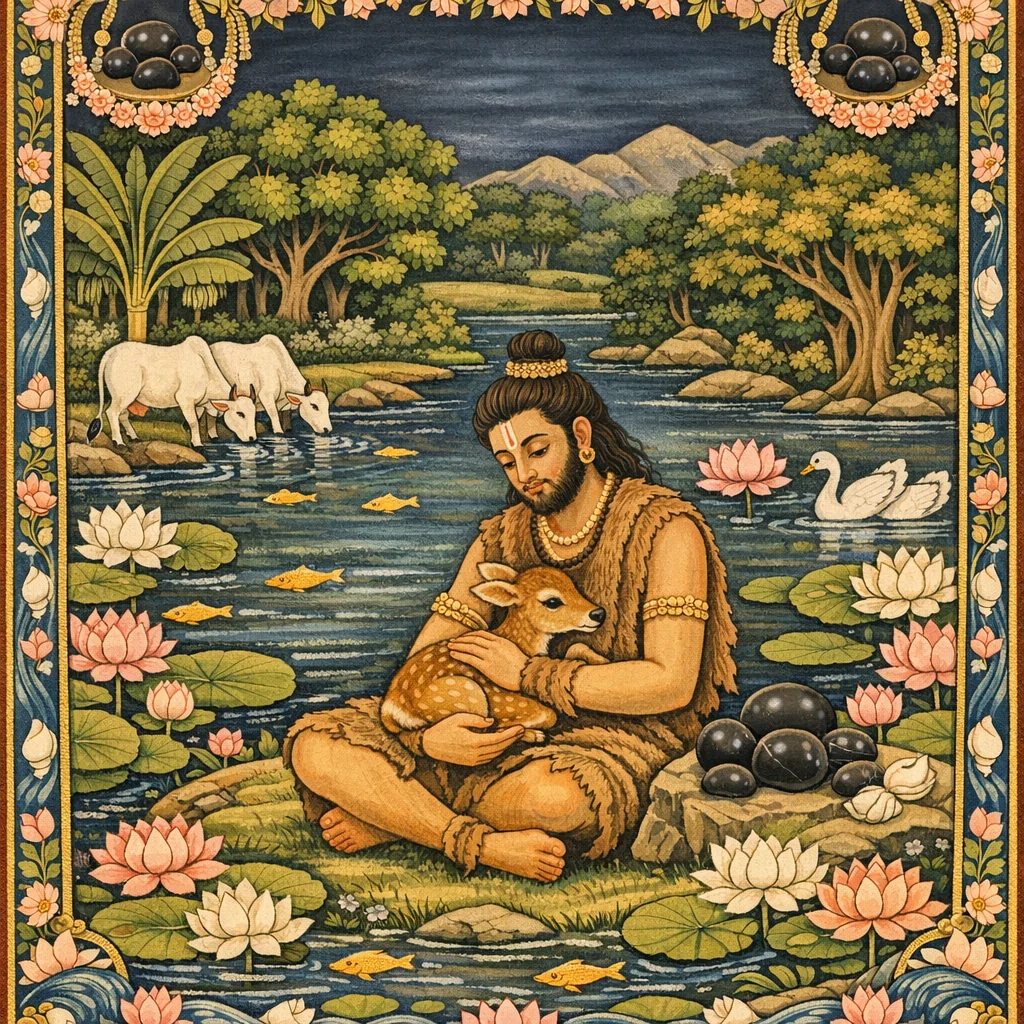
Adhyaya 8
Bharata Mahārāja’s Attachment to a Deer and His Fall from Yoga
Continuing Bharata’s forest renunciation and regulated worship, this chapter marks the decisive turn: after morning ablutions in the Gaṇḍakī, Bharata chants his mantra when a pregnant doe, startled by a nearby lion’s roar, miscarries mid-leap and dies, leaving a fawn drifting in the river. Moved by compassion, Bharata rescues it, but care ripens into possessive affection—feeding, guarding, petting, carrying, and constantly checking the deer—so that he gradually neglects niyama and the worship of Bhagavān. When the deer goes missing, his mind becomes agitated and irrational; he laments, idealizes its footprints, and projects meanings onto the moon, showing how attachment distorts buddhi. Śukadeva explains the fall as karma-driven: despite renunciation, latent impressions reawaken through misplaced saṅga. At death, Bharata’s consciousness fixes on the deer; he attains a deer body yet retains memory due to prior bhakti. Repentant, he avoids bad association, returns to the Śālagrāma region, and waits for death, setting up the next chapter’s continuation of his purification and eventual return to human spiritual pursuit.
Shlokas
Verse 1
श्रीशुक उवाच एकदा तु महानद्यां कृताभिषेकनैयमिकावश्यको ब्रह्माक्षरमभिगृणानो मुहूर्तत्रयमुदकान्त उपविवेश ॥ १ ॥
Śrī Śukadeva Gosvāmī continued: O King, one day, after completing his morning duties—evacuating, urinating, and bathing—Mahārāja Bharata sat for a short while on the bank of the great river Gaṇḍakī and began chanting his mantra, beginning with the praṇava “oṁ”, the sacred brahmākṣara.
Verse 2
तत्र तदा राजन् हरिणी पिपासया जलाशयाभ्याशमेकैवोपजगाम ॥ २ ॥
O King, while Bharata Mahārāja was sitting on the bank of that river, a doe, tormented by thirst, came there alone to drink from the water.
Verse 3
तया पेपीयमान उदके तावदेवाविदूरेण नदतो मृगपतेरुन्नादो लोकभयङ्कर उदपतत् ॥ ३ ॥
As the doe drank the water with deep satisfaction, a lion very nearby let out a thunderous roar. That sound, terrifying to all beings, reached the doe’s ears.
Verse 4
तमुपश्रुत्य सा मृगवधू: प्रकृतिविक्लवा चकितनिरीक्षणा सुतरामपिहरिभयाभिनिवेशव्यग्रहृदया पारिप्लवदृष्टिरगततृषा भयात् सहसैवोच्चक्राम ॥ ४ ॥
Hearing that roar, the doe—by nature ever fearful of being slain—became distraught and looked about in alarm. Her heart, seized by fear of the lion, was unsettled and her eyes darted here and there; though her thirst was not yet quenched, she suddenly leapt across the river in terror.
Verse 5
तस्या उत्पतन्त्या अन्तर्वत्न्या उरुभयावगलितो योनिनिर्गतो गर्भ: स्रोतसि निपपात ॥ ५ ॥
As the pregnant doe sprang in fear, the fawn, dislodged by her overwhelming terror, slipped from her womb and fell into the river’s current.
Verse 6
तत्प्रसवोत्सर्पणभयखेदातुरा स्वगणेन वियुज्यमाना कस्याञ्चिद्दर्यां कृष्णसारसती निपपाताथ च ममार ॥ ६ ॥
Tormented by the fear and anguish of her miscarriage and separated from her herd, the black doe, having crossed the river, became utterly distressed. She fell into a cave and died at once.
Verse 7
तं त्वेणकुणकं कृपणं स्रोतसानूह्यमानमभिवीक्ष्यापविद्धं बन्धुरिवानुकम्पया राजर्षिर्भरत आदाय मृतमातरमित्याश्रमपदमनयत् ॥ ७ ॥
Seated on the riverbank, the great king-sage Bharata saw a helpless fawn, carried along by the current, bereft of its mother. Compassion rose within him; like a true friend he lifted the little deer from the waves and, knowing it was motherless, brought it to his āśrama.
Verse 8
तस्य ह वा एणकुणक उच्चैरेतस्मिन् कृतनिजाभिमानस्याहरहस्तत्पोषणपालनलालनप्रीणनानुध्यानेनात्मनियमा: सहयमा: पुरुषपरिचर्यादय एकैकश: कतिपयेनाहर्गणेन वियुज्यमाना: किल सर्व एवोदवसन् ॥ ८ ॥
Gradually Mahārāja Bharata grew deeply affectionate toward the young deer. He fed it grass, maintained and protected it from tigers and other beasts, stroked it when it itched, and sometimes kissed it in love to keep it comfortable. Absorbed in caring for the deer, he neglected the disciplines of spiritual life and forgot the worship of the Supreme Personality of Godhead; within a few days, even the memory of his spiritual progress faded.
Verse 9
अहो बतायं हरिणकुणक: कृपण ईश्वररथचरणपरिभ्रमणरयेण स्वगणसुहृद् बन्धुभ्य: परिवर्जित: शरणं च मोपसादितो मामेव मातापितरौ भ्रातृज्ञातीन् यौथिकांश्चैवोपेयाय नान्यं कञ्चन वेद मय्यतिविस्रब्धश्चात एव मया मत्परायणस्य पोषणपालनप्रीणनलालनमनसूयुनानुष्ठेयं शरण्योपेक्षादोषविदुषा ॥ ९ ॥
Alas, this helpless young deer, by the force of time—an instrument of the Supreme Lord—has been separated from its herd, friends, and relatives and has taken shelter of me alone. It thinks of me as its father and mother, brother and kin; trusting me completely, it knows no one else. Therefore, without envy, I must surely nourish it, protect it, please it, and fondle it; to neglect one who has sought shelter is a grave fault.
Verse 10
नूनं ह्यार्या: साधव उपशमशीला: कृपणसुहृद एवंविधार्थे स्वार्थानपि गुरुतरानुपेक्षन्ते ॥ १० ॥
Surely the noble and saintly are peaceful by nature and compassionate to suffering beings. To protect one who has taken shelter, they set aside even their own most important personal interests.
Verse 11
इति कृतानुषङ्ग आसनशयनाटनस्नानाशनादिषु सह मृगजहुना स्नेहानुबद्धहृदय आसीत् ॥ ११ ॥
Attached to the deer, Mahārāja Bharata would lie down with it, walk with it, bathe with it, and even eat with it. Thus his heart became bound in affection to the young animal.
Verse 12
कुशकुसुमसमित्पलाशफलमूलोदकान्याहरिष्यमाणो वृकसालावृकादिभ्यो भयमाशंसमानो यदा सह हरिणकुणकेन वनं समाविशति ॥ १२ ॥
Whenever Mahārāja Bharata entered the forest to gather kuśa grass, flowers, firewood, leaves, fruits, roots, and water, he feared that dogs, jackals, tigers, and other ferocious animals might kill the young deer. Therefore, each time he went into the forest, he always took the deer with him.
Verse 13
पथिषु च मुग्धभावेन तत्र तत्र विषक्तमतिप्रणयभरहृदय: कार्पण्यात्स्कन्धेनोद्वहति एवमुत्सङ्ग उरसि चाधायोपलालयन्मुदं परमामवाप ॥ १३ ॥
Along the paths, the fawn’s innocent, childlike ways enchanted Mahārāja Bharata, and his mind clung to it again and again. His heart, heavy with affection, would in compassion lift the deer onto his shoulders and carry it. Sometimes he kept it on his lap, and when he slept, upon his chest—fondling it tenderly and tasting the highest delight.
Verse 14
क्रियायां निर्वर्त्यमानायामन्तरालेऽप्युत्थायोत्थाय यदैनमभिचक्षीत तर्हि वाव स वर्षपति: प्रकृतिस्थेन मनसा तस्मा आशिष आशास्ते स्वस्ति स्ताद्वत्स ते सर्वत इति ॥ १४ ॥
Even while worshiping the Lord or performing a rite, Mahārāja Bharata would, though the act was unfinished, rise again and again at intervals to see where the fawn was. When he saw it resting comfortably, his mind returned to calm satisfaction, and he would bless it: “My dear little one, may auspiciousness be yours in every way.”
Verse 15
अन्यदा भृशमुद्विग्नमना नष्टद्रविण इव कृपण: सकरुणमतितर्षेण हरिणकुणक विरहविह्वलहृदयसन्तापस्तमेवानुशोचन् किल कश्मलं महदभिरम्भित इति होवाच ॥ १५ ॥
At times, when Bharata Mahārāja could not see the fawn, his mind grew intensely disturbed—like a miser who gains wealth only to lose it and fall into misery. The fever of separation scorched his heart; filled with compassion and aching longing, he lamented. Thus, overcome by delusion, he spoke as follows.
Verse 16
अपि बत स वै कृपण एणबालको मृतहरिणीसुतोऽहो ममानार्यस्य शठकिरातमतेरकृतसुकृतस्य कृतविस्रम्भ आत्मप्रत्ययेन तदविगणयन् सुजन इवागमिष्यति ॥ १६ ॥
“Alas, that helpless fawn—its mother is dead. And alas for me, so unworthy: my mind is like a crafty hunter’s, steeped in deceit and cruelty, devoid of true merit; yet it trusted me. Will it return, like a noble soul who overlooks a treacherous friend’s faults, and place its faith in me once more?”
Verse 17
अपि क्षेमेणास्मिन्नाश्रमोपवने शष्पाणि चरन्तं देवगुप्तं द्रक्ष्यामि ॥ १७ ॥
“Alas, shall I see him again, safe within this hermitage-grove—guarded by the Lord, fearless of tigers and other beasts, wandering as he grazes on tender grass?”
Verse 18
अपि च न वृक: सालावृकोऽन्यतमो वा नैकचर एकचरो वा भक्षयति ॥ १८ ॥
I do not know; perhaps the fawn was devoured by a wolf or a dog, by boars that roam in a herd, or by a tiger that wanders alone.
Verse 19
निम्लोचति ह भगवान् सकलजगत्क्षेमोदयस्त्रय्यात्माद्यापि मम न मृगवधून्यास आगच्छति ॥ १९ ॥
Alas! Bhagavan Surya, the source of the world’s welfare and awakening, the very embodiment of the Vedas, is now setting; yet the poor doe who trusted me after her mother’s death has still not returned.
Verse 20
अपिस्विदकृतसुकृतमागत्य मां सुखयिष्यति हरिणराजकुमारो विविधरुचिरदर्शनीयनिजमृगदारकविनोदैरसन्तोषं स्वानामपनुदन् ॥ २० ॥
Will that fawn, like a little prince, return and gladden me? When will it again display its charming plays and lovely ways, soothing my wounded heart? Surely my merit is scant; otherwise it would have returned by now.
Verse 21
क्ष्वेलिकायां मां मृषासमाधिनाऽऽमीलितदृशं प्रेमसंरम्भेण चकितचकित आगत्य पृषदपरुषविषाणाग्रेण लुठति ॥ २१ ॥
Alas, while playing, the little deer would see me feigning samadhi with closed eyes; stirred by a lover’s anger it would approach in startled steps and timidly touch me with the tips of its soft horns, like drops of water.
Verse 22
आसादितहविषि बर्हिषि दूषिते मयोपालब्धो भीतभीत: सपद्युपरतरास ऋषिकुमारवदवहितकरणकलाप आस्ते ॥ २२ ॥
When I set the sacrificial offerings upon the kuśa grass, the deer, in play, would touch the grass with its teeth and thus defile it. When I pushed it away and chastised it, it would at once grow fearful and sit motionless like a sage’s son, restraining its senses and ceasing its play.
Verse 23
किं वा अरे आचरितं तपस्तपस्विन्यानया यदियमवनि: सविनयकृष्णसारतनयतनुतरसुभगशिवतमाखरखुरपदपङ्क्तिभिर्द्रविणविधुरातुरस्य कृपणस्य मम द्रविणपदवीं सूचयन्त्यात्मानं च सर्वत: कृतकौतुकं द्विजानां स्वर्गापवर्गकामानां देवयजनं करोति ॥ २३ ॥
After speaking like a madman, Mahārāja Bharata rose and went outside. Seeing the deer’s hoofprints upon the earth, he praised them with love: “Alas, unfortunate Bharata! My austerity is paltry; this very earth has performed severe penance, and thus the small, beautiful, most auspicious, soft hoofmarks of the kṛṣṇasāra fawn are impressed upon her surface. This line of footprints shows me—wretched and bereft of my ‘wealth’ through separation from the deer—the path it has taken through the forest and the way to regain what I have lost. By these marks this land has also become a fit place for brāhmaṇas who desire heaven or liberation to perform sacrifices to the devas.”
Verse 24
अपिस्विदसौ भगवानुडुपतिरेनं मृगपतिभयान्मृतमातरं मृगबालकं स्वाश्रमपरिभ्रष्टमनुकम्पया कृपणजनवत्सल: परिपाति ॥ २४ ॥
Could it be that Bhagavān Uḍupati—the moon, so affectionate to the wretched—has learned that my fawn has strayed from the āśrama and become motherless out of fear of the lion, and thus, by compassion, shelters it near himself to protect it?
Verse 25
किं वाऽऽत्मजविश्लेषज्वरदवदहनशिखाभिरुपतप्यमानहृदयस्थलनलिनीकं मामुपसृतमृगीतनयं शिशिरशान्तानुरागगुणितनिजवदनसलिलामृतमयगभस्तिभि: स्वधयतीति च ॥ २५ ॥
Or else, seeing the lotus of my heart scorched by the forest-fire flames of separation’s fever—as though I were parted from my own son—because the fawn has come near me, the moon is surely sprinkling me with his cool rays, like nectarean water from his face, as a friend splashes water upon a friend burning with high fever, thus bringing me relief and joy.
Verse 26
एवमघटमानमनोरथाकुलहृदयो मृगदारकाभासेन स्वारब्धकर्मणा योगारम्भणतो विभ्रंशित: स योगतापसो भगवदाराधनलक्षणाच्च कथमितरथा जात्यन्तर एणकुणक आसङ्ग: साक्षान्नि:श्रेयसप्रतिपक्षतया प्राक्परित्यक्तदुस्त्यजहृदयाभिजातस्य तस्यैवमन्तरायविहत योगारम्भणस्य राजर्षेर्भरतस्य तावन्मृगार्भकपोषणपालनप्रीणनलालनानुषङ्गेणाविगणयत आत्मानमहिरिवाखुबिलं दुरतिक्रम: काल: करालरभस आपद्यत ॥ २६ ॥
Śukadeva Gosvāmī continued: My dear King, in this way Bharata’s heart was agitated by an uncontrollable desire, appearing in the form of the fawn. By the fruits of his past karma he fell from mystic yoga, austerity, and the very marks of worship of Bhagavān. Were it not for that karma, how could one who had abandoned the association of son and family—seeing them as obstacles on the path of the highest good—become attached to a deer of another species? Driven by karma, he became absorbed in feeding, maintaining, pleasing, and fondling the fawn, neglecting his own spiritual welfare. Then, in due course, insurmountable Death—like a venomous serpent entering a mouse’s hole—stood before him with dreadful speed.
Verse 27
तदानीमपि पार्श्ववर्तिनमात्मजमिवानुशोचन्तमभिवीक्षमाणो मृग एवाभिनिवेशितमना विसृज्य लोकमिमं सह मृगेण कलेवरं मृतमनु न मृतजन्मानुस्मृतिरितरवन्मृगशरीरमवाप ॥ २७ ॥
At the time of death the King saw the deer sitting by his side, lamenting as if it were his own son. His mind was absorbed in the deer’s body; therefore—like those bereft of Kṛṣṇa consciousness—he left this world, the deer, and his own body, and after death attained the body of a deer. Yet there was one special advantage: though he lost the human form and received a deer’s form, he did not forget the events of his previous life.
Verse 28
तत्रापि ह वा आत्मनो मृगत्वकारणं भगवदाराधनसमीहानुभावेनानुस्मृत्य भृशमनुतप्यमान आह ॥ २८ ॥
Though dwelling in a deer’s body, Bharata Mahārāja, by the power of his firm worship of Bhagavān in his former life, understood the cause of that birth. Remembering his past and present, he repented constantly and spoke as follows.
Verse 29
अहो कष्टं भ्रष्टोऽहमात्मवतामनुपथाद्यद्विमुक्तसमस्तसङ्गस्य विविक्तपुण्यारण्यशरणस्यात्मवत आत्मनि सर्वेषामात्मनां भगवति वासुदेवे तदनुश्रवणमननसङ्कीर्तनाराधनानुस्मरणाभियोगेनाशून्यसकलयामेन कालेन समावेशितं समाहितं कार्त्स्न्येन मनस्तत्तु पुनर्ममाबुधस्यारान्मृगसुतमनु परिसुस्राव ॥ २९ ॥
Alas, what misery! I have fallen from the path of the self-realized. Having renounced all attachments and taken shelter of a solitary, holy forest, I controlled mind and senses and kept my mind absorbed at every moment in devotion to Vāsudeva—hearing, contemplating, chanting, worshiping, and remembering Him. Yet by my own folly my mind again flowed into attachment, this time to a fawn; thus I have gained a deer’s body and fallen far from my devotional practice.
Verse 30
इत्येवं निगूढनिर्वेदो विसृज्य मृगीं मातरं पुनर्भगवत्क्षेत्रमुपशमशीलमुनिगणदयितं शालग्रामं पुलस्त्यपुलहाश्रमं कालञ्जरात्प्रत्याजगाम ॥ ३० ॥
Thus, with deep but hidden detachment and freed from all material concern, he left his mother doe at Kālañjara Mountain. Then he returned again to the Lord’s holy region of Śālagrāma and to the āśrama of Pulastya and Pulaha.
Verse 31
तस्मिन्नपि कालं प्रतीक्षमाणः सङ्गाच्च भृशमुद्विग्नः । आत्मसहचरः शुष्कपर्णतृणवीरुधा वर्तमानो मृगत्वनिमित्तावसानमेव ॥ गणयन्मृगशरीरं तीर्थोदकक्लिन्नमुत्ससर्ज ॥ ३१ ॥
Staying in that āśrama, he waited for his destined time and was greatly wary of bad association. Without revealing his past to anyone, he lived on dry leaves and grasses; he was not truly alone, for the Paramātmā was his companion. Thus, counting only the end of his deerhood, he bathed in the sacred waters there and at last gave up the deer’s body.
Frequently Asked Questions
The lion’s roar functions as a catalyst of kāla (time), precipitating an event that draws Bharata’s compassion into a new object of attachment. The miscarriage and death create an apparently “innocent” scenario where dhayā (mercy) is natural; yet the narrative demonstrates that even virtuous impulses can become binding when they replace exclusive remembrance of Vāsudeva.
Śukadeva explains the fall as the resurfacing of past karma and saṁskāras that redirected Bharata’s attention from Bhagavān to the deer. The practical mechanism is gradual: protective care becomes emotional dependence, which then displaces regulated worship and constant smaraṇa—showing that the mind’s object, not the external status of āśrama, determines steadiness.
Because his consciousness at death was absorbed in the deer, he attained a deer body—illustrating the Bhāgavata principle that anta-kāla-smṛti shapes the next embodiment. The advantage was that, by the strength of prior devotional service, he retained memory and discernment, enabling repentance, detachment, and deliberate avoidance of bad association in his deer life.
No. The chapter affirms that compassion for the surrendered is noble, even for renunciants. The caution is about misplacement and excess: compassion must be harmonized with sādhana so that service to a dependent being does not become a substitute object of love that eclipses worship and remembrance of the Supreme Personality of Godhead.
Pulastya and Pulaha are great ṛṣis associated with sacred hermitage lineages. Bharata’s movement to that āśrama region (near Śālagrāma) signals a return to sanctified association and disciplined living—an intentional strategy to counteract saṅga-driven fall-down by re-rooting consciousness in holy place (tīrtha) and the presence of the Paramātmā.