Adhyaya 20
Pūru-vaṁśa, Duṣmanta–Śakuntalā, and the Rise of Mahārāja Bharata
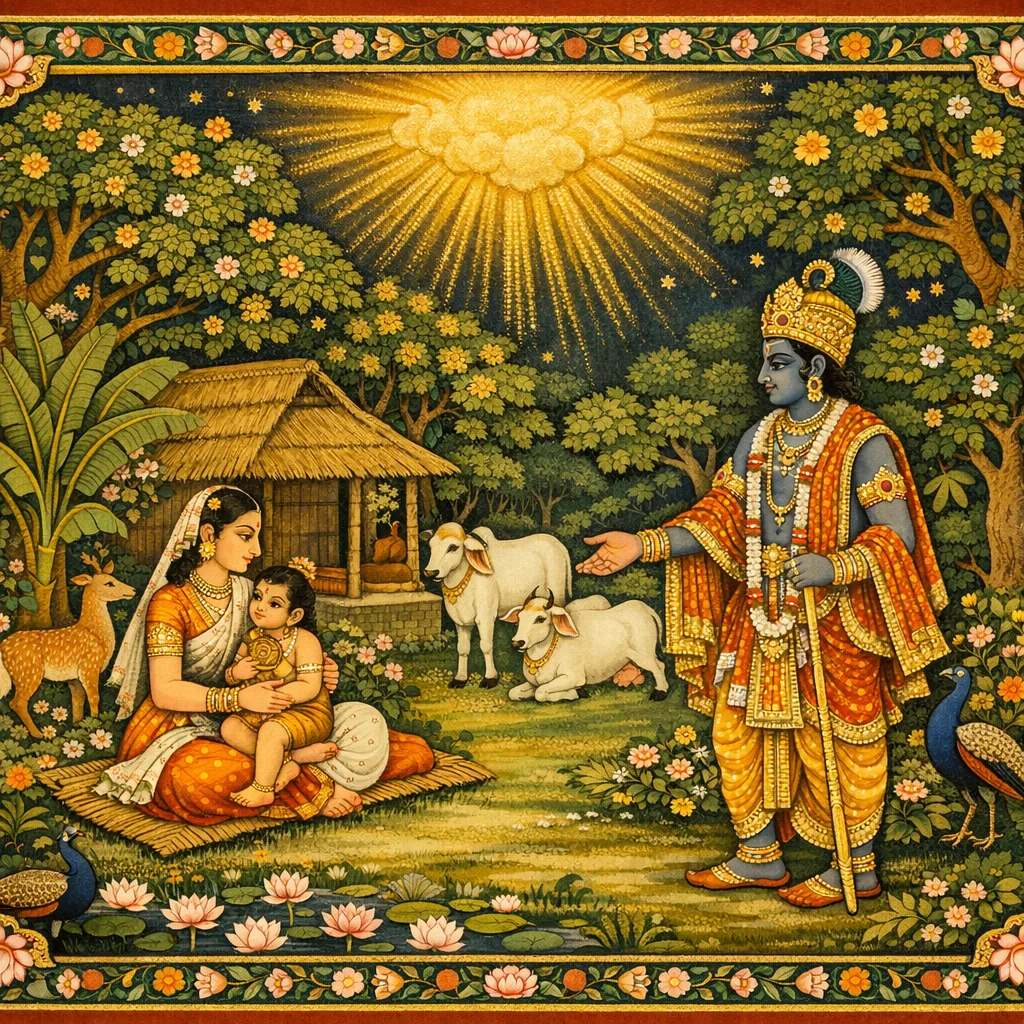
Śukadeva Gosvāmī shifts the dynastic account to the Pūru lineage—the branch in which Mahārāja Parīkṣit is born—naming successive kings and noting that brāhmaṇa lines can also arise from royal descendants. The genealogy reaches Raudrāśva and his ten sons (born of the Apsarā Ghṛtācī), then continues through Ṛteyu to Rantināva and Kaṇva, connecting the line to the setting of Kaṇva’s āśrama. The chapter then turns from lists to lived history: King Duṣmanta meets Śakuntalā in Kaṇva Muni’s forest hermitage, enters a Gandharva marriage, and returns to his capital; Śakuntalā bears a mighty son. When Duṣmanta at first refuses to accept wife and child, a celestial voice establishes the Vedic doctrine of paternity and compels recognition. The son, Bharata, becomes a world emperor, renowned for great yajñas, charity, and the suppression of anti-Vedic forces, yet later regards family attachment as a spiritual impediment. A succession crisis leads to the Marut-stoma sacrifice and the adoption of Bharadvāja; his complex birth (involving Bṛhaspati and Mamatā) is resolved by divine arrangement, preparing the next continuation of the dynasty through Bharata’s successor line.
Shlokas
Verse 1
श्रीबादरायणिरुवाच पूरोर्वंशं प्रवक्ष्यामि यत्र जातोऽसि भारत । यत्र राजर्षयो वंश्या ब्रह्मवंश्याश्च जज्ञिरे ॥ १ ॥
Śukadeva Gosvāmī said: O Mahārāja Parīkṣit, descendant of Bharata, I shall now describe the dynasty of Pūru, in which you were born—where many saintly kings (rājarṣis) appeared, and from which many brāhmaṇa lineages also began.
Verse 2
जनमेजयो ह्यभूत् पूरो: प्रचिन्वांस्तत्सुतस्तत: । प्रवीरोऽथ मनुस्युर्वै तस्माच्चारुपदोऽभवत् ॥ २ ॥
In the Pūru dynasty was born King Janamejaya. His son was Pracinvān, whose son was Pravīra; thereafter Pravīra’s son was Manusyu, and from Manusyu was born a son named Cārupada.
Verse 3
तस्य सुद्युरभूत् पुत्रस्तस्माद् बहुगवस्तत: । संयातिस्तस्याहंयाती रौद्राश्वस्तत्सुत: स्मृत: ॥ ३ ॥
Cārupada’s son was Sudyu, and Sudyu’s son was Bahugava. Bahugava’s son was Saṁyāti; from Saṁyāti came Ahaṁyāti, and from Ahaṁyāti was born Raudrāśva.
Verse 4
ऋतेयुस्तस्य कक्षेयु: स्थण्डिलेयु: कृतेयुक: । जलेयु: सन्नतेयुश्च धर्मसत्यव्रतेयव: ॥ ४ ॥ दशैतेऽप्सरस: पुत्रा वनेयुश्चावम: स्मृत: । घृताच्यामिन्द्रियाणीव मुख्यस्य जगदात्मन: ॥ ५ ॥
Raudrāśva had ten sons—Ṛteyu, Kakṣeyu, Sthaṇḍileyu, Kṛteyuka, Jaleyu, Sannateyu, Dharmeyu, Satyeyu, Vrateyu, and Vaneyu—of whom Vaneyu was the youngest. All were born of the apsarā Ghṛtācī, and as the ten senses move under the rule of the universal life, so these sons acted wholly under their father Raudrāśva’s control.
Verse 5
ऋतेयुस्तस्य कक्षेयु: स्थण्डिलेयु: कृतेयुक: । जलेयु: सन्नतेयुश्च धर्मसत्यव्रतेयव: ॥ ४ ॥ दशैतेऽप्सरस: पुत्रा वनेयुश्चावम: स्मृत: । घृताच्यामिन्द्रियाणीव मुख्यस्य जगदात्मन: ॥ ५ ॥
Raudrāśva had ten sons—Ṛteyu, Kakṣeyu, Sthaṇḍileyu, Kṛteyuka, Jaleyu, Sannateyu, Dharmeyu, Satyeyu, Vrateyu, and Vaneyu—Vaneyu being the youngest. All were born of the apsarā Ghṛtācī, and they remained wholly under their father’s control, as the ten senses are governed by the universal life.
Verse 6
ऋतेयो रन्तिनावोऽभूत् त्रयस्तस्यात्मजा नृप । सुमतिर्ध्रुवोऽप्रतिरथ: कण्वोऽप्रतिरथात्मज: ॥ ६ ॥
Ṛteyu had a son named Rantināva. O King, Rantināva had three sons—Sumati, Dhruva, and Apratiratha. Apratiratha had only one son, who was known as Kaṇva.
Verse 7
तस्य मेधातिथिस्तस्मात् प्रस्कन्नाद्या द्विजातय: । पुत्रोऽभूत् सुमते रेभिर्दुष्मन्तस्तत्सुतो मत: ॥ ७ ॥
Kaṇva’s son was Medhātithi, whose sons were all dvijas (brāhmaṇas), headed by Praskanna and others. Rantināva’s son was Sumati, and Sumati’s son was Rebhi. Mahārāja Duṣmanta is renowned as the son of Rebhi.
Verse 8
दुष्मन्तो मृगयां यात: कण्वाश्रमपदं गत: । तत्रासीनां स्वप्रभया मण्डयन्तीं रमामिव ॥ ८ ॥ विलोक्य सद्यो मुमुहे देवमायामिव स्त्रियम् । बभाषे तां वरारोहां भटै: कतिपयैर्वृत: ॥ ९ ॥
Once, King Duṣmanta went into the forest to hunt and, greatly fatigued, came to the hermitage of Kaṇva Muni. There he beheld a supremely beautiful woman, like Goddess Lakṣmī herself, seated and adorning the entire āśrama with her own radiance. Naturally drawn by her beauty, the King approached her with a few soldiers and spoke to her.
Verse 9
दुष्मन्तो मृगयां यात: कण्वाश्रमपदं गत: । तत्रासीनां स्वप्रभया मण्डयन्तीं रमामिव ॥ ८ ॥ विलोक्य सद्यो मुमुहे देवमायामिव स्त्रियम् । बभाषे तां वरारोहां भटै: कतिपयैर्वृत: ॥ ९ ॥
Once, King Duṣmanta went into the forest to hunt and, greatly fatigued, came to the hermitage of Kaṇva Muni. There he beheld a supremely beautiful woman, like Goddess Lakṣmī herself, seated and adorning the entire āśrama with her own radiance. Naturally drawn by her beauty, the King approached her with a few soldiers and spoke to her.
Verse 10
तद्दर्शनप्रमुदित: सन्निवृत्तपरिश्रम: । पप्रच्छ कामसन्तप्त: प्रहसञ्श्लक्ष्णया गिरा ॥ १० ॥
Seeing her, the King was delighted, and his weariness subsided. Burning with desire, he questioned her with a smile, speaking in gentle, polished words.
Verse 11
का त्वं कमलपत्राक्षि कस्यासि हृदयङ्गमे । किंस्विच्चिकीर्षितं तत्र भवत्या निर्जने वने ॥ ११ ॥
O lotus-eyed beauty, enchantress of the heart—who are you, and whose daughter are you? What is your purpose in this lonely forest? Why do you remain here?
Verse 12
व्यक्तं राजन्यतनयां वेद्म्यहं त्वां सुमध्यमे । न हि चेत: पौरवाणामधर्मे रमते क्वचित् ॥ १२ ॥
O slender-waisted beauty, it is clear to me that you are the daughter of a kṣatriya. I am of the Pūru dynasty; my mind never delights in adharma.
Verse 13
श्रीशकुन्तलोवाच विश्वामित्रात्मजैवाहं त्यक्ता मेनकया वने । वेदैतद् भगवान् कण्वो वीर किं करवाम ते ॥ १३ ॥
Śakuntalā said: I am the daughter of Viśvāmitra. My mother, Menakā, abandoned me in the forest. O hero, the mighty sage Kaṇva knows all this; tell me, how may I serve you?
Verse 14
आस्यतां ह्यरविन्दाक्ष गृह्यतामर्हणं च न: । भुज्यतां सन्ति नीवारा उष्यतां यदि रोचते ॥ १४ ॥
O lotus-eyed King, please sit and accept whatever welcome we can offer. We have nīvārā rice; kindly partake. And if you wish, stay here without hesitation.
Verse 15
श्रीदुष्मन्त उवाच उपपन्नमिदं सुभ्रु जाताया: कुशिकान्वये । स्वयं हि वृणुते राज्ञां कन्यका: सदृशं वरम् ॥ १५ ॥
King Duṣmanta replied: O sūbhrū of lovely brows, you were born in the Kuśika line, and your reception is worthy of your family. Besides, the daughters of kings generally choose for themselves a suitable husband.
Verse 16
ओमित्युक्ते यथाधर्ममुपयेमे शकुन्तलाम् । गान्धर्वविधिना राजा देशकालविधानवित् ॥ १६ ॥
When Śakuntalā replied with silence, as if saying “oṁ,” the agreement was fulfilled according to dharma. Then the King, expert in the laws of marriage and in the rules of time and place, at once married her by the Gandharva rite, uttering the praṇava (oṁkāra).
Verse 17
अमोघवीर्यो राजर्षिर्महिष्यां वीर्यमादधे । श्वोभूते स्वपुरं यात: कालेनासूत सा सुतम् ॥ १७ ॥
King-ṛṣi Duṣmanta, whose virility never proved fruitless, placed his seed at night in the womb of Queen Śakuntalā and at dawn returned to his own city. In due course, Śakuntalā gave birth to a son.
Verse 18
कण्व: कुमारस्य वने चक्रे समुचिता: क्रिया: । बद्ध्वा मृगेन्द्रंतरसा क्रीडति स्म स बालक: ॥ १८ ॥
In the forest, Sage Kaṇva performed all the proper rites for the newborn, such as the jātakarma ceremony and others. Later the boy grew so mighty that he would seize a lion, bind it, and play with it.
Verse 19
तं दुरत्ययविक्रान्तमादाय प्रमदोत्तमा । हरेरंशांशसम्भूतं भर्तुरन्तिकमागमत् ॥ १९ ॥
Śakuntalā, foremost among beautiful women, took her son—whose valor was insurmountable and who was born as a portion of a portion of Lord Hari—and approached her husband, Duṣmanta.
Verse 20
यदा न जगृहे राजा भार्यापुत्रावनिन्दितौ । शृण्वतां सर्वभूतानां खे वागाहाशरीरिणी ॥ २० ॥
When the king refused to accept his blameless wife and son, then, as all present listened, an unembodied voice resounded from the sky as a divine omen.
Verse 21
माता भस्त्रा पितु: पुत्रो येन जात: स एव स: । भरस्व पुत्रं दुष्मन्त मावमंस्था: शकुन्तलाम् ॥ २१ ॥
The voice proclaimed: “The mother is but a vessel, like the skin of a bellows; the son truly belongs to the father, for by Vedic ordinance the father is born again as the son. Therefore, O Duṣmanta, maintain your own child and do not dishonor Śakuntalā.”
Verse 22
रेतोधा: पुत्रो नयति नरदेव यमक्षयात् । त्वं चास्य धाता गर्भस्य सत्यमाह शकुन्तला ॥ २२ ॥
O King Duṣmanta, he who gives the seed is the true father, and the son delivers him from the jurisdiction of Yamarāja. You are the real begetter of this child; Śakuntalā speaks the truth.
Verse 23
पितर्युपरते सोऽपि चक्रवर्ती महायशा: । महिमा गीयते तस्य हरेरंशभुवो भुवि ॥ २३ ॥
When Mahārāja Duṣmanta departed this earth, his illustrious son became a cakravartin emperor. In this world his glory is sung as a partial manifestation of Lord Hari.
Verse 24
चक्रं दक्षिणहस्तेऽस्य पद्मकोशोऽस्य पादयो: । ईजे महाभिषेकेण सोऽभिषिक्तोऽधिराड् विभु: ॥ २४ ॥ पञ्चपञ्चाशता मेध्यैर्गङ्गायामनु वाजिभि: । मामतेयं पुरोधाय यमुनामनु च प्रभु: ॥ २५ ॥ अष्टसप्ततिमेध्याश्वान् बबन्ध प्रददद् वसु । भरतस्य हि दौष्मन्तेरग्नि: साचीगुणे चित: । सहस्रं बद्वशो यस्मिन् ब्राह्मणा गा विभेजिरे ॥ २६ ॥
Mahārāja Bharata, the son of Duṣmanta, bore on the palm of his right hand the mark of Śrī Kṛṣṇa’s disc, and on the soles of his feet the mark of a lotus whorl. Worshiping the Supreme Puruṣa through the grand mahābhiṣeka ceremony, he was anointed and became the sovereign lord of the whole earth. Then, with Māmateya, son of Bhṛgu, as his priest, he performed fifty-five aśvamedha sacrifices on the banks of the Gaṅgā and seventy-eight on the banks of the Yamunā, from Prayāga’s confluence up to the source. Establishing the sacrificial fire in an excellent place, he bestowed vast wealth upon the brāhmaṇas—so many cows that thousands of brāhmaṇas each received one badva (13,084) as their share.
Verse 25
चक्रं दक्षिणहस्तेऽस्य पद्मकोशोऽस्य पादयो: । ईजे महाभिषेकेण सोऽभिषिक्तोऽधिराड् विभु: ॥ २४ ॥ पञ्चपञ्चाशता मेध्यैर्गङ्गायामनु वाजिभि: । मामतेयं पुरोधाय यमुनामनु च प्रभु: ॥ २५ ॥ अष्टसप्ततिमेध्याश्वान् बबन्ध प्रददद् वसु । भरतस्य हि दौष्मन्तेरग्नि: साचीगुणे चित: । सहस्रं बद्वशो यस्मिन् ब्राह्मणा गा विभेजिरे ॥ २६ ॥
Mahārāja Bharata, the son of Duṣmanta, bore on the palm of his right hand the mark of Śrī Kṛṣṇa’s disc, and on the soles of his feet the mark of a lotus whorl. Worshiping the Supreme Puruṣa through the grand mahābhiṣeka ceremony, he was anointed and became the sovereign lord of the whole earth. Then, with Māmateya, son of Bhṛgu, as his priest, he performed fifty-five aśvamedha sacrifices on the banks of the Gaṅgā and seventy-eight on the banks of the Yamunā, from Prayāga’s confluence up to the source. Establishing the sacrificial fire in an excellent place, he bestowed vast wealth upon the brāhmaṇas—so many cows that thousands of brāhmaṇas each received one badva (13,084) as their share.
Verse 26
चक्रं दक्षिणहस्तेऽस्य पद्मकोशोऽस्य पादयो: । ईजे महाभिषेकेण सोऽभिषिक्तोऽधिराड् विभु: ॥ २४ ॥ पञ्चपञ्चाशता मेध्यैर्गङ्गायामनु वाजिभि: । मामतेयं पुरोधाय यमुनामनु च प्रभु: ॥ २५ ॥ अष्टसप्ततिमेध्याश्वान् बबन्ध प्रददद् वसु । भरतस्य हि दौष्मन्तेरग्नि: साचीगुणे चित: । सहस्रं बद्वशो यस्मिन् ब्राह्मणा गा विभेजिरे ॥ २६ ॥
Mahārāja Bharata, the son of Duṣmanta, bore on the palm of his right hand the mark of Śrī Kṛṣṇa’s disc, and on the soles of his feet the mark of a lotus whorl. Worshiping the Supreme Puruṣa through the grand mahābhiṣeka ceremony, he was anointed and became the sovereign lord of the whole earth. Then, with Māmateya, son of Bhṛgu, as his priest, he performed fifty-five aśvamedha sacrifices on the banks of the Gaṅgā and seventy-eight on the banks of the Yamunā, from Prayāga’s confluence up to the source. Establishing the sacrificial fire in an excellent place, he bestowed vast wealth upon the brāhmaṇas—so many cows that thousands of brāhmaṇas each received one badva (13,084) as their share.
Verse 27
त्रयस्त्रिंशच्छतं ह्यश्वान्बद्ध्वा विस्मापयन् नृपान् । दौष्मन्तिरत्यगान्मायां देवानां गुरुमाययौ ॥ २७ ॥
Bharata, the son of Mahārāja Duṣmanta, bound thirty-three hundred horses for those sacrifices and thus astonished the other kings. He surpassed even the splendor of the demigods, for he attained Hari, the supreme spiritual master.
Verse 28
मृगाञ्छुक्लदत: कृष्णान् हिरण्येन परीवृतान् । अदात् कर्मणि मष्णारे नियुतानि चतुर्दश ॥ २८ ॥
When Bharata performed the sacrifice known as Maṣṇāra, he gave in charity fourteen lakhs of excellent elephants—white-tusked, black-bodied, and completely covered with golden ornaments.
Verse 29
भरतस्य महत् कर्म न पूर्वे नापरे नृपा: । नैवापुर्नैव प्राप्स्यन्ति बाहुभ्यां त्रिदिवं यथा ॥ २९ ॥
Mahārāja Bharata’s great deeds were achieved by no kings of the past, nor will any kings of the future achieve them. Just as one cannot reach the heavenly worlds by mere strength of arms, no one can imitate Bharata’s wondrous activities.
Verse 30
किरातहूणान् यवनान् पौण्ड्रान् कङ्कान् खशाञ्छकान् । अब्रह्मण्यनृपांश्चाहन् म्लेच्छान् दिग्विजयेऽखिलान् ॥ ३० ॥
On his campaign of conquest, Mahārāja Bharata defeated or slew all the Kirātas, Hūṇas, Yavanas, Pauṇḍras, Kaṅkas, Khaśas, Śakas, and the mleccha kings who opposed the Vedic principles of brahminical culture.
Verse 31
जित्वा पुरासुरा देवान् ये रसौकांसि भेजिरे । देवस्त्रियो रसां नीता: प्राणिभि: पुनराहरत् ॥ ३१ ॥
Formerly, after conquering the demigods, the asuras took shelter in the lower realm called Rasātala and carried there the wives and daughters of the demigods as well. Mahārāja Bharata, however, rescued those women, along with their attendants, from the demons’ grasp and returned them to the demigods.
Verse 32
सर्वान्कामान् दुदुहतु: प्रजानां तस्य रोदसी । समास्त्रिणवसाहस्रीर्दिक्षु चक्रमवर्तयत् ॥ ३२ ॥
Mahārāja Bharata provided all necessities for his subjects, both on this earth and in the heavenly planets, for twenty-seven thousand years. He circulated his orders and distributed his soldiers in all directions.
Verse 33
स संराड्लोकपालाख्यमैश्वर्यमधिराट् श्रियम् । चक्रं चास्खलितं प्राणान् मृषेत्युपरराम ह ॥ ३३ ॥
As the ruler of the entire universe, Emperor Bharata had the opulences of a great kingdom and unconquerable soldiers. His sons and family had seemed to him to be his entire life. But finally he thought of all this as an impediment to spiritual advancement, and therefore he ceased from enjoying it.
Verse 34
तस्यासन् नृप वैदर्भ्य: पत्न्यस्तिस्र: सुसम्मता: । जघ्नुस्त्यागभयात् पुत्रान् नानुरूपा इतीरिते ॥ ३४ ॥
O King Parīkṣit, Mahārāja Bharata had three pleasing wives, who were daughters of the King of Vidarbha. When all three of them bore children who did not resemble the King, these wives thought that he would consider them unfaithful queens and reject them, and therefore they killed their own sons.
Verse 35
तस्यैवं वितथे वंशे तदर्थं यजत: सुतम् । मरुत्स्तोमेन मरुतो भरद्वाजमुपाददु: ॥ ३५ ॥
The King, his attempt for progeny frustrated in this way, performed a sacrifice named marut-stoma to get a son. The demigods known as the Maruts, being fully satisfied with him, then presented him a son named Bharadvāja.
Verse 36
अन्तर्वत्न्यां भ्रातृपत्न्यां मैथुनाय बृहस्पति: । प्रवृत्तो वारितो गर्भं शप्त्वा वीर्यमुपासृजत् ॥ ३६ ॥
When the demigod named Bṛhaspati was attracted by his brother’s wife, Mamatā, who at that time was pregnant, he desired to have sexual relations with her. The son within her womb forbade this, but Bṛhaspati cursed him and forcibly discharged semen into the womb of Mamatā.
Verse 37
तं त्यक्तुकामां ममतां भर्तुस्त्यागविशङ्किताम् । नामनिर्वाचनं तस्य श्लोकमेनं सुरा जगु: ॥ ३७ ॥
Fearing that her husband would abandon her for bearing an illegitimate son, Mamatā thought of giving up the child; then the demigods resolved the matter by proclaiming a name for him.
Verse 38
मूढे भर द्वाजमिमं भर द्वाजं बृहस्पते । यातौ यदुक्त्वा पितरौ भरद्वाजस्ततस्त्वयम् ॥ ३८ ॥
Bṛhaspati said to Mamatā, “Foolish woman, though this child was born in one man’s wife by another man’s seed, you must still maintain him—Bharadvāja.” Mamatā replied, “O Bṛhaspati, you maintain Bharadvāja!” Saying so, both departed, and thus the child became known as Bharadvāja.
Verse 39
चोद्यमाना सुरैरेवं मत्वा वितथमात्मजम् । व्यसृजन् मरुतोऽबिभ्रन् दत्तोऽयं वितथेऽन्वये ॥ ३९ ॥
Though urged by the demigods to raise the child, Mamatā deemed him “Vitatha”—useless—because of his illicit birth and abandoned him. The Marut demigods then maintained him, and later, when Mahārāja Bharata lamented for want of a son, this child was given to him as his son.
Frequently Asked Questions
Bharata is the son of Duṣmanta and Śakuntalā and is portrayed as a partial representation (aṁśa) of the Supreme Lord’s potency in governance. His importance is theological and civilizational: he embodies rakṣaṇa by upholding Vedic culture, performing major yajñas, giving immense charity, and establishing order. He also exemplifies the Bhāgavatam’s ethical arc—world mastery is ultimately subordinate to spiritual advancement, as he later recognizes attachment to family as an impediment.
The text presents the refusal as a dramatic moral and dharmic crisis—public recognition of lineage, responsibility, and truthfulness is tested in the royal court. The resolution comes through an unembodied celestial voice that cites Vedic injunctions: the son belongs to the father; the father is “born as the son,” and the son delivers the father from Yama’s custody. This divine testimony restores dharma, protects Śakuntalā’s honor, and secures the dynastic continuation.
Gandharva-vivāha is marriage by mutual consent, traditionally recognized for kṣatriyas when conducted within dharmic boundaries. It is mentioned to show that Duṣmanta’s union with Śakuntalā was not illicit but performed according to an accepted Vedic category of marriage, marked here by praṇava (oṁkāra) and the king’s knowledge of marital law—thereby establishing the legitimacy of Bharata’s birth.
The chapter articulates a classical Vedic legal-theological view for inheritance and duty: the father, as procreator, bears primary responsibility for maintenance and recognition, and the son is described as the father’s continuation who grants deliverance from Yamarāja’s bondage. The mother is honored as the bearer, yet the passage emphasizes paternal accountability to prevent abandonment and social injustice—especially when a woman’s chastity and a child’s legitimacy are publicly questioned.
After Bharata’s wives kill their sons out of fear of rejection, Bharata performs the Marut-stoma sacrifice for progeny. The Maruts—storm-deities and attendants of Indra—become pleased and provide him a son named Bharadvāja. The narrative frames this as daiva-vyavasthā: when human arrangements fail and dharma is threatened, divine agencies preserve the continuity of the royal line.