Adhyaya 31
Nārada Instructs the Pracetās: Bhakti as the Goal of All Paths
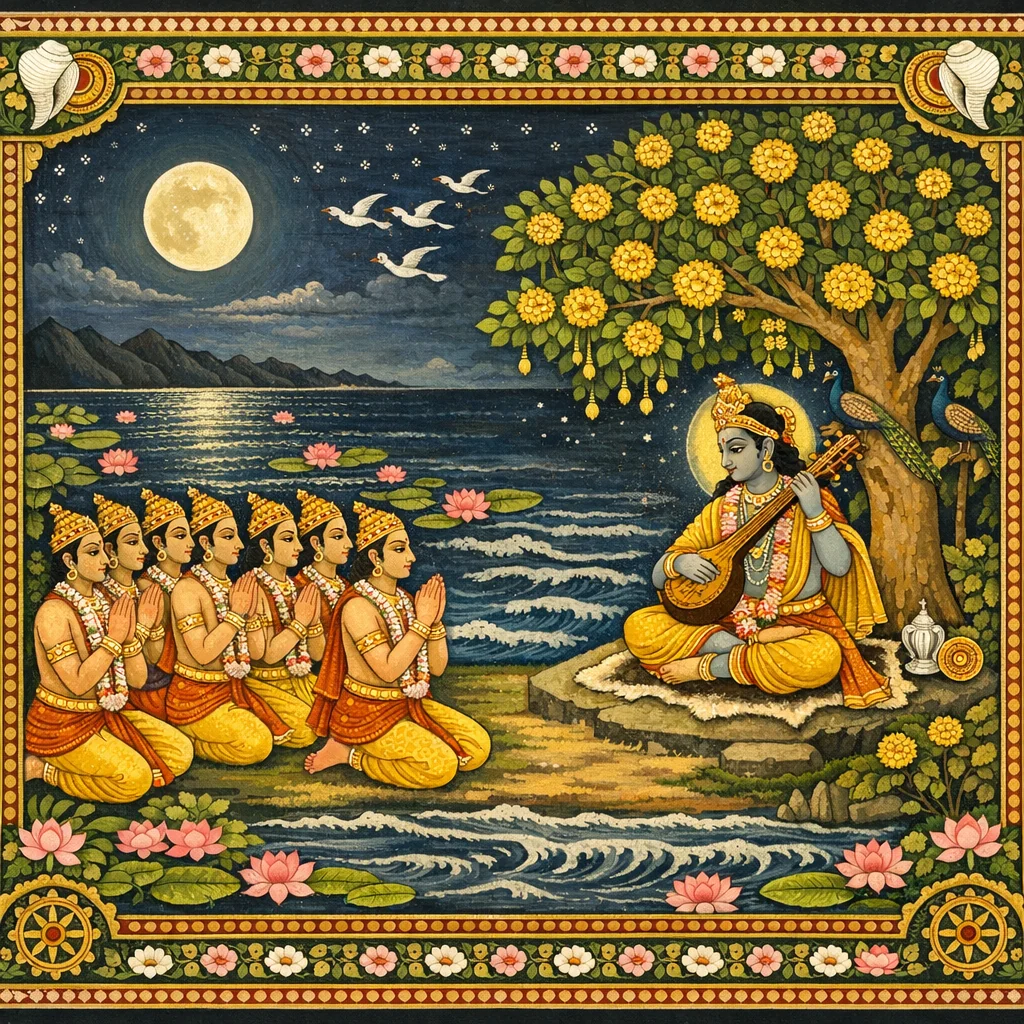
After a long tenure of household life and the cultivation of realized knowledge, the Pracetās remember the Lord’s blessings and renounce, entrusting their wife to the care of a qualified son (v.1). They go to the western seashore near the liberated sage Jājali, perfect an equal vision toward all beings, and deepen Kṛṣṇa consciousness (v.2). Practicing yogic discipline—āsana, prāṇāyāma, and restraint of mind, speech, and senses—they become free from attachment; then Nārada arrives (v.3–4). Honoring him, they confess that family absorption nearly made them forget the earlier teachings of Śiva and Viṣṇu, and they beg for torchlike knowledge to cross ignorance (v.5–7). Nārada teaches that life is perfected only when dedicated to devotional service: even “three births” (biological, initiation, and eligibility for Viṣṇu worship) and lofty disciplines are useless without Hari-bhakti (v.9–13). He portrays the Lord as the root that satisfies all devas (v.14) and explains the cosmos’s emanation from and re-entry into the Lord, stressing simultaneous difference and non-difference and the Lord’s transcendence over the guṇas (v.15–18). He prescribes mercy, contentment, and sense-restraint as swift means to please Janārdana, describing the Lord’s intimate reciprocity with pure devotees and His indifference to proud materialists (v.19–22). Nārada departs; the Pracetās gain firm attachment and advance to the supreme destination (v.23–24). The frame narrative closes: Maitreya finishes for Vidura; Śukadeva turns to Priyavrata’s descendants; Vidura returns to Hastināpura, and the śravaṇa-phala promises both worldly and ultimate benefits to hearers (v.25–31).
Shlokas
Verse 1
मैत्रेय उवाच तत उत्पन्नविज्ञाना आश्वधोक्षजभाषितम् । स्मरन्त आत्मजे भार्यां विसृज्य प्राव्रजन् गृहात् ॥ १ ॥
Maitreya said: Thereafter the Pracetās attained perfect knowledge in spiritual consciousness. Remembering the words and blessings of the Lord Adhokṣaja, they entrusted their wife with the care of a worthy son and departed from home to the life of renunciation.
Verse 2
दीक्षिता ब्रह्मसत्रेण सर्वभूतात्ममेधसा । प्रतीच्यां दिशि वेलायां सिद्धोऽभूद्यत्र जाजलि: ॥ २ ॥
Having been initiated through the brahma-satra and endowed with the wisdom that beholds the Self in all beings, the Pracetās went to the western seashore, where the liberated sage Jājali resided. By perfecting this equal vision, they became accomplished in Kṛṣṇa consciousness.
Verse 3
तान्निर्जितप्राणमनोवचोदृशो जितासनान् शान्तसमानविग्रहान् । परेऽमले ब्रह्मणि योजितात्मन: सुरासुरेड्यो ददृशे स्म नारद: ॥ ३ ॥
By practicing yogic postures, the Pracetās conquered their life air, mind, speech, and outward vision. Through prāṇāyāma they were freed from material attachment, becoming peaceful and equipoised, and they fixed their inner being upon the supreme, stainless Brahman. While they were thus engaged, the great sage Nārada—revered by both devas and asuras—came to see them.
Verse 4
तमागतं त उत्थाय प्रणिपत्याभिनन्द्य च । पूजयित्वा यथादेशं सुखासीनमथाब्रुवन् ॥ ४ ॥
As soon as the Pracetās saw the great sage Nārada arrive, they rose at once from their āsanas. They offered obeisances, welcomed him, and worshiped him as prescribed; and when Nārada Muni was comfortably seated, they began to inquire from him.
Verse 5
प्रचेतस ऊचु: स्वागतं ते सुरर्षेऽद्य दिष्ट्या नो दर्शनं गत: । तव चङ्क्रमणं ब्रह्मन्नभयाय यथा रवे: ॥ ५ ॥
The Pracetās said: Welcome, O devarṣi; by our good fortune we behold you today. O brāhmaṇa, as the sun’s course dispels the fear born of night’s darkness, so your holy wandering drives away every kind of fear.
Verse 6
यदादिष्टं भगवता शिवेनाधोक्षजेन च । तद् गृहेषु प्रसक्तानां प्रायश: क्षपितं प्रभो ॥ ६ ॥
O master, because we became overly attached to household affairs, we have almost forgotten the instructions given to us by Bhagavān Śiva and by Adhokṣaja Śrī Viṣṇu.
Verse 7
तन्न: प्रद्योतयाध्यात्मज्ञानं तत्त्वार्थदर्शनम् । येनाञ्जसा तरिष्यामो दुस्तरं भवसागरम् ॥ ७ ॥
Therefore, please illumine us with spiritual knowledge—the vision of truth—by which we may readily cross this ocean of material existence, so difficult to traverse.
Verse 8
मैत्रेय उवाच इति प्रचेतसां पृष्टो भगवान्नारदो मुनि: । भगवत्युत्तमश्लोक आविष्टात्माब्रवीन्नृपान् ॥ ८ ॥
Maitreya said: Thus petitioned by the Pracetās, the sage Nārada—supreme devotee, ever absorbed in Uttamaśloka, the Supreme Lord—began to reply to those kings.
Verse 9
नारद उवाच तज्जन्म तानि कर्माणि तदायुस्तन्मनो वच: । नृणां येन हि विश्वात्मा सेव्यते हरिरीश्वर: ॥ ९ ॥
Narada said: When one is born to render bhakti-service to Hari, the Supreme Controller and Soul of the universe, then his birth, his deeds, his lifespan, his mind, and his words are truly perfected.
Verse 10
किं जन्मभिस्त्रिभिर्वेह शौक्रसावित्रयाज्ञिकै: । कर्मभिर्वा त्रयीप्रोक्तै: पुंसोऽपि विबुधायुषा ॥ १० ॥
Even if one attains the three births—śaukra, sāvitra, and yājñika—along with Vedic duties and a demigod’s lifespan, without service to the Lord all becomes useless.
Verse 11
श्रुतेन तपसा वा किं वचोभिश्चित्तवृत्तिभि: । बुद्ध्या वा किं निपुणया बलेनेन्द्रियराधसा ॥ ११ ॥
Without devotional service, what value are hearing, austerity, eloquence, mental speculation, refined intelligence, strength, and the power of the senses?
Verse 12
किं वा योगेन साङ्ख्येन न्यासस्वाध्याययोरपि । किं वा श्रेयोभिरन्यैश्च न यत्रात्मप्रदो हरि: ॥ १२ ॥
If Hari, the giver of the true Self, is not realized, then what use are yoga, sāṅkhya, renunciation, Vedic study, or any other auspicious practices? All are futile.
Verse 13
श्रेयसामपि सर्वेषामात्मा ह्यवधिरर्थत: । सर्वेषामपि भूतानां हरिरात्मात्मद: प्रिय: ॥ १३ ॥
In truth, the ultimate end of all auspicious paths is self-realization; and for all beings, Hari is the Soul of the soul, the giver of the Self, and the dearest Lord.
Verse 14
यथा तरोर्मूलनिषेचनेन तृप्यन्ति तत्स्कन्धभुजोपशाखा: । प्राणोपहाराच्च यथेन्द्रियाणां तथैव सर्वार्हणमच्युतेज्या ॥ १४ ॥
As watering a tree’s root nourishes trunk, branches, and twigs, and as feeding the stomach enlivens the senses and limbs, so worship of Acyuta through bhakti automatically fulfills all proper offerings and honors.
Verse 15
यथैव सूर्यात्प्रभवन्ति वार: पुनश्च तस्मिन्प्रविशन्ति काले । भूतानि भूमौ स्थिरजङ्गमानि तथा हरावेव गुणप्रवाह: ॥ १५ ॥
As in the rainy season water is born from the sun and, in the heat of summer, that very water is in time drawn back into the sun, so all beings—moving and unmoving—arise from the earth and at last return to earth as dust. In the same way, everything emanates from the Supreme Personality of Godhead, Śrī Hari, and in due course enters into Him again.
Verse 16
एतत्पदं तज्जगदात्मन: परं सकृद्विभातं सवितुर्यथा प्रभा । यथासवो जाग्रति सुप्तशक्तयो द्रव्यक्रियाज्ञानभिदाभ्रमात्यय: ॥ १६ ॥
As sunlight is not different from the sun, so the cosmic manifestation is not different from the Supreme Personality of Godhead, the Soul of the universe; therefore He pervades this creation. Just as the powers of the senses are manifest in wakefulness but unmanifest in sleep, so the whole cosmos appears different and yet not different from the Supreme Person.
Verse 17
यथा नभस्यभ्रतम:प्रकाशा भवन्ति भूपा न भवन्त्यनुक्रमात् । एवं परे ब्रह्मणि शक्तयस्त्वमू रजस्तम:सत्त्वमिति प्रवाह: ॥ १७ ॥
My dear kings, just as in the sky clouds, darkness, and illumination appear one after another, so within the Supreme Absolute the energies known as rajas, tamas, and sattva flow in sequence—sometimes manifest and sometimes withdrawn.
Verse 18
तेनैकमात्मानमशेषदेहिनां कालं प्रधानं पुरुषं परेशम् । स्वतेजसा ध्वस्तगुणप्रवाह- मात्मैकभावेन भजध्वमद्धा ॥ १८ ॥
Because the Supreme Lord is the cause of all causes, He alone is the Supersoul of all embodied beings—time, pradhāna (material nature), puruṣa, and the supreme controller. By His own effulgence He destroys the flow of the modes and remains untouched by their interactions, as the Lord of material nature. Therefore worship Him directly in devotional service, knowing yourself to be one with Him in spiritual quality.
Verse 19
दयया सर्वभूतेषु सन्तुष्ट्या येन केन वा । सर्वेन्द्रियोपशान्त्या च तुष्यत्याशु जनार्दन: ॥ १९ ॥
By showing mercy to all living beings, by remaining satisfied in whatever way one can, and by restraining the senses from sense enjoyment, one very quickly pleases Janārdana, the Supreme Personality of Godhead.
Verse 20
अपहतसकलैषणामलात्म- न्यविरतमेधितभावनोपहूत: । निजजनवशगत्वमात्मनोऽय- न्न सरति छिद्रवदक्षर: सतां हि ॥ २० ॥
Cleansed of all material longings, the devotees become free from the mind’s defilement. Thus they remember the Lord without interruption and call to Him with heartfelt devotion. Knowing Himself to be conquered by His devotees, the Supreme Personality of Godhead does not leave them even for a moment, just as the sky above never disappears.
Verse 21
न भजति कुमनीषिणां स इज्यां हरिरधनात्मधनप्रियो रसज्ञ: । श्रुतधनकुलकर्मणां मदैर्ये विदधति पापमकिञ्चनेषु सत्सु ॥ २१ ॥
Hari, the relisher of devotional rasa, does not accept the worship of the ill-minded; He is dear to the akincana devotees who possess nothing, yet are fully satisfied with the wealth of devotional service. Those intoxicated by learning, riches, high birth, and fruitive work often offend and deride such saintly, humble devotees; even if they offer worship, the Lord does not receive it.
Verse 22
श्रियमनुचरतीं तदर्थिनश्च द्विपदपतीन् विबुधांश्च यत्स्वपूर्ण: । न भजति निजभृत्यवर्गतन्त्र: कथममुमुद्विसृजेत्पुमान् कृतज्ञ: ॥ २२ ॥
Though fully self-sufficient, the Lord becomes dependent upon His devotees, for He is governed by His own servants. He cares not for Śrī, the goddess of fortune, nor for the kings and demigods who chase her favors. Who, being truly grateful, would not worship the Supreme Lord, so wonderfully conquered by bhakti?
Verse 23
मैत्रेय उवाच इति प्रचेतसो राजन्नन्याश्च भगवत्कथा: । श्रावयित्वा ब्रह्मलोकं ययौ स्वायम्भुवो मुनि: ॥ २३ ॥
The great sage Maitreya continued: My dear King Vidura, Śrī Nārada Muni, the son of Lord Brahmā, thus recounted to the Pracetās these and other narrations concerning their relationship with the Supreme Lord. Thereafter he returned to Brahmaloka.
Verse 24
तेऽपि तन्मुखनिर्यातं यशो लोकमलापहम् । हरेर्निशम्य तत्पादं ध्यायन्तस्तद्गतिं ययु: ॥ २४ ॥
Hearing from Nārada’s mouth the glories of Hari, which dispel all the world’s ill fortune, the Pracetās too became attached to the Supreme Lord. Meditating upon His lotus feet, they attained the highest destination.
Verse 25
एतत्तेऽभिहितं क्षत्तर्यन्मां त्वं परिपृष्टवान् । प्रचेतसां नारदस्य संवादं हरिकीर्तनम् ॥ २५ ॥
O Vidura (kṣattā), I have spoken all that you asked. The dialogue of Nārada and the Pracetās—Hari-kīrtana describing the Lord’s glories—I have related as far as I was able.
Verse 26
श्रीशुक उवाच य एष उत्तानपदो मानवस्यानुवर्णित: । वंश: प्रियव्रतस्यापि निबोध नृपसत्तम ॥ २६ ॥
Śukadeva Gosvāmī continued: O best of kings, Parīkṣit, I have finished describing the line of Uttānapāda, the first son of Svāyambhuva Manu. Now I shall relate the deeds of Priyavrata’s descendants; hear with full attention.
Verse 27
यो नारदादात्मविद्यामधिगम्य पुनर्महीम् । भुक्त्वा विभज्य पुत्रेभ्य ऐश्वरं समगात्पदम् ॥ २७ ॥
Although Mahārāja Priyavrata learned ātma-vidyā from the sage Nārada, he still ruled the earth. After fully enjoying wealth and sovereignty, he divided his kingdom among his sons and at last attained the supreme state, returning home—back to Godhead.
Verse 28
इमां तु कौषारविणोपवर्णितां क्षत्ता निशम्याजितवादसत्कथाम् । प्रवृद्धभावोऽश्रुकलाकुलो मुने- र्दधार मूर्ध्ना चरणं हृदा हरे: ॥ २८ ॥
O King, thus hearing from the great sage Maitreya Kausāravi these sacred narrations of Ajita, the Supreme Lord, Vidura was overwhelmed with ecstasy. Tears filled his eyes as he at once fell at his guru’s lotus feet, and he enshrined Hari within the core of his heart.
Verse 29
विदुर उवाच सोऽयमद्य महायोगिन् भवता करुणात्मना । दर्शितस्तमस: पारो यत्राकिञ्चनगो हरि: ॥ २९ ॥
Vidura said: O great yogin, O foremost devotee, by your causeless mercy I have today been shown the path that leads beyond this world of darkness. By following it, one who becomes free of all possession returns to Hari’s abode—home, back to Godhead.
Verse 30
श्रीशुक उवाच इत्यानम्य तमामन्त्र्य विदुरो गजसाह्वयम् । स्वानां दिदृक्षु: प्रययौ ज्ञातीनां निर्वृताशय: ॥ ३० ॥
Śukadeva Gosvāmī continued: Thus Vidura bowed to the great sage Maitreya and, having taken his permission, departed for Gajasāhvaya—Hastināpura—to see his own kinsmen, though his heart was free from material desire.
Verse 31
एतद्य: शृणुयाद्राजन् राज्ञां हर्यर्पितात्मनाम् । आयुर्धनं यश: स्वस्ति गतिमैश्वर्यमाप्नुयात् ॥ ३१ ॥ ऋषभ उवाच नायं देहो देहभाजां नृलोके कष्टान् कामानर्हते विड्भुजां ये । तपो दिव्यं पुत्रका येन सत्त्वं शुद्ध्येद्यस्माद् ब्रह्मसौख्यं त्वनन्तम् ॥ १ ॥
O King, those who hear these narrations of kings who have wholly offered themselves to Śrī Hari easily attain long life, wealth, good fame, auspicious well-being, and at last the chance to return to the Lord’s own dhāma, along with true opulence.
Frequently Asked Questions
Because the Bhāgavatam defines spiritual success by the satisfaction and realization of the Supreme Personality of Godhead (Hari). Practices like tapas, yoga, sannyāsa, and śāstra-study can refine the mind and senses, but if they do not culminate in devotion—service, remembrance, and surrender to Bhagavān—they remain incomplete and may still reinforce subtle pride or impersonal conclusions. Nārada’s criterion is teleological: the value of any sādhana is measured by whether it awakens loving service to the Lord.
Nārada outlines a Vedic-cultural progression of refinement: (1) śaukra—physical birth from purified parents; (2) sāvitra—second birth through dīkṣā/upanayana-like initiation by the guru, granting access to mantra and regulated life; (3) yājñika—eligibility to worship Viṣṇu through sacrifice/arcana and God-centered ritual life. He then adds the decisive point: even with these privileges and even a demigod’s lifespan, life is ‘useless’ if one does not actually engage in the Lord’s service.
Just as watering a tree’s root nourishes every branch and leaf, worshiping the Supreme Lord automatically satisfies the demigods because they are empowered limbs within His cosmic administration. The analogy is not anti-deva; it is hierarchical theology: devas are honored most correctly when the root—Bhagavān—is served, making separate appeasement unnecessary as an ultimate practice.
Jājali is described here as a great liberated sage residing on the western seashore. The narrative places the Pracetās in a sanctified environment associated with a realized saint, emphasizing their transition from household responsibilities to concentrated sādhana and equal vision (sama-darśana), culminating in Nārada’s decisive bhakti instruction.