Adhyaya 20
Lord Viṣṇu Instructs Pṛthu: Forgiveness, Ātmā-Deha Viveka, and the Bhakti Ideal of Kingship
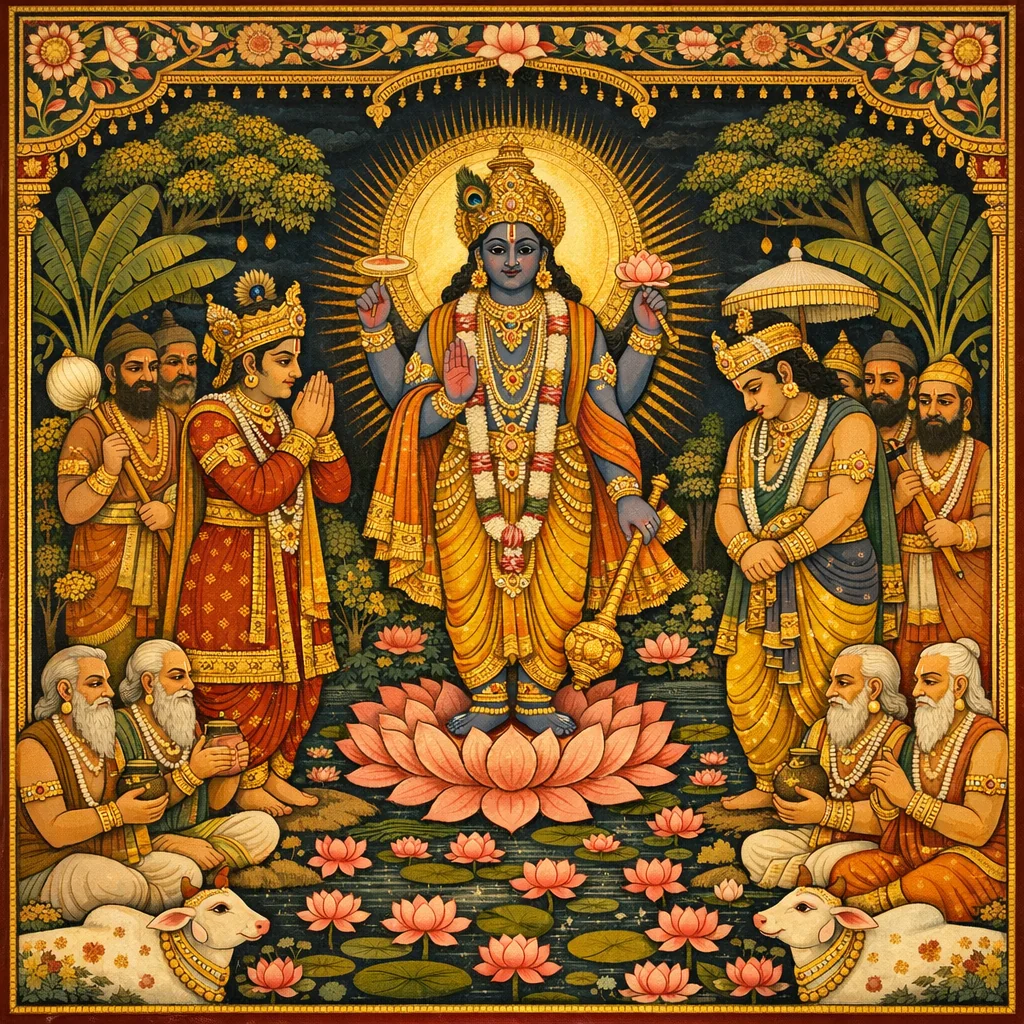
After Indra disrupts Pṛthu’s hundredth aśvamedha and tension rises, Bhagavān Viṣṇu appears personally with Indra to settle the conflict and protect dharma. He urges Pṛthu to forgive Indra, teaching that true greatness is freedom from malice, equanimity, and clear discrimination between the ātmā and the body. A ruler devoted to Him, acting without desire for gain, becomes inwardly satisfied, sees all equally, and remains steady amid happiness and distress. Viṣṇu then defines royal duty: protect the citizens under brāhmaṇical guidance and paramparā-based dharma; taxation without protection is condemned. Though Viṣṇu offers a boon, Pṛthu rejects material blessings and even sāyujya, begging instead for endless capacity to hear the Lord’s glories from pure devotees. Viṣṇu blesses him with steadfast bhakti and instructs careful obedience to divine order. The chapter ends with worship, reconciliation, and Viṣṇu’s departure, preparing for Pṛthu’s continued reign grounded in devotion and humility.
Shlokas
Verse 1
मैत्रेय उवाच । भगवानपि वैकुण्ठः साकं मघवता विभुः । यज्ञैर्यज्ञपतिस्तुष्टो यज्ञभुक् तमभाषत ॥ १ ॥
Maitreya said: Dear Vidura, pleased by the performance of ninety-nine aśvamedha sacrifices, the Lord of Vaikuṇṭha—Śrī Viṣṇu, master and enjoyer of all yajñas—appeared, accompanied by Indra (Maghavā). Then the Lord began to speak.
Verse 2
श्रीभगवानुवाच एष तेऽकार्षीद्भङ्गं हयमेधशतस्य ह । क्षमापयत आत्मानममुष्य क्षन्तुमर्हसि ॥ २ ॥
The Supreme Lord said: My dear King Pṛthu, Indra, the ruler of heaven, has disrupted your completion of the hundred sacrifices. Now he has come with Me seeking your forgiveness; therefore, please pardon him.
Verse 3
सुधिय: साधवो लोके नरदेव नरोत्तमा: । नाभिद्रुह्यन्ति भूतेभ्यो यर्हि नात्मा कलेवरम् ॥ ३ ॥
O king among men, one who is clear in intelligence, saintly in conduct, and eager to do welfare for others is the best of human beings. Knowing that the body is not the self (ātman), he is never malicious toward any creature.
Verse 4
पुरुषा यदि मुह्यन्ति त्वादृशा देवमायया । श्रम एव परं जातो दीर्घया वृद्धसेवया ॥ ४ ॥
If even a person like you—so advanced by faithfully following the instructions of the previous ācāryas—becomes bewildered by My divine māyā, then the progress gained through long service to elders is reduced to mere wasted labor.
Verse 5
अत: कायमिमं विद्वानविद्याकामकर्मभि: । आरब्ध इति नैवास्मिन्प्रतिबुद्धोऽनुषज्जते ॥ ५ ॥
Therefore, the wise, knowing this body to be set in motion by nescience, desire, and actions born of illusion, do not—once awakened—become attached to the body.
Verse 6
असंसक्त: शरीरेऽस्मिन्नमुनोत्पादिते गृहे । अपत्ये द्रविणे वापि क: कुर्यान्ममतां बुध: ॥ ६ ॥
How can a truly learned person, wholly unattached to bodily identity, ever develop possessiveness toward house, children, wealth, and other products of the body?
Verse 7
एक: शुद्ध: स्वयंज्योतिर्निर्गुणोऽसौ गुणाश्रय: । सर्वगोऽनावृत: साक्षी निरात्मात्मात्मन: पर: ॥ ७ ॥
The individual soul is one, pure, nonmaterial, and self-effulgent. He is the shelter of all noble qualities, all-pervading, uncovered by matter, and the witness of every act—distinct from other beings and transcendental to all embodied souls.
Verse 8
य एवं सन्तमात्मानमात्मस्थं वेद पूरुष: । नाज्यते प्रकृतिस्थोऽपि तद्गुणै: स मयि स्थित: ॥ ८ ॥
Though dwelling within material nature, one who thus knows the ātmā and the Paramātmā seated within is never touched by the guṇas, for he remains established in Me through loving bhakti-service.
Verse 9
य: स्वधर्मेण मां नित्यं निराशी: श्रद्धयान्वित: । भजते शनकैस्तस्य मनो राजन् प्रसीदति ॥ ९ ॥
My dear King, one who remains in his own duty (svadharma) and worships Me daily with faith, free from desire for material gain, gradually finds his mind becoming peaceful and satisfied.
Verse 10
परित्यक्तगुण: सम्यग्दर्शनो विशदाशय: । शान्तिं मे समवस्थानं ब्रह्म कैवल्यमश्नुते ॥ १० ॥
When the heart is freed from all material taint, the devotee’s mind becomes broad, clear, and equal-seeing. In that state there is peace, and one abides with Me in My sac-cid-ānanda form, attaining Brahman’s kaivalya.
Verse 11
उदासीनमिवाध्यक्षं द्रव्यज्ञानक्रियात्मनाम् । कूटस्थमिममात्मानं यो वेदाप्नोति शोभनम् ॥ ११ ॥
One who knows that this body—made of the five gross elements, the senses, the organs of action, and the mind—is merely overseen by the unmoving Self, like a detached witness, becomes fit to be freed from material bondage and attains auspicious liberation.
Verse 12
भिन्नस्य लिङ्गस्य गुणप्रवाहो द्रव्यक्रियाकारकचेतनात्मन: । दृष्टासु सम्पत्सु विपत्सु सूरयो न विक्रियन्ते मयि बद्धसौहृदा: ॥ १२ ॥
Lord Viṣṇu told King Pṛthu: Dear King, the ceaseless changes of this material world arise from the interaction of the three guṇas. The five elements, the senses, the presiding devas of the senses, and the mind stirred by the soul—together these make up the body. But the spirit soul is wholly different from this gross and subtle combination; therefore My devotee, bound to Me in deep friendship and love and established in knowledge, is never disturbed by material happiness or distress.
Verse 13
सम: समानोत्तममध्यमाधम: सुखे च दु:खे च जितेन्द्रियाशय: । मयोपक्लृप्ताखिललोकसंयुतो विधत्स्व वीराखिललोकरक्षणम् ॥ १३ ॥
My heroic King, remain always equipoised and treat all people equally—those above you, in the middle, or below. Do not be disturbed by fleeting happiness or distress; fully master mind and senses. In whatever condition My arrangement places you, perform your royal duty, for your chief task is to protect the citizens.
Verse 14
श्रेय: प्रजापालनमेव राज्ञो यत्साम्पराये सुकृतात् षष्ठमंशम् । हर्तान्यथा हृतपुण्य: प्रजाना- मरक्षिता करहारोऽघमत्ति ॥ १४ ॥
A king’s highest good is the protection of his people, for in the next life he receives one sixth of the fruits of their pious deeds. But a ruler who merely collects taxes and does not properly protect the citizens as human beings has his own merit taken away by them, and in return he becomes liable to punishment for the impious acts of his subjects.
Verse 15
एवं द्विजाग्र्यानुमतानुवृत्त धर्मप्रधानोऽन्यतमोऽवितास्या: । ह्रस्वेन कालेन गृहोपयातान् द्रष्टासि सिद्धाननुरक्तलोक: ॥ १५ ॥
Lord Viṣṇu continued: My dear King Pṛthu, if you protect the citizens according to the instructions of the foremost brāhmaṇas—received through disciplic succession by hearing, from guru to disciple—and if you follow the dharma they have established, free from attachment to mental concoctions, then all your people will be happy and will love you; and before long you will behold liberated siddhas such as the four Kumāras—Sanaka, Sanātana, Sanandana, and Sanat-kumāra.
Verse 16
वरं च मत्कञ्चन मानवेन्द्र वृणीष्व तेऽहं गुणशीलयन्त्रित: । नाहं मखैर्वै सुलभस्तपोभि- र्योगेन वा यत्समचित्तवर्ती ॥ १६ ॥
O best of kings, I am captivated by your noble qualities and spotless conduct; therefore ask of Me whatever benediction you desire. One who lacks such elevated character cannot win My favor merely by sacrifices, severe austerities, or mystic yoga. Yet I remain perfectly equipoised within the heart of one who is himself equipoised in all circumstances.
Verse 17
मैत्रेय उवाच स इत्थं लोकगुरुणा विष्वक्सेनेन विश्वजित् । अनुशासित आदेशं शिरसा जगृहे हरे: ॥ १७ ॥
The great sage Maitreya said: Dear Vidura, thus Mahārāja Pṛthu, conqueror of the whole world, having been instructed by the Lord—the universal teacher, Viṣvaksena Hari—accepted the Lord’s command by placing it upon his head in reverence.
Verse 18
स्पृशन्तं पादयो: प्रेम्णा व्रीडितं स्वेन कर्मणा । शतक्रतुं परिष्वज्य विद्वेषं विससर्ज ह ॥ १८ ॥
Indra, ashamed of his own deeds, fell down in affection to touch King Pṛthu’s lotus feet. Yet Pṛthu Mahārāja at once embraced Śatakratu Indra in overflowing joy and cast aside all envy toward him for having stolen the sacrificial horse.
Verse 19
भगवानथ विश्वात्मा पृथुनोपहृतार्हण: । समुज्जिहानया भक्त्या गृहीतचरणाम्बुज: ॥ १९ ॥
The Supreme Lord, the Soul of the universe, accepted the worship offered by Pṛthu and showed him mercy. King Pṛthu abundantly adored the Lord’s lotus feet; and as he worshiped, his devotional ecstasy in bhakti steadily increased, rising ever higher.
Verse 20
प्रस्थानाभिमुखोऽप्येनमनुग्रहविलम्बित: । पश्यन् पद्मपलाशाक्षो न प्रतस्थे सुहृत्सताम् ॥ २० ॥
The Lord was about to depart, yet, out of grace toward Mahārāja Pṛthu’s noble conduct, He lingered. With lotus-leaf eyes, ever the well-wisher of His devotees, He did not leave.
Verse 21
स आदिराजो रचिताञ्जलिर्हरिं विलोकितुं नाशकदश्रुलोचन: । न किञ्चनोवाच स बाष्पविक्लवो हृदोपगुह्यामुमधादवस्थित: ॥ २१ ॥
The original king, Pṛthu, stood with folded hands; his tear-filled eyes could not behold Hari clearly. His voice choked, he spoke nothing—he only embraced the Lord within his heart and remained standing so.
Verse 22
अथावमृज्याश्रुकला विलोकयन्- नतृप्तदृग्गोचरमाह पूरुषम् । पदा स्पृशन्तं क्षितिमंस उन्नते विन्यस्तहस्ताग्रमुरङ्गविद्विष: ॥ २२ ॥
Then the King wiped away his tears and tried to behold the Supreme Person, yet his eyes were not satisfied. The Lord stood as if His lotus feet nearly touched the earth, resting the front of His hand upon the raised shoulder of Garuḍa, enemy of the serpents. Thus Pṛthu offered the following prayers.
Verse 23
पृथुरुवाच वरान्विभो त्वद्वरदेश्वराद् बुध: कथं वृणीते गुणविक्रियात्मनाम् । ये नारकाणामपि सन्ति देहिनां तानीश कैवल्यपते वृणे न च ॥ २३ ॥
Pṛthu said: “O Lord, among all bestowers of boons You are the supreme. Why should a wise man ask You for gifts meant for beings bewildered by nature’s modes? Such boons come even to those who suffer in hell. O Master of liberation, I do not desire even sāyujya—merging into Your existence.”
Verse 24
न कामये नाथ तदप्यहं क्वचिन् न यत्र युष्मच्चरणाम्बुजासव: । महत्तमान्तर्हृदयान्मुखच्युतो विधत्स्व कर्णायुतमेष मे वर: ॥ २४ ॥
O Lord, I do not desire even sāyujya if there is no nectar of Your lotus feet. This is my boon: grant me millions of ears, so I may hear the glories of Your lotus feet from the mouths of Your pure devotees.
Verse 25
स उत्तमश्लोक महन्मुखच्युतो भवत्पदाम्भोजसुधा कणानिल: । स्मृतिं पुनर्विस्मृततत्त्ववर्त्मनां कुयोगिनां नो वितरत्यलं वरै: ॥ २५ ॥
O Uttamaśloka Lord, the transcendental sound that flows from the mouths of great devotees, bearing the saffron-like fragrance of the nectar-dust of Your lotus feet, gradually restores remembrance to souls who have forgotten the path of truth; therefore I seek no other boon than the chance to hear from the lips of Your pure devotee.
Verse 26
यश: शिवं सुश्रव आर्यसङ्गमे यदृच्छया चोपशृणोति ते सकृत् । कथं गुणज्ञो विरमेद्विना पशुं श्रीर्यत्प्रवव्रे गुणसङ्ग्रहेच्छया ॥ २६ ॥
O supremely glorified Lord, whoever in the company of pure devotees hears even once—by chance—the auspicious fame of Your deeds will not abandon their association, unless he is no better than an animal; even Lakṣmī accepted the perfection of hearing and chanting, longing to hear Your limitless līlās and transcendental glories.
Verse 27
अथाभजे त्वाखिलपूरुषोत्तमं गुणालयं पद्मकरेव लालस: । अप्यावयोरेकपतिस्पृधो: कलि- र्न स्यात्कृतत्वच्चरणैकतानयो: ॥ २७ ॥
Now I long to serve Your lotus feet, O Supreme Puruṣottama, reservoir of all transcendental qualities, just as Lakṣmī holds a lotus in her hand; yet I fear that, since we would both be intent on the same service, rivalry might arise between her and me.
Verse 28
जगज्जनन्यां जगदीश वैशसं स्यादेव यत्कर्मणि न: समीहितम् । करोषि फल्ग्वप्युरु दीनवत्सल: स्व एव धिष्ण्येऽभिरतस्य किं तया ॥ २८ ॥
O Lord of the universe, Lakṣmī, the mother of all, may be angered that I intrude upon the service to which she is so attached; yet I hope You will favor me, O compassionate friend of the poor, for You magnify even the smallest service. And You are self-sufficient—what harm could her displeasure do to You?
Verse 29
भजन्त्यथ त्वामत एव साधवो व्युदस्तमायागुणविभ्रमोदयम् । भवत्पदानुस्मरणादृते सतां निमित्तमन्यद्भगवन्न विद्महे ॥ २९ ॥
Therefore the saintly sādhus, freed from the bewildering play of māyā’s guṇas, worship You in bhakti, for only devotion removes the illusion of material existence. O Bhagavān, for liberated souls we know no motive other than constant remembrance of Your lotus feet.
Verse 30
मन्ये गिरं ते जगतां विमोहिनीं वरं वृणीष्वेति भजन्तमात्थ यत् । वाचा नु तन्त्या यदि ते जनोऽसित: कथं पुन: कर्म करोति मोहित: ॥ ३० ॥
My Lord, Your words can bewilder the world; to tell a pure devotee, “Choose a boon,” seems unfitting. Ordinary people, bound by the sweet speech of the Vedas, again and again perform fruit-seeking works, enchanted by the results of their actions.
Verse 31
त्वन्माययाद्धा जन ईश खण्डितो यदन्यदाशास्त ऋतात्मनोऽबुध: । यथा चरेद् बालहितं पिता स्वयं तथा त्वमेवार्हसि न: समीहितुम् ॥ ३१ ॥
My Lord, by Your māyā the living beings forget their true position and, in ignorance, hanker for other material happiness. As a father acts for a child’s welfare without waiting to be asked, so please bestow upon me whatever You know to be best for me.
Verse 32
मैत्रेय उवाच इत्यादिराजेन नुत: स विश्वदृक् तमाह राजन्मयि भक्तिरस्तु ते । दिष्ट्येदृशी धीर्मयि ते कृता यया मायां मदीयां तरति स्म दुस्त्यजाम् ॥ ३२ ॥
Maitreya said: Having heard King Pṛthu’s prayer, the all-seeing Lord addressed him, “O King, may devotion (bhakti) to Me ever remain in you. Blessed is such pure intelligence, by which one crosses My māyā, so difficult to give up.”
Verse 33
तत्त्वं कुरु मयादिष्टमप्रमत्त: प्रजापते । मदादेशकरो लोक: सर्वत्राप्नोति शोभनम् ॥ ३३ ॥
O protector of the people, carry out what I have commanded with full vigilance, and be misled by nothing. One who faithfully executes My orders finds auspiciousness and good fortune everywhere in the world.
Verse 34
मैत्रेय उवाच इति वैन्यस्य राजर्षे: प्रतिनन्द्यार्थवद्वच: । पूजितोऽनुगृहीत्वैनं गन्तुं चक्रेऽच्युतो मतिम् ॥ ३४ ॥
Maitreya said: The infallible Lord (Acyuta) fully appreciated the meaningful prayers of the royal sage Pṛthu. After accepting the King’s proper worship, He blessed him with grace and resolved to depart.
Verse 35
देवर्षिपितृगन्धर्वसिद्धचारणपन्नगा: । किन्नराप्सरसो मर्त्या: खगा भूतान्यनेकश: ॥ ३५ ॥ यज्ञेश्वरधिया राज्ञा वाग्वित्ताञ्जलिभक्तित: । सभाजिता ययु: सर्वे वैकुण्ठानुगतास्तत: ॥ ३६ ॥
King Pṛthu duly worshiped the devas, the divine sages, the Pitṛs, the Gandharvas, Siddhas, Cāraṇas, Pannagas, Kinnaras, Apsarās, mortals, birds, and many other beings who appeared in the sacrificial arena, honoring them with proper rites and bhakti.
Verse 36
देवर्षिपितृगन्धर्वसिद्धचारणपन्नगा: । किन्नराप्सरसो मर्त्या: खगा भूतान्यनेकश: ॥ ३५ ॥ यज्ञेश्वरधिया राज्ञा वाग्वित्ताञ्जलिभक्तित: । सभाजिता ययु: सर्वे वैकुण्ठानुगतास्तत: ॥ ३६ ॥
Knowing Viṣṇu as Yajñeśvara, the King honored the Supreme Personality of Godhead and His personal associates as well, offering sweet words, as much wealth as he could, and folded-hands bhakti; thereafter all returned to their own abodes, following the Lord’s path toward Vaikuṇṭha.
Verse 37
भगवानपि राजर्षे: सोपाध्यायस्य चाच्युत: । हरन्निव मनोऽमुष्य स्वधाम प्रत्यपद्यत ॥ ३७ ॥
The infallible Bhagavān, Acyuta, as though stealing away the hearts of the King and the priests present, returned to His own abode in the spiritual sky.
Verse 38
अदृष्टाय नमस्कृत्य नृप: सन्दर्शितात्मने । अव्यक्ताय च देवानां देवाय स्वपुरं ययौ ॥ ३८ ॥
King Pṛthu offered respectful obeisances to the unmanifest Lord, the God of all devas—though beyond material sight, He had revealed Himself to the King; having bowed down, Pṛthu returned to his city.
Frequently Asked Questions
Viṣṇu’s intervention protects both the sacrificial order and the devotee’s character. He teaches that true advancement is marked by kṣamā, absence of malice, and steady intelligence rooted in ātmā-deha viveka. If Pṛthu—an exemplary king following ācārya-instructions—were to be carried away by anger and rivalry, even religious success (yajña) could become spiritually hollow. Forgiveness thus preserves bhakti and public dharma simultaneously.
The chapter defines protection of citizens as the king’s primary occupational duty. A ruler who protects under brāhmaṇical guidance and paramparā-based principles shares in citizens’ piety, whereas one who merely collects taxes without protection incurs liability for their impiety and loses his own merit. The teaching frames governance as service-accountability before Bhagavān, not as entitlement.
Pṛthu identifies material boons as automatically available within saṁsāra and therefore unworthy of a learned devotee’s request. He also rejects sāyujya because it lacks the ‘nectar’ of devotion—service and relish of the Lord’s lotus feet. By asking for limitless capacity to hear from pure devotees, he chooses śravaṇa-bhakti as the enduring benediction that awakens one’s forgotten relationship with Bhagavān and sustains liberated devotion.
Sanaka, Sanātana, Sanandana, and Sanat-kumāra are eternally liberated sages associated with pristine jñāna and devotion. Viṣṇu indicates that when Pṛthu rules according to brāhmaṇa guidance and avoids mental concoction, such liberated personalities become accessible—signaling that righteous governance aligned with bhakti attracts the highest spiritual association and instruction.