Adhyaya 9
Viśvarūpa’s Death, Vṛtrāsura’s Manifestation, and the Devas’ Surrender to Nārāyaṇa
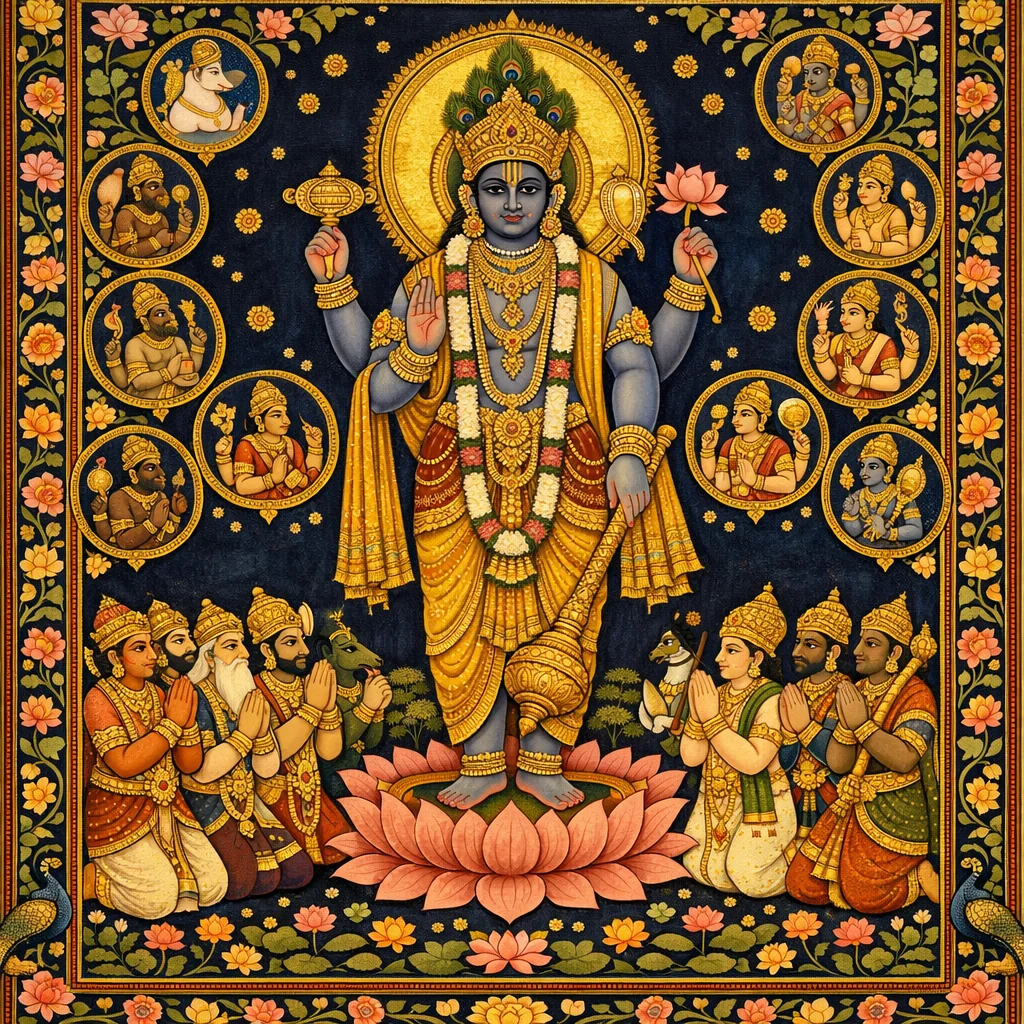
Continuing the Deva–Asura tension intensified by sacrificial intrigue, Śukadeva describes Viśvarūpa serving as the devas’ priest while secretly offering oblations to asuras due to maternal kinship. Indra, fearing defeat, kills Viśvarūpa—incurring brahma-hatyā—and later distributes the sin among earth, trees, women, and water, each receiving a compensatory boon and manifesting a lasting ‘mark’ (deserts, sap, menstruation, foam). In retaliation, Tvaṣṭā performs a rite to produce an Indra-killer; from the Anvāhārya fire arises the terrifying Vṛtra, whose austerity enables him to ‘cover’ the worlds and swallow the devas’ weapons. Overwhelmed, the devas abandon self-reliance and worship the Supersoul, Nārāyaṇa, praising His avatāras and reconciling apparent theological contradictions through His inconceivable śakti. Hari appears with attendants, receives their prayers, and instructs Indra to approach Dadhīci for his body so Viśvakarmā can fashion a bone-vajra empowered by the Lord to slay Vṛtrāsura—while revealing that Vṛtra is also a devotee, reshaping the coming battle as a providential unfolding of bhakti and cosmic order.
Shlokas
Verse 1
श्रीशुक उवाच तस्यासन् विश्वरूपस्य शिरांसि त्रीणि भारत । सोमपीथं सुरापीथमन्नादमिति शुश्रुम ॥ १ ॥
Śrī Śukadeva Gosvāmī continued: Viśvarūpa, who was engaged as the priest of the demigods, had three heads. He used one to drink the beverage soma-rasa, another to drink wine and the third to eat food. O King Parīkṣit, thus I have heard from authorities.
Verse 2
स वै बर्हिषि देवेभ्यो भागं प्रत्यक्षमुच्चकै: । अददद्यस्य पितरो देवा: सप्रश्रयं नृप ॥ २ ॥
O Mahārāja Parīkṣit, the demigods were related to Viśvarūpa from his father’s side, and therefore he visibly offered clarified butter in the fire while chanting mantras such as indrāya idaṁ svāhā [“this is meant for King Indra”] and idam agnaye [“this is for the demigod of fire”]. He loudly chanted these mantras and offered each of the demigods his proper share.
Verse 3
स एव हि ददौ भागं परोक्षमसुरान् प्रति । यजमानोऽवहद् भागं मातृस्नेहवशानुग: ॥ ३ ॥
Although offering clarified butter in the sacrificial fire in the name of the demigods, without the knowledge of the demigods he also offered oblations to the demons because they were his relatives through his mother.
Verse 4
तद्देवहेलनं तस्य धर्मालीकं सुरेश्वर: । आलक्ष्य तरसा भीतस्तच्छीर्षाण्यच्छिनद् रुषा ॥ ४ ॥
Once upon a time, however, the King of heaven, Indra, understood that Viśvarūpa was secretly cheating the demigods by offering oblations on behalf of the demons. He became extremely afraid of being defeated by the demons, and in great anger at Viśvarūpa he cut Viśvarūpa’s three heads from his shoulders.
Verse 5
सोमपीथं तु यत्तस्य शिर आसीत् कपिञ्जल: । कलविङ्क: सुरापीथमन्नादं यत् स तित्तिरि: ॥ ५ ॥
Thereafter, the head meant for drinking soma-rasa was transformed into a kapiñjala [francolin partridge]. Similarly, the head meant for drinking wine was transformed into a kalaviṅka [sparrow], and the head meant for eating food became a tittiri [common partridge].
Verse 6
ब्रह्महत्यामञ्जलिना जग्राह यदपीश्वर: । संवत्सरान्ते तदघं भूतानां स विशुद्धये । भूम्यम्बुद्रुमयोषिद्भ्यश्चतुर्धा व्यभजद्धरि: ॥ ६ ॥
Although Indra was so powerful that he could neutralize the sinful reactions for killing a brāhmaṇa, he repentantly accepted the burden of these reactions with folded hands. He suffered for one year, and then to purify himself he distributed the reactions for this sinful killing among the earth, water, trees and women.
Verse 7
भूमिस्तुरीयं जग्राह खातपूरवरेण वै । ईरिणं ब्रह्महत्याया रूपं भूमौ प्रदृश्यते ॥ ७ ॥
In return for King Indra’s benediction that ditches in the earth would be filled automatically, the land accepted one fourth of the sinful reactions for killing a brāhmaṇa. Because of those sinful reactions, we find many deserts on the surface of the earth.
Verse 8
तुर्यं छेदविरोहेण वरेण जगृहुर्द्रुमा: । तेषां निर्यासरूपेण ब्रह्महत्या प्रदृश्यते ॥ ८ ॥
In return for Indra’s benediction that their branches and twigs would grow back when trimmed, the trees accepted one fourth of the reactions for killing a brāhmaṇa. These reactions are visible in the flowing of sap from trees. [Therefore one is forbidden to drink this sap.]
Verse 9
शश्वत्कामवरेणांहस्तुरीयं जगृहु: स्त्रिय: । रजोरूपेण तास्वंहो मासि मासि प्रदृश्यते ॥ ९ ॥
In return for Lord Indra’s benediction that they would be able to enjoy lusty desires continuously, even during pregnancy for as long as sex is not injurious to the embryo, women accepted one fourth of the sinful reactions. As a result of those reactions, women manifest the signs of menstruation every month.
Verse 10
द्रव्यभूयोवरेणापस्तुरीयं जगृहुर्मलम् । तासु बुद्बुदफेनाभ्यां दृष्टं तद्धरति क्षिपन् ॥ १० ॥
And in return for King Indra’s benediction that water would increase the volume of other substances with which it was mixed, water accepted one fourth of the sinful reactions. Therefore there are bubbles and foam in water. When one collects water, these should be avoided.
Verse 11
हतपुत्रस्ततस्त्वष्टा जुहावेन्द्राय शत्रवे । इन्द्रशत्रो विवर्धस्व मा चिरं जहि विद्विषम् ॥ ११ ॥
After Viśvarūpa was killed, his father, Tvaṣṭā, performed ritualistic ceremonies to kill Indra. He offered oblations in the sacrificial fire, saying, “O enemy of Indra, flourish to kill your enemy without delay.”
Verse 12
अथान्वाहार्यपचनादुत्थितो घोरदर्शन: । कृतान्त इव लोकानां युगान्तसमये यथा ॥ १२ ॥
Thereafter, from the southern side of the sacrificial fire known as Anvāhārya came a fearful personality who looked like the destroyer of the entire creation at the end of the millennium.
Verse 13
विष्वग्विवर्धमानं तमिषुमात्रं दिने दिने । दग्धशैलप्रतीकाशं सन्ध्याभ्रानीकवर्चसम् ॥ १३ ॥ तप्तताम्रशिखाश्मश्रुं मध्याह्नार्कोग्रलोचनम् ॥ १४ ॥ देदीप्यमाने त्रिशिखे शूल आरोप्य रोदसी । नृत्यन्तमुन्नदन्तं च चालयन्तं पदा महीम् ॥ १५ ॥ दरीगम्भीरवक्त्रेण पिबता च नभस्तलम् । लिहता जिह्वयर्क्षाणि ग्रसता भुवनत्रयम् ॥ १६ ॥ महता रौद्रदंष्ट्रेण जृम्भमाणं मुहुर्मुहु: । वित्रस्ता दुद्रुवुर्लोका वीक्ष्य सर्वे दिशो दश ॥ १७ ॥
Like arrows released in the four directions, the demon’s body grew, day after day. Tall and blackish, he appeared like a burnt hill and was as lustrous as a bright array of clouds in the evening. The hair on the demon’s body and his beard and moustache were the color of melted copper, and his eyes were piercing like the midday sun. He appeared unconquerable, as if holding the three worlds on the points of his blazing trident. Dancing and shouting with a loud voice, he made the entire surface of the earth tremble as if from an earthquake. As he yawned again and again, he seemed to be trying to swallow the whole sky with his mouth, which was as deep as a cave. He seemed to be licking up all the stars in the sky with his tongue and eating the entire universe with his long, sharp teeth. Seeing this gigantic demon, everyone, in great fear, ran here and there in all directions.
Verse 14
विष्वग्विवर्धमानं तमिषुमात्रं दिने दिने । दग्धशैलप्रतीकाशं सन्ध्याभ्रानीकवर्चसम् ॥ १३ ॥ तप्तताम्रशिखाश्मश्रुं मध्याह्नार्कोग्रलोचनम् ॥ १४ ॥ देदीप्यमाने त्रिशिखे शूल आरोप्य रोदसी । नृत्यन्तमुन्नदन्तं च चालयन्तं पदा महीम् ॥ १५ ॥ दरीगम्भीरवक्त्रेण पिबता च नभस्तलम् । लिहता जिह्वयर्क्षाणि ग्रसता भुवनत्रयम् ॥ १६ ॥ महता रौद्रदंष्ट्रेण जृम्भमाणं मुहुर्मुहु: । वित्रस्ता दुद्रुवुर्लोका वीक्ष्य सर्वे दिशो दश ॥ १७ ॥
Like arrows released in the four directions, the demon’s body grew, day after day. Tall and blackish, he appeared like a burnt hill and was as lustrous as a bright array of clouds in the evening. The hair on the demon’s body and his beard and moustache were the color of melted copper, and his eyes were piercing like the midday sun. He appeared unconquerable, as if holding the three worlds on the points of his blazing trident. Dancing and shouting with a loud voice, he made the entire surface of the earth tremble as if from an earthquake. As he yawned again and again, he seemed to be trying to swallow the whole sky with his mouth, which was as deep as a cave. He seemed to be licking up all the stars in the sky with his tongue and eating the entire universe with his long, sharp teeth. Seeing this gigantic demon, everyone, in great fear, ran here and there in all directions.
Verse 15
विष्वग्विवर्धमानं तमिषुमात्रं दिने दिने । दग्धशैलप्रतीकाशं सन्ध्याभ्रानीकवर्चसम् ॥ १३ ॥ तप्तताम्रशिखाश्मश्रुं मध्याह्नार्कोग्रलोचनम् ॥ १४ ॥ देदीप्यमाने त्रिशिखे शूल आरोप्य रोदसी । नृत्यन्तमुन्नदन्तं च चालयन्तं पदा महीम् ॥ १५ ॥ दरीगम्भीरवक्त्रेण पिबता च नभस्तलम् । लिहता जिह्वयर्क्षाणि ग्रसता भुवनत्रयम् ॥ १६ ॥ महता रौद्रदंष्ट्रेण जृम्भमाणं मुहुर्मुहु: । वित्रस्ता दुद्रुवुर्लोका वीक्ष्य सर्वे दिशो दश ॥ १७ ॥
Like arrows released in the four directions, the demon’s body grew, day after day. Tall and blackish, he appeared like a burnt hill and was as lustrous as a bright array of clouds in the evening. The hair on the demon’s body and his beard and moustache were the color of melted copper, and his eyes were piercing like the midday sun. He appeared unconquerable, as if holding the three worlds on the points of his blazing trident. Dancing and shouting with a loud voice, he made the entire surface of the earth tremble as if from an earthquake. As he yawned again and again, he seemed to be trying to swallow the whole sky with his mouth, which was as deep as a cave. He seemed to be licking up all the stars in the sky with his tongue and eating the entire universe with his long, sharp teeth. Seeing this gigantic demon, everyone, in great fear, ran here and there in all directions.
Verse 16
विष्वग्विवर्धमानं तमिषुमात्रं दिने दिने । दग्धशैलप्रतीकाशं सन्ध्याभ्रानीकवर्चसम् ॥ १३ ॥ तप्तताम्रशिखाश्मश्रुं मध्याह्नार्कोग्रलोचनम् ॥ १४ ॥ देदीप्यमाने त्रिशिखे शूल आरोप्य रोदसी । नृत्यन्तमुन्नदन्तं च चालयन्तं पदा महीम् ॥ १५ ॥ दरीगम्भीरवक्त्रेण पिबता च नभस्तलम् । लिहता जिह्वयर्क्षाणि ग्रसता भुवनत्रयम् ॥ १६ ॥ महता रौद्रदंष्ट्रेण जृम्भमाणं मुहुर्मुहु: । वित्रस्ता दुद्रुवुर्लोका वीक्ष्य सर्वे दिशो दश ॥ १७ ॥
Like arrows released in the four directions, the demon’s body grew, day after day. Tall and blackish, he appeared like a burnt hill and was as lustrous as a bright array of clouds in the evening. The hair on the demon’s body and his beard and moustache were the color of melted copper, and his eyes were piercing like the midday sun. He appeared unconquerable, as if holding the three worlds on the points of his blazing trident. Dancing and shouting with a loud voice, he made the entire surface of the earth tremble as if from an earthquake. As he yawned again and again, he seemed to be trying to swallow the whole sky with his mouth, which was as deep as a cave. He seemed to be licking up all the stars in the sky with his tongue and eating the entire universe with his long, sharp teeth. Seeing this gigantic demon, everyone, in great fear, ran here and there in all directions.
Verse 17
विष्वग्विवर्धमानं तमिषुमात्रं दिने दिने । दग्धशैलप्रतीकाशं सन्ध्याभ्रानीकवर्चसम् ॥ १३ ॥ तप्तताम्रशिखाश्मश्रुं मध्याह्नार्कोग्रलोचनम् ॥ १४ ॥ देदीप्यमाने त्रिशिखे शूल आरोप्य रोदसी । नृत्यन्तमुन्नदन्तं च चालयन्तं पदा महीम् ॥ १५ ॥ दरीगम्भीरवक्त्रेण पिबता च नभस्तलम् । लिहता जिह्वयर्क्षाणि ग्रसता भुवनत्रयम् ॥ १६ ॥ महता रौद्रदंष्ट्रेण जृम्भमाणं मुहुर्मुहु: । वित्रस्ता दुद्रुवुर्लोका वीक्ष्य सर्वे दिशो दश ॥ १७ ॥
Like arrows released in the four directions, the demon’s body grew, day after day. Tall and blackish, he appeared like a burnt hill and was as lustrous as a bright array of clouds in the evening. The hair on the demon’s body and his beard and moustache were the color of melted copper, and his eyes were piercing like the midday sun. He appeared unconquerable, as if holding the three worlds on the points of his blazing trident. Dancing and shouting with a loud voice, he made the entire surface of the earth tremble as if from an earthquake. As he yawned again and again, he seemed to be trying to swallow the whole sky with his mouth, which was as deep as a cave. He seemed to be licking up all the stars in the sky with his tongue and eating the entire universe with his long, sharp teeth. Seeing this gigantic demon, everyone, in great fear, ran here and there in all directions.
Verse 18
येनावृता इमे लोकास्तपसा त्वाष्ट्रमूर्तिना । स वै वृत्र इति प्रोक्त: पाप: परमदारुण: ॥ १८ ॥
That very fearful demon, who was actually the son of Tvaṣṭā, covered all the planetary systems by dint of austerity. Therefore he was named Vṛtra, or one who covers everything.
Verse 19
तं निजघ्नुरभिद्रुत्य सगणा विबुधर्षभा: । स्वै: स्वैर्दिव्यास्त्रशस्त्रौघै: सोऽग्रसत्तानि कृत्स्नश: ॥ १९ ॥
The demigods, headed by Indra, charged the demon with their soldiers, striking him with their own transcendental bows and arrows and other weapons but Vṛtrāsura swallowed all their weapons.
Verse 20
ततस्ते विस्मिता: सर्वे विषण्णा ग्रस्ततेजस: । प्रत्यञ्चमादिपुरुषमुपतस्थु: समाहिता: ॥ २० ॥
Struck with wonder and disappointment upon seeing the strength of the demon, the demigods lost their own strength. Therefore they all met together to try to please the Supersoul, the Supreme Personality of Godhead, Nārāyaṇa, by worshiping Him.
Verse 21
श्रीदेवा ऊचु: वाय्वम्बराग्न्यप्क्षितयस्त्रिलोका ब्रह्मादयो ये वयमुद्विजन्त: । हराम यस्मै बलिमन्तकोऽसौ बिभेति यस्मादरणं ततो न: ॥ २१ ॥
The demigods said: The three worlds are created by the five elements — namely ether, air, fire, water and earth — which are controlled by various demigods, beginning from Lord Brahmā. Being very much afraid that the time factor will end our existence, we offer presentations unto time by performing our work as time dictates. The time factor himself, however, is afraid of the Supreme Personality of Godhead. Therefore let us now worship that Supreme Lord, who alone can give us full protection.
Verse 22
अविस्मितं तं परिपूर्णकामं स्वेनैव लाभेन समं प्रशान्तम् । विनोपसर्पत्यपरं हि बालिश: श्वलाङ्गुलेनातितितर्ति सिन्धुम् ॥ २२ ॥
Free from all material conceptions of existence and never wonder-struck by anything, the Lord is always jubilant and fully satisfied by His own spiritual perfection. He has no material designations, and therefore He is steady and unattached. That Supreme Personality of Godhead is the only shelter of everyone. Anyone desiring to be protected by others is certainly a great fool who desires to cross the sea by holding the tail of a dog.
Verse 23
यस्योरुशृङ्गे जगतीं स्वनावं मनुर्यथाबध्य ततार दुर्गम् । स एव नस्त्वाष्ट्रभयाद्दुरन्तात् त्राताश्रितान्वारिचरोऽपि नूनम् ॥ २३ ॥
The Manu named King Satyavrata formerly saved himself by tying the small boat of the entire world to the horn of the Matsya avatāra, the fish incarnation. By the grace of the Matsya avatāra, Manu saved himself from the great danger of the flood. May that same fish incarnation save us from the great and fearful danger caused by the son of Tvaṣṭā.
Verse 24
पुरा स्वयम्भूरपि संयमाम्भ- स्युदीर्णवातोर्मिरवै: कराले । एकोऽरविन्दात् पतितस्ततार तस्माद् भयाद्येन स नोऽस्तु पार: ॥ २४ ॥
In the beginning of creation, a tremendous wind caused fierce waves of inundating water. The great waves made such a horrible sound that Lord Brahmā almost fell from his seat on the lotus into the water of devastation, but he was saved with the help of the Lord. Thus we also expect the Lord to protect us from this dangerous condition.
Verse 25
य एक ईशो निजमायया न: ससर्ज येनानुसृजाम विश्वम् ।
The Supreme Personality of Godhead, who created us by His external potency and by whose mercy we expand the creation of the universe, is always situated before us as the Supersoul, but we cannot see His form. We are unable to see Him because all of us think that we are separate and independent gods.
Verse 26
यो न: सपत्नैर्भृशमर्द्यमानान् देवर्षितिर्यङ्नृषु नित्य एव । कृतावतारस्तनुभि: स्वमायया कृत्वात्मसात् पाति युगे युगे च ॥ २६ ॥ तमेव देवं वयमात्मदैवतं परं प्रधानं पुरुषं विश्वमन्यम् । व्रजाम सर्वे शरणं शरण्यं स्वानां स नो धास्यति शं महात्मा ॥ २७ ॥
By His inconceivable internal potency, the Supreme Personality of Godhead expands into various transcendental bodies as Vāmanadeva, the incarnation of strength among the demigods; Paraśurāma, the incarnation among saints; Nṛsiṁhadeva and Varāha, incarnations among animals; and Matsya and Kūrma, incarnations among aquatics. He accepts various transcendental bodies among all types of living entities, and among human beings He especially appears as Lord Kṛṣṇa and Lord Rāma. By His causeless mercy, He protects the demigods, who are always harassed by the demons. He is the supreme worshipable Deity of all living entities. He is the supreme cause, represented as the male and female creative energies. Although different from this universe, He exists in His universal form [virāṭ-rūpa]. In our fearful condition, let us take shelter of Him, for we are sure that the Supreme Lord, the Supreme Soul, will give us His protection.
Verse 27
यो न: सपत्नैर्भृशमर्द्यमानान् देवर्षितिर्यङ्नृषु नित्य एव । कृतावतारस्तनुभि: स्वमायया कृत्वात्मसात् पाति युगे युगे च ॥ २६ ॥ तमेव देवं वयमात्मदैवतं परं प्रधानं पुरुषं विश्वमन्यम् । व्रजाम सर्वे शरणं शरण्यं स्वानां स नो धास्यति शं महात्मा ॥ २७ ॥
By His inconceivable internal potency, the Supreme Personality of Godhead expands into various transcendental bodies as Vāmanadeva, the incarnation of strength among the demigods; Paraśurāma, the incarnation among saints; Nṛsiṁhadeva and Varāha, incarnations among animals; and Matsya and Kūrma, incarnations among aquatics. He accepts various transcendental bodies among all types of living entities, and among human beings He especially appears as Lord Kṛṣṇa and Lord Rāma. By His causeless mercy, He protects the demigods, who are always harassed by the demons. He is the supreme worshipable Deity of all living entities. He is the supreme cause, represented as the male and female creative energies. Although different from this universe, He exists in His universal form [virāṭ-rūpa]. In our fearful condition, let us take shelter of Him, for we are sure that the Supreme Lord, the Supreme Soul, will give us His protection.
Verse 28
श्रीशुक उवाच इति तेषां महाराज सुराणामुपतिष्ठताम् । प्रतीच्यां दिश्यभूदावि: शङ्खचक्रगदाधर: ॥ २८ ॥
Śrī Śukadeva Gosvāmī said: My dear King, when all the demigods offered Him their prayers, the Supreme Personality of Godhead, Lord Hari, carrying His weapons, the conchshell, disc and club, appeared first within their hearts and then before them.
Verse 29
आत्मतुल्यै: षोडशभिर्विना श्रीवत्सकौस्तुभौ । पर्युपासितमुन्निद्रशरदम्बुरुहेक्षणम् ॥ २९ ॥ दृष्ट्वा तमवनौ सर्व ईक्षणाह्लादविक्लवा: । दण्डवत् पतिता राजञ्छनैरुत्थाय तुष्टुवु: ॥ ३० ॥
Surrounding and serving the Supreme Personality of Godhead, Nārāyaṇa, were sixteen personal attendants, decorated with ornaments and appearing exactly like Him but without the mark of Śrīvatsa and the Kaustubha jewel. O King, when all the demigods saw the Supreme Lord in that posture, smiling with eyes like the petals of lotuses grown in autumn, they were overwhelmed with happiness and immediately fell down like rods, offering daṇḍavats. Then they slowly rose and pleased the Lord by offering Him prayers.
Verse 30
आत्मतुल्यै: षोडशभिर्विना श्रीवत्सकौस्तुभौ । पर्युपासितमुन्निद्रशरदम्बुरुहेक्षणम् ॥ २९ ॥ दृष्ट्वा तमवनौ सर्व ईक्षणाह्लादविक्लवा: । दण्डवत् पतिता राजञ्छनैरुत्थाय तुष्टुवु: ॥ ३० ॥
Surrounding and serving the Supreme Personality of Godhead, Nārāyaṇa, were sixteen personal attendants, decorated with ornaments and appearing exactly like Him but without the mark of Śrīvatsa and the Kaustubha jewel. O King, when all the demigods saw the Supreme Lord in that posture, smiling with eyes like the petals of lotuses grown in autumn, they were overwhelmed with happiness and immediately fell down like rods, offering daṇḍavats. Then they slowly rose and pleased the Lord by offering Him prayers.
Verse 31
श्रीदेवा ऊचु: नमस्ते यज्ञवीर्याय वयसे उत ते नम: । नमस्ते ह्यस्तचक्राय नम: सुपुरुहूतये ॥ ३१ ॥
The demigods said: O Supreme Personality of Godhead, You are competent to give the results of sacrifice, and You are also the time factor that destroys all such results in due course. You are the one who releases the cakra to kill the demons. O Lord, who possess many varieties of names, we offer our respectful obeisances unto You.
Verse 32
यत्ते गतीनां तिसृणामीशितु: परमं पदम् । नार्वाचीनो विसर्गस्य धातर्वेदितुमर्हति ॥ ३२ ॥
O supreme controller, You control the three destinations [promotion to the heavenly planets, birth as a human being, and condemnation in hell], yet Your supreme abode is Vaikuṇṭha-dhāma. Since we appeared after You created this cosmic manifestation, Your activities are impossible for us to understand. We therefore have nothing to offer You but our humble obeisances.
Verse 33
ॐ नमस्तेऽस्तु भगवन्नारायण वासुदेवादिपुरुष महापुरुष महानुभाव परममङ्गल परमकल्याण परमकारुणिक केवल जगदाधार लोकैकनाथ सर्वेश्वर लक्ष्मीनाथ परमहंसपरिव्राजकै: परमेणात्मयोगसमाधिना परिभावितपरिस्फुटपारमहंस्यधर्मेणोद्घाटिततम:कपाट द्वारे चित्तेऽपावृत आत्मलोके स्वयमुपलब्धनिजसुखानुभवो भवान् ॥ ३३ ॥
O Supreme Personality of Godhead, O Nārāyaṇa, O Vāsudeva, original person! O most exalted person, supreme experience, welfare personified! O supreme benediction, supremely merciful and changeless! O support of the cosmic manifestation, sole proprietor of all planetary systems, master of everything and husband of the goddess of fortune! Your Lordship is realized by the topmost sannyāsīs, who wander about the world to preach Kṛṣṇa consciousness, fully absorbed in samādhi through bhakti-yoga. Because their minds are concentrated upon You, they can receive the conception of Your personality in their fully purified hearts. When the darkness in their hearts is completely eradicated and You are revealed to them, the transcendental bliss they enjoy is the transcendental form of Your Lordship. No one but such persons can realize You. Therefore we simply offer You our respectful obeisances.
Verse 34
दुरवबोध इव तवायं विहारयोगो यदशरणोऽशरीर इदमनवेक्षितास्मत्समवाय आत्मनैवाविक्रियमाणेन सगुणमगुण: सृजसि पासि हरसि ॥ ३४ ॥
O Lord, You need no support, and although You have no material body, You do not need cooperation from us. Since You are the cause of the cosmic manifestation and You supply its material ingredients without being transformed, You create, maintain and annihilate this cosmic manifestation by Yourself. Nevertheless, although You appear engaged in material activity, You are transcendental to all material qualities. Consequently these transcendental activities of Yours are extremely difficult to understand.
Verse 35
अथ तत्र भवान् किं देवदत्तवदिह गुणविसर्गपतित: पारतन्त्र्येण स्वकृतकुशलाकुशलं फलमुपाददात्याहोस्विदात्माराम उपशमशील: समञ्जसदर्शन उदास्त इति ह वाव न विदाम: ॥ ३५ ॥
These are our inquiries. The ordinary conditioned soul is subject to the material laws, and he thus receives the fruits of his actions. Does Your Lordship, like an ordinary human being, exist within this material world in a body produced by the material modes? Do You enjoy or suffer the good or bad results of actions under the influence of time, past work and so forth? Or, on the contrary, are You present here only as a neutral witness who is self-sufficient, free from all material desires, and always full of spiritual potency? We certainly cannot understand Your actual position.
Verse 36
न हि विरोध उभयं भगवत्यपरिमितगुणगण ईश्वरेऽनवगाह्यमाहात्म्येऽर्वाचीनविकल्पवितर्कविचारप्रमाणाभासकुतर्कशास्त्रकलिलान्त:करणाश्रयदुरवग्रहवादिनां विवादानवसर उपरत समस्तमायामये केवल एवात्ममायामन्तर्धाय को न्वर्थो दुर्घट इव भवति स्वरूपद्वयाभावात् ॥ ३६ ॥
O Supreme Personality of Godhead, all contradictions can be reconciled in You. O Lord, since You are the Supreme Person, the reservoir of unlimited spiritual qualities, the supreme controller, Your unlimited glories are inconceivable to the conditioned souls. Many modern theologians argue about right and wrong without knowing what is actually right. Their arguments are always false and their judgments inconclusive because they have no authorized evidence with which to gain knowledge of You. Because their minds are agitated by scriptures containing false conclusions, they are unable to understand the truth concerning You. Furthermore, because of polluted eagerness to arrive at the right conclusion, their theories are incapable of revealing You, who are transcendental to their material conceptions. You are one without a second, and therefore in You contradictions like doing and not doing, happiness and distress, are not contradictory. Your potency is so great that it can do and undo anything as You like. With the help of that potency, what is impossible for You? Since there is no duality in Your constitutional position, You can do everything by the influence of Your energy.
Verse 37
समविषममतीनां मतमनुसरसि यथा रज्जुखण्डः सर्पादिधियाम् ॥ ३७ ॥
A rope causes fear for a bewildered person who considers it a snake, but not for a person with proper intelligence who knows it to be only a rope. Similarly, You, as the Supersoul in everyone’s heart, inspire fear or fearlessness according to one’s intelligence, but in You there is no duality.
Verse 38
स एव हि पुन: सर्ववस्तुनि वस्तुस्वरूप: सर्वेश्वर: सकलजगत्कारणकारणभूत: सर्व प्रत्यगात्मत्वात् सर्वगुणाभासोपलक्षित एक एव पर्यवशेषित: ॥ ३८ ॥
With deliberation, one will see that the Supreme Soul, although manifested in different ways, is actually the basic principle of everything. The total material energy is the cause of the material manifestation, but the material energy is caused by Him. Therefore He is the cause of all causes, the manifester of intelligence and the senses. He is perceived as the Supersoul of everything. Without Him, everything would be dead. You, as that Supersoul, the supreme controller, are the only one remaining.
Verse 39
अथ ह वाव तव महिमामृतरससमुद्रविप्रुषा सकृदवलीढया स्वमनसि निष्यन्दमानानवरतसुखेन विस्मारितदृष्टश्रुतविषयसुखलेशाभासा: परमभागवता एकान्तिनो भगवति सर्वभूतप्रियसुहृदि सर्वात्मनि नितरां निरन्तरं निर्वृतमनस: कथमु ह वा एते मधुमथन पुन: स्वार्थकुशला ह्यात्मप्रियसुहृद: साधवस्त्वच्चरणाम्बुजानुसेवां विसृजन्ति न यत्र पुनरयं संसारपर्यावर्त: ॥ ३९ ॥
Therefore, O killer of the Madhu demon, incessant transcendental bliss flows in the minds of those who have even once tasted but a drop of the nectar from the ocean of Your glories. Such exalted devotees forget the tiny reflection of so-called material happiness produced from the material senses of sight and sound. Free from all desires, such devotees are the real friends of all living entities. Offering their minds unto You and enjoying transcendental bliss, they are expert in achieving the real goal of life. O Lord, You are the soul and dear friend of such devotees, who never need return to this material world. How could they give up engagement in Your devotional service?
Verse 40
त्रिभुवनात्मभवन त्रिविक्रम त्रिनयन त्रिलोकमनोहरानुभाव तवैव विभूतयो दितिजदनुजादयश्चापि तेषामुपक्रमसमयोऽयमिति स्वात्ममायया सुरनरमृगमिश्रित जलचराकृतिभिर्यथापराधं दण्डं दण्डधर दधर्थ एवमेनमपि भगवञ्जहि त्वाष्ट्रमुत यदि मन्यसे ॥ ४० ॥
O Lord, O personified three worlds, father of the three worlds! O strength of the three worlds, in the form of the Vāmana incarnation! O three-eyed form of Nṛsiṁhadeva! O most beautiful person within the three worlds! Everything and everyone, including human beings and even the Daitya demons and the Dānavas, is but an expansion of Your energy. O supremely powerful one, You have always appeared in Your forms as the various incarnations to punish the demons as soon as they become very powerful. You appear as Lord Vāmanadeva, Lord Rāma and Lord Kṛṣṇa. You appear sometimes as an animal like Lord Boar, sometimes a mixed incarnation like Lord Nṛsiṁhadeva and Lord Hayagrīva, and sometimes an aquatic like Lord Fish and Lord Tortoise. Assuming such various forms, You have always punished the demons and Dānavas. We therefore pray that Your Lordship appear today as another incarnation, if You so desire, to kill the great demon Vṛtrāsura.
Verse 41
अस्माकं तावकानां तततत नतानां हरे तव चरणनलिनयुगल ध्यानानुबद्धहृदयनिगडानां स्वलिङ्गविवरणेनात्मसात्कृतानामनुकम्पानुरञ्जितविशदरुचिरशिशिरस्मितावलोकेन विगलित मधुरमुख रसामृत कलया चान्तस्तापमनघार्हसि शमयितुम् ॥ ४१ ॥
O supreme protector, O grandfather, O supreme pure, O Lord! We are all surrendered souls at Your lotus feet. Indeed, our minds are bound to Your lotus feet in meditation by chains of love. Now please manifest Your incarnation. Accepting us as Your own eternal servants and devotees, be pleased with us and sympathetic toward us. By Your love-filled glance, with its cool and pleasing smile of sympathy, and by the sweet, nectarean words emanating from Your beautiful face, free us from the anxiety caused by this Vṛtrāsura, who always pains the cores of our hearts.
Verse 42
अथ भगवंस्तवास्माभिरखिलजगदुत्पत्तिस्थितिलयनिमित्तायमानदिव्यमायाविनोदस्य सकलजीवनिकायानामन्तर्हृदयेषु बहिरपि च ब्रह्मप्रत्यगात्मस्वरूपेण प्रधानरूपेण च यथादेशकालदेहावस्थानविशेषं तदुपादानोपलम्भकतयानुभवत: सर्वप्रत्ययसाक्षिण आकाशशरीरस्य साक्षात्परब्रह्मण: परमात्मन: कियानिह वार्थविशेषो विज्ञापनीय: स्याद्विस्फुलिङ्गादिभिरिव हिरण्यरेतस: ॥ ४२ ॥
O Lord, as the small sparks of a fire cannot possibly perform the actions of the whole fire, we sparks of Your Lordship cannot inform You of the necessities of our lives. You are the complete whole. Therefore, of what do we need to inform You? You know everything because You are the original cause of the cosmic manifestation, the maintainer and the annihilator of the entire universal creation. You always engage in Your pastimes with Your spiritual and material energies, for You are the controller of all these varied energies. You exist within all living entities, within the cosmic manifestation, and also beyond them. You exist internally as Parabrahman and externally as the ingredients of the material creation. Therefore, although manifested in various stages, at different times and places, and in various bodies, You, the Personality of Godhead, are the original cause of all causes. Indeed, You are the original element. You are the witness of all activities, but because You are as great as the sky, You are never touched by any of them. You are the witness of everything as Parabrahman and Paramātmā. O Supreme Personality of Godhead, nothing is unknown to You.
Verse 43
अत एव स्वयं तदुपकल्पयास्माकं भगवत: परमगुरोस्तव चरणशतपलाशच्छायां विविधवृजिन संसारपरिश्रमोपशमनीमुपसृतानां वयं यत्कामेनोपसादिता: ॥ ४३ ॥
Dear Lord, You are omniscient, and therefore You know very well why we have taken shelter at Your lotus feet, which provide shade that gives relief from all material disturbances. Since You are the supreme spiritual master and You know everything, we have sought shelter of Your lotus feet for instruction. Please give us relief by counteracting our present distress. Your lotus feet are the only shelter for a fully surrendered devotee and are the only means for subduing all the tribulations of this material world.
Verse 44
अथो ईश जहि त्वाष्ट्रं ग्रसन्तं भुवनत्रयम् । ग्रस्तानि येन न: कृष्ण तेजांस्यस्त्रायुधानि च ॥ ४४ ॥
Therefore, O Lord, O supreme controller, O Lord Kṛṣṇa, please annihilate this dangerous demon Vṛtrāsura, Tvaṣṭā’s son, who has already swallowed all our weapons, our paraphernalia for fighting, and our strength and influence.
Verse 45
हंसाय दह्रनिलयाय निरीक्षकाय कृष्णाय मृष्टयशसे निरुपक्रमाय । सत्सङ्ग्रहाय भवपान्थनिजाश्रमाप्ता- वन्ते परीष्टगतये हरये नमस्ते ॥ ४५ ॥
O Lord, O supreme pure, You live within the core of everyone’s heart and observe all the desires and activities of the conditioned souls. O Supreme Personality of Godhead known as Lord Kṛṣṇa, Your reputation is bright and illuminating. You have no beginning, for You are the beginning of everything. This is understood by pure devotees because You are easily accessible to the pure and truthful. When the conditioned souls are liberated and sheltered at Your lotus feet after roving throughout the material world for many millions of years, they attain the highest success of life. Therefore, O Lord, O Supreme Personality of Godhead, we offer our respectful obeisances at Your lotus feet.
Verse 46
श्रीशुक उवाच अथैवमीडितो राजन् सादरं त्रिदशैर्हरि: । स्वमुपस्थानमाकर्ण्य प्राह तानभिनन्दित: ॥ ४६ ॥
Śrī Śukadeva Gosvāmī continued: O King Parīkṣit, when the demigods offered the Lord their sincere prayers in this way, the Lord listened by His causeless mercy. Being pleased, He then replied to the demigods.
Verse 47
श्रीभगवानुवाच प्रीतोऽहं व: सुरश्रेष्ठा मदुपस्थानविद्यया । आत्मैश्वर्यस्मृति: पुंसां भक्तिश्चैव यया मयि ॥ ४७ ॥
The Supreme Personality of Godhead said: O beloved demigods, you have offered your prayers to Me with great knowledge, and I am certainly most pleased with you. A person is liberated by such knowledge, and thus he remembers My exalted position, which is above the conditions of material life. Such a devotee is fully purified by offering prayers in full knowledge. This is the source of devotional service to Me.
Verse 48
किं दुरापं मयि प्रीते तथापि विबुधर्षभा: । मय्येकान्तमतिर्नान्यन्मत्तो वाञ्छति तत्त्ववित् ॥ ४८ ॥
O best of the intelligent demigods, although it is true that nothing is difficult for one to obtain when I am pleased with him, a pure devotee, whose mind is exclusively fixed upon Me, does not ask Me for anything but the opportunity to engage in devotional service.
Verse 49
न वेद कृपण: श्रेय आत्मनो गुणवस्तुदृक् । तस्य तानिच्छतो यच्छेद्यदि सोऽपि तथाविध: ॥ ४९ ॥
Those who think material assets to be everything or to be the ultimate goal of life are called misers [kṛpaṇas]. They do not know the ultimate necessity of the soul. Moreover, if one awards that which is desired by such fools, he must also be considered foolish.
Verse 50
स्वयं नि:श्रेयसं विद्वान् न वक्त्यज्ञाय कर्म हि । न राति रोगिणोऽपथ्यं वाञ्छतोऽपि भिषक्तम: ॥ ५० ॥
A pure devotee who is fully accomplished in the science of devotional service will never instruct a foolish person to engage in fruitive activities for material enjoyment, not to speak of helping him in such activities. Such a devotee is like an experienced physician, who never encourages a patient to eat food injurious to his health, even if the patient desires it.
Verse 51
मघवन् यात भद्रं वो दध्यञ्चमृषिसत्तमम् । विद्याव्रततप:सारं गात्रं याचत मा चिरम् ॥ ५१ ॥ H
O Maghavan [Indra], all good fortune unto you. I advise you to approach the exalted saint Dadhyañca [Dadhīci]. He has become very accomplished in knowledge, vows and austerities, and his body is very strong. Go ask him for his body without delay.
Verse 52
स वा अधिगतो दध्यङ्ङश्विभ्यां ब्रह्म निष्कलम् । यद्वा अश्वशिरो नाम तयोरमरतां व्यधात् ॥ ५२ ॥
That saintly Dadhyañca, who is also known as Dadhīci, personally assimilated the spiritual science and then delivered it to the Aśvinī-kumāras. It is said that Dadhyañca gave them mantras through the head of a horse. Therefore the mantras are called Aśvaśira. After obtaining the mantras of spiritual science from Dadhīci, the Aśvinī-kumāras became jīvan-mukta, liberated even in this life.
Verse 53
दध्यङ्ङाथर्वणस्त्वष्ट्रे वर्माभेद्यं मदात्मकम् । विश्वरूपाय यत्प्रादात् त्वष्टा यत्त्वमधास्तत: ॥ ५३ ॥
Dadhyañca’s invincible protective covering known as the Nārāyaṇa-kavaca was given to Tvaṣṭā, who delivered it to his son Viśvarūpa, from whom you have received it. Because of this Nārāyaṇa-kavaca, Dadhīci’s body is now very strong. You should therefore beg him for his body.
Verse 54
युष्मभ्यं याचितोऽश्विभ्यां धर्मज्ञोऽङ्गानि दास्यति । ततस्तैरायुधश्रेष्ठो विश्वकर्मविनिर्मित: । येन वृत्रशिरो हर्ता मत्तेजउपबृंहित: ॥ ५४ ॥
When the Aśvinī-kumāras beg for Dadhyañca’s body on your behalf, he will surely give it because of affection. Do not doubt this, for Dadhyañca is very experienced in religious understanding. When Dadhyañca awards you his body, Viśvakarmā will prepare a thunderbolt from his bones. This thunderbolt will certainly kill Vṛtrāsura because it will be invested with My power.
Verse 55
तस्मिन् विनिहते यूयं तेजोऽस्त्रायुधसम्पद: । भूय: प्राप्स्यथ भद्रं वो न हिंसन्ति च मत्परान् ॥ ५५ ॥
When Vṛtrāsura is killed because of My spiritual strength, you will regain your strength, weapons and wealth. Thus there will be all good fortune for all of you. Although Vṛtrāsura can destroy all the three worlds, do not fear that he will harm you. He is also a devotee and will never be envious of you.
Frequently Asked Questions
Indra killed Viśvarūpa upon discovering that oblations were being offered to asuras as well as devas, driven by fear of losing sovereignty. The moral teaching is that fear-based, adharmic action—especially violence against a brāhmaṇa—creates heavy reaction even for powerful administrators, and that cosmic power cannot replace surrender and ethical restraint aligned with the Supreme.
Indra bore the reaction for a year and then apportioned one fourth each to earth, trees, women, and water, granting each a boon in exchange. The ‘signs’ are described as deserts on earth, sap flow in trees (hence restrictions), menstruation in women, and foam/bubbles in water—mythic-ethical markers linking cosmic history, ritual purity concerns, and karmic consequence.
Vṛtrāsura is the formidable being generated by Tvaṣṭā’s sacrificial rite to counter Indra; he becomes so vast by austerity that he ‘covers’ the planetary systems. Thus he is named Vṛtra—“one who covers”—signifying both his cosmic threat and the narrative pressure that drives the devas to take exclusive shelter of Nārāyaṇa.
Their stuti establishes that the Lord grants the fruits of sacrifice yet, as kāla, also dissolves those fruits—showing He is the ultimate controller of karma without being bound by it. This frames a key Bhagavata doctrine: the Supreme reconciles opposites through acintya-śakti, and therefore the safest refuge is bhakti rather than dependence on secondary protectors.
Because Viśvakarmā will fashion a vajra (thunderbolt) from Dadhīci’s bones, empowered by the Lord to kill Vṛtrāsura. The episode highlights yajña-dāna at its highest: voluntary self-sacrifice for dharma under divine instruction, while also stressing that victory comes from the Lord’s śakti, not merely from weapons.
Bhāgavata theology distinguishes external role from inner consciousness: one may appear as an antagonist in the cosmic drama yet possess devotion. By stating that Vṛtrāsura is a devotee and not envious, the text prepares the reader to interpret the coming conflict as spiritually meaningful—where bhakti, not mere faction, is the decisive identity.