Adhyaya 11
Vṛtrāsura Rebukes Indra; Heroic Combat and the Asura’s Pure Devotional Prayers
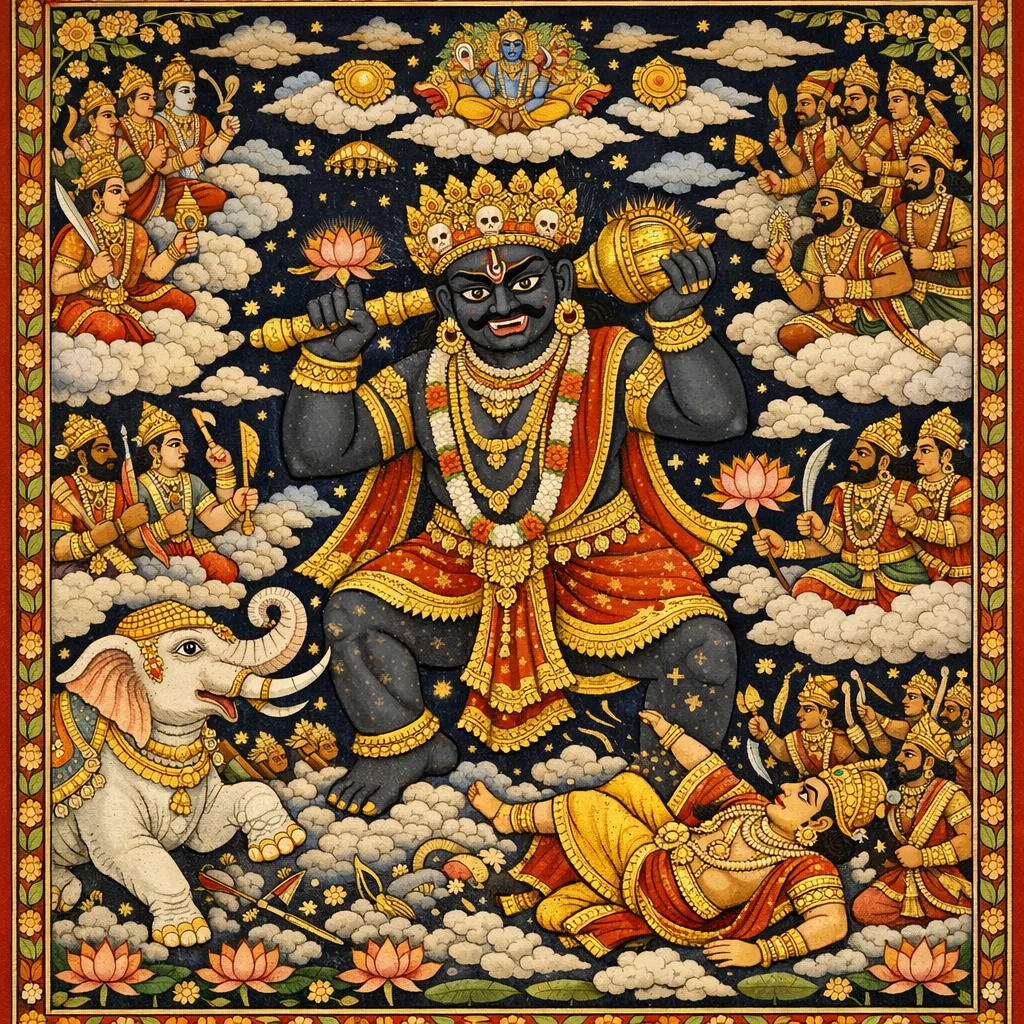
Following the prior escalation of the Indra–Vṛtrāsura conflict (and the background of the thunderbolt empowered by Viṣṇu and Dadhīci), the battle turns when the demigods exploit a tactical moment and strike the demons from behind, scattering their ranks. Vṛtrāsura, distressed at his army’s cowardice, condemns dishonorable warfare and challenges the devas to stand and fight face to face. His roar stuns the battlefield; he advances with trident, tramples the devas, and catches Indra’s hurled club, using it to strike Airāvata and unseat Indra—an act praised by both armies. Yet Vṛtrāsura restrains himself from killing Indra when Indra is vulnerable, modeling a kṣatriya-like adherence to dharma even amid rage. Remembering Indra’s killing of his brāhmaṇa-brother (Viśvarūpa), Vṛtrāsura castigates Indra’s sins, then pivots into theological certainty: Indra will kill him by Viṣṇu’s will. The chapter culminates in Vṛtrāsura’s celebrated bhakti-prayers—rejecting svarga, sovereignty, siddhis, and even impersonal liberation—seeking only eternal servitude to the Lord’s devotees. This devotional climax prepares the next movement of the narrative: Indra’s decisive act with the thunderbolt and the unfolding consequences of divine providence versus personal culpability.
Shlokas
Verse 1
श्रीशुक उवाच त एवं शंसतो धर्मं वच: पत्युरचेतस: । नैवागृह्णन्त सम्भ्रान्ता: पलायनपरा नृप ॥ १ ॥
Śrī Śukadeva Gosvāmī said: O King, Vṛtrāsura, the commander in chief of the demons, advised his lieutenants in the principles of religion, but the cowardly demoniac commanders, intent upon fleeing the battlefield, were so disturbed by fear that they could not accept his words.
Verse 2
विशीर्यमाणां पृतनामासुरीमसुरर्षभ: । कालानुकूलैस्त्रिदशै: काल्यमानामनाथवत् ॥ २ ॥ दृष्ट्वातप्यत सङ्कुद्ध इन्द्रशत्रुरमर्षित: । तान् निवार्यौजसा राजन् निर्भर्त्स्येदमुवाच ह ॥ ३ ॥
O King Parīkṣit, the demigods, taking advantage of a favorable opportunity presented by time, attacked the army of the demons from the rear and began driving away the demoniac soldiers, scattering them here and there as if their army had no leader. Seeing the pitiable condition of his soldiers, Vṛtrāsura, the best of the asuras, who was called Indraśatru, the enemy of Indra, was very much aggrieved. Unable to tolerate such reverses, he stopped and forcefully rebuked the demigods, speaking the following words in an angry mood.
Verse 3
विशीर्यमाणां पृतनामासुरीमसुरर्षभ: । कालानुकूलैस्त्रिदशै: काल्यमानामनाथवत् ॥ २ ॥ दृष्ट्वातप्यत सङ्कुद्ध इन्द्रशत्रुरमर्षित: । तान् निवार्यौजसा राजन् निर्भर्त्स्येदमुवाच ह ॥ ३ ॥
O King Parīkṣit, the demigods, taking advantage of a favorable opportunity presented by time, attacked the army of the demons from the rear and began driving away the demoniac soldiers, scattering them here and there as if their army had no leader. Seeing the pitiable condition of his soldiers, Vṛtrāsura, the best of the asuras, who was called Indraśatru, the enemy of Indra, was very much aggrieved. Unable to tolerate such reverses, he stopped and forcefully rebuked the demigods, speaking the following words in an angry mood.
Verse 4
किं व उच्चरितैर्मातुर्धावद्भि: पृष्ठतो हतै: । न हि भीतवध: श्लाघ्यो न स्वर्ग्य: शूरमानिनाम् ॥ ४ ॥
O demigods, these demoniac soldiers have taken birth uselessly. Indeed, they have come from the bodies of their mothers exactly like stool. What is the benefit of killing such enemies from behind while they are running in fear? One who considers himself a hero should not kill an enemy who is afraid of losing his life. Such killing is never glorious, nor can it promote one to the heavenly planets.
Verse 5
यदि व: प्रधने श्रद्धा सारं वा क्षुल्लका हृदि । अग्रे तिष्ठत मात्रं मे न चेद ग्राम्यसुखे स्पृहा ॥ ५ ॥
O insignificant demigods, if you truly have faith in your heroism, if you have patience in the cores of your hearts and if you are not ambitious for sense gratification, please stand before me for a moment.
Verse 6
एवं सुरगणान् क्रुद्धो भीषयन् वपुषा रिपून् । व्यनदत् सुमहाप्राणो येन लोका विचेतस: ॥ ६ ॥
Śukadeva Gosvāmī said: Vṛtrāsura, the angry and most powerful hero, terrified the demigods with his stout and strongly built body. When he roared with a resounding voice, nearly all living entities fainted.
Verse 7
तेन देवगणा: सर्वे वृत्रविस्फोटनेन वै । निपेतुर्मूर्च्छिता भूमौ यथैवाशनिना हता: ॥ ७ ॥
When all the demigods heard Vṛtrāsura’s tumultuous roar, which resembled that of a lion, they fainted and fell to the ground as if struck by thunderbolts.
Verse 8
ममर्द पद्भ्यां सुरसैन्यमातुरं निमीलिताक्षं रणरङ्गदुर्मद: । गां कम्पयन्नुद्यतशूल ओजसा नालं वनं यूथपतिर्यथोन्मद: ॥ ८ ॥
As the demigods closed their eyes in fear, Vṛtrāsura, taking up his trident and making the earth tremble with his great strength, trampled the demigods beneath his feet on the battlefield the way a mad elephant tramples hollow bamboos in the forest.
Verse 9
विलोक्य तं वज्रधरोऽत्यमर्षित: स्वशत्रवेऽभिद्रवते महागदाम् । चिक्षेप तामापततीं सुदु:सहां जग्राह वामेन करेण लीलया ॥ ९ ॥
Seeing Vṛtrāsura’s disposition, Indra, the King of heaven, became intolerant and threw at him one of his great clubs, which are extremely difficult to counteract. However, as the club flew toward him, Vṛtrāsura easily caught it with his left hand.
Verse 10
स इन्द्रशत्रु: कुपितो भृशं तया महेन्द्रवाहं गदयोरुविक्रम: । जघान कुम्भस्थल उन्नदन्मृधे तत्कर्म सर्वे समपूजयन्नृप ॥ १० ॥
O King Parīkṣit, the powerful Vṛtrāsura, the enemy of King Indra, angrily struck the head of Indra’s elephant with that club, making a tumultuous sound on the battlefield. For this heroic deed, the soldiers on both sides glorified him.
Verse 11
ऐरावतो वृत्रगदाभिमृष्टो विघूर्णितोऽद्रि: कुलिशाहतो यथा । अपासरद् भिन्नमुख: सहेन्द्रो मुञ्चन्नसृक् सप्तधनुर्भृशार्त: ॥ ११ ॥
Struck with the club by Vṛtrāsura like a mountain struck by a thunderbolt, the elephant Airāvata, feeling great pain and spitting blood from its broken mouth, was pushed back fourteen yards. In great distress, the elephant fell, with Indra on its back.
Verse 12
न सन्नवाहाय विषण्णचेतसे प्रायुङ्क्त भूय: स गदां महात्मा । इन्द्रोऽमृतस्यन्दिकराभिमर्श वीतव्यथक्षतवाहोऽवतस्थे ॥ १२ ॥
When he saw Indra’s carrier elephant thus fatigued and injured and when he saw Indra morose because his carrier had been harmed in that way, the great soul Vṛtrāsura, following religious principles, refrained from again striking Indra with the club. Taking this opportunity, Indra touched the elephant with his nectar-producing hand, thus relieving the animal’s pain and curing its injuries. Then the elephant and Indra both stood silently.
Verse 13
स तं नृपेन्द्राहवकाम्यया रिपुं वज्रायुधं भ्रातृहणं विलोक्य । स्मरंश्च तत्कर्म नृशंसमंह: शोकेन मोहेन हसञ्जगाद ॥ १३ ॥
O King, when the great hero Vṛtrāsura saw Indra, his enemy, the killer of his brother, standing before him with a thunderbolt in his hand, desiring to fight, Vṛtrāsura remembered how Indra had cruelly killed his brother. Thinking of Indra’s sinful activities, he became mad with lamentation and forgetfulness. Laughing sarcastically, he spoke as follows.
Verse 14
श्रीवृत्र उवाच दिष्ट्या भवान् मे समवस्थितो रिपु- र्यो ब्रह्महा गुरुहा भ्रातृहा च । दिष्ट्यानृणोऽद्याहमसत्तम त्वया मच्छूलनिर्भिन्नदृषद्धृदाचिरात् ॥ १४ ॥
Śrī Vṛtrāsura said: He who has killed a brāhmaṇa, he who has killed his spiritual master — indeed, he who has killed my brother — is now, by good fortune, standing before me face to face as my enemy. O most abominable one, when I pierce your stonelike heart with my trident, I shall be freed from my debt to my brother.
Verse 15
यो नोऽग्रजस्यात्मविदो द्विजाते- र्गुरोरपापस्य च दीक्षितस्य । विश्रभ्य खड्गेन शिरांस्यवृश्चत् पशोरिवाकरुण: स्वर्गकाम: ॥ १५ ॥
Only for the sake of living in the heavenly planets, you killed my elder brother — a self-realized, sinless, qualified brāhmaṇa who had been appointed your chief priest. He was your spiritual master, but although you entrusted him with the performance of your sacrifice, you later mercilessly severed his heads from his body the way one butchers an animal.
Verse 16
श्रीह्रीदयाकीर्तिभिरुज्झितं त्वां स्वकर्मणा पुरुषादैश्च गर्ह्यम् । कृच्छ्रेण मच्छूलविभिन्नदेह- मस्पृष्टवह्निं समदन्ति गृध्रा: ॥ १६ ॥
Indra, you are bereft of all shame, mercy, glory and good fortune. Deprived of these good qualities by the reactions of your fruitive activities, you are to be condemned even by the man-eaters [Rākṣasas]. Now I shall pierce your body with my trident, and after you die with great pain, even fire will not touch you; only the vultures will eat your body.
Verse 17
अन्येऽनु ये त्वेह नृशंसमज्ञा यदुद्यतास्त्रा: प्रहरन्ति मह्यम् । तैर्भूतनाथान् सगणान् निशात त्रिशूलनिर्भिन्नगलैर्यजामि ॥ १७ ॥
You are naturally cruel. If the other demigods, unaware of my prowess, follow you by attacking me with raised weapons, I shall sever their heads with this sharp trident. With those heads I shall perform a sacrifice to Bhairava and the other leaders of the ghosts, along with their hordes.
Verse 18
अथो हरे मे कुलिशेन वीर हर्ता प्रमथ्यैव शिरो यदीह । तत्रानृणो भूतबलिं विधाय मनस्विनां पादरज: प्रपत्स्ये ॥ १८ ॥
But if in this battle you cut off my head with your thunderbolt and kill my soldiers, O Indra, O great hero, I shall take great pleasure in offering my body to other living entities [such as jackals and vultures]. I shall thus be relieved of my obligations to the reactions of my karma, and my fortune will be to receive the dust from the lotus feet of great devotees like Nārada Muni.
Verse 19
सुरेश कस्मान्न हिनोषि वज्रं पुर: स्थिते वैरिणि मय्यमोघम् । मा संशयिष्ठा न गदेव वज्र: स्यान्निष्फल: कृपणार्थेव याच्ञा ॥ १९ ॥
O King of the demigods, since I, your enemy, am standing before you, why don’t you hurl your thunderbolt at me? Although your attack upon me with your club was certainly useless, like a request of money from a miser, the thunderbolt you carry will not be useless. You need have no doubts about this.
Verse 20
नन्वेष वज्रस्तव शक्र तेजसा हरेर्दधीचेस्तपसा च तेजित: । तेनैव शत्रुं जहि विष्णुयन्त्रितो यतो हरिर्विजय: श्रीर्गुणास्तत: ॥ २० ॥
O Indra, King of heaven, the thunderbolt you carry to kill me has been empowered by the prowess of Lord Viṣṇu and the strength of Dadhīci’s austerities. Since you have come here to kill me in accordance with Lord Viṣṇu’s order, there is no doubt that I shall be killed by the release of your thunderbolt. Lord Viṣṇu has sided with you. Therefore your victory, opulence and all good qualities are assured.
Verse 21
अहं समाधाय मनो यथाह न: सङ्कर्षणस्तच्चरणारविन्दे । त्वद्वज्ररंहोलुलितग्राम्यपाशो गतिं मुनेर्याम्यपविद्धलोक: ॥ २१ ॥
By the force of your thunderbolt, I shall be freed of material bondage and shall give up this body and this world of material desires. Fixing my mind upon the lotus feet of Lord Saṅkarṣaṇa, I shall attain the destination of such great sages as Nārada Muni, just as Lord Saṅkarṣaṇa has said.
Verse 22
पुंसां किलैकान्तधियां स्वकानां या: सम्पदो दिवि भूमौ रसायाम् । न राति यद्द्वेष उद्वेग आधि- र्मद: कलिर्व्यसनं सम्प्रयास: ॥ २२ ॥
Persons who fully surrender at the lotus feet of the Supreme Personality of Godhead and always think of His lotus feet are accepted and recognized by the Lord as His own personal assistants or servants. The Lord never bestows upon such servants the brilliant opulences of the upper, lower and middle planetary systems of this material world. When one possesses material opulence in any of these three divisions of the universe, his possessions naturally increase his enmity, anxiety, mental agitation, pride and belligerence. Thus one goes through much endeavor to increase and maintain his possessions, and he suffers great unhappiness when he loses them.
Verse 23
त्रैवर्गिकायासविघातमस्मत्- पतिर्विधत्ते पुरुषस्य शक्र । ततोऽनुमेयो भगवत्प्रसादो यो दुर्लभोऽकिञ्चनगोचरोऽन्यै: ॥ २३ ॥
Our Lord, the Supreme Personality of Godhead, forbids His devotees to endeavor uselessly for religion, economic development and sense gratification. O Indra, one can thus infer how kind the Lord is. Such mercy is obtainable only by unalloyed devotees, not by persons who aspire for material gains.
Verse 24
अहं हरे तव पादैकमूल- दासानुदासो भवितास्मि भूय: । मन: स्मरेतासुपतेर्गुणांस्ते गृणीत वाक् कर्म करोतु काय: ॥ २४ ॥
O my Lord, O Supreme Personality of Godhead, will I again be able to be a servant of Your eternal servants who find shelter only at Your lotus feet? O Lord of my life, may I again become their servant so that my mind may always think of Your transcendental attributes, my words always glorify those attributes, and my body always engage in the loving service of Your Lordship?
Verse 25
न नाकपृष्ठं न च पारमेष्ठ्यं न सार्वभौमं न रसाधिपत्यम् । न योगसिद्धीरपुनर्भवं वा समञ्जस त्वा विरहय्य काङ्क्षे ॥ २५ ॥
O my Lord, source of all opportunities, I do not desire to enjoy in Dhruvaloka, the heavenly planets or the planet where Lord Brahmā resides, nor do I want to be the supreme ruler of all the earthly planets or the lower planetary systems. I do not desire to be master of the powers of mystic yoga, nor do I want liberation if I have to give up Your lotus feet.
Verse 26
अजातपक्षा इव मातरं खगा: स्तन्यं यथा वत्सतरा: क्षुधार्ता: । प्रियं प्रियेव व्युषितं विषण्णा मनोऽरविन्दाक्ष दिदृक्षते त्वाम् ॥ २६ ॥
O lotus-eyed Lord, as baby birds that have not yet developed their wings always look for their mother to return and feed them, as small calves tied with ropes await anxiously the time of milking, when they will be allowed to drink the milk of their mothers, or as a morose wife whose husband is away from home always longs for him to return and satisfy her in all respects, I always yearn for the opportunity to render direct service unto You.
Verse 27
ममोत्तमश्लोकजनेषु सख्यं संसारचक्रे भ्रमत: स्वकर्मभि: । त्वन्माययात्मात्मजदारगेहे- ष्वासक्तचित्तस्य न नाथ भूयात् ॥ २७ ॥
O my Lord, my master, I am wandering throughout this material world as a result of my fruitive activities. Therefore I simply seek friendship in the association of Your pious and enlightened devotees. My attachment to my body, wife, children and home is continuing by the spell of Your external energy, but I wish to be attached to them no longer. Let my mind, my consciousness and everything I have be attached only to You.
Frequently Asked Questions
Vṛtrāsura frames warfare under dharma-yuddha: a true hero confronts a prepared opponent, not a fleeing or terrified one. His rebuke exposes that victory gained through fear and opportunism lacks kīrti (glory) and does not elevate one spiritually. The Bhāgavata uses this to contrast external “success” with inner dharma and to spotlight Vṛtrāsura’s unexpected nobility despite being labeled an asura.
The chapter distinguishes temperament and role from ultimate consciousness. Vṛtrāsura’s outward ferocity belongs to the battlefield narrative, but his inner orientation is exclusive dependence on Bhagavān: he accepts death as Viṣṇu’s arrangement, rejects svarga and power, and prays for dāsyam—service to the Lord’s servants. In Bhāgavata theology, bhakti is measured by śaraṇāgati and remembrance, not by social designation (deva/asura) or external intensity.
It demonstrates adherence to righteous conduct even toward an enemy. Seeing Indra disadvantaged, Vṛtrāsura refrains from a second strike, aligning with the principle that a warrior should not exploit helplessness. This restraint heightens the chapter’s moral tension: Indra’s eventual victory will not be due to Indra’s superior virtue but to the thunderbolt empowered by Viṣṇu and Dadhīci—emphasizing divine providence over mere martial dominance.
He asks not for heaven, dominion, mystic powers, or even liberation devoid of devotion. His prayer is for perpetual association with and service to the Lord’s devotees (the “servant of Your servants”), so that mind, speech, and body remain engaged in glorification and loving service. The imagery of dependent calves, fledgling birds, and a longing spouse conveys single-pointed yearning for direct service (sevā) rather than reward.
Saṅkarṣaṇa is a plenary expansion of the Supreme Lord associated with sustaining and spiritual strength, also linked with Balarāma in Vaiṣṇava theology. Vṛtrāsura’s fixation on Saṅkarṣaṇa’s lotus feet signals that his ‘death’ is contemplated as yogic transition—mind anchored in Bhagavān at the final moment—thereby aligning the battle narrative with the canto’s liberation-through-bhakti emphasis.