Adhyaya 19
Puṁsavana / Viṣṇu-vrata: Worship of Lakṣmī-Nārāyaṇa for Auspicious Progeny and Fortune
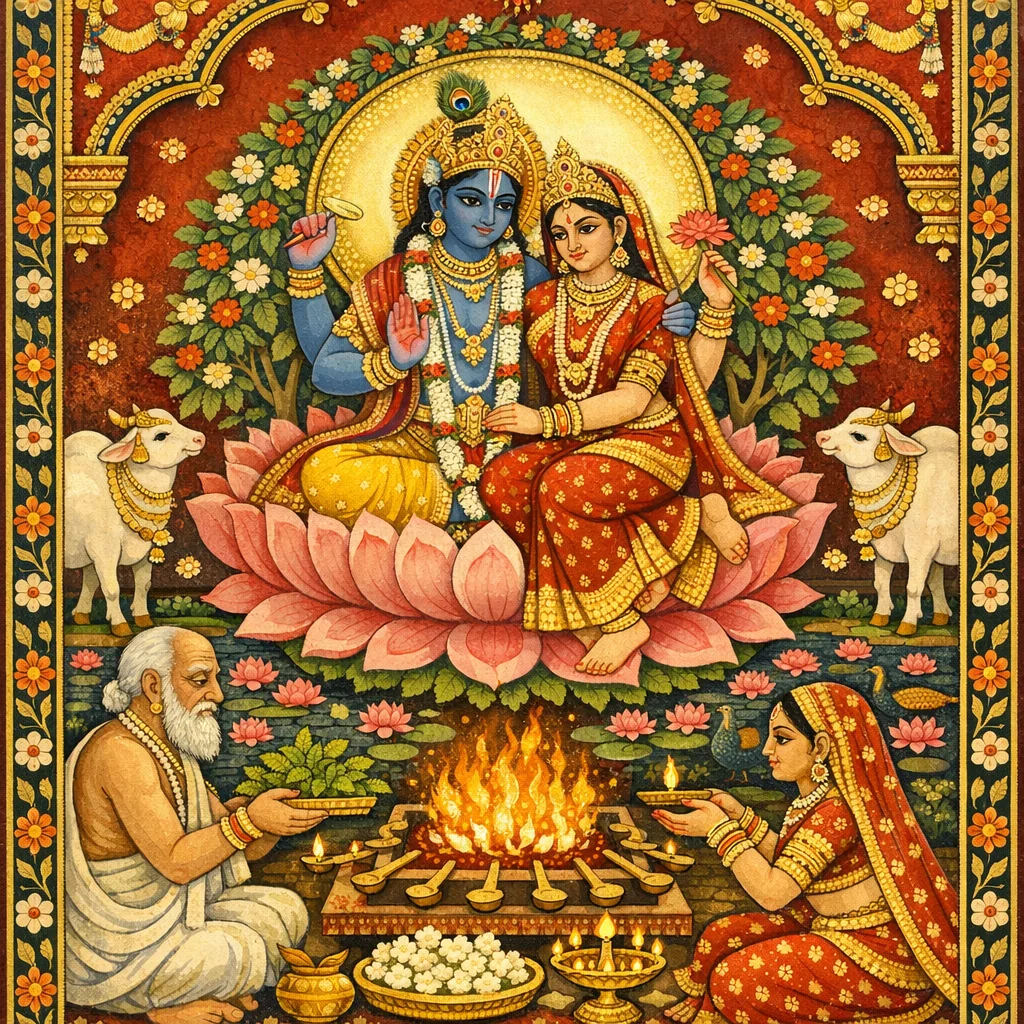
Parīkṣit, having heard of the puṁsavana vow, requests a detailed procedure for pleasing Viṣṇu (v.1). Śukadeva outlines a yearlong devotional vrata beginning on the bright fortnight’s first day of Agrahāyaṇa: the wife, under husband and brāhmaṇa guidance, performs morning purification, dresses in white, hears the Marut-birth narration (context from Diti’s observance), and worships Viṣṇu with Lakṣmī before eating (vv.2–3). The chapter provides core prayers glorifying Viṣṇu as Lakṣmī’s Lord and master of all opulences, and Lakṣmī as His internal potency (vv.4–6), followed by a daily worship-mantra and full upacāra offerings (v.7). A fire component includes twelve ghee oblations with a specified mantra (v.8), stressing Lakṣmī-Nārāyaṇa as the joint source of auspiciousness (v.9). Daṇḍavat repetitions and a theological prayer explain energy, yajña, and the Lord-Potency relationship (vv.10–14). The vrata’s domestic rhythm includes prasāda, honoring brāhmaṇas and chaste women, and mutual spousal participation (vv.15–20). After one year, Kārttika pūrṇimā fasting and a concluding festival offering yield blessings—sons, fortune, health, marital stability—culminating in the reaffirmation that Diti’s successful observance produced the Maruts and a happy life, bridging the narrative to subsequent discussions of devotional efficacy and karmic outcomes (vv.21–28).
Shlokas
Verse 1
श्रीराजोवाच व्रतं पुंसवनं ब्रह्मन् भवता यदुदीरितम् । तस्य वेदितुमिच्छामि येन विष्णु: प्रसीदति ॥ १ ॥
Mahārāja Parīkṣit said: My dear lord, you have already spoken about the puṁsavana vow. Now I want to hear about it in detail, for I understand that by observing this vow one can please the Supreme Lord, Viṣṇu.
Verse 2
श्रीशुक उवाच शुक्ले मार्गशिरे पक्षे योषिद्भर्तुरनुज्ञया । आरभेत व्रतमिदं सार्वकामिकमादित: ॥ २ ॥ निशम्य मरुतां जन्म ब्राह्मणाननुमन्त्र्य च । स्नात्वा शुक्लदती शुक्ले वसीतालङ्कृताम्बरे । पूजयेत्प्रातराशात्प्राग्भगवन्तं श्रिया सह ॥ ३ ॥
Śukadeva Gosvāmī said: On the first day of the bright fortnight of the month of Agrahāyaṇa [November-December], following the instructions of her husband, a woman should begin this regulative devotional service with a vow of penance, for it can fulfill all one’s desires. Before beginning the worship of Lord Viṣṇu, the woman should hear the story of how the Maruts were born. Under the instructions of qualified brāhmaṇas, in the morning she should wash her teeth, bathe, and dress herself with white cloth and ornaments, and before taking breakfast she should worship Lord Viṣṇu and Lakṣmī.
Verse 3
श्रीशुक उवाच शुक्ले मार्गशिरे पक्षे योषिद्भर्तुरनुज्ञया । आरभेत व्रतमिदं सार्वकामिकमादित: ॥ २ ॥ निशम्य मरुतां जन्म ब्राह्मणाननुमन्त्र्य च । स्नात्वा शुक्लदती शुक्ले वसीतालङ्कृताम्बरे । पूजयेत्प्रातराशात्प्राग्भगवन्तं श्रिया सह ॥ ३ ॥
Śukadeva Gosvāmī said: On the first day of the bright fortnight of the month of Agrahāyaṇa [November-December], following the instructions of her husband, a woman should begin this regulative devotional service with a vow of penance, for it can fulfill all one’s desires. Before beginning the worship of Lord Viṣṇu, the woman should hear the story of how the Maruts were born. Under the instructions of qualified brāhmaṇas, in the morning she should wash her teeth, bathe, and dress herself with white cloth and ornaments, and before taking breakfast she should worship Lord Viṣṇu and Lakṣmī.
Verse 4
अलं ते निरपेक्षाय पूर्णकाम नमोऽस्तु ते । महाविभूतिपतये नम: सकलसिद्धये ॥ ४ ॥
[She should then pray to the Lord as follows.] My dear Lord, You are full in all opulences, but I do not beg You for opulence. I simply offer my respectful obeisances unto You. You are the husband and master of Lakṣmīdevī, the goddess of fortune, who has all opulences. Therefore You are the master of all mystic yoga. I simply offer my obeisances unto You.
Verse 5
यथा त्वं कृपया भूत्या तेजसा महिमौजसा । जुष्ट ईश गुणै: सर्वैस्ततोऽसि भगवान् प्रभु: ॥ ५ ॥
O my Lord, because You are endowed with causeless mercy, all opulences, all prowess and all glories, strength and transcendental qualities, You are the Supreme Personality of Godhead, the master of everyone.
Verse 6
विष्णुपत्नि महामाये महापुरुषलक्षणे । प्रीयेथा मे महाभागे लोकमातर्नमोऽस्तु ते ॥ ६ ॥
[After profusely offering obeisances unto Lord Viṣṇu, the devotee should offer respectful obeisances unto mother Lakṣmī, the goddess of fortune, and pray as follows.] O wife of Lord Viṣṇu, O internal energy of Lord Viṣṇu, you are as good as Lord Viṣṇu Himself, for you have all of His qualities and opulences. O goddess of fortune, please be kind to me. O mother of the entire world, I offer my respectful obeisances unto you.
Verse 7
ॐ नमो भगवते महापुरुषाय महानुभावाय महाविभूतिपतये सह महाविभूतिभिर्बलिमुपहरामीति । अनेनाहरहर्मन्त्रेण विष्णोरावाहनार्घ्यपाद्योपस्पर्शनस्नानवासउपवीतविभूषणगन्धपुष्पधूप दीपोपहाराद्युपचारान् सुसमाहितोपाहरेत् ॥ ७ ॥
“My Lord Viṣṇu, full in six opulences, You are the best of all enjoyers and the most powerful. O husband of mother Lakṣmī, I offer my respectful obeisances unto You, who are accompanied by many associates, such as Viśvaksena. I offer all the paraphernalia for worshiping You.” One should chant this mantra every day with great attention while worshiping Lord Viṣṇu with all paraphernalia, such as water for washing His feet, hands and mouth and water for His bath. One must offer Him various presentations for His worship, such as garments, a sacred thread, ornaments, scents, flowers, incense and lamps.
Verse 8
हवि:शेषं च जुहुयादनले द्वादशाहुती: । ॐ नमो भगवते महापुरुषाय महाविभूतिपतये स्वाहेति ॥ ८ ॥
Śukadeva Gosvāmī continued: After worshiping the Lord with all the paraphernalia mentioned above, one should chant the following mantra while offering twelve oblations of ghee on the sacred fire: oṁ namo bhagavate mahā-puruṣāya mahāvibhūti-pataye svāhā.
Verse 9
श्रियं विष्णुं च वरदावाशिषां प्रभवावुभौ । भक्त्या सम्पूजयेन्नित्यं यदीच्छेत्सर्वसम्पद: ॥ ९ ॥
If one desires all opulences, his duty is to daily worship Lord Viṣṇu with His wife, Lakṣmī. With great devotion one should worship Him according to the above-mentioned process. Lord Viṣṇu and the goddess of fortune are an immensely powerful combination. They are the bestowers of all benedictions and the sources of all good fortune. Therefore the duty of everyone is to worship Lakṣmī-Nārāyaṇa.
Verse 10
प्रणमेद्दण्डवद्भूमौ भक्तिप्रह्वेण चेतसा । दशवारं जपेन्मन्त्रं तत: स्तोत्रमुदीरयेत् ॥ १० ॥
One should offer obeisances unto the Lord with a mind humbled through devotion. While offering daṇḍavats by falling on the ground like a rod, one should chant the above mantra ten times. Then one should chant the following prayer.
Verse 11
युवां तु विश्वस्य विभू जगत: कारणं परम् । इयं हि प्रकृति: सूक्ष्मा मायाशक्तिर्दुरत्यया ॥ ११ ॥
My Lord Viṣṇu and mother Lakṣmī, goddess of fortune, you are the proprietors of the entire creation. Indeed, you are the cause of the creation. Mother Lakṣmī is extremely difficult to understand because she is so powerful that the jurisdiction of her power is difficult to overcome. Mother Lakṣmī is represented in the material world as the external energy, but actually she is always the internal energy of the Lord.
Verse 12
तस्या अधीश्वर: साक्षात्त्वमेव पुरुष: पर: । त्वं सर्वयज्ञ इज्येयं क्रियेयं फलभुग्भवान् ॥ १२ ॥
My Lord, You are the master of energy, and therefore You are the Supreme Person. You are sacrifice [yajña] personified. Lakṣmī, the embodiment of spiritual activities, is the original form of worship offered unto You, whereas You are the enjoyer of all sacrifices.
Verse 13
गुणव्यक्तिरियं देवी व्यञ्जको गुणभुग्भवान् । त्वं हि सर्वशरीर्यात्मा श्री: शरीरेन्द्रियाशया: । नामरूपे भगवती प्रत्ययस्त्वमपाश्रय: ॥ १३ ॥
Mother Lakṣmī, who is here, is the reservoir of all spiritual qualities, whereas You manifest and enjoy all these qualities. Indeed, You are actually the enjoyer of everything. You live as the Supersoul of all living entities, and the goddess of fortune is the form of their bodies, senses and minds. She also has a holy name and form, whereas You are the support of all such names and forms and the cause for their manifestation.
Verse 14
यथा युवां त्रिलोकस्य वरदौ परमेष्ठिनौ । तथा म उत्तमश्लोक सन्तु सत्या महाशिष: ॥ १४ ॥
You are both the supreme rulers and benedictors of the three worlds. Therefore, my Lord, Uttamaśloka, may my ambitions be fulfilled by Your grace.
Verse 15
इत्यभिष्टूय वरदं श्रीनिवासं श्रिया सह । तन्नि:सार्योपहरणं दत्त्वाचमनमर्चयेत् ॥ १५ ॥
Śrī Śukadeva Gosvāmī continued: Thus one should worship Lord Viṣṇu, who is known as Śrīnivāsa, along with mother Lakṣmī, the goddess of fortune, by offering prayers according to the process mentioned above. After removing all the paraphernalia of worship, one should offer them water to wash their hands and mouths, and then one should worship them again.
Verse 16
तत: स्तुवीत स्तोत्रेण भक्तिप्रह्वेण चेतसा । यज्ञोच्छिष्टमवघ्राय पुनरभ्यर्चयेद्धरिम् ॥ १६ ॥
Thereafter, with devotion and humility, one should offer prayers to the Lord and mother Lakṣmī. Then one should smell the remnants of the food offered and then again worship the Lord and Lakṣmījī.
Verse 17
पतिं च परया भक्त्या महापुरुषचेतसा । प्रियैस्तैस्तैरुपनमेत् प्रेमशील: स्वयं पति: । बिभृयात् सर्वकर्माणि पत्न्या उच्चावचानि च ॥ १७ ॥
Accepting her husband as the representative of the Supreme Person, a wife should worship him with unalloyed devotion by offering him prasāda. The husband, being very pleased with his wife, should engage himself in the affairs of his family.
Verse 18
कृतमेकतरेणापि दम्पत्योरुभयोरपि । पत्न्यां कुर्यादनर्हायां पतिरेतत् समाहित: ॥ १८ ॥
Between the husband and wife, one person is sufficient to execute this devotional service. Because of their good relationship, both of them will enjoy the result. Therefore if the wife is unable to execute this process, the husband should carefully do so, and the faithful wife will share the result.
Verse 19
विष्णोर्व्रतमिदं बिभ्रन्न विहन्यात्कथञ्चन । विप्रान् स्त्रियो वीरवती: स्रग्गन्धबलिमण्डनै: । अर्चेदहरहर्भक्त्या देवं नियममास्थिता ॥ १९ ॥ उद्वास्य देवं स्वे धाम्नि तन्निवेदितमग्रत: । अद्यादात्मविशुद्ध्यर्थं सर्वकामसमृद्धये ॥ २० ॥
One should accept this viṣṇu-vrata, which is a vow in devotional service, and should not deviate from its execution to engage in anything else. By offering the remnants of prasāda, flower garlands, sandalwood pulp and ornaments, one should daily worship the brāhmaṇas and worship women who peacefully live with their husbands and children. Every day the wife must continue following the regulative principles to worship Lord Viṣṇu with great devotion. Thereafter, Lord Viṣṇu should be laid in His bed, and then one should take prasāda. In this way, husband and wife will be purified and will have all their desires fulfilled.
Verse 20
विष्णोर्व्रतमिदं बिभ्रन्न विहन्यात्कथञ्चन । विप्रान् स्त्रियो वीरवती: स्रग्गन्धबलिमण्डनै: । अर्चेदहरहर्भक्त्या देवं नियममास्थिता ॥ १९ ॥ उद्वास्य देवं स्वे धाम्नि तन्निवेदितमग्रत: । अद्यादात्मविशुद्ध्यर्थं सर्वकामसमृद्धये ॥ २० ॥
One should accept this viṣṇu-vrata, which is a vow in devotional service, and should not deviate from its execution to engage in anything else. By offering the remnants of prasāda, flower garlands, sandalwood pulp and ornaments, one should daily worship the brāhmaṇas and worship women who peacefully live with their husbands and children. Every day the wife must continue following the regulative principles to worship Lord Viṣṇu with great devotion. Thereafter, Lord Viṣṇu should be laid in His bed, and then one should take prasāda. In this way, husband and wife will be purified and will have all their desires fulfilled.
Verse 21
एतेन पूजाविधिना मासान् द्वादश हायनम् । नीत्वाथोपरमेत्साध्वी कार्तिके चरमेऽहनि ॥ २१ ॥
The chaste wife must perform such devotional service continuously for one year. After one year passes, she should fast on the full-moon day in the month of Kārttika [October-November].
Verse 22
श्वोभूतेऽप उपस्पृश्य कृष्णमभ्यर्च्य पूर्ववत् । पय:शृतेन जुहुयाच्चरुणा सह सर्पिषा । पाकयज्ञविधानेन द्वादशैवाहुती: पति: ॥ २२ ॥
On the morning of the next day, one should wash oneself, and after worshiping Lord Kṛṣṇa as before, one should cook as one cooks for festivals as stated in the Gṛhya-sūtras. Sweetrice should be cooked with ghee, and with this preparation the husband should offer oblations to the fire twelve times.
Verse 23
आशिष: शिरसादाय द्विजै: प्रीतै: समीरिता: । प्रणम्य शिरसा भक्त्या भुञ्जीत तदनुज्ञया ॥ २३ ॥
Thereafter, he should satisfy the brāhmaṇas. When the satisfied brāhmaṇas bestow their blessings, he should devotedly offer them respectful obeisances with his head, and with their permission he should take prasāda.
Verse 24
आचार्यमग्रत: कृत्वा वाग्यत: सह बन्धुभि: । दद्यात्पत्न्यै चरो: शेषं सुप्रजास्त्वं सुसौभगम् ॥ २४ ॥
Before taking his meal, the husband must first seat the ācārya comfortably, and, along with his relatives and friends, should control his speech and offer prasāda to the guru. Then the wife should eat the remnants of the oblation of sweetrice cooked with ghee. Eating the remnants insures a learned, devoted son and all good fortune.
Verse 25
एतच्चरित्वा विधिवद्व्रतं विभो रभीप्सितार्थं लभते पुमानिह । स्त्री चैतदास्थाय लभेत सौभगं श्रियं प्रजां जीवपतिं यशो गृहम् ॥ २५ ॥
If this vow or ritualistic ceremony is observed according to the description of śāstra, even in this life a man will be able to achieve all the benedictions he desires from the Lord. A wife who performs this ritualistic ceremony will surely receive good fortune, opulence, sons, a long-living husband, a good reputation and a good home.
Verse 26
कन्या च विन्देत समग्रलक्षणं पतिं त्ववीरा हतकिल्बिषां गतिम् । मृतप्रजा जीवसुता धनेश्वरी सुदुर्भगा सुभगा रूपमग्र्यम् ॥ २६ ॥ विन्देद्विरूपा विरुजा विमुच्यते य आमयावीन्द्रियकल्यदेहम् । एतत्पठन्नभ्युदये च कर्म- ण्यनन्ततृप्ति: पितृदेवतानाम् ॥ २७ ॥ तुष्टा: प्रयच्छन्ति समस्तकामान् होमावसाने हुतभुक् श्रीहरिश्च । राजन् महन्मरुतां जन्म पुण्यं दितेर्व्रतं चाभिहितं महत्ते ॥ २८ ॥ नैवोद्विजे पर दुरत्ययवैतरण्या- स्त्वद्वीर्यगायनमहामृतमग्नचित्त: । शोचे ततो विमुखचेतस इन्द्रियार्थ- मायासुखाय भरमुद्वहतो विमूढान् ॥ ४३ ॥
If an unmarried girl observes this vrata, she will be able to get a very good husband. If a woman who is avīrā — who has no husband or son — executes this ritualistic ceremony, she can be promoted to the spiritual world. A woman whose children have died after birth can get a child with a long duration of life and also become very fortunate in possessing wealth. If a woman is unfortunate she will become fortunate, and if ugly she will become beautiful. By observing this vrata, a diseased man can gain relief from his disease and have an able body with which to work. If one recites this narration while offering oblations to the pitās and demigods, especially during the śrāddha ceremony, the demigods and inhabitants of Pitṛloka will be extremely pleased with him and bestow upon him the fulfillment of all desires. After one performs this ritualistic ceremony, Lord Viṣṇu and His wife, mother Lakṣmī, the goddess of fortune, are very pleased with him. O King Parīkṣit, now I have completely described how Diti performed this ceremony and had good children — the Maruts — and a happy life. I have tried to explain this to you as elaborately as possible.
Verse 27
कन्या च विन्देत समग्रलक्षणं पतिं त्ववीरा हतकिल्बिषां गतिम् । मृतप्रजा जीवसुता धनेश्वरी सुदुर्भगा सुभगा रूपमग्र्यम् ॥ २६ ॥ विन्देद्विरूपा विरुजा विमुच्यते य आमयावीन्द्रियकल्यदेहम् । एतत्पठन्नभ्युदये च कर्म- ण्यनन्ततृप्ति: पितृदेवतानाम् ॥ २७ ॥ तुष्टा: प्रयच्छन्ति समस्तकामान् होमावसाने हुतभुक् श्रीहरिश्च । राजन् महन्मरुतां जन्म पुण्यं दितेर्व्रतं चाभिहितं महत्ते ॥ २८ ॥ नैवोद्विजे पर दुरत्ययवैतरण्या- स्त्वद्वीर्यगायनमहामृतमग्नचित्त: । शोचे ततो विमुखचेतस इन्द्रियार्थ- मायासुखाय भरमुद्वहतो विमूढान् ॥ ४३ ॥
If an unmarried girl observes this vrata, she will be able to get a very good husband. If a woman who is avīrā — who has no husband or son — executes this ritualistic ceremony, she can be promoted to the spiritual world. A woman whose children have died after birth can get a child with a long duration of life and also become very fortunate in possessing wealth. If a woman is unfortunate she will become fortunate, and if ugly she will become beautiful. By observing this vrata, a diseased man can gain relief from his disease and have an able body with which to work. If one recites this narration while offering oblations to the pitās and demigods, especially during the śrāddha ceremony, the demigods and inhabitants of Pitṛloka will be extremely pleased with him and bestow upon him the fulfillment of all desires. After one performs this ritualistic ceremony, Lord Viṣṇu and His wife, mother Lakṣmī, the goddess of fortune, are very pleased with him. O King Parīkṣit, now I have completely described how Diti performed this ceremony and had good children — the Maruts — and a happy life. I have tried to explain this to you as elaborately as possible.
Verse 28
कन्या च विन्देत समग्रलक्षणं पतिं त्ववीरा हतकिल्बिषां गतिम् । मृतप्रजा जीवसुता धनेश्वरी सुदुर्भगा सुभगा रूपमग्र्यम् ॥ २६ ॥ विन्देद्विरूपा विरुजा विमुच्यते य आमयावीन्द्रियकल्यदेहम् । एतत्पठन्नभ्युदये च कर्म- ण्यनन्ततृप्ति: पितृदेवतानाम् ॥ २७ ॥ तुष्टा: प्रयच्छन्ति समस्तकामान् होमावसाने हुतभुक् श्रीहरिश्च । राजन् महन्मरुतां जन्म पुण्यं दितेर्व्रतं चाभिहितं महत्ते ॥ २८ ॥ नैवोद्विजे पर दुरत्ययवैतरण्या- स्त्वद्वीर्यगायनमहामृतमग्नचित्त: । शोचे ततो विमुखचेतस इन्द्रियार्थ- मायासुखाय भरमुद्वहतो विमूढान् ॥ ४३ ॥
If an unmarried girl observes this vrata, she will be able to get a very good husband. If a woman who is avīrā — who has no husband or son — executes this ritualistic ceremony, she can be promoted to the spiritual world. A woman whose children have died after birth can get a child with a long duration of life and also become very fortunate in possessing wealth. If a woman is unfortunate she will become fortunate, and if ugly she will become beautiful. By observing this vrata, a diseased man can gain relief from his disease and have an able body with which to work. If one recites this narration while offering oblations to the pitās and demigods, especially during the śrāddha ceremony, the demigods and inhabitants of Pitṛloka will be extremely pleased with him and bestow upon him the fulfillment of all desires. After one performs this ritualistic ceremony, Lord Viṣṇu and His wife, mother Lakṣmī, the goddess of fortune, are very pleased with him. O King Parīkṣit, now I have completely described how Diti performed this ceremony and had good children — the Maruts — and a happy life. I have tried to explain this to you as elaborately as possible.
Frequently Asked Questions
The chapter frames the vrata as a time-bound, purity-oriented sādhana anchored in a calendrical vrata structure (tithi-māsa-niyama). Beginning in the bright fortnight signals growth and auspicious increase (śukla-pakṣa), aligning household intent (progeny, fortune, stability) with devotional discipline. The text’s emphasis is not mere astrology but regulated bhakti: cleanliness, mantra, worship before eating, and hearing sacred narrative—practices that cultivate sattva and steadiness for a full year.
The prayer states that Lakṣmī appears as the external energy in the material world yet is always the Lord’s internal energy (antaraṅgā-śakti). This reconciles two functions: she governs prosperity and embodied capacities in the world, while remaining transcendently united with Viṣṇu as His personal potency. The chapter uses this śakti-tattva to justify worshiping Lakṣmī-Nārāyaṇa together as the complete source of auspiciousness.
The text presents broad eligibility: married women (with husband’s guidance), husbands on behalf of wives, unmarried girls seeking a suitable husband, and women facing misfortune (avīrā, child-loss, poverty). The promised results range from progeny, reputation, fortune, health, and marital longevity to spiritual promotion for those without worldly supports. The narrative intent is to show that regulated devotion to Lakṣmī-Nārāyaṇa converts personal aims into God-pleasing practice, with results granted by divine satisfaction rather than mechanical ritualism.