Adhyaya 5
Nārada Instructs Dakṣa’s Sons; Allegory of the World; Dakṣa Curses Nārada
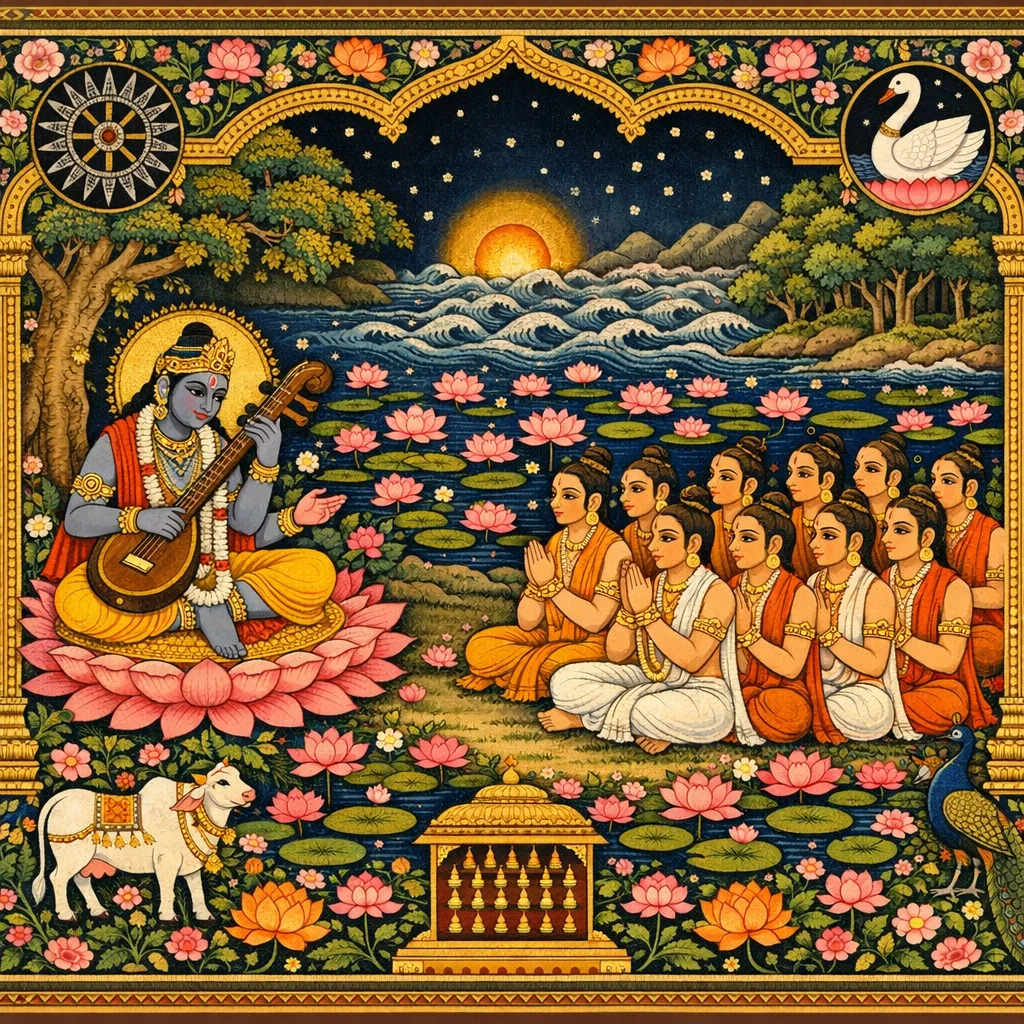
Continuing the Prajāpati line within visarga (secondary creation), Dakṣa fathers the Haryaśvas and orders them to increase progeny. They travel west to the tīrtha Nārāyaṇa-saras (Sindhu’s meeting with the sea) and, through austerity and purification, become inclined to paramahaṁsa-life. Nārada arrives and speaks a deliberate allegory—‘the one man,’ ‘the unchaste woman,’ ‘the two-way river,’ ‘the house of twenty-five,’ ‘the haṁsa,’ and ‘time like razors’—to redirect their intelligence from fruitive expansion to liberation. The Haryaśvas decode each symbol as metaphysics: the Supreme Enjoyer, māyā-buddhi, prakṛti’s cycles, the tattvas, śāstra-discrimination, and kāla. Accepting Nārada as guru, they depart on the path of no return. Dakṣa produces a second set (Savalāśvas) who repeat the tapas at the same tīrtha; Nārada’s brief instruction—follow your elder brothers—leads them also to renunciation and bhakti. The chapter closes with Dakṣa’s grief and anger: he accuses Nārada of prematurely inducing vairāgya, invokes the ‘three debts’ (to devas, ṛṣis, and pitṛs), and curses Nārada to have no fixed residence—accepted by the tolerant sage. This sets up the next narrative tension: Dakṣa’s continued role in creation and the consequences of offenses toward a mahā-bhāgavata.
Shlokas
Verse 1
श्रीशुक उवाच तस्यां स पाञ्चजन्यां वै विष्णुमायोपबृंहित: । हर्यश्वसंज्ञानयुतं पुत्रानजनयद्विभु: ॥ १ ॥
Śrīla Śukadeva Gosvāmī continued: Impelled by the illusory energy of Lord Viṣṇu, Prajāpati Dakṣa begot ten thousand sons in the womb of Pāñcajanī [Asiknī]. My dear King, these sons were called the Haryaśvas.
Verse 2
अपृथग्धर्मशीलास्ते सर्वे दाक्षायणा नृप । पित्रा प्रोक्ता: प्रजासर्गे प्रतीचीं प्रययुर्दिशम् ॥ २ ॥
My dear King, all the sons of Prajāpati Dakṣa were alike in being very gentle and obedient to the orders of their father. When their father ordered them to beget children, they all went in the western direction.
Verse 3
तत्र नारायणसरस्तीर्थं सिन्धुसमुद्रयो: । सङ्गमो यत्र सुमहन्मुनिसिद्धनिषेवितम् ॥ ३ ॥
In the west, where the river Sindhu meets the sea, there is a great place of pilgrimage known as Nārāyaṇa-saras. Many sages and others advanced in spiritual consciousness live there.
Verse 4
तदुपस्पर्शनादेव विनिर्धूतमलाशया: । धर्मे पारमहंस्ये च प्रोत्पन्नमतयोऽप्युत ॥ ४ ॥ तेपिरे तप एवोग्रं पित्रादेशेन यन्त्रिता: । प्रजाविवृद्धये यत्तान् देवर्षिस्तान् ददर्श ह ॥ ५ ॥
In that holy place, the Haryaśvas began regularly touching the lake’s waters and bathing in them. Gradually becoming very much purified, they became inclined toward the activities of paramahaṁsas. Nevertheless, because their father had ordered them to increase the population, they performed severe austerities to fulfill his desires. One day, when the great sage Nārada saw those boys performing such fine austerities to increase the population, Nārada approached them.
Verse 5
तदुपस्पर्शनादेव विनिर्धूतमलाशया: । धर्मे पारमहंस्ये च प्रोत्पन्नमतयोऽप्युत ॥ ४ ॥ तेपिरे तप एवोग्रं पित्रादेशेन यन्त्रिता: । प्रजाविवृद्धये यत्तान् देवर्षिस्तान् ददर्श ह ॥ ५ ॥
In that holy place, the Haryaśvas began regularly touching the lake’s waters and bathing in them. Gradually becoming very much purified, they became inclined toward the activities of paramahaṁsas. Nevertheless, because their father had ordered them to increase the population, they performed severe austerities to fulfill his desires. One day, when the great sage Nārada saw those boys performing such fine austerities to increase the population, Nārada approached them.
Verse 6
उवाच चाथ हर्यश्वा: कथं स्रक्ष्यथ वै प्रजा: । अदृष्ट्वान्तं भुवो यूयं बालिशा बत पालका: ॥ ६ ॥ तथैकपुरुषं राष्ट्रं बिलं चादृष्टनिर्गमम् । बहुरूपां स्त्रियं चापि पुमांसं पुंश्चलीपतिम् ॥ ७ ॥ नदीमुभयतो वाहां पञ्चपञ्चाद्भुतं गृहम् । क्वचिद्धंसं चित्रकथं क्षौरपव्यं स्वयं भ्रमि ॥ ८ ॥
The great sage Nārada said: My dear Haryaśvas, you have not seen the extremities of the earth. There is a kingdom where only one man lives and where there is a hole from which, having entered, no one emerges. A woman there who is extremely unchaste adorns herself with various attractive dresses, and the man who lives there is her husband. In that kingdom, there is a river flowing in both directions, a wonderful home made of twenty-five materials, a swan that vibrates various sounds, and an automatically revolving object made of sharp razors and thunderbolts. You have not seen all this, and therefore you are inexperienced boys without advanced knowledge. How, then, will you create progeny?
Verse 7
उवाच चाथ हर्यश्वा: कथं स्रक्ष्यथ वै प्रजा: । अदृष्ट्वान्तं भुवो यूयं बालिशा बत पालका: ॥ ६ ॥ तथैकपुरुषं राष्ट्रं बिलं चादृष्टनिर्गमम् । बहुरूपां स्त्रियं चापि पुमांसं पुंश्चलीपतिम् ॥ ७ ॥ नदीमुभयतो वाहां पञ्चपञ्चाद्भुतं गृहम् । क्वचिद्धंसं चित्रकथं क्षौरपव्यं स्वयं भ्रमि ॥ ८ ॥
The great sage Nārada said: My dear Haryaśvas, you have not seen the extremities of the earth. There is a kingdom where only one man lives and where there is a hole from which, having entered, no one emerges. A woman there who is extremely unchaste adorns herself with various attractive dresses, and the man who lives there is her husband. In that kingdom, there is a river flowing in both directions, a wonderful home made of twenty-five materials, a swan that vibrates various sounds, and an automatically revolving object made of sharp razors and thunderbolts. You have not seen all this, and therefore you are inexperienced boys without advanced knowledge. How, then, will you create progeny?
Verse 8
उवाच चाथ हर्यश्वा: कथं स्रक्ष्यथ वै प्रजा: । अदृष्ट्वान्तं भुवो यूयं बालिशा बत पालका: ॥ ६ ॥ तथैकपुरुषं राष्ट्रं बिलं चादृष्टनिर्गमम् । बहुरूपां स्त्रियं चापि पुमांसं पुंश्चलीपतिम् ॥ ७ ॥ नदीमुभयतो वाहां पञ्चपञ्चाद्भुतं गृहम् । क्वचिद्धंसं चित्रकथं क्षौरपव्यं स्वयं भ्रमि ॥ ८ ॥
The great sage Nārada said: My dear Haryaśvas, you have not seen the extremities of the earth. There is a kingdom where only one man lives and where there is a hole from which, having entered, no one emerges. A woman there who is extremely unchaste adorns herself with various attractive dresses, and the man who lives there is her husband. In that kingdom, there is a river flowing in both directions, a wonderful home made of twenty-five materials, a swan that vibrates various sounds, and an automatically revolving object made of sharp razors and thunderbolts. You have not seen all this, and therefore you are inexperienced boys without advanced knowledge. How, then, will you create progeny?
Verse 9
कथं स्वपितुरादेशमविद्वांसो विपश्चित: । अनुरूपमविज्ञाय अहो सर्गं करिष्यथ ॥ ९ ॥
Alas, your father is omniscient, but you do not know his actual order. Without knowing the actual purpose of your father, how will you create progeny?
Verse 10
श्रीशुक उवाच तन्निशम्याथ हर्यश्वा औत्पत्तिकमनीषया । वाच: कूटं तु देवर्षे: स्वयं विममृशुर्धिया ॥ १० ॥
Śrī Śukadeva Gosvāmī said: Hearing these enigmatic words of Nārada Muni, the Haryaśvas considered them with their natural intelligence, without help from others.
Verse 11
भू: क्षेत्रं जीवसंज्ञं यदनादि निजबन्धनम् । अदृष्ट्वा तस्य निर्वाणं किमसत्कर्मभिर्भवेत् ॥ ११ ॥
[The Haryaśvas understood the meaning of Nārada’s words as follows.] The word “bhūḥ” [“the earth”] refers to the field of activities. The material body, which is a result of the living being’s actions, is his field of activities, and it gives him false designations. Since time immemorial, he has received various types of material bodies, which are the roots of bondage to the material world. If one foolishly engages in temporary fruitive activities and does not look toward the cessation of this bondage, what will be the benefit of his actions?
Verse 12
एक एवेश्वरस्तुर्यो भगवान् स्वाश्रय: पर: । तमदृष्ट्वाभवं पुंस: किमसत्कर्मभिर्भवेत् ॥ १२ ॥
[Nārada Muni had said that there is a kingdom where there is only one male. The Haryaśvas realized the purport of this statement.] The only enjoyer is the Supreme Personality of Godhead, who observes everything, everywhere. He is full of six opulences and fully independent of everyone else. He is never subject to the three modes of material nature, for He is always transcendental to this material creation. If the members of human society do not understand Him, the Supreme, through their advancement in knowledge and activities, but simply work very hard like cats and dogs all day and night for temporary happiness, what will be the benefit of their activities?
Verse 13
पुमान्नैवैति यद्गत्वा बिलस्वर्गं गतो यथा । प्रत्यग्धामाविद इह किमसत्कर्मभिर्भवेत् ॥ १३ ॥
[Nārada Muni had described that there is a bila, or hole, from which, having entered, one does not return. The Haryaśvas understood the meaning of this allegory.] Hardly once has a person who has entered the lower planetary system called Pātāla been seen to return. Similarly, if one enters the Vaikuṇṭha-dhāma [pratyag-dhāma], he does not return to this material world. If there is such a place, from which, having gone, one does not return to the miserable material condition of life, what is the use of jumping like monkeys in the temporary material world and not seeing or understanding that place? What will be the profit?
Verse 14
नानारूपात्मनो बुद्धि: स्वैरिणीव गुणान्विता । तन्निष्ठामगतस्येह किमसत्कर्मभिर्भवेत् ॥ १४ ॥
[Nārada Muni had described a woman who is a professional prostitute. The Haryaśvas understood the identity of this woman.] Mixed with the mode of passion, the unsteady intelligence of every living entity is like a prostitute who changes dresses just to attract one’s attention. If one fully engages in temporary fruitive activities, not understanding how this is taking place, what does he actually gain?
Verse 15
तत्सङ्गभ्रंशितैश्वर्यं संसरन्तं कुभार्यवत् । तद्गतीरबुधस्येह किमसत्कर्मभिर्भवेत् ॥ १५ ॥
[Nārada Muni had also spoken of a man who is the husband of the prostitute. The Haryaśvas understood this as follows.] If one becomes the husband of a prostitute, he loses all independence. Similarly, if a living entity has polluted intelligence, he prolongs his materialistic life. Frustrated by material nature, he must follow the movements of the intelligence, which brings various conditions of happiness and distress. If one performs fruitive activities under such conditions, what will be the benefit?
Verse 16
सृष्ट्यप्ययकरीं मायां वेलाकूलान्तवेगिताम् । मत्तस्य तामविज्ञस्य किमसत्कर्मभिर्भवेत् ॥ १६ ॥
[Nārada Muni had said that there is a river flowing in both directions. The Haryaśvas understood the purport of this statement.] Material nature functions in two ways — by creation and dissolution. Thus the river of material nature flows both ways. A living entity who unknowingly falls in this river is submerged in its waves, and since the current is swifter near the banks of the river, he is unable to get out. What will be the benefit of performing fruitive activities in that river of māyā?
Verse 17
पञ्चविंशतितत्त्वानां पुरुषोऽद्भुतदर्पण: । अध्यात्ममबुधस्येह किमसत्कर्मभिर्भवेत् ॥ १७ ॥
[Nārada Muni had said that there is a house made of twenty-five elements. The Haryaśvas understood this analogy.] The Supreme Lord is the reservoir of the twenty-five elements, and as the Supreme Being, the conductor of cause and effect, He causes their manifestation. If one engages in temporary fruitive activities, not knowing that Supreme Person, what benefit will he derive?
Verse 18
ऐश्वरं शास्त्रमुत्सृज्य बन्धमोक्षानुदर्शनम् । विविक्तपदमज्ञाय किमसत्कर्मभिर्भवेत् ॥ १८ ॥
[Nārada Muni had spoken of a swan. That swan is explained in this verse.] The Vedic literatures [śāstras] vividly describe how to understand the Supreme Lord, the source of all material and spiritual energy. Indeed, they elaborately explain these two energies. The swan [haṁsa] is one who discriminates between matter and spirit, who accepts the essence of everything, and who explains the means of bondage and the means of liberation. The words of scriptures consist of variegated vibrations. If a foolish rascal leaves aside the study of these śāstras to engage in temporary activities, what will be the result?
Verse 19
कालचक्रं भ्रमि तीक्ष्णं सर्वं निष्कर्षयज्जगत् । स्वतन्त्रमबुधस्येह किमसत्कर्मभिर्भवेत् ॥ १९ ॥
[Nārada Muni had spoken of a physical object made of sharp blades and thunderbolts. The Haryaśvas understood this allegory as follows.] Eternal time moves very sharply, as if made of razors and thunderbolts. Uninterrupted and fully independent, it drives the activities of the entire world. If one does not try to study the eternal element of time, what benefit can he derive from performing temporary material activities?
Verse 20
शास्त्रस्य पितुरादेशं यो न वेद निवर्तकम् । कथं तदनुरूपाय गुणविस्रम्भ्युपक्रमेत् ॥ २० ॥
[Nārada Muni had asked how one could ignorantly defy one’s own father. The Haryaśvas understood the meaning of this question.] One must accept the original instructions of the śāstra. According to Vedic civilization, one is offered a sacred thread as a sign of second birth. One takes his second birth by dint of having received instructions in the śāstra from a bona fide spiritual master. Therefore, śāstra, scripture, is the real father. All the śāstras instruct that one should end his material way of life. If one does not know the purpose of the father’s orders, the śāstras, he is ignorant. The words of a material father who endeavors to engage his son in material activities are not the real instructions of the father.
Verse 21
इति व्यवसिता राजन् हर्यश्वा एकचेतस: । प्रययुस्तं परिक्रम्य पन्थानमनिवर्तनम् ॥ २१ ॥
Śukadeva Gosvāmī continued: My dear King, after hearing the instructions of Nārada, the Haryaśvas, the sons of Prajāpati Dakṣa, were firmly convinced. They all believed in his instructions and reached the same conclusion. Having accepted him as their spiritual master, they circumambulated that great sage and followed the path by which one never returns to this world.
Verse 22
स्वरब्रह्मणि निर्भातहृषीकेशपदाम्बुजे । अखण्डं चित्तमावेश्य लोकाननुचरन्मुनि: ॥ २२ ॥
The seven musical notes — ṣa, ṛ, gā, ma, pa, dha and ni — are used in musical instruments, but originally they come from the Sāma Veda. The great sage Nārada vibrates sounds describing the pastimes of the Supreme Lord. By such transcendental vibrations, such as Hare Kṛṣṇa, Hare Kṛṣṇa, Kṛṣṇa Kṛṣṇa, Hare Hare/ Hare Rāma, Hare Rāma, Rāma Rāma, Hare Hare, he fixes his mind at the lotus feet of the Lord. Thus he directly perceives Hṛṣīkeśa, the master of the senses. After delivering the Haryaśvas, Nārada Muni continued traveling throughout the planetary systems, his mind always fixed at the lotus feet of the Lord.
Verse 23
नाशं निशम्य पुत्राणां नारदाच्छीलशालिनाम् । अन्वतप्यत क: शोचन् सुप्रजस्त्वं शुचां पदम् ॥ २३ ॥
The Haryaśvas, the sons of Prajāpati Dakṣa, were very well-behaved, cultured sons, but unfortunately, because of the instructions of Nārada Muni, they deviated from the order of their father. When Dakṣa heard this news, which was brought to him by Nārada Muni, he began to lament. Although he was the father of such good sons, he had lost them all. Certainly this was lamentable.
Verse 24
स भूय: पाञ्चजन्यायामजेन परिसान्त्वित: । पुत्रानजनयद्दक्ष: सवलाश्वान्सहस्रिण: ॥ २४ ॥
When Prajāpati Dakṣa was lamenting for his lost children, Lord Brahmā pacified him with instructions, and thereafter Dakṣa begot one thousand more children in the womb of his wife, Pāñcajanī. This time his sons were known as the Savalāśvas.
Verse 25
ते च पित्रा समादिष्टा: प्रजासर्गे धृतव्रता: । नारायणसरो जग्मुर्यत्र सिद्धा: स्वपूर्वजा: ॥ २५ ॥
In accordance with their father’s order to beget children, the second group of sons also went to Nārāyaṇa-saras, the same place where their brothers had previously attained perfection by following the instructions of Nārada. Undertaking great vows of austerity, the Savalāśvas remained at that holy place.
Verse 26
तदुपस्पर्शनादेव विनिर्धूतमलाशया: । जपन्तो ब्रह्म परमं तेपुस्तत्र महत्तप: ॥ २६ ॥
At Nārāyaṇa-saras, the second group of sons performed penances in the same way as the first. They bathed in the holy water, and by its touch all the dirty material desires in their hearts were cleansed away. They murmured mantras beginning with oṁkāra and underwent a severe course of austerities.
Verse 27
अब्भक्षा: कतिचिन्मासान् कतिचिद्वायुभोजना: । आराधयन् मन्त्रमिममभ्यस्यन्त इडस्पतिम् ॥ २७ ॥ ॐ नमो नारायणाय पुरुषाय महात्मने । विशुद्धसत्त्वधिष्ण्याय महाहंसाय धीमहि ॥ २८ ॥
For a few months the sons of Prajāpati Dakṣa drank only water and ate only air. Thus undergoing great austerities, they recited this mantra: “Let us offer our respectful obeisances unto Nārāyaṇa, the Supreme Personality of Godhead, who is always situated in His transcendental abode. Since He is the Supreme Person [paramahaṁsa], let us offer our respectful obeisances unto Him.”
Verse 28
अब्भक्षा: कतिचिन्मासान् कतिचिद्वायुभोजना: । आराधयन् मन्त्रमिममभ्यस्यन्त इडस्पतिम् ॥ २७ ॥ ॐ नमो नारायणाय पुरुषाय महात्मने । विशुद्धसत्त्वधिष्ण्याय महाहंसाय धीमहि ॥ २८ ॥
For a few months the sons of Prajāpati Dakṣa drank only water and ate only air. Thus undergoing great austerities, they recited this mantra: “Let us offer our respectful obeisances unto Nārāyaṇa, the Supreme Personality of Godhead, who is always situated in His transcendental abode. Since He is the Supreme Person [paramahaṁsa], let us offer our respectful obeisances unto Him.”
Verse 29
इति तानपि राजेन्द्र प्रजासर्गधियो मुनि: । उपेत्य नारद: प्राह वाच: कूटानि पूर्ववत् ॥ २९ ॥
O King Parīkṣit, Nārada Muni approached these sons of Prajāpati Dakṣa, who were engaged in tapasya to beget children, and spoke enigmatic words to them just as he had spoken to their elder brothers.
Verse 30
दाक्षायणा: संशृणुत गदतो निगमं मम । अन्विच्छतानुपदवीं भ्रातृणां भ्रातृवत्सला: ॥ ३० ॥
O sons of Dakṣa, please hear my words of instruction attentively. You are all very affectionate to your elder brothers, the Haryaśvas. Therefore you should follow their path.
Verse 31
भ्रातृणां प्रायणं भ्राता योऽनुतिष्ठति धर्मवित् । स पुण्यबन्धु: पुरुषो मरुद्भि: सह मोदते ॥ ३१ ॥
A brother aware of the principles of religion follows in the footsteps of his elder brothers. Because of being highly elevated, such a pious brother gets the opportunity to associate and enjoy with demigods like the Maruts, who are all affectionate to their brothers.
Verse 32
एतावदुक्त्वा प्रययौ नारदोऽमोघदर्शन: । तेऽपि चान्वगमन् मार्गं भ्रातृणामेव मारिष ॥ ३२ ॥
Śukadeva Gosvāmī continued: O best of the advanced Āryans, after saying this much to the sons of Prajāpati Dakṣa, Nārada Muni, whose merciful glance never goes in vain, left as he had planned. The sons of Dakṣa followed their elder brothers. Not attempting to produce children, they engaged themselves in Kṛṣṇa consciousness.
Verse 33
सध्रीचीनं प्रतीचीनं परस्यानुपथं गता: । नाद्यापि ते निवर्तन्ते पश्चिमा यामिनीरिव ॥ ३३ ॥
The Savalāśvas took to the correct path, which is obtainable by a mode of life meant to achieve devotional service, or the mercy of the Supreme Personality of Godhead. Like nights that have gone to the west, they have not returned even until now.
Verse 34
एतस्मिन् काल उत्पातान् बहून् पश्यन् प्रजापति: । पूर्ववन्नारदकृतं पुत्रनाशमुपाशृणोत् ॥ ३४ ॥
At this time, Prajāpati Dakṣa observed many inauspicious signs, and he heard from various sources that his second group of sons, the Savalāśvas, had followed the path of their elder brothers in accordance with the instructions of Nārada.
Verse 35
चुक्रोध नारदायासौ पुत्रशोकविमूर्च्छित: । देवर्षिमुपलभ्याह रोषाद्विस्फुरिताधर: ॥ ३५ ॥
When he heard that the Savalāśvas had also left this world to engage in devotional service, Dakṣa was angry at Nārada, and he almost fainted due to lamentation. When Dakṣa met Nārada, Dakṣa’s lips began trembling in anger, and he spoke as follows.
Verse 36
श्रीदक्ष उवाच अहो असाधो साधूनां साधुलिङ्गेन नस्त्वया । असाध्वकार्यर्भकाणां भिक्षोर्मार्ग: प्रदर्शित: ॥ ३६ ॥
Prajāpati Dakṣa said: Alas, Nārada Muni, you wear the dress of a saintly person, but you are not actually a saint. Indeed, although I am now in gṛhastha life, I am a saintly person. By showing my sons the path of renunciation, you have done me an abominable injustice.
Verse 37
ऋणैस्त्रिभिरमुक्तानाममीमांसितकर्मणाम् । विघात: श्रेयस: पाप लोकयोरुभयो: कृत: ॥ ३७ ॥
Prajāpati Dakṣa said: My sons were not at all freed from their three debts. Indeed, they did not properly consider their obligations. O Nārada Muni, O personality of sinful action, you have obstructed their progress toward good fortune in this world and the next because they are still indebted to the saintly persons, the demigods and their father.
Verse 38
एवं त्वं निरनुक्रोशो बालानां मतिभिद्धरे: । पार्षदमध्ये चरसि यशोहा निरपत्रप: ॥ ३८ ॥
Prajāpati Dakṣa continued: Thus committing violence against other living entities and yet claiming to be an associate of Lord Viṣṇu, you are defaming the Supreme Personality of Godhead. You needlessly created a mentality of renunciation in innocent boys, and therefore you are shameless and devoid of compassion. How could you travel with the personal associates of the Supreme Lord?
Verse 39
ननु भागवता नित्यं भूतानुग्रहकातरा: । ऋते त्वां सौहृदघ्नं वै वैरङ्करमवैरिणाम् ॥ ३९ ॥
All the devotees of the Lord but you are very kind to the conditioned souls and are eager to benefit others. Although you wear the dress of a devotee, you create enmity with people who are not your enemies, or you break friendship and create enmity between friends. Are you not ashamed of posing as a devotee while performing these abominable actions?
Verse 40
नेत्थं पुंसां विराग: स्यात् त्वया केवलिना मृषा । मन्यसे यद्युपशमं स्नेहपाशनिकृन्तनम् ॥ ४० ॥
Prajāpati Dakṣa continued: If you think that simply awakening the sense of renunciation will detach one from the material world, I must say that unless full knowledge is awakened, simply changing dresses as you have done cannot possibly bring detachment.
Verse 41
नानुभूय न जानाति पुमान् विषयतीक्ष्णताम् । निर्विद्यते स्वयं तस्मान्न तथा भिन्नधी: परै: ॥ ४१ ॥
Material enjoyment is indeed the cause of all unhappiness, but one cannot give it up unless one has personally experienced how much suffering it is. Therefore one should be allowed to remain in so-called material enjoyment while simultaneously advancing in knowledge to experience the misery of this false material happiness. Then, without help from others, one will find material enjoyment detestful. Those whose minds are changed by others do not become as renounced as those who have personal experience.
Verse 42
यन्नस्त्वं कर्मसन्धानां साधूनां गृहमेधिनाम् । कृतवानसि दुर्मर्षं विप्रियं तव मर्षितम् ॥ ४२ ॥
Although I live in household life with my wife and children, I honestly follow the Vedic injunctions by engaging in fruitive activities to enjoy life without sinful reactions. I have performed all kinds of yajñas, including the deva-yajña, ṛṣi-yajña, pitṛ-yajña and nṛ-yajña. Because these yajñas are called vratas [vows], I am known as a gṛhavrata. Unfortunately, you have given me great displeasure by misguiding my sons, for no reason, to the path of renunciation. This can be tolerated once.
Verse 43
तन्तुकृन्तन यन्नस्त्वमभद्रमचर: पुन: । तस्माल्लोकेषु ते मूढ न भवेद्भ्रमत: पदम् ॥ ४३ ॥
You have made me lose my sons once, and now you have again done the same inauspicious thing. Therefore you are a rascal who does not know how to behave toward others. You may travel all over the universe, but I curse you to have no residence anywhere.
Verse 44
श्रीशुक उवाच प्रतिजग्राह तद्बाढं नारद: साधुसम्मत: । एतावान्साधुवादो हि तितिक्षेतेश्वर: स्वयम् ॥ ४४ ॥
Śrī Śukadeva Gosvāmī continued: My dear King, since Nārada Muni is an approved saintly person, when cursed by Prajāpati Dakṣa he replied, “tad bāḍham: Yes, what you have said is good. I accept this curse.” He could have cursed Prajāpati Dakṣa in return, but because he is a tolerant and merciful sādhu, he took no action.
Frequently Asked Questions
The Haryaśvas interpret it as a complete map of saṁsāra and liberation: (1) ‘one man’ = the Supreme Enjoyer, Bhagavān, independent of guṇas; (2) ‘hole with no return’ = either descent into Pātāla (rare return) and, more importantly, entry into Vaikuṇṭha (no return to misery); (3) ‘unchaste woman’ = fickle, passion-mixed intelligence that changes ‘dress’ (identities) to attract the jīva; (4) ‘husband’ = the conditioned soul enslaved by that buddhi; (5) ‘river flowing both ways’ = prakṛti’s cycles of creation and dissolution; (6) ‘house of twenty-five’ = the tattva framework (elements) resting in the Supreme as cause and controller; (7) ‘haṁsa’ = śāstra-guided discrimination between matter and spirit; (8) ‘razors and thunderbolts’ = relentless kāla driving all change. The point is that without knowing these truths, producing progeny as an ultimate goal is spiritually misdirected.
Dakṣa argues from pravṛtti-mārga (world-maintaining duty): before adopting renunciation, one should discharge obligations to devas (through yajña), ṛṣis (through study/teaching), and pitṛs/father (through progeny and lineage rites). He sees Nārada’s instruction as inducing vairāgya without sufficient experiential maturity. The Bhāgavata, however, frames Nārada’s intervention as higher guidance: when bhakti awakens and the goal (ending bondage) is understood, the supreme duty becomes surrender to Nārāyaṇa.