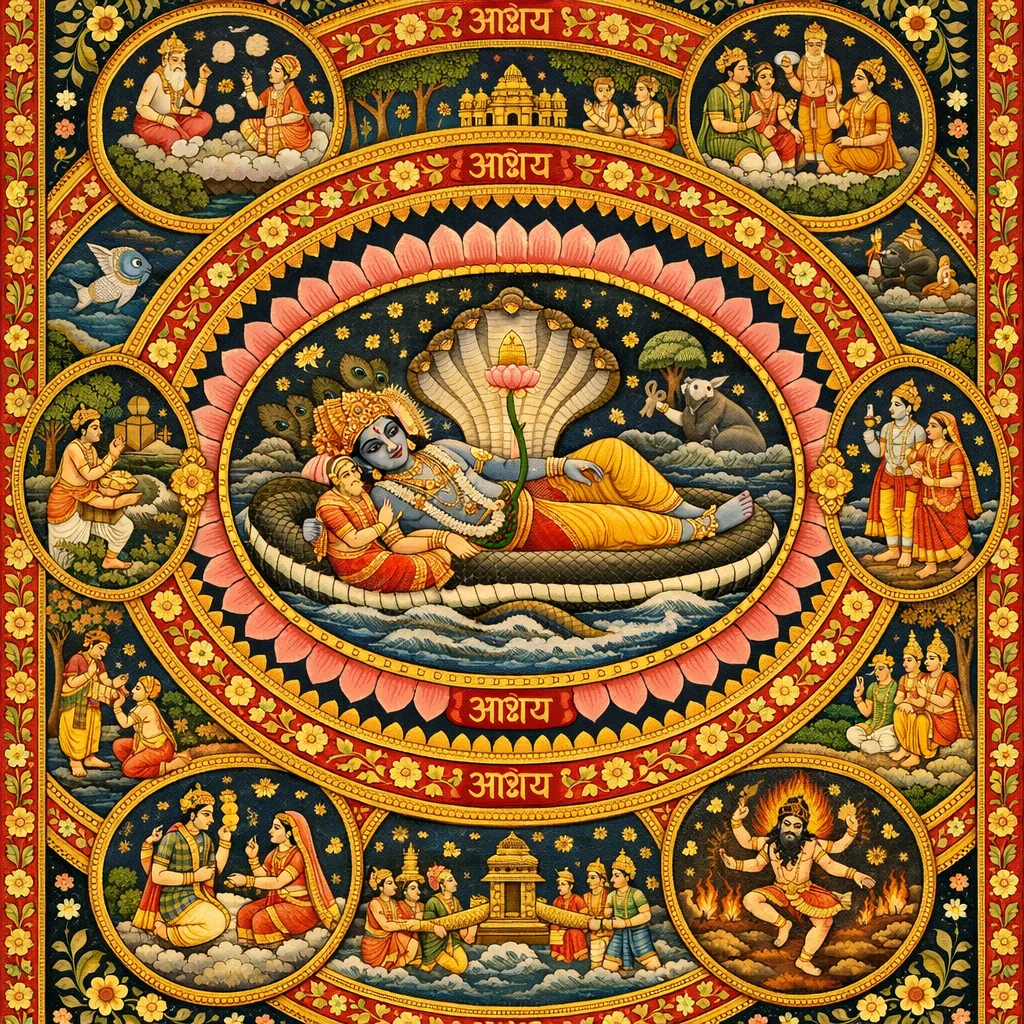
Adhyaya 10
Daśa-lakṣaṇam: The Ten Topics, Virāṭ-Puruṣa Sense-Manifestation, and the Supreme Shelter (Āśraya)
This chapter functions as an interpretive hinge within Skandha 2. Śukadeva Gosvāmī first enumerates the Bhāgavatam’s ten defining subjects (daśa-lakṣaṇam), clarifying that the other nine are described to spotlight the transcendence of the tenth—āśraya, the Supreme Being. He distinguishes sarga (primary creation of elemental categories and senses) from visarga (secondary creation through guṇa-interaction), and outlines governance themes such as manvantara and poṣaṇa. The narration then moves into a cosmological-theological account of Mahā-Viṣṇu entering each universe as Garbhodakaśāyī, establishing the etymology of Nārāyaṇa, and asserting the Lord’s absolute dependence-relationship: all ingredients, time, modes, and jīvas exist only by His mercy. A detailed ‘cosmic anatomy’ sequence follows, describing how the virāṭ-puruṣa’s desires manifest the senses, their objects, and their presiding deities. The chapter concludes by transcending the gross universal form, affirming that pure devotees accept the Lord’s personal transcendental form, and transitions the narrative frame toward Vidura–Maitreya discussions, setting up the next section’s inquiry-driven exposition.
Shlokas
Verse 1
श्रीशुक उवाच अत्र सर्गो विसर्गश्च स्थानं पोषणमूतय: । मन्वन्तरेशानुकथा निरोधो मुक्तिराश्रय: ॥ १ ॥
Śrī Śukadeva Gosvāmī said: In the Śrīmad-Bhāgavatam there are ten divisions of statements regarding the following: the creation of the universe, subcreation, planetary systems, protection by the Lord, the creative impetus, the change of Manus, the science of God, returning home, back to Godhead, liberation, and the summum bonum.
Verse 2
दशमस्य विशुद्ध्यर्थं नवानामिह लक्षणम् । वर्णयन्ति महात्मान: श्रुतेनार्थेन चाञ्जसा ॥ २ ॥
To isolate the transcendence of the summum bonum, the symptoms of the rest are described sometimes by Vedic inference, sometimes by direct explanation, and sometimes by summary explanations given by the great sages.
Verse 3
भूतमात्रेन्द्रियधियां जन्म सर्ग उदाहृत: । ब्रह्मणो गुणवैषम्याद्विसर्ग: पौरुष: स्मृत: ॥ ३ ॥
The elementary creation of sixteen items of matter — namely the five elements [fire, water, land, air and sky], sound, form, taste, smell, touch, and the eyes, ears, nose, tongue, skin and mind — is known as sarga, whereas subsequent resultant interaction of the modes of material nature is called visarga.
Verse 4
स्थितिर्वैकुण्ठविजय: पोषणं तदनुग्रह: । मन्वन्तराणि सद्धर्म ऊतय: कर्मवासना: ॥ ४ ॥
The right situation for the living entities is to obey the laws of the Lord and thus be in perfect peace of mind under the protection of the Supreme Personality of Godhead. The Manus and their laws are meant to give right direction in life. The impetus for activity is the desire for fruitive work.
Verse 5
अवतारानुचरितं हरेश्चास्यानुवर्तिनाम् । पुंसामीशकथा: प्रोक्ता नानाख्यानोपबृंहिता: ॥ ५ ॥
The science of God describes the incarnations of the Personality of Godhead and His different activities together with the activities of His great devotees.
Verse 6
निरोधोऽस्यानुशयनमात्मन: सह शक्तिभि: । मुक्तिर्हित्वान्यथारूपं स्वरूपेण व्यवस्थिति: ॥ ६ ॥
The merging of the living entity, along with his conditional living tendency, with the mystic lying down of the Mahā-Viṣṇu is called the winding up of the cosmic manifestation. Liberation is the permanent situation of the form of the living entity after he gives up the changeable gross and subtle material bodies.
Verse 7
आभासश्च निरोधश्च यतोऽस्त्यध्यवसीयते । स आश्रय: परं ब्रह्म परमात्मेति शब्द्यते ॥ ७ ॥
The supreme one who is celebrated as the Supreme Being or the Supreme Soul is the supreme source of the cosmic manifestation as well as its reservoir and winding up. Thus He is the Supreme Fountainhead, the Absolute Truth.
Verse 8
योऽध्यात्मिकोऽयं पुरुष: सोऽसावेवाधिदैविक: । यस्तत्रोभयविच्छेद: पुरुषो ह्याधिभौतिक: ॥ ८ ॥
The individual person possessing different instruments of senses is called the adhyātmic person, and the individual controlling deity of the senses is called adhidaivic. The embodiment seen on the eyeballs is called the adhibhautic person.
Verse 9
एकमेकतराभावे यदा नोपलभामहे । त्रितयं तत्र यो वेद स आत्मा स्वाश्रयाश्रय: ॥ ९ ॥
All three of the above-mentioned stages of different living entities are interdependent. In the absence of one, another is not understood. But the Supreme Being who sees every one of them as the shelter of the shelter is independent of all, and therefore He is the supreme shelter.
Verse 10
पुरुषोऽण्डं विनिर्भिद्य यदासौ स विनिर्गत: । आत्मनोऽयनमन्विच्छन्नपोऽस्राक्षीच्छुचि: शुची: ॥ १० ॥
After separating the different universes, the gigantic universal form of the Lord [Mahā-Viṣṇu], which came out of the Causal Ocean, the place of appearance for the first puruṣa-avatāra, entered into each of the separate universes, desiring to lie on the created transcendental water [Garbhodaka].
Verse 11
तास्ववात्सीत् स्वसृष्टासु सहस्रंपरिवत्सरान् । तेन नारायणो नाम यदाप: पुरुषोद्भवा: ॥ ११ ॥
That Supreme Person is not impersonal and therefore is distinctively a nara, or person. Therefore the transcendental water created from the Supreme Nara is known as nāra. And because He lies down on that water, He is known as Nārāyaṇa.
Verse 12
द्रव्यं कर्म च कालश्च स्वभावो जीव एव च । यदनुग्रहत: सन्ति न सन्ति यदुपेक्षया ॥ १२ ॥
One should definitely know that all material ingredients, activities, time and modes, and the living entities who are meant to enjoy them all, exist by His mercy only, and as soon as He does not care for them, everything becomes nonexistent.
Verse 13
एको नानात्वमन्विच्छन् योगतल्पात् समुत्थित: । वीर्यं हिरण्मयं देवो मायया व्यसृजत् त्रिधा ॥ १३ ॥
The Lord, while lying on His bed of mystic slumber, generated the seminal symbol, golden in hue, through external energy out of His desire to manifest varieties of living entities from Himself alone.
Verse 14
अधिदैवमथाध्यात्ममधिभूतमिति प्रभु: । अथैकं पौरुषं वीर्यं त्रिधाभिद्यत तच्छृणु ॥ १४ ॥
Just hear from me how the potency of His Lordship divides one into three, called the controlling entities, the controlled entities and the material bodies, in the manner mentioned above.
Verse 15
अन्त:शरीर आकाशात् पुरुषस्य विचेष्टत: । ओज: सहो बलं जज्ञे तत: प्राणो महानसु: ॥ १५ ॥
From the sky situated within the transcendental body of the manifesting Mahā-Viṣṇu, sense energy, mental force and bodily strength are all generated, as well as the sum total of the fountainhead of the total living force.
Verse 16
अनुप्राणन्ति यं प्राणा: प्राणन्तं सर्वजन्तुषु । अपानन्तमपानन्ति नरदेवमिवानुगा: ॥ १६ ॥
As the followers of a king follow their lord, similarly when the total energy is in motion, all other living entities move, and when the total energy stops endeavoring, all other living entities stop sensual activities.
Verse 17
प्राणेनाक्षिपता क्षुत् तृडन्तरा जायते विभो: । पिपासतो जक्षतश्च प्राङ्मुखं निरभिद्यत ॥ १७ ॥
The living force, being agitated by the virāṭ-puruṣa, generated hunger and thirst, and when He desired to drink and eat, the mouth opened.
Verse 18
मुखतस्तालु निर्भिन्नं जिह्वा तत्रोपजायते । ततो नानारसो जज्ञे जिह्वया योऽधिगम्यते ॥ १८ ॥
From the mouth the palate became manifested, and thereupon the tongue was also generated. After this all the different tastes came into existence so that the tongue can relish them.
Verse 19
विवक्षोर्मुखतो भूम्नो वह्निर्वाग् व्याहृतं तयो: । जले चैतस्य सुचिरं निरोध: समजायत ॥ १९ ॥
When the Supreme desired to speak, speeches were vibrated from the mouth. Then the controlling deity Fire was generated from the mouth. But when He was lying in the water, all these functions remained suspended.
Verse 20
नासिके निरभिद्येतां दोधूयति नभस्वति । तत्र वायुर्गन्धवहो घ्राणो नसि जिघृक्षत: ॥ २० ॥
Thereafter, when the supreme puruṣa desired to smell odors, the nostrils and respiration were generated, the nasal instrument and odors came into existence, and the controlling deity of air, carrying smell, also became manifested.
Verse 21
यदात्मनि निरालोकमात्मानं च दिदृक्षत: । निर्भिन्ने ह्यक्षिणी तस्य ज्योतिश्चक्षुर्गुणग्रह: ॥ २१ ॥
Thus when everything existed in darkness, the Lord desired to see Himself and all that was created. Then the eyes, the illuminating god Sun, the power of vision and the object of sight all became manifested.
Verse 22
बोध्यमानस्य ऋषिभिरात्मनस्तज्जिघृक्षत: । कर्णौ च निरभिद्येतां दिश: श्रोत्रं गुणग्रह: ॥ २२ ॥
By development of the desire of the great sages to know, the ears, the power of hearing, the controlling deity of hearing, and the objects of hearing became manifested. The great sages desired to hear about the Self.
Verse 23
वस्तुनो मृदुकाठिन्यलघुगुर्वोष्णशीतताम् । जिघृक्षतस्त्वङ् निर्भिन्ना तस्यां रोममहीरुहा: । तत्र चान्तर्बहिर्वातस्त्वचा लब्धगुणो वृत: ॥ २३ ॥
When there was a desire to perceive the physical characteristics of matter, such as softness, hardness, warmth, cold, lightness and heaviness, the background of sensation, the skin, the skin pores, the hairs on the body and their controlling deities (the trees) were generated. Within and outside the skin is a covering of air through which sense perception became prominent.
Verse 24
हस्तौ रुरुहतुस्तस्य नानाकर्मचिकीर्षया । तयोस्तु बलवानिन्द्र आदानमुभयाश्रयम् ॥ २४ ॥
Thereafter when the Supreme Person desired to perform varieties of work, the two hands and their controlling strength, and Indra, the demigod in heaven, became manifested, as also the acts dependent on both the hands and the demigod.
Verse 25
गतिं जिगीषत: पादौ रुरुहातेऽभिकामिकाम् । पद्भ्यां यज्ञ: स्वयं हव्यं कर्मभि: क्रियते नृभि: ॥ २५ ॥
Thereupon, because of His desiring to control movement, His legs became manifested, and from the legs the controlling deity named Viṣṇu was generated. By His personal supervision of this act, all varieties of human being are busily engaged in dutiful occupational sacrifice.
Verse 26
निरभिद्यत शिश्नो वै प्रजानन्दामृतार्थिन: । उपस्थ आसीत् कामानां प्रियं तदुभयाश्रयम् ॥ २६ ॥
Thereupon, for sexual pleasure, begetting offspring and tasting heavenly nectar, the Lord developed the genitals, and thus there is the genital organ and its controlling deity, the Prajāpati. The object of sexual pleasure and the controlling deity are under the control of the genitals of the Lord.
Verse 27
उत्सिसृक्षोर्धातुमलं निरभिद्यत वै गुदम् । तत: पायुस्ततो मित्र उत्सर्ग उभयाश्रय: ॥ २७ ॥
Thereafter, when He desired to evacuate the refuse of eatables, the evacuating hole, anus, and the sensory organ thereof developed along with the controlling deity Mitra. The sensory organ and the evacuating substance are both under the shelter of the controlling deity.
Verse 28
आसिसृप्सो: पुर: पुर्या नाभिद्वारमपानत: । तत्रापानस्ततो मृत्यु: पृथक्त्वमुभयाश्रयम् ॥ २८ ॥
Thereafter, when He desired to move from one body to another, the navel and the air of departure and death were combinedly created. The navel is the shelter for both, namely death and the separating force.
Verse 29
आदित्सोरन्नपानानामासन् कुक्ष्यन्त्रनाडय: । नद्य: समुद्राश्च तयोस्तुष्टि: पुष्टिस्तदाश्रये ॥ २९ ॥
When there was a desire to have food and drink, the abdomen and the intestines and also the arteries became manifested. The rivers and seas are the source of their sustenance and metabolism.
Verse 30
निदिध्यासोरात्ममायां हृदयं निरभिद्यत । ततो मनश्चन्द्र इति सङ्कल्प: काम एव च ॥ ३० ॥
When there was a desire to think about the activities of His own energy, then the heart (the seat of the mind), the mind, the moon, determination and all desire became manifested.
Verse 31
त्वक्चर्ममांसरुधिरमेदोमज्जास्थिधातव: । भूम्यप्तेजोमया: सप्त प्राणो व्योमाम्बुवायुभि: ॥ ३१ ॥
The seven elements of the body, namely the thin layer on the skin, the skin itself, the flesh, blood, fat, marrow and bone, are all made of earth, water and fire, whereas the life breath is produced by the sky, water and air.
Verse 32
गुणात्मकानीन्द्रियाणि भूतादिप्रभवा गुणा: । मन: सर्वविकारात्मा बुद्धिर्विज्ञानरूपिणी ॥ ३२ ॥
The sense organs are attached to the modes of material nature, and the modes of material nature are products of the false ego. The mind is subjected to all kinds of material experiences (happiness and distress), and the intelligence is the feature of the mind’s deliberation.
Verse 33
एतद्भगवतो रूपं स्थूलं ते व्याहृतं मया । मह्यादिभिश्चावरणैरष्टभिर्बहिरावृतम् ॥ ३३ ॥
Thus by all this, the external feature of the Personality of Godhead is covered by gross forms such as those of planets, which were explained to you by me.
Verse 34
अत: परं सूक्ष्मतममव्यक्तं निर्विशेषणम् । अनादिमध्यनिधनं नित्यं वाङ्मनस: परम् ॥ ३४ ॥
Therefore beyond this [gross manifestation] is a transcendental manifestation finer than the finest form. It has no beginning, no intermediate stage and no end; therefore it is beyond the limits of expression or mental speculation and is distinct from the material conception.
Verse 35
अमुनी भगवद्रूपे मया ते ह्यनुवर्णिते । उभे अपि न गृह्णन्ति मायासृष्टे विपश्चित: ॥ ३५ ॥
Neither of the above forms of the Lord, as just described unto you from the material angle of vision, is accepted by the pure devotees of the Lord who know Him well.
Verse 36
स वाच्यवाचकतया भगवान् ब्रह्मरूपधृक् । नामरूपक्रिया धत्ते सकर्माकर्मक: पर: ॥ ३६ ॥
He, the Personality of Godhead, manifests Himself in a transcendental form, being the subject of His transcendental name, quality, pastimes, entourage and transcendental variegatedness. Although He is unaffected by all such activities, He appears to be so engaged.
Verse 37
प्रजापतीन्मनून् देवानृषीन् पितृगणान् पृथक् । सिद्धचारणगन्धर्वान् विद्याध्रासुरगुह्यकान् ॥ ३७ ॥ किन्नराप्सरसो नागान् सर्पान् किम्पुरुषान्नरान् । मातृ रक्ष:पिशाचांश्च प्रेतभूतविनायकान् ॥ ३८ ॥ कूष्माण्डोन्मादवेतालान् यातुधानान् ग्रहानपि । खगान्मृगान् पशून् वृक्षान् गिरीन्नृप सरीसृपान् ॥ ३९ ॥ द्विविधाश्चतुर्विधा येऽन्ये जलस्थलनभौकस: । कुशलाकुशला मिश्रा: कर्मणां गतयस्त्विमा: ॥ ४० ॥
O King, know from me that all living entities are created by the Supreme Lord according to their past deeds. This includes Brahmā and his sons like Dakṣa, the periodical heads like Vaivasvata Manu, the demigods like Indra, Candra and Varuṇa, the great sages like Bhṛgu, Vyāsa and Vasiṣṭha, the inhabitants of Pitṛloka and Siddhaloka, the Cāraṇas, Gandharvas, Vidyādharas, Asuras, Yakṣas, Kinnaras and angels, the serpentines, the monkey-shaped Kimpuruṣas, the human beings, the inhabitants of Mātṛloka, the demons, Piśācas, ghosts, spirits, lunatics and evil spirits, the good and evil stars, the goblins, the animals in the forest, the birds, the household animals, the reptiles, the mountains, the moving and standing living entities, the living entities born from embryos, from eggs, from perspiration and from seeds, and all others, whether they be in the water, land or sky, in happiness, in distress or in mixed happiness and distress. All of them, according to their past deeds, are created by the Supreme Lord.
Verse 38
प्रजापतीन्मनून् देवानृषीन् पितृगणान् पृथक् । सिद्धचारणगन्धर्वान् विद्याध्रासुरगुह्यकान् ॥ ३७ ॥ किन्नराप्सरसो नागान् सर्पान् किम्पुरुषान्नरान् । मातृ रक्ष:पिशाचांश्च प्रेतभूतविनायकान् ॥ ३८ ॥ कूष्माण्डोन्मादवेतालान् यातुधानान् ग्रहानपि । खगान्मृगान् पशून् वृक्षान् गिरीन्नृप सरीसृपान् ॥ ३९ ॥ द्विविधाश्चतुर्विधा येऽन्ये जलस्थलनभौकस: । कुशलाकुशला मिश्रा: कर्मणां गतयस्त्विमा: ॥ ४० ॥
O King, know from me that all living entities are created by the Supreme Lord according to their past deeds. This includes Brahmā and his sons like Dakṣa, the periodical heads like Vaivasvata Manu, the demigods like Indra, Candra and Varuṇa, the great sages like Bhṛgu, Vyāsa and Vasiṣṭha, the inhabitants of Pitṛloka and Siddhaloka, the Cāraṇas, Gandharvas, Vidyādharas, Asuras, Yakṣas, Kinnaras and angels, the serpentines, the monkey-shaped Kimpuruṣas, the human beings, the inhabitants of Mātṛloka, the demons, Piśācas, ghosts, spirits, lunatics and evil spirits, the good and evil stars, the goblins, the animals in the forest, the birds, the household animals, the reptiles, the mountains, the moving and standing living entities, the living entities born from embryos, from eggs, from perspiration and from seeds, and all others, whether they be in the water, land or sky, in happiness, in distress or in mixed happiness and distress. All of them, according to their past deeds, are created by the Supreme Lord.
Verse 39
प्रजापतीन्मनून् देवानृषीन् पितृगणान् पृथक् । सिद्धचारणगन्धर्वान् विद्याध्रासुरगुह्यकान् ॥ ३७ ॥ किन्नराप्सरसो नागान् सर्पान् किम्पुरुषान्नरान् । मातृ रक्ष:पिशाचांश्च प्रेतभूतविनायकान् ॥ ३८ ॥ कूष्माण्डोन्मादवेतालान् यातुधानान् ग्रहानपि । खगान्मृगान् पशून् वृक्षान् गिरीन्नृप सरीसृपान् ॥ ३९ ॥ द्विविधाश्चतुर्विधा येऽन्ये जलस्थलनभौकस: । कुशलाकुशला मिश्रा: कर्मणां गतयस्त्विमा: ॥ ४० ॥
O King, know from me that all living entities are created by the Supreme Lord according to their past deeds. This includes Brahmā and his sons like Dakṣa, the periodical heads like Vaivasvata Manu, the demigods like Indra, Candra and Varuṇa, the great sages like Bhṛgu, Vyāsa and Vasiṣṭha, the inhabitants of Pitṛloka and Siddhaloka, the Cāraṇas, Gandharvas, Vidyādharas, Asuras, Yakṣas, Kinnaras and angels, the serpentines, the monkey-shaped Kimpuruṣas, the human beings, the inhabitants of Mātṛloka, the demons, Piśācas, ghosts, spirits, lunatics and evil spirits, the good and evil stars, the goblins, the animals in the forest, the birds, the household animals, the reptiles, the mountains, the moving and standing living entities, the living entities born from embryos, from eggs, from perspiration and from seeds, and all others, whether they be in the water, land or sky, in happiness, in distress or in mixed happiness and distress. All of them, according to their past deeds, are created by the Supreme Lord.
Verse 40
प्रजापतीन्मनून् देवानृषीन् पितृगणान् पृथक् । सिद्धचारणगन्धर्वान् विद्याध्रासुरगुह्यकान् ॥ ३७ ॥ किन्नराप्सरसो नागान् सर्पान् किम्पुरुषान्नरान् । मातृ रक्ष:पिशाचांश्च प्रेतभूतविनायकान् ॥ ३८ ॥ कूष्माण्डोन्मादवेतालान् यातुधानान् ग्रहानपि । खगान्मृगान् पशून् वृक्षान् गिरीन्नृप सरीसृपान् ॥ ३९ ॥ द्विविधाश्चतुर्विधा येऽन्ये जलस्थलनभौकस: । कुशलाकुशला मिश्रा: कर्मणां गतयस्त्विमा: ॥ ४० ॥
O King, know from me that all living entities are created by the Supreme Lord according to their past deeds. This includes Brahmā and his sons like Dakṣa, the periodical heads like Vaivasvata Manu, the demigods like Indra, Candra and Varuṇa, the great sages like Bhṛgu, Vyāsa and Vasiṣṭha, the inhabitants of Pitṛloka and Siddhaloka, the Cāraṇas, Gandharvas, Vidyādharas, Asuras, Yakṣas, Kinnaras and angels, the serpentines, the monkey-shaped Kimpuruṣas, the human beings, the inhabitants of Mātṛloka, the demons, Piśācas, ghosts, spirits, lunatics and evil spirits, the good and evil stars, the goblins, the animals in the forest, the birds, the household animals, the reptiles, the mountains, the moving and standing living entities, the living entities born from embryos, from eggs, from perspiration and from seeds, and all others, whether they be in the water, land or sky, in happiness, in distress or in mixed happiness and distress. All of them, according to their past deeds, are created by the Supreme Lord.
Verse 41
सत्त्वं रजस्तम इति तिस्र: सुरनृनारका: । तत्राप्येकैकशो राजन् भिद्यन्ते गतयस्त्रिधा । यदैकैकतरोऽन्याभ्यां स्वभाव उपहन्यते ॥ ४१ ॥
According to the different modes of material nature — the mode of goodness, the mode of passion and the mode of darkness — there are different living creatures, who are known as demigods, human beings and hellish living entities. O King, even a particular mode of nature, being mixed with the other two, is divided into three, and thus each kind of living creature is influenced by the other modes and acquires its habits also.
Verse 42
स एवेदं जगद्धाता भगवान् धर्मरूपधृक् । पुष्णाति स्थापयन् विश्वं तिर्यङ्नरसुरादिभि: ॥ ४२ ॥
He, the Personality of Godhead, as the maintainer of all in the universe, appears in different incarnations after establishing the creation, and thus He reclaims all kinds of conditioned souls amongst the humans, the nonhumans and the demigods.
Verse 43
तत: कालाग्निरुद्रात्मा यत्सृष्टमिदमात्मन: । संनियच्छति तत् काले घनानीकमिवानिल: ॥ ४३ ॥
Thereafter, at the end of the millennium, the Lord Himself in the form of Rudra, the destroyer, will annihilate the complete creation as the wind displaces the clouds.
Verse 44
इत्थंभावेन कथितो भगवान् भगवत्तम: । नेत्थंभावेन हि परं द्रष्टुमर्हन्ति सूरय: ॥ ४४ ॥
The great transcendentalists thus describe the activities of the Supreme Personality of Godhead, but the pure devotees deserve to see more glorious things in transcendence, beyond these features.
Verse 45
नास्य कर्मणि जन्मादौ परस्यानुविधीयते । कर्तृत्वप्रतिषेधार्थं माययारोपितं हि तत् ॥ ४५ ॥
There is no direct engineering by the Lord for the creation and destruction of the material world. What is described in the Vedas about His direct interference is simply to counteract the idea that material nature is the creator.
Verse 46
अयं तु ब्रह्मण: कल्प: सविकल्प उदाहृत: । विधि: साधारणो यत्र सर्गा: प्राकृतवैकृता: ॥ ४६ ॥
This process of creation and annihilation described in summary herein is the regulative principle during the duration of Brahmā’s one day. It is also the regulative principle in the creation of mahat, in which the material nature is dispersed.
Verse 47
परिमाणं च कालस्य कल्पलक्षणविग्रहम् । यथा पुरस्ताद्व्याख्यास्ये पाद्मं कल्पमथो शृणु ॥ ४७ ॥
O King, I shall in due course explain the measurement of time in its gross and subtle features with the specific symptoms of each, but for the present let me explain unto you the Pādma-kalpa.
Verse 48
शौनक उवाच यदाह नो भवान् सूत क्षत्ता भागवतोत्तम: । चचार तीर्थानि भुवस्त्यक्त्वा बन्धून् सुदुस्त्यजान् ॥ ४८ ॥
Śaunaka Ṛṣi, after hearing all about the creation, inquired from Sūta Gosvāmī about Vidura, for Sūta Gosvāmī had previously informed him how Vidura left home, leaving aside all his relatives, who were very difficult to leave.
Verse 49
क्षत्तु: कौशारवेस्तस्य संवादोऽध्यात्मसंश्रित: । यद्वा स भगवांस्तस्मै पृष्टस्तत्त्वमुवाच ह ॥ ४९ ॥ ब्रूहि नस्तदिदं सौम्य विदुरस्य विचेष्टितम् । बन्धुत्यागनिमित्तं च यथैवागतवान् पुन: ॥ ५० ॥
Śaunaka Ṛṣi said: Let us know, please, what topics were discussed between Vidura and Maitreya, who talked on transcendental subjects, and what was inquired by Vidura and replied by Maitreya. Also please let us know the reason for Vidura’s giving up the connection of his family members, and why he again came home. Please also let us know the activities of Vidura while he was in the places of pilgrimage.
Verse 50
क्षत्तु: कौशारवेस्तस्य संवादोऽध्यात्मसंश्रित: । यद्वा स भगवांस्तस्मै पृष्टस्तत्त्वमुवाच ह ॥ ४९ ॥ ब्रूहि नस्तदिदं सौम्य विदुरस्य विचेष्टितम् । बन्धुत्यागनिमित्तं च यथैवागतवान् पुन: ॥ ५० ॥
Śaunaka Ṛṣi said: Let us know, please, what topics were discussed between Vidura and Maitreya, who talked on transcendental subjects, and what was inquired by Vidura and replied by Maitreya. Also please let us know the reason for Vidura’s giving up the connection of his family members, and why he again came home. Please also let us know the activities of Vidura while he was in the places of pilgrimage.
Verse 51
सूत उवाच राज्ञा परीक्षिता पृष्टो यदवोचन्महामुनि: । तद्वोऽभिधास्ये शृणुत राज्ञ: प्रश्नानुसारत: ॥ ५१ ॥ यच्च व्रजन्त्यनिमिषामृषभानुवृत्त्या दूरेयमा ह्युपरि न: स्पृहणीयशीला: । भर्तुर्मिथ: सुयशस: कथनानुराग- वैक्लव्यबाष्पकलया पुलकीकृताङ्गा: ॥
Śrī Sūta Gosvāmī explained: I shall now explain to you the very subjects explained by the great sage in answer to King Parīkṣit’s inquiries. Please hear them attentively.
Frequently Asked Questions
Because āśraya (Bhagavān) is transcendental and independent, the Bhāgavatam uses the dependent categories—creation, time, guṇas, karmic governance, and dissolution—as inferential and direct teaching tools. By showing that sarga/visarga, the worlds (sthāna), and even liberation (mukti) rely on the Supreme, the text isolates the āśraya as the final explanatory ground: the shelter of all shelters.
Sarga is the elementary creation of foundational categories—elements, sense objects, and sense instruments (including mind). Visarga is the subsequent, resultant creation that unfolds through the interaction of the material modes (guṇas), leading to differentiated forms, functions, and living situations within the cosmos.
Nārāyaṇa is the Supreme Person who lies upon the transcendental waters within the universe. The waters are called nāra because they emanate from the Supreme Nara (the personal Absolute), and because He rests upon (ayana) those waters, He is known as Nārāyaṇa.
Adhyātmika refers to the individual embodied experiencer with sense instruments; adhidaivika refers to the presiding deities controlling those senses; adhibhautika refers to the perceivable embodied field/object level. The framework teaches interdependence within conditioned experience, while highlighting that the Supreme Being remains independent as the ultimate shelter beyond all three.
It denies materialistic misreadings that reduce the cosmos to autonomous nature while also clarifying the Lord’s transcendence: material nature operates as His energy under His sanction. Vedic statements of ‘direct’ divine action are presented to negate the misconception that prakṛti is the ultimate creator, not to imply the Lord is forced into mechanical labor like a finite agent.