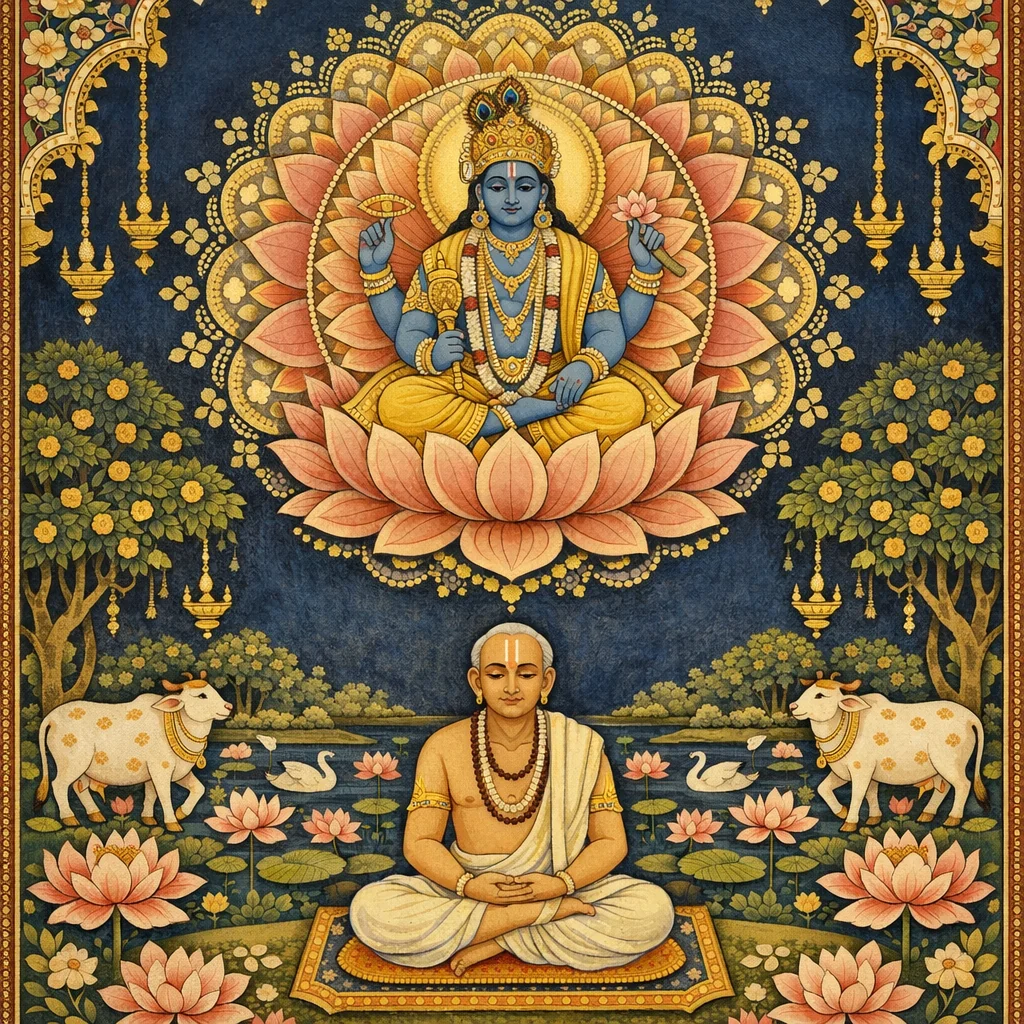
Adhyaya 2
The Lord in the Heart and the Discipline of Yoga-Bhakti
Continuing from the canto’s opening emphasis on hearing and fixing the mind upon the Supreme, Śukadeva explains to Parīkṣit how Brahmā, before manifest creation, regained consciousness by meditating on the virāṭ-rūpa and pleasing the Lord—linking cosmogenesis to devotion rather than independent material causation. He critiques bewildering Vedic sound that diverts people toward heavenly ambitions, urging minimal necessities, renunciation, and reliance on the Lord’s protection instead of flattering the wealthy. The chapter then gives a concrete meditative theology: the Lord as Paramātmā in the heart, described with four arms and divine ornaments, and a step-by-step method of meditation from the lotus feet upward to the smiling face, purifying intelligence progressively. Next, it outlines yogic departure at death: regulation of prāṇa, merging mind and self toward the Superself, and contrasting desireless bhakti-yogīs with those seeking siddhis or higher planets. The narrative expands into cosmological pathways (Suṣumṇā, Vaiśvānara, Śiśumāra, Maharloka, Satyaloka) and culminates in the doctrinal conclusion: Brahmā’s Vedic scrutiny establishes attraction to Śrī Kṛṣṇa as the highest dharma, and constant hearing and remembrance leads back to Godhead—preparing the reader for deeper creation accounts and the Bhāgavatam’s explicit Kṛṣṇa-centered theology in subsequent chapters.
Shlokas
Verse 1
श्रीशुक उवाच एवं पुरा धारणयात्मयोनि- र्नष्टां स्मृतिं प्रत्यवरुध्य तुष्टात् । तथा ससर्जेदममोघदृष्टि- र्यथाप्ययात् प्राग् व्यवसायबुद्धि: ॥ १ ॥
Śrī Śukadeva Gosvāmī said: Formerly, prior to the manifestation of the cosmos, Lord Brahmā, by meditating on the virāṭ-rūpa, regained his lost consciousness by appeasing the Lord. Thus he was able to rebuild the creation as it was before.
Verse 2
शाब्दस्य हि ब्रह्मण एष पन्था यन्नामभिर्ध्यायति धीरपार्थै: । परिभ्रमंस्तत्र न विन्दतेऽर्थान् मायामये वासनया शयान: ॥ २ ॥
The way of presentation of the Vedic sounds is so bewildering that it directs the intelligence of the people to meaningless things like the heavenly kingdoms. The conditioned souls hover in dreams of such heavenly illusory pleasures, but actually they do not relish any tangible happiness in such places.
Verse 3
अत: कविर्नामसु यावदर्थ: स्यादप्रमत्तो व्यवसायबुद्धि: । सिद्धेऽन्यथार्थे न यतेत तत्र परिश्रमं तत्र समीक्षमाण: ॥ ३ ॥
For this reason the enlightened person should endeavor only for the minimum necessities of life while in the world of names. He should be intelligently fixed and never endeavor for unwanted things, being competent to perceive practically that all such endeavors are merely hard labor for nothing.
Verse 4
सत्यां क्षितौ किं कशिपो: प्रयासै- र्बाहौ स्वसिद्धे ह्युपबर्हणै: किम् । सत्यञ्जलौ किं पुरुधान्नपात्र्या दिग्वल्कलादौ सति किं दुकूलै: ॥ ४ ॥
When there are ample earthly flats to lie on, what is the necessity of cots and beds? When one can use his own arms, what is the necessity of a pillow? When one can use the palms of his hands, what is the necessity of varieties of utensils? When there is ample covering, or the skins of trees, what is the necessity of clothing?
Verse 5
चीराणि किं पथि न सन्ति दिशन्ति भिक्षां नैवाङ्घ्रिपा: परभृत: सरितोऽप्यशुष्यन् । रुद्धा गुहा: किमजितोऽवति नोपसन्नान् कस्माद् भजन्ति कवयो धनदुर्मदान्धान् ॥ ५ ॥
Are there no torn clothes lying on the common road? Do the trees, which exist for maintaining others, no longer give alms in charity? Do the rivers, being dried up, no longer supply water to the thirsty? Are the caves of the mountains now closed? Or above all, does the Almighty Lord not protect the fully surrendered souls? Why then do the learned sages go to flatter those who are intoxicated by hard-earned wealth?
Verse 6
एवं स्वचित्ते स्वत एव सिद्ध आत्मा प्रियोऽर्थो भगवाननन्त: । तं निर्वृतो नियतार्थो भजेत संसारहेतूपरमश्च यत्र ॥ ६ ॥
Thus being fixed, one must render service unto the Supersoul situated in one’s own heart by His omnipotency. Because He is the Almighty Personality of Godhead, eternal and unlimited, He is the ultimate goal of life, and by worshiping Him one can end the cause of the conditioned state of existence.
Verse 7
कस्तां त्वनादृत्य परानुचिन्ता- मृते पशूनसतीं नाम कुर्यात् । पश्यञ्जनं पतितं वैतरण्यां स्वकर्मजान् परितापाञ्जुषाणम् ॥ ७ ॥
Who else but the gross materialists will neglect such transcendental thought and take to the nonpermanent names only, seeing the mass of people fallen in the river of suffering as the consequence of accruing the result of their own work?
Verse 8
केचित् स्वदेहान्तर्हृदयावकाशे प्रादेशमात्रं पुरुषं वसन्तम् । चतुर्भुजं कञ्जरथाङ्गशङ्ख- गदाधरं धारणया स्मरन्ति ॥ ८ ॥
Others conceive of the Personality of Godhead residing within the body in the region of the heart and measuring only eight inches, with four hands carrying a lotus, a wheel of a chariot, a conchshell and a club respectively.
Verse 9
प्रसन्नवक्त्रं नलिनायतेक्षणं कदम्बकिञ्जल्कपिशङ्गवाससम् । लसन्महारत्नहिरण्मयाङ्गदं स्फुरन्महारत्नकिरीटकुण्डलम् ॥ ९ ॥
His mouth expresses His happiness. His eyes spread like the petals of a lotus, and His garments, yellowish like the saffron of a kadamba flower, are bedecked with valuable jewels. His ornaments are all made of gold, set with jewels, and He wears a glowing headdress and earrings.
Verse 10
उन्निद्रहृत्पङ्कजकर्णिकालये योगेश्वरास्थापितपादपल्लवम् । श्रीलक्षणं कौस्तुभरत्नकन्धर- मम्लानलक्ष्म्या वनमालयाचितम् ॥ १० ॥
His lotus feet are placed over the whorls of the lotuslike hearts of great mystics. On His chest is the Kaustubha jewel, engraved with a beautiful calf, and there are other jewels on His shoulders. His complete torso is garlanded with fresh flowers.
Verse 11
विभूषितं मेखलयाङ्गुलीयकै- र्महाधनैर्नूपुरकङ्कणादिभि: । स्निग्धामलाकुञ्चितनीलकुन्तलै- र्विरोचमानाननहासपेशलम् ॥ ११ ॥
He is well decorated with an ornamental wreath about His waist and rings studded with valuable jewels on His fingers. His leglets, His bangles, His oiled hair, curling with a bluish tint, and His beautiful smiling face are all very pleasing.
Verse 12
अदीनलीलाहसितेक्षणोल्लसद्- भ्रूभङ्गसंसूचितभूर्यनुग्रहम् । ईक्षेत चिन्तामयमेनमीश्वरं यावन्मनो धारणयावतिष्ठते ॥ १२ ॥
The Lord’s magnanimous pastimes and the glowing glancing of His smiling face are all indications of His extensive benedictions. One must therefore concentrate on this transcendental form of the Lord, as long as the mind can be fixed on Him by meditation.
Verse 13
एकैकशोऽङ्गानि धियानुभावयेत् पादादि यावद्धसितं गदाभृत: । जितं जितं स्थानमपोह्य धारयेत् परं परं शुद्ध्यति धीर्यथा यथा ॥ १३ ॥
The process of meditation should begin from the lotus feet of the Lord and progress to His smiling face. The meditation should be concentrated upon the lotus feet, then the calves, then the thighs, and in this way higher and higher. The more the mind becomes fixed upon the different parts of the limbs, one after another, the more the intelligence becomes purified.
Verse 14
यावन्न जायेत परावरेऽस्मिन् विश्वेश्वरे द्रष्टरि भक्तियोग: । तावत् स्थवीय: पुरुषस्य रूपं क्रियावसाने प्रयत: स्मरेत ॥ १४ ॥
Unless the gross materialist develops a sense of loving service unto the Supreme Lord, the seer of both the transcendental and material worlds, he should remember or meditate upon the universal form of the Lord at the end of his prescribed duties.
Verse 15
स्थिरं सुखं चासनमास्थितो यति- र्यदा जिहासुरिममङ्ग लोकम् । काले च देशे च मनो न सज्जयेत् प्राणान् नियच्छेन्मनसा जितासु: ॥ १५ ॥
O King, whenever the yogī desires to leave this planet of human beings, he should not be perplexed about the proper time or place, but should comfortably sit without being disturbed and, regulating the life air, should control the senses by the mind.
Verse 16
मन: स्वबुद्ध्यामलया नियम्य क्षेत्रज्ञ एतां निनयेत् तमात्मनि । आत्मानमात्मन्यवरुध्य धीरो लब्धोपशान्तिर्विरमेत कृत्यात् ॥ १६ ॥
Thereafter, the yogī should merge his mind, by his unalloyed intelligence, into the living entity, and then merge the living entity into the Superself. And by doing this, the fully satisfied living entity becomes situated in the supreme stage of satisfaction, so that he ceases from all other activities.
Verse 17
न यत्र कालोऽनिमिषां पर: प्रभु: कुतो नु देवा जगतां य ईशिरे । न यत्र सत्त्वं न रजस्तमश्च न वै विकारो न महान् प्रधानम् ॥ १७ ॥
In that transcendental state of labdhopaśānti, there is no supremacy of devastating time, which controls even the celestial demigods who are empowered to rule over mundane creatures. (And what to speak of the demigods themselves?) Nor is there the mode of material goodness, nor passion, nor ignorance, nor even the false ego, nor the material Causal Ocean, nor the material nature.
Verse 18
परं पदं वैष्णवमामनन्ति तद् यन्नेति नेतीत्यतदुत्सिसृक्षव: । विसृज्य दौरात्म्यमनन्यसौहृदा हृदोपगुह्यार्हपदं पदे पदे ॥ १८ ॥
The transcendentalists desire to avoid everything godless, for they know that supreme situation in which everything is related with the Supreme Lord Viṣṇu. Therefore a pure devotee who is in absolute harmony with the Lord does not create perplexities, but worships the lotus feet of the Lord at every moment, taking them into his heart.
Verse 19
इत्थं मुनिस्तूपरमेद् व्यवस्थितो विज्ञानदृग्वीर्यसुरन्धिताशय: । स्वपार्ष्णिनापीड्य गुदं ततोऽनिलं स्थानेषु षट्सून्नमयेज्जितक्लम: ॥ १९ ॥
By the strength of scientific knowledge, one should be well situated in absolute realization and thus be able to extinguish all material desires. One should then give up the material body by blocking the air hole [through which stool is evacuated] with the heel of one’s foot and by lifting the life air from one place to another in the six primary places.
Verse 20
नाभ्यां स्थितं हृद्यधिरोप्य तस्मा- दुदानगत्योरसि तं नयेन्मुनि: । ततोऽनुसन्धाय धिया मनस्वी स्वतालुमूलं शनकैर्नयेत् ॥ २० ॥
The meditative devotee should slowly push up the life air from the navel to the heart, from there to the chest, and from there to the root of the palate. He should search out the proper places with intelligence.
Verse 21
तस्माद् भ्रुवोरन्तरमुन्नयेत निरुद्धसप्तायतनोऽनपेक्ष: । स्थित्वा मुहूर्तार्धमकुण्ठदृष्टि- र्निर्भिद्य मूर्धन् विसृजेत्परं गत: ॥ २१ ॥
Thereafter the bhakti-yogī should push the life air up between the eyebrows, and then, blocking the seven outlets of the life air, he should maintain his aim for going back home, back to Godhead. If he is completely free from all desires for material enjoyment, he should then reach the cerebral hole and give up his material connections, having gone to the Supreme.
Verse 22
यदि प्रयास्यन् नृप पारमेष्ठ्यं वैहायसानामुत यद् विहारम् । अष्टाधिपत्यं गुणसन्निवाये सहैव गच्छेन्मनसेन्द्रियैश्च ॥ २२ ॥
However, O King, if a yogī maintains a desire for improved material enjoyments, like transference to the topmost planet, Brahmaloka, or the achievement of the eightfold perfections, travel in outer space with the Vaihāyasas, or a situation in one of the millions of planets, then he has to take away with him the materially molded mind and senses.
Verse 23
योगेश्वराणां गतिमाहुरन्त- र्बहिस्त्रिलोक्या: पवनान्तरात्मनाम् । न कर्मभिस्तां गतिमाप्नुवन्ति विद्यातपोयोगसमाधिभाजाम् ॥ २३ ॥
The transcendentalists are concerned with the spiritual body. As such, by the strength of their devotional service, austerities, mystic power and transcendental knowledge, their movements are unrestricted, within and beyond the material worlds. The fruitive workers, or the gross materialists, can never move in such an unrestricted manner.
Verse 24
वैश्वानरं याति विहायसा गत: सुषुम्णया ब्रह्मपथेन शोचिषा । विधूतकल्कोऽथ हरेरुदस्तात् प्रयाति चक्रं नृप शैशुमारम् ॥ २४ ॥
O King, when such a mystic passes over the Milky Way by the illuminating Suṣumṇā to reach the highest planet, Brahmaloka, he goes first to Vaiśvānara, the planet of the deity of fire, wherein he becomes completely cleansed of all contaminations, and thereafter he still goes higher, to the circle of Śiśumāra, to relate with Lord Hari, the Personality of Godhead.
Verse 25
तद् विश्वनाभिं त्वतिवर्त्य विष्णो- रणीयसा विरजेनात्मनैक: । नमस्कृतं ब्रह्मविदामुपैति कल्पायुषो यद् विबुधा रमन्ते ॥ २५ ॥
This Śiśumāra is the pivot for the turning of the complete universe, and it is called the navel of Viṣṇu [Garbhodakaśāyī Viṣṇu]. The yogī alone goes beyond this circle of Śiśumāra and attains the planet [Maharloka] where purified saints like Bhṛgu enjoy a duration of life of 4,300,000,000 solar years. This planet is worshipable even for saints who are transcendentally situated.
Verse 26
अथो अनन्तस्य मुखानलेन दन्दह्यमानं स निरीक्ष्य विश्वम् । निर्याति सिद्धेश्वरयुष्टधिष्ण्यं यद् द्वैपरार्ध्यं तदु पारमेष्ठ्यम् ॥ २६ ॥
At the time of the final devastation of the complete universe [the end of the duration of Brahmā’s life], a flame of fire emanates from the mouth of Ananta [from the bottom of the universe]. The yogī sees all the planets of the universe burning to ashes, and thus he leaves for Satyaloka by airplanes used by the great purified souls. The duration of life in Satyaloka is calculated to be 15,480,000,000,000 years.
Verse 27
न यत्र शोको न जरा न मृत्यु- र्नार्तिर्न चोद्वेग ऋते कुतश्चित् । यच्चित्ततोऽद: कृपयानिदंविदां दुरन्तदु:खप्रभवानुदर्शनात् ॥ २७ ॥
In that planet of Satyaloka, there is neither bereavement, nor old age nor death. There is no pain of any kind, and therefore there are no anxieties, save that sometimes, due to consciousness, there is a feeling of compassion for those unaware of the process of devotional service, who are subjected to unsurpassable miseries in the material world.
Verse 28
ततो विशेषं प्रतिपद्य निर्भय- स्तेनात्मनापोऽनलमूर्तिरत्वरन् । ज्योतिर्मयो वायुमुपेत्य काले वाय्वात्मना खं बृहदात्मलिङ्गम् ॥ २८ ॥
After reaching Satyaloka, the devotee is specifically able to be incorporated fearlessly by the subtle body in an identity similar to that of the gross body, and one after another he gradually attains stages of existence from earthly to watery, fiery, glowing and airy, until he reaches the ethereal stage.
Verse 29
घ्राणेन गन्धं रसनेन वै रसं रूपं च दृष्टया श्वसनं त्वचैव । श्रोत्रेण चोपेत्य नभोगुणत्वं प्राणेन चाकूतिमुपैति योगी ॥ २९ ॥
The devotee thus surpasses the subtle objects of different senses like aroma by smelling, the palate by tasting, vision by seeing forms, touch by contacting, the vibrations of the ear by ethereal identification, and the sense organs by material activities.
Verse 30
स भूतसूक्ष्मेन्द्रियसंनिकर्षं मनोमयं देवमयं विकार्यम् । संसाद्य गत्या सह तेन याति विज्ञानतत्त्वं गुणसंनिरोधम् ॥ ३० ॥
The devotee, thus surpassing the gross and the subtle forms of coverings, enters the plane of egoism. And in that status he merges the material modes of nature [ignorance and passion] in this point of neutralization and thus reaches egoism in goodness. After this, all egoism is merged in the mahat-tattva, and he comes to the point of pure self-realization.
Verse 31
तेनात्मनात्मानमुपैति शान्त- मानन्दमानन्दमयोऽवसाने । एतां गतिं भागवतीं गतो य: स वै पुनर्नेह विषज्जतेऽङ्ग ॥ ३१ ॥
Only the purified soul can attain the perfection of associating with the Personality of Godhead in complete bliss and satisfaction in his constitutional state. Whoever is able to renovate such devotional perfection is never again attracted by this material world, and he never returns.
Verse 32
एते सृती ते नृप वेदगीते त्वयाभिपृष्टे च सनातने च । ये वै पुरा ब्रह्मण आह तुष्ट आराधितो भगवान् वासुदेव: ॥ ३२ ॥
Your Majesty Mahārāja Parīkṣit, know that all that I have described in reply to your proper inquiry is just according to the version of the Vedas, and it is eternal truth. This was described personally by Lord Kṛṣṇa unto Brahmā, with whom the Lord was satisfied upon being properly worshiped.
Verse 33
न ह्यतोऽन्य: शिव: पन्था विशत: संसृताविह । वासुदेवे भगवति भक्तियोगो यतो भवेत् ॥ ३३ ॥
For those who are wandering in the material universe, there is no more auspicious means of deliverance than what is aimed at in the direct devotional service of Lord Kṛṣṇa.
Verse 34
भगवान् ब्रह्म कार्त्स्न्येन त्रिरन्वीक्ष्य मनीषया । तदध्यवस्यत् कूटस्थो रतिरात्मन् यतो भवेत् ॥ ३४ ॥
The great personality Brahmā, with great attention and concentration of the mind, studied the Vedas three times, and after scrutinizingly examining them, he ascertained that attraction for the Supreme Personality of Godhead Śrī Kṛṣṇa is the highest perfection of religion.
Verse 35
भगवान् सर्वभूतेषु लक्षित: स्वात्मना हरि: । दृश्यैर्बुद्ध्यादिभिर्द्रष्टा लक्षणैरनुमापकै: ॥ ३५ ॥
The Personality of Godhead Lord Śrī Kṛṣṇa is in every living being along with the individual soul. And this fact is perceived and hypothesized in our acts of seeing and taking help from the intelligence.
Verse 36
तस्मात् सर्वात्मना राजन् हरि: सर्वत्र सर्वदा । श्रोतव्य: कीर्तितव्यश्च स्मर्तव्यो भगवान्नृणाम् ॥ ३६ ॥
O King, it is therefore essential that every human being hear about, glorify and remember the Supreme Lord, the Personality of Godhead, always and everywhere.
Verse 37
पिबन्ति ये भगवत आत्मन: सतां कथामृतं श्रवणपुटेषु सम्भृतम् । पुनन्ति ते विषयविदूषिताशयं व्रजन्ति तच्चरणसरोरुहान्तिकम् ॥ ३७ ॥
Those who drink through aural reception, fully filled with the nectarean message of Lord Kṛṣṇa, the beloved of the devotees, purify the polluted aim of life known as material enjoyment and thus go back to Godhead, to the lotus feet of Him [the Personality of Godhead].
Frequently Asked Questions
Because the chapter distinguishes śreyaḥ (ultimate good) from preyaḥ (temporary pleasure). Heaven-oriented aims keep the jīva within karma’s cycle, whereas the Bhāgavatam’s Vedic conclusion is devotion to Bhagavān; thus, misdirected Vedic engagement becomes “hard labor for nothing” when it does not awaken service to the Lord.
By aṅga-dhyāna: begin at the lotus feet and move upward—feet, calves, thighs, torso, ornaments, and finally the smiling face—fixing the mind sequentially. This graduated concentration purifies intelligence and stabilizes remembrance, making meditation devotional rather than merely technical.
This refers to Paramātmā, the localized expansion of the Supreme Lord situated in the heart, described with four hands and divine symbols. The chapter treats this as a valid object of meditation, yet it culminates in the higher conclusion that direct devotional service and attraction to Śrī Kṛṣṇa is the most auspicious and complete realization.
Śiśumāra is presented as the cosmic pivot (identified as the navel of Garbhodakaśāyī Viṣṇu) around which the universe turns. The yogī’s journey beyond it symbolizes transcending lower cosmic conditioning and aligning consciousness with Lord Hari, moving toward purified realms and ultimately toward spiritual perfection.
A bhakti-yogī aims for freedom from material desire and return to the Supreme, therefore transcending the need for planetary promotion or powers. A siddhi-seeking yogī retains subtle material desire, so he must carry a materially molded mind and senses, remaining within the graded cosmos rather than attaining final, desireless perfection.