Adhyaya 8
Parīkṣit’s Comprehensive Inquiries and the Bhāgavata as Śabda-avatāra
Continuing the momentum of Skandha 2’s cosmological and devotional setup, Mahārāja Parīkṣit intensifies his inquiry to Śukadeva Gosvāmī, asking how Nārada described the Lord’s transcendental qualities and to whom he spoke. Parīkṣit foregrounds the soteriological purpose of hearing: regular, serious śravaṇa of Śrīmad-Bhāgavatam manifests Kṛṣṇa in the heart and cleanses lust, anger, and hankering, like autumn rains clearing muddy pools. He then expands into a systematic catalogue of questions that effectively outlines forthcoming Bhāgavata topics: the jīva’s embodiment and causality; the Lord’s body versus conditioned bodies; Brahmā’s lotus-birth and vision of the Lord; Paramātmā in the heart untouched by māyā; the actual placement of planetary systems within the virāṭ-puruṣa; measures of time, lifespans, yugas, and manvantaras; karma and guṇa-driven transmigration; cosmic geography; varṇāśrama characteristics; elements (tattvas), devotional process, and yogic perfections; Vedic literature and subsidiary rites; creation, maintenance, dissolution, and the Lord’s witnessing role through internal and external potencies. Sūta notes Śukadeva’s pleasure and readiness to answer, introducing that this science was first spoken by the Lord to Brahmā—bridging into the next explanatory sequence.
Shlokas
Verse 1
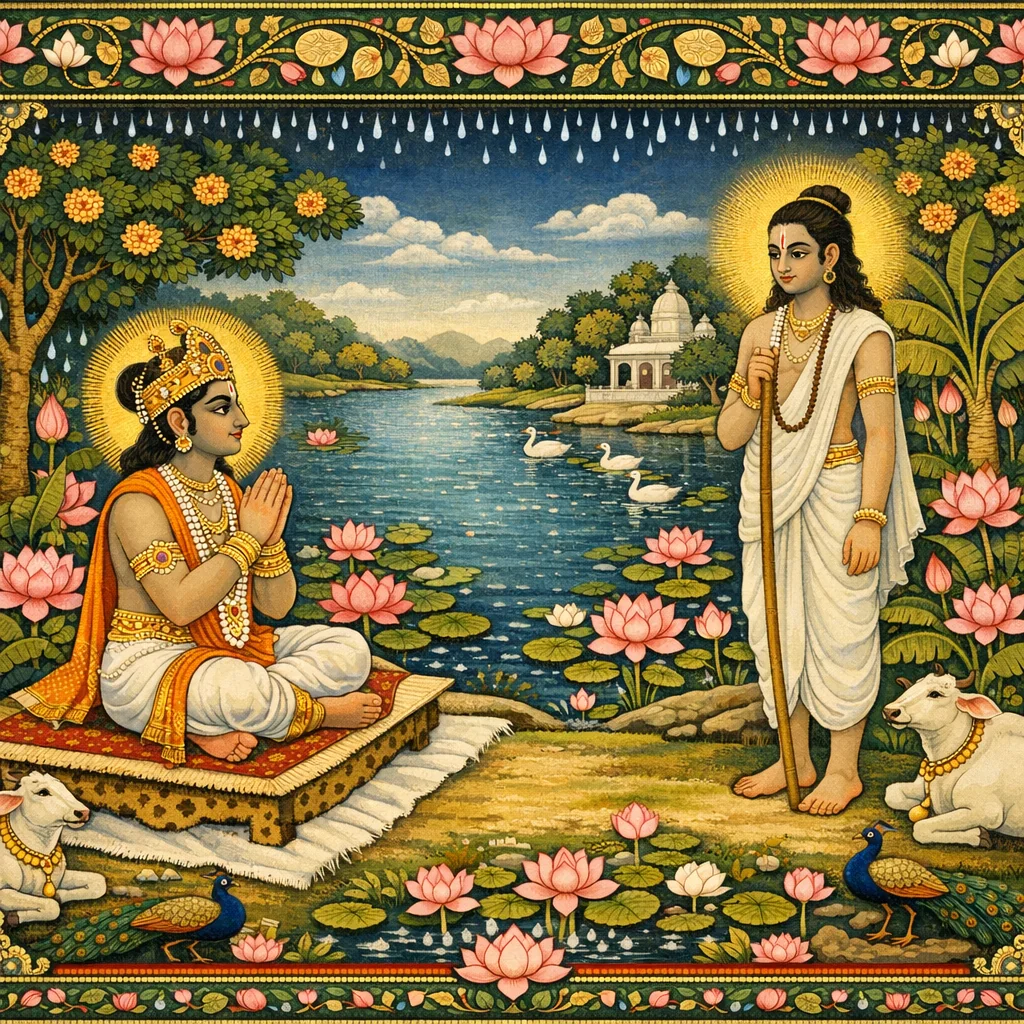
राजोवाच ब्रह्मणा चोदितो ब्रह्मन् गुणाख्यानेऽगुणस्य च । यस्मै यस्मै यथा प्राह नारदो देवदर्शन: ॥ १ ॥
King Parīkṣit inquired from Śukadeva Gosvāmī: How did Nārada Muni, whose hearers are as fortunate as those instructed by Lord Brahmā, explain the transcendental qualities of the Lord, who is without material qualities, and before whom did he speak?
Verse 2
एतद् वेदितुमिच्छामि तत्त्वं तत्त्वविदां वर । हरेरद्भुतवीर्यस्य कथा लोकसुमङ्गला: ॥ २ ॥
The King said: I wish to know. Narrations concerning the Lord, who possesses wonderful potencies, are certainly auspicious for living beings in all planets.
Verse 3
कथयस्व महाभाग यथाहमखिलात्मनि । कृष्णे निवेश्य नि:सङ्गं मनस्त्यक्ष्ये कलेवरम् ॥ ३ ॥
O greatly fortunate Śukadeva Gosvāmī, please continue narrating Śrīmad-Bhāgavatam so that I can place my mind upon the Supreme Soul, Lord Kṛṣṇa, and, being completely freed from material qualities, thus relinquish this body.
Verse 4
शृण्वत: श्रद्धया नित्यं गृणतश्च स्वचेष्टितम् । कालेन नातिदीर्घेण भगवान् विशते हृदि ॥ ४ ॥
Persons who hear Śrīmad-Bhāgavatam regularly and are always taking the matter very seriously will have the Personality of Godhead Śrī Kṛṣṇa manifested in their hearts within a short time.
Verse 5
प्रविष्ट: कर्णरन्ध्रेण स्वानां भावसरोरुहम् । धुनोति शमलं कृष्ण: सलिलस्य यथा शरत् ॥ ५ ॥
The sound incarnation of Lord Kṛṣṇa, the Supreme Soul [i.e., Śrīmad-Bhāgavatam], enters into the heart of a self-realized devotee, sits on the lotus flower of his loving relationship, and thus cleanses the dust of material association, such as lust, anger and hankering. Thus it acts like autumnal rains upon pools of muddy water.
Verse 6
धौतात्मा पुरुष: कृष्णपादमूलं न मुञ्चति । मुक्त सर्वपरिक्लेश: पान्थ: स्वशरणं यथा ॥ ६ ॥
A pure devotee of the Lord whose heart has once been cleansed by the process of devotional service never relinquishes the lotus feet of Lord Kṛṣṇa, for they fully satisfy him, as a traveler is satisfied at home after a troubled journey.
Verse 7
यदधातुमतो ब्रह्मन् देहारम्भोऽस्य धातुभि: । यदृच्छया हेतुना वा भवन्तो जानते यथा ॥ ७ ॥
O learned brāhmaṇa, the transcendental spirit soul is different from the material body. Does he acquire the body accidentally or by some cause? Will you kindly explain this, for it is known to you.
Verse 8
आसीद् यदुदरात् पद्मं लोकसंस्थानलक्षणम् । यावानयं वै पुरुष इयत्तावयवैः पृथक् ॥ तावानसाविति प्रोक्तः संस्थावयववानिव ॥ ८ ॥
If the Supreme Personality of Godhead, from whose abdomen the lotus stem sprouted, is possessed of a gigantic body according to His own caliber and measurement, then what is the specific difference between the body of the Lord and those of common living entities?
Verse 9
अज: सृजति भूतानि भूतात्मा यदनुग्रहात् । ददृशे येन तद्रूपं नाभिपद्मसमुद्भव: ॥ ९ ॥
Brahmā, who was not born of a material source but of the lotus flower coming out of the navel abdomen of the Lord, is the creator of all those who are materially born. Of course, by the grace of the Lord, Brahmā was able to see the form of the Lord.
Verse 10
स चापि यत्र पुरुषो विश्वस्थित्युद्भवाप्यय: । मुक्त्वात्ममायां मायेश: शेते सर्वगुहाशय: ॥ १० ॥
Please also explain the Personality of Godhead, who lies in every heart as the Supersoul, and as the Lord of all energies, but is untouched by His external energy.
Verse 11
पुरुषावयवैर्लोका: सपाला: पूर्वकल्पिता: । लोकैरमुष्यावयवा: सपालैरिति शुश्रुम ॥ ११ ॥
O learned brāhmaṇa, it was formerly explained that all the planets of the universe with their respective governors are situated in the different parts of the gigantic body of the virāṭ-puruṣa. I have also heard that the different planetary systems are supposed to be in the gigantic body of the virāṭ-puruṣa. But what is their actual position? Will you please explain that?
Verse 12
यावान् कल्पोविकल्पो वा यथा कालोऽनुमीयते । भूतभव्यभवच्छब्द आयुर्मानं च यत् सत: ॥ १२ ॥
Also please explain the duration of time between creation and annihilation, and that of other subsidiary creations, as well as the nature of time, indicated by the sound of past, present and future. Also, please explain the duration and measurement of life of the different living beings known as the demigods, the human beings, etc., in different planets of the universe.
Verse 13
कालस्यानुगतिर्या तु लक्ष्यतेऽण्वी बृहत्यपि । यावत्य: कर्मगतयो यादृशीर्द्विजसत्तम ॥ १३ ॥
O purest of the brāhmaṇas, please also explain the cause of the different durations of time, both short and long, as well as the beginning of time, following the course of action.
Verse 14
यस्मिन् कर्मसमावायो यथा येनोपगृह्यते । गुणानां गुणिनां चैव परिणाममभीप्सताम् ॥ १४ ॥
Then again, kindly describe how the proportionate accumulation of the reactions resulting from the different modes of material nature act upon the desiring living being, promoting or degrading him among the different species of life, beginning from the demigods down to the most insignificant creatures.
Verse 15
भूपातालककुब्व्योमग्रहनक्षत्रभूभृताम् । सरित्समुद्रद्वीपानां सम्भवश्चैतदोकसाम् ॥ १५ ॥
O best of the brāhmaṇas, please also describe how the creation of the globes throughout the universe, the four directions of the heavens, the sky, the planets, the stars, the mountains, the rivers, the seas and the islands, as well as their different kinds of inhabitants, takes place.
Verse 16
प्रमाणमण्डकोशस्य बाह्याभ्यन्तरभेदत: । महतां चानुचरितं वर्णाश्रमविनिश्चय: ॥ १६ ॥
Also, please describe the inner and outer space of the universe by specific divisions, as well as the character and activities of the great souls, and also the characteristics of the different classifications of the castes and orders of social life.
Verse 17
युगानि युगमानं च धर्मो यश्च युगे युगे । अवतारानुचरितं यदाश्चर्यतमं हरे: ॥ १७ ॥
Please explain all the different ages in the duration of the creation, and also the duration of such ages. Also tell me about the different activities of the different incarnations of the Lord in different ages.
Verse 18
नृणां साधारणो धर्म: सविशेषश्च यादृश: । श्रेणीनां राजर्षीणां च धर्म: कृच्छ्रेषु जीवताम् ॥ १८ ॥
Please also explain what may generally be the common religious affiliations of human society, as well as their specific occupational duties in religion, the classification of the social orders as well as the administrative royal orders, and the religious principles for one who may be in distress.
Verse 19
तत्त्वानां परिसंख्यानं लक्षणं हेतुलक्षणम् । पुरुषाराधनविधिर्योगस्याध्यात्मिकस्य च ॥ १९ ॥
Kindly explain all about the elementary principles of creation, the number of such elementary principles, their causes, and their development, and also the process of devotional service and the method of mystic powers.
Verse 20
योगेश्वरैश्वर्यगतिर्लिङ्गभङ्गस्तु योगिनाम् । वेदोपवेदधर्माणामितिहासपुराणयो: ॥ २० ॥
What are the opulences of the great mystics, and what is their ultimate realization? How does the perfect mystic become detached from the subtle astral body? What is the basic knowledge of the Vedic literatures, including the branches of history and the supplementary Purāṇas?
Verse 21
सम्प्लव: सर्वभूतानां विक्रम: प्रतिसंक्रम: । इष्टापूर्तस्य काम्यानां त्रिवर्गस्य च यो विधि: ॥ २१ ॥
Please explain unto me how the living beings are generated, how they are maintained, and how they are annihilated. Tell me also of the advantages and disadvantages of discharging devotional service unto the Lord. What are the Vedic rituals and injunctions of the supplementary Vedic rites, and what are the procedures of religion, economic development and sense satisfaction?
Verse 22
यो वानुशायिनां सर्ग: पाषण्डस्य च सम्भव: । आत्मनो बन्धमोक्षौ च व्यवस्थानं स्वरूपत: ॥ २२ ॥
Please also explain how, merged in the body of the Lord, living beings are created, and how the infidels appear in the world. Also please explain how the unconditioned living entities exist.
Verse 23
यथात्मतन्त्रो भगवान् विक्रीडत्यात्ममायया । विसृज्य वा यथा मायामुदास्ते साक्षिवद् विभु: ॥ २३ ॥
The independent Personality of Godhead enjoys His pastimes by His internal potency and at the time of annihilation gives them up to the external potency, and He remains a witness to it all.
Verse 24
सर्वमेतच्च भगवन् पृच्छतो मेऽनुपूर्वश: । तत्त्वतोऽर्हस्युदाहर्तुं प्रपन्नाय महामुने ॥ २४ ॥
O great sage, representative of the Lord, kindly satisfy my inquisitiveness in all that I have inquired from you and all that I may not have inquired from you from the very beginning of my questionings. Since I am a soul surrendered unto you, please impart full knowledge in this connection.
Verse 25
अत्र प्रमाणं हि भवान् परमेष्ठी यथात्मभू: । अपरे चानुतिष्ठन्ति पूर्वेषां पूर्वजै: कृतम् ॥ २५ ॥
O great sage, you are as good as Brahmā, the original living being. Others follow custom only, as followed by the previous philosophical speculators.
Verse 26
न मेऽसव: परायन्ति ब्रह्मन्ननशनादमी । पिबतोऽच्युतपीयूषम् तद्वाक्याब्धिविनि:सृतम् ॥ २६ ॥
O learned brāhmaṇa, because of my drinking the nectar of the message of the infallible Personality of Godhead, which is flowing down from the ocean of your speeches, I do not feel any sort of exhaustion due to my fasting.
Verse 27
सूत उवाच स उपामन्त्रितो राज्ञा कथायामिति सत्पते: । ब्रह्मरातो भृशं प्रीतो विष्णुरातेन संसदि ॥ २७ ॥
Sūta Gosvāmī said: Thus Śukadeva Gosvāmī, being invited by Mahārāja Parīkṣit to speak on topics of the Lord Śrī Kṛṣṇa with the devotees, was very much pleased.
Verse 28
प्राह भागवतं नाम पुराणं ब्रह्मसम्मितम् । ब्रह्मणे भगवत्प्रोक्तं ब्रह्मकल्प उपागते ॥ २८ ॥
He began to reply to the inquiries of Mahārāja Parīkṣit by saying that the science of the Personality of Godhead was spoken first by the Lord Himself to Brahmā when he was first born. Śrīmad-Bhāgavatam is the supplementary Vedic literature, and it is just in pursuance of the Vedas.
Verse 29
यद् यत् परीक्षिदृषभ: पाण्डूनामनुपृच्छति । आनुपूर्व्येण तत्सर्वमाख्यातुमुपचक्रमे ॥ २९ ॥
He also prepared himself to reply to all that King Parīkṣit had inquired from him. Mahārāja Parīkṣit was the best in the dynasty of the Pāṇḍus, and thus he was able to ask the right questions from the right person.
Frequently Asked Questions
This chapter presents Bhāgavatam as śabda-avatāra: when heard regularly with seriousness (niṣṭhā) from realized devotees, its transcendental sound enters the heart, awakens sambandha (relationship) with the Lord, and cleanses anarthas like kāma, krodha, and lobha. The result is not merely conceptual belief but a lived inner revelation—Paramātmā/Bhagavān becoming experientially present through purified consciousness.
Parīkṣit seeks to prevent a materialistic misunderstanding of divine form. The Bhāgavata uses cosmic-form language (virāṭ) to explain the Lord’s energies and the universe’s arrangement, but the Lord’s body is not a product of karma, guṇas, or material elements. Ordinary bodies are acquired through causality (karma and guṇa); the Lord’s form is self-manifest, fully controlled, and never conditioned by māyā.