Adhyaya 7
Bhagavān’s Avatāras, Their Protections (Poṣaṇa), and the Limits of Knowing Him
Continuing Brahmā’s instruction to Nārada on how the Supreme Lord is the root cause behind creation and governance, this chapter presents a sweeping avatāra-saṅgraha (catalog of incarnations) illustrating poṣaṇa—divine protection of the cosmos and devotees—across yugas and crises. Brahmā recounts major descents: Varāha’s rescue of Earth; Kapila’s teaching of sāṅkhya-bhakti to Devahūti; Dattātreya’s blessing of dynasties; the Kumāras restoring spiritual truth; Nara-Nārāyaṇa’s invincible tapas; Dhruva and Pṛthu as paradigms of devotion and righteous rule; Hayagrīva safeguarding Veda; Matsya and Kūrma in cosmic transitions; Nṛsiṁha’s protection of the devas; Gajendra’s rescue; Vāmana’s humbling of Bali; Haṁsa’s instruction to Nārada; Dhanvantari’s healing; Paraśurāma’s correction of fallen kṣatriyas; Rāma’s dharma-līlā; and Kṛṣṇa’s extraordinary childhood and royal pastimes. The chapter then turns reflective: Viṣṇu’s greatness is immeasurable; even Brahmā and Śeṣa cannot reach His limit. Yet surrendered devotees can cross māyā and know Him by grace. Brahmā concludes by urging Nārada to expand this Bhāgavata science so humans can develop firm devotional service, linking this avatāra overview to the next stage of systematic teaching and transmission.
Shlokas
Verse 1
ब्रह्मोवाच यत्रोद्यत: क्षितितलोद्धरणाय बिभ्रत् क्रौडीं तनुं सकलयज्ञमयीमनन्त: । अन्तर्महार्णव उपागतमादिदैत्यं तं दंष्ट्रयाद्रिमिव वज्रधरो ददार ॥ १ ॥
Lord Brahmā said: When the unlimitedly powerful Lord assumed the form of a boar as a pastime, just to lift the planet earth, which was drowned in the great ocean of the universe called the Garbhodaka, the first demon [Hiraṇyākṣa] appeared, and the Lord pierced him with His tusk.
Verse 2
जातो रुचेरजनयत् सुयमान् सुयज्ञ आकूतिसूनुरमरानथ दक्षिणायाम् । लोकत्रयस्य महतीमहरद् यदार्तिं स्वायम्भुवेन मनुना हरिरित्यनूक्त: ॥ २ ॥
The Prajāpati first begot Suyajña in the womb of his wife Ākūti, and then Suyajña begot demigods, headed by Suyama, in the womb of his wife Dakṣiṇā. Suyajña, as the Indradeva, diminished very great miseries in the three planetary systems [upper, lower and intermediate], and because he so diminished the miseries of the universe, he was later called Hari by the great father of mankind, namely Svāyambhuva Manu.
Verse 3
जज्ञे च कर्दमगृहे द्विज देवहूत्यां स्त्रीभि: समं नवभिरात्मगतिं स्वमात्रे । ऊचे ययात्मशमलं गुणसङ्गपङ्क- मस्मिन् विधूय कपिलस्य गतिं प्रपेदे ॥ ३ ॥
The Lord then appeared as the Kapila incarnation, being the son of the prajāpati brāhmaṇa Kardama and his wife, Devahūti, along with nine other women [sisters]. He spoke to His mother about self-realization, by which, in that very lifetime, she became fully cleansed of the mud of the material modes and thereby achieved liberation, the path of Kapila.
Verse 4
अत्रेरपत्यमभिकाङ्क्षत आह तुष्टो दत्तो मयाहमिति यद् भगवान् स दत्त: । यत्पादपङ्कजपरागपवित्रदेहा योगर्द्धिमापुरुभयीं यदुहैहयाद्या: ॥ ४ ॥
The great sage Atri prayed for offspring, and the Lord, being satisfied with him, promised to incarnate as Atri’s son, Dattātreya [Datta, the son of Atri]. And by the grace of the lotus feet of the Lord, many Yadus, Haihayas, etc., became so purified that they obtained both material and spiritual blessings.
Verse 5
तप्तं तपो विविधलोकसिसृक्षया मे आदौ सनात् स्वतपस: स चतु:सनोऽभूत् । प्राक्कल्पसम्प्लवविनष्टमिहात्मतत्त्वं सम्यग् जगाद मुनयो यदचक्षतात्मन् ॥ ५ ॥
To create different planetary systems I had to undergo austerities and penance, and the Lord, thus being pleased with me, incarnated in four sanas [Sanaka, Sanatkumāra, Sanandana and Sanātana]. In the previous creation the spiritual truth was devastated, but the four sanas explained it so nicely that the truth at once became clearly perceived by the sages.
Verse 6
धर्मस्य दक्षदुहितर्यजनिष्ट मूर्त्यां नारायणो नर इति स्वतप:प्रभाव: । दृष्ट्वात्मनो भगवतो नियमावलोपं देव्यस्त्वनङ्गपृतना घटितुं न शेकु: ॥ ६ ॥
To exhibit His personal way of austerity and penance, He appeared in twin forms as Nārāyaṇa and Nara in the womb of Mūrti, the wife of Dharma and the daughter of Dakṣa. Celestial beauties, the companions of Cupid, went to try to break His vows, but they were unsuccessful, for they saw that many beauties like them were emanating from Him, the Personality of Godhead.
Verse 7
कामं दहन्ति कृतिनो ननु रोषदृष्टया रोषं दहन्तमुत ते न दहन्त्यसह्यम् । सोऽयं यदन्तरमलं प्रविशन् बिभेति काम: कथं नु पुनरस्य मन: श्रयेत ॥ ७ ॥
Great stalwarts like Lord Śiva can, by their wrathful glances, overcome lust and vanquish him, yet they cannot be free from the overwhelming effects of their own wrath. Such wrath can never enter into the heart of Him [the Lord], who is above all this. So how can lust take shelter in His mind?
Verse 8
विद्ध: सपत्न्युदितपत्रिभिरन्ति राज्ञो बालोऽपि सन्नुपगतस्तपसे वनानि । तस्मा अदाद् ध्रुवगतिं गृणते प्रसन्नो दिव्या: स्तुवन्ति मुनयो यदुपर्यधस्तात् ॥ ८ ॥
Being insulted by sharp words spoken by the co-wife of the king, even in his presence, Prince Dhruva, though only a boy, took to severe penances in the forest. And the Lord, being satisfied by his prayer, awarded him the Dhruva planet, which is worshiped by great sages, both upward and downward.
Verse 9
यद्वेनमुत्पथगतं द्विजवाक्यवज्र- निष्प्लुष्टपौरुषभगं निरये पतन्तम् । त्रात्वार्थितो जगति पुत्रपदं च लेभे दुग्धा वसूनि वसुधा सकलानि येन ॥ ९ ॥
Mahārāja Vena went astray from the path of righteousness, and the brāhmaṇas chastised him by the thunderbolt curse. By this King Vena was burnt with his good deeds and opulence and was en route to hell. The Lord, by His causeless mercy, descended as his son, by the name of Pṛthu, delivered the condemned King Vena from hell, and exploited the earth by drawing all kinds of crops as produce.
Verse 10
नाभेरसावृषभ आस सुदेविसूनु- र्यो वै चचार समदृग् जडयोगचर्याम् । यत्पारमहंस्यमृषय: पदमामनन्ति स्वस्थ: प्रशान्तकरण: परिमुक्तसङ्ग: ॥ १० ॥
The Lord appeared as the son of Sudevī, the wife of King Nābhi, and was known as Ṛṣabhadeva. He performed materialistic yoga to equibalance the mind. This stage is also accepted as the highest perfectional situation of liberation, wherein one is situated in one’s self and is completely satisfied.
Verse 11
सत्रे ममास भगवान् हयशीरषाथो साक्षात् स यज्ञपुरुषस्तपनीयवर्ण: । छन्दोमयो मखमयोऽखिलदेवतात्मा वाचो बभूवुरुशती: श्वसतोऽस्य नस्त: ॥ ११ ॥
The Lord appeared as the Hayagrīva incarnation in a sacrifice performed by me [Brahmā]. He is the personified sacrifices, and the hue of His body is golden. He is the personified Vedas as well, and the Supersoul of all demigods. When He breathed, all the sweet sounds of the Vedic hymns came out of His nostrils.
Verse 12
मत्स्यो युगान्तसमये मनुनोपलब्ध: क्षोणीमयो निखिलजीवनिकायकेत: । विस्रंसितानुरुभये सलिले मुखान्मे आदाय तत्र विजहार ह वेदमार्गान् ॥ १२ ॥
At the end of the millennium, the would-be Vaivasvata Manu, of the name Satyavrata, would see that the Lord in the fish incarnation is the shelter of all kinds of living entities, up to those in the earthly planets. Because of my fear of the vast water at the end of the millennium, the Vedas come out of my [Brahmā’s] mouth, and the Lord enjoys those vast waters and protects the Vedas.
Verse 13
क्षीरोदधावमरदानवयूथपाना- मुन्मथ्नताममृतलब्धय आदिदेव: । पृष्ठेन कच्छपवपुर्विदधार गोत्रं निद्राक्षणोऽद्रिपरिवर्तकषाणकण्डू: ॥ १३ ॥
The primeval Lord then assumed the tortoise incarnation in order to serve as a resting place [pivot] for the Mandara Mountain, which was acting as a churning rod. The demigods and demons were churning the Ocean of Milk with the Mandara Mountain in order to extract nectar. The mountain moved back and forth, scratching the back of Lord Tortoise, who, while partially sleeping, was experiencing an itching sensation.
Verse 14
त्रैपिष्टपोरुभयहा स नृसिंहरूपं कृत्वा भ्रमद्भ्रुकुटिदंष्ट्रकरालवक्त्रम् । दैत्येन्द्रमाशु गदयाभिपतन्तमारा- दूरौ निपात्य विददार नखै: स्फुरन्तम् ॥ १४ ॥
The Personality of Godhead assumed the incarnation of Nṛsiṁhadeva in order to vanquish the great fears of the demigods. He killed the king of the demons [Hiraṇyakaśipu], who challenged the Lord with a club in his hand, by placing the demon on His thighs and piercing him with His nails, rolling His eyebrows in anger and showing His fearful teeth and mouth.
Verse 15
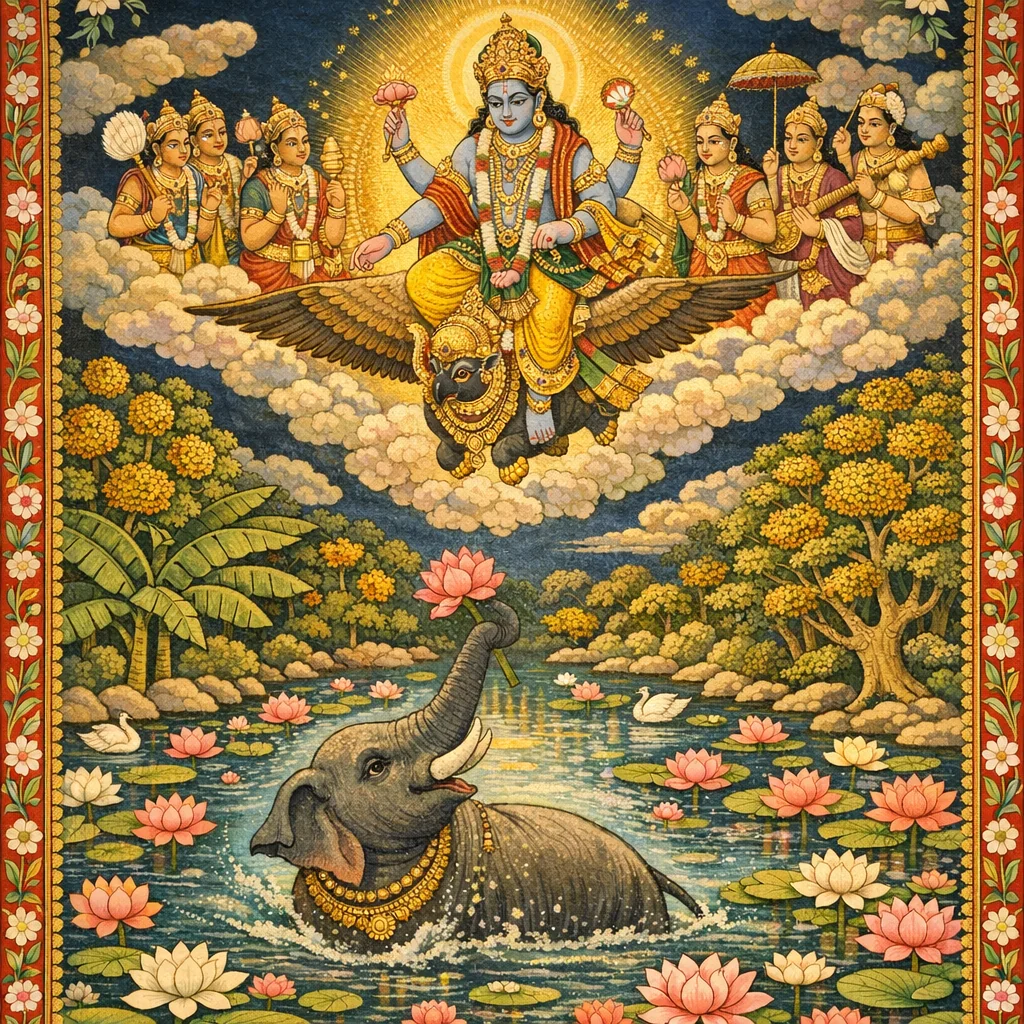
अन्त:सरस्युरुबलेन पदे गृहीतो ग्राहेण यूथपतिरम्बुजहस्त आर्त: । आहेदमादिपुरुषाखिललोकनाथ तीर्थश्रव: श्रवणमङ्गलनामधेय ॥ १५ ॥
The leader of the elephants, whose leg was attacked in a river by a crocodile of superior strength, was much aggrieved. Taking a lotus flower in his trunk, he addressed the Lord, saying, “O original enjoyer, Lord of the universe! O deliverer, as famous as a place of pilgrimage! All are purified simply by hearing Your holy name, which is worthy to be chanted.”
Verse 16
श्रुत्वा हरिस्तमरणार्थिनमप्रमेय- श्चक्रायुध: पतगराजभुजाधिरूढ: । चक्रेण नक्रवदनं विनिपाट्य तस्मा- द्धस्ते प्रगृह्य भगवान् कृपयोज्जहार ॥ १६ ॥
The Personality of Godhead, after hearing the elephant’s plea, felt that the elephant needed His immediate help, for he was in great distress. Thus at once the Lord appeared there on the wings of the king of birds, Garuḍa, fully equipped with His weapon, the wheel [cakra]. With the wheel He cut to pieces the mouth of the crocodile to save the elephant, and He delivered the elephant by lifting him by his trunk.
Verse 17
ज्यायान् गुणैरवरजोऽप्यदिते: सुतानां लोकान् विचक्रम इमान् यदथाधियज्ञ: । क्ष्मां वामनेन जगृहे त्रिपदच्छलेन याच्ञामृते पथि चरन् प्रभुभिर्न चाल्य: ॥ १७ ॥
The Lord, although transcendental to all material modes, still surpassed all the qualities of the sons of Aditi, known as the Ādityas. The Lord appeared as the youngest son of Aditi. And because He surpassed all the planets of the universe, He is the Supreme Personality of Godhead. On the pretense of asking for a measurement of three footsteps of land, He took away all the lands of Bali Mahārāja. He asked simply because without begging, no authority can take one’s rightful possession.
Verse 18
नार्थो बलेरयमुरुक्रमपादशौच- माप: शिखाधृतवतो विबुधाधिपत्यम् । यो वै प्रतिश्रुतमृते न चिकीर्षदन्य- दात्मानमङ्ग मनसा हरयेऽभिमेने ॥ १८ ॥
Bali Mahārāja, who put on his head the water washed from the lotus feet of the Lord, did not think of anything besides his promise, in spite of being forbidden by his spiritual master. The king dedicated his own personal body to fulfill the measurement of the Lord’s third step. For such a personality, even the kingdom of heaven, which he conquered by his strength, was of no value.
Verse 19
तुभ्यं च नारद भृशं भगवान् विवृद्ध- भावेन साधुपरितुष्ट उवाच योगम् । ज्ञानं च भागवतमात्मसतत्त्वदीपं यद्वासुदेवशरणा विदुरञ्जसैव ॥ १९ ॥
O Nārada, you were taught about the science of God and His transcendental loving service by the Personality of Godhead in His incarnation of Haṁsāvatāra. He was very much pleased with you, due to your intense proportion of devotional service. He also explained unto you, lucidly, the full science of devotional service, which is especially understandable by persons who are souls surrendered unto Lord Vāsudeva, the Personality of Godhead.
Verse 20
चक्रं च दिक्ष्वविहतं दशसु स्वतेजो मन्वन्तरेषु मनुवंशधरो बिभर्ति । दुष्टेषु राजसु दमं व्यदधात् स्वकीर्तिं सत्ये त्रिपृष्ठ उशतीं प्रथयंश्चरित्रै: ॥ २० ॥
As the incarnation of Manu, the Lord became the descendant of the Manu dynasty and ruled over the miscreant kingly order, subduing them by His powerful wheel weapon. Undeterred in all circumstances, His rule was characterized by His glorious fame, which spread over the three lokas, and above them to the planetary system of Satyaloka, the topmost in the universe.
Verse 21
धन्वन्तरिश्च भगवान् स्वयमेव कीर्ति- र्नाम्ना नृणां पुरुरुजां रुज आशु हन्ति । यज्ञे च भागममृतायुरवावरुन्ध आयुष्यवेदमनुशास्त्यवतीर्य लोके ॥ २१ ॥
The Lord in His incarnation of Dhanvantari very quickly cures the diseases of the ever-diseased living entities simply by His fame personified, and only because of Him do the demigods achieve long lives. Thus the Personality of Godhead becomes ever glorified. He also exacted a share from the sacrifices, and it is He only who inaugurated the medical science or the knowledge of medicine in the universe.
Verse 22
क्षत्रं क्षयाय विधिनोपभृतं महात्मा ब्रह्मध्रुगुज्झितपथं नरकार्तिलिप्सु । उद्धन्त्यसाववनिकण्टकमुग्रवीर्य- स्त्रि:सप्तकृत्व उरुधारपरश्वधेन ॥ २२ ॥
When the ruling administrators, who are known as the kṣatriyas, turned astray from the path of the Absolute Truth, being desirous to suffer in hell, the Lord, in His incarnation as the sage Paraśurāma, uprooted those unwanted kings, who appeared as the thorns of the earth. Thus He thrice seven times uprooted the kṣatriyas with His keenly sharpened chopper.
Verse 23
अस्मत्प्रसादसुमुख: कलया कलेश इक्ष्वाकुवंश अवतीर्य गुरोर्निदेशे । तिष्ठन् वनं सदयितानुज आविवेश यस्मिन् विरुध्य दशकन्धर आर्तिमार्च्छत् ॥ २३ ॥
Due to His causeless mercy upon all living entities within the universe, the Supreme Personality of Godhead, along with His plenary extensions, appeared in the family of Mahārāja Ikṣvāku as the Lord of His internal potency, Sītā. Under the order of His father, Mahārāja Daśaratha, He entered the forest and lived there for considerable years with His wife and younger brother. Rāvaṇa, who was very materially powerful, with ten heads on his shoulders, committed a great offense against Him and was thus ultimately vanquished.
Verse 24
यस्मा अदादुदधिरूढभयाङ्गवेपो मार्गं सपद्यरिपुरं हरवद् दिधक्षो: । दूरे सुहृन्मथितरोषसुशोणदृष्टया तातप्यमानमकरोरगनक्रचक्र: ॥ २४ ॥
The Personality of Godhead Rāmacandra, being aggrieved for His distant intimate friend [Sītā], glanced over the city of the enemy Rāvaṇa with red-hot eyes like those of Hara [who wanted to burn the kingdom of heaven]. The great ocean, trembling in fear, gave Him His way because its family members, the aquatics like the sharks, snakes and crocodiles, were being burnt by the heat of the angry red-hot eyes of the Lord.
Verse 25
वक्ष:स्थलस्पर्शरुग्नमहेन्द्रवाह- दन्तैर्विडम्बितककुब्जुष ऊढहासम् । सद्योऽसुभि: सह विनेष्यति दारहर्तु- र्विस्फूर्जितैर्धनुष उच्चरतोऽधिसैन्ये ॥ २५ ॥
When Rāvaṇa was engaged in the battle, the trunk of the elephant which carried the King of heaven, Indra, broke in pieces, having collided with the chest of Rāvaṇa, and the scattered broken parts illuminated all directions. Rāvaṇa therefore felt proud of his prowess and began to loiter in the midst of the fighting soldiers, thinking himself the conqueror of all directions. But his laughter, overtaken by joy, along with his very air of life, suddenly ceased with the tingling sound of the bow of Rāmacandra, the Personality of Godhead.
Verse 26
भूमे: सुरेतरवरूथविमर्दिताया: क्लेशव्ययाय कलया सितकृष्णकेश: । जात: करिष्यति जनानुपलक्ष्यमार्ग: कर्माणि चात्ममहिमोपनिबन्धनानि ॥ २६ ॥
When the world is overburdened by the fighting strength of kings who have no faith in God, the Lord, just to diminish the distress of the world, descends with His plenary portion. The Lord comes in His original form, with beautiful black hair. And just to expand His transcendental glories, He acts extraordinarily. No one can properly estimate how great He is.
Verse 27
तोकेन जीवहरणं यदुलूकिकाया- स्त्रैमासिकस्य च पदा शकटोऽपवृत्त: । यद् रिङ्गतान्तरगतेन दिविस्पृशोर्वा उन्मूलनं त्वितरथार्जुनयोर्न भाव्यम् ॥ २७ ॥
There is no doubt about Lord Kṛṣṇa’s being the Supreme Lord. Otherwise, how was it possible for Him to kill a giant demon like Pūtanā when He was just on the lap of His mother, to overturn a cart with His leg when He was only three months old, or to uproot a pair of arjuna trees so high that they touched the sky, when He was only crawling? All these activities are impossible for anyone other than the Lord Himself.
Verse 28
यद् वै व्रजे व्रजपशून् विषतोयपीतान् पालांस्त्वजीवयदनुग्रहदृष्टिवृष्टया । तच्छुद्धयेऽतिविषवीर्यविलोलजिह्व- मुच्चाटयिष्यदुरगं विहरन् ह्रदिन्याम् ॥ २८ ॥
Then also when the cowherd boys and their animals drank the poisoned water of the river Yamunā, and after the Lord [in His childhood] revived them by His merciful glance, just to purify the water of the river Yamunā He jumped into it as if playing and chastised the venomous Kāliya snake, which was lurking there, its tongue emitting waves of poison. Who can perform such herculean tasks but the Supreme Lord?
Verse 29
तत् कर्म दिव्यमिव यन्निशि नि:शयानं दावाग्निना शुचिवने परिदह्यमाने । उन्नेष्यति व्रजमतोऽवसितान्तकालं नेत्रे पिधाप्य सबलोऽनधिगम्यवीर्य: ॥ २९ ॥
On the very night of the day of the chastisement of the Kāliya snake, when the inhabitants of Vrajabhūmi were sleeping carefreely, there was a forest fire ablaze due to dry leaves, and it appeared that all the inhabitants were sure to meet their death. But the Lord, along with Balarāma, saved them simply by closing His eyes. Such are the superhuman activities of the Lord.
Verse 30
गृह्णीत यद् यदुपबन्धममुष्य माता शुल्बं सुतस्य न तु तत् तदमुष्य माति । यज्जृम्भतोऽस्य वदने भुवनानि गोपी संवीक्ष्य शङ्कितमना: प्रतिबोधितासीत् ॥ ३० ॥
When the cowherd woman [Kṛṣṇa’s foster mother, Yaśodā] was trying to tie the hands of her son with ropes, she found the rope to be always insufficient in length, and when she finally gave up, Lord Kṛṣṇa, by and by, opened His mouth, wherein the mother found all the universes situated. Seeing this, she was doubtful in her mind, but she was convinced in a different manner of the mystic nature of her son.
Verse 31
नन्दं च मोक्ष्यति भयाद् वरुणस्य पाशाद् गोपान् बिलेषु पिहितान् मयसूनुना च । अह्न्यापृतं निशि शयानमतिश्रमेण लोकं विकुण्ठमुपनेष्यति गोकुलं स्म ॥ ३१ ॥
Lord Kṛṣṇa saved His foster father, Nanda Mahārāja, from the fear of the demigod Varuṇa and released the cowherd boys from the caves of the mountain, for they were placed there by the son of Maya. Also, to the inhabitants of Vṛndāvana, who were busy working during daytime and sleeping soundly at night because of their hard labor in the day, Lord Kṛṣṇa awarded promotion to the highest planet in the spiritual sky. All these acts are transcendental and certainly prove without any doubt His Godhood.
Verse 32
गोपैर्मखे प्रतिहते व्रजविप्लवाय देवेऽभिवर्षति पशून् कृपया रिरक्षु: । धर्तोच्छिलीन्ध्रमिव सप्तदिनानि सप्त- वर्षो महीध्रमनघैककरे सलीलम् ॥ ३२ ॥
When the cowherd men of Vṛndāvana, under instruction of Kṛṣṇa, stopped offering sacrifice to the heavenly King, Indra, the whole tract of land known as Vraja was threatened with being washed away by constant heavy rains for seven days. Lord Kṛṣṇa, out of His causeless mercy upon the inhabitants of Vraja, held up the hill known as Govardhana with one hand only, although He was only seven years old. He did this to protect the animals from the onslaught of water.
Verse 33
क्रीडन् वने निशि निशाकररश्मिगौर्यां रासोन्मुख: कलपदायतमूर्च्छितेन । उद्दीपितस्मररुजां व्रजभृद्वधूनां हर्तुर्हरिष्यति शिरो धनदानुगस्य ॥ ३३ ॥
When the Lord was engaged in His pastimes of the rāsa dance in the forest of Vṛndāvana, enlivening the sexual desires of the wives of the inhabitants of Vṛndāvana by sweet and melodious songs, a demon of the name Śaṅkhacūḍa, a rich follower of the treasurer of heaven [Kuvera], kidnapped the damsels, and the Lord severed his head from his trunk.
Verse 34
ये च प्रलम्बखरदर्दुरकेश्यरिष्ट- मल्लेभकंसयवना: कपिपौण्ड्रकाद्या: । अन्ये च शाल्वकुजबल्वलदन्तवक्र- सप्तोक्षशम्बरविदूरथरुक्मिमुख्या: ॥ ३४ ॥ ये वा मृधे समितिशालिन आत्तचापा: काम्बोजमत्स्यकुरुसृञ्जयकैकयाद्या: । यास्यन्त्यदर्शनमलं बलपार्थभीम- व्याजाह्वयेन हरिणा निलयं तदीयम् ॥ ३५ ॥
All demonic personalities like Pralamba, Dhenuka, Baka, Keśī, Ariṣṭa, Cāṇūra, Muṣṭika, Kuvalayāpīḍa elephant, Kaṁsa, Yavana, Narakāsura and Pauṇḍraka, great marshals like Śālva, Dvivida monkey and Balvala, Dantavakra, the seven bulls, Śambara, Vidūratha and Rukmī, as also great warriors like Kāmboja, Matsya, Kuru, Sṛñjaya and Kekaya, would all fight vigorously, either with the Lord Hari directly or with Him under His names of Baladeva, Arjuna, Bhīma, etc. And the demons, thus being killed, would attain either the impersonal brahmajyoti or His personal abode in the Vaikuṇṭha planets.
Verse 35
ये च प्रलम्बखरदर्दुरकेश्यरिष्ट- मल्लेभकंसयवना: कपिपौण्ड्रकाद्या: । अन्ये च शाल्वकुजबल्वलदन्तवक्र- सप्तोक्षशम्बरविदूरथरुक्मिमुख्या: ॥ ३४ ॥ ये वा मृधे समितिशालिन आत्तचापा: काम्बोजमत्स्यकुरुसृञ्जयकैकयाद्या: । यास्यन्त्यदर्शनमलं बलपार्थभीम- व्याजाह्वयेन हरिणा निलयं तदीयम् ॥ ३५ ॥
All demonic personalities like Pralamba, Dhenuka, Baka, Keśī, Ariṣṭa, Cāṇūra, Muṣṭika, Kuvalayāpīḍa elephant, Kaṁsa, Yavana, Narakāsura and Pauṇḍraka, great marshals like Śālva, Dvivida monkey and Balvala, Dantavakra, the seven bulls, Śambara, Vidūratha and Rukmī, as also great warriors like Kāmboja, Matsya, Kuru, Sṛñjaya and Kekaya, would all fight vigorously, either with the Lord Hari directly or with Him under His names of Baladeva, Arjuna, Bhīma, etc. And the demons, thus being killed, would attain either the impersonal brahmajyoti or His personal abode in the Vaikuṇṭha planets.
Verse 36
कालेन मीलितधियामवमृश्य नृणां स्तोकायुषां स्वनिगमो बत दूरपार: । आविर्हितस्त्वनुयुगं स हि सत्यवत्यां वेदद्रुमं विटपशो विभजिष्यति स्म ॥ ३६ ॥
The Lord Himself in His incarnation as the son of Satyavatī [Vyāsadeva] will consider his compilation of the Vedic literature to be very difficult for the less intelligent persons with short life, and thus He will divide the tree of Vedic knowledge into different branches, according to the circumstances of the particular age.
Verse 37
देवद्विषां निगमवर्त्मनि निष्ठितानां पूर्भिर्मयेन विहिताभिरदृश्यतूर्भि: । लोकान् घ्नतां मतिविमोहमतिप्रलोभं वेषं विधाय बहु भाष्यत औपधर्म्यम् ॥ ३७ ॥
When the atheists, after being well versed in the Vedic scientific knowledge, annihilate inhabitants of different planets, flying unseen in the sky on well-built rockets prepared by the great scientist Maya, the Lord will bewilder their minds by dressing Himself attractively as Buddha and will preach on subreligious principles.
Verse 38
यर्ह्यालयेष्वपि सतां न हरे: कथा: स्यु: पाषण्डिनो द्विजजना वृषला नृदेवा: । स्वाहा स्वधा वषडिति स्म गिरो न यत्र शास्ता भविष्यति कलेर्भगवान् युगान्ते ॥ ३८ ॥
Thereafter, at the end of Kali-yuga, when there exist no topics on the subject of God, even at the residences of so-called saints and respectable gentlemen of the three higher castes, and when the power of government is transferred to the hands of ministers elected from the lowborn śūdra class or those less than them, and when nothing is known of the techniques of sacrifice, even by word, at that time the Lord will appear as the supreme chastiser.
Verse 39
सर्गे तपोऽहमृषयो नव ये प्रजेशा: स्थानेऽथ धर्ममखमन्वमरावनीशा: । अन्ते त्वधर्महरमन्युवशासुराद्या मायाविभूतय इमा: पुरुशक्तिभाज: ॥ ३९ ॥
At the beginning of creation there are penance, myself [Brahmā] and the Prajāpatis, the great sages who generate; then, during the maintenance of the creation, there are Lord Viṣṇu, the demigods with controlling powers, and the kings of different planets. But at the end there is irreligion, and then Lord Śiva and the atheists full of anger, etc. All of them are different representative manifestations of the energy of the supreme power, the Lord.
Verse 40
विष्णोर्नु वीर्यगणनां कतमोऽर्हतीह य: पार्थिवान्यपि कविर्विममे रजांसि । चस्कम्भ य: स्वरहसास्खलता त्रिपृष्ठं यस्मात् त्रिसाम्यसदनादुरुकम्पयानम् ॥ ४० ॥
Who can describe completely the prowess of Viṣṇu? Even the scientist, who might have counted the particles of the atoms of the universe, cannot do so. Because it is He only who in His form of Trivikrama moved His leg effortlessly beyond the topmost planet, Satyaloka, up to the neutral state of the three modes of material nature. And all were moved.
Verse 41
नान्तं विदाम्यहममी मुनयोऽग्रजास्ते मायाबलस्य पुरुषस्य कुतोऽवरा ये । गायन् गुणान् दशशतानन आदिदेव: शेषोऽधुनापि समवस्यति नास्य पारम् ॥ ४१ ॥
Neither I nor all the sages born before you know fully the omnipotent Personality of Godhead. So what can others, who are born after us, know about Him? Even the first incarnation of the Lord, namely Śeṣa, has not been able to reach the limit of such knowledge, although He is describing the qualities of the Lord with ten hundred faces.
Verse 42
येषां स एष भगवान् दययेदनन्त: सर्वात्मनाश्रितपदो यदि निर्व्यलीकम् । ते दुस्तरामतितरन्ति च देवमायां नैषां ममाहमिति धी: श्वशृगालभक्ष्ये ॥ ४२ ॥
But anyone who is specifically favored by the Supreme Lord, the Personality of Godhead, due to unalloyed surrender unto the service of the Lord, can overcome the insurmountable ocean of illusion and can understand the Lord. But those who are attached to this body, which is meant to be eaten at the end by dogs and jackals, cannot do so.
Verse 43
वेदाहमङ्ग परमस्य हि योगमायां यूयं भवश्च भगवानथ दैत्यवर्य: । पत्नी मनो: स च मनुश्च तदात्मजाश्च प्राचीनबर्हिर्ऋभुरङ्ग उत ध्रुवश्च ॥ ४३ ॥ इक्ष्वाकुरैलमुचुकुन्दविदेहगाधि- रघ्वम्बरीषसगरा गयनाहुषाद्या: । मान्धात्रलर्कशतधन्वनुरन्तिदेवा देवव्रतो बलिरमूर्त्तरयो दिलीप: ॥ ४४ ॥ सौभर्युतङ्कशिबिदेवलपिप्पलाद- सारस्वतोद्धवपराशरभूरिषेणा: । येऽन्ये विभीषणहनूमदुपेन्द्रदत्त- पार्थार्ष्टिषेणविदुरश्रुतदेववर्या: ॥ ४५ ॥
O Nārada, although the potencies of the Lord are unknowable and immeasurable, still, because we are all surrendered souls, we know how He acts through yoga-māyā potencies. And, similarly, the potencies of the Lord are also known to the all-powerful Śiva, the great king of the atheist family, namely Prahlāda Mahārāja, Svāyambhuva Manu, his wife Śatarūpā, his sons and daughters like Priyavrata, Uttānapāda, Ākūti, Devahūti and Prasūti, Prācīnabarhi, Ṛbhu, Aṅga the father of Vena, Mahārāja Dhruva, Ikṣvāku, Aila, Mucukunda, Mahārāja Janaka, Gādhi, Raghu, Ambarīṣa, Sagara, Gaya, Nāhuṣa, Māndhātā, Alarka, Śatadhanve, Anu, Rantideva, Bhīṣma, Bali, Amūrttaraya, Dilīpa, Saubhari, Utaṅka, Śibi, Devala, Pippalāda, Sārasvata, Uddhava, Parāśara, Bhūriṣeṇa, Vibhīṣaṇa, Hanumān, Śukadeva Gosvāmī, Arjuna, Ārṣṭiṣeṇa, Vidura, Śrutadeva, etc.
Verse 44
वेदाहमङ्ग परमस्य हि योगमायां यूयं भवश्च भगवानथ दैत्यवर्य: । पत्नी मनो: स च मनुश्च तदात्मजाश्च प्राचीनबर्हिर्ऋभुरङ्ग उत ध्रुवश्च ॥ ४३ ॥ इक्ष्वाकुरैलमुचुकुन्दविदेहगाधि- रघ्वम्बरीषसगरा गयनाहुषाद्या: । मान्धात्रलर्कशतधन्वनुरन्तिदेवा देवव्रतो बलिरमूर्त्तरयो दिलीप: ॥ ४४ ॥ सौभर्युतङ्कशिबिदेवलपिप्पलाद- सारस्वतोद्धवपराशरभूरिषेणा: । येऽन्ये विभीषणहनूमदुपेन्द्रदत्त- पार्थार्ष्टिषेणविदुरश्रुतदेववर्या: ॥ ४५ ॥
O Nārada, although the potencies of the Lord are unknowable and immeasurable, still, because we are all surrendered souls, we know how He acts through yoga-māyā potencies. And, similarly, the potencies of the Lord are also known to the all-powerful Śiva, the great king of the atheist family, namely Prahlāda Mahārāja, Svāyambhuva Manu, his wife Śatarūpā, his sons and daughters like Priyavrata, Uttānapāda, Ākūti, Devahūti and Prasūti, Prācīnabarhi, Ṛbhu, Aṅga the father of Vena, Mahārāja Dhruva, Ikṣvāku, Aila, Mucukunda, Mahārāja Janaka, Gādhi, Raghu, Ambarīṣa, Sagara, Gaya, Nāhuṣa, Māndhātā, Alarka, Śatadhanve, Anu, Rantideva, Bhīṣma, Bali, Amūrttaraya, Dilīpa, Saubhari, Utaṅka, Śibi, Devala, Pippalāda, Sārasvata, Uddhava, Parāśara, Bhūriṣeṇa, Vibhīṣaṇa, Hanumān, Śukadeva Gosvāmī, Arjuna, Ārṣṭiṣeṇa, Vidura, Śrutadeva, etc.
Verse 45
वेदाहमङ्ग परमस्य हि योगमायां यूयं भवश्च भगवानथ दैत्यवर्य: । पत्नी मनो: स च मनुश्च तदात्मजाश्च प्राचीनबर्हिर्ऋभुरङ्ग उत ध्रुवश्च ॥ ४३ ॥ इक्ष्वाकुरैलमुचुकुन्दविदेहगाधि- रघ्वम्बरीषसगरा गयनाहुषाद्या: । मान्धात्रलर्कशतधन्वनुरन्तिदेवा देवव्रतो बलिरमूर्त्तरयो दिलीप: ॥ ४४ ॥ सौभर्युतङ्कशिबिदेवलपिप्पलाद- सारस्वतोद्धवपराशरभूरिषेणा: । येऽन्ये विभीषणहनूमदुपेन्द्रदत्त- पार्थार्ष्टिषेणविदुरश्रुतदेववर्या: ॥ ४५ ॥
O Nārada, although the potencies of the Lord are unknowable and immeasurable, still, because we are all surrendered souls, we know how He acts through yoga-māyā potencies. And, similarly, the potencies of the Lord are also known to the all-powerful Śiva, the great king of the atheist family, namely Prahlāda Mahārāja, Svāyambhuva Manu, his wife Śatarūpā, his sons and daughters like Priyavrata, Uttānapāda, Ākūti, Devahūti and Prasūti, Prācīnabarhi, Ṛbhu, Aṅga the father of Vena, Mahārāja Dhruva, Ikṣvāku, Aila, Mucukunda, Mahārāja Janaka, Gādhi, Raghu, Ambarīṣa, Sagara, Gaya, Nāhuṣa, Māndhātā, Alarka, Śatadhanve, Anu, Rantideva, Bhīṣma, Bali, Amūrttaraya, Dilīpa, Saubhari, Utaṅka, Śibi, Devala, Pippalāda, Sārasvata, Uddhava, Parāśara, Bhūriṣeṇa, Vibhīṣaṇa, Hanumān, Śukadeva Gosvāmī, Arjuna, Ārṣṭiṣeṇa, Vidura, Śrutadeva, etc.
Verse 46
ते वै विदन्त्यतितरन्ति च देवमायां स्त्रीशूद्रहूणशबरा अपि पापजीवा: । यद्यद्भुतक्रमपरायणशीलशिक्षा- स्तिर्यग्जना अपि किमु श्रुतधारणा ये ॥ ४६ ॥
Surrendered souls, even from groups leading sinful lives, such as women, the laborer class, the mountaineers and the Siberians, or even the birds and beasts, can also know about the science of Godhead and become liberated from the clutches of the illusory energy by surrendering unto the pure devotees of the Lord and by following in their footsteps in devotional service.
Verse 47
शश्वत् प्रशान्तमभयं प्रतिबोधमात्रं शुद्धं समं सदसत: परमात्मतत्त्वम् । शब्दो न यत्र पुरुकारकवान् क्रियार्थो माया परैत्यभिमुखे च विलज्जमाना तद् वै पदं भगवत: परमस्य पुंसो ब्रह्मेति यद् विदुरजस्रसुखं विशोकम् ॥ ४७ ॥
What is realized as the Absolute Brahman is full of unlimited bliss without grief. That is certainly the ultimate phase of the supreme enjoyer, the Personality of Godhead. He is eternally void of all disturbances and is fearless. He is complete consciousness as opposed to matter. Uncontaminated and without distinctions, He is the principle primeval cause of all causes and effects, in whom there is no sacrifice for fruitive activities and in whom the illusory energy does not stand.
Verse 48
सध्रयङ् नियम्य यतयो यमकर्तहेतिं । जह्यु: स्वराडिव निपानखनित्रमिन्द्र: ॥ ४८ ॥
In such a transcendental state there is no need of artificial control of the mind, mental speculation or meditation, as performed by the jñānīs and yogīs. One gives up such processes, as the heavenly King, Indra, forgoes the trouble to dig a well.
Verse 49
स श्रेयसामपि विभुर्भगवान् यतोऽस्य भावस्वभावविहितस्य सत: प्रसिद्धि: । देहे स्वधातुविगमेऽनुविशीर्यमाणे व्योमेव तत्र पुरुषो न विशीर्यतेऽज: ॥ ४९ ॥
The Personality of Godhead is the supreme master of everything auspicious because the results of whatever actions are performed by the living being, in either the material or spiritual existence, are awarded by the Lord. As such, He is the ultimate benefactor. Every individual living entity is unborn, and therefore even after the annihilation of the material elementary body, the living entity exists, exactly like the air within the body.
Verse 50
सोऽयं तेऽभिहितस्तात भगवान् विश्वभावन: । समासेन हरेर्नान्यदन्यस्मात् सदसच्च यत् ॥ ५० ॥
My dear son, I have now explained in brief the Supreme Personality of Godhead, who is creator of the manifested worlds. Without Him (Hari, the Lord), there are no other causes of the phenomenal and noumenal existences.
Verse 51
इदं भागवतं नाम यन्मे भगवतोदितम् । संग्रहोऽयं विभूतीनां त्वमेतद् विपुलीकुरु ॥ ५१ ॥
O Nārada, this science of God, Śrīmad-Bhāgavatam, was spoken to me in summary by the Supreme Personality of Godhead, and it was spoken as the accumulation of His diverse potencies. Please expand this science yourself.
Verse 52
यथा हरौ भगवति नृणां भक्तिर्भविष्यति । सर्वात्मन्यखिलाधारे इति सङ्कल्प्य वर्णय ॥ ५२ ॥
Please describe the science of Godhead with determination and in a manner by which it will be quite possible for the human being to develop transcendental devotional service unto the Personality of Godhead Hari, the Supersoul of every living being and the summum bonum source of all energies.
Verse 53
मायां वर्णयतोऽमुष्य ईश्वरस्यानुमोदत: । शृण्वत: श्रद्धया नित्यं माययात्मा न मुह्यति ॥ ५३ ॥
The Lord’s activities in association with His different energies should be described, appreciated and heard in accordance with the teachings of the Supreme Lord. If this is done regularly with devotion and respect, one is sure to get out of the illusory energy of the Lord.
Frequently Asked Questions
The avatāra list functions as a theological map of poṣaṇa: the Lord repeatedly descends to protect dharma, rescue devotees, restore Vedic knowledge, and re-balance cosmic order. Rather than isolated legends, the incarnations collectively demonstrate that the Supreme Person remains transcendental yet personally intervenes through His energies. The chapter also uses the list to argue epistemically: the Lord’s acts are limitless, so He is known fully only by His grace received through bhakti.
The Nara-Nārāyaṇa episode shows the Lord as the standard of tapas and self-mastery: attempts to disrupt His vows fail because He is ātmārāma and self-sufficient. Verse 7 sharpens the point—great beings like Śiva can conquer lust but may still be affected by their own anger; the Lord, however, is beyond the guṇas, so neither lust nor wrath can take shelter in His heart. The teaching is that divine transcendence is not repression but ontological freedom from material modes.
Bali is praised because he exemplifies surrendered integrity (śaraṇāgati and satya): even when warned by his guru, he honors his promise to the Lord and offers his own body for the third step. The Bhāgavata presents this as the devotee’s victory—material loss becomes spiritual gain—showing that devotion values the Lord’s pleasure above worldly sovereignty, including heaven.
The chapter states that even Brahmā and ancient sages cannot fully measure the Lord, and Śeṣa with countless mouths cannot reach the end of His qualities. Yet one who is specifically favored due to unalloyed surrender can cross the ocean of illusion and understand Him. Attachment to the perishable body blocks this knowledge, while service to pure devotees opens it.
Brahmā indicates that the Lord spoke the Bhāgavata to him in summary (saṅkṣepa) as a concentrated presentation of divine potencies and līlā. Nārada is commissioned to elaborate it pedagogically for human society so that people can practically develop bhakti to Hari. This establishes a transmission chain: revelation received through surrender is responsibly expanded for the liberation (mukti) of others.