Adhyaya 1
The First Step in God Realization: The Glory of Hearing and the Virāṭ-Rūpa Meditation
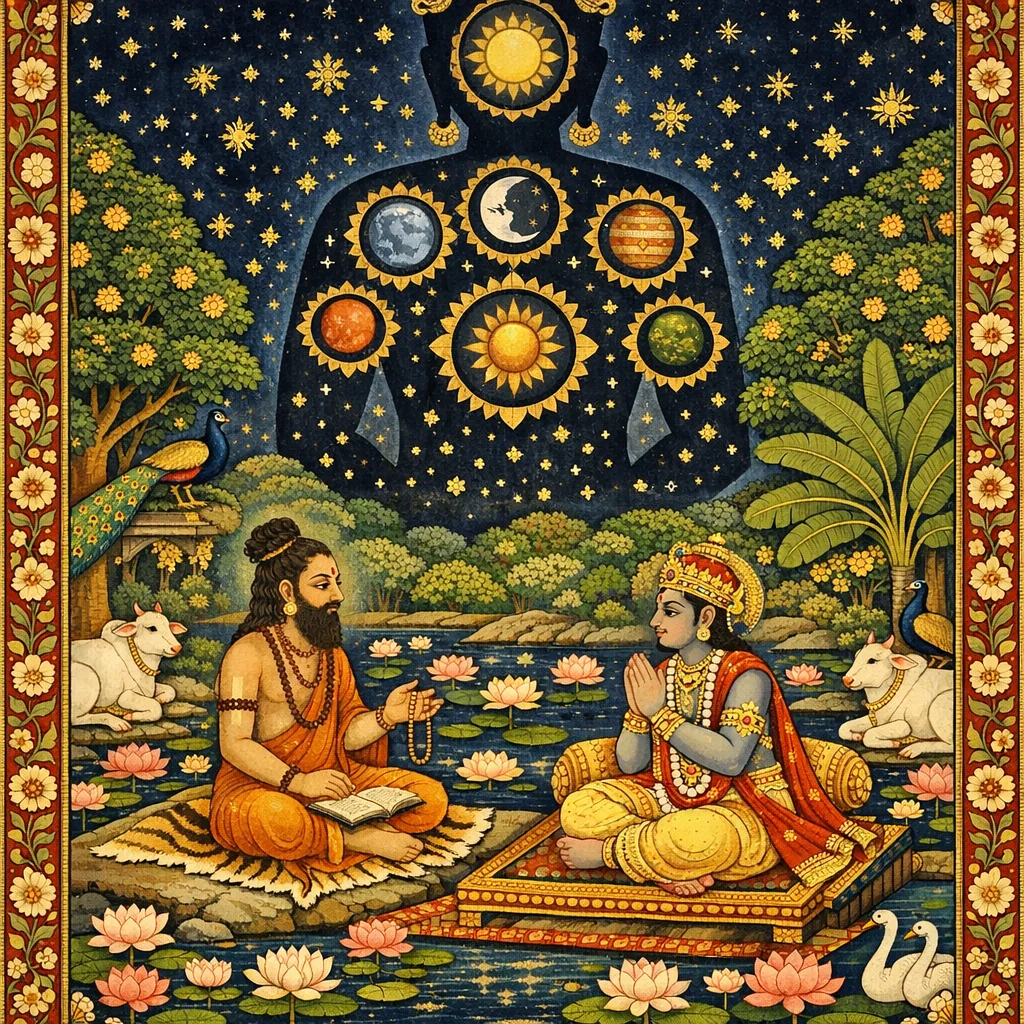
Śukadeva Gosvāmī praises Parīkṣit’s question as universally auspicious, contrasting it with the distracted life of materialistic householders who spend their days in wealth-making and maintenance and their nights in sleep or sex. He declares that freedom from misery begins with hearing, glorifying, and remembering the Supreme Lord (Paramātmā, controller and savior), and that the highest perfection is to remember Bhagavān at death—whether one follows jñāna, yoga, or karma. He affirms the Bhāgavatam’s supreme authority, recounting how even he, self-realized, was attracted to Kṛṣṇa’s līlā, and he recommends nāma-saṅkīrtana as the fearless path for all seekers. With Parīkṣit’s remaining seven days in view, Śukadeva outlines a disciplined end-of-life sādhana: renunciation, solitude, prāṇāyāma, oṁ-smaraṇa, sense-withdrawal, and focused meditation. Responding to Parīkṣit’s request for details, he introduces concentration on the Lord’s gross potency—the virāṭ-puruṣa—describing the cosmic body and planetary systems as His limbs. The chapter ends by insisting that the mind must ultimately fix on the all-blissful Supreme Person, or else it risks misdirection and degradation, setting up the next stages of deeper theological exposition.
Shlokas
Verse 1
श्रीशुक उवाच वरीयानेष ते प्रश्न: कृतो लोकहितं नृप । आत्मवित्सम्मत: पुंसां श्रोतव्यादिषु य: पर: ॥ १ ॥
Śrī Śukadeva Gosvāmī said: My dear King, your question is glorious because it is very beneficial to all kinds of people. The answer to this question is the prime subject matter for hearing, and it is approved by all transcendentalists.
Verse 2
श्रोतव्यादीनि राजेन्द्र नृणां सन्ति सहस्रश: । अपश्यतामात्मतत्त्वं गृहेषु गृहमेधिनाम् ॥ २ ॥
Those persons who are materially engrossed, being blind to the knowledge of ultimate truth, have many subject matters for hearing in human society, O Emperor.
Verse 3
निद्रया ह्रियते नक्तं व्यवायेन च वा वय: । दिवा चार्थेहया राजन् कुटुम्बभरणेन वा ॥ ३ ॥
The lifetime of such an envious householder is passed at night either in sleeping or in sex indulgence, and in the daytime either in making money or maintaining family members.
Verse 4
देहापत्यकलत्रादिष्वात्मसैन्येष्वसत्स्वपि । तेषां प्रमत्तो निधनं पश्यन्नपि न पश्यति ॥ ४ ॥
Persons devoid of ātma-tattva do not inquire into the problems of life, being too attached to the fallible soldiers like the body, children and wife. Although sufficiently experienced, they still do not see their inevitable destruction.
Verse 5
तस्माद्भारत सर्वात्मा भगवानीश्वरो हरि: । श्रोतव्य: कीर्तितव्यश्च स्मर्तव्यश्चेच्छताभयम् ॥ ५ ॥
O descendant of King Bharata, one who desires to be free from all miseries must hear about, glorify and also remember the Personality of Godhead, who is the Supersoul, the controller and the savior from all miseries.
Verse 6
एतावान् सांख्ययोगाभ्यां स्वधर्मपरिनिष्ठया । जन्मलाभ: पर: पुंसामन्ते नारायणस्मृति: ॥ ६ ॥
The highest perfection of human life, achieved either by complete knowledge of matter and spirit, by practice of mystic powers, or by perfect discharge of occupational duty, is to remember the Personality of Godhead at the end of life.
Verse 7
प्रायेण मुनयो राजन्निवृत्ता विधिषेधत: । नैर्गुण्यस्था रमन्ते स्म गुणानुकथने हरे: ॥ ७ ॥
O King Parīkṣit, mainly the topmost transcendentalists, who are above the regulative principles and restrictions, take pleasure in describing the glories of the Lord.
Verse 8
इदं भागवतं नाम पुराणं ब्रह्मसम्मितम् । अधीतवान् द्वापरादौ पितुर्द्वैपायनादहम् ॥ ८ ॥
At the end of the Dvāpara-yuga, I studied this great supplement of Vedic literature named Śrīmad-Bhāgavatam, which is equal to all the Vedas, from my father, Śrīla Dvaipāyana Vyāsadeva.
Verse 9
परिनिष्ठितोऽपि नैर्गुण्य उत्तमश्लोकलीलया । गृहीतचेता राजर्षे आख्यानं यदधीतवान् ॥ ९ ॥
O saintly King, I was certainly situated perfectly in transcendence, yet I was still attracted by the delineation of the pastimes of the Lord, who is described by enlightened verses.
Verse 10
तदहं तेऽभिधास्यामि महापौरुषिको भवान् । यस्य श्रद्दधतामाशु स्यान्मुकुन्दे मति: सती ॥ १० ॥
That very Śrīmad-Bhāgavatam I shall recite before you because you are the most sincere devotee of Lord Kṛṣṇa. One who gives full attention and respect to hearing Śrīmad-Bhāgavatam achieves unflinching faith in the Supreme Lord, the giver of salvation.
Verse 11
एतन्निर्विद्यमानानामिच्छतामकुतोभयम् । योगिनां नृप निर्णीतं हरेर्नामानुकीर्तनम् ॥ ११ ॥
O King, constant chanting of the holy name of the Lord after the ways of the great authorities is the doubtless and fearless way of success for all, including those who are free from all material desires, those who are desirous of all material enjoyment, and also those who are self-satisfied by dint of transcendental knowledge.
Verse 12
किं प्रमत्तस्य बहुभि: परोक्षैर्हायनैरिह । वरं मुहूर्तं विदितं घटते श्रेयसे यत: ॥ १२ ॥
What is the value of a prolonged life which is wasted, inexperienced by years in this world? Better a moment of full consciousness, because that gives one a start in searching after his supreme interest.
Verse 13
खट्वाङ्गो नाम राजर्षिर्ज्ञात्वेयत्तामिहायुष: । मुहूर्तात्सर्वमुत्सृज्य गतवानभयं हरिम् ॥ १३ ॥
The saintly King Khaṭvāṅga, after being informed that the duration of his life would be only a moment more, at once freed himself from all material activities and took shelter of the supreme safety, the Personality of Godhead.
Verse 14
तवाप्येतर्हि कौरव्य सप्ताहं जीवितावधि: । उपकल्पय तत्सर्वं तावद्यत्साम्परायिकम् ॥ १४ ॥
Mahārāja Parīkṣit, now your duration of life is limited to seven more days, so during this time you can perform all those rituals which are needed for the best purpose of your next life.
Verse 15
अन्तकाले तु पुरुष आगते गतसाध्वस: । छिन्द्यादसङ्गशस्त्रेण स्पृहां देहेऽनु ये च तम् ॥ १५ ॥
At the last stage of one’s life, one should be bold enough not to be afraid of death. But one must cut off all attachment to the material body and everything pertaining to it and all desires thereof.
Verse 16
गृहात् प्रव्रजितो धीर: पुण्यतीर्थजलाप्लुत: । शुचौ विविक्त आसीनो विधिवत्कल्पितासने ॥ १६ ॥
One should leave home and practice self-control. In a sacred place he should bathe regularly and sit down in a lonely place duly sanctified.
Verse 17
अभ्यसेन्मनसा शुद्धं त्रिवृद्ब्रह्माक्षरं परम् । मनो यच्छेज्जितश्वासो ब्रह्मबीजमविस्मरन् ॥ १७ ॥
After sitting in the above manner, make the mind remember the three transcendental letters [a-u-m], and by regulating the breathing process, control the mind so as not to forget the transcendental seed.
Verse 18
नियच्छेद्विषयेभ्योऽक्षान्मनसा बुद्धिसारथि: । मन: कर्मभिराक्षिप्तं शुभार्थे धारयेद्धिया ॥ १८ ॥
Gradually, as the mind becomes progressively spiritualized, withdraw it from sense activities, and by intelligence the senses will be controlled. The mind too absorbed in material activities can be engaged in the service of the Personality of Godhead and become fixed in full transcendental consciousness.
Verse 19
तत्रैकावयवं ध्यायेदव्युच्छिन्नेन चेतसा । मनो निर्विषयं युक्त्वा तत: किञ्चन न स्मरेत् । पदं तत्परमं विष्णोर्मनो यत्र प्रसीदति ॥ १९ ॥
Thereafter, you should meditate upon the limbs of Viṣṇu, one after another, without being deviated from the conception of the complete body. Thus the mind becomes free from all sense objects. There should be no other thing to be thought upon. Because the Supreme Personality of Godhead, Viṣṇu, is the Ultimate Truth, the mind becomes completely reconciled in Him only.
Verse 20
रजस्तमोभ्यामाक्षिप्तं विमूढं मन आत्मन: । यच्छेद्धारणया धीरो हन्ति या तत्कृतं मलम् ॥ २० ॥
One’s mind is always agitated by the passionate mode of material nature and bewildered by the ignorant mode of nature. But one can rectify such conceptions by the relation of Viṣṇu and thus become pacified by cleansing the dirty things created by them.
Verse 21
यस्यां सन्धार्यमाणायां योगिनो भक्तिलक्षण: । आशु सम्पद्यते योग आश्रयं भद्रमीक्षत: ॥ २१ ॥
O King, by this system of remembrance and by being fixed in the habit of seeing the all-good personal conception of the Lord, one can very soon attain devotional service to the Lord, under His direct shelter.
Verse 22
राजोवाच यथा सन्धार्यते ब्रह्मन् धारणा यत्र सम्मता । यादृशी वा हरेदाशु पुरुषस्य मनोमलम् ॥ २२ ॥
The fortunate King Parīkṣit, inquiring further, said: O brāhmaṇa, please describe in full detail how and where the mind has to be applied and how the conception can be fixed so that the dirty things in a person’s mind can be removed.
Verse 23
श्रीशुक उवाच जितासनो जितश्वासो जितसङ्गो जितेन्द्रिय: । स्थूले भगवतो रूपे मन: सन्धारयेद्धिया ॥ २३ ॥
Śukadeva Gosvāmī answered: One should control the sitting posture, regulate the breathing process by the yogic prāṇāyāma and thus control the mind and senses and with intelligence apply the mind to the gross potencies of the Lord [called the virāṭ-rūpa].
Verse 24
विशेषस्तस्य देहोऽयं स्थविष्ठश्च स्थवीयसाम् । यत्रेदं व्यज्यते विश्वं भूतं भव्यं भवच्च सत् ॥ २४ ॥
This gigantic manifestation of the phenomenal material world as a whole is the personal body of the Absolute Truth, wherein the universal resultant past, present and future of material time is experienced.
Verse 25
अण्डकोशे शरीरेऽस्मिन् सप्तावरणसंयुते । वैराज: पुरुषो योऽसौ भगवान् धारणाश्रय: ॥ २५ ॥
The gigantic universal form of the Personality of Godhead, within the body of the universal shell, which is covered by sevenfold material elements, is the subject for the virāṭ conception.
Verse 26
पातालमेतस्य हि पादमूलं पठन्ति पार्ष्णिप्रपदे रसातलम् । महातलं विश्वसृजोऽथ गुल्फौ तलातलं वै पुरुषस्य जङ्घे ॥ २६ ॥
Persons who have realized it have studied that the planets known as Pātāla constitute the bottoms of the feet of the universal Lord, and the heels and the toes are the Rasātala planets. The ankles are the Mahātala planets, and His shanks constitute the Talātala planets.
Verse 27
द्वे जानुनी सुतलं विश्वमूर्ते- रूरुद्वयं वितलं चातलं च । महीतलं तज्जघनं महीपते नभस्तलं नाभिसरो गृणन्ति ॥ २७ ॥
The knees of the universal form are the planetary system of the name Sutala, and the two thighs are the Vitala and Atala planetary systems. The hips are Mahītala, and outer space is the depression of His navel.
Verse 28
उर:स्थलं ज्योतिरनीकमस्य ग्रीवा महर्वदनं वै जनोऽस्य । तपो वराटीं विदुरादिपुंस: सत्यं तु शीर्षाणि सहस्रशीर्ष्ण: ॥ २८ ॥
The chest of the Original Personality of the gigantic form is the luminary planetary system, His neck is the Mahar planets, His mouth is the Janas planets, and His forehead is the Tapas planetary system. The topmost planetary system, known as Satyaloka, is the head of He who has one thousand heads.
Verse 29
इन्द्रादयो बाहव आहुरुस्रा: कर्णौ दिश:श्रोत्रममुष्य शब्द: । नासत्यदस्रौ परमस्य नासे घ्राणोऽस्य गन्धो मुखमग्निरिद्ध: ॥ २९ ॥
His arms are the demigods headed by Indra, the ten directional sides are His ears, and physical sound is His sense of hearing. His nostrils are the two Aśvinī-kumāras, and material fragrance is His sense of smell. His mouth is the blazing fire.
Verse 30
द्यौरक्षिणी चक्षुरभूत्पतङ्ग: पक्ष्माणि विष्णोरहनी उभे च । तद्भ्रूविजृम्भ: परमेष्ठिधिष्ण्य- मापोऽस्य तालु रस एव जिह्वा ॥ ३० ॥
The sphere of outer space constitutes His eyepits, and the eyeball is the sun as the power of seeing. His eyelids are both the day and night, and in the movements of His eyebrows, Brahmā and similar supreme personalities reside. His palate is the director of water, Varuṇa, and the juice or essence of everything is His tongue.
Verse 31
छन्दांस्यनन्तस्य शिरो गृणन्ति दंष्ट्रा यम: स्नेहकला द्विजानि । हासो जनोन्मादकरी च माया दुरन्तसर्गो यदपाङ्गमोक्ष: ॥ ३१ ॥
They say that the Vedic hymns are the cerebral passage of the Lord, and His jaws of teeth are Yama, god of death, who punishes the sinners. The art of affection is His set of teeth, and the most alluring illusory material energy is His smile. This great ocean of material creation is but the casting of His glance over us.
Verse 32
व्रीडोत्तरौष्ठोऽधर एव लोभो धर्म: स्तनोऽधर्मपथोऽस्य पृष्ठम् । कस्तस्य मेढ्रं वृषणौ च मित्रौ कुक्षि: समुद्रा गिरयोऽस्थिसङ्घा: ॥ ३२ ॥
Modesty is the upper portion of His lips, hankering is His chin, religion is the breast of the Lord, and irreligion is His back. Brahmājī, who generates all living beings in the material world, is His genitals, and the Mitrā-varuṇas are His two testicles. The ocean is His waist, and the hills and mountains are the stacks of His bones.
Verse 33
नद्योऽस्य नाड्योऽथ तनूरुहाणि महीरुहा विश्वतनोर्नृपेन्द्र । अनन्तवीर्य: श्वसितं मातरिश्वा गतिर्वय: कर्म गुणप्रवाह: ॥ ३३ ॥
O King, the rivers are the veins of the gigantic body, the trees are the hairs of His body, and the omnipotent air is His breath. The passing ages are His movements, and His activities are the reactions of the three modes of material nature.
Verse 34
ईशस्य केशान् विदुरम्बुवाहान् वासस्तु सन्ध्यां कुरुवर्य भूम्न: । अव्यक्तमाहुर्हृदयं मनश्च स चन्द्रमा: सर्वविकारकोश: ॥ ३४ ॥
O best amongst the Kurus, the clouds which carry water are the hairs on His head, the terminations of days or nights are His dress, and the supreme cause of material creation is His intelligence. His mind is the moon, the reservoir of all changes.
Verse 35
विज्ञानशक्तिं महिमामनन्ति सर्वात्मनोऽन्त:करणं गिरित्रम् । अश्वाश्वतर्युष्ट्रगजा नखानि सर्वे मृगा: पशव: श्रोणिदेशे ॥ ३५ ॥
The principle of matter [mahat-tattva] is the consciousness of the omnipresent Lord, as asserted by the experts, and Rudradeva is His ego. The horse, mule, camel and elephant are His nails, and wild animals and all quadrupeds are situated in the belt zone of the Lord.
Verse 36
वयांसि तद्व्याकरणं विचित्रं मनुर्मनीषा मनुजो निवास: । गन्धर्वविद्याधरचारणाप्सर: स्वरस्मृतीरसुरानीकवीर्य: ॥ ३६ ॥
Varieties of birds are indications of His masterful artistic sense. Manu, the father of mankind, is the emblem of His standard intelligence, and humanity is His residence. The celestial species of human beings, like the Gandharvas, Vidyādharas, Cāraṇas and angels, all represent His musical rhythm, and the demoniac soldiers are representations of His wonderful prowess.
Verse 37
ब्रह्माननं क्षत्रभुजो महात्मा विडूरुरङ्घ्रिश्रितकृष्णवर्ण: । नानाभिधाभीज्यगणोपपन्नो द्रव्यात्मक: कर्म वितानयोग: ॥ ३७ ॥
The virāṭ-puruṣa’s face is the brāhmaṇas, His arms are the kṣatriyas, His thighs are the vaiśyas, and the śūdras are under the protection of His feet. All the worshipable demigods are also overtaken by Him, and it is the duty of everyone to perform sacrifices with feasible goods to appease the Lord.
Verse 38
इयानसावीश्वरविग्रहस्य य: सन्निवेष: कथितो मया ते । सन्धार्यतेऽस्मिन् वपुषि स्थविष्ठे मन: स्वबुद्ध्या न यतोऽस्ति किञ्चित् ॥ ३८ ॥
I have thus explained to you the gross material gigantic conception of the Personality of Godhead. One who seriously desires liberation concentrates his mind on this form of the Lord, because there is nothing more than this in the material world.
Verse 39
स सर्वधीवृत्त्यनुभूतसर्व आत्मा यथा स्वप्नजनेक्षितैक: । तं सत्यमानन्दनिधिं भजेत नान्यत्र सज्जेद् यत आत्मपात: ॥ ३९ ॥
One should concentrate his mind upon the Supreme Personality of Godhead, who alone distributes Himself in so many manifestations just as ordinary persons create thousands of manifestations in dreams. One must concentrate the mind on Him, the only all-blissful Absolute Truth. Otherwise one will be misled and will cause his own degradation.
Frequently Asked Questions
Because it targets the essential human duty—inquiring into the supreme benefit (śreyas) rather than temporary welfare (preyas). Śukadeva contrasts this with society’s endless topics for hearing that keep people blind to ātma-tattva. A question that leads to hearing and remembering Bhagavān benefits all classes of people and is endorsed by realized transcendentalists.
It advises fearless detachment from body-centered attachments, leaving home, practicing self-control, and fixing consciousness on Bhagavān through regulated posture, breath, oṁ-remembrance, withdrawal from sense engagement, and systematic meditation—culminating in steady remembrance of the Lord at death, which is stated as the highest perfection across paths (jñāna, yoga, and karma).
The virāṭ-rūpa functions as a concrete meditative framework for the conditioned mind: by seeing the universe and its planetary systems as the Lord’s body, one redirects attention away from sense objects toward the Lord’s presence and sovereignty. This purifies agitation from rajas and tamas and quickly leads the practitioner toward devotional service under the Lord’s shelter.
Khaṭvāṅga is cited as an exemplar of immediate spiritual decision: upon learning he had only a moment to live, he renounced material engagement and took shelter of the Supreme Lord. The narrative supports the chapter’s urgency theme—quality of consciousness is superior to length of life.