Adhyaya 168
Adhyāya 168: Arjuna’s counters to māyā-rains and the onset of darkness (Nivātakavaca engagement)
Upa-parva: Nivātakavaca-yuddha (Arjuna’s engagement with the Nivātakavacas)
Arjuna reports a sequence of escalating, environment-based assaults: a massive stone-rain (aśmavarṣa) that presses in from all sides, which he pulverizes with Indra-empowered arrows. As the stone fragments fall like sparks, the encounter shifts to an intense water-rain of thick torrents that obscure space and orientation; Arjuna then deploys a drying/absorbing divine weapon (viśoṣaṇa-astra) taught by Indra to neutralize the deluge. The Dānavas answer by projecting further māyā—fire and wind—which Arjuna counters with the water-weapon (salilāstra) and a mountain/rock-weapon (śaila-mahāstra) to check the gale. A compounded, fear-inducing ‘rain’ of dreadful astras follows, culminating in dense darkness that disorients horses and causes Mātali to lose control and drop his golden goad. Mātali, frightened and cognitively overwhelmed, recalls having witnessed earlier cosmic battles (including Vṛtra and Śambara conflicts) yet claims never to have experienced such a condition, interpreting it as an exceptional, near-apocalyptic scenario. Arjuna steadies himself, reassures Mātali, and releases a delusive counter-māyā (mohanī astra-māyā) for the benefit of the gods. Despite momentary restoration of light, the Dānavas repeatedly reassert concealment; Arjuna notes that enemies vanish under māyā, and he targets openings when they present themselves, continuing the engagement amid intermittent visibility.
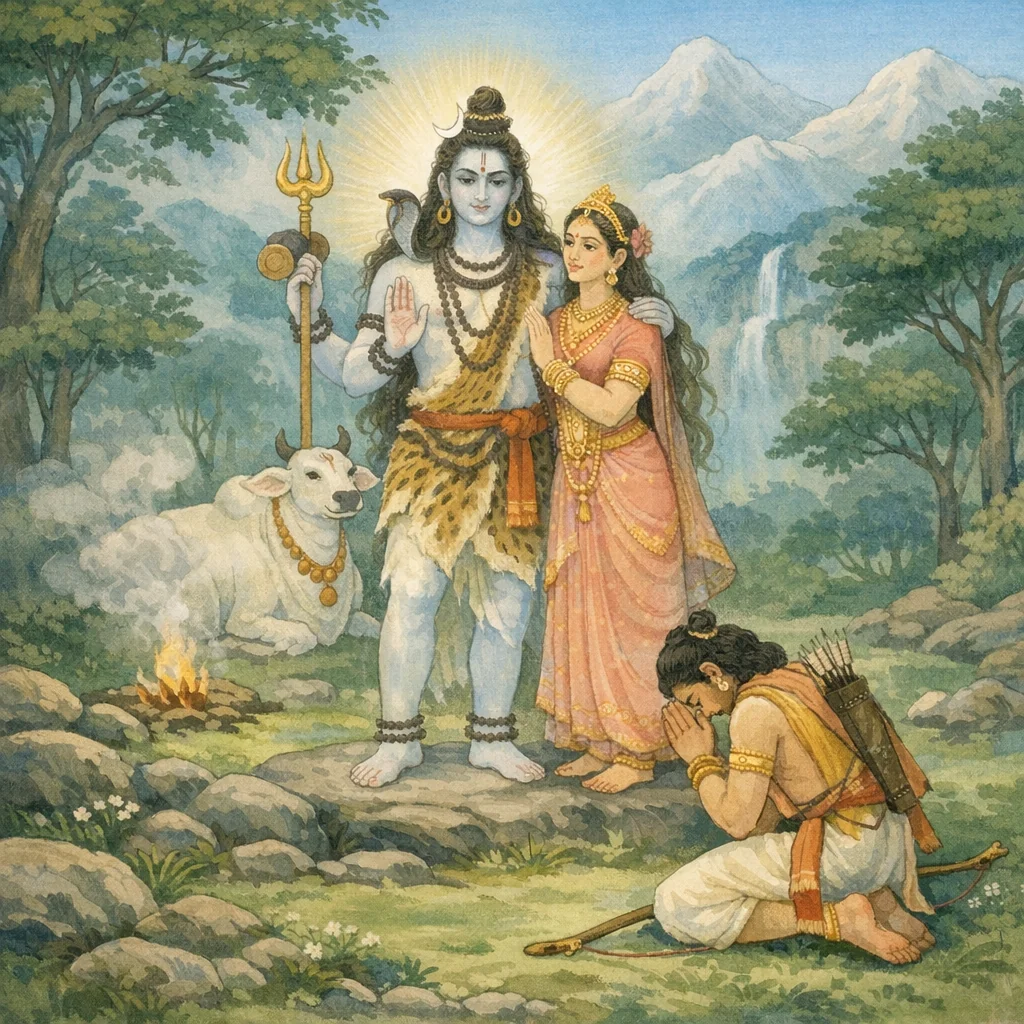
Chapter Arc: अर्जुन अपनी तपस्या-यात्रा और स्वर्ग-प्रवास से लौटकर युधिष्ठिर के सम्मुख आता है; प्रणाम करते ही धर्मराज का हर्ष गद्गद हो उठता है और वे पूछ बैठते हैं—स्वर्ग में समय कैसे बीता, इन्द्र को कैसे तुष्ट किया, और दिव्यास्त्र कैसे प्राप्त हुए? → अर्जुन क्रमशः अपने अनुभवों का वृत्तांत सुनाता है—किरात-वेषधारी शंकर का रहस्योद्घाटन, फिर दिव्य-स्वरूप में महेश्वर का प्रकट होना, और वह क्षण जब देवाधिदेव स्वयं सामने खड़े होकर कहते हैं: ‘तुष्टोऽस्मि… जो मनोगत हो, मांगो।’ साथ ही अस्त्र-विद्या की भयावह मर्यादा भी उद्घाटित होती है—अल्प-शक्ति वाले पर प्रयोग करने से यह समस्त जगत को दग्ध कर सकती है। → भगवान् वृषभध्वज (उमा सहित) अर्जुन को प्रत्यक्ष वर देते हैं—पाशुपत (रौद्र) महास्त्र का प्रदान, तथा धनुष और अक्षय बाणों से भरे तरकस आदि दिव्य आयुधों का सौंपा जाना; साथ ही कठोर चेतावनी कि इसका प्रयोग केवल प्रतिघात/निवारण और परम-आवश्यकता में ही हो। → अर्जुन का तप, शौर्य और संयम देव-स्वीकृति पाता है; युधिष्ठिर को यह आश्वासन मिलता है कि पाण्डवों के पास अब ऐसे अस्त्र हैं जो महाविपत्ति में भी रक्षा कर सकते हैं—पर उनकी शक्ति के साथ उत्तरदायित्व भी जुड़ा है। → पाशुपतास्त्र का प्राप्त होना भविष्य के महासंघर्ष की छाया डालता है—अब प्रश्न यह रह जाता है कि धर्म की मर्यादा में रहते हुए, कब और किस सीमा तक इन अस्त्रों का उपयोग होगा।
Shlokas
Verse 1
/ (दाक्षिणात्य अधिक पाठका १ श्लोक मिलाकर कुल १८ श्लोक हैं) हि >> [हुक माप आप८ सप्तषष्ट्यांधेकशततमो< ध्याय: अर्जुनके द्वारा अपनी तपस्या-यात्राके वृत्तान्तका वर्णन, भगवान् शिवके साथ संग्राम और पाशुपतास्त्र-प्राप्तिकी कथा वैशम्पायन उवाच यथागतं गते शक्रे भ्रातृभि: सह सज्भतः | कृष्णया चैव बीभत्सुर्थर्मपुत्रमपूजयत्,वैशम्पायनजी कहते हैं--जनमेजय! देवराज इन्द्रके चले जानेपर भाइयों तथा द्रौोपदीके साथ मिलकर अर्जुनने धर्मपुत्र युधिष्ठिरको प्रणाम किया
Vaiśampāyana said: When Indra had departed as he had come, Arjuna—reunited with his brothers and with Draupadī—paid reverent homage to Yudhiṣṭhira, the son of Dharma. The moment underscores the ethic that even after divine encounters and personal achievement, one returns to humility, family solidarity, and rightful respect for the elder and rightful leader.
Verse 2
अभिवादयमान त॑ मूर्ध्न्युपाप्राय पाण्डवम् । हर्षगद्गदया वाचा प्रद्ृष्टो$र्जुनमब्रवीत्,पाण्डुनन्दन अर्जुनको प्रणाम करते देख युधिष्छिर बड़े प्रसन्न हुए एवं उनका मस्तक सूँघकर हर्षगद्गद-वाणीमें इस प्रकार बोले--
Vaiśampāyana said: Seeing Arjuna, the son of Pāṇḍu, bowing in reverence, Yudhiṣṭhira was filled with joy. He drew him close, affectionately smelled his head, and, his voice trembling with happiness, spoke to Arjuna—an intimate gesture that underscores familial love, respect, and the dharmic bond between brothers even amid hardship.
Verse 3
कथमर्जुन कालो<यं स्वर्गे व्यतिगतस्तव । कथं चास्त्राण्यवाप्तानि देवराजश्न तोषित:,“अर्जुन! स्वर्गमें तुम्हारा यह समय किस प्रकार बीता? कैसे तुमने दिव्यास्त्र प्राप्त किये और कैसे देवराज इन्द्रको संतुष्ट किया?
Vaiśampāyana said: “Arjuna, how did this period of yours pass in heaven? How did you obtain the divine weapons, and in what way did you satisfy Indra, the king of the gods?”
Verse 4
सम्यग वा ते गृहीतानि कच्चिदस्त्राणि पाण्डव । कच्चित् सुराधिप: प्रीतो रुद्रो वास्त्राण्यदात् तव,'पाण्डुनन्दन! क्या तुमने सभी अस्त्र अच्छी तरह सीख लिये? क्या देवराज इन्द्र अथवा भगवान् रुद्रने प्रसन्न होकर तुम्हें अस्त्र प्रदान किये हैं?
Vaiśampāyana said: “O Pāṇḍava, have you truly mastered the weapons you received? And has the lord of the gods—Indra—or else Rudra, being pleased with you, granted you divine missiles?”
Verse 5
यथा दृष्टश्न॒ ते शक्रो भगवान् वा पिनाकधृक् । यथैवास्त्राण्यवाप्तानि यथैवाराधितश्ष ते,'शत्रुदमन! तुमने जिस प्रकार देवराज इन्द्रका दर्शन किया है अथवा जैसे पिनाकधारी भगवान् शिवको देखा है, जिस प्रकार तुमने सब अस्त्रोंकी शिक्षा प्राप्त की है और जैसे तुम्हारेद्वारा देवाराधनका कार्य सम्पादित हुआ है, वह सब बताओ। भगवान् इन्द्रने अभी- अभी कहा था कि “अर्जुनने मेरा अत्यन्त प्रिय कार्य सम्पन्न किया है” सो वह उनका कौन- सा प्रिय कार्य था, जिसे तुमने सम्पन्न किया है
Vaiśampāyana said: “Tell (me) everything exactly as it happened—how you beheld Śakra (Indra), or how you saw the blessed Pināka-bearing Lord (Śiva); how you obtained the celestial weapons; and how your acts of worship and divine propitiation were successfully accomplished. And since Indra has just declared, ‘Arjuna has carried out a deed most dear to me,’ what was that beloved task of his that you fulfilled?”
Verse 6
यथोक्तवांस्त्वां भगवान् शतक्रतुररिंदम । कृतप्रियस्त्वयास्मीति तस्य ते कि प्रियं कृतम्,'शत्रुदमन! तुमने जिस प्रकार देवराज इन्द्रका दर्शन किया है अथवा जैसे पिनाकधारी भगवान् शिवको देखा है, जिस प्रकार तुमने सब अस्त्रोंकी शिक्षा प्राप्त की है और जैसे तुम्हारेद्वारा देवाराधनका कार्य सम्पादित हुआ है, वह सब बताओ। भगवान् इन्द्रने अभी- अभी कहा था कि “अर्जुनने मेरा अत्यन्त प्रिय कार्य सम्पन्न किया है” सो वह उनका कौन- सा प्रिय कार्य था, जिसे तुमने सम्पन्न किया है
Vaiśampāyana said: “O subduer of foes, the blessed Śatakratu (Indra) spoke to you as he did and declared, ‘You have done what is dear to me.’ What, then, was that cherished deed of his that you accomplished?”
Verse 7
एतदिच्छाम्यहं श्रीतुं विस्तरेण महाद्युते । यथा तुष्टो महादेवो देवराजस्तथानघ,“महातेजस्वी वीर! मैं ये सब बातें विस्तारपूर्वक सुनना चाहता हूँ। शत्रुओंका दमन करनेवाले निष्पाप अर्जुन! जिस प्रकार तुम्हारे ऊपर महादेवजी तथा देवराज इन्द्र संतुष्ट हुए और वज्रधारी इन्द्रका जो प्रिय कार्य तुमने सम्पन्न किया है, वह सब पूर्णरूपसे बताओ
Vaiśaṃpāyana said: “O mighty one, I wish to hear all this in full detail—how Mahādeva and likewise the king of the gods became pleased with you, O sinless subduer of foes.”
Verse 8
यच्चापि वज्पाणेस्तु प्रियं कृतमरिंदम । एतदाख्याहि मे सर्वमखिलेन धनंजय,“महातेजस्वी वीर! मैं ये सब बातें विस्तारपूर्वक सुनना चाहता हूँ। शत्रुओंका दमन करनेवाले निष्पाप अर्जुन! जिस प्रकार तुम्हारे ऊपर महादेवजी तथा देवराज इन्द्र संतुष्ट हुए और वज्रधारी इन्द्रका जो प्रिय कार्य तुमने सम्पन्न किया है, वह सब पूर्णरूपसे बताओ
Vaiśampāyana said: “O subduer of foes, Dhanañjaya, tell me fully and in detail what pleasing deed you accomplished for the thunderbolt-bearing Indra. I wish to hear the whole account completely.”
Verse 9
अजुन उवाच शृणु हन्त महाराज विधिना येन दृष्टवान् | शतक्रतुमहं देव॑ं भगवन्तं च शड्करम्,अर्जुन बोले--महाराज! मैंने जिस विधिसे देवराज इन्द्र तथा भगवान् शंकरका दर्शन किया था, वह सब बतलाता हूँ, सुनिये! शत्रुओंका मर्दन करनेवाले नरेश! आपकी बतायी हुई विद्याको ग्रहण करके आपहीके आदेशसे मैं तपस्या करनेके लिये वनकी ओर प्रस्थित हुआ
Arjuna said: “Listen, O great king. I shall tell you the method by which I obtained the vision of the god Indra, the lord of a hundred sacrifices, and of the Blessed Śaṅkara. Hear how, following the prescribed discipline and acting under your instruction, I set out for the forest to undertake austerities—seeking divine encounter not for vanity, but for the higher purpose of righteous strength and protection.”
Verse 10
विद्यामधीत्य तां राजंस्त्वयोक्तामरिमर्दन । भवता च समादिष्टस्तपसे प्रस्थितो वनम्,अर्जुन बोले--महाराज! मैंने जिस विधिसे देवराज इन्द्र तथा भगवान् शंकरका दर्शन किया था, वह सब बतलाता हूँ, सुनिये! शत्रुओंका मर्दन करनेवाले नरेश! आपकी बतायी हुई विद्याको ग्रहण करके आपहीके आदेशसे मैं तपस्या करनेके लिये वनकी ओर प्रस्थित हुआ
Arjuna said: “O King—crusher of foes—having studied the sacred knowledge you taught, and acting under your very command, I set out for the forest to undertake austerities. Now listen as I recount, in due order, how I obtained the vision of Indra, lord of the gods, and of Śaṅkara.”
Verse 11
भगुतुड़्मथो गत्वा काम्यकादास्थितस्तप: । एकरात्रोषित: कज्चिदपश्यं ब्राह्मणं पथि,काम्यक वनसे चलकर तपस्यामें पूरी आशा रखकर मैं भृगुतुंग पर्वतपर पहुँचा और वहाँ एक रात रहकर जब आगे बढ़ा, तब मार्गमें किसी ब्राह्मणदेवताका मुझे दर्शन हुआ
Arjuna said: “Having gone to Bhṛgutunga, and with my resolve fixed on performing austerities after leaving the Kāmyaka forest, I stayed there for a single night. Then, as I proceeded onward, I beheld a certain brāhmaṇa on the road.”
Verse 12
स मामपृच्छत् कौन्तेय क्वासि गन्ता ब्रवीहि मे । तस्मा अवितथं सर्वमन्रुवं कुरुनन्दन,उन्होंने मुझसे कहा--“कुन्तीनन्दन! कहाँ जाते हो? मुझे ठीक-ठीक बताओ।” तब मैंने उनसे सब कुछ सच-सच बता दिया
He questioned me, “O son of Kuntī, where are you going? Tell me plainly.” Then, O delight of the Kurus, I answered him truthfully, without distortion, and disclosed everything as it was. The moment underscores the ethic of straightforward speech—responding without deceit when directly asked, especially in matters that test one’s integrity.
Verse 13
स तथ्यं मम तच्छुत्वा ब्राह्मणो राजसत्तम | अपूजयत मां राजन प्रीतिमांश्वाभवन्न्मयि,नृपश्रेष्ठ! ब्राह्मणदेवताने मेरी यथार्थ बातें सुनकर मेरी प्रशंसा की और मुझपर बड़े प्रसन्न हुए
Hearing my truthful words, O best of kings, the Brahmin honored me; and, O king, he became filled with affection toward me. The passage underscores that sincerity and adherence to truth naturally elicit respect and goodwill from the righteous.
Verse 14
ततो मामब्रवीत् प्रीतस्तप आतिष्ठ भारत । तपस्वी नचिरेण त्वं द्रक्ष्स्से विबुधाधिपम्,तत्पश्चात् उन्होंने प्रसन्नतापूर्वक कहा--“भारत! तुम तपस्याका आश्रय लो! तपमें प्रवृत्त होनेपर तुम्हें शीघ्र ही देवराज इन्द्रका दर्शन होगा”
Then, pleased, he said to me: “O Bhārata, take refuge in austerity—undertake tapas. When you are steadfast in ascetic practice, before long you will behold the lord of the gods (Indra).” The passage frames disciplined self-restraint as the ethical means by which divine encounter and higher purpose are attained.
Verse 15
ततो<हं वचनात् तस्य गिरिमारुह्मु शैशिरम् । तपो5तप्यं महाराज मासं मूलूफलाशन:,महाराज! उनके इस आदेशको मानकर मैं हिमालय पर्वतपर आरूढ़ हो तपस्यामें संलग्न हो गया और एक मासतक केवल फल-फूल खाकर रहा
Then, O great king, obeying his command, I ascended the wintry mountain and undertook austerities; for a full month I lived only on roots and fruits. The passage highlights disciplined obedience to rightful instruction and the ethical ideal of self-restraint as a means to gain inner strength and spiritual merit.
Verse 16
द्वितीयश्षापि मे मासो जल॑ भक्षयतो गत: । निराहारस्तृतीये5थ मासे पाण्डवनन्दन,इसी प्रकार मैंने दूसरा महीना भी केवल जल पीकर बिताया। पाण्डवनन्दन! तीसरे महीनेमें मैं पूर्णतः निराहार रहा। चौथे महीनेमें मैं ऊपरको हाथ उठाये खड़ा रहा। इतनेपर भी मेरा बल क्षीण नहीं हुआ, यह एक आश्वर्यकी-सी बात हुई
Arjuna said: “My second month also passed with me subsisting only on water. Then, O delight of the Pāṇḍavas, in the third month I remained entirely without food. Yet even under such austerity my strength did not wane—something that seemed truly astonishing.”
Verse 17
ऊर्ध्वबाहुश्नतुर्थ तु मासमस्मि स्थितस्तदा । नच मे हीयते प्राणस्तदद्भुतमिवाभवत्,इसी प्रकार मैंने दूसरा महीना भी केवल जल पीकर बिताया। पाण्डवनन्दन! तीसरे महीनेमें मैं पूर्णतः निराहार रहा। चौथे महीनेमें मैं ऊपरको हाथ उठाये खड़ा रहा। इतनेपर भी मेरा बल क्षीण नहीं हुआ, यह एक आश्वर्यकी-सी बात हुई
Arjuna said: “In the fourth month, I stood with my arms raised upward. Yet my vital strength did not diminish; it seemed almost miraculous.” In context, the statement underscores the power of disciplined austerity (tapas) and unwavering resolve—an ethical ideal in the epic when undertaken for a righteous aim and with self-mastery rather than vanity.
Verse 18
पज्चमे त्वथ सम्प्राप्ते प्रथमे दिवसे गते । वराहसंस्थितं भूतं मत्समीपं समागमत्,पाँचवाँ महीना प्रारम्भ होनेपर जब एक दिन बीत गया तब दूसरे दिन एक शूकररूपधारी जीव मेरे निकट आया
Arjuna said: When the fifth month arrived, and the first day had passed, on the next day a being assuming the form of a boar came near me. The episode signals the approach of a test or encounter in the forest, where appearances may conceal a deeper intent and the hero must respond with vigilance and discernment.
Verse 19
निघ्नन् प्रोथेन पृथिवीं विलिखंश्ररणैरपि । सम्मार्जञ्जठरेणोर्वी विवर्तश्न मुहुर्मुहु:,वह अपनी थूथुनसे पृथ्वीपर चोट करता और पैरोंसे धरती खोदता था। बार-बार लेटकर वह अपने पेटसे वहाँकी भूमिको ऐसा स्वच्छ कर देता था, मानो उसपर झाड़ दिया गया हो
Arjuna said: “Striking the earth with his snout and even scraping it with his horns, he would dig up the ground with his feet. Again and again he would lie down and, with his belly, rub the soil so clean that it looked as though the place had been swept.”
Verse 20
अनु तस्यापरं भूतं महत् कैरातसंस्थितम् । भधनुर्बाणासिमत् प्राप्तं सत्रीगणानुगतं तदा,उसके पीछे किरात-जैसी आकृतिमें एक महान् पुरुषका दर्शन हुआ। उसने धनुष-बाण और खड्ग ले रखे थे। उसके साथ स्त्रियोंका एक समुदाय भी था
Then, following close behind him, there appeared a great being, standing in the guise of a Kirāta (mountain hunter). He was equipped with a bow and arrows and also a sword; at that time he was accompanied by a company of women. The scene heightens the sense of a divine or extraordinary encounter presented through a deliberately rustic, ascetic-forest disguise, testing perception and discernment in the wilderness setting.
Verse 21
ततो<हं धनुरादाय तथाक्षय्ये महेषुधी । अताडयं शरेणाथ तद् भूतं लोमहर्षणम्
“Then I took up my bow, and likewise my two inexhaustible great quivers. Thereupon I struck that hair-raising being with an arrow.”
Verse 22
तब मैंने धनुष तथा अक्षय तरकस लेकर एक बाणके द्वारा उस रोमांचकारी सूकरपर आघात किया ।। युगपत् तं किरातस्तु विकृष्य बलवद् धनुः । अभ्याजचघ्ने दृढतरं कम्पयन्निव मे मन:,साथ ही किरातने भी अपने सुदृढ़ धनुषको खींचकर उसपर गहरी चोटकी, जिससे मेरा हृदय कम्पित-सा हो उठा
Arjuna said: “Then I took up my bow and my inexhaustible quiver and struck that hair-raising boar with a single arrow. At that very moment the Kirāta, drawing his powerful bow to the full, also hit it with an even firmer blow—so that my heart seemed to tremble.”
Verse 23
स तु मामब्रवीद् राजन् मम पूर्वपरिग्रह: । मृगयाधर्ममुत्स॒ज्य किमर्थ ताडितस्त्वया,राजन्! फिर वह किरात मुझसे बोला--'“यह सूअर तो पहले मेरा निशाना बन चुका था, फिर तुमने आखेटके नियमको छोड़कर उसपर प्रहार क्यों किया?”
Then that hunter said to me, “O King, this boar had already been claimed by me as my quarry. Why did you strike it, abandoning the proper code of the hunt, O King?”
Verse 24
एष ते निशितैर्बाणैर्दर्प हन्मि स्थिरो भव । स धनुष्मान् महाकायस्ततो मामभ्यभाषत,इतना ही नहीं उस विशालकाय एवं धनुर्धर किरातने उस समय मुझसे यह भी कहा --'अच्छा, ठहर जाओ। मैं अपने पैने बाणोंसे अभी तुम्हारा घमंड चूर-चूर किये देता हूँ!
Arjuna said, “Stand firm. With these sharp arrows I shall shatter your pride.” Then that mighty, great-bodied archer—the Kirāta—spoke back to me, challenging my resolve and meeting my arrogance with equal force, as the encounter sharpened into a test of strength and self-mastery.
Verse 25
ततो गिरिमिवात्यर्थमावृणोन्मां महाशरै: । तं॑ चाहं शरवर्षेण महता समवाकिरम्,ऐसा कहकर उस भीलने जैसे पर्वतपर वर्षा हो, उस प्रकार महान् बाणोंकी बौछार करके मुझे सब ओरसे ढक दिया; तब मैंने भी भारी बाणवर्षा करके उसे सब ओरसे आच्छादित कर दिया
Then he covered me completely with great arrows, as though a mountain were being shrouded by a torrential downpour. In response, I too overwhelmed him on every side with a mighty rain of arrows—meeting force with force in the heat of combat.
Verse 26
ततः शरैर्दीप्तमुखैर्यन्त्रितैरनुमन्त्रितै: । प्रत्यविध्यमहं तं॑ तु वजैरिव शिलोच्चयम्,तदनन्तर जैसे वज्रसे पर्वतपर आघात किया जाय, उसी प्रकार प्रज्वलित मुखवाले अभिमन्त्रित और खूब खींचकर छोड़े हुए बाणोंद्वारा मैंने उसे बार-बार घायल किया
Arjuna said: “Then, with arrows whose tips blazed—well-drawn to full tension and empowered by mantra—I struck him again and again, as though a mountain of rock were being smitten by thunderbolts.” The verse underscores disciplined martial action: strength is not mere fury, but controlled force guided by skill, intention, and consecrated resolve.
Verse 27
तस्य तच्छतथा रूपमभवच्च सहस्रधा । तानि चास्य शरीराणि शरैरहमताडयम्,उस समय उसके सैकड़ों और सहस्रों रूप प्रकट हुए और मैंने उसके सभी शरीरोंपर बाणोंसे गहरी चोट पहुँचायी
Arjuna said: “Then his form manifested in hundreds and thousands of appearances; and I struck all those bodies of his with my arrows, wounding them deeply.” The verse underscores disciplined valor: when confronted with deceptive, proliferating forms in battle, the warrior’s duty is steady action guided by resolve rather than confusion.
Verse 28
पुनस्तानि शरीराणि एकीभूतानि भारत । अदृश्यन्त महाराज तान्यहं व्यधमं पुन:,भारत! फिर उसके वे सारे शरीर एकरूप दिखायी दिये। महाराज! उस एकरूपमें भी मैंने उसे पुन: अच्छी तरह घायल किया
Arjuna said: “Then, O Bhārata, those bodies were again seen as merged into a single form. O great king, even in that unified form I struck him again, wounding him thoroughly.”
Verse 29
अर्णुर्ब॑हच्छिरा भूत्वा बृहच्चाणुशिरा: पुन: । एकीभूतस्तदा राजन् सो<भ्यवर्तत मां युधि,कभी उसका शरीर तो बहुत छोटा हो जाता, परंतु मस्तक बहुत बड़ा दिखायी देता था। फिर वह विशाल शरीर धारण कर लेता और मस्तक बहुत छोटा बना लेता था। राजन! अन्तमें वह एक ही रूपमें प्रकट होकर युद्धमें मेरा सामना करने लगा। भरतर्षभ! जब मैं बाणोंकी वर्षा करके भी युद्धमें उसे परास्त न कर सका, तब मैंने महान् वायव्यास्त्रका प्रयोग किया
Arjuna said: “O King, he would at times become a being with a very small body but an enormous head; then again he would assume a vast body while his head appeared tiny. Finally, gathering himself into a single, unified form, he advanced against me in battle.”
Verse 30
यदाभिभवितु बाणैर्न च शक्नोमि तं रणे । ततो महास्त्रमातिष्ठं वायव्यं भरतर्षभ,कभी उसका शरीर तो बहुत छोटा हो जाता, परंतु मस्तक बहुत बड़ा दिखायी देता था। फिर वह विशाल शरीर धारण कर लेता और मस्तक बहुत छोटा बना लेता था। राजन! अन्तमें वह एक ही रूपमें प्रकट होकर युद्धमें मेरा सामना करने लगा। भरतर्षभ! जब मैं बाणोंकी वर्षा करके भी युद्धमें उसे परास्त न कर सका, तब मैंने महान् वायव्यास्त्रका प्रयोग किया
Arjuna said: “When, even by overwhelming him with volleys of arrows, I was unable to subdue him in battle, then, O bull among the Bharatas, I resorted to the great weapon—the Vāyavya astra (the missile of the Wind).”
Verse 31
न चैनमशकं हन्तुं हल 0 खा भवत् | तस्मिन् प्रतिहते चास्त्रे मे महानभूत्,किंतु उससे भी उसका वध न कर सका। यह एक अद्भुत-सी घटना हुई। वायव्यास्त्रके निष्फल हो जानेपर मुझे महान् आश्चर्य हुआ
Arjuna said: “O Bharata, I could not slay him even with the Wind-weapon. And when that missile was checked and rendered ineffective, great astonishment arose in me. This was a truly extraordinary occurrence—despite my effort, I was unable to bring about his death.”
Verse 32
भूय एव महाराज सविशेषमहं ततः । अस्त्रपूगेन महता रणे भूतमवाकिरम्,महाराज! तब मैंने पुनः विशेष प्रयत्न करके रणभूमिमें किरातरूपधारी उस अद्भुत पुरुषपर महान् अस्त्रसमूहकी वर्षा की
Arjuna said: “Then again, O great king, exerting myself with special effort, I showered that wondrous being—who had assumed the form of a Kirāta—on the battlefield with a vast multitude of weapons.”
Verse 33
स्थूणाकर्णमथो जालं शरवर्षमथोल्बणम् | शलभास्त्रमश्मवर्ष समास्थायाहमभ्ययाम्,स्थूणाकर्ण5, वारुणास्त्र-, भयंकर शरवर्षास्त्रर, शलभास्त्र5<४ तथा अभ्मवर्ष४ इन अस्त्रोंका सहारा ले मैं उस किरातपर टूट पड़ा
Arjuna said: “Taking recourse to the weapons called Sthūṇākarṇa, Jāla, the dreadful shower of arrows, Śalabhāstra, and the rain of stones, I rushed straight at that Kirāta.” In the episode’s moral frame, the verse highlights Arjuna’s unwavering resolve and disciplined reliance on astras in a trial that tests not only martial skill but also humility before a superior, divinely-backed opponent.
Verse 34
जग्रास प्रसभं तानि सर्वाण्यस्त्राणि मे नृप । तेषु सर्वेषु जग्धेषु ब्रह्मास्त्र महदादिशम्,राजन! उसने मेरे उन सभी अस्त्रोंको बलपूर्वक अपना ग्रास बना लिया। उन सबके भक्षण कर लिये जानेपर मैंने महान ब्रह्मास्त्रका प्रयोग किया
Arjuna said: “O King, he forcibly swallowed up all those weapons of mine. When all of them had been consumed, I then unleashed the mighty Brahmāstra.”
Verse 35
ततः प्रज्वलितैर्बाणै: सर्वतः सोपचीयते । उपचीयमानश्न मया महास्त्रेण व्यवर्धत,तब प्रज्वलित बाणोंद्वारा वह अस्त्र सब ओर बढ़ने लगा। मेरे महान अस्त्रसे बढ़नेकी प्रेरणा पाकर वह ब्रह्मास्त्र अधिक वेगसे बढ़ चला
Then, with blazing arrows, that weapon swelled on every side. And as I urged it on with my great missile, it grew still more—gaining force and spreading with greater speed, as a destructive power once set in motion by a warrior’s resolve.
Verse 36
ततः: संतापिता लोका मत्प्रसूतेन तेजसा । क्षणेन हि दिश: खं च सर्वतो हि विदीपितम्,तदनन्तर मेरे द्वारा प्रकट किये हुए ब्रह्मास्त्रके तेजसे वहाँके सब लोग संतप्त हो उठे। एक ही क्षणमें सम्पूर्ण दिशाएँ और आकाश सब ओरसे आगकी लपटोंसे उद्दीप्त हो उठे
Arjuna said: “Then the people there were scorched by the blazing energy that had issued forth from me. In a single instant, all the directions and the sky were lit up on every side, as if tongues of fire had flared everywhere.”
Verse 37
तदप्यस्त्रं महातेजा: क्षणेनैव व्यशातयत् । ब्रह्मास्त्रे तु हते राजन् भयं मां महदाविशत्
Arjuna said: “Even that weapon the mighty one neutralized in an instant. But when the Brahmāstra had been destroyed, O King, a great fear seized me.”
Verse 38
परंतु उस महान् तेजस्वी वीरने क्षणभरमें ही मेरे उस ब्रह्मास्त्रको भी शान्त कर दिया। राजन! उस ब्रह्मास्त्रके नष्ट होनेपर मेरे मनमें महान् भय समा गया ।। ततो<हं धनुरादाय तथाक्षय्ये महेषुधी । सहसाभ्यहनं भूत॑ तान्यप्यस्त्राण्यभक्षयत्,तब मैं धनुष और दोनों अक्षय तरकस लेकर सहसा उस दिव्य पुरुषपर आघात करने लगा, किंतु उसने उन सबको भी अपना आहार बना लिया
Then I took up my bow and, with my two inexhaustible quivers of great arrows, rushed at that wondrous being and struck at him with all speed. Yet he consumed even those missiles as though they were his food. Seeing my Brahmāstra neutralized and my weapons rendered futile, fear rose powerfully in my mind—an ethical shock that reveals how human prowess, when met by a higher power, must confront its limits.
Verse 39
हतेष्वस्त्रेषु सर्वेषु भक्षितेष्वायुधेषु च । मम तस्य च भूतस्य बाहुयुद्धमवर्तत,जब मेरे सारे अस्त्र-शस्त्र नष्ट होकर उसके आहार बन गये, तब मेरा उस अलौकिक प्राणीके साथ मल्लयुद्ध प्रारम्भ हो गया
When all my missiles had been exhausted and my weapons had been destroyed—indeed, consumed as his food—then a hand-to-hand combat began between me and that uncanny being. With no reliance left on arms, the encounter turned into a direct test of resolve and prowess, where courage and steadfastness had to stand in place of weaponry.
Verse 40
व्यायामं मुष्टिभि: कृत्वा तलैरपि समागतै: । अपाययंश्व तद् भूत॑ निश्रचेष्टमगमं महीम्,पहले मुक्कों और थप्पड़ोंसे मैंने उससे टक्कर लेनेकी चेष्टाकी, परंतु उसपर मेरा कोई वश नहीं चला और मैं निश्वेष्ट होकर पृथ्वीपर गिर पड़ा। महाराज! तब वह अलौकिक प्राणी हँसकर मेरे देखते-देखते स्त्रियोंसहित वहीं अन्तर्धान हो गया
Arjuna said: “I grappled with that being, striking with my fists and with my open palms as we closed upon each other; yet I could not bring it under my control. Overpowered, I became motionless and fell to the earth. Then, O King, that wondrous being laughed and, even as I watched, vanished on the spot together with the women.”
Verse 41
ततः प्रहस्य तद् भूतं तत्रैवान्तरधीयत । सह स्त्रीभिर्महाराज पश्यतो मे<द्भधुतोपमम्,पहले मुक्कों और थप्पड़ोंसे मैंने उससे टक्कर लेनेकी चेष्टाकी, परंतु उसपर मेरा कोई वश नहीं चला और मैं निश्वेष्ट होकर पृथ्वीपर गिर पड़ा। महाराज! तब वह अलौकिक प्राणी हँसकर मेरे देखते-देखते स्त्रियोंसहित वहीं अन्तर्धान हो गया
Then that uncanny being laughed and, even as I watched, vanished on the very spot—together with the women, O great king. The episode underscores a moral limit: sheer physical force and anger cannot master what is beyond ordinary human power, and one must recognize the boundaries of one’s agency with humility and restraint.
Verse 42
एवं कृत्वा स भगवांस्ततो<न्यद् रूपमास्थित: । दिव्यमेव महाराज वसानो<द्धभुतमम्बरम्,राजन! वास्तवमें वे भगवान् शंकर थे। उन्होंने पूर्वोक्त बर्ताव करके दूसरा रूप धारण कर लिया। देवताओंके स्वामी भगवान् महेश्वर किरातरूप छोड़कर दिव्य स्वरूपका आश्रय ले अलौकिक एवं अद्भुत वस्त्र धारण किये वहाँ खड़े हो गये
Having done so, that Blessed Lord then assumed another form. O great king, casting off the hunter’s guise, the divine Lord Maheśvara stood there in his own celestial manifestation, clothed in wondrous, otherworldly garments—revealing that the encounter was truly with Śaṅkara himself.
Verse 43
हित्वा किरातरूपं च भगवांस्त्रिदशे श्वर: । स्वरूपं दिव्यमास्थाय तस्थौ तत्र महेश्वर:,राजन! वास्तवमें वे भगवान् शंकर थे। उन्होंने पूर्वोक्त बर्ताव करके दूसरा रूप धारण कर लिया। देवताओंके स्वामी भगवान् महेश्वर किरातरूप छोड़कर दिव्य स्वरूपका आश्रय ले अलौकिक एवं अद्भुत वस्त्र धारण किये वहाँ खड़े हो गये
Arjuna said: “Then the Blessed Lord, the sovereign of the gods, casting aside the guise of a Kirāta (mountain-hunter), assumed his own radiant divine form. There, Mahādeva stood revealed.” In the narrative, the episode underscores that the deity may adopt a humble or testing disguise to examine a seeker’s resolve; when steadfastness and sincerity are proven, the divine presence is disclosed openly, affirming devotion and disciplined effort as ethically transformative.
Verse 44
अदृश्यत तत: साक्षाद् भगवान् गोवृषध्वज: । उमासहायो व्यालधृग् बहुरूप: पिनाकधृकू,इस प्रकार उमासहित साक्षात् भगवान् वृषभ-ध्वजका दर्शन हुआ। उन्होंने अपने अंगोंमें सर्प और हाथमें पिनाक धारण कर रखे थे। अनेक रूपधारी भगवान् शूलपाणि उस रणभूमिमें मेरे निकट आकर पूर्ववत् सामने खड़े हो गये और बोले--'परंतप! मैं तुमपर संतुष्ट हूँ"
Then the Blessed Lord, whose banner bears the bull, became visible in person—accompanied by Umā, adorned with serpents, and holding the bow Pināka. The many-formed Lord, the wielder of the trident, came near me on that battlefield, stood before me as before, and said: “O scorcher of foes, I am pleased with you.”
Verse 45
स मामभ्येत्य समरे तथैवाभिमुखं स्थितम् । शूलपाणिरथोवाच तुष्टोउस्मीति परंतप,इस प्रकार उमासहित साक्षात् भगवान् वृषभ-ध्वजका दर्शन हुआ। उन्होंने अपने अंगोंमें सर्प और हाथमें पिनाक धारण कर रखे थे। अनेक रूपधारी भगवान् शूलपाणि उस रणभूमिमें मेरे निकट आकर पूर्ववत् सामने खड़े हो गये और बोले--'परंतप! मैं तुमपर संतुष्ट हूँ"
Then, in the midst of battle, Śūlapāṇi approached me as I stood facing him, just as before. Coming near and standing directly before me, he said, “O scorcher of foes, I am pleased with you.” The moment underscores that divine favor is granted not by mere force, but by steadfastness, courage, and disciplined intent in a righteous trial.
Verse 46
ततस्तदू धनुरादाय तूणौ चाक्षय्यसायकौ । प्रादान्ममैव भगवान् धारयस्वेति चाब्रवीत्,अमरत्वमपाहाय ब्रूहि यत् ते मनोगतम् । तदनन्तर मेरे धनुष और अक्षय बाणोंसे भरे हुए दोनों तरकस लेकर भगवान् शिवने मुझे ही दे दिये और कहा--'परंतप! ये अपने अस्त्र ग्रहण करो।' कुन्तीकुमार! मैं तुमसे संतुष्ट हूँ। बोलो, तुम्हारा कौन-सा कार्य सिद्ध करूँ? वीर! तुम्हारे मनमें जो कामना हो, बताओ मैं उसे पूर्ण कर दूँगा। अमरत्वको छोड़कर और तुम्हारे मनमें जो भी कामना हो, बताओ'
Then the Blessed Lord (Śiva), taking up that bow and the two quivers filled with inexhaustible arrows, handed them over to me and said, “Bear these.” He continued: “O scorcher of foes, I am pleased with you. Speak—what purpose of yours shall I accomplish? Hero, tell me whatever desire is in your mind; I will fulfill it—except for immortality.”
Verse 47
तुष्टोडस्मि तव कौन्तेय ब्रूहि किं करवाणि ते । यत् ते मनोगतं वीर तद् ब्रूहि वितराम्पहम्
Arjuna said: “O son of Kuntī, I am pleased with you. Tell me—what shall I do for you? Whatever wish lies in your heart, O hero, speak it out; I will grant it.”
Verse 48
ततः प्राञज्जलिरेवाहमस्त्रेषु गतमानस:,मेरा मन तो अस्त्र-शस्त्रोंमें लगा हुआ था। उस समय मैंने हाथ जोड़कर मन-ही-मन भगवान् शंकरको प्रणाम किया और यह बात कही--“यदि मुझपर भगवान् प्रसन्न हैं, तो मेरा मनोवांछित वर इस प्रकार है--देवताओंके पास जो कोई भी दिव्यास्त्र हैं, उन्हें मैं जानना चाहता हूँ।” यह सुनकर भगवान् शंकरने मुझसे कहा--'पाण्डुनन्दन! मैं तुम्हें सम्पूर्ण दिव्यास्त्रोंकी प्राप्तिका वर देता हूँ
Then I stood with folded hands, my mind wholly intent on weapons and their mysteries. Inwardly I bowed to Lord Śaṅkara and spoke: “If the Blessed Lord is pleased with me, this is the boon I desire—whatever divine missiles and weapons the gods possess, I wish to know them all.” Hearing this, Lord Śaṅkara replied: “O son of Pāṇḍu, I grant you the boon of obtaining all divine weapons.” The episode frames martial power as something to be sought only through humility, divine sanction, and disciplined intent, not through pride or mere ambition.
Verse 49
प्रणम्य मनसा शर्व ततो वचनमाददे । भगवान् मे प्रसन्नश्वेदीप्सितो5यं वरो मम,मेरा मन तो अस्त्र-शस्त्रोंमें लगा हुआ था। उस समय मैंने हाथ जोड़कर मन-ही-मन भगवान् शंकरको प्रणाम किया और यह बात कही--“यदि मुझपर भगवान् प्रसन्न हैं, तो मेरा मनोवांछित वर इस प्रकार है--देवताओंके पास जो कोई भी दिव्यास्त्र हैं, उन्हें मैं जानना चाहता हूँ।” यह सुनकर भगवान् शंकरने मुझसे कहा--'पाण्डुनन्दन! मैं तुम्हें सम्पूर्ण दिव्यास्त्रोंकी प्राप्तिका वर देता हूँ
Arjuna, bowing in his mind to Śarva (Śiva), then spoke: “If the Blessed Lord is pleased with me, this is the boon I desire: I wish to know and obtain the divine weapons that are in the keeping of the gods.” Hearing this, Śiva grants him the boon of access to all celestial missiles—an episode that frames martial power as something to be sought through humility, self-control, and divine sanction rather than mere ambition.
Verse 50
अस्त्राणीच्छाम्यहं ज्ञातुं यानि देवेषु कानिचित् । ददानीत्येव भगवानन्रवीत् त्रयम्बकश्न माम्,मेरा मन तो अस्त्र-शस्त्रोंमें लगा हुआ था। उस समय मैंने हाथ जोड़कर मन-ही-मन भगवान् शंकरको प्रणाम किया और यह बात कही--“यदि मुझपर भगवान् प्रसन्न हैं, तो मेरा मनोवांछित वर इस प्रकार है--देवताओंके पास जो कोई भी दिव्यास्त्र हैं, उन्हें मैं जानना चाहता हूँ।” यह सुनकर भगवान् शंकरने मुझसे कहा--'पाण्डुनन्दन! मैं तुम्हें सम्पूर्ण दिव्यास्त्रोंकी प्राप्तिका वर देता हूँ
Arjuna said: “I wish to know the divine weapons—whatever ones exist among the gods.” Hearing this, the Blessed Lord Tryambaka (Śiva) replied to me, “I grant them.” In the narrative setting, Arjuna’s request is not for personal vanity but for the disciplined acquisition of divine means to uphold dharma in the coming conflict; devotion and humility precede power, and power is framed as a responsibility rather than a possession.
Verse 51
रौद्रमस्त्रं मदीयं त्वामुपस्थास्यति पाण्डव । प्रददौ च मम प्रीत: सो<स्त्रं पाशुपतं महत्,'पाण्डुकुमार! मेरा रौद्रास्त्र स्वयं तुम्हें प्राप्त हो जायगा। यह कहकर भगवान् पशुपतिने बड़ी प्रसन्नताके साथ मुझे अपना महान् पाशुपतास्त्र प्रदान किया
Arjuna said: “O son of Pāṇḍu, my Raudra weapon will come into your possession. Saying this, the Lord—Pāśupati—pleased with me, bestowed upon me his great Pāśupata weapon.” In the narrative, divine power is granted not as a reward for pride, but as a trust given to one who has won the deity’s favor through discipline and right intent; the ethical undertone is that such force is to be borne with restraint and used only for the protection of dharma.
Verse 52
उवाच च महादेवो दत्त्वा मे5स्त्रं सनातनम् | न प्रयोज्यं भवेदेतन्मानुषेषु कथठ्चन,अपना सनातन अस्त्र मुझे देकर महादेवजी फिर बोले--तुम्हें मनुष्योंपर किसी प्रकार इस अस्त्रका प्रयोग नहीं करना चाहिये
After granting me the eternal weapon, Mahādeva spoke again: “This must never be employed against human beings under any circumstance.” The injunction frames the gift not as a license for violence, but as a power bound by restraint and moral limits.
Verse 53
जगद् विनिर्दहेदेवमल्पतेजसि पातितम् | पीड्यमानेन बलवत् प्रयोज्यं स्याद्ू धनंजय
Arjuna said: “If, when cast down upon one of little splendor, it would burn up the whole world in this manner, then it should be employed only with great force against one who is truly powerful—O Dhanañjaya.”
Verse 54
तदप्रतिहतं दिव्यं सर्वास्त्रप्रतिषिधनम्
Arjuna said: “That (weapon) is irresistible and divine, and it has the power to check and neutralize every other weapon.”
Verse 55
उत्सादनममित्राणां परसेनानिकर्तनम्,वह शत्रुओंका संहारक और विपक्षियोंकी सेनाका विध्वंसक है। उसकी प्राप्ति बहुत कठिन है। देवता, दानव तथा राक्षस किसीके लिये भी उसका वेग सहन करना अत्यन्त कठिन है। फिर भगवान् शिवकी आज्ञा होनेपर मैं वहीं बैठ गया और वे मेरे देखते-देखते अन्तर्धान हो गये
Arjuna said: “It is a power that crushes enemies and cuts down opposing armies—truly a slayer of foes and a destroyer of hostile forces. To obtain it is exceedingly difficult. Even gods, Dānavas, and Rākṣasas can scarcely endure its irresistible force. Then, at Lord Śiva’s command, I remained seated there, and before my very eyes they vanished from sight.”
Verse 56
दुरासदं दुष्प्रसहं सुरदानवराक्षसै: । अनुज्ञातस्त्वहं तेन तत्रैव समुपाविशम्,वह शत्रुओंका संहारक और विपक्षियोंकी सेनाका विध्वंसक है। उसकी प्राप्ति बहुत कठिन है। देवता, दानव तथा राक्षस किसीके लिये भी उसका वेग सहन करना अत्यन्त कठिन है। फिर भगवान् शिवकी आज्ञा होनेपर मैं वहीं बैठ गया और वे मेरे देखते-देखते अन्तर्धान हो गये
Arjuna said: “That (divine power/weapon) is exceedingly hard to approach and impossible to withstand—even for the gods, the Dānavas, and the Rākṣasas. Its force is extremely difficult for anyone to endure. Then, having received Lord Śiva’s permission, I sat down right there; and before my very eyes he vanished from sight.”
Verse 57
प्रेक्षतश्नैेव मे देवस्तत्रैवान्तरधीयत,वह शत्रुओंका संहारक और विपक्षियोंकी सेनाका विध्वंसक है। उसकी प्राप्ति बहुत कठिन है। देवता, दानव तथा राक्षस किसीके लिये भी उसका वेग सहन करना अत्यन्त कठिन है। फिर भगवान् शिवकी आज्ञा होनेपर मैं वहीं बैठ गया और वे मेरे देखते-देखते अन्तर्धान हो गये
Arjuna said: “While I was still watching, the divine being gradually vanished right there. He is the slayer of enemies and the destroyer of opposing armies. To attain him is exceedingly difficult; even gods, Dānavas, and Rākṣasas find his force almost impossible to endure. Then, in obedience to Lord Śiva’s command, I remained seated in that very place, and before my eyes he disappeared.”
Verse 167
इति श्रीमहाभारते वनपर्वणि निवातकवचयुद्धपर्वणि गन्धमादनवासे युधिष्ठटिरार्जुनसंवादे सप्तषष्ट्यधिकशततमो<ध्याय:
Thus, in the Śrī Mahābhārata, within the Vana Parva—specifically in the section concerning the battle with the Nivātakavacas—during the Pāṇḍavas’ stay at Gandhamādana, in the dialogue between Yudhiṣṭhira and Arjuna, ends the one-hundred-and-sixty-seventh chapter. (This is a colophon marking the close of the chapter rather than a spoken verse.)
Verse 473
अमरत्वमपाहाय ब्रूहि यत् ते मनोगतम् । तदनन्तर मेरे धनुष और अक्षय बाणोंसे भरे हुए दोनों तरकस लेकर भगवान् शिवने मुझे ही दे दिये और कहा--'परंतप! ये अपने अस्त्र ग्रहण करो।' कुन्तीकुमार! मैं तुमसे संतुष्ट हूँ। बोलो, तुम्हारा कौन-सा कार्य सिद्ध करूँ? वीर! तुम्हारे मनमें जो कामना हो, बताओ मैं उसे पूर्ण कर दूँगा। अमरत्वको छोड़कर और तुम्हारे मनमें जो भी कामना हो, बताओ'
Arjuna said: “Setting aside immortality, tell me what you truly have in mind.” After this, Lord Śiva himself took up my bow and the two quivers filled with inexhaustible arrows, gave them to me, and said: “O scorcher of foes, accept these weapons. Son of Kuntī, I am pleased with you. Speak—what task of yours shall I accomplish? Hero, whatever desire rests in your heart, tell me; I will fulfill it. Only leave aside immortality, and state whatever wish you hold within.”
Verse 536
अस्त्राणां प्रतिघाते च सर्वथैव प्रयोजयेत् । “अपनेसे अल्पशक्तिवाले विपक्षी पर यदि इसका प्रहार किया जाय तो यह सम्पूर्ण विश्वको दग्ध कर देगा। धनंजय! जब शत्रुके द्वारा अपनेको बहुत पीड़ा प्राप्त होने लगे, उस दशामें आत्मरक्षाके लिये इसका प्रयोग करना चाहिये। शत्रुके अस्त्रोंका विनाश करनेके लिये सर्वथा इसका प्रयोग उचित है”
Arjuna said: “This weapon should be employed, in every way, for countering weapons. If it is hurled against an opponent of lesser power, it would burn up the entire world. Therefore, O Dhanañjaya, when one is being grievously tormented by the enemy, it should be used for self-protection. To destroy the enemy’s missiles, its use is wholly appropriate.”
Verse 546
मूर्तिमन्मे स्थित पारश्वे प्रसन्ने गोवृषध्वजे । इस प्रकार भगवान् वृषभध्वजके प्रसन्न होनेपर सम्पूर्ण अस्त्रोंका निवारण करनेवाला और कहीं भी कुण्ठित न होनेवाला दिव्य पाशुपतास्त्र मूर्तिमान् हो मेरे पास आकर खड़ा हो गया
Arjuna said: When the Lord bearing the bull on His banner was pleased, the divine Pāśupata weapon—capable of neutralizing all other missiles and never failing in any place—appeared in embodied form and stood beside me. The episode underscores that supreme power is granted not by pride but by disciplined devotion and divine approval, and that such force is to be held with restraint and responsibility.
Frequently Asked Questions
How to maintain disciplined agency when perception is compromised: Arjuna must act decisively while resisting panic and avoiding indiscriminate escalation amid māyā-driven sensory collapse.
Competence is ethical: trained discernment and proportionate response—matching specific threats with specific remedies—functions as a moral technology for stability under uncertainty.
No explicit phalaśruti is present in this chapter segment; its meta-significance is implicit, illustrating how instruction (Indra’s teaching) and composure transform chaos into intelligible, governable conditions.