Adhyaya 27
शकुनिवधः — Sahadeva’s Slaying of Śakuni (with Ulūka’s fall)
Upa-parva: Śakuni-vadha (Episode: Sahadeva’s engagement with Śakuni and Ulūka)
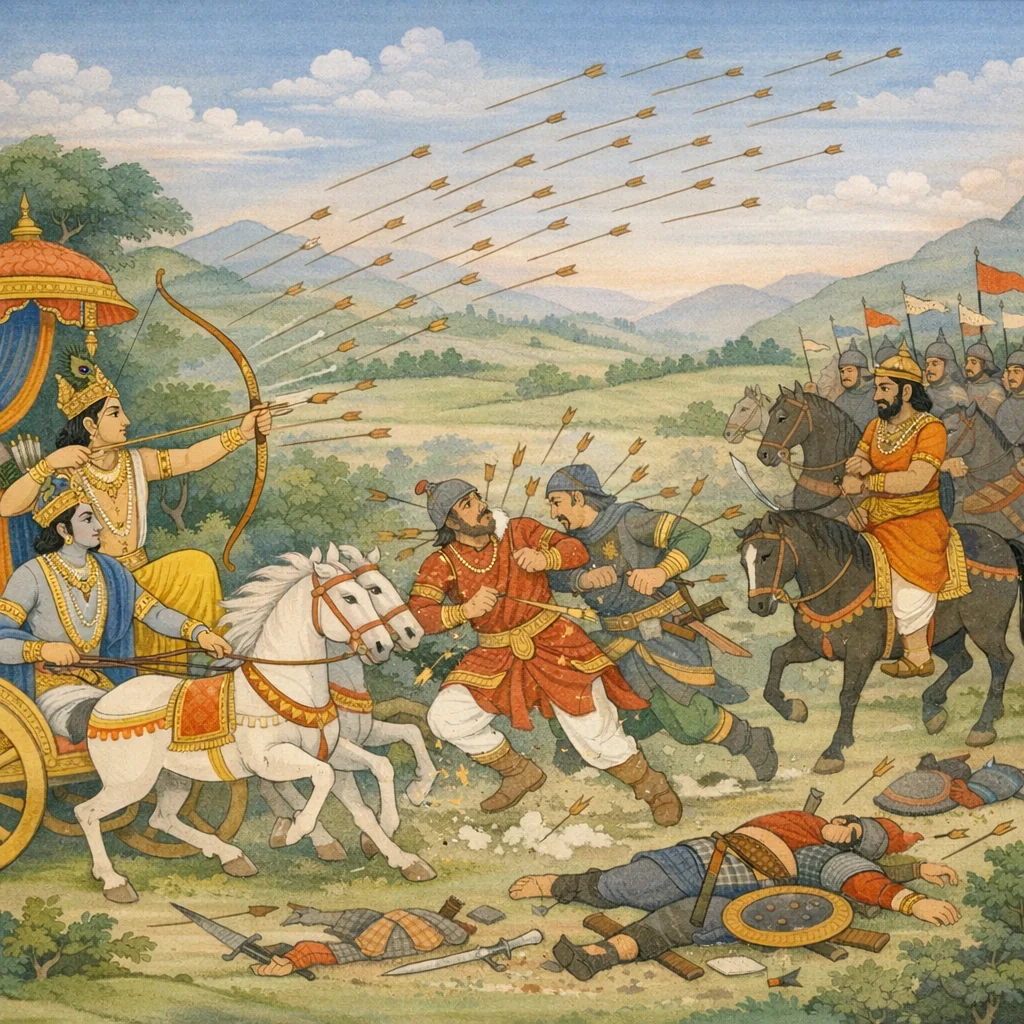
Saṃjaya reports a dense combat sequence during an attritional phase of the war. Śakuni advances upon Sahadeva; missile exchanges intensify, with Bhīma also targeted by Ulūka. The battlefield is described as visually obscured by arrow-storms and strewn with the material remains of combat. Sahadeva is struck on the head by a spear, prompting Bhīma’s forceful counteraction that disrupts Śakuni’s followers; Duryodhana issues a rallying admonition against retreat, reframing withdrawal as loss of honor and posthumous repute. Sahadeva regains momentum: he breaks Śakuni’s bow, absorbs renewed attacks, and decapitates Ulūka. Śakuni grieves and re-engages, cycling through weaponry—bow, sword, mace, and a formidable śakti—each neutralized by Sahadeva, who repeatedly severs incoming threats. In the climax, Sahadeva disables Śakuni’s insignia (chatra, dhvaja, and bow), wounds him comprehensively, and finally removes Śakuni’s head with a decisive arrow. The Kaurava troops, seeing Śakuni fallen, disperse in fear, while the Pandava side signals victory with conches and public commendation, interpreting the event as closure of a longstanding moral antagonism.
Chapter Arc: घोड़सवारों के बीच दुर्योधन को स्थिर खड़ा देख श्रीकृष्ण अर्जुन से कहते हैं—अब शेष युद्ध का भार कुछ ही क्षणों में निर्णीत होने जा रहा है; बीते महावीरों (भीष्म, द्रोण, कर्ण) के पतन की स्मृति वर्तमान को और तीखा कर देती है। → कृष्ण अर्जुन को स्मरण कराते हैं कि शत्रु-बल का अधिकांश नष्ट हो चुका है और स्वजन-सुरक्षा का दायित्व निभाया गया है; फिर भी दुर्योधन का अडिग अभिमान अंतिम प्रतिरोध बनकर खड़ा है। उधर सुशर्मा अपने पुत्रों और सेना सहित उग्र होकर सामने आता है, मानो पराजय को भी चुनौती दे रहा हो। → अर्जुन शत-शर-वर्षा से शत्रु-पंक्तियों को चीरते हुए सुशर्मा तथा उसके पुत्रों/अनुयायियों का संहार करता है; साथ ही भीम क्षणभर में कौरव-सेना पर इन्द्र-वज्र-स्पर्शी बाण-वृष्टि बरसाकर चारों ओर से उन्हें ढक देता है—रणभूमि में निर्णायक टूटन यहीं घटती है। → कौरव-पक्ष की पंक्तियाँ बिखरती हैं; अर्जुन का लक्ष्य-भेदन और भीम की सर्वतोमुखी बाण-वर्षा मिलकर शत्रु-बल को पीछे ढकेल देती है। दुर्योधन पर भी बाण-वृष्टि का दबाव बढ़ता है और युद्ध का पलड़ा पाण्डवों की ओर झुकता है। → सचेत होकर सहदेव क्रोध में दुर्योधन पर तीक्ष्ण बाणों की वर्षा आरम्भ करता है—अब प्रश्न यह है कि दुर्योधन इस घेराव से कैसे निकलेगा और अगला निर्णायक द्वंद्व किसके हाथों होगा।
Shlokas
Verse 1
पम्प बछ। अर: सप्तविशो<्ध्याय: श्रीकृष्ण और अर्जुनकी बातचीत, अर्जुनद्वारा सत्यकर्मा, सत्येषु तथा पैंतालीस पुत्रों और सेनासहित सुशर्माका वध तथा भीमके द्वारा धृतराष्ट्रपुत्र सुदर्शनका अन्त संजय उवाच दुर्योधनो महाराज सुदर्शश्वापि ते सुत: । हतशेषौ तदा संख्ये वाजिमध्ये व्यवस्थितौ,संजय कहते हैं--महाराज! उस समय आपके पुत्र दुर्योधन और सुदर्शन ये--दो ही बच गये थे। दोनों ही घुड़सवारोंके बीचमें खड़े थे
Sañjaya said: O King, at that time on the battlefield only two of your sons remained—Duryodhana and Sudarśana. Both were positioned amid the cavalry, standing their ground after the slaughter of the rest. The verse underscores the stark moral and human cost of adharma-driven war: power and pride narrow, at last, to mere survival among ruins.
Verse 2
ततो दुर्योधन दृष्टवा वाजिमध्ये व्यवस्थितम् | उवाच देवकीपुत्र: कुन्तीपुत्रं धनंजयम्,तदनन्तर दुर्योधनको घुड़सवारोंके बीचमें खड़ा देख देवकीनन्दन भगवान् श्रीकृष्णने कुन्तीकुमार अर्जुनसे इस प्रकार कहा--
Then, seeing Duryodhana stationed amid the horsemen, Devakī’s son—Śrī Kṛṣṇa—addressed Kuntī’s son Dhanañjaya (Arjuna). The scene underscores the moral gravity of leadership in war: Kṛṣṇa draws Arjuna’s attention to the enemy king’s position, preparing him to act with disciplined purpose rather than personal hatred.
Verse 3
शत्रवों हतभूयिष्ठा ज्ञातय: परिपालिता: । गृहीत्वा संजयं चासौ निवृत्त: शिनिपुड्भव:,“भरतनन्दन! शत्रुओंके अधिकांश योद्धा मारे गये और अपने कुटुम्बी जनोंकी रक्षा हुई। उधर देखो, वे शिनिप्रवर सात्यकि संजयको कैद करके उसे साथ लिये लौटे आ रहे हैं। रणभूमिमें सेवकोंसहित धृतराष्ट्रके पापी पुत्रोंसे युद्ध करके दोनों भाई नकुल और सहदेव भी बहुत थक गये हैं
Sañjaya said: “Most of the enemy warriors have been slain, and our own kinsmen have been protected. And look—Sātyaki, the foremost of the Śinis, has seized Sañjaya and is now returning with him.”
Verse 4
परिश्रान्तश्न नकुल: सहदेवश्व भारत । योधयित्वा रणे पापान् धार्तराष्ट्रानू सहानुगान्,“भरतनन्दन! शत्रुओंके अधिकांश योद्धा मारे गये और अपने कुटुम्बी जनोंकी रक्षा हुई। उधर देखो, वे शिनिप्रवर सात्यकि संजयको कैद करके उसे साथ लिये लौटे आ रहे हैं। रणभूमिमें सेवकोंसहित धृतराष्ट्रके पापी पुत्रोंसे युद्ध करके दोनों भाई नकुल और सहदेव भी बहुत थक गये हैं
Sañjaya said: “O Bhārata, Nakula and Sahadeva too have become utterly weary, having fought in battle against the sinful sons of Dhṛtarāṣṭra together with their followers.”
Verse 5
दुर्योधनमभित्यज्य त्रय एते व्यवस्थिता: । कृपश्च कृतवर्मा च द्रौणिश्वैव महारथ:,“उधर कृपाचार्य, कृतवर्मा और महारथी अश्वत्थामा--ये तीनों युद्धभूमिमें दुर्योधनको छोड़कर कहीं अन्यत्र स्थित हैं
Sañjaya said: Leaving Duryodhana behind, these three remained stationed elsewhere—Kṛpa, Kṛtavarmā, and the great chariot-warrior Aśvatthāmā (son of Droṇa). The line underscores a grim ethical tension: at the moment their king lies abandoned, the surviving leaders are separated from him, foreshadowing the collapse of loyalty and order amid the ruin of war.
Verse 6
असौ तिष्ठति पाज्चाल्य: श्रिया परमया युतः । दुर्योधनबलं हत्वा सह सर्व: प्रभद्रकै:,“इधर, सम्पूर्ण प्रभद्रकोंसहित दुर्योधनकी सेनाका संहार करके पांचालराजकुमार धृष्टद्युम्न अपनी सुन्दर कान्तिसे सुशोभित हो रहे हैं
Sañjaya said: “There stands the Pāñcāla prince, endowed with supreme splendor. Having destroyed Duryodhana’s forces together with all the Prabhadrakas, he now remains conspicuous—his victory marked not by mere survival, but by the visible radiance of prowess fulfilled in the harsh demands of war.”
Verse 7
असौ दुर्योधन: पार्थ वाजिमध्ये व्यवस्थित: । छत्रेण प्रियमाणेन प्रेक्षमाणो मुहुर्मुहु:,'पार्थ! वह रहा दुर्योधन, जो छत्र धारण किये घुड़सवारोंके बीचमें खड़ा है और बारंबार इधर ही देख रहा है
Sañjaya said: “O Pārtha, there stands Duryodhana amid the horsemen, being shaded and honored by a parasol, repeatedly casting his gaze this way again and again.” The scene underscores the outward signs of royal pride and protection even as the battle’s moral weight and impending ruin press in.
Verse 8
प्रतिव्यूह्दू बल॑ सर्व रणमध्ये व्यवस्थित: । एन॑ हत्वा शितैर्बाणै: कृतकृत्यो भविष्यसि,“वह अपनी सारी सेनाका व्यूह बनाकर युद्धभूमिमें खड़ा है। तुम इसे पैने बाणोंसे मारकर कृतकृत्य हो जाओगे
Sañjaya said: “His entire host stands arrayed in full battle-formation in the very midst of the field. Slay him with sharp arrows, and you will have fulfilled your duty—your purpose in this war will be accomplished.”
Verse 9
गजानीकं हतं दृष्टवा त्वां च प्राप्तमरिंदम । यावन्न विद्रवन्त्येते तावज्जहि सुयोधनम्,“शत्रुदमन! गजसेनाका वध और तुम्हारा आगमन हुआ देख ये कौरव-योद्धा जबतक भाग नहीं जाते तभीतक दुर्योधनको मार डालो
Sañjaya said: “O subduer of foes, seeing the elephant-corps destroyed and seeing you arrive, strike down Suyodhana (Duryodhana) at once—before these Kaurava warriors lose heart and scatter in flight.” The counsel is tactical and urgent: in the moral chaos of war, a decisive act against the chief instigator is presented as the quickest way to end further slaughter.
Verse 10
यातु वक्षित्तु पाज्चाल्यं क्षिप्रमागम्यतामिति । परिश्रान्तबलस्तात नैष मुच्येत किल्बिषी,“अपने दलका कोई पुरुष पांचालराज धृष्टद्युम्नके पास जाय और कहे कि “आप शीघ्रतापूर्वक चलें।” तात! यह पापात्मा दुर्योधन अब बच नहीं सकता, क्योंकि इसकी सारी सेना थक गयी है
Verse 11
हत्वा तव बल सर्व संग्रामे धृतराष्ट्रज: । जितान् पाण्डुसुतान् मत्वा रूपं धारयते महत्
Sañjaya said: Having slain all your forces in the battle, the son of Dhṛtarāṣṭra—imagining that the sons of Pāṇḍu have been conquered—assumes a grand and imposing demeanor. The verse highlights the moral blindness that can follow violence: outward triumph and pride arise from a mistaken sense of victory, even when the deeper outcome of the war remains uncertain.
Verse 12
“दुर्योधन समझता है कि “संग्रामभूमिमें तुम्हारी सारी सेनाका संहार करके पाण्डवोंको पराजित कर दूँगा।” इसीलिये वह अत्यन्त उग्र रूप धारण कर रहा है ।। निहतं स्वबलं दृष्टवा पीडितं चापि पाण्डवै: । ध्रुवमेष्यति संग्रामे वधायैवात्मनो नृप:,'परंतु अपनी सेनाको पाण्डवोंद्वारा पीड़ित एवं मारी गयी देख राजा दुर्योधन निश्चय ही अपने विनाशके लिये ही युद्धस्थलमें पदार्पण करेगा"
Sañjaya said: Seeing his own forces slain and grievously harried by the Pāṇḍavas, King Duryodhana will surely enter the battlefield only for his own death. Driven by wrath and delusion, he imagines that by annihilating the opposing host he will defeat the Pāṇḍavas; yet this very resolve, born of pride and desperation, hastens his ruin and exposes the ethical blindness that war can intensify when dharma is abandoned.
Verse 13
एवमुक्त: फाल्गुनस्तु कृष्णं वचनमत्रवीत् । धृतराष्ट्रसुता: सर्वे हता भीमेन माधव
Sañjaya said: Thus addressed, Phālguna (Arjuna) spoke these words to Kṛṣṇa: “O Mādhava, all the sons of Dhṛtarāṣṭra have been slain by Bhīma.” The statement underscores the grim moral weight of the war’s culmination—victory achieved through the fulfillment of vows and duty, yet marked by irreversible loss and the heavy consequences of adharma-driven conflict.
Verse 14
हतो भीष्मो हतो द्रोण: कर्णो वैकर्तनो हतः
Sanjaya said: “Bhishma has been slain; Drona has been slain; Karna—son of the charioteer (Vaikartana)—has been slain.” The line compresses the moral weight of the war into a stark tally: the fall of the foremost elders and champions signals not merely military loss but the collapse of the Kaurava cause under the burden of adharma and the inexorable consequences of violence.
Verse 15
मद्रराजो हतः शल्यो हतः कृष्ण जयद्रथ: । “श्रीकृष्ण! भीष्म मारे जा चुके, द्रोणका भी अन्त हो गया, वैकर्तन कर्ण भी मार डाला गया, मद्रराज शल्यका भी वध हो गया और जयद्रथ भी यमलोक पहुँच गया ।। श्रीकृष्ण दुर्योधनकी ओर संकेत करते हुए उसे मारनेके लिये अर्जुनको प्रेरित कर रहे हैं हया: पञ्चशता: शिष्टा: शकुने: सौबलस्य च,“सुबलपुत्र शकुनिके पास पाँच सौ घुड़सवारोंकी सेना अभी शेष है। जनार्दन! उसके पास दो सौ रथ, सौसे कुछ अधिक हाथी और तीन हजार पैदल सैनिक भी शेष रह गये हैं
Sañjaya said: “The king of Madra, Śalya, has been slain; Jayadratha too has been killed. And of Śakuni, the son of Subala, five hundred horsemen still remain.” In the moral atmosphere of the war-report, Sañjaya’s terse tally of deaths and remaining forces underscores the inexorable consequences of adharma-driven choices and the collapsing support-system of Duryodhana’s side as the battle nears its end.
Verse 16
रथानां तु शते शिष्टे द्वे एव तु जनार्दन । दन्तिनां च शतं साग्रं त्रिसाहस्रा: पदातय:,“सुबलपुत्र शकुनिके पास पाँच सौ घुड़सवारोंकी सेना अभी शेष है। जनार्दन! उसके पास दो सौ रथ, सौसे कुछ अधिक हाथी और तीन हजार पैदल सैनिक भी शेष रह गये हैं
Sañjaya said: “O Janārdana, of the chariots only two hundred remain; of the elephants a little more than a hundred remain; and the foot-soldiers are three thousand.” In the moral atmosphere of the epic’s war-reporting, this is a sober accounting of dwindling forces—an implicit reminder of the relentless cost of adharma-driven conflict and the inexorable narrowing of options as the battle consumes men and means.
Verse 17
अश्वत्थामा कृपश्रैव त्रिगर्ताधिपतिस्तथा । उलूक: शकुनिश्चैव कृतवर्मा च सात्वत:
Sañjaya said: “Aśvatthāmā, and Kṛpa as well; likewise the ruler of the Trigartas; Ulūka and Śakuni too; and Kṛtavarmā of the Sātvatas.” In this war-reporting context, the verse functions as a sober roll-call of key Kaurava-aligned figures—names that carry the ethical weight of chosen loyalties and the consequences of counsel, strategy, and violence on the battlefield.
Verse 18
एतद् बलमभूच्छेषं धार्तराष्ट्रस्य माधव । “माधव! दुर्योधनकी सेनामें अश्वत्थामा, कृपाचार्य, त्रिगर्तराज सुशर्मा, उलूक, शकुनि और सात्वतवंशी कृतवर्मा--ये थोड़े-से ही वीर सैनिक शेष रह गये हैं ।। मोक्षो न नूनं कालात् तु विद्यते भुवि कस्यचित्
Sanjaya said: “O Madhava, this is all the remaining strength of Dhritarashtra’s host. Indeed, for no one on earth is there any escape from Time.”
Verse 19
तथा विनिहते सैन्ये पश्य दुर्योधनं स्थितम् । अद्याल्वा हि महाराजो हतामित्रो भविष्यति
Sanjaya said: “When the army has been thus cut down, look—Duryodhana still stands. Today, indeed, the great king will become one whose enemies are slain.”
Verse 20
“निश्चय ही इस पृथ्वीपर किसीको भी कालसे छुटकारा नहीं मिलता, तभी तो इस प्रकार अपनी सेनाका संहार होनेपर भी दुर्योधन युद्धके लिये खड़ा है, उसे देखिये। आजके दिन महाराज युधिष्ठिर शत्रुहीन हो जायँगे ।। नहि मे मोक्ष्यते कश्चित् परेषामिह चिन्तये । ये त्वद्य समरं कृष्ण न हास्यन्ति मदोत्कटा:
Sanjaya said: “Truly, on this earth no one at all escapes the grasp of Time. That is why Duryodhana, even after seeing his own army destroyed, still stands ready for battle—look at him. Today King Yudhishthira will become free of enemies. As for me, I do not expect anyone here to be spared; I think only of the fate of the others. Those who, intoxicated with pride, will not abandon the fight today, O Krishna, are rushing toward their end.”
Verse 21
अद्य युद्धे सुसंक्रुद्धों दीर्घ राज्ञा प्रजागरम्
Sañjaya said: “Today, in the battle, being fiercely enraged, he kept the king awake for a long time.”
Verse 22
निकृत्या वै दुराचारो यानि रत्नानि सौबल:
Sañjaya said: By deceit indeed, the wicked-natured Saubala (Śakuni) obtained those jewels—an act that reveals his corrupt conduct and the moral stain of winning by fraud rather than by rightful means.
Verse 23
सभायामहरद् यूते पुनस्तान्याहराम्यहम् । “दुराचारी सुबलपुत्र शकुनिने द्यूतसभामें छल करके जिन रत्नोंको हर लिया था, उन सबको मैं वापस ले लूँगा ।। अद्य ता अपि रोत्स्यन्ति सर्वा नागपुरे स्त्रिय:
Sanjaya said: “In the dice-assembly he carried them off by gambling; now I shall bring those very treasures back again. Today, even all the women in the city of the Nāgas will weep.” The statement frames the coming violence as a retaliatory ‘recovery’ of what was unjustly seized through deceit, while also foreshadowing the wider, indiscriminate suffering that follows from adharma and vengeance.
Verse 24
समाप्तमद्य वै कर्म सर्व कृष्ण भविष्यति
Sañjaya said: “Today, indeed, the entire course of action will reach its conclusion; all that is to come will now unfold under Kṛṣṇa’s determining will.”
Verse 25
नापयाति भयात् कृष्ण संग्रामाद् यदि चेन्मम
Sañjaya said: “O Kṛṣṇa, if out of fear he does not withdraw from the battle—if that is indeed my concern—then the issue turns on courage and resolve amid the demands of war.”
Verse 26
इस प्रकार श्रीमह्याभारत शल्यपर्वमें धतराष्ट्रके ग्यारह पुत्रोंका वधविषयक छब्बीसवाँ अध्याय पूरा हुआ,मम होतदशक्तं वै वाजिवृन्दमरिंदम
Thus ends the twenty-sixth chapter of the Śalya Parvan of the revered Mahābhārata, dealing with the slaying of eleven sons of Dhṛtarāṣṭra. Sañjaya adds that his own power was insufficient against the massed force of horses—an admission that, amid the moral collapse of war, personal effort and loyalty meet their limits before the overwhelming machinery of battle.
Verse 27
एवमुक्तस्तु दाशार्ह: पाण्डवेन यशस्विना,इति श्रीमहाभारते शल्यपर्वणि सुशर्मवधे सप्तविंशो5ध्याय:
Sañjaya said: Thus was Dāśārha addressed by the illustrious Pāṇḍava. Here ends the twenty-seventh chapter of the Śalya Parva of the Śrī Mahābhārata, in the section concerning the slaying of Suśarman. The verse functions as a narrative colophon, marking the close of an episode and underscoring the epic’s ethical frame: speech and counsel in war are recorded not merely as events, but as lessons in duty, resolve, and the consequences of enmity.
Verse 28
तदनीकमभिप्रेक्ष्य त्रय: सज्जा महारथा:,मान्यवर! उस सेनाको देखकर तीन महारथी भीमसेन, अर्जुन और सहदेव युद्ध- सामग्रीसे सुसज्जित हो दुर्योधनके वधकी इच्छासे सिंहनाद करते हुए आगे बढ़े
Sañjaya said: Seeing that battle-array, three great chariot-warriors—Bhīmasena, Arjuna, and Sahadeva—fully armed and prepared for combat, advanced with lion-like roars, intent on the slaying of Duryodhana. The verse underscores the climactic resolve of the Pāṇḍavas’ champions: their martial vigor is directed toward ending the war by striking at its chief instigator, framing violence here as a targeted act within the grim logic of kṣatriya-duty rather than mere bloodlust.
Verse 29
भीमसेनोथर्जुनश्वैव सहदेवश्व॒ मारिष | प्रययु: सिंहनादेन दुर्योधनजिघांसया,मान्यवर! उस सेनाको देखकर तीन महारथी भीमसेन, अर्जुन और सहदेव युद्ध- सामग्रीसे सुसज्जित हो दुर्योधनके वधकी इच्छासे सिंहनाद करते हुए आगे बढ़े
Sañjaya said: “Then Bhīmasena, Arjuna, and Sahadeva, O revered one, advanced with a lion-like roar, driven by the resolve to slay Duryodhana.” The verse highlights the warriors’ focused intent in battle—valor and determination directed toward a single adversary, set within the grave moral tension of fratricidal war.
Verse 30
तान् प्रेक्ष्य सहितान् सर्वान् जवेनोद्यतकार्मुकान् । सौबलोअभ्यद्रवद् युद्धे पाण्डवानाततायिन:,उन सबको बड़े वेगसे धनुष उठाये एक साथ आक्रमण करते देख सुबलपुत्र शकुनि रणभूमिमें आततायी पाण्डवोंकी ओर दौड़ा
Sañjaya said: Seeing them all gathered together, rushing forward with great speed and bows raised, Saubala (Śakuni), in the midst of battle, charged toward the Pāṇḍavas—described here as aggressors—on the field.
Verse 31
सुदर्शनस्तव सुतो भीमसेनं समभ्ययात् | सुशर्मा शकुनिश्चैव युयुधाते किरीटिना
Sañjaya said: Your son Sudarśana advanced straight toward Bhīmasena. And Suśarmā, together with Śakuni, was engaged in combat with the diademed Arjuna. The report highlights how, amid the moral collapse of war, each warrior is drawn into a fated confrontation—some seeking honor in direct battle, others relying on stratagem—while the field narrows into decisive personal duels.
Verse 32
आपका पुत्र सुदर्शन भीमका सामना करने लगा। सुशर्मा और शकुनिने किरीटधारी अर्जुनके साथ युद्ध छेड़ दिया ।। सहदेवं तव सुतो हयपृष्ठगतो< भ्ययात् । ततो हि यत्नतः क्षिप्रं तव पुत्रो जनाधिप
Sañjaya said: Your son advanced against Sahadeva, mounted on horseback. Then, O king, your son quickly pressed the attack with deliberate effort—signaling the relentless momentum of battle where resolve and strategy, rather than mere anger, drive the next clash.
Verse 33
प्रासेन सहदेवस्य शिरसि प्राहरद् भृूशम् । नरेश्वर! घोड़ेकी पीठपर बैठा हुआ आपका पुत्र दुर्योधन सहदेवके सामने आया। उसने बड़े यत्नसे सहदेवके मस्तकपर शीघ्रतापूर्वक प्रासका प्रहार किया ।। सोपाविशद् रथोपस्थे तव पुत्रेण ताडित:
Sañjaya said: O king, your son Duryodhana, mounted on horseback, advanced to face Sahadeva. With great force and urgency he struck Sahadeva on the head with a spear. Wounded by your son’s blow, Sahadeva sank down upon the chariot-seat. The episode underscores the brutal immediacy of battle, where prowess and aggression press against the warrior’s duty to endure and continue the fight without abandoning righteous resolve.
Verse 34
प्रतिलभ्य तत: संज्ञां सहदेवो विशाम्पते
Sañjaya said: Then Sahadeva, O lord of the people, regained consciousness—signaling a return from the brink amid the violence of battle and the resilience that sustains a warrior’s duty.
Verse 35
पार्थोडपि युधि विक्रम्य कुन्तीपुत्रो धनंजय:
Sañjaya said: Even Pārtha—Dhanañjaya Arjuna, the son of Kuntī—displayed his valor on the battlefield, advancing with heroic prowess in the midst of the war.
Verse 36
तदनीकं तदा पार्थो व्यधमद् बहुभि: शरै:
Sañjaya said: Then Pārtha (Arjuna) shattered that battle-formation, striking it down with a multitude of arrows. The verse underscores disciplined martial skill directed toward a decisive end in war, where force is applied with focus rather than cruelty for its own sake.
Verse 37
पातयित्वा हयानू् सर्वास्त्रिगर्तानां रथान् ययौ । पार्थने अपने बहुसंख्यक बाणोंद्वारा घुड़सवारोंकी उस सेनाको छिजन्न-भिन्न कर डाला तथा समस्त घोड़ोंको धराशायी करके त्रिगर्तदेशीय रथियोंपर चढ़ाई कर दी ।। ततस्ते सहिता भूत्वा त्रिगर्तानां महारथा:
Sañjaya said: Having brought down the horses, he advanced against all the Trigarta chariots. By a great multitude of arrows, Pārtha shattered the force of the mounted horsemen; and after felling all their horses to the ground, he charged upon the Trigarta chariot-warriors. Then those great chariot-fighters of the Trigartas, gathering together in a body, (prepared to respond).
Verse 38
अर्जुन वासुदेवं च शरवर्षरवाकिरन् । तब वे त्रिगर्तदेशीय महारथी एक साथ होकर अर्जुन और श्रीकृष्णको अपने बाणोंकी वर्षसे आच्छादित करने लगे ।। सत्यकर्माणमारक्षिप्य क्षुरप्रेण महायशा:,शिरक्षिच्छेद सहसा तप्तकुण्डलभूषणम् । प्रभो! उस समय महायशस्वी पाण्डुनन्दन अर्जुनने क्षुरप्रद्वारा सत्यकर्मापर प्रहार करके उसके रथकी ईषा (हरसा) काट डाली। तत्पश्चात् उन महायशस्वी वीरने शिलापर तेज किये हुए क्षुरप्रद्वारा उसके तपाये हुए सुवर्णके कुण्डलोंसे विभूषित मस्तकको सहसा काट लिया
Sanjaya said: The warriors from Trigarta showered Arjuna and Vasudeva (Krishna) with a rain of arrows, seeking to smother both the hero and his charioteer beneath their missile-storm. Then Arjuna, the illustrious son of Pandu, struck at Satyakarman with a razor-edged shaft, severing the chariot’s pole; and immediately thereafter, with a keenly whetted razor-arrow, he cut off Satyakarman’s head—adorned with heated golden earrings—swiftly and decisively. The passage underscores the grim precision of battlefield skill and the inexorable consequences of choosing violent alliance in an unrighteous cause.
Verse 39
ततोअस्य स्यन्दनस्येषां चिच्छिदे पाण्डुनन्दन: । शिलाशितेन च विभो क्षुरप्रेण महायशा:
Sañjaya said: Then the son of Pāṇḍu, the illustrious hero, with a razor-edged arrow sharpened on stone, cut down the reins of his opponent’s chariot. In the moral texture of the battle, this is a tactical act aimed at disabling mobility and control rather than striking the body directly—an instance of war-skill used to gain advantage by neutralizing the enemy’s means of action.
Verse 40
सत्येषुमथ चादत्त योधानां मिषतां तत:
Sañjaya said: Then, as the warriors looked on, he swiftly took up his true-aiming arrows—an act that signals resolute intent and disciplined skill amid the moral gravity of battle.
Verse 41
त॑ निहत्य ततः पार्थ: सुशर्माणं त्रिभि: शरै:
Sañjaya said: Having slain him, then Pārtha (Arjuna) struck Suśarmā with three arrows—an image of swift, disciplined force in the midst of righteous warfare, where prowess is exercised without hesitation once the battle’s duty is engaged.
Verse 42
ततः प्रायात् त्वरन् पार्थो दीर्घकालं सुसंवृतम्
Sañjaya said: Then Pārtha set out in haste, after a long time of being held back and kept under restraint—signaling a decisive return to action amid the pressures of war and duty.
Verse 43
तमर्जुन: पृषत्कानां शतेन भरतर्षभ
Sañjaya said: O bull among the Bharatas, Arjuna struck him with a hundred arrows—an image of relentless martial resolve amid the grim duties of war.
Verse 44
पूरयित्वा ततो बाहान् प्राहरत् तस्य धन्विन: । भरतश्रेष्ठ! अर्जुनने सौ बाणोंद्वारा उसे आच्छादित करके उस थधनुर्धर वीरके घोड़ोंपर घातक प्रहार किया ।। ततः शरं समादाय यमदण्डोपमं तदा
Sañjaya said: Then, having fully drawn back his arms, Arjuna struck at that bowman. O best of the Bharatas, after covering him with a shower of keen arrows, Arjuna delivered a deadly blow upon the horses of that mighty archer. Thereupon, taking up an arrow like the rod of Yama, he prepared to strike again.
Verse 45
सुशर्माणं समुद्दिश्य चिक्षेपाशु हसन्निव । इसके बाद यमदण्डके समान भयंकर बाण हाथमें लेकर सुशर्माको लक्ष्य करके हँसते हुए-से शीघ्र ही छोड़ दिया ।। स शर: प्रेषितस्तेन क्रोधदीप्तेन धन्विना
Sañjaya said: Aiming at Suśarmā, the archer swiftly let fly an arrow, as if laughing. That shaft, released by the bowman blazing with anger, sped forth like a rod of Death—an image of how wrath in war turns skill into terror and hastens ruin.
Verse 46
सुशर्माणं समासाद्य बिभेद हृदयं रणे । क्रोधसे तमतमाये हुए धनुर्धर अर्जुनके द्वारा चलाये गये उस बाणने सुशर्मापर चोट करके उसकी छाती छेद डाली ।। स गतासुर्महाराज पपात धरणीतले
Sanjaya said: Closing in upon Suśarmā on the battlefield, Arjuna—his wrath fully kindled—drove an arrow that pierced Suśarmā’s chest and split his heart. Bereft of life, O great king, Suśarmā fell upon the earth. The passage underscores the grim finality of war: prowess and anger achieve decisive results, yet the outcome is death, reminding the listener of the heavy moral cost borne by all who choose the path of battle.
Verse 47
सुशर्माणं रणे हत्वा पुत्रानस्य महारथान्
Sañjaya said: Having slain Suśarmā in the battle, and also his sons—mighty chariot-warriors—(the narrative proceeds to describe the further course of the war). The line underscores the relentless moral weight of kṣatriya-duty in a fratricidal conflict, where valor and obligation drive acts that are grievous even when deemed lawful in war.
Verse 48
ततो<स्य निशितैर्बाणै: सर्वान् हत्वा पदानुगान्
Sañjaya said: Then, with his razor-sharp arrows, he slew all those who were following in his footsteps—his attendants and supporters—cutting down the very train that sustained his advance in the battle. In the brutal ethic of war, this act shows how the destruction of a leader’s immediate followers can collapse his momentum and isolate him amid the chaos of combat.
Verse 49
भीमस्तु समरे क्रुद्धः पुत्र तव जनाधिप
Sañjaya said: O king, your son—Bhīma—was enraged in the midst of battle. The line signals the surge of wrath that drives his conduct on the battlefield, foreshadowing forceful action where personal anger and the demands of war press against restraint and righteous measure.
Verse 50
सुदर्शनमदृश्यं तं शरैश्नक्रे हसन्निव । ततोअस्य प्रहसन् क्रुद्ध: शिर: कायादपाहरत्
Sañjaya said: Indra, as though laughing, struck down that Sudarśana with his arrows and made him vanish from sight. Then, laughing again yet filled with wrath, he severed his head from his body—an image of how, in war, divine power can swiftly punish overreaching aggression and bring a violent end to a warrior’s course.
Verse 51
क्षुरप्रेण सुतीक्ष्णेन स हतः प्रापतद् भुवि । जनेश्वर! दूसरी ओर कुपित हुए भीमसेनने हँसते-हँसते बाणोंकी वर्षा करके सुदर्शनको ढक दिया। फिर क्रोधपूर्वक अट्टहास करते हुए उन्होंने उसके मस्तकको तीखे क्षुरप्रद्वारा धड़से काट लिया। सुदर्शन मरकर पृथ्वीपर गिर पड़ा || ४९-५० $ ।। तस्मिंस्तु निहते वीरे ततस्तस्य पदानुगा:
Sañjaya said: Struck down by a razor-edged, exceedingly sharp arrow, he fell to the ground. O lord of men, on the other side Bhīmasena—though enraged—laughed as he showered arrows, completely covering Sudarśana. Then, roaring with wrathful laughter, he severed Sudarśana’s head with a keen razor-headed shaft. Sudarśana died and collapsed upon the earth. When that heroic warrior had been slain, then his followers…
Verse 52
ततस्तु निशितैर्बाणैस्तवानीकं वृकोदर:
Sañjaya said: Then, with razor-sharp arrows, Vṛkodara (Bhīma) struck at your army formation—pressing the attack with relentless force amid the chaos of battle.
Verse 53
तत: क्षणेन तद् भीमो न््यहनद् भरतर्षभ,भरतश्रेष्ठ) इसके बाद भीमसेनने क्षणभरमें आपकी सेनाका संहार कर डाला। भारत! जब उन कौरव-सैनिकोंका संहार होने लगा, तब महारथी सेनापतिगण भीमसेनपर आक्रमण करके उनके साथ युद्ध करने लगे
Sañjaya said: Then, in a mere moment, Bhīma struck down and shattered that force, O bull among the Bharatas. As the Kaurava soldiers began to be destroyed, the great chariot-warriors who were commanders and leaders rushed to attack Bhīmasena and engaged him in battle—showing how, in war, the fall of the many compels the foremost to step forward, even when the tide turns against them.
Verse 54
तेषु तूत्साद्यमानेषु सेनाध्यक्षा महारथा: । भीमसेनं समासाद्य ततो<युद्धयन्त भारत,भरतश्रेष्ठ) इसके बाद भीमसेनने क्षणभरमें आपकी सेनाका संहार कर डाला। भारत! जब उन कौरव-सैनिकोंका संहार होने लगा, तब महारथी सेनापतिगण भीमसेनपर आक्रमण करके उनके साथ युद्ध करने लगे
Verse 55
स तान् सर्वान् शरैघोरैरवाकिरत पाण्डव: । तथैव तावका राजन् पाण्डवेयान् महारथान्
Sañjaya said: The Pāṇḍava showered all of them with dreadful arrows. In the same way, O King, your warriors rained arrows upon the great chariot-fighters of the Pāṇḍavas. The verse underscores the reciprocal escalation of violence in battle—each side answering force with force—highlighting the grim symmetry of war where prowess and retaliation drive the conflict onward.
Verse 56
व्याकुलं तदभूत् सर्व पाण्डवानां परै: सह
Sañjaya said: Then the entire host of the Pāṇḍavas, together with their opposing foes, fell into turmoil and confusion—an image of the battlefield’s moral and emotional disarray as the struggle for victory overwhelms steadiness of mind.
Verse 57
तावकानां च समरे पाण्डवेयैर्युयुत्सताम् । शत्रुओंके साथ जूझनेवाले पाण्डवोंका और पाण्डवोंके साथ युद्धकी इच्छा रखनेवाले आपके सैनिकोंका सारा सैन्यदल समरांगणमें परस्पर मिलकर एक-सा हो गया ।। तत्र योधास्तदा पेतु: परस्परसमाहता: । उभयो: सेनयो राजन् संशोचन्त: सम बान्धवान्,राजन! उस समय वहाँ एक-दूसरेकी मार खाकर दोनों दलोंके योद्धा अपने भाई- बन्धुओंके लिये शोक करते हुए धराशायी हो जाते थे
Sañjaya said: In that battle, your warriors who longed to fight the sons of Pāṇḍu, and the Pāṇḍavas who were locked in combat with your men—when the armies met upon the field, the whole host became as one indistinguishable mass, mingled together in the press of war. There, O King, warriors of both sides, struck down by one another, fell to the earth—lamenting their own kinsmen even as the conflict raged, revealing the tragic moral cost of fratricidal war.
Verse 136
यावेतावास्थितौ कृष्ण तावद्य न भविष्यत: । भगवान् श्रीकृष्णके ऐसा कहनेपर अर्जुन उनसे इस प्रकार बोले--“माधव! धुृतराष्ट्रके प्राय: सभी पुत्र भीमसेनके हाथसे मारे गये हैं। श्रीकृष्ण! ये जो दो पुत्र खड़े हैं, इनका भी आज अन्त हो जायगा
Sañjaya said: “O Kṛṣṇa, so long as these two remain standing, they will not survive even today.” The line conveys the grim certainty of imminent death in the climactic violence of the war, where resolve and vengeance eclipse any remaining hope of reconciliation.
Verse 203
तान् वै सर्वान् हनिष्यामि यद्यपि स्युर्न मानुषा: । “श्रीकृष्ण! मैं सोचता हूँ कि आज शत्रुदलका कोई भी योद्धा यहाँ मेरे हाथसे बचकर नहीं जा सकेगा। जो मदोन्मत्त वीर आज युद्ध छोड़कर भाग नहीं जायँगे, उन सबको, वे मनुष्य न होकर देवता या दैत्य ही क्यों न हों, मैं मार डालूँगा
Verse 216
अपनेष्यामि गान्धारं घातयित्वा शितै: शरै: । “आज मैं अत्यन्त कुपित हो गान्धारराज शकुनिको पैने बाणोंसे मरवाकर राजा युधिष्ठिरके दीर्घकालीन जागरणरूपी रोगको दूर कर दूँगा
Sañjaya said: “I shall remove the Gandhāra king—having him slain by sharp arrows. Today, in fierce anger, I will have Śakuni, the ruler of Gandhāra, killed with keen shafts and thus dispel King Yudhiṣṭhira’s long-standing affliction of sleepless wakefulness.”
Verse 236
श्रुत्वा पतींक्ष पुत्रांश्ष पाण्डवैर्निहतान् युधि । “आज हस्तिनापुरकी वे सारी स्त्रियाँ भी युद्धमें पाण्डवोंके हाथसे अपने पतियों और पुत्रोंको मारा गया सुनकर फूट-फूटकर रोयेंगी
Sañjaya said: Hearing that their husbands and sons have been slain in battle by the Pāṇḍavas, the women of Hastināpura will wail and weep uncontrollably. The verse underscores the moral aftermath of war: victory on the field inevitably becomes grief in the homes, especially for those left behind.
Verse 243
अद्य दुर्योधनो दीप्तां श्रियं प्राणांश्व॒ मोक्ष्यति । 'श्रीकृष्णण आज हमलोगोंका सारा कार्य समाप्त हो जायगा। आज दुर्योधन अपनी उज्ज्वल राजलक्ष्मी और प्राणोंको भी खो बैठेगा
Sañjaya said: “Today Duryodhana will forfeit his blazing royal fortune—and even his very life.” In the moral arc of the war, this line marks the ripening of adharma’s consequences: sovereignty sought through injustice and obstinacy culminates in the loss of both kingship and breath.
Verse 253
निहतं विद्धि वार्ष्णेय धार्तराष्ट्रं सुबालिशम् | वृष्णिनन्दन श्रीकृष्ण! यदि वह मेरे भयसे युद्धसे भाग न जाय, तो मेरे द्वारा उस मूढ़ दुर्योधनको आप मारा गया ही समझें
Sanjaya said: “O Vārṣṇeya, know that foolish Dhṛtarāṣṭra’s son is as good as slain. O Śrī Kṛṣṇa, delight of the Vṛṣṇis—if, out of fear of me, he does not flee from the battle, then regard that deluded Duryodhana as already killed by my hand.”
Verse 263
सोढुं ज्यातलनिर्घोषं याहि यावन्निहन्म्पहम् । 'शत्रुदमन! यह घुड़सवारोंकी सेना मेरे गाण्डीव धनुषकी टंकारको नहीं सह सकेगी। आप घोड़े बढ़ाइये, मैं अभी इन सबको मारे डालता हूँ
Sañjaya said: “Go forward—before I strike them down—so that they may be made to endure the thunderous twang of the bowstring. O tamer of foes, this cavalry will not be able to bear the resounding clang of my Gāṇḍīva bow. Urge the horses on; I shall immediately slay them all.”
Verse 273
अचोदयद्धयान् राजन् दुर्योधनबल प्रति | राजन्! यशस्वी पाण्डुपुत्र अर्जुके ऐसा कहनेपर दशार्हकुलनन्दन श्रीकृष्णने दुर्योधनकी सेनाकी ओर घोड़े बढ़ा दिये
Sañjaya said: O King, he urged the horses forward toward Duryodhana’s army. Thus, at Arjuna’s words, Kṛṣṇa—the illustrious scion of the Dāśārha line—drove the chariot toward the Kaurava host, embodying resolute duty in the midst of war.
Verse 333
रुधिराप्लुतसर्वाड़ आशीविष इव श्वसन् | आपके पुत्रद्वारा ताड़ित होकर सहदेव फुफकारते हुए विषधर सर्पके समान लंबी साँस खींचते हुए रथके पिछले भागमें बैठ गये। उनका सारा शरीर लहूलुहान हो गया
Sañjaya said: Sahadeva, his whole body drenched in blood, was struck by your son. Breathing hard like a venomous serpent and hissing in pain and fury, he drew long breaths and sat down in the rear of the chariot. His entire body had become a mass of wounds and blood—an image of the brutal cost of battle and the endurance demanded of a warrior amid relentless violence.
Verse 353
शूराणामश्चवपृष्ठेभ्य: शिरांसि निचकर्त ह । कुन्तीपुत्र अर्जुनने भी युद्धमें पराक्रम करके घोड़ोंकी पीठोंसे शूरवीरोंके मस्तक काट गिराये
Sañjaya said: Arjuna, the son of Kuntī, displayed fierce prowess in the battle, cutting down the heads of brave warriors from the backs of their horses. The scene underscores the terrible efficiency of martial skill in war—valor expressed through lethal action, where heroism and violence stand side by side under the demands of kṣatriya duty.
Verse 393
शिरक्षिच्छेद सहसा तप्तकुण्डलभूषणम् । प्रभो! उस समय महायशस्वी पाण्डुनन्दन अर्जुनने क्षुरप्रद्वारा सत्यकर्मापर प्रहार करके उसके रथकी ईषा (हरसा) काट डाली। तत्पश्चात् उन महायशस्वी वीरने शिलापर तेज किये हुए क्षुरप्रद्वारा उसके तपाये हुए सुवर्णके कुण्डलोंसे विभूषित मस्तकको सहसा काट लिया
Sañjaya said: In that moment, Arjuna—the illustrious son of Pāṇḍu—struck with a razor-edged arrow and cut the axle/pole of his opponent’s chariot. Then, with another keen, whetted razor-arrow, he swiftly severed the enemy’s head, adorned with heated golden earrings. The scene underscores the grim precision of war: skill and resolve are exercised without hesitation, and the ethical weight lies in the warrior’s duty-bound action amid relentless violence.
Verse 403
यथा सिंहो वने राजन् मृगं परिबुभुक्षित: । राजन! जैसे वनमें भूखा सिंह किसी मृगको दबोच लेता है, उसी प्रकार अर्जुनने समस्त योद्धाओंके देखते-देखते सत्येषुके भी प्राण हर लिये
Sañjaya said: “O King, just as a lion in the forest, driven by hunger, seizes a deer, so did Arjuna—before the very eyes of all the warriors—take away the life of Satyeṣu as well.” The simile underscores the ruthless inevitability of battlefield death, where prowess and necessity override personal regard, and the king is made to confront the stark moral cost of war.
Verse 416
विद्धवा तानहनत् सर्वान् रथान् रुक्मविभूषितान् । सत्येषुका वध करके अर्जुनने सुशर्माको तीन बाणोंसे घायल कर दिया और उन समस्त स्वर्णभूषित रथोंका विध्वंस कर डाला
Sañjaya said: Having pierced them, he struck down all those chariots adorned with gold. The scene underscores the relentless momentum of battle, where martial skill and resolve translate into swift destruction, even of splendidly equipped forces.
Verse 423
मुज्चन् क्रोधविषं तीक्ष्णं प्रस्थलाधिपतिं प्रति । तत्पश्चात् पार्थ अपने दीर्घकालसे संचित किये हुए तीखे क्रोधरूपी विषको प्रस्थलेश्वर सुशर्मापर छोड़नेके लिये तीव्र गतिसे आगे बढ़े
Sanjaya said: Releasing his sharp, poison-like wrath toward the lord of Prasthala, Partha then surged forward at great speed, intent on pouring out upon Susharma—ruler of Prasthala—the fierce anger he had long restrained. The verse frames anger as a venom that, once unleashed in war, becomes a deliberate act of retribution rather than a momentary impulse.
Verse 463
नन्दयन् पाण्डवान् सर्वान् व्यथयंश्वापि तावकान् | महाराज! सुशर्मा आपके पुत्रोंको व्यथित और समस्त पाण्डवोंको आनन्दित करता हुआ प्राणशून्य होकर पृथ्वीपर गिर पड़ा
Sanjaya said: “Gladdening all the Pāṇḍavas and at the same time afflicting your side, O great king, Suśarmā—having caused distress to your sons and joy to the Pāṇḍavas—fell to the earth lifeless.”
Verse 473
सप्त चाष्टौ च त्रिंशच्च सायकैरनयत् क्षयम् । रणभूमिमें सुशर्माका वध करके अर्जुनने अपने बाणोंद्वारा उसके पैंतालीस महारथी पुत्रोंकी भी यमलोक पहुँचा दिया
Sañjaya said: With his arrows Arjuna brought to destruction seven, eight, and thirty warriors; and on the battlefield, after slaying Suśarmā, he also sent Suśarmā’s forty-five sons—great chariot-fighters—to Yama’s realm by his own shafts. The passage underscores the grim, inexorable logic of kṣatriya warfare: prowess and duty drive the combat forward, even as the ethical weight of mass killing remains starkly visible.
Verse 483
अभ्यगाद् भारतीं सेनां हतशेषां महारथ: । तदनन्तर पैने बाणोंद्वारा उसके सारे सेवकोंका संहार करके महारथी अर्जुनने मरनेसे बची हुई कौरवी सेनापर आक्रमण किया
Sañjaya said: Then the great chariot-warrior advanced against the Bharata (Kaurava) host—what remained after slaughter—pressing the attack upon the surviving troops. The scene underscores the grim momentum of war: once protectors and attendants are cut down, the remnant army is driven into further peril, revealing how violence, once unleashed, consumes even those left behind.
Verse 516
परिवत्रू रणे भीम॑ किरन्तो विविधान् शरान् । उस वीरके मारे जानेपर उसके सेवकोंने नाना प्रकारके बाणोंकी वर्षा करते हुए रणभूमिमें भीमसेनको सब ओरसे घेर लिया
Sañjaya said: “In the midst of battle, they showered Bhīma with many kinds of arrows. When that warrior had been slain, his attendants, raining down diverse volleys of shafts, surrounded Bhīmasena on all sides upon the battlefield.”
Verse 523
इन्द्राशनिसमस्पर्श: समनन््तात् पर्यवाकिरत् । तत्पश्चात् भीमसेनने इन्द्रके वजकी भाँति कठोर स्पर्शवाले तीखे बाणोंद्वारा आपकी सेनाको चारों ओरसे ढक दिया
Sañjaya said: Then Bhīmasena showered arrows on all sides—arrows whose touch was as hard and searing as Indra’s thunderbolt—so that your army was covered and hemmed in from every direction. The scene underscores how, in the frenzy of war, martial prowess can overwhelm entire hosts, pressing the combatants into a harsh test of courage and duty amid destruction.
Verse 553
शरवर्षेण महता समन्तात् पर्यवारयन् | राजन! पाए्डुपुत्र भीमने उन सबपर भयंकर बाणोंकी वृष्टि की। इसी प्रकार आपके सैनिकोंने भी बड़ी भारी बाण-वर्षा करके पाण्डव महारथियोंको सब ओरसे आच्छादित कर दिया
Sañjaya said: “With a mighty rain of arrows they hemmed them in on every side. O King, Bhīma, the son of Pāṇḍu, poured down a dreadful shower of shafts upon them all. In the same way, your troops too, by unleashing a great storm of arrows, covered the Pāṇḍava great chariot-warriors from every direction.”
Verse 3436
दुर्योधनं शरैस्ती3णै: संक्रुद्ध: समवाकिरत् । प्रजानाथ! थोड़ी देरमें सचेत होनेपर क्रोधमें भरे हुए सहदेव दुर्योधनपर पैने बाणोंकी वर्षा करने लगे
Sañjaya said: Enraged, Sahadeva showered Duryodhana with sharp arrows. In the moral atmosphere of the war, this moment shows how even a righteous warrior, once fully alert and provoked, can be driven by wrath to relentless violence—dharma now expressed through the harsh duty of battle rather than through gentleness.
Frequently Asked Questions
The dilemma concerns whether battlefield duty permits tactical withdrawal when morale collapses: Duryodhana frames retreat as dishonor, while the narrative simultaneously depicts fear, exhaustion, and survival pressures—testing the boundary between prudence and perceived dereliction of kṣātra norms.
The chapter implies that long-term ethical and strategic choices generate binding consequences: manipulative agency may yield short-term advantage, but the epic’s moral economy tends toward eventual accountability, often realized through constrained, high-stakes confrontations.
No explicit phalaśruti formula appears in the provided passage; however, the narrative functions as implicit meta-commentary by marking Śakuni’s fall as a closure-point for earlier wrongdoing, reinforcing the epic’s didactic linkage between action, responsibility, and outcome.