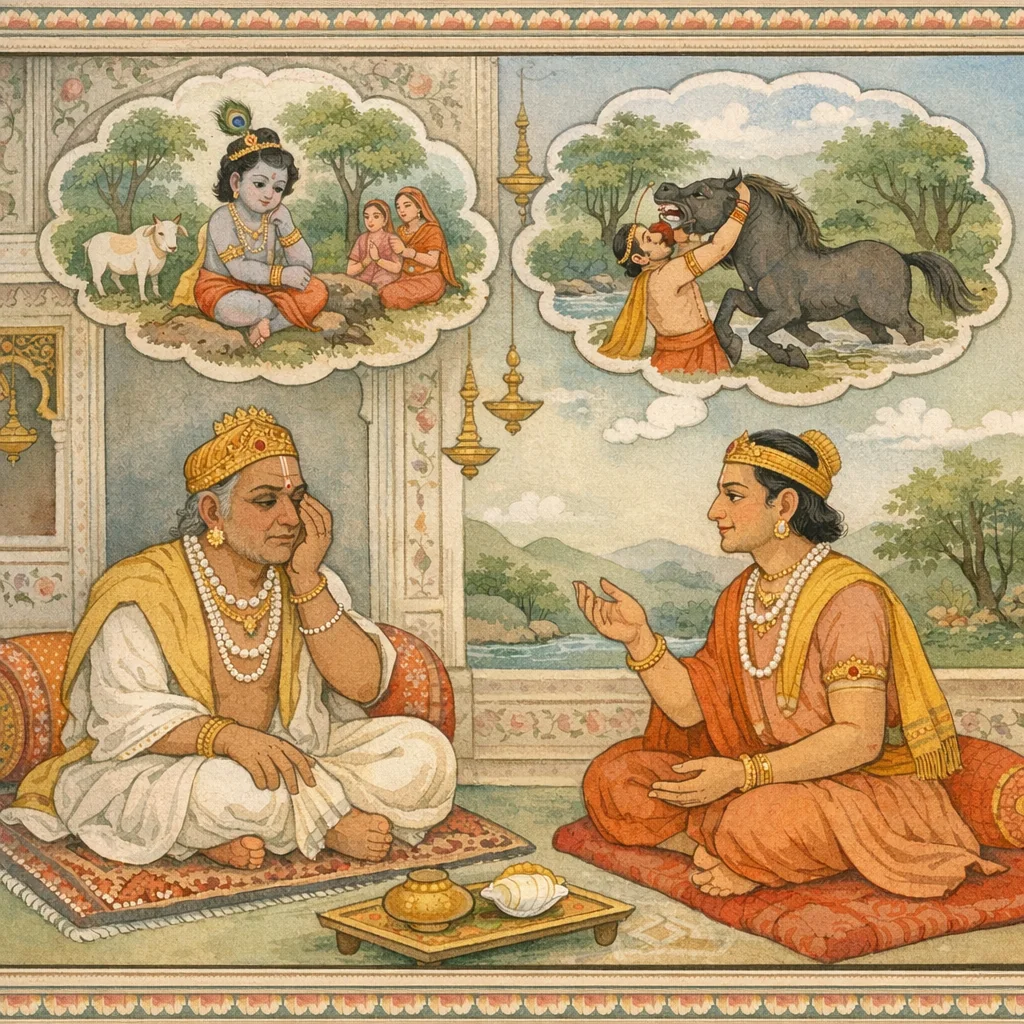
Adhyaya 11
Droṇa’s Conditional Boon: The Plan to Capture Yudhiṣṭhira (द्रोणेन युधिष्ठिरग्रहणोपायः)
Upa-parva: Droṇābhiṣeka (Droṇa’s appointment as commander) — strategic objective of capturing Yudhiṣṭhira
Sañjaya reports to Dhṛtarāṣṭra the circumstances surrounding Droṇa’s rise to commander and the strategic deliberation that follows. Droṇa, honored with senāpati authority, offers Duryodhana a boon commensurate with the honor received. Duryodhana, consulting with allies, requests that Yudhiṣṭhira be brought alive. Droṇa interrogates the rationale—why capture rather than kill—implicitly acknowledging Yudhiṣṭhira’s reputation for non-hostility (ajātaśatru) and the political value of preserving a rival for negotiation or control. Duryodhana reveals a pragmatic calculus: killing Yudhiṣṭhira would provoke Arjuna into decisive retaliation, whereas capturing him could force a settlement or renewed exile through oath-bound mechanisms. Droṇa, recognizing the strategic intent, grants a conditional promise: Yudhiṣṭhira can be seized only if Arjuna is diverted from the field or separated from protective proximity. The chapter ends with Sañjaya noting that Duryodhana publicizes this objective across the army positions to reinforce resolve, despite the condition that makes the plan operationally complex.
Chapter Arc: धृतराष्ट्र, युद्ध-समाचार सुनते-सुनते, संजय से कहते हैं—अब मुझे बताओ: वह कौन-सा बल है जिसके सहारे पाण्डवों की आशा बढ़ती जाती है? और क्यों कौरवों की विजय किसी उपाय से दिखाई नहीं देती? → संजय धृतराष्ट्र के भय और जिज्ञासा को शांत करने के लिए श्रीकृष्ण की संक्षिप्त लीलाओं का स्मरण कराते हैं—गोपकुल में बाल्यकाल से ही उनकी अद्भुत शक्ति, यमुना-वन में अश्वराज का वध, और दूर-दूर के प्रदेशों (अवन्ती, दाक्षिणात्य, पर्वतीय, दशेरक, काश्मीरक, पिशाच, समुद्गल आदि) पर उनके प्रभाव/विजय का वर्णन। साथ ही अर्जुन की अपराजेयता और केशव के अमेय गुणों का प्रतिपादन होता है। → धृतराष्ट्र का निष्कर्ष कठोर होकर फूट पड़ता है—“किसी भी उपाय से कुरुओं की जय नहीं दिखती; हृषीकेश के कर्मों का अंत बुद्धि-पराक्रम से भी नहीं जाना जा सकता।” इसी बोध के साथ पराजय का छाया-निर्णय अध्याय का शिखर बनता है। → वृत्तांत युद्ध-रणनीति से अधिक ‘कारण’ पर टिकता है: कृष्ण-अर्जुन की महिमा के सामने कौरव-पक्ष की आशा क्षीण पड़ती है। धृतराष्ट्र के भीतर आत्मस्वीकृति उभरती है कि विनाश का बीज उनके ही पक्ष के अहं/द्वेष में था, और जो काल से परिपक्व है उसका वध तिनके से भी हो जाता है। → धृतराष्ट्र संजय से आग्रह करते हैं कि अब युद्ध का यथार्थ क्रम बताओ—आगे रणभूमि में क्या घटा, किस प्रकार घटनाएँ दैवयोग से ‘अन्यथा’ हो रही हैं?
Shlokas
Verse 1
भीकम (2 अमान एकादशोब< ध्याय: धृतराष्ट्रका भगवान् श्रीकृष्णकी संक्षिप्त लीलाओंका वर्णन करते हुए श्रीकृष्ण और अर्जुनकी महिमा बताना धृतराष्ट्र रवाच शृणु दिव्यानि कर्माणि वासुदेवस्य संजय । कृतवान् यानि गोविन्दो यथा नान्य: पुमान् क्वचित्,धृतराष्ट्र बोले--संजय! वसुदेवनन्दन भगवान् श्रीकृष्णके दिव्य कर्मोंका वर्णन सुनो। भगवान् गोविन्दने जो-जो कार्य किये हैं, वैसा दूसरा कोई पुरुष कदापि नहीं कर सकता
Dhṛtarāṣṭra said: “Sañjaya, recount for me the divine deeds of Vāsudeva. The acts that Govinda has accomplished are such as no other man anywhere could perform.” In the midst of war and moral crisis, the blind king turns from mere strategy to the extraordinary agency of Kṛṣṇa, implicitly acknowledging a power that surpasses ordinary human capacity and thus reframes the conflict in terms of providence and dharma.
Verse 2
संवर्धता गोपकुले बालेनैव महात्मना । विख्यापितं बल बाद्दोस्त्रिषु लोकेषु संजय,संजय! बाल्यावस्थामें ही जब कि वे गोपकुलमें पल रहे थे, महात्मा श्रीकृष्णने अपनी भुजाओंके बल और पराक्रमको तीनों लोकोंमें विख्यात कर दिया
Vaiśampāyana said: While that great-souled one was still growing up among the cowherd community, even in his very childhood he made the strength of his arms and his heroic prowess renowned throughout the three worlds, O Sañjaya. The verse underscores how innate power, when aligned with a noble purpose, becomes a source of protection and moral confidence for society.
Verse 3
उच्चै:श्रवस्तुल्यबलं वायुवेगसमं जवे । जघान हयराजं तं यमुनावनवासिनम्,यमुनाके तटवर्ती वनमें उच्चै:श्रवाकें समान बलशाली और वायुके समान वेगवान् अश्वराज केशी रहता था। उसे श्रीकृष्णने मार डाला
Vaiśampāyana said: In the forest by the banks of the Yamunā there lived the horse-king Keśī—mighty like Uccaiḥśravas and swift as the wind. Śrī Kṛṣṇa struck down that formidable creature, removing a violent threat and restoring safety to the region.
Verse 4
दानवं घोरकर्माणं गवां मृत्युमिवोत्थितम् । वृषरूपधरं बाल्ये भुजाभ्यां निजघान ह,इसी प्रकार एक भयंकर कर्म करनेवाला दानव वहाँ बैलका रूप धारण करके रहता था, जो गौओंके लिये मृत्युके समान प्रकट हुआ था। उसे भी श्रीकृष्णने बाल्यावस्थामें अपने हाथोंसे ही मार डाला
Verse 5
प्रलम्बं नरकं जम्भं पीठं चापि महासुरम् | मुरं चान्तकसंकाशमवधीत् पुष्करेक्षण:,तत्पश्चात् कमलनयन श्रीकृष्णने प्रलम्ब, नरकासुर, जम्भासुर, पीठ नामक महान् असुर और यमराजसदृश मुरका भी संहार किया
Vaiśampāyana said: Then Puṣkarekṣaṇa (Śrī Kṛṣṇa, the lotus-eyed one) slew Pralamba, Naraka, Jambha, and the great demon named Pīṭha, and also Mura, who was terrible like Antaka (Death). The verse recalls Kṛṣṇa’s earlier destruction of oppressive asuras, underscoring the ethical idea that divine power is exercised to remove violent tyranny and protect the moral order.
Verse 6
तथा कंसो महातेजा जरासंधेन पालित: । विक्रमेणैव कृष्णेन सगण: पातितो रणे,इसी प्रकार श्रीकृष्णने पराक्रम करके ही जरासंधके द्वारा सुरक्षित महातेजस्वी कंसको उसके गणोंसहित रणभूमिमें मार गिराया
Vaiśampāyana said: “In the same way, the mighty and radiant Kaṁsa—though protected by Jarāsandha—was nevertheless struck down in battle by Kṛṣṇa through sheer valor, along with his followers. The point is clear: when adharma is upheld by power and alliances, it is still vulnerable before righteous strength and resolute action.”
Verse 7
सुनामा रणविक्रान्त: समग्राक्षीहिणीपति: । भोजराजस्य मध्यस्थो भ्राता कंसस्य वीर्यवान्
Vaiśampāyana said: “There was Sunāmā—valiant in battle, commander of a complete army-division, a trusted intermediary of the Bhoja king, and the mighty brother of Kaṁsa.”
Verse 8
बलदेवद्वितीयेन कृष्णेनामित्रघातिना । तरस्वी समरे दग्ध: ससैन्य: शूरसेनराट्
Vaiśampāyana said: Accompanied by Baladeva, Kṛṣṇa—the slayer of foes—burned with irresistible might in the battle; and the king of the Śūrasenas, together with his army, was consumed. The verse underscores how martial power, when allied with a formidable protector and directed by a relentless warrior, can annihilate not only an individual ruler but also the collective force that sustains him—raising the ethical tension between heroic prowess and the devastation it brings.
Verse 9
शत्रुहन्ता श्रीकृष्णने बलरामजीके साथ जाकर युद्धमें पराक्रम दिखानेवाले, बलवान, वेगवान्, सम्पूर्ण अक्षौहिणी सेनाओंके अधिपति, भोजराज कंसके मझले भाई शूरसेन देशके राजा सुनामाको समरमें सेनासहित दग्ध कर डाला ।। दुर्वासा नाम विप्रर्षिस्तथा परमकोपन: । आराधित: सदारेण स चास्मै प्रददौ वरान्,पत्नीसहित श्रीकृष्णने परम क्रोधी ब्रह्मर्षि दुर्वासाकी आराधना की। अतः उन्होंने प्रसन्न होकर उन्हें बहुत-से वर दिये
Vaiśampāyana said: Kṛṣṇa, the slayer of enemies, went together with Balarāma and displayed prowess in battle. In the fight he burned down, along with his forces, the powerful and swift king Sunāmā—lord of entire akṣauhiṇī armies—who was the middle brother of the Bhoja king Kaṁsa and ruler in the Śūrasena country. Likewise, the brahmarṣi Durvāsā, a seer-priest of exceedingly fierce temper, was worshipfully served by Kṛṣṇa together with his wife; pleased, he granted him many boons. Ethically, the passage juxtaposes martial might with disciplined reverence: victory in war is paired with humility before spiritual power and the duty of honoring ascetics.
Verse 10
तथा गान्धारराजस्य सुतां वीर: स्वयंवरे । निर्जित्य पृथिवीपालानावहत् पुष्करेक्षण:,कमलनयन वीर श्रीकृष्णने स्वयंवरमें गान्धारराजकी पुत्रीको प्राप्त करके समस्त राजाओंको जीतकर उसके साथ विवाह किया। उस समय अच्छी जातिके घोड़ोंकी भाँति श्रीकृष्णके वैवाहिक रथमें जुते हुए वे असहिष्णु राजालोग कोड़ोंकी मारसे घायल कर दिये गये थे
Vaiśaṃpāyana said: In the svayaṃvara of the king of Gāndhāra, the heroic Puṣkarekṣaṇa won the king’s daughter; having defeated the assembled rulers, he carried her away as his bride. The episode underscores the royal code of contest and conquest in marriage-rites, where prowess and public victory are treated as the warrant for a union, even as it exposes the tension between personal choice and the coercive force of kṣatriya competition.
Verse 11
अमृष्यमाणा राजानो यस्य जात्या हया इव | रथे वैवाहिके युक्ता: प्रतोदेन कृतव्रणा:,कमलनयन वीर श्रीकृष्णने स्वयंवरमें गान्धारराजकी पुत्रीको प्राप्त करके समस्त राजाओंको जीतकर उसके साथ विवाह किया। उस समय अच्छी जातिके घोड़ोंकी भाँति श्रीकृष्णके वैवाहिक रथमें जुते हुए वे असहिष्णु राजालोग कोड़ोंकी मारसे घायल कर दिये गये थे इति श्रीमहाभारते द्रोणपर्वणि द्रोणाभिषेकपर्वणि धृतराष्ट्रविलापे एकादशो<ध्याय:
Vaiśampāyana said: The kings, unable to bear the humiliation, were like well-bred horses by nature—yoked to his wedding chariot and left wounded by the lash of the goad. The verse evokes the ethical tension between royal pride and the force used to subdue rivals in the pursuit of marriage and political victory, foreshadowing how wounded honor fuels later enmity and war.
Verse 12
जरासंध॑ महाबाहुमुपायेन जनार्दन: । परेण घातयामास समग्राक्षीहिणीपतिम्,जनार्दन श्रीकृष्णने समस्त अक्षौहिणी सेनाओंके अधिपति महाबाहु जरासंधको उपायपूर्वक दूसरे योद्धा (भीमसेन)-के द्वारा मरवा दिया
Vaiśampāyana said: Janārdana (Kṛṣṇa), employing a strategic means rather than direct force, caused the mighty-armed Jarāsandha—lord of a complete akṣauhiṇī—to be slain by another warrior (Bhīmasena). The line underscores that in epic politics and warfare, outcomes are often secured through prudent strategy, raising ethical questions about means and ends even when confronting a formidable, oppressive power.
Verse 13
चेदिराजं च विक्रान्तं राजसेनापतिं बली । अर्घ्ये विवदमानं च जघान पशुवत् तदा,बलवान् श्रीकृष्णने राजाओंकी सेनाके अधिपति पराक्रमी चेदिराज शिशुपालको अग्रपूजनके समय विवाद करनेके कारण पशुकी भाँति मार डाला
Vaiśampāyana said: At that time the mighty Śrī Kṛṣṇa struck down the valiant king of Cedi—Śiśupāla, commander of the royal host—because he raised a quarrel during the rite of offering arghya (the honor of first worship), killing him like a beast. The episode frames a moral warning: public insult and disruptive pride in a sacred assembly invite swift retribution, and the protection of rightful honor is upheld even through severe punishment.
Verse 14
सौभ दैत्यपुरं खस्थं शाल्वगुप्तं दुरासदम् । समुद्रकुक्षौ विक्रम्य पातयामास माधव:
Vaiśampāyana said: Madhava (Kṛṣṇa), after advancing into the very bosom of the sea, brought down Saubha—the aerial stronghold of the Dānavas—well-guarded by Śālva and exceedingly hard to assail. The episode underscores that even seemingly invincible power, when rooted in adharma and oppression, is ultimately checked by resolute, righteous force.
Verse 15
तत्पश्चात् माधवने आकाशमें स्थित रहनेवाले सौभ नामक दुर्धर्ष दैत्य-नगरको, जो राजा शाल्दद्वारा सुरक्षित था, समुद्रके बीच पराक्रम करके मार गिराया ।। अड्डान् वज़ान् कलिज्रांश्न मागधान् काशिकोसलान् | वात्स्यगार्ग्यकरूषांश्व॒ पौण्डरांशक्राप्पजयद् रणे,उन्होंने रणक्षेत्रमें अंग, वंग, कलिंग, मगध, काशि, कोसल, वत्स, गर्ग, करूष तथा पौण्ड़र आदि देशोंपर विजय पायी थी
Then, thereafter, Mādhava (Kṛṣṇa) by his prowess struck down in the midst of the sea the formidable demon-city named Saubha, which was stationed in the sky and protected by King Śālva. In battle he also overcame the peoples of Aṅga, Vaṅga, Kaliṅga, Magadha, Kāśī and Kosala, as well as the Vatsas, the Gārgyas, the Karūṣas, and the Pauṇḍras—an account that underscores how power, when aligned with rightful purpose, can dismantle even seemingly invincible strongholds.
Verse 16
आन्न्त्यान् दाक्षिणात्यांश्न॒ पर्वतीयान् दशेरकान् । काश्मीरकानौरसिकान् पिशाचांश्व समुद्गलान्,संजय! इसी प्रकार कमलनयन श्रीकृष्णने अवन्ती, दक्षिण प्रान्त, पर्वतीय देश, दशेरक, काश्मीर, औरसिक, पिशाच, मुद्गल, काम्बोज, वाटधान, चोल, पाण्डब, त्रिगर्त, मालव, अत्यन्त दुर्जय दरद आदि देशोंके योद्धाओंको तथा नाना दिशाओंसे आये हुए खशों, शकों और अनुयायियों-सहित कालयवनको भी जीत लिया
Vaiśaṃpāyana said: “O Sañjaya, he (Śrī Kṛṣṇa), the lotus-eyed one, subdued many frontier and regional peoples—those of Ānantya, the southern lands, the mountain tracts, the Daśerakas, the Kāśmīras, the Aurasikas, the Piśācas, and the Mudgalas.” In context, the verse functions as a catalogue of conquered regions, underscoring Kṛṣṇa’s political and military ascendancy and the ethical idea that power, when aligned with righteous purpose, can establish order across diverse and often turbulent frontiers.
Verse 17
काम्बोजान् वाटधानांश्व चोलान् पाण्ड्यांश्व॒ संजय । त्रिगर्तान् मालवांश्वैव दरदांश्व॒ सुदुर्जयान्,संजय! इसी प्रकार कमलनयन श्रीकृष्णने अवन्ती, दक्षिण प्रान्त, पर्वतीय देश, दशेरक, काश्मीर, औरसिक, पिशाच, मुद्गल, काम्बोज, वाटधान, चोल, पाण्डब, त्रिगर्त, मालव, अत्यन्त दुर्जय दरद आदि देशोंके योद्धाओंको तथा नाना दिशाओंसे आये हुए खशों, शकों और अनुयायियों-सहित कालयवनको भी जीत लिया
Vaiśampāyana said: “O Sañjaya, (he subdued) the Kāmbojas and the Vāṭadhānas, the Coḷas and the Pāṇḍyas; the Trigartas and the Mālavas as well, and the Daradas—peoples exceedingly hard to conquer.” The verse continues the account of Kṛṣṇa’s wide-ranging victories, portraying the consolidation of power across many regions as a prelude to the larger moral and political conflicts of the epic.
Verse 18
नानादिग्भ्यश्न सम्प्राप्तान् खशांश्चैव शकांस्तथा । जितवान् पुण्डरीकाक्षो यवनं च सहानुगम्,संजय! इसी प्रकार कमलनयन श्रीकृष्णने अवन्ती, दक्षिण प्रान्त, पर्वतीय देश, दशेरक, काश्मीर, औरसिक, पिशाच, मुद्गल, काम्बोज, वाटधान, चोल, पाण्डब, त्रिगर्त, मालव, अत्यन्त दुर्जय दरद आदि देशोंके योद्धाओंको तथा नाना दिशाओंसे आये हुए खशों, शकों और अनुयायियों-सहित कालयवनको भी जीत लिया
Vaiśampāyana said: O Sañjaya, the lotus-eyed Śrī Kṛṣṇa conquered warriors who had come from many directions—among them the Khaśas and the Śakas—and he also subdued the Yavanas together with their followers. The verse underscores Kṛṣṇa’s role as a protector and unifier: his victories are presented not as mere conquest, but as the establishment of order by overcoming disruptive forces and bringing diverse peoples under a single, stabilizing authority.
Verse 19
प्रविश्य मकरावासं यादोगणनिषेवितम् । जिगाय वरुणं संख्ये सलिलान्तर्गतं पुरा,पूर्वकालमें श्रीकृष्णने जल-जन्तुओंसे भरे हुए समुद्रमें प्रवेश करके जलके भीतर निवास करनेवाले वरुण देवताको युद्धमें परास्त किया
Vaiśampāyana said: In former times, Śrī Kṛṣṇa entered the ocean—home of makaras and frequented by hosts of aquatic beings—and there, within the waters, he defeated Varuṇa in battle. The narration underscores Kṛṣṇa’s unsurpassed prowess even in domains ruled by other deities, presenting his victory as a demonstration of divine authority rather than mere aggression.
Verse 20
युधि पञ्चजन हत्वा दैत्यं पातालवासिनम् | पाज्चजन्यं हृषीकेशो दिव्यं शड्खमवाप्तवान्
Vaiśampāyana said: In battle, after slaying the demon Pañcajana who dwelt in the netherworld, Hṛṣīkeśa (Kṛṣṇa) obtained the divine conch named Pāñcajanya. The episode underscores that divine insignia are not mere ornaments: they are earned through the overcoming of destructive forces and become instruments that rally the righteous in war.
Verse 21
इसी प्रकार हृषीकेशने पाताल-निवासी पंचजन नामक दैत्यको युद्धमें मारकर दिव्य पाज्चजन्य शंख प्राप्त किया ।। खाण्डवे पार्थसहितस्तोषयित्वा हुताशनम् । आग्नेयमस्त्रं दुर्धर्ष चक्र लेभे महाबल:,खाण्डव वनमें अर्जुनके साथ अग्निदेवको संतुष्ट करके महाबली श्रीकृष्णने दुर्धर्ष आग्नेय अस्त्र चक्रको प्राप्त किया था
Vaiśampāyana said: In the Khāṇḍava forest, the mighty Hṛṣīkeśa (Kṛṣṇa), together with Pārtha (Arjuna), pleased the Fire-god. Having satisfied Agni, he obtained the formidable Agneya weapon in the form of the discus. In the same manner, he had earlier slain in battle the underworld-dwelling demon named Pañcajana and thereby acquired the divine conch called Pāñcajanya. The passage underscores that divine weapons and emblems are not mere ornaments of war but are gained through decisive action aligned with cosmic order—protecting the world and supporting righteous allies.
Verse 22
वैनतेयं समारुह्य त्रासयित्वामरावतीम् | महेन्द्रभवनाद् वीर: पारिजातमुपानयत्,वीर श्रीकृष्ण गरुड़पर आरूढ़ हो अमरावती पुरीमें जाकर वहाँके निवासियोंको भयभीत करके महेन्द्रभवनसे पारिजात वृक्ष उठा ले आये
Vaiśampāyana said: Mounting Vainateya (Garuḍa), the heroic one went to Amarāvatī and struck fear among its inhabitants; from Mahendra’s palace he brought away the Pārijāta tree. The episode recalls Kṛṣṇa’s extraordinary power and resolve, and also raises an ethical tension: even a righteous purpose can involve coercion when confronting divine authority and possession.
Verse 23
तच्च मर्षितवान् शक्रो जानंस्तस्य पराक्रमम् | राज्ञां चाप्यजितं कज्चित् कृष्णेनेह न शुश्रुम,उनके पराक्रमको इन्द्र अच्छी तरह जानते थे, इसलिये उन्होंने वह सब चुपचाप सह लिया। राजाओंमेंसे किसीको भी मैंने ऐसा नहीं सुना है, जिसे श्रीकृष्णने जीत न लिया हो
Verse 24
यच्च तन्महदाक्षर्य सभायां मम संजय । कृतवान् पुण्डरीकाक्ष: कस्तदन्य इहाहति,संजय! उस दिन मेरी सभामें कमलनयन श्रीकृष्णने जो महान् आश्चर्य प्रकट किया था, उसे इस संसारमें उनके सिवा दूसरा कौन कर सकता है?
Vaiśampāyana said: “O Sañjaya, that great marvel which the lotus-eyed Kṛṣṇa displayed in my royal assembly—who else in this world could accomplish such a deed? By recalling it, one recognizes that extraordinary power and moral authority belong uniquely to him.”
Verse 25
यच्च भकक्त्या प्रसन्नो5हमद्राक्ष॑ कृष्णमी श्वरम् । तन्मे सुविदितं सर्व प्रत्यक्षमिव चागमम्,मैंने प्रसन्न होकर भक्तिभावसे भगवान् श्रीकृष्णके उस ईश्वरीय रूपका जो दर्शन किया, वह सब मुझे आज भी अच्छी तरह स्मरण है। मैंने उन्हें प्रत्यक्षकी भाँति जान लिया था
Verse 26
नान्तो विक्रमयुक्तस्य बुद्धया युक्तस्य वा पुनः । कर्मणां शक््यते गन्तुं हृषीकेशस्थ संजय,संजय! बुद्धि और पराक्रमसे युक्त भगवान् हृषीकेशके कर्मोका अन्त नहीं जाना जा सकता
Vaiśampāyana said: “O Sañjaya—Sañjaya!—the deeds of Hṛṣīkeśa cannot be traced to their end. Whether one relies on valor or on keen intelligence, no one can fully comprehend the limit of His actions.”
Verse 27
तथा गदश्न साम्बश्न प्रद्युम्नोडथ विदूरथ: । अगावहोडनिरुद्धश्ष चारुदेष्ण: ससारण:
Vaiśampāyana said: Likewise, Gada and Sāmba, and then Pradyumna and Vidūratha; Agāvaha, Aniruddha, and Cārudeṣṇa together with Sāraṇa—these warriors too were present/arrayed in that unfolding war narrative, indicating the widening involvement of the Vṛṣṇi–Yādava line and their allies in the conflict.
Verse 28
उल्मुको निशठश्वैव झिल्ली बश्रुश्न वीर्यवान् पृथुश्न विपृथुश्नमेव शमीको5थारिमेजय:
Vaiśampāyana said: Ulmuka, Niṣaṭha, and also Jhillī; Baśruśna the mighty; Pṛthuśna and Vipṛthuśna; and then Śamīka and Arimejaya—these (persons) are being enumerated in sequence, as part of the genealogical and narrative record that frames the unfolding events of the war.
Verse 29
एते<न्ये बलवन्तश्न वृष्णिवीरा: प्रहारिण: । कथंचित् पाण्डवानीकं श्रयेयु: समरे स्थिता:
Vaiśampāyana said: “These others too—mighty, battle-hardened heroes of the Vṛṣṇis, skilled in striking—might, once they have taken their stand in the fight, somehow find refuge by joining the Pāṇḍava host.”
Verse 30
आहूता वृष्णिवीरेण केशवेन महात्मना | ततः संशयितं सर्व भवेदिति मतिर्मम
Vaiśampāyana said: “When I was summoned by Keśava—the great-souled hero of the Vṛṣṇis—my mind concluded that everything thereafter would become uncertain and fraught with doubt.”
Verse 31
वनमाला और हल धारण करनेवाले वीर बलराम कैलास-शिखरके समान गौरवर्ण हैं। उनमें दस हजार हाथियोंका बल है। वे भी उसी पक्षमें रहेंगे, जहाँ श्रीकृष्ण हैं
Vaiśampāyana said: The heroic Balarāma—adorned with a forest-garland and bearing the plough—shines with a fair radiance like the peak of Mount Kailāsa. Possessing the strength of ten thousand elephants, he too will stand on that very side where Śrī Kṛṣṇa is, indicating that allegiance is guided not merely by force but by righteous affinity and trust in Kṛṣṇa’s counsel.
Verse 32
यमाहु: सर्वपितरं वासुदेव॑ द्विजातय: । अपि वा होष पाण्डूनां योत्स्यते<र्थाय संजय
Vaiśampāyana said: “The twice-born declare Vāsudeva to be the universal Father of all. Or else, O Saṃjaya, he will fight for the sake of the Pāṇḍavas.”
Verse 33
संजय! जिन भगवान् वासुदेवको द्विजगण सबका पिता बताते हैं, क्या वे पाण्डवोंके लिये स्वयं युद्ध करेंगे? ।। स यदा तात संनहोत् पाण्डवार्थाय संजय । न तदा प्रतिसंयोद्धा भविता तत्र कश्षन,तात! संजय! जब पाण्डवोंके लिये श्रीकृष्ण कवच बाँधकर युद्धके लिये तैयार हो जाय, उस समय वहाँ कोई भी योद्धा उनका सामना करनेको तैयार न होगा
Vaiśampāyana said: “Sañjaya, the Brahmin sages proclaim that blessed Vāsudeva is the father of all. If he were to take up arms for the sake of the Pāṇḍavas, would he himself fight? For, dear Sañjaya, when Kṛṣṇa arms himself and prepares for battle on the Pāṇḍavas’ behalf, then no warrior there would be able—or willing—to stand against him.”
Verse 34
यदि सम कुरव: सर्वे जयेयुर्नाम पाण्डवान् | वार्ष्णेयो<र्थाय तेषां वै गृह्नीयाच्छस्त्रमुत्तमम्,यदि सब कौरव पाण्डवोंको जीत लें तो वृष्णिवंशभूषण भगवान् श्रीकृष्ण उनके हितके लिये अवश्य उत्तम शस्त्र ग्रहण कर लेंगे
Vaiśampāyana said: “Even if all the Kauravas were to overcome the Pāṇḍavas, the Vārṣṇeya (Kṛṣṇa), for their welfare, would certainly take up the finest weapon.”
Verse 35
ततः सर्वान् नरव्याप्रो हत्वा नरपतीन् रणे | कौरवांश्व महाबाहु: कुन्त्यै दद्यात् स मेदिनीम्,उस दशामें पुरुषसिंह महाबाहु श्रीकृष्ण सब राजाओं तथा कौरवोंको रणभूमिमें मारकर सारी पृथ्वी कुन्तीको दे देंगे
Vaiśampāyana said: “Then that lion among men, the mighty-armed one, having slain in battle all the kings and the Kauravas, would bestow this entire earth upon Kuntī.” The line frames victory not as personal possession but as a transfer of sovereignty, highlighting the political-ethical idea that conquest is ultimately meant to restore rightful order and honor obligations to elders and lineage.
Verse 36
यस्य यन्ता हृषीकेशो योद्धा यस्य धनंजय: । रथस्य तस्य कः संख्ये प्रत्यनीको भवेद् रथ:,जिसके सारथि सम्पूर्ण इन्द्रियोंके नियन्ता श्रीकृष्ण तथा योद्धा अर्जुन हैं, रणभूमिमें उस रथका सामना करनेवाला दूसरा कौन रथ होगा?
Vaiśampāyana said: “For that chariot whose charioteer is Hṛṣīkeśa (Kṛṣṇa), the master of the senses, and whose warrior is Dhanaṃjaya (Arjuna), what other chariot in battle could ever stand as its opposing counterpart?”
Verse 37
न केनचिदुपायेन कुरूणां दृश्यते जय: । तस्मान्मे सर्वमाचक्ष्व यथा युद्धमवर्तत,किसी भी उपायसे कौरवोंकी जय होती नहीं दिखायी देती। इसलिये तुम मुझसे सब समाचार कहो। वह युद्ध किस प्रकार हुआ?
Vaiśampāyana said: 'By no stratagem does victory for the Kurus appear possible. Therefore, tell me everything in full—how did that battle unfold?'
Verse 38
अर्जुन: केशवस्यात्मा कृष्णो5प्यात्मा किरीटिन: । अर्जुने विजयो नित्यं कृष्णे कीर्तिश्व शाश्वती,अर्जुन श्रीकृष्णके आत्मा हैं और श्रीकृष्ण किरीटधारी अर्जुनके आत्मा हैं। अर्जुनमें विजय नित्य विद्यमान है और श्रीकृष्णमें कीर्तिका सनातन निवास है
Vaiśaṃpāyana said: Arjuna is, as it were, the very self of Keśava, and Kṛṣṇa likewise is the very self of the diadem-wearing Arjuna. In Arjuna, victory abides unfailingly; in Kṛṣṇa, imperishable fame has its eternal dwelling. The statement frames their alliance as a moral and strategic unity: where righteous resolve and skill stand with divine wisdom and renown, success and lasting glory naturally follow.
Verse 39
सर्वेष्वपि च लोकेषु बीभत्सुरपराजित: । प्राधान्येनेव भूयिष्ठममेया: केशवे गुणा:,अर्जुन सम्पूर्ण लोकोंमें कभी कहीं भी पराजित नहीं हुए हैं। श्रीकृष्णमें असंख्य गुण हैं। यहाँ प्राय: प्रधान गुणके नाम लिये गये हैं
Vaiśampāyana said: In all the worlds, Bībhatsu (Arjuna) has never been defeated anywhere. In Keśava (Śrī Kṛṣṇa) the virtues are immeasurable; here, as it were, only the foremost among them are being named—those principal qualities by which he upholds righteousness and guides others amid the turmoil of war.
Verse 40
मोहाद् दुर्योधन: कृष्णं यो न वेत्तीह केशवम् | मोहितो दैवयोगेन मृत्युपाशपुरस्कृत:,दुर्योधन मोहवश सच्चिदानन्दस्वरूप भगवान् केशवको नहीं जानता है, वह दैवयोगसे मोहित हो मौतके फंदेमें फँस गया
Vaiśampāyana said: Blinded by delusion, Duryodhana does not recognize Kṛṣṇa here—Keśava as he truly is. Bewildered by the workings of fate, he moves forward with the noose of death set before him, unable to discern the righteous path or the power of the Lord who stands near.
Verse 41
न वेद कृष्णं दाशार्हमर्जुनं चैव पाण्डवम् । पूर्वदेवी महात्मानौ नरनारायणावुभौ
Vaiśampāyana said: She did not recognize Kṛṣṇa of the Dāśārha line, nor Arjuna the Pāṇḍava—those two great-souled ones who, in former times, were the divine pair Nara and Nārāyaṇa. The narration underscores how the same eternal righteousness can appear in new forms, and how ignorance of true identity can veil the presence of dharma even when it stands before one’s eyes.
Verse 42
यह दशा्कुलभूषण श्रीकृष्ण और पाण्डुपुत्र अर्जुनको नहीं जानता है, वे दोनों पूर्वदेवता महात्मा नर और नारायण हैं ।। एकात्मानौ द्विधाभूतौ दृश्येते मानवैर्भुवि । मनसा5पि हि दुर्धर्षा सेनामेतां यशस्विनौ
Vaiśampāyana said: Whoever fails to recognize Śrī Kṛṣṇa—the ornament of the Yadu line—and Arjuna, the son of Pāṇḍu, does not know their true nature. Those two are the ancient divine beings, the great-souled Nara and Nārāyaṇa. Though one in essence, they appear on earth to human eyes as two; and even by mere will they are irresistible—those illustrious ones—against this entire army.
Verse 43
युगस्येव विपर्यासो लोकानामिव मोहनम्
Vaiśampāyana said: “It was as though the very order of the age had been overturned—an enchantment that bewildered the people. In that moment, what should have been clear became confused, and the world seemed seized by delusion, as if righteousness and right judgment were eclipsed by the upheaval of war.”
Verse 44
न होव ब्रह्मचर्येण न वेदाध्यपयनेन च
Vaiśampāyana said: “Not by the observance of brahmacarya, nor even by the teaching of the Vedas…” (the statement continues), indicating that mere ascetic discipline or scholastic authority alone is insufficient to secure the intended moral or spiritual outcome; the narrative frames a critique of relying solely on external religious credentials without the deeper qualities or conduct demanded by dharma.
Verse 45
लोकसम्भावितौ वीरीौ कृतास्त्रौ युद्धदुर्मदौ
Vaiśampāyana said: The two heroes, celebrated and esteemed by the world, were fully trained in the use of weapons and, intoxicated with the arrogance that battle can breed, were fierce and hard to restrain in war.
Verse 46
यां तां श्रियमसूयाम: पुरा दृष्टवा युधिषछ्टिरे
Vaiśampāyana said: “O Yudhiṣṭhira, that very prosperity and splendor which we once beheld and even begrudged—”
Verse 47
मत्कृते चाप्यनुप्राप्त: कुरूणामेष संक्षय:
Vaiśampāyana said: “And for my sake as well, this destruction of the Kurus has come to pass.” The line underscores the moral weight of personal agency in war—how attachment, loyalty, or a single person’s cause can be invoked to explain (or justify) a vast collective ruin.
Verse 48
अनन्तमिदमैश्वर्य लोके प्राप्तो युधिष्ठिर:
Vaiśampāyana said: “Yudhiṣṭhira has attained in this world a boundless sovereignty (and splendor).” The line underscores the vast, almost immeasurable reach of royal power and fortune that has come to him—an achievement that, in the Mahābhārata’s ethical frame, also carries the weight of responsibility and the moral burden of how such power is gained and used amid war.
Verse 49
यस्य कोपान्महात्मानौ भीष्मद्रोणौ निपातितौ । युधिष्ठिर इस संसारमें अनन्त ऐश्वर्यके भागी हुए हैं। जिनके कोपसे महात्मा भीष्म और द्रोण मार गिराये गये ।। प्राप्त: प्रकृतितो धर्मो न धर्मो मामकान् प्रति
Vaiśampāyana said: By whose wrath the great-souled Bhīṣma and Droṇa were brought down, that very Yudhiṣṭhira becomes a sharer of unending sovereignty in this world. Yet the dharma that arises naturally and is truly obtained is not found in relation to my own (kinsmen); in the heat of this war, righteousness does not stand on the side of partiality.
Verse 50
क्रूर: सर्वविनाशाय कालो5सौ नातिवर्तते । युधिष्ठटिरको धर्मका स्वाभाविक फल प्राप्त हुआ है, किंतु मेरे पुत्रोंकी उसका फल नहीं मिल रहा है। सबका विनाश करनेके लिये प्राप्त हुआ यह क्रूर काल बीत नहीं रहा है ।। अन्यथा चिन्तिता हार्था नरैस्तात मनस्विभि:
Vaiśampāyana said: “This ruthless Time, arrived to bring about universal destruction, does not pass. Yudhiṣṭhira—steadfast in dharma—has obtained the natural fruit of righteousness; yet my sons do not receive its reward. This cruel Time, come to annihilate all, will not move on. Otherwise, dear one, the outcomes envisioned by high-minded men would have turned out differently.”
Verse 51
तस्मादपरिहार्ये<र्थे सम्प्राप्ते कृच्छू उत्तमे । अपारणीये दुश्निन्त्ये यथाभूत॑ प्रचक्ष्य मे,अतः इस अनिवार्य, अपार, दुश्निन्त्य एवं महान् संकटके प्राप्त होनेपर जो घटना जिस प्रकार हुई हो, वह मुझे बताओ
Therefore, since an unavoidable matter has arisen—an extreme crisis, immeasurable and hard to fathom—tell me exactly how the events occurred, as they truly happened. The request underscores a commitment to truthful narration even when the situation is ethically and emotionally grave.
Verse 331
यदि गद, साम्ब, प्रद्युम्न, विदूरथ, अगावह, अनिरुद्ध, चारुदेष्ण, सारण, उल्मुक, निशठ, झिल्ली, पराक्रमी बश्रु, पृथु, विपृथु, शमीक तथा अरिमेजय--ये तथा दूसरे भी बलवान एवं प्रहारकुशल वृष्णिवंशी योद्धा वृष्णिवंशके प्रमुख वीर महात्मा केशवके बुलानेपर पाण्डव-सेनामें आ जायेँ और समरभूमिमें खड़े हो जायेँ तो हमारा सारा उद्योग संशयमें पड़ जाय; ऐसा मेरा विश्वास है ।। नागायुतबलो वीर: कैलासशिखरोपम: । वनमाली हली रामस्तत्र यत्र जनार्दन:
Vaiśampāyana said: “If Gada, Sāmba, Pradyumna, Vidūratha, Agāvaha, Aniruddha, Cārudeṣṇa, Sāraṇa, Ulmuka, Niśaṭha, Jhillī, the valiant Baśru, Pṛthu, Vipṛthu, Śamīka, Arimejaya—and other powerful, strike-skilled warriors of the Vṛṣṇi line—should, at the summons of the great-souled Keśava, enter the Pāṇḍavas’ army and stand upon the battlefield, then all our efforts would fall into uncertainty; such is my conviction. Mighty as ten thousand nāgas, heroic, like the peak of Kailāsa—Rāma the plough-bearer, garlanded with forest-flowers, is there wherever Janārdana is.”
Verse 423
नाशयेतामिहेच्छन्तौ मानुषत्वाच्च नेच्छत: । उनकी आत्मा तो एक है; परंतु इस भूतलके मनुष्योंको वे शरीरसे दो होकर दिखायी देते हैं। उन्हें मनसे भी पराजित नहीं किया जा सकता। वे यशस्वी श्रीकृष्ण और अर्जुन यदि इच्छा करें तो मेरी सेनाको तत्काल नष्ट कर सकते हैं; परंतु मानवभावका अनुसरण करनेके कारण ये वैसी इच्छा नहीं करते हैं
Vaiśampāyana said: “If they wished, they could destroy (everything) here; yet, because they adhere to the condition of being human, they do not wish to do so. In truth their Self is one, but on this earth they appear to men as two bodies. They cannot be overcome even in thought. Those glorious ones—Śrī Kṛṣṇa and Arjuna—could, if they chose, annihilate my army in an instant; but following the human mode of conduct, they do not entertain such a wish.”
Verse 436
भीष्मस्य च वधस्तात द्रोणस्य च महात्मन: । तात! भीष्म तथा महात्मा द्रोणका वध युगके उलट जानेकी-सी बात है। सम्पूर्ण लोकोंको यह घटना मानो मोहमें डालनेवाली है
Vaiśampāyana said: “O dear one, the slaying of Bhīṣma and of the great-souled Droṇa is like the world turned upside down. Such an event bewilders all beings, for it overturns ordinary expectations about righteousness, protection, and the fall of the seemingly invincible.”
Verse 443
न क्रियाभिरनन चास्त्रेण मृत्यो: कश्षिन्निवार्यते जान पड़ता है, कोई भी न तो ब्रह्मचर्यके पालनसे, न वेदोंके स्वाध्यायसे, न कर्मोके अनुष्ठानसे और न अस्त्रोंके प्रयोगसे ही अपनेको मृत्युसे बचा सकता है
Vaiśampāyana said: No one can ward off death—neither by ritual acts nor by the use of weapons. The verse underscores the inevitability of mortality even amid disciplined conduct and martial power, reminding the listener that human effort has limits before the law of time.
Verse 453
भीष्मद्रोणौ हतौ श्रुत्वा कि नु जीवामि संजय । संजय! लोकसम्मानित, अस्त्रविद्याके ज्ञाता तथा युद्धदुर्मद वीरवर भीष्म और द्रोणाचार्यके मारे जानेका समाचार सुनकर मैं किसलिये जीवित रहूँ?
Vaiśampāyana said: “O Sañjaya, having heard that Bhīṣma and Droṇa have been slain, why should I go on living? Sañjaya—those two foremost heroes, honored by the world, masters of the science of weapons, and fierce in the pride of battle—when I hear the report that Bhīṣma and Droṇa are dead, for what reason should I remain alive?”
Verse 463
अद्य तामनुजानीमो भीष्मद्रोणवधेन ह । पूर्वकालमें राजा युधिष्ठिरके पास जिस प्रसिद्ध राजलक्ष्मीको देखकर हमलोग उनसे डाह करने लगे थे, आज भीष्म और द्रोणाचार्यके वधसे हम उसके कटु फलका अनुभव कर रहे हैं
Vaiśampāyana said: “Today we must accept it—indeed, because of the slaying of Bhīṣma and Droṇa. Long ago, seeing King Yudhiṣṭhira’s famed royal fortune, we were seized by envy; today, through the deaths of Bhīṣma and Droṇācārya, we are tasting the bitter fruit of that jealousy.”
Verse 473
पक्वानां हि वधे सूत वज्ायन्ते तृणान्युत । सूत! मेरे ही कारण यह कौरवोंका विनाश प्राप्त हुआ है। जो कालसे परिपक्व हो गये हैं, उनके वधके लिये तिनके भी वज्रका काम करते हैं
Vaiśampāyana said: “O Sūta, when beings have ripened for death, even blades of grass become like thunderbolts for their destruction. Indeed, it is because of me that the ruin of the Kauravas has come about. For those whom Time has made fully ripe, even the slightest cause becomes an instrument of irresistible fate.”
Verse 506
अन्यथैव प्रपद्यन्ते दैवादिति मतिर्मम । तात! मनस्वी पुरुषोंद्वारा अन्य प्रकारसे सोचे हुए कार्य भी दैवयोगसे कुछ और ही प्रकारके हो जाते हैं; ऐसा मेरा अनुभव है
Vaiśampāyana said: “My conviction is that things turn out otherwise, by the force of destiny. Dear one, even actions carefully conceived by a strong-willed man often, through the conjunction of fate, come to fruition in an entirely different way—such is what I have learned from experience.”
Frequently Asked Questions
The dilemma concerns legitimizing an objective framed as restraint (capture alive) while still instrumentalizing a righteous king for political control, raising the question of whether a less-lethal aim is ethically sound when pursued for coercive ends.
The passage teaches that power must acknowledge constraints: even the most celebrated warrior cannot guarantee outcomes against superior counter-force (Arjuna), and policy claims must be conditional on real capacities rather than on prestige or desire.
No explicit phalaśruti appears; the meta-commentary is structural—Sañjaya’s framing emphasizes how stated intentions, conditional promises, and public proclamations shape collective action and foreshadow later consequences.