Adhyaya 1
सैन्यसंनिवेशः (Sainyasaṃniveśaḥ) — Deployment, Omens, and Yuddha-Dharma Conventions
Upa-parva: Kurukṣetra-sainyasaṃniveśa (Encampment and Rules of Engagement) — Opening Unit
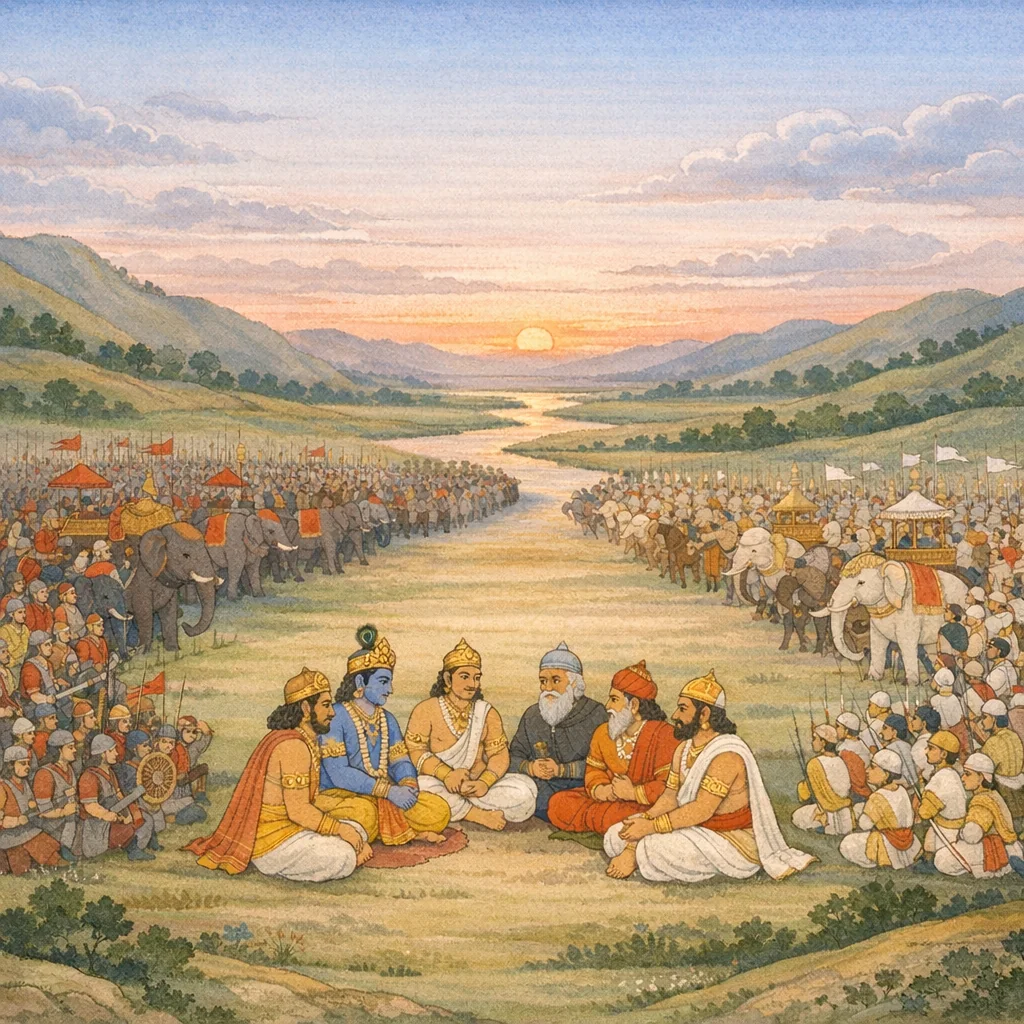
Janamejaya asks how the Kuru, Pāṇḍava, and Somaka forces—along with allied rulers from diverse regions—engaged in conflict. Vaiśaṃpāyana describes the Pāṇḍavas’ arrival at Kurukṣetra, their westward encampment facing east, and Yudhiṣṭhira’s systematic organization of thousands of camps, provisioning, and identification signals (saṃjñā/abhijñāna) to recognize units in wartime conditions. The narrative emphasizes the scale of mobilization, portraying the land as emptied of able-bodied men and filled with concentrated forces. Duryodhana arrays his side upon seeing Pāṇḍava standards; both sides display morale through conches, drums, and banners, with Kṛṣṇa and Arjuna sounding their divine conches, producing fear and disorientation in opposing ranks. Environmental phenomena—dust obscuring visibility, unusual precipitation, and strong winds—function as ominous atmospheric markers. The chapter culminates in both sides establishing explicit rules of engagement (yuddha-dharma): reciprocity in combat categories, prohibitions against striking the vulnerable or certain support personnel, and constraints against deceitful or opportunistic killing, followed by mutual astonishment at the assembled forces and a temporary settling into camps.
Chapter Arc: वैशम्पायन जनमेजय से कहते हैं—हे पृथ्वीपते, अब सुनो कि तपःक्षेत्र कुरुक्षेत्र में कौरव, पाण्डव और सोमक वीर कैसे आमने-सामने उतरे। → दोनों पक्ष महाबल से भरे, ‘जिगीषा’ (विजय-लालसा) लेकर कुरुक्षेत्र में उतरते हैं। सेनाओं का जमाव ऐसा है मानो युगान्त में दो समुद्र टकरा रहे हों; रथ, अश्व, गज और पदातियों की भीड़ से दिशाएँ भर जाती हैं, और पृथ्वी मानो युवकों से रिक्त—केवल वृद्ध-बाल शेष—हो गई हो। → कुरुक्षेत्र में दोनों सेनाओं का वह ‘अद्भुत संगम’—सागर-क्षोभ के समान—जहाँ युद्ध की प्रसन्नता और प्रलय की छाया एक साथ उपस्थित है; इसी क्षण युद्ध का अनिवार्य होना स्पष्ट हो उठता है। → सेनाएँ अपने-अपने स्थान पर निविष्ट होती हैं; हर्षित, सुमनस और व्यवस्थित होकर ठहरती हैं। तत्पश्चात् कौरव-पाण्डव-सोमक परस्पर मिलकर युद्ध-धर्म के नियम स्थिर करते हैं—विशेषतः संध्या के बाद वैर-भाव न रखकर प्रेम/मर्यादा बनाए रखने का विधान। → नियम बन चुके हैं; अब अगला चरण—शंखनाद, व्यूह-रचना और प्रथम प्रहार—निकट है।
Shlokas
Verse 1
इस प्रकार श्रीमहाभारत उद्योगपर्वके अन्तर्गत अम्बोपाख्यानपर्वमें पाण्डवसेनानिर्याणविषयक एक सौ छानबेवाँ अध्याय पूरा हुआ ॥/ १९६ ॥। है 2-2 7:20 बक। आप >फ स्टार: उद्योगपर्व सम्पूर्णम् है 2 7:20 बछ। हि अनुष्टुप् छन््द (अन्य बड़े छनन््द ) बड़े छनन््दोंकों ३२ अक्षरोंक कुलयोग अनुष्टुप् मानकर गिननेपर उत्तर भारतीय पाठसे लिये गये छलोक--५९७८॥ (७८४।- ) २ ०७८ ।5 (७०७६ ॥|5 दक्षिण भारतीय पाठसे लिये गये एलोक--६८॥ (५॥) ७॥- ७६- उद्योगपर्वकी सम्पूर्ण एलोक-संख्या ७१३३ नल (0) आसऔअस+- छः ३ श्रीपरमात्मने नम: श्रीमहाभारतम् भीष्मपर्व जम्बूखण्डविनिर्माणपर्व प्रथमो 5 ध्याय: कुरुक्षेत्रमें उभय पक्षके सैनिकोंकी स्थिति तथा युद्धके नियमोंका निर्माण नारायणं नमस्कृत्य नरं चैव नरोत्तमम् । देवीं सरस्वतीं व्यासं ततो जयमुदीरयेत् ।। अन्तर्यामी नारायणस्वरूप भगवान् श्रीकृष्ण, (उनके नित्य सखा) नरस्वरूप नरश्रेष्ठ अर्जुन, (उनकी लीला प्रकट करनेवाली) भगवती सरस्वती और (उन लीलाओंका संकलन करनेवाले) महर्षि वेदव्यासको नमस्कार करके जय (महाभारत)-का पाठ करना चाहिये। जनमेजय उवाच कथं युयुधिरे वीरा: कुरुपाण्डवसोमका: । पार्थिवा: सुमहात्मानो नानादेशसमागता:,जनमेजयने पूछा--मुने! कौरव, पाण्डव और सोमकवीरों तथा नाना देशोंसे आये हुए अन्य महामना नरेशोंने वहाँ किस प्रकार युद्ध किया? इति श्रीमहाभारते भीष्मपर्वणि जम्बूखण्डविनिर्माणपर्वणि सैन्यशिक्षणे प्रथमो5ध्याय:
Having bowed to Nārāyaṇa (the indwelling Lord), to Nara—the supreme among men—along with the goddess Sarasvatī and Vyāsa, one should then recite ‘Jaya’ (the Mahābhārata). Janamejaya said: “How did the heroes—the Kurus, the Pāṇḍavas, and the Somakas—together with the great-souled kings who had assembled from many lands, actually fight there?”
Verse 2
वैशग्पायन उवाच यथा युयुधिरे वीरा: कुरुपाण्डवसोमका: । कुरुक्षेत्रे तपःक्षेत्रे शृणु त्वं पृथिवीपते,वैशम्पायनजीने कहा--पृथ्वीपते! वीर कौरव, पाण्डव और सोमकोंने तपोभूमि कुरक्षेत्रमें जिस प्रकार युद्ध किया था, उसे बताता हूँ; सुनो
Vaiśampāyana said: O lord of the earth, listen as I recount how the heroic Kurus, the Pāṇḍavas, and the Somakas fought upon Kurukṣetra—hallowed as a field of austerity—where the struggle of arms unfolds within a landscape charged with moral and spiritual consequence.
Verse 3
तेडवतीर्य कुरुक्षेत्र पाण्डवा: सहसोमका: । कौरवा: समवर्तन्त जिगीषन्तो महाबला:,सोमकोंसहित पाण्डव तथा कौरव दोनों महाबली थे। वे एक-दूसरेको जीतनेकी आशासे कुरक्षेत्रमें उतरकर आमने-सामने डटे हुए थे
Having descended onto the field of Kurukṣetra, the Pāṇḍavas—together with the Somakas—took their positions. The Kauravas too, mighty in strength, arrayed themselves opposite, each side intent on victory. Thus, driven by the resolve to conquer, the two armies stood face to face on the ground where dharma itself would be tested through war.
Verse 4
वेदाध्ययनसम्पन्ना: सर्वे युद्धाभिनन्दिन: । आशंसन्तो जयं युद्धे बलेनाभिमुखा रणे,वे सब-के-सब वेदाध्ययनसे सम्पन्न और युद्धका अभिनन्दन करनेवाले थे और संग्राममें विजयकी आशा रखकर रणभूमिमें बलपूर्वक एक-दूसरेके सम्मुख खड़े थे
All of them were accomplished in Vedic study and took delight in warfare. Hoping for victory in battle, they stood facing one another on the field, each pressing forward with strength and resolve—learning and martial zeal now harnessed to the harsh test of war.
Verse 5
अभियाय च दुर्धर्षा धार्तराष्ट्रस्य वाहिनीम् | प्राड्मुखा: पश्चिमे भागे न्यविशन्त ससैनिका:,पाण्डवोंके योद्धालोग अपने-अपने सैनिकोंके सहित धृतराष्ट्रपुत्रकी दुर्धर्ष सेनाके सम्मुख जाकर पश्चिमभागमें पूर्वाभिमुख होकर ठहर गये थे
Having advanced to face the formidable army of Dhṛtarāṣṭra’s sons, the Pāṇḍava warriors, each with his own troops, took their position on the western side, standing with their fronts turned eastward. The scene underscores the deliberate order and resolve with which both sides enter a war that will test duty, loyalty, and righteousness.
Verse 6
समन्तपज्चकाद् बाहरं शिबिराणि सहस्रश: । कारयामास विधिवत कुन्तीपुत्रो युधिष्ठिर:,कुन्तीनन्दन युधिष्ठिरने समन्तपंचकक्षेत्रसे बाहर यथायोग्य सहस्रों शिविर बनवाये थे
Vaiśaṃpāyana said: Outside the region of Samantapañcaka, Kuntī’s son Yudhiṣṭhira had thousands of military camps properly constructed in due order—an act of disciplined preparation that reflects the king’s concern for orderly conduct even on the brink of war.
Verse 7
शून्या च पृथिवी सर्वा बालवृद्धावशेषिता । निरश्वपुरुषेवासीदू रथकुञ्जरवर्जिता,समस्त पृथ्वीके सभी प्रदेश नवयुवकोंसे सूने हो रहे थे। उनमें केवल बालक और वृद्ध ही शेष रह गये थे। सारी वसुधा घोड़े, हाथी, रथ और तरुण पुरुषोंसे हीन-सी हो रही थी
Vaiśaṃpāyana said: The whole earth seemed emptied out, with only children and the aged left behind. Deprived of horses and fighting men, and bereft of chariots and elephants, the land appeared as though its strength and vigor had been drained away—an ominous sign of society’s collapse under the weight of impending war.
Verse 8
यावत्तपति सूर्यो हि जम्बूद्वीपस्य मण्डलम् । तावदेव समायातं बल पार्थिवसत्तम,नृपश्रेष्ठ! सूर्यदेव जम्बूद्वीपके जितने भूमण्डलको अपनी किरणोंसे तपाते हैं, उतनी दूरकी सेनाएँ वहाँ युद्धके लिये आ गयी थीं
Vaiśaṃpāyana said: “O best of kings, O foremost among rulers: from as far as the Sun’s rays heat the whole expanse of Jambūdvīpa, armies had gathered there for battle.” The line underscores the vast scale of the impending war and the collective moral weight of rulers choosing armed conflict.
Verse 9
एकस्था: सर्ववर्णास्ति मण्डलं बहुयोजनम् । पर्याक्रामन्त देशांश्ष नदी: शैलान् वनानि च,वहाँ सभी वर्णके लोग एक ही स्थानपर एकत्र थे। युद्धभूमिका घेरा कई योजन लंबा था। उन सब लोगोंने वहाँके अनेक प्रदेशों, नदियों, पर्वतों और वनोंको सब ओरसे घेर लिया था
Vaiśaṃpāyana said: All the social orders were gathered together in one place. The encircling ring of the battlefield stretched for many yojanas. From every side they had surrounded the region—its tracts of land, rivers, mountains, and forests—signaling the vast, all-encompassing mobilization that precedes a war in which the whole realm, not merely the warriors, becomes implicated.
Verse 10
तेषां युधिष्ठिरो राजा सर्वेषां पुरुषर्षभ । व्यादिदेश सवाह्यानां भक्ष्यभोज्यमनुत्तमम्,नरश्रेष्ठ! राजा युधिष्ठिरने सेना और सवारियों-सहित उन सबके लिये उत्तमोत्तम भोजन प्रस्तुत करनेका आदेश दे दिया था
Vaiśaṃpāyana said: King Yudhiṣṭhira, foremost among men, ordered that excellent food and provisions be served for all of them, including their mounts and attendants. The scene underscores royal duty expressed as hospitality and care—even amid the gathering momentum toward war—showing that dharma includes responsible provision for guests, dependents, and animals alike.
Verse 11
शय्याश्व विविधास्तात तेषां रात्रौ युधिष्ठिर: । एवंवेदी वेदितव्य: पाण्डवेयोडयमित्युत,तात! रातके समय युधिष्ठिरने उन सबके सोनेके लिये नाना प्रकारकी शय्याओंका भी प्रबन्ध कर दिया था। युद्धकाल उपस्थित होनेपर कुरुनन्दन युधिष्ठिरने सभी सैनिकोंके पहचानके लिये उन्हें भिन्न-भिन्न प्रकारके संकेत और आभूषण दे दिये थे, जिससे यह जान पड़े कि यह पाण्डवपक्षका सैनिक है
Vaiśaṃpāyana said: “O dear one, during the night Yudhiṣṭhira arranged various kinds of beds for them. And so that each man might be recognized in the press of war, he also established distinguishing marks—so it would be known, ‘This is a soldier of the Pāṇḍavas.’”
Verse 12
अभिश्ञानानि सर्वेषां संज्ञाक्षाभरणानि च । योजयामास कौरव्यो युद्धकाल उपस्थिते,तात! रातके समय युधिष्ठिरने उन सबके सोनेके लिये नाना प्रकारकी शय्याओंका भी प्रबन्ध कर दिया था। युद्धकाल उपस्थित होनेपर कुरुनन्दन युधिष्ठिरने सभी सैनिकोंके पहचानके लिये उन्हें भिन्न-भिन्न प्रकारके संकेत और आभूषण दे दिये थे, जिससे यह जान पड़े कि यह पाण्डवपक्षका सैनिक है
Vaiśaṃpāyana said: When the time of war had arrived, the Kuru prince (Yudhiṣṭhira) arranged for all the troops distinctive marks of recognition—identifying signs and ornaments—so that each man could be known for who he was and to which side he belonged. In the looming violence of battle, this practical ordering serves the ethical aim of preventing confusion and misidentification among one’s own forces.
Verse 13
दृष्टवा ध्वजाग्र पार्थस्य धार्तराष्ट्री महामना: । सह सर्वर्महीपालै: प्रत्यव्यूहत पाण्डवम्,कुन्तीपुत्र अर्जुनके ध्वजका अग्रभाग देखकर महामना दुर्योधनने समस्त भूपालोंके साथ पाण्डव-सेनाके विरुद्ध अपनी सेनाकी व्यूहरचना की
Seeing the foremost part of Arjuna’s banner, the high-minded son of Dhṛtarāṣṭra, together with all the allied kings, drew up a counter-formation against the Pāṇḍava host—signaling the deliberate resolve to meet the righteous claim of the Pāṇḍavas with organized force on the battlefield.
Verse 14
पाण्डुरेणातपत्रेण प्रियमाणेन मूर्थनि । मध्ये नागसहस्रस्य भ्रातृभि: परिवारित:,उसके मस्तकपर श्वेत छत्र तना हुआ था। वह एक हजार हाथियोंके बीचमें अपने भाइयोंसे घिरा हुआ शोभा पाता था
Vaiśaṃpāyana said: With a white royal parasol held above his head, he appeared resplendent—surrounded by his brothers and stationed amid a thousand elephants. The image conveys sovereign dignity and the ordered might of a great host as it prepares for the coming conflict.
Verse 15
दृष्टवा दुर्योधन हृष्टा: पञज्चाला युद्धनन्दिन: । दश्मु: प्रीता महाशड्खान् भेर्यश्व॒ मधुरस्वना:,दुर्योधनको देखकर युद्धका अभिनन्दन करनेवाले पांचाल सैनिक बहुत प्रसन्न हुए और प्रसन्नतापूर्वक बड़े-बड़े शंखों तथा मधुर ध्वनि करनेवाली भेरियोंको बजाने लगे
Verse 16
ततः प्रह्ृष्टां तां सेनामभिवीक्ष्याथ पाण्डवा: | बभूवुर्हष्टमनसो वासुदेवश्च वीर्यवान्,तदनन्तर अपनी सेनाको हर्ष और उल्लासमें भरी हुई देख समस्त पाण्डवोंके मनमें बड़ा हर्ष हुआ तथा पराक्रमी वसुदेवनन्दन भगवान् श्रीकृष्ण भी संतुष्ट हुए
Then, seeing that army filled with joy and high spirits, all the Pāṇḍavas became glad at heart; and the mighty Vāsudeva—Kṛṣṇa, son of Vasudeva—was also pleased. The verse highlights how righteous confidence and unity of purpose can steady the mind on the eve of battle, turning fear into resolve when one’s cause and leadership are trusted.
Verse 17
ततो हर्ष समागम्य वासुदेवधनंजयौ । दभ्मतु:ः पुरुषव्याप्रौ दिव्यौ शड्खौ रथे स्थितौ,उस समय एक ही रथपर बैठे हुए पुरुषसिंह श्रीकृष्ण और अर्जुन आनन्दमग्न होकर अपने दिव्य शंखोंको बजाने लगे
Then, filled with exhilaration as the moment of battle drew near, Vāsudeva (Kṛṣṇa) and Dhanañjaya (Arjuna)—those tiger-like heroes seated together on the same chariot—blew their divine conches. The act signals confident resolve and a public declaration of readiness to uphold their chosen duty in the face of war.
Verse 18
पाञज्चजन्यस्थ निर्घोषं देवदत्तस्य चोभयो: । श्रुत्वा तु निनदं योधा: शकृन्मूत्रं प्रसुखुवुः,पांचजन्य और देवदत्त दोनों शंखोंकी ध्वनि सुनकर शत्रुपक्षके बहुत-से सैनिक भयके मारे मल-मूत्र करने लगे
Vaiśaṃpāyana said: Hearing the thunderous blare of both conches—Pāñcajanya and Devadatta—many warriors of the opposing host were so overwhelmed by fear that they lost control of themselves, voiding stool and urine. The scene underscores how inner steadiness and morale can decide the temper of battle even before weapons are raised.
Verse 19
यथा सिंहस्य नदतः स्वनं श्रुत्वेतरे मृगा: । त्रसेयुनिनिदं श्रुत्वा तथासीदत तद्धलम्,जैसे गर्जते हुए सिंहकी आवाज सुनकर दूसरे वन्य पशु भयभीत हो जाते हैं, उसी प्रकार उन दोनोंका शंखनाद सुनकर कौरवसेनाका उत्साह शिथिल पड़ गया--वह खिन्न-सी हो गयी
Vaiśaṃpāyana said: Just as the other beasts of the forest tremble on hearing the roar of a lion, so too, upon hearing that thunderous blare, the Kaurava host’s spirit slackened and their confidence sank into dejection. The verse underscores how moral and psychological force can decide the temper of battle even before weapons are joined.
Verse 20
उदतिष्ठद् रजो भौम॑ न प्राज्ञायत किंचन । अस्तड़त इवादित्ये सैन्येन सहसा55वृते,धरतीसे धूल उड़कर आकाशमें छा गयी। कुछ भी सूझ नहीं पड़ता था। सेनाकी गर्दसे सहसा आच्छादित हो जानेके कारण सूर्य अस्त हो गये-से जान पड़ते थे
Vaiśaṃpāyana said: Dust rose up from the earth, and nothing could be clearly perceived. With the armies suddenly shrouded in that haze, the sun itself seemed as though it had set—an ominous sign of the confusion and moral darkness that war brings.
Verse 21
ववर्ष तत्र पर्जन्यो मांसशोणितवृष्टिमान् । दिक्षु सर्वाणि सैन्यानि तदद्भुतमिवाभवत्,उस समय वहाँ मेघ सब दिशाओंमें समस्त सैनिकोंपर मांस और रक्तकी वर्षा करने लगे। वह एक अद्भुत-सी बात हुई
Vaiśaṃpāyana said: There, the rain-cloud poured down a shower of flesh and blood. In every direction it fell upon all the armies—an omen so dreadful and uncanny that it seemed like a marvel, foretelling the moral horror and vast destruction about to be unleashed by war.
Verse 22
वायुस्तत: प्रादुरभून्नीचै: शर्करकर्षण: । विनिष्नंस्तान्यनीकानि शतशो5थ सहस्रश:,तदनन्तर वहाँ नीचेसे बालू तथा कंकड़ खींचकर सब ओर बिखेरनेवाली बवंडरकी-सी वायु उठी, जिसने सैकड़ों-हजारों सैनिकोंको घायल कर दिया
Then a wind suddenly arose, low and whirling, dragging up sand and gravel and scattering it in every direction. It struck and battered those battle-formations, wounding soldiers by the hundreds and even by the thousands—an ominous sign that the coming conflict would be marked by widespread suffering and disorder.
Verse 23
उभे सैन्ये च राजेन्द्र युद्धाय मुदिते भृशम् । कुरुक्षेत्रे स्थिते यत्ते सागरक्षुभितोपमे,राजेन्द्र! कुरक्षेत्रमें युद्धके लिये अत्यन्त हर्षोल्लासमें भरी हुई दोनों पक्षकी सेनाएँ दो विक्षुब्ध महासागरोंके समान एक-दूसरेके सम्मुख खड़ी थीं
Vaiśaṃpāyana said: “O king, both armies—exceedingly elated and eager for battle—stood facing one another on the field of Kurukṣetra, like two great oceans churned into turmoil.” The verse frames the war not merely as a clash of forces but as an overwhelming, morally charged upheaval in which collective excitement and impending violence surge together.
Verse 24
तयोस्तु 2242 : स तु संगम: । युगान्ते समनुप्राप्ते द्ययो: सागरयोरिव,दोनों सेनाओंका वह अद्भुत समागम प्रलयकाल आनेपर परस्पर मिलनेवाले दो समुद्रोंक समान जान पड़ता था
Vaiśaṃpāyana said: The meeting of those two armies appeared wondrous and awe-inspiring—like the confluence of two oceans when the end of an age arrives, suggesting an inevitable, world-shaking collision born of accumulated conflict and adharma.
Verse 25
शून्या5डसीत् पृथिवी सर्वा वृद्धबालावशेषिता । निरश्वपुरुषेवासीदू् रथकुञज्जरवर्जिता
Vaiśaṃpāyana said: The whole earth seemed emptied out, with only the aged and the children left behind. It looked like a deserted settlement—bereft of horses and men, and stripped of chariots and elephants—because the fighting hosts had gone to the battlefield.
Verse 26
ततस्ते समयं चक्र: कुरुपाण्डवसोमका:
Then the Kurus, the Pāṇḍavas, and the Somakas made an agreement among themselves—setting the appointed terms and understanding by which the impending conflict would proceed, indicating that even in war there were recognized conventions and collective decisions.
Verse 27
निवत्ते विहिते युद्धे स्यात् प्रीतिर्न: परस्परम्
Vaiśaṃpāyana said: “If the war, once duly undertaken and carried out according to prescribed rule, comes to an end, then may there be mutual goodwill between us.”
Verse 28
वाचा युद्धप्रवृत्तानां वाचैव प्रतियोधनम् । निष्क्रान्ता: पृतनामध्यान्न हन्तव्या: कदाचन,जो वाग्युद्धमें प्रवृत्त हों उनके साथ वाणीद्वारा ही युद्ध किया जाय। जो सेनासे बाहर निकल गये हों उनका वध कदापि न किया जाय। भारत! रथीको रथीसे ही युद्ध करना चाहिये, इसी प्रकार हाथीसवारके साथ हाथीसवार, घुड़सवारके साथ घुड़सवार तथा पैदलके साथ पैदल ही युद्ध करे
Vaiśaṃpāyana said: “Those who engage only in a battle of words should be answered with words alone. And those who have stepped out from the midst of the army should never be slain.” The verse frames battlefield conduct as governed by restraint and propriety: speech-contests are not to be met with weapons, and a combatant who has withdrawn from the fighting mass is to be spared.
Verse 29
रथी च रथिना योध्यो गजेन गजधूर्गत: । अश्वेनाश्वी पदातिश्न पादातेनैव भारत,जो वाग्युद्धमें प्रवृत्त हों उनके साथ वाणीद्वारा ही युद्ध किया जाय। जो सेनासे बाहर निकल गये हों उनका वध कदापि न किया जाय। भारत! रथीको रथीसे ही युद्ध करना चाहिये, इसी प्रकार हाथीसवारके साथ हाथीसवार, घुड़सवारके साथ घुड़सवार तथा पैदलके साथ पैदल ही युद्ध करे
Vaiśaṃpāyana said: “O Bhārata, combat should be matched in kind: a chariot-warrior should fight a chariot-warrior; one mounted on an elephant should engage an elephant-rider; a horseman should fight a horseman; and a foot-soldier should fight a foot-soldier. Thus the battle is to be waged according to proper order and fairness, not by striking those who are at a disadvantage.”
Verse 30
यथायोगं यथाकामं यथोत्साहं यथाबलम् । समाभाष्य प्रहर्तव्यं न विश्वस्ते न विह्लले,जिसमें जैसी योग्यता, इच्छा, उत्साह तथा बल हो उसके अनुसार ही विपक्षीको बताकर उसे सावधान करके ही उसके ऊपर प्रहार किया जाय। जो विश्वास करके असावधान हो रहा हो अथवा जो युद्धसे घबराया हुआ हो, उसपर प्रहार करना उचित नहीं है
‘One should strike an opponent only in a manner proportionate to one’s own preparedness—according to one’s discipline, intention, ardor, and strength—and only after addressing him and making him alert. It is not proper to attack one who has become trusting and therefore careless, nor one who is bewildered or shaken by fear in battle.’
Verse 31
एकेन सह संयुक्त: प्रपन्नो विमुखस्तथा । क्षीणशस्त्रो विवर्मा च न हन्तव्य: कदाचन,जो एकके साथ युद्धमें लगा हो, शरणमें आया हो, पीठ दिखाकर भागा हो और जिसके अस्त्र-शस्त्र और कवच कट गये हों; ऐसे मनुष्यको कदापि न मारा जाय
Vaiśaṃpāyana said: One who is engaged in combat with only a single opponent, or who has sought refuge, or who has turned his back and fled, and also one whose weapons are spent and whose armour is gone—such a man should never be slain. The verse states a rule of righteous warfare: victory must not be pursued by killing the helpless or the surrendered.
Verse 32
न सूतेषु न धुर्येषु न च शस्त्रोपनायिषु । न भेरीशड्खवादेषु प्रहर्तव्यं कथंचन,घोड़ोंकी सेवाके लिये नियुक्त हुए सूतों, बोझ ढोनेवालों, शस्त्र पहुँचानेवालों तथा भेरी और शंख बजानेवालोंपर कोई किसी प्रकार भी प्रहार न करे
Vaiśaṃpāyana said: “No one should strike, under any circumstance, those appointed as charioteers and attendants of horses, those who bear burdens, those who bring weapons, or those who sound the war-drums and conches.” The injunction frames a rule of righteous conduct in battle: non-combatant support personnel are not to be treated as legitimate targets.
Verse 33
एवं ते समयं कृत्वा कुरुपाण्डवसोमका: । विस्मयं परम जग्मु: प्रेक्षमाणा: परस्परम्,इस प्रकार नियम बनाकर कौरव, पाण्डव तथा सोमक एक-दूसरेकी ओर देखते हुए बड़े आश्वर्यचकित हुए
Having thus made their mutual agreement, the Kurus, the Pāṇḍavas, and the Somakas—looking at one another—were seized by the greatest astonishment. The moment underscores how, even on the brink of war, formal pledges and collective decisions can suddenly reveal unexpected consequences and provoke moral and strategic uncertainty.
Verse 34
निविश्य च महात्मानस्ततस्ते पुरुषर्षभा: | हृष्टरूपा: सुमनसो बभूवु: सहसैनिका:,तदनन्तर वे महामना पुरुषरत्न अपने-अपने स्थानपर स्थित हो सैनिकोंसहित प्रसन्नचित्त होकर हर्ष एवं उत्साहसे भर गये
Then those great-souled bull-like men, having taken their respective positions, became cheerful and clear-minded; together with their troops they were filled with joy and renewed ardor—an outward sign of readiness and resolve as the war-order settled into place.
Verse 256
तेन सेनासमूहेन समानीतेन कौरवै: । कौरवोंद्वारा संग्रह करके वहाँ लाये हुए उस सैन्यसमूहद्वारा सारी पृथ्वी नवयुवकोंसे सूनी-सी हो रही थी। सर्वत्र केवल बालक और बूढ़े ही शेष रह गये थे। सारी वसुधा घोड़े, हाथी, रथ और तरुण पुरुषोंसे हीन-सी हो गयी थी
Vaiśaṃpāyana said: By that massed host, gathered and brought together by the Kauravas, the earth seemed emptied of its young men. Everywhere only boys and the aged were left behind; the whole land appeared bereft of horses, elephants, chariots, and vigorous youth—an ominous sign of how war drains society of its strength and future.
Verse 266
धर्मान् संस्थापयामासुर्युद्धानां भरतर्षभ । भरतश्रेष्ठ! तत्पश्चात् कौरव, पाण्डव तथा सोमकोंने परस्पर मिलकर युद्धके सम्बन्धमें कुछ नियम बनाये। युद्धधर्मकी मर्यादा स्थापित की
Vaiśaṃpāyana said: O bull among the Bharatas, they then established the codes of conduct for warfare—setting in place the boundaries of righteous battle so that the coming conflict would be governed by dharma rather than mere rage or expediency.
Verse 276
यथापरं यथायोगं न च स्यात् कस्यचित् पुनः । वे नियम इस प्रकार हैं--चालू युद्धके बंद होनेपर संध्याकालमें हम सब लोगोंमें परस्पर प्रेम बना रहे। उस समय पुनः किसीका किसीके साथ शत्रुतापूर्ण अयोग्य बर्ताव नहीं होना चाहिये
Vaiśaṃpāyana said: “Let things proceed in due order and as is proper; and once the day’s fighting has ceased, no one should again behave toward anyone with hostile impropriety. At twilight, when the battle is suspended, let mutual goodwill remain among all.”
Frequently Asked Questions
The chapter presents the tension between inevitability of armed engagement and the attempt to constrain harm through yuddha-dharma—codifying who may be targeted, under what conditions, and prohibiting attacks on certain vulnerable or non-combat-support roles.
Even under extreme political rupture, the text frames conduct as accountable to norms: organization, restraint, reciprocity, and role-based protections are portrayed as instruments to preserve a minimum ethical order within conflict.
No explicit phalaśruti is stated here; the chapter functions as structural meta-context—establishing setting, scale, and ethical constraints—so later discourses and outcomes can be interpreted against declared norms of conduct.