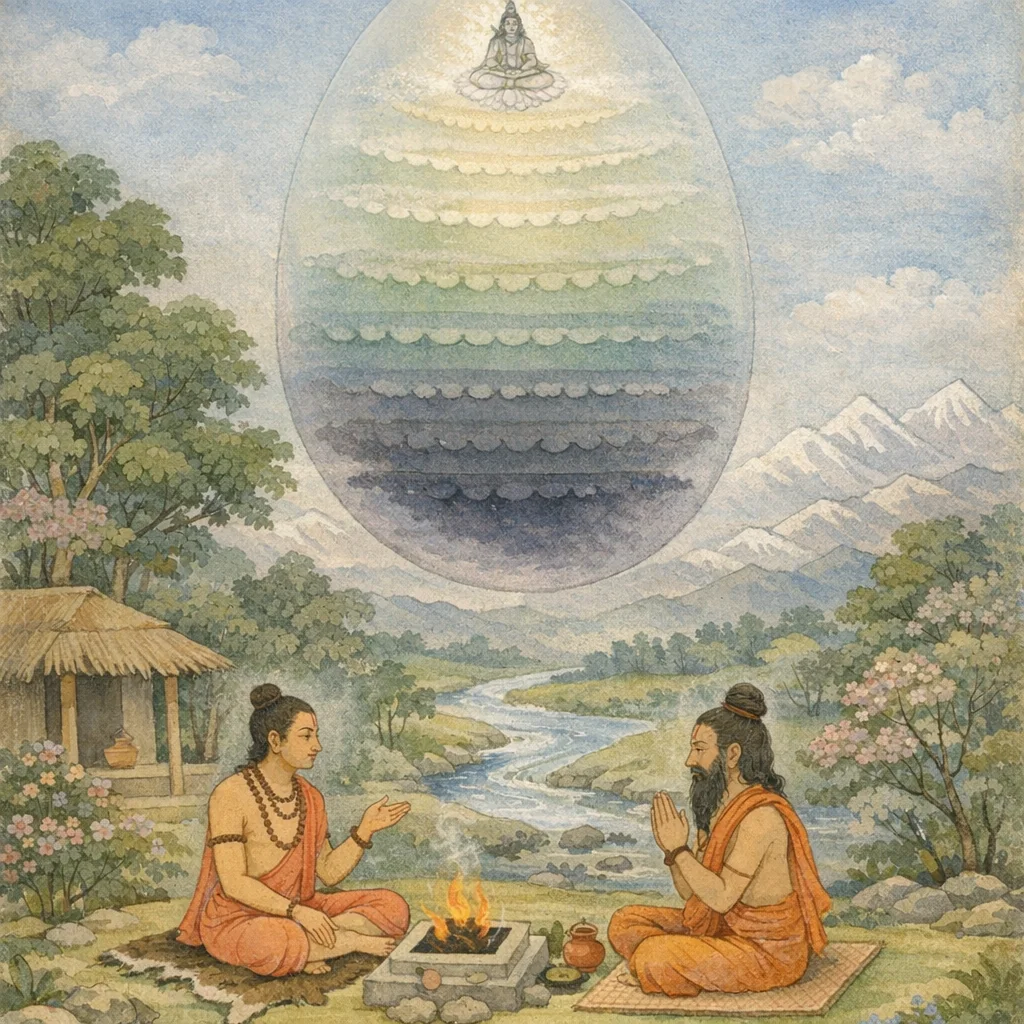
ब्रह्माण्डदान-प्रशंसा तथा ब्रह्माण्ड-प्रमाण-वर्णनम् (Praise of the Gift of the Cosmic Egg and Description of the Brahmāṇḍa’s Measure)
Adhyāya 15 unfolds as a didactic dialogue: Vyāsa asks Sanatkumāra for the one gift whose fruit equals that of all gifts. Sanatkumāra extols brahmāṇḍa-dāna—the “gift of the cosmic egg,” an emblem of total offering—as the supreme dāna for seekers of mokṣa, whose merit matches every donation. Vyāsa then seeks clear definition of the brahmāṇḍa—its measure, nature, basis, and true form—so the teaching rests on intelligible meaning rather than mere praise. Sanatkumāra gives a concise cosmogonic sequence: the unmanifest cause; Śiva as the stainless manifest principle; and Brahmā’s emergence through differentiation by time. He describes the brahmāṇḍa as a fourteen-world structure (caturdaśa-bhuvana), including the seven pātālas and the higher worlds, with vertical measures indicated. The inner lesson is that “totality” serves as a pedagogical symbol for complete, undivided intention in giving, integrated with a Śaiva cosmology that frames karma and liberation.
Shlokas
Verse 1
व्यास उवाच । येनैकेन हि दत्तेन सर्वेषां प्राप्यते फलम् । दानानां तन्ममाख्या हि मानुषाणां हितार्थतः
Vyāsa said: “There is a single gift by whose offering the complete fruit of all gifts is attained. I shall now declare it, for the welfare of humankind.”
Verse 2
सनत्कुमार उवाच । शृणु कालेः प्रदत्ताद्वै फलं विंदंति मानवाः । एकस्मादपि सर्वेषां दानानां तद्वदामि ते
Sanatkumāra said: “Listen—people truly obtain the fruit of gifts when they are given at the proper time. Even from a single act among all forms of charity, I shall explain that result to you.”
Verse 3
दानानामुत्तमं दानं ब्रह्माण्डं खलु मानवैः । दातव्यं मुक्तिकामैस्तु संसारोत्तारणाय वै
Of all gifts, the supreme gift is indeed the gift of the brahmāṇḍa—the offering of the entire universe. Therefore, those who yearn for liberation should give, that they may cross beyond saṃsāra.
Verse 4
ब्रह्मांडे सकलं दत्तं यत्फलं लभते नरः । तदेकभावादाप्नोति सप्तलोकाधिपो भवेत्
Whatever merit a person gains by giving away everything within the whole cosmos, that very fruit is attained through single-minded devotion to Lord Śiva. By such one-pointedness, one becomes sovereign over the seven worlds.
Verse 5
यावच्चन्द्रदिवाकरौ नभसि वै यावत्स्थिरा मेदिनी । तावत्सोऽपि नरः स्वबांधवयुतस्स्ववर्गौकसामोकसि । सर्वेष्वेव मनोनुगेषु ककुभिर्ब्रह्माण्डदः क्रीडते । पश्चाद्याति पदं सुदुर्लभतरं देवैर्मुदे माधवम्
As long as the moon and the sun abide in the sky, and as long as the earth stands firm, so long does that person—together with his own kinsmen—sport in his own heavenly realms, tasting a bliss akin to liberation. He roams freely through every wished-for region and direction, even across the spheres of the cosmos. Thereafter, to the delight of the gods, he attains that station exceedingly hard to reach: Mādhava’s supreme abode.
Verse 6
व्यास उवाच । भगवन्ब्रूहि ब्राह्माण्डं यत्प्रमाणं यदात्मकम् । यदाधारं यथाभूतं येन मे प्रत्ययो भवेत्
Vyāsa said: “O Blessed Lord, tell me of the Brahmāṇḍa, the cosmic egg—its measure, its essential nature, and the foundation on which it rests—just as it truly is, so that clear certainty may arise in me.”
Verse 7
सनत्कुमार उवाच । मुने शृणु प्रवक्ष्यामि यदुत्सेधं तु विस्तरम् । ब्रह्माण्डं तत्तु संक्षेपाच्छ्रुत्वा पापात्प्रमुच्यते
Sanatkumāra said: O sage, listen. I shall explain the measure and vast extent of the cosmic egg (the Brahmāṇḍa). By hearing this account even in brief, one becomes freed from sin.
Verse 8
यत्तत्कारणमव्यक्तं व्यक्तं शिवमनामयम् । तस्मात्संजायते ब्रह्मा द्विधाभूताद्धि कालतः
That Reality is the unmanifest Cause (avyakta) and also the manifest (vyakta)—Śiva, the stainless Lord, free from all affliction. From Him Brahmā is born, for by the power of Time the One becomes twofold.
Verse 9
ब्राह्माण्डं सृजति ब्रह्मा चतुर्द्दशभवात्मकम् । तद्वच्मि क्रमतस्तात समासाच्छृणु यत्नतः
Brahmā brings forth the cosmic egg (Brahmāṇḍa), formed of the fourteen worlds. Dear one, I shall relate it in proper order; listen carefully, in brief, with attentive effort.
Verse 10
पातालानि तु सप्तैव भुवनानि तथोर्द्ध्वतः । उच्छ्रायो द्विगुणस्तस्य जलमध्ये स्थितस्य च
There are indeed seven nether realms (Pātālas), and likewise the worlds above. The vertical extent of that cosmic region is said to be twice as much, and it is situated in the midst of the waters.
Verse 11
तस्याधारः स्थितो नागस्स च विष्णुः प्रकीर्तितः । ब्रह्मणो वचसो हेतोर्बिभर्ति सकलं त्विदम्
Its supporting base is the great Serpent, who is also celebrated as Viṣṇu. By the efficacy of Brahmā’s utterance and command, he upholds this entire universe.
Verse 12
शेषस्यास्य गुणान् वक्तुं न शक्ता देवदानवाः । योनंतः पठ्यते सिद्धैर्देवर्षिगणपूजितः
Even the gods and the Dānavas cannot fully describe the qualities of this Supreme Lord. The Siddhas recite Him as the One whose source and end are unfathomable—praised by the Siddhas and worshipped by the hosts of divine seers.
Verse 13
शिरःसाहस्रयुक्तस्स सर्वा विद्योतयन्दिशः । फणामणिसहस्रेण स्वस्तिकामलभूषणः
Endowed with a thousand heads, he illuminated all the directions. Adorned with thousands of hood-jewels, he was ornamented with auspicious svastika-marks and lotus-like emblems—radiant with divine splendor.
Verse 14
मदाघूर्णितनेत्रोऽसौ साग्निश्श्वेत इवाचलः । स्रग्वी किरीटी ह्याभाति यस्सदैवैक कुंडलः
His eyes rolled with a divine, intoxicated rapture; he appeared like a white mountain blazing with fire. Wearing a garland and a diadem, he shone forth—ever adorned with a single earring.
Verse 15
इति श्रीशिवमहापुराणे पञ्चम्यामुमासंहितायां ब्रह्माण्डकथने पाताललोकवर्णनं नाम पंचदशोऽध्यायः
Thus, in the Śrī Śiva Mahāpurāṇa—within the fifth book, the Umāsaṃhitā, in the section describing the cosmos—ends the fifteenth chapter entitled “Description of Pātāla (the Netherworlds).”
Verse 16
लांगलासक्तहस्ताग्रो बिभ्रन्मुसलमुत्तमम् । योऽर्च्यते नागकन्याभिस्स्वर्णवर्णाभिरादरात्
He whose foremost hand rests upon the plough, and who bears an excellent pestle—He is worshipped with reverence by the Nāga maidens of golden hue.
Verse 17
संकर्षणात्मको रुद्रो विषानलशिखोज्ज्वलः । कल्पांते निष्क्रमन्ते यद्वक्त्रेभ्योऽग्निशिखा मुहुः । दग्ध्वा जगत्त्रयं शान्ता भवंतीत्यनुशुश्रुम
We have heard that Rudra, whose very nature is Saṅkarṣaṇa and who blazes with the flames of poison and fire, at the end of a kalpa repeatedly sends forth tongues of fire from His mouths; having burned the three worlds, those flames then become tranquil.
Verse 18
आस्ते पातालमूलस्थस्स शेषः क्षितिमण्डलम् । बिभ्रत्स्वपृष्ठे भूतेशश्शेषोऽशेषगुणार्चितः
At the very root of Pātāla abides Śeṣa, bearing the whole circle of the earth upon his own back. That Śeṣa—lordly among beings—is revered for his countless excellences.
Verse 19
तस्य वीर्यप्रभावश्च साकांक्षैस्त्रिदशैरपि । न हि वर्णयितुं शक्यः स्वरूपं ज्ञातुमेव वा
Even the thirty-three gods, though eager to know, are unable to describe His majesty and power; indeed, they cannot truly know His essential nature.
Verse 20
आस्ते कुसुममालेव फणामणिशिलारुणा । यस्यैषा सकला पृथ्वी कस्तद्वीर्यं वदिष्यति
Reddened by the jewel-like stones upon the hood of the cosmic serpent, the whole Earth rests upon Him like a garland of flowers. Who, then, can truly describe His might?
Verse 21
यदा विजृम्भतेऽनंतो मदाघूर्णितलोचनः । तदा चलति भूरेषा साद्रितोयाधिकानना
Whenever Ananta (Śeṣa)—his eyes rolling as if intoxicated—stretches and expands, at that very moment this Earth, with her mountains, waters, and vast forests, begins to tremble and move.
Verse 22
दशसाहस्रमेकैकं पातालं मुनि सत्तम । अतलं वितलं चैव सुतलं च रसातलम्
O best of sages, each of the nether regions (Pātālas) extends for ten thousand yojanas: namely Atala, Vitala, Sutala, and Rasātala.
Verse 23
तलं तलातलं चाग्र्यं पातालं सप्तमं मतम् । भूमेरधस्सप्त लोका इमे ज्ञेया विचक्षणैः
Below the earth are these seven realms, which the discerning should understand: Tala, Talātala, and the excellent lower regions, with Pātāla regarded as the seventh.
Verse 24
उच्छ्रायो द्विगुणश्चैषां सर्वेषां रत्नभूमयः । रत्नवन्तोऽथ प्रासादा भूमयो हेमसंभवाः
Their height was twice as great; for all of them, even the ground itself was gem-like. Their mansions were adorned with jewels, and their floors were formed of gold.
Verse 25
तेषु दानवदैतेया नागानां जातयस्तथा । निवसंति महानागा राक्षसा दैत्यसंभवाः
There dwell the Dānavas and Daityas, and likewise the various races of Nāgas. Great serpents also live there, as well as Rākṣasas who are born of the Daityas.
Verse 26
प्राह स्वर्गसदोमध्ये पातालानीति नारदः । स्वर्लोकादति रम्याणि तेभ्योऽसावागतो दिवि
In the midst of the celestial assembly, Nārada declared, “There are the Pātālas (netherworlds). They are even more delightful than Svarga.” Hearing this, he (the one being spoken of) came up to the heavens from those realms.
Verse 27
नानाभूषणभूषासु मणयो यत्र सुप्रभाः । आह्लादकानि शुभ्राणि पातालं केन तत्समम्
Adorned with many kinds of ornaments, there are gems there that shine with excellent radiance. Delightful and brilliantly white—what, indeed, could be comparable to that Pātāla, the nether realm?
Verse 28
पाताले कस्य न प्रीतिरितश्चेतश्च शोभितम् । देवदानवकन्याभिर्विमुक्तस्याभिजायते
In Pātāla, who would not feel delight? Even the mind is captivated there; and for one released from restraint, attachment arises through the maidens of the Devas and the Dānavas.
Verse 29
दिवार्करश्मयो यत्र न भवंति विधो निशि । न शीतमातपो यत्र मणितेजोऽत्र केवलम्
In that realm, the sun’s rays do not blaze by day, nor does the moon shine at night. There, neither cold nor heat is felt—only the pure, jewel-like radiance prevails.
Verse 30
भक्ष्यभोज्यान्नपानानि भुज्यंते मुदितैर्भृशम् । यत्र न जायते कालो गतोऽपि मुनिसत्तम
There, the delighted ones partake abundantly of foods to be eaten and savored, of grain-dishes and of drinks. In that place, O best of sages, Kāla—Time—does not arise at all, even though it seems to have already passed.
Verse 31
पुंस्कोकिलरुतं यत्र पद्मानि कमलाकराः । नद्यस्सरांसि रम्याणि ह्यन्योन्यविचराणि च
There, the calls of male cuckoos resound; lotus-blooms fill the lotus-lakes. Lovely rivers and ponds are found, and they flow and mingle with one another, moving in mutual interconnection.
Verse 32
भूषणान्यतिशुभ्राणि गंधाढ्यं चानुलेपनम् । वीणावेणुमृदंगानां स्वना गेयानि च द्विज
There are exceedingly radiant ornaments, and unguents rich with fragrance; and, O twice-born one, the resonant sounds of vīṇā, flute, and mṛdaṅga, along with songs to be sung.
Verse 33
दैत्योरगैश्च भुज्यंते पाताले वै सुखानि च । तपसा समवाप्नोति दानवैस्सिद्धमानवैः
In Pātāla (the nether realms), comforts are indeed enjoyed by the Daityas and the serpent-beings as well. Yet that very attainment is reached through tapas (austerity) by the Dānavas and by perfected men (siddha-mānava).
Frequently Asked Questions
A theological argument about the hierarchy of gifts: Sanatkumāra asserts that brahmāṇḍa-dāna—an idealized total-gift—yields the aggregate fruit of all dānas, and then grounds that claim by defining what the brahmāṇḍa is (origin, structure, and measure).
Rahasya-wise, ‘giving the brahmāṇḍa’ functions as a symbol of complete relinquishment: the donor’s intention is trained toward totality rather than partial charity, aligning ethical action with cosmological wholeness and directing merit toward liberation rather than finite rewards.
No distinct iconographic manifestation (mūrti) of Śiva/Umā is foregrounded in the sampled verses; instead, Śiva is invoked as the anāmayam (stainless) manifest principle emerging from the unmanifest cause, serving as the metaphysical anchor for Brahmā’s cosmogenic activity.