Sarga 64
गोदावरीतटे सीतान्वेषणम् — The Search for Sītā at the Godāvarī
अरण्यकाण्ड
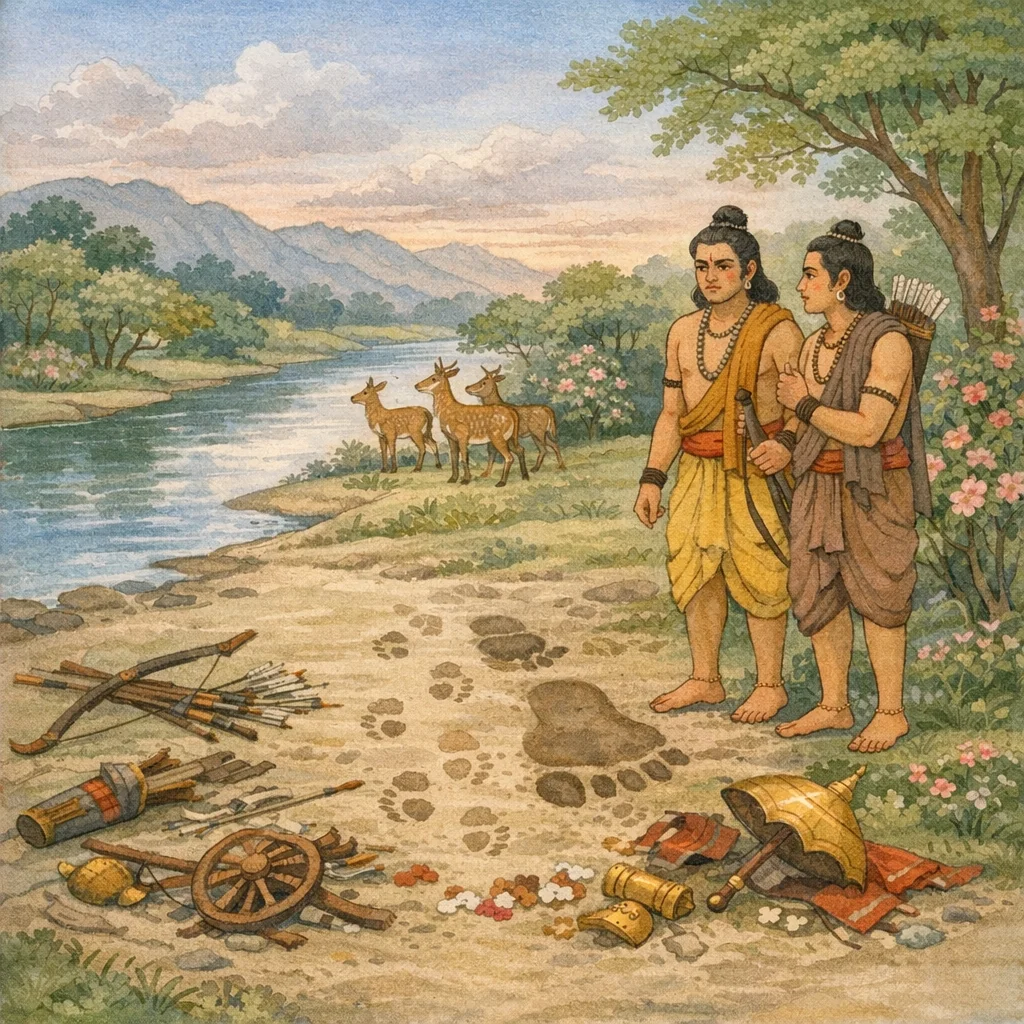
Sarga 64 opens with Rāma overwhelmed by grief and urgently instructing Lakṣmaṇa to search the Godāvarī, suspecting Sītā went there to gather lotuses. Lakṣmaṇa examines the river’s tīrthas but receives no reply; Rāma then approaches and questions the Godāvarī itself, which remains silent, depicted as fearful of Rāvaṇa’s might. Rāma’s sorrow flares into anger as he laments how he can face Janaka and his own mother without Sītā, and he vows to scour the Godāvarī, Jana-sthāna, and Mount Prasravaṇa. Deer appear like omen-witnesses, gesturing toward the south/southwest; Lakṣmaṇa interprets this as the direction of the abduction. Following the sign, the brothers find fallen flowers that Rāma recognizes as those he gave Vaidehī to wear, suggesting violent disruption. Rāma addresses Prasravaṇa as a sentient guardian and, in rage, threatens mountain and river with destruction. He then discovers large rākṣasa footprints and Sītā’s frantic tracks, along with battle debris—broken bow, quivers, chariot fragments, parasol, armor, fallen attendants, and blood-like stains—forming a forensic map of the seizure. The chapter closes with Rāma’s apocalyptic vow: if the gods do not restore Sītā, he will unleash arrows to overturn the cosmic order, heightening the tension between righteous grief and unbounded wrath.
Shlokas
Verse 1
स दीनो दीनया वाचा लक्ष्मणं वाक्यमब्रवीत्।शीघ्रं लक्ष्मण जानीहि गत्वा गोदावरीं नदीम्।।।।अपि गोदावरीं सीता पद्मान्यानयितुं गता।
Dejected, Rama spoke to Lakshmana in a piteous voice: “Go quickly, Lakshmana—go to the river Godavari and find out whether Sita has gone there to gather lotuses.”
Verse 2
एवमुक्तस्तु रामेण लक्ष्मणः परवीरहा।।।।नदीं गोदावरीं रम्यां जगाम लघुविक्रमः।
Thus instructed by Rāma, Lakṣmaṇa—the slayer of enemy champions—went swiftly to the lovely river Godāvarī.
Verse 3
तां लक्ष्मणस्तीर्थवती विचित्वा राममब्रवीत्।।।।नैनां पश्यामि तीर्थेषु क्रोशतो न शृणोति मे।
After searching the river-landings and fords, Lakṣmaṇa said to Rāma: “I do not see her at these crossings; even when I cry out, no one answers me.”
Verse 4
कं नु वा देशमापन्ना वैदेही क्लेशनाशिनी।।।।न ह्यहं वेद तं देशं यत्र सा जनकात्मजा।
Behold, Lakṣmaṇa—here lie shattered golden fragments from Vaidehī’s ornaments, and also, O son of Sumitrā, garlands of many kinds.
Verse 5
लक्ष्मणस्य वचश्श्रुत्वा दीनस्सन्तापमोहितः।।।।रामस्समभिचक्राम स्वयं गोदावरीं नदीम्।स तामुपस्थितो रामः क्व सीतेत्येवमब्रवीत्।।।।
Hearing Lakṣmaṇa’s words, Rāma—dejected and overwhelmed by grief—went himself to the river Godāvarī. Approaching it, he cried, “Where are you, Sītā?”
Verse 6
लक्ष्मणस्य वचश्श्रुत्वा दीनस्सन्तापमोहितः।।3.64.5।।रामस्समभिचक्राम स्वयं गोदावरीं नदीम्।स तामुपस्थितो रामः क्व सीतेत्येवमब्रवीत्।।3.64.6।।
Hearing Lakṣmaṇa’s words, Rāma—dejected and bewildered by burning grief—went himself to the river Godāvarī. Approaching it, Rāma cried out, “Where are you, Sītā?”
Verse 7
भूतानि राक्षसेन्द्रेण वधार्हेण हृतामिति।न तां शशंसू रामाय तथा गोदावरी नदि।।।।
Even the beings of nature—and likewise the river Godāvarī—did not tell Rāma that she had been carried off by the rākṣasa-lord, one fit to be slain.
Verse 8
ततः प्रचोदिता भूतैश्शंसास्मैतां प्रियामिति।न तु साभ्यवदतसितां पृष्टा रामेण शोचता।।।।
Then, though urged by the beings of nature—“Tell him of his beloved!”—the river, questioned by grieving Rāma, did not speak of Sītā.
Verse 9
रावणस्य तु तद्रूपं कर्माणि च दुरात्मनः।ध्यात्वा भयात्तु वैदेहीं सा नदी न शशंस ताम्।।।।
But recalling the form and deeds of evil-minded Rāvaṇa, that river, out of fear, disclosed nothing about Vaidehī.
Verse 10
निराशस्तु तया नद्या सीताया दर्शने कृतः।उवाच रामस्सौमित्रिं सीतादर्शनकर्शितः।।।।
When the river gave no sign and his hope failed, and worn down by the anguish of not seeing Sita, Rama spoke to Saumitri (Lakshmana).
Verse 11
एषा गोदावरी सौम्य किंचिन्न प्रति भाषते।किं नु लक्ष्मण वक्ष्यामि समेत्य जनकं वचः।।।।मातरं चैव वैदेह्या विना तामहमप्रियम्।
“O gentle Lakshmana, this Godavari does not answer even a little. What sorrowful words shall I speak when I meet Janaka—and Sita’s mother too—if I come without Vaidehi?”
Verse 12
या मे राज्यविहीनस्य वने वन्येन जीवतः।।।।सर्वं व्यपनयेच्छोकं वैदेही क्व नु सा गता।
“Where has that Vaidehi gone—she who used to dispel all my sorrow when I was stripped of my kingdom and living in the forest on wild fare?”
Verse 13
ज्ञातिपक्षविहीनस्य राजपुत्रीमपश्यतः।।।।मन्ये दीर्घा भविष्यन्ति रात्रयो मम जाग्रतः।
Far from my kin, and not beholding the princess, I think the nights will grow long for me as I lie awake.
Verse 14
गोदावरीं जनस्थानमिमं प्रस्रवणं गिरिम्।।।।सर्वाण्यनुगमिष्यामि यदि सीता हि दृश्यते।
I will search everywhere—along the Godāvarī, through Jana-sthāna, and on this Prasravaṇa mountain—until Sītā is seen.
Verse 15
एते मृगा महावीर्य मामीक्षन्ते मुहुर्मुहुः।।।।वक्तुकामा इव हि मे इङ्गितान्युपलक्षये।
O mighty one, these deer keep looking at me again and again; from their gestures, it seems to me as though they wish to tell me something.
Verse 16
तांस्तु दृष्ट्वा नरव्याघ्रो राघवः प्रत्युवाच ह।।।।क्व सीतेति निरीक्षन्वै बाष्पसंरुद्धया दृशा।
Seeing them, Rāghava—the tiger among men—questioned them, peering through eyes choked with tears: “Where is Sītā?”
Verse 17
एवमुक्ता नरेन्द्रेण ते मृगास्सहसोत्थिताः।।।।दक्षिणाभिमुखास्सर्वे दर्शयन्तो नभस्थलम्।मैथिली ह्रियमाणा सा दिशं यामन्वपद्यत।।।।तेन मार्गेण धावन्तो निरीक्षन्ते नराधिपम्।
Thus addressed by the prince, the deer sprang up at once. All facing south, they pointed toward the sky’s expanse—the direction along which Maithilī was being carried away. Then, running along that very path, they kept looking back at the lord of men.
Verse 18
एवमुक्ता नरेन्द्रेण ते मृगास्सहसोत्थिताः।।3.64.17।।दक्षिणाभिमुखास्सर्वे दर्शयन्तो नभस्थलम्।मैथिली ह्रियमाणा सा दिशं यामन्वपद्यत।।3.64.18।।तेन मार्गेण धावन्तो निरीक्षन्ते नराधिपम्।
Thus addressed by the king, the deer sprang up at once; all facing south, they pointed toward the expanse of the sky. Maithilī, borne away by force, was taken in that direction; and they ran along that path, again and again looking back toward Lord Rāma.
Verse 19
येन मार्गं च भूमिं च निरीक्षन्ते स्म ते मृगाः।।।।पुनश्च मार्गमिच्छन्ति लक्ष्मणेनोपलक्षिताः।
The deer kept scanning both the ground and the route; and once more they sought to go along that very path, as Lakṣmaṇa observed.
Verse 20
तेषां वचनसर्वस्वं लक्षयामास चेङ्गितम्।।।।उवाच लक्ष्मणो ज्येष्ठं धीमान्भ्रातरमार्तवत्।
Perceiving their gestures and grasping the full import of their message, wise Lakṣmaṇa spoke to his distressed elder brother.
Verse 21
क्व सितेति त्वया पृष्टा यथेमे सहसोत्थिताः।।।।दर्शयन्ति क्षितिं चैव दक्षिणां च दिशं मृगाः।साधु गच्छावहे देव दिशमेतां हि नैऋतिम्।।।।यदि स्यादागमः कश्चिदार्या वा साऽथ लक्ष्यते।
When you asked, “Where is Sītā?”, these deer sprang up at once and seem to point to the ground and the southern direction. Therefore, my lord, let us proceed rightly toward this south‑western quarter; perhaps we may find some clue, or even behold that noble lady.
Verse 22
क्व सितेति त्वया पृष्टा यथेमे सहसोत्थिताः।।3.64.21।।दर्शयन्ति क्षितिं चैव दक्षिणां च दिशं मृगाः।साधु गच्छावहे देव दिशमेतां हि नैऋतिम्।।3.64.22।।यदि स्यादागमः कश्चिदार्या वा साऽथ लक्ष्यते।
When you asked, “Where is Sītā?”, these deer sprang up at once and point to the ground and to the southern direction. Therefore, my lord, let us go toward the south‑western quarter; perhaps some sign will appear, or that noble lady may be found.
Verse 23
बाढमित्येव काकुत्स्थः प्रस्थितो दक्षिणां दिशम्।।।।लक्ष्मणानुगतश्शीमन्वीक्षमाणो वसुन्धराम्।
Saying, “So be it,” Rāma of the Kakutsthas set out toward the south, carefully scanning the ground, with the illustrious Lakṣmaṇa following behind.
Verse 24
एवं सम्भाषमाणौ तावन्योन्यं भ्रातरावुभौ।।।।वसुन्धरायां पतितं पुष्पमार्गमपश्यताम्।
As the two brothers spoke with one another, they saw upon the earth a trail of fallen flowers.
Verse 25
तां पुष्पवृष्टिं पतितां दृष्ट्वा रामो महीतले।।।।उवाच लक्ष्मणं वीरो दुःखितो दुःखितं वचः।
Seeing that shower of flowers fallen upon the ground, the valiant Rāma, filled with sorrow, spoke sorrowful words to Lakṣmaṇa.
Verse 26
अभिजानामि पुष्पाणि तानीमानीह लक्ष्मण।।।।पिनद्धानि हि वैदेह्या मया दत्तानि कानने।
“Lakṣmaṇa, I recognize these very flowers here—Vaidehī wore them, for I myself gave them to her in this forest.”
Verse 27
मन्ये सूर्यश्च वायुश्च मेदिनी च यशस्विनी।।।।अभिरक्षन्ति पुष्पाणि प्रकुर्वन्तो मम प्रियम्।
I think the sun, the wind, and the renowned earth have preserved these flowers, as though granting me a kindness.
Verse 28
एवमुक्त्वा महाबाहुं लक्ष्मणं पुरुषर्षभः।।।।उवाच रामो धर्मात्मा गिरिं प्रस्रवणाकुलम्।
Having spoken thus to long-armed Lakṣmaṇa, righteous Rāma—the best of men—addressed Mount Prasravaṇa, abounding in streams.
Verse 29
कच्चित् क्षितिभृतां नाथ दृष्टा सर्वाङ्गसुन्दरी।।।।रामा रम्ये वनोद्देशे मया विरहिता त्वया।
O lord among mountains, have you perhaps seen Sītā, she of lovely limbs, who has been torn away from me in this fair tract of forest?
Verse 30
क्रुद्धोऽब्रवीद्गिरिं तत्र सिंहः क्षुद्रमृगं यथा।।।।तां हेमवर्णां हेमाभां सीतां दर्शय पर्वत।यावत्सानूनि सर्वाणि न ते विध्वंसयाम्यहम्।।।।
Angry, Rāma spoke to the mountain like a lion confronting a petty beast: “Show me Sītā—golden in hue and radiant like gold—or I will shatter all your slopes.”
Verse 31
क्रुद्धोऽब्रवीद्गिरिं तत्र सिंहः क्षुद्रमृगं यथा।।3.64.30।।तां हेमवर्णां हेमाभां सीतां दर्शय पर्वत।यावत्सानूनि सर्वाणि न ते विध्वंसयाम्यहम्।।3.64.31।।
In wrath, Rāma spoke to the mountain like a lion to a lesser beast: “Show me Sītā, radiant as gold; otherwise I shall shatter all your slopes and ridges.”
Verse 32
एवमुक्तस्तु रामेण पर्वतो मैथिलीं प्रति।शंसन्निव ततस्सीतां नादर्शयत राघवे।।।।
Thus addressed by Rāma, the mountain seemed to echo as though it would speak of Maithilī—yet it did not reveal Sītā to the son of Raghu.
Verse 33
ततो दाशरथी राम उवाच च शिलोच्चयम्।मम बाणाग्निनिर्दग्धो भस्मीभूतो भविष्यसि।।।।असेव्यः सततं चैव निस्तृणद्रुमपल्लवः।
Then Rāma, son of Daśaratha, said to the rocky mountain: “Scorched by the fire of my arrows, you shall be reduced to ash—forever unfit for resort, stripped of grass, trees, and tender shoots.”
Verse 34
इमां वा सरितं चाद्य शोषयिष्यामि लक्ष्मण।।।।यदि नाख्याति मे सीतामार्यां चन्द्रनिभाननाम्।
“Lakṣmaṇa, I will dry up this river this very day, if it does not tell me of noble Sītā—her face like the moon.”
Verse 35
एवं स रुषितो रामो दिधक्षन्निव चक्षुषा।।।।ददर्श भूमौ निष्क्रान्तं राक्षसस्य पदं महत्।त्रस्ताया रामकाङ्क्षिण्याः प्रधावन्त्या इतस्ततः।।।।राक्षसेनानुवृत्ताया मैथिल्याश्च पदान्यथ।
Thus enraged, Rāma—his eyes as though ready to burn—saw upon the ground the huge footprints of a rākṣasa, and then the scattered footprints of Maithilī, frightened and running here and there, pursued by the demon, yearning for Rāma.
Verse 36
एवं स रुषितो रामो दिधक्षन्निव चक्षुषा।।3.64.35।।ददर्श भूमौ निष्क्रान्तं राक्षसस्य पदं महत्।त्रस्ताया रामकाङ्क्षिण्याः प्रधावन्त्या इतस्ततः।।3.64.36।।राक्षसेनानुवृत्ताया मैथिल्याश्च पदान्यथ।
Thus Rāma, enraged as though he would burn with his gaze, saw upon the ground the rākṣasa’s massive tracks, and Maithilī’s footprints—frightened, running here and there, pursued while yearning for him.
Verse 37
स समीक्ष्य परिक्रान्तं सीताया राक्षसस्य च।।।।भग्नं धनुश्च तूणी च विकीर्णं बहुधा रथम्।सम्भ्रान्तहृदयो रामश्शशंस भ्रातरंप्रियम्।।।।
Seeing the marks of Sītā’s struggle with the rākṣasa—the bow and quiver broken, and the chariot shattered and scattered into many pieces—Rāma, his heart shaken, spoke to his beloved brother.
Verse 38
स समीक्ष्य परिक्रान्तं सीताया राक्षसस्य च।।3.64.37।।भग्नं धनुश्च तूणी च विकीर्णं बहुधा रथम्।सम्भ्रान्तहृदयो रामश्शशंस भ्रातरंप्रियम्।।3.64.38।।
Seeing the bow and quiver shattered, and the chariot broken and scattered into many pieces, Rāma—his heart thrown into turmoil—spoke to his beloved brother, Lakṣmaṇa.
Verse 39
पश्य लक्ष्मण वैदेह्याशशीर्णाः कनकबिन्दवः।भूषणानां हि सौमित्रे माल्यानि विविधानि च।।।।
Behold, Lakṣmaṇa—here lie shattered golden fragments from Vaidehī’s ornaments, and also, O son of Sumitrā, garlands of many kinds.
Verse 40
तप्तबिन्दुनिकाशैश्च चित्रैः क्षतजबिन्दुभिः।आवृतं पश्य सौमित्रे सर्वतो धरणीतलम्।।।
Behold, O Saumitri—the face of the earth is covered on every side with variegated drops of blood, gleaming like droplets of gold heated in fire.
Verse 41
मन्ये लक्ष्मण वैदेही राक्षसैः कामरूपिभिः।भित्वाभित्वा विभक्ता वा भक्षिता वा भविष्यति।।।।
I fear, Lakṣmaṇa, that Vaidehī has been torn apart by rākṣasas who assume forms at will—cut and cut again, divided into portions, or even devoured.
Verse 42
तस्या निमित्तं वैदेह्या द्वयोर्विवदमानयोः।बभूव युद्धं सौमित्रे घोरं राक्षसयोरिह।।।।
O Saumitri, for Vaidehī’s sake, a dreadful battle must have taken place here between two rākṣasas who were disputing with each other.
Verse 43
मुक्तामणिमयं चेदं तपनीयविभूषितम्।धरण्यां पतितं सौम्य कस्य भग्नं महद्धनुः।।।।
O gentle one, whose mighty bow is this—set with pearls and gems and adorned with gold—lying here on the ground, broken?
Verse 44
तरुणादित्यसङ्काशं वैडूर्यगुलिकाचितम्।विशीर्णं पतितं भूमौ कवचं कस्य काञ्चनम्।।।।
Whose golden armor is this—studded with vaiḍūrya (cat’s-eye) beads, radiant like the rising sun—lying on the ground, shattered and strewn about?
Verse 45
छत्रं शतशलाकं च दिव्यमाल्योपशोभितम्।भग्नदण्डमिदं कस्य भूमौ सम्यङ्निपातितम्।।।।
Whose parasol is this—of a hundred ribs, adorned with divine garlands—laid properly upon the ground, its staff broken?
Verse 46
काञ्चनोरश्छदा श्चेमे पिशाचवदनाः खराः।भीमरूपा महाकायाः कस्य वा निहता रणे।।।।
And whose are these asses—wearing golden chest-plates, with piśāca-like faces, dreadful in form and huge of body—slain here in battle?
Verse 47
दीप्तपावकसङ्काशो द्युतिमान्समरध्वजः।अपविद्धश्च भग्नश्च कस्य साङ्ग्रामिको रथः।।।।
Whose war-chariot is this—bearing a battle-flag, blazing like fire, radiant—now overturned and shattered?
Verse 48
रथाक्षमात्रा विशिखास्तपनीयविभूषणाः।कस्येमेऽभिहता बाणाः प्रकीर्णा घोरकर्मणः।।।।
Whose arrows are these—shafted like a chariot-axle, adorned with gleaming gold—now smashed and scattered? Who is the dread-doer behind such a deed?
Verse 49
शरावरौ शरैः पूर्णौ विध्वस्तौ पश्य लक्ष्मण।प्रतोदाभीशुहस्तो वै कस्यायं सारथिर्हतः।।।।
See, Lakṣmaṇa—two quivers filled with arrows lie smashed. And here is a charioteer slain, still clutching whip and reins. Whose men were these?
Verse 50
कस्येमौ पुरुषव्याघ्र शयाते निहतौ युधि।चामरग्राहिणौ सौम्य सोष्णीषमणिकुण्डलौ।।।।
O tiger among men, gentle one—whose are these two, slain in battle and lying here: attendants holding chamara fly-whisks, wearing jeweled earrings and headgear?
Verse 51
पदवीपुरुषस्यैषा व्यक्तं कस्यापि रक्षसः।वैरं शतगुणं पश्य ममेदं जीवितान्तकम्।।।।
This is plainly the trail of some man—or some rākṣasa. See: my enmity has become a hundredfold, and it will end only with the end of his life… or mine.
Verse 52
सुघोरहृदयैस्सौम्य राक्षसैः कामरूपिभिः।हृता मृता वा सीता सा भक्षिता वा तपस्विनी।।।।नधर्मस्त्रायते सीतां ह्रियमाणां महावने।
Gentle one, those shape-shifting rākṣasas with dreadful hearts—have they abducted Sītā, or killed her, or even devoured that helpless ascetic woman? In this vast forest, even dharma did not shield Sītā as she was being carried away.
Verse 53
भक्षितायां हि वैदेह्यां हृतायामपि लक्ष्मण।।।।के हि लोके प्रियं कर्तुं शक्तास्सौम्य ममेश्वराः।
If Vaidehī has been devoured—or even if she has merely been carried off—then, Lakṣmaṇa, gentle one, who in this world, even among the gods, could make happiness possible for me?
Verse 54
कर्तारमपि लोकानां शूरं करुणवेदिनम्।।।।अज्ञानादवमन्येरत्सर्वभूतानि लक्ष्मण।
Lakṣmaṇa, through ignorance all beings may even come to disdain the very Creator of the worlds—though heroic and compassionate—if such injustice is seen to prevail.
Verse 55
मृदुं लोकहिते युक्तं दान्तं करुणवेदिनम्।।।।निर्वीर्य इति मन्यन्ते नूनं मां त्रिदशेश्वराः।
Surely the gods think of me as gentle—devoted to the world’s good, self-restrained, compassionate—yet as one without power.
Verse 56
मां प्राप्य हि गुणो दोषस्संवृत्तः पश्य लक्ष्मण।।।।अद्यैव सर्वभूतानां रक्षसामभवाय च।संहृत्यैव शशिज्योत्स्नां महान्सूर्य इवोदितः।।।।संहृत्यैव गुणान्सर्वान्मम तेजः प्रकाशते।
O Lakṣmaṇa, see how even what would be called a fault becomes a merit when it is joined with my purpose. Today, for the destruction of the rākṣasas and the protection of all beings, my splendour will rise like the great sun that overwhelms the moonlight—so that my righteous power shines forth, eclipsing all lesser considerations.
Verse 57
मां प्राप्य हि गुणो दोषस्संवृत्तः पश्य लक्ष्मण।।3.64.56।।अद्यैव सर्वभूतानां रक्षसामभवाय च।संहृत्यैव शशिज्योत्स्नां महान्सूर्य इवोदितः।।3.64.57।।संहृत्यैव गुणान्सर्वान्मम तेजः प्रकाशते।
O Lakṣmaṇa, what is called a fault becomes a merit when aligned with my righteous aim. Today, for the destruction of the rākṣasas and for the sake of all beings, my splendour rises like the great sun that blots out moonlight—my power shining forth beyond all lesser measures.
Verse 58
नैव यक्षा न गन्धर्वा न पिशाचा न राक्षसाः।।।।किन्नरा वा मनुष्या वा सुखं प्राप्स्यन्ति लिक्ष्मण।
O Lakṣmaṇa, neither yakṣas nor gandharvas, neither piśācas nor rākṣasas—nor even kinnaras or human beings—will find peace now, in the wake of this outrage.
Verse 59
ममास्त्रबाणसम्पूर्णमाकाशं पश्य लक्ष्मण।।।।निस्सम्पातं करिष्यामि ह्यद्य त्रैलोक्यचारिणाम्।
O Lakṣmaṇa, look: I will fill the sky with my weapons and arrows, and today I will make it impossible for those who move through the three worlds to pass or descend freely.
Verse 60
सन्निरुद्धग्रहगणमावारितनिशाकरम्।।।।विप्रणष्टानलमरुद्भास्करद्युतिसंवृतम्।विनिर्मथितशैलाग्रं शुष्यमाणजलाशयम्।।।।ध्वस्तद्रुमलतागुल्मं विप्रणाशितसागरम्।त्रैलोक्यं तु करिष्यामि संयुक्तं कालकर्मणा।।।।
I will make the three worlds fall into a fatal upheaval: the courses of planets will be obstructed and the moon checked; the radiance of fire, wind, and sun will be blotted out; mountain-peaks will be shattered, waters will dry up; trees, creepers, and shrubs will be ruined, and even the ocean brought to destruction—such will be the world bound to the work of death.
Verse 61
सन्निरुद्धग्रहगणमावारितनिशाकरम्।।3.64.60।।विप्रणष्टानलमरुद्भास्करद्युतिसंवृतम्।विनिर्मथितशैलाग्रं शुष्यमाणजलाशयम्।।3.64.61।।ध्वस्तद्रुमलतागुल्मं विप्रणाशितसागरम्।त्रैलोक्यं तु करिष्यामि संयुक्तं कालकर्मणा।।3.64.62।।
I will cast the three worlds into a death-bound catastrophe: the planets’ paths will be blocked and the moon restrained; the brilliance of fire, wind, and sun will be veiled; mountain summits will be crushed, waters will dry; vegetation will be devastated, and the ocean itself undone—thus will the worlds be yoked to death’s work.
Verse 62
सन्निरुद्धग्रहगणमावारितनिशाकरम्।।3.64.60।।विप्रणष्टानलमरुद्भास्करद्युतिसंवृतम्।विनिर्मथितशैलाग्रं शुष्यमाणजलाशयम्।।3.64.61।।ध्वस्तद्रुमलतागुल्मं विप्रणाशितसागरम्।त्रैलोक्यं तु करिष्यामि संयुक्तं कालकर्मणा।।3.64.62।।
I will bind the three worlds to a deadly fate—checking the moon and the planets, obscuring the splendour of sun, fire, and wind; crushing mountain peaks, drying waters; destroying trees and creepers, and laying waste even to the ocean—such is the ruin I can bring by death’s work.
Verse 63
न तां कुशलिनीं सीतां प्रदास्यन्ति ममेश्वराः।अस्मिन्मुहूर्ते सौमित्रे मम द्रक्ष्यन्ति विक्रमम्।।।।
If the gods do not restore Sītā to me safe and unharmed, then this very moment, O son of Sumitrā, they shall witness my power.
Verse 64
नाकाशमुत्पतिष्यन्ति सर्वभूतानि लक्ष्मण।मम चापगुणोन्मुक्तैर्बाणजालैर्निरन्तरम्।।।।
O Lakṣmaṇa, no beings will be able to take flight in the sky: by the unbroken net of arrows released from my bowstring, there will be no space left for movement.
Verse 65
अर्दितं मम नाराचैर्ध्वस्तभ्रान्तमृगद्विजम्।समाकुलममर्यादं जगत्पश्याद्य लक्ष्मण।।।।
O Lakṣmaṇa, look now: by my steel-shafted darts this world will be thrown into turmoil—beasts and birds shattered and driven into bewildered flight—transgressing all bounds of propriety.
Verse 66
आकर्णपूर्णैरिषुभिर्जीवलोकं दुरावरैः।करिष्ये मैथिलीहेतोरपिशाचमराक्षसम्।।।।
For Maithilī’s sake, with irresistible arrows drawn back to the ear, I will make this world of living beings free of piśācas and rākṣasas.
Verse 67
मम रोषप्रयुक्तानां सायकानां बलं सुराः।द्रक्ष्यन्त्यद्य विमुक्तानामतिदूरातिगामिनाम्।।।।
Today the gods themselves will behold the power of my arrows—loosed in rage—arrows that fly far beyond ordinary reach.
Verse 68
नैव देवा न दैतेया न पिशाचा न राक्षसाः।भविष्यन्ति मम क्रोधात्त्रैलोक्ये विप्रणाशिते।।।।
When my wrath lays waste the three worlds, none will remain at all—neither the devas nor the daityas, neither the piśācas nor the rākṣasas.
Verse 69
देवदानवयक्षाणां लोका ये रक्षसामपि।बहुधा न भविष्यन्ति बाणौघैश्शकलीकृताः।।।।
The realms of the devas, dānavas, and yakṣas—and even those of the rākṣasas—once shattered into fragments by volleys of my arrows, will not endure.
Verse 70
निर्मर्यादानिमान्लोकान्करिष्याम्यद्य सायकैः।हृतां मृतां वा सौमित्रे न दास्यन्ति ममेश्वराः।।।।
O Saumitri, if the devas do not hand her back to me—whether abducted or even dead—today I will make these worlds ‘without bounds’ by my arrows; I will overstep all limits.
Verse 71
तथारुपां हि वैदेहीं न दास्यन्ति यदि प्रियाम्।नाशयामि जगत्सर्वं त्रैलोक्यं सचराचरम्।।।।
If they do not return my beloved Vaidehī to me in her true state, I will destroy the entire cosmos—the three worlds with all that moves and all that does not.
Verse 72
इत्युक्त्वा रोषताम्राक्षो रामो निष्पीड्य कार्मुकम्।शरमादाय सन्दीप्तं घोरमाशीविषोपमम्।।।।सन्धाय धनुषि श्रीमान्रामः परपुरञ्जयः।युगान्ताग्निरिव क्रुद्ध इदं वचनमब्रवीत्।।।।
Having spoken thus, Rāma—his eyes reddened with anger—gripped and bent his bow, took up a blazing, dreadful arrow like a venomous serpent, set it upon the bow; and that illustrious conqueror of enemy strongholds, wrathful like the fire at the end of time, spoke these words.
Verse 73
इत्युक्त्वा रोषताम्राक्षो रामो निष्पीड्य कार्मुकम्।शरमादाय सन्दीप्तं घोरमाशीविषोपमम्।।3.64.72।।सन्धाय धनुषि श्रीमान्रामः परपुरञ्जयः।युगान्ताग्निरिव क्रुद्ध इदं वचनमब्रवीत्।।3.64.73।।
This verse repeats the same scene: after speaking, Rāma—eyes red with anger—bent his bow, took a blazing, dreadful arrow like a venomous serpent, fixed it to the bow, and, like end-of-age fire, spoke again.
Verse 74
यथा जरा यथा मृत्युर्यथा कालो यथा विधिः।नित्यं न प्रतिहन्यन्ते सर्वभूतेषु लक्ष्मण।।।।तथाहं क्रोधसंयुक्तो न निवार्योऽस्मि सर्वथा।
Just as, among all beings, old age and death—time and destiny—are ever inevitable and cannot be turned back, so too, O Lakṣmaṇa, when I am joined with wrath, I cannot be restrained in any way.
Verse 75
पुरेव मे चारुदंतीमनिन्दितां दिशन्ति सीतां यदि नाद्य मैथिलीम्।सदेवगन्धर्वमनुष्यपन्नगं जगत्सशैलं परिवर्तयाम्यहम्।।।।
If they do not show me today Maithilī Sītā—blemishless, with lovely teeth, as before—then I will overturn the whole world, with its mountains, together with gods, gandharvas, men, and serpents.
Frequently Asked Questions
Rāma’s dharma-sankat is the shift from disciplined, lawful grief to potentially unbounded retaliation: he threatens to destroy river, mountain, and even cosmic order unless Sītā is returned, raising the question of how far righteous anger may go without violating maryādā.
The chapter frames nature and material traces as valid pramāṇa-like indicators for action (signs, footprints, debris), while warning that grief can eclipse विवेक (discernment); Lakṣmaṇa’s measured interpretation models counsel that channels emotion into purposeful search rather than indiscriminate destruction.
Godāvarī river and its tīrthas, Jana-sthāna, and Mount Prasravaṇa form the search-grid; the south/southwestern (naiṛti) directional cue becomes a navigational marker, converting landscape into a narrative “map” of abduction and pursuit.