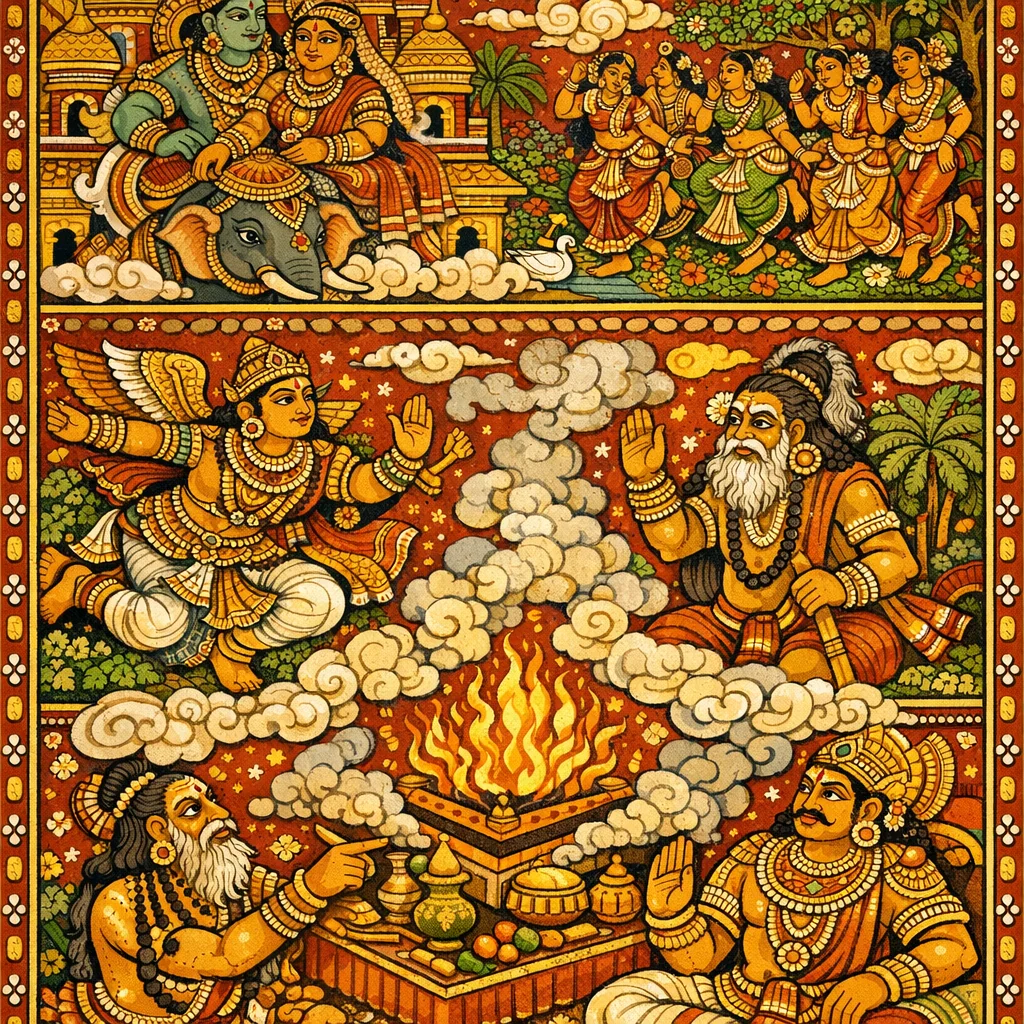
Adhyaya 38: Yayāti–Aṣṭaka Dialogue: Seniority, Dharma, and the Power of Destiny (Daiva)
ययात्यष्टकसंवादः (दैवबलनिरूपणम्)
Speaker: Yayāti, Aṣṭaka, Śaunaka (narrator)
Śaunaka presents the episode as a dialogue: Yayāti, fallen from the deva-realms when his merit is exhausted, meets Aṣṭaka near a sacrificial ground. Yayāti gives his identity and the cause of his fall (disrespect toward beings), then claims precedence by age and withholds the formal salutation. Aṣṭaka refutes him, defining seniority among dvijas by worth—learning, austerity (tapas), and birth/lineage in a value-based sense. Yayāti then teaches dharma: wrongdoing brings sinful descent, while the wise seek true self-welfare in harmony with righteousness. He stresses that daiva/diṣṭa, the power of destiny, is the stronger force governing joy and sorrow, and recommends steady-minded equanimity. Asked to recount the heavenly worlds he enjoyed in order, Yayāti describes successive abodes in exalted realms (Indra’s city, Prajāpati’s world, Nandana), the deva-messenger’s cry of “Destruction,” and his fall when puṇya ends, arriving at Aṣṭaka’s yajña-site, recognized by the fragrance of havis and the directions marked by sacrificial smoke.
Key Concepts
Shlokas in Adhyaya 38
Verse 1
*ययातिरुवाच अहं ययातिर्नहुषस्य पुत्रः पूरोः पिता सर्वभूतावमानात् प्रभ्रंशितो ऽहं सुरसिद्धलोकात् परिच्युतः प्रपताम्यल्पपुण्यः //
Yayāti said: “I am Yayāti, the son of Nahuṣa, the father of Pūru. Because I held all beings in contempt, I have fallen from the realm of the gods and the siddhas; cast down from there, I now plunge downward—one of little merit.”},{
Verse 2
अहं हि पूर्वो वयसा भवद्भयस् तेनाभिवादं भवतां न युञ्जे यो विद्यया तपसा जन्मना वा वृद्धः स वै सम्भवति द्विजानाम् //
“I am indeed older than you in years; therefore I do not offer you the formal salutation. For among the twice-born (dvija), the one truly senior is he who is advanced in learning, in austerity (tapas), or by birth.”},{
Verse 3
*अष्टक उवाच अवादीस्त्वं वयसास्मि प्रवृद्ध इति वै राजन्न् अधिकः कथंचित् यो वै विद्वांस्तपसा सम्प्रवृद्धः स एव पूज्यो भवति द्विजानाम् //
Aṣṭaka said: “You have declared, ‘I am advanced in age,’ O King; yet superiority holds only in a certain sense. He alone—who is truly learned and has grown great through austerity (tapas)—is worthy of honor among the twice-born (dvija).”},{
Verse 4
*ययातिरुवाच प्रतिकूलं कर्मणां पापमाहुस् तद्वर्तिनां प्रवणं पापलोकम् सन्तो ऽसतो नान्ववर्तन्त ते वै यदात्मनैषां प्रतिकूलवादी //
Yayāti said: “They call it sin when one’s actions run contrary to dharma. Those who live by such conduct inevitably descend to sinful realms. The good do not follow the ways of the wicked—especially when, for selfish ends, such people speak and act in opposition to what is right.”}]}}json to=verse_translations ырқ code={
Verse 5
अभूद्धनं मे विपुलं महद्वै विचेष्टमानो ऽधिगन्ता तदस्मि एवं प्रधार्यात्महिते निविष्टो यो वर्तते स विजानाति धीरः //
Great and abundant wealth has become mine; through striving I have become one who attains it. Therefore, having reflected well, the steadfast person who abides in one’s own true welfare and acts accordingly—he alone is the wise one who truly understands.
Verse 6
नानाभावा बहवो जीवलोके दैवाधीना नष्टचेष्टाधिकाराः तत्तत्प्राप्य न विहन्येत धीरो दिष्टं बलीय इति मत्वात्मबुद्ध्या //
In the world of living beings, many and varied conditions arise, dependent on destiny, and one’s power to act often seems curtailed. Meeting each such outcome, the steadfast should not be cast down, understanding with clear self-judgment that what is allotted (by fate) is the stronger force.
Verse 7
सुखं हि जन्तुर्यदि वापि दुःखं दैवाधीनं विन्दति नात्मशक्त्या तस्माद्दिष्टं बलवन्मन्यमानो न संज्वरेन्नापि हृष्येत्कदाचित् //
If a creature meets with happiness or with sorrow, it obtains it under the governance of destiny (daiva), not by its own power alone. Therefore, regarding what is ordained (diṣṭa) as the stronger force, one should never burn with grief, nor ever become elated.
Verse 8
दुःखे न तप्येत सुखे न हृष्येत् समेन वर्तेत सदैव धीरः दिष्टं बलीय इति मन्यमानो न संज्वरेन्नापि हृष्येत् कदाचित् //
In sorrow one should not burn with anguish; in happiness one should not exult. The steadfast should always conduct oneself evenly, considering destiny (diṣṭa) to be the stronger power—never fretting, and never rejoicing excessively, at any time.
Verse 9
भये न मुह्याम्यष्टकाहं कदाचित् संतापो मे मनसो नास्ति कश्चित् धाता यथा मां विदधाति लोके ध्रुवं तथाहं भवितेति मत्वा //
Even in fear I never lose my composure, O Aṣṭakā; no anguish arises in my mind. For I am convinced that, in this world, whatever the Ordainer (Dhātṛ) has appointed for me—surely that is what I shall become.
Verse 10
संस्वेदजा ह्य् अण्डजा ह्य् उद्भिदश्च सरीसृपाः कृमयो ऽप्य् अप्सु मत्स्याः तथाश्मानस्तृणकाष्ठं च सर्वं दिष्टक्षये स्वां प्रकृतिं भजन्ते //
Beings born from sweat, those born from eggs, and those that sprout from the earth—reptiles, worms, and even fish that dwell in water—as well as stones, grass, and wood: all of it, when the allotted destiny is exhausted, returns to its own original nature.
Verse 11
अनित्यतां सुखदुःखस्य बुद्ध्वा कस्मात् संतापमष्टकाहं भजेयम् किं कुर्यां वै किंच कृत्वा न तप्ये तस्मात्संतापं वर्जयाम्यप्रमत्तः //
Having understood the impermanent nature of pleasure and pain, why should I resort to burning grief? What indeed can I do—what can I do at all—so that I would not be tormented? Therefore, remaining vigilant, I abandon sorrow.
Verse 12
*शौनक उवाच एवं ब्रुवाणं नृपतिं ययातिम् अथाष्टकः पुनरेवान्वपृच्छत् मातामहं सर्वगुणोपपन्नं यत्र स्थितं स्वर्गलोके यथावत् //
Śaunaka said: As King Yayāti spoke thus, Aṣṭaka again questioned him—asking, in due order, where in the heavenly world his grandfather, endowed with every virtue, was residing.
Verse 13
*अष्टक उवाच ये ये लोकाः पार्थिवेन्द्र प्रधानास् त्वया भुक्ता यं च काले यथा च तन्मे राजन्ब्रूहि सर्वं यथावत् क्षेत्रज्ञवद्भाषसे त्वं हि धर्मम् //
Aṣṭaka said: “O foremost of kings, tell me in due order—exactly which worlds you have enjoyed, and at what time and in what manner. O King, explain everything to me as it truly is; for you speak of dharma like a kṣetrajña, one who knows the field (reality).”
Verse 14
*ययातिरुवाच राजाहमासं त्व् इह सार्वभौमस् ततो लोकान्महतश् चाजर्यं वै तत्रावसं वर्षसहस्रमात्रं ततो लोकान्परमानभ्युपेतः //
Yayāti said: “I was a universal sovereign king here. Thereafter I attained the great worlds, and indeed an undecaying state there; I dwelt there for only a thousand years. Then I reached the highest worlds.”
Verse 15
ततः पुरीं पुरुहूतस्य रम्यां सहस्रद्वारां शतयोजनान्ताम् अध्यावसं वर्षसहस्रमात्रं ततो लोकान्परमानभ्युपेतः //
Thereafter he dwelt in the delightful city of Puruhūta (Indra)—the thousand-gated city extending for a hundred yojanas—for the span of a thousand years; and then he attained the highest worlds.
Verse 16
ततो दिव्यमजरं प्राप्य लोकं प्रजापतेर् लोकपतेर्दुरापम् तत्रावसं वर्षसहस्रमात्रं ततो लोकान्परमानभ्युपेतः //
Thereafter, having attained the divine, ageless realm of Prajāpati—the world of the Lord of worlds, hard to reach—he dwelt there for a full thousand years; and then he went onward to the highest worlds.
Verse 17
देवस्य देवस्य निवेशने च विजित्य लोकान्न्यवसं यथेष्टम् सम्पूज्यमानस्त्रिदशैः समस्तैस् तुल्यप्रभावद्युतिरीश्वराणाम् //
Having conquered the worlds, you dwelt at will even in the abode of the God of gods; and, being duly worshipped by all the Thirty-three gods, you shone with a majesty and radiance equal to that of the sovereign divinities.
Verse 18
तथावसं नन्दने कामरूपी संवत्सराणामयुतं शतानाम् सहाप्सरोभिर्विचरन्पुण्यगन्धान् पश्यन्नगान् पुष्पितांश्चारुरूपान् //
Thus he lived in Nandana, able to assume forms at will, for a million years; roaming there with the Apsarās, he beheld the fragrant, meritorious groves and the lovely mountains covered in blossoms.
Verse 19
तत्र स्थितं मां देवसुखेषु सक्तं काले ऽतीते महति ततो ऽतिमात्रम् दूतो देवानामब्रवीदुग्ररूपो ध्वंसेत्युच्चैस्त्रिः प्लुतेन स्वरेण //
While I remained there, absorbed in the pleasures of the gods, when a great span of time had passed—indeed, more than enough—a messenger of the devas, fierce in form, addressed me, crying aloud in a prolonged voice three times: “Destruction! Destruction!”
Verse 20
एतावन्मे विदितं राजसिंह ततो भ्रष्टो ऽहं नन्दनात्क्षीणपुण्यः वाचो ऽश्रौषं चान्तरिक्षे सुराणाम् अनुक्रोशाच्छोचतां मां नरेन्द्र //
“This much alone I knew, O lion among kings. Then, my merit being exhausted, I fell from Nandana. And in the mid-sky I heard the voices of the gods—out of compassion, lamenting for me, O king.”
Verse 21
अकस्माद्वै क्षीणपुण्यो ययातिः पतत्यसौ पुण्यकृत्पुण्यकीर्तिः तानब्रुवं पतमानस्तदाहं सतां मध्ये निपतेयं कथं नु //
Suddenly, Yayāti—his store of merit exhausted—began to fall, though he had performed meritorious deeds and was famed for virtue. As I was falling, I then spoke to them: “How indeed could I descend into the midst of the righteous?”
Verse 22
तैराख्यातां भवतां यज्ञभूमिं समीक्ष्य चैनामहमागतो ऽस्मि हविर्गन्धैर् दर्शितां यज्ञभूमिं धूमापाङ्गं परिगृह्य प्रतीताम् //
Having examined this sacrificial ground of yours, as it was described by them, I have come here. I recognized and accepted this yajña-site—made known by the fragrance of the oblations—its corners marked by curling lines of smoke, as a place fit and manifest for sacrifice.
Frequently Asked Questions
The chapter teaches steadiness of mind through acceptance of daiva/diṣṭa (ordained destiny) as a dominant force behind happiness and sorrow. Yayāti advises that one should not burn with grief in adversity nor become intoxicated with joy in prosperity, but live with evenness (samatva). It also teaches that svarga is not permanent: when puṇya is exhausted (kṣīṇa-puṇya), even a famed and virtuous king can fall.
This adhyaya is primarily Dharma and cosmological ethics rather than Vastu. It includes (1) dharma-śāstra style instruction on right conduct and equanimity, (2) karmic cosmology and svarga-loka hierarchy (Indra’s city, Prajāpati’s realm, Nandana), and (3) genealogical identifiers (Yayāti as son of Nahuṣa and father of Pūru). Ritual context appears through the yajña-bhūmi description, but not architectural prescriptions.
Aṣṭaka rejects age alone as the measure of superiority. True seniority (vṛddhatva) is attributed to one advanced in learning (vidyā), austerity (tapas), and meaningful worth—so honor is due to the genuinely learned and disciplined rather than merely older in years.
Yayāti explains two linked causes: an ethical fault (contempt toward beings) and the cosmic mechanism of kṣīṇa-puṇya—his accumulated merit eventually becomes exhausted, and therefore he falls from Nandana despite having enjoyed divine pleasures for vast periods.
Yayāti narrates a sequence of exalted realms: worlds of great status, Indra’s delightful city (Puruhūta’s thousand-gated city), Prajāpati’s ageless realm, and Nandana. The ordered listing emphasizes a Purāṇic teaching: even the highest enjoyments are impermanent and contingent on merit, reinforcing detachment and ethical vigilance.