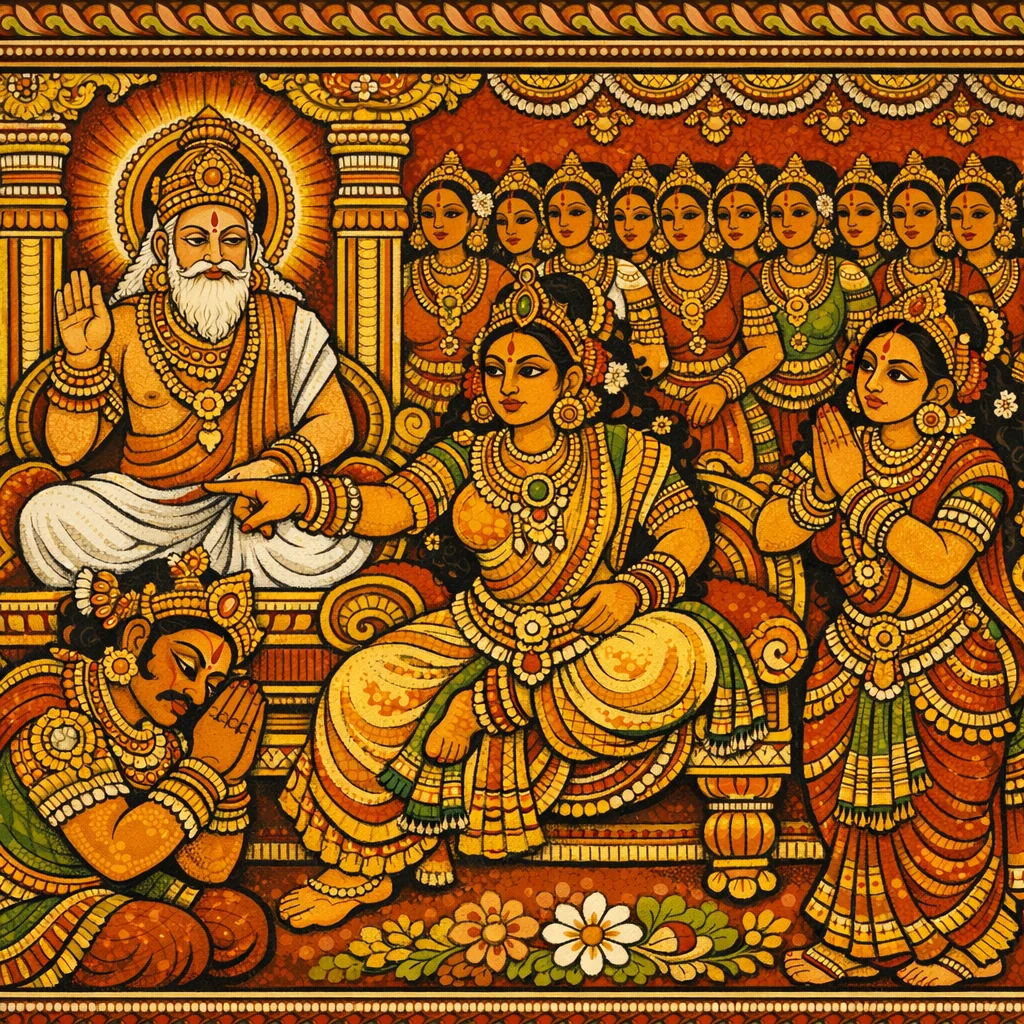
Adhyaya 29: Śukra Warns Vṛṣaparvan: The Ripening of Adharma and Devayānī’s Demand for Śarmiṣṭhā as Attendant
देवयानी-शर्मिष्ठा-दासीभावप्रतिज्ञा
Speaker: Śaunaka (narrator), Śukra (Kāvya–Bhārgava), Vṛṣaparvan, Devayānī, Śarmiṣṭhā, Nurse (Dhātrī)
Śaunaka recounts Śukra’s confrontation with Vṛṣaparvan: Śukra declares that adharma bears fruit slowly but unfailingly, and warns that killing the brāhmaṇa Kaca will make sin “ripen” at once. He threatens to abandon the king and his realm, accusing him of neglecting his own daughter. Vṛṣaparvan pleads, even speaking of entering the ocean as a last refuge; Śukra insists Devayānī must be appeased. The king offers wealth and any boon. Devayānī demands that the king himself confirm Śukra’s authority over Asura wealth, then asks for Śarmiṣṭhā, with a thousand maidens, to serve her and accompany her to her marriage destination. Vṛṣaparvan agrees; the nurse summons Śarmiṣṭhā, who accepts servitude to protect her kin. Devayānī asserts social superiority, Śarmiṣṭhā reiterates her sacrifice, and Śukra re-enters the city honored by the Dānavas.
Key Concepts
Shlokas in Adhyaya 29
Verse 1
*शौनक उवाच ततः काव्यो भृगुश्रेष्ठः समन्युरुपगम्य ह वृषपर्वाणम् आसीनम् इत्युवाचाविचारयन् //
Śaunaka said: Then Kāvya—Śukra, foremost among the Bhṛgus—approached Vṛṣaparvan as he sat, filled with pent-up anger, and spoke to him without deliberation.
Verse 2
नाधर्मश्चरितो राजन् सद्यः फलति गौर् इव शनैरावर्त्यमानस्तु मूलान्यपि निकृन्तति //
O King, adharma does not bear fruit at once—like a cow that yields milk only in due season; but when it steadily accumulates and returns upon a person, it cuts down even the very roots of prosperity and life.
Verse 3
यदि नात्मनि पुत्रेषु न चेत्पश्यति नप्तृषु पापमाचरितं कर्म त्रिवर्गमतिवर्तते //
If a person does not perceive (the consequences of) sinful conduct in oneself, nor in one’s sons, nor even in one’s grandsons, that sin—once committed—nevertheless oversteps the (supposed gains of the) three aims of life (dharma, artha, and kāma).
Verse 4
फलत्येवं ध्रुवं पापं गुरुभुक्तमिवोदरे यदा घातयसे विप्रं कचमाङ्गिरसं तदा //
Thus sin surely ripens—like a heavy meal digested in the belly—at the very moment you strike down the Brahmin Kaca, the descendant of Aṅgiras.
Verse 5
अपापशीलं धर्मज्ञं शुश्रूषुं मद्गृहे रतम् वधादनर्हतस्तस्य वधाच्च दुहितुर्मम //
He is of blameless conduct, a knower of dharma, devoted to service, and attached to my household. He does not deserve to be slain; and by slaying him, my daughter too would be (as good as) slain.
Verse 6
वृषपर्वन्निबोध त्वं त्यक्ष्यामि त्वां सबान्धवम् स्थातुं त्वद्विषये राजन् न शक्नोमि त्वया सह //
O Vṛṣaparvan, understand this: I will abandon you together with your kinsmen. O king, I am not able to remain in your dominion in your presence.
Verse 7
अद्यैवमभिजानामि दैत्यं मिथ्याप्रलापिनम् यतस्त्वमात्मनोदीर्णां दुहितां किमुपेक्षसे //
Now I understand you for what you are—an asura who speaks falsely. For how can you neglect your own daughter, born of your very self?
Verse 8
*वृषपर्वोवाच नावद्यं न मृषावादं त्वयि जानामि भार्गव त्वयि सत्यं च धर्मश्च तत्प्रसीदतु मां भवान् //
Vṛṣaparvan said: “O Bhārgava, I know of no fault in you, nor any falsehood. In you abide truth and dharma; therefore, be gracious to me.”
Verse 9
अद्यास्मानपहाय त्वम् इतो यास्यसि भार्गव समुद्रं सम्प्रवेक्ष्यामि नान्यदस्ति परायणम् //
“Today, leaving us behind, you will depart from here, O Bhārgava. I shall enter the ocean—there is no other refuge for me.”
Verse 10
*शुक्र उवाच समुद्रं प्रविशध्वं वो दिशो वा व्रजतासुराः दुहितुर्नाप्रियं सोढुं शक्तो ऽहं दयिता हि मे //
Śukra said: “O Asuras, enter the ocean at once—or else flee to the quarters. I cannot endure what is displeasing to my daughter, for she is dear to me.”
Verse 11
प्रसाद्यतां देवयानी जीवितं यत्र मे स्थितम् योगक्षेमकरस्ते ऽहम् इन्द्रस्येव बृहस्पतिः //
“Let Devayānī be graciously reconciled, for my very life depends upon her. I shall be your bringer of yoga-kṣema—welfare and security—like Bṛhaspati to Indra.”
Verse 12
*वृषपर्वोवाच यत्किंचिद् असुरेन्द्राणां विद्यते वसु भार्गव भुवि हस्तिरथाश्वं वा तस्य त्वं मम चेश्वरः //
Vṛṣaparvan said: “O Bhārgava, whatever wealth belongs to the lords of the Asuras—whether on earth it be elephants, chariots, or horses—over all of that you are the master, and so am I.”
Verse 13
*शुक्र उवाच यत्किंचिद् अस्ति द्रविणं दैत्येन्द्राणां महासुर तस्येश्वरो ऽस्मि यद्येतद् देवयानी प्रसाद्यताम् //
Śukra said: “O great Asura, whatever wealth belongs to the lords of the Daityas—I am its master. If this be so, then let Devayānī be appeased and shown favor.”
Verse 14
*शौनक उवाच ततस्तु त्वरितः शुक्रस् तेन राज्ञा समं ययौ उवाच चैनां सुभगे प्रतिपन्नं वचस्तव //
Śaunaka said: Then Śukra, acting swiftly, went together with that king; and he addressed her, “O fortunate one, your words are well-considered and rightly understood.”
Verse 15
*देवयान्युवाच यदि त्वमीश्वरस्तात राज्ञो वित्तस्य भार्गव नाभिजानामि तत्ते ऽहं राजा वदतु मां स्वयम् //
Devayānī said: “If you, dear one, are indeed the master of the king’s wealth, O Bhārgava, then I do not understand your claim. Let the king himself declare it to me.”
Verse 16
*वृषपर्वोवाच यं काममभिजानासि देवयानि शुचिस्मिते तत्ते ऽहं सम्प्रदास्यामि यद्यपि स्यात्सुदुर्लभम् //
Vṛṣaparvan said: “O Devayānī of pure smiles, whatever desire you have in mind—though it may be exceedingly difficult to obtain—I shall grant it to you.”
Verse 17
*देवयान्युवाच दासीं कन्यासहस्रेण शर्मिष्ठामभिकामये अनुयास्यति मां तत्र यत्र दास्यति मे पिता //
Devayānī said: “I desire Śarmiṣṭhā as my maidservant, together with a thousand maidens. She shall accompany me to the place where my father will give me (in marriage).”
Verse 18
*वृषपर्वोवाच उत्तिष्ठ धात्रि गच्छ त्वं शर्मिष्ठां शीघ्रमानय यं च कामयते कामं देवयानी करोतु तम् //
Vṛṣaparvan said: “Rise, nurse. Go and quickly bring Śarmiṣṭhā. And whatever desire Devayānī longs for—let her have that fulfilled.”
Verse 19
*शौनक उवाच ततो धात्री तत्र गत्वा शर्मिष्ठाम् इदमब्रवीत् उत्तिष्ठ भद्रे शर्मिष्ठे ज्ञातीनां सुखमावह //
Śaunaka said: Then the nurse went there and spoke to Śarmiṣṭhā: “Rise, noble Śarmiṣṭhā; bring comfort and well-being to your kinsfolk.”
Verse 20
त्यजति ब्राह्मणः शिष्यान् देवयान्या प्रचोदितः यं सा कामयते कामं स कार्यो ऽत्र त्वयानघे दासीत्वम् अभिजातासि देवयान्याः सुशोभने //
Urged on by Devayānī, the brāhmaṇa (Kaca) abandons his disciples. O sinless one, you must carry out here whatever desire she longs for. O fair one, you have been born to be Devayānī’s maidservant.
Verse 21
*शर्मिष्ठोवाच यं च कामयते कामं करवाण्यहमद्य तम् मा गान्मन्युवशं शुक्रो देवयानी च मत्कृते //
Śarmiṣṭhā said: “Whatever desire she longs for, I shall fulfill that wish today. Let not Śukra and Devayānī, because of me, fall under the sway of anger.”
Verse 22
*शौनक उवाच ततः कन्यासहस्रेण वृता शिबिकया तदा पितुर्निदेशात्त्वरिता निश्चक्राम पुरोत्तमात् //
Śaunaka said: Then, surrounded by a thousand maidens and seated in a palanquin, she—hastening at her father’s command—set out from the excellent city.
Verse 23
*शर्मिष्ठोवाच अहं कन्यासहस्रेण दाशी ते परिचारिका ध्रुवं त्वां तत्र यास्यामि यत्र दास्यति ते पिता //
Śarmiṣṭhā said: “I, together with a thousand maidens, shall be your slave and attendant. I will surely go with you to that place where your father will give you (in marriage).”
Verse 24
*देवयान्युवाच स्तुवतो दुहिता चाहं याचतः प्रतिगृह्णतः स्तूयमानस्य दुहिता कथं दासी भविष्यसि //
Devayānī said: “I am the daughter of one who is praised; and you are the daughter of one who begs and accepts. When I am the daughter of the praised, how could you become my maidservant?”
Verse 25
*शर्मिष्ठोवाच येन केनचिदार्तानां ज्ञातीनां सुखमावहेत् अनुयास्याम्यहं तत्र यत्र दास्यति ते पिता //
Śarmiṣṭhā said: “By whatever means it may be, if it can bring comfort to my afflicted kinsfolk, I will go there—wherever your father will give (or assign) me.”
Verse 26
*शौनक उवाच प्रतिश्रुते दासभावे दुहित्रा वृषपर्वणः देवयानी नृपश्रेष्ठ पितरं वाक्यमब्रवीत् //
Śaunaka said: O best of kings, when Vṛṣaparvan’s daughter had promised to become a servant, Devayānī spoke these words to her father.
Verse 27
*देवयान्युवाच प्रविशामि पुरं तात तुष्टास्मि द्विजसत्तम अमोघं तव विज्ञानम् अस्ति विद्याबलं च ते //
Devayānī said: “Father, I shall enter the city. I am satisfied, O best of Brahmins. Unfailing is your discernment, and the power of your learning is truly yours.”
Verse 28
*शौनक उवाच एवमुक्तो द्विजश्रेष्ठो दुहित्रा सुमहायशाः प्रविवेश पुरं हृष्टः पूजितः सर्वदानवैः //
Śaunaka said: Thus addressed, the foremost of the twice-born sages, of very great renown, entered the city with his daughter, delighted, and was honored by all the Dānavas.
Frequently Asked Questions
The chapter teaches that adharma does not always produce immediate results, but it accumulates and eventually destroys prosperity at its roots. It also presents a rājadharma lesson: a ruler’s neglect of justice—especially toward dependents like one’s own daughter—and harm to a brāhmaṇa (Kaca) destabilize the kingdom by driving away the preceptor (Śukra), whose presence is linked to the state’s welfare and security.
This adhyāya is primarily Dharma and narrative-genealogy oriented. It focuses on moral causality (pāpa-phala), protection of brāhmaṇas, the king’s duty to uphold justice, and the Devayānī–Śarmiṣṭhā arrangement that becomes significant for later Puranic genealogical developments. Vastu or architectural prescriptions are not discussed in this chapter.