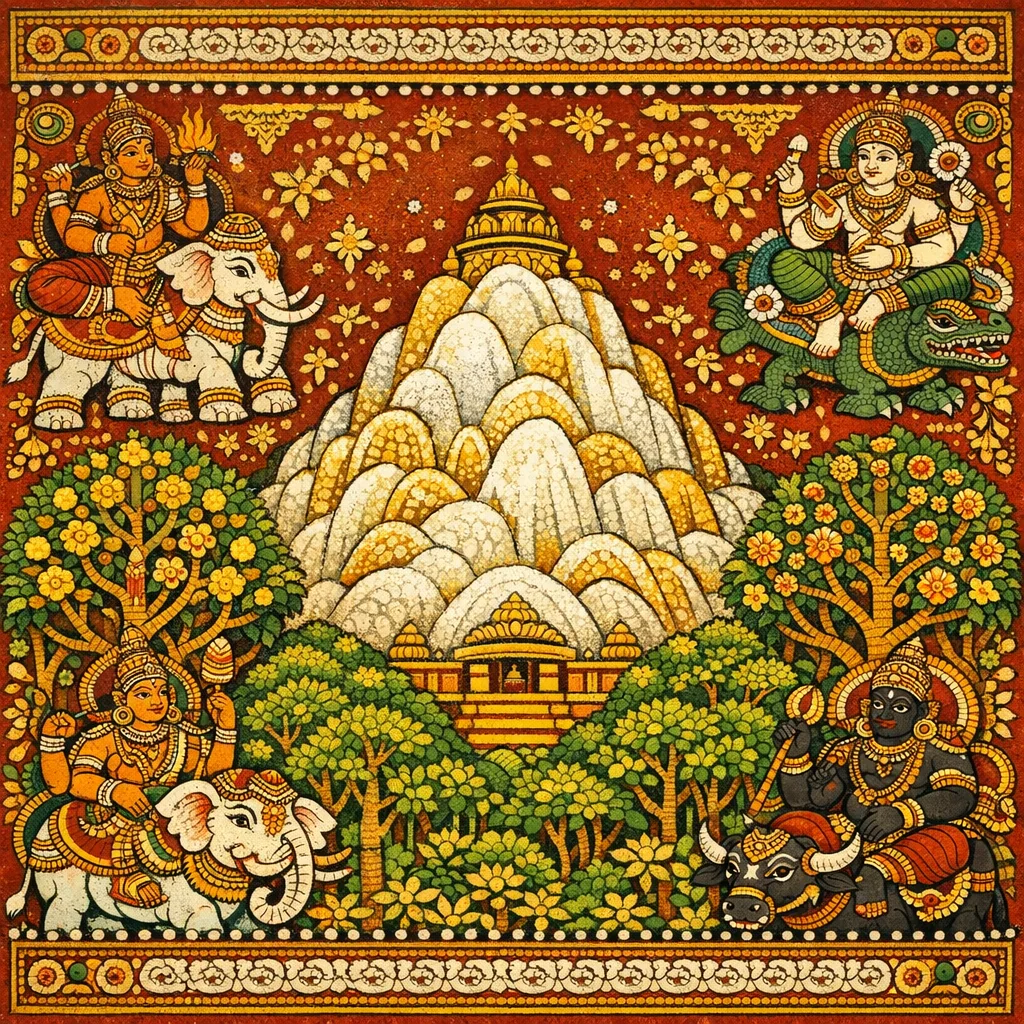
Adhyaya 92: Rite of Donating the ‘Sugar Mountain’ (Śarkarā-Śaila Dāna) and Its Merit
शर्कराशैलदानविधिः (शर्कराचल-प्रदानम्)
Speaker: Īśvara (the Lord, as narrator/teacher), Vasiṣṭha (in the embedded exemplum), The King (listener in the exemplum), Nārada (addressed within the narrative)
Īśvara teaches the rite for constructing and offering the Śarkarā-śaila, the “Sugar Mountain,” following the earlier Dhānya-parvata model: the mountain’s grade is fixed by bhāra-weight; a central Meru is arranged; three golden sacred trees are installed; fragrant groves are planted on the slopes; and specified deities/symbols are set facing prescribed directions. After invocation and the full ritual sequence, the donor gives the middle mountain to the guru and the remaining mountains to the officiants, reciting protective and merit-bestowing mantras that recount Śarkarācala’s origin from droplets of amṛta. The chapter then illustrates karmic causality in dialogue: a king asks Vasiṣṭha why his fortune and radiance are unmatched, and Vasiṣṭha explains past-life causes—Līlāvatī’s faithful mountain-gift and a poor goldsmith’s dharmic honesty—ripening into present sovereignty. It concludes by urging performance of the complete set of ten mountain-gifts (beginning with Dhānyācala) and affirms that even devoted witnessing, touching, hearing, and approving of such gifts removes sin and grants heaven.
Key Concepts
Shlokas in Adhyaya 92
Verse 1
*ईश्वर उवाच अथातः सम्प्रवक्ष्यामि शर्कराशैलमुत्तमम् यस्य प्रदानाद्विष्ण्वर्करुद्रास्तुष्यन्ति सर्वदा //
Īśvara said: “Now I shall fully explain the excellent ‘Śarkarā-śaila’ (the gift of a mountain-like heap of śarkarā). By offering it, Viṣṇu, Arka (the Sun), and Rudra are ever pleased.”
Verse 2
अष्टाभिः शर्कराभारैर् उत्तमः स्यान्महाचलः चतुर्भिर्मध्यमः प्रोक्तो भाराभ्यामधमः स्मृतः //
A Mahācala is held to be of the highest grade when it weighs eight bhāras of śarkarā; it is declared middling when it weighs four, and is remembered as inferior when it weighs two bhāras.
Verse 3
भारेण वार्धभारेण कुर्याद्यः स्वल्पवित्तवान् विष्कम्भपर्वतान्कुर्यात् तुरीयांशेन मानवः //
A man of limited means should build taking one bhāra—or even a half-bhāra—as his standard; and he should make the transverse supports (viṣkambha-parvatas) at one-fourth of that measure, O Manu.
Verse 4
धान्यपर्वतवत्सर्वम् आसाद्यामरसंयुतम् मेरोरुपरि तद्वच्च स्थाप्यं हेमतरुत्रयम् //
Having arranged everything in the manner of a “mountain of grain” and furnished it with offerings fit for the Immortals, one should likewise place, upon the central Meru, a triad of golden trees.
Verse 5
मन्दारः पारिजातश्च तृतीयः कल्पपादपः एतद्वृक्षत्रयं मूर्ध्नि सर्वेष्वपि नियोजयेत् //
Mandāra, Pārijāta, and thirdly the wish-fulfilling Kalpa-tree (Kalpa-pādapa)—this triad of sacred trees should be set upon the head, the uppermost part, in all cases.
Verse 6
हरिचन्दनसंतानौ पूर्वपश्चिमभागयोः निवेश्यौ सर्वशैलेषु विशेषाच्छर्कराचले //
Groves of haricandana and sandalwood should be planted on the eastern and western sides of all mountains—most especially upon Śarkarācala, the Sugar Mountain.
Verse 7
मन्दरे कामदेवस्तु प्रत्यग्वक्त्रः सदा भवेत् गन्धमादनशृङ्गे तु धनदः स्यादुदङ्मुखः //
On Mount Mandara, Kāmadeva should always be installed facing west; and on the peak of Gandhamādana, Dhanada (Kubera), the Lord of wealth, should be installed facing north.
Verse 8
प्राङ्मुखो वेदमूर्तिस्तु हंसः स्याद्विपुलाचले हैमी सुपार्श्वे सुरभिर् दक्षिणाभिमुखी भवेत् //
Facing east, the Swan—embodying the Vedas—should be installed upon the broad mountain. On its auspicious flank the golden image should be placed, and Surabhī, the wish-fulfilling cow, should be set facing south.
Verse 9
धान्यपर्वतवत्सर्वम् आवाहनविधानकम् कृत्वा तु गुरवे दद्यान् मध्यमं पर्वतोत्तमम् ऋत्विग्भ्यश् चतुरः शैलान् इमान्मन्त्रानुदीरयन् //
Having performed the entire rite of invocation (āvāhana) and the full procedure exactly as in the offering of the “Mountain of Grain,” one should present to one’s guru the excellent middle mountain; and then, reciting these mantras, give the four other mountains to the officiating priests (ṛtvij).
Verse 10
सौभाग्यामृतसारो ऽयं पर्वतः शर्करायुतः तस्मादानन्दकारी त्वं भव शैलेन्द्र सर्वदा //
This mountain is the very essence of the nectar of good fortune, rich with gravel and pebbles; therefore, O lord among mountains, be forever a giver of joy.
Verse 11
अमृतं पिबतां ये तु निपेतुर्भुवि शीकराः देवानां तत्समुत्थस्त्वं पाहि नः शर्कराचल //
O Śarkarācala (mountain), protect us—you who arose from the gods—for the droplets that fell upon the earth from those drinking the nectar of immortality became you.
Verse 12
मनोभवधनुर्मध्याद् उद्भूता शर्करा यतः तन्मयो ऽसि महाशैल पाहि संसारसागरात् //
O great mountain, since the pebble (śarkarā) that arose from the middle of Manobhava’s bow is your very substance, you are of its essence; therefore protect me from the ocean of saṃsāra, worldly existence.
Verse 13
यो दद्याच्छर्कराशैलम् अनेन विधिना नरः सर्वपापैर् विनिर्मुक्तः स याति परमं पदम् //
A man who, following this prescribed procedure, donates a “mountain of sugar,” is freed from all sins and attains the supreme state.
Verse 14
चन्द्रतारार्कसंकाशम् अधिरुह्यानुजीविभिः सहैव यानमातिष्ठेत् तत्र विष्णुप्रचोदितः //
Urged on by Viṣṇu, he should then board the conveyance—shining like the moon, the stars, and the sun—together with his attendants and dependents, and take his place there.
Verse 15
ततः कल्पशतान्ते तु सप्तद्वीपाधिपो भवेत् आयुरारोग्यसम्पन्नो यावज्जन्मार्बुदत्रयम् //
Then, at the end of a hundred kalpas, one becomes the sovereign lord of the seven continents, endowed with long life and perfect health, for as many as three arbuda lifetimes.
Verse 16
भोजनं शक्तितः कुर्यात् सर्वशैलेष्वमत्सरः सर्वत्राक्षारलवणम् अश्नीयात्तदनुज्ञया पर्वतोपस्करान्सर्वान् प्रापयेद्ब्राह्मणालयम् //
Let one take food according to one’s capacity, free from envy in all places and among all communities. Everywhere, with due permission, one should partake only of alkaline and salted fare; and all mountain-produced provisions and supplies should be conveyed to the dwelling-place of Brahmanas.
Verse 17
*ईश्वर उवाच आसीत्पुरा बृहत्कल्पे धर्ममूर्तिर्जनाधिपः सुहृच्छक्रस्य निहता येन दैत्याः सहस्रशः //
The Lord said: In former times, in the great aeon called Bṛhat-kalpa, there was a sovereign among men who was the very embodiment of Dharma. For the sake of Indra (Śakra), his ally, he caused the Daityas to be slain—by the thousands.
Verse 18
सोमसूर्यादयो यस्य तेजसा विगतप्रभाः भवन्ति शतशो येन शत्रवश्चापराजिताः यथेच्छारूपधारी च मनुष्यो ऽप्यपराजितः //
By whose radiance even the Moon, the Sun, and other luminaries lose their brilliance; through whom hundreds of enemies become powerless and are subdued; and by whom a man, assuming whatever form he wishes, becomes unconquerable.
Verse 19
तस्य भानुमती नाम भार्या त्रैलोक्यसुन्दरी लक्ष्मीवद् दिव्यरूपेण निर्जितामरसुन्दरी //
His wife was named Bhānumatī—an enchantress of the three worlds; with a divine beauty like Lakṣmī, she surpassed even the loveliness of the celestial maidens.
Verse 20
राज्ञस्तस्याग्र्यमहिषी प्राणेभ्यो ऽपि गरीयसी दशनारीसहस्राणां मध्ये श्रीरिव राजते //
That king’s chief queen—dearer to him even than his own life-breath—shines among ten thousand women like Śrī (Fortune) herself.
Verse 21
नृपकोटिसहस्रेण न कदाचित्स मुच्यते कदाचिदास्थानगतः पप्रच्छ स पुरोधसम् विस्मयेनावृतो राजा वसिष्ठमृषिसत्तमम् //
Even with thousands of crores of kings, he would never be set free. Once, when he had come to the royal court, the king—overwhelmed with astonishment—questioned his family priest, Vasiṣṭha, the foremost among sages.
Verse 22
*राजोवाच भगवन्केन धर्मेण मम लक्ष्मीरनुत्तमा कस्माच्च विपुलं तेजो मच्छरीरे सदोत्तमम् //
The King said: “O Blessed Lord, by what form of dharma has my prosperity become unsurpassed? And from what cause has abundant, ever-excellent radiance arisen in my body, O best of beings?”
Verse 23
*वसिष्ठ उवाच पुरा लीलावती नाम वेश्या शिवपरायणा तया दत्तश्चतुर्दश्यां गुरवे लवणाचलः हेमवृक्षादिभिः सार्धं यथावद्विधिपूर्वकम् //
Vasiṣṭha said: Formerly there was a courtesan named Līlāvatī, wholly devoted to Śiva. On the fourteenth lunar day, she duly presented to her spiritual preceptor a “mountain of salt,” together with golden trees and other such offerings, in accordance with the proper ritual procedure.
Verse 24
शूद्रः सुवर्णकारश्च नाम्ना शौण्डो ऽभवत्तदा भृत्यो लीलावतीगेहे तेन हेम्ना विनिर्मिताः //
At that time there was a Śūdra who worked as a goldsmith, named Śauṇḍa. He served as a household attendant in Līlāvatī’s home, and with that gold various objects were fashioned.
Verse 25
तरवः सुरमुख्याश्च श्रद्धायुक्तेन पार्थिव अतिरूपेण सम्पन्ना घटयित्वा विना भृतिम् धर्मकार्यमिति ज्ञात्वा न गृह्णाति कथंचन //
O king, even trees and the foremost among the gods—when worship is performed with faith and with excellent, well-prepared offerings—do not accept it in any way if it has been obtained or arranged without proper recompense, understanding that it is an act that must be righteous (dharma).
Verse 26
उज्ज्वालिताश्च तत्पत्न्या सौवर्णामरपादपाः लीलावती गिरेः पार्श्वे परिचर्यां च पार्थिव //
And, O king, his wife caused the golden wish-fulfilling trees to blaze forth in splendor; and Līlāvatī, by the mountain’s side, continued her acts of service and attendance.
Verse 27
कृत्वा ताभ्याम् अशाठ्येन गुरुशुश्रूषणादिकम् सा च लीलावती वेश्याकालेन महतापि च //
Having performed with those two, without deceit, the duties beginning with sincere service to elders and teachers, she—Līlāvatī—also passed through a long span of life as a courtesan.
Verse 28
कालधर्ममनुप्राप्ता कर्मयोगेण नारद सर्वपापविनिर्मुक्ता जगाम शिवमन्दिरम् //
Having reached the destined law of time (the appointed end), O Nārada, and through the discipline of karma-yoga, she—freed from all sins—went to Śiva’s temple, his abode.
Verse 29
यो ऽसौ सुवर्णकारस्तु दरिद्रो ऽप्यतिसत्त्ववान् न मौल्यमादाद्वेश्यातः स भवानिह साम्प्रतम् //
That goldsmith—though poor—was exceedingly virtuous; he took no payment from the courtesan. You are that very man here now.
Verse 30
सप्तद्वीपपतिर्जातः सूर्यायुतसमप्रभः यया सुवर्णकारस्य तरवो हेमनिर्मिताः सम्यगुज्ज्वालिताः पत्न्या सेयं भानुमती तव //
You became the lord of the seven continents, radiant like tens of thousands of suns; and by this wife of yours, Bhānumatī, even the trees fashioned by the goldsmith—made of gold—were made to shine forth perfectly.
Verse 31
उज्ज्वालनादुज्ज्वलरुपमस्याः संजातमस्मिन्भुवनाधिपत्यम् यस्मात्कृतं तत्परिकर्म रात्राव् अनुद्धताभ्यां लवणाचलस्य //
By the rite of kindling the sacred fire, her form became radiant, and from that arose sovereignty over this world. Therefore, that preparatory rite (parikarma) should be performed at night, by two who are humble and unarrogant, at Lavaṇācala (the Salt Mountain).
Verse 32
तस्माच्च लोकेष्वपराजितत्वम् आरोग्यसौभाग्ययुता च लक्ष्मीः तस्मात्त्वमप्यत्र विधानपूर्वं धान्याचलादीन्दशधा कुरुष्व //
Therefore, in the worlds one attains invincibility, and also Lakṣmī—prosperity endowed with health and good fortune. Hence you too, here, in accordance with proper procedure, should perform the tenfold gifts, beginning with the “mountain of grain” (Dhānyācala) and the rest.
Verse 33
तथेति सत्कृत्य स धर्ममूर्तिर् वचो वसिष्ठस्य ददौ च सर्वान् धान्याचलदीञ्छतशो मुरारेर् लोकं जगामामरपूज्यमानः //
Saying, “So be it,” that embodiment of Dharma honoured Vasiṣṭha’s words and bestowed them all—mountains of grain and gifts in the hundreds. Thereafter, worshipped by the gods, he went to the world of Murāri (Viṣṇu).
Verse 34
पश्येदपीमानधनो ऽतिभक्त्या स्पृशेन्मनुष्यैरपि दीयमानान् शृणोति भक्त्याथ मतिं ददाति विकल्मषः सो ऽपि दिवं प्रयाति //
Even a poor man, if he beholds them with intense devotion, touches (or reverently receives) what is being given by others, listens with devotion, and then offers counsel (his understanding)—he becomes free from sin, and he too attains heaven.
Verse 35
दुःस्वप्नं प्रशममुपैति पठ्यमानैः शैलेन्द्रैर्भवभयभेदनैर्मनुष्यैः यः कुर्यात्किमु मुनिपुंगवेह सम्यक् शान्तात्मा सकलगिरीन्द्रसम्प्रदानम् //
When these “lords of mountains” (sacred verses) that shatter the fear of worldly existence are recited by people, evil dreams subside and come to rest. If this is so, O best of sages, what more need be said of one who, with a tranquil mind, duly performs the complete offering (sampradāna) of all the mountain-lords?
Frequently Asked Questions
The chapter teaches the full vidhi (procedure) for donating a Śarkarā-śaila—how to size it by bhāra-weight, how to arrange it like a ritual ‘mountain’ with a central Meru, golden sacred trees, fragrant groves, and direction-facing deity placements—along with the mantras and the promised spiritual fruits (sin-removal and attainment of the supreme state).
This adhyāya is primarily Dharma-focused, specifically dāna-dharma and ritual procedure (prayoga). It includes a strong ethical teaching on righteous procurement and fair payment, and it uses an embedded narrative (itihāsa-style exemplum) to explain karmic causality behind prosperity; it is not a Vastu-śāstra chapter nor a genealogical catalog.
A Mahācala is uttama at eight bhāras of śarkarā, madhyama at four bhāras, and adhama at two bhāras. The text also permits smaller standards (one bhāra or half-bhāra) for donors of limited means.
The chapter prescribes directional placements: Kāmadeva on Mandara facing west; Kubera (Dhanada) on Gandhamādana’s peak facing north; the Veda-embodying Swan facing east on the broad mountain; Surabhī facing south; and eastern/western sides planted with haricandana and sandalwood lineages, with three golden trees (Mandāra, Pārijāta, Kalpataru) installed atop the central Meru.
It teaches that ritual gifts must be grounded in dharma: offerings made with faith must be ethically obtained and properly compensated. Līlāvatī’s devoted gifting yields liberation, while the goldsmith’s honest refusal to take improper payment becomes a karmic cause for later royal sovereignty and radiance—showing that both devotion and ethical conduct produce lasting fruit.