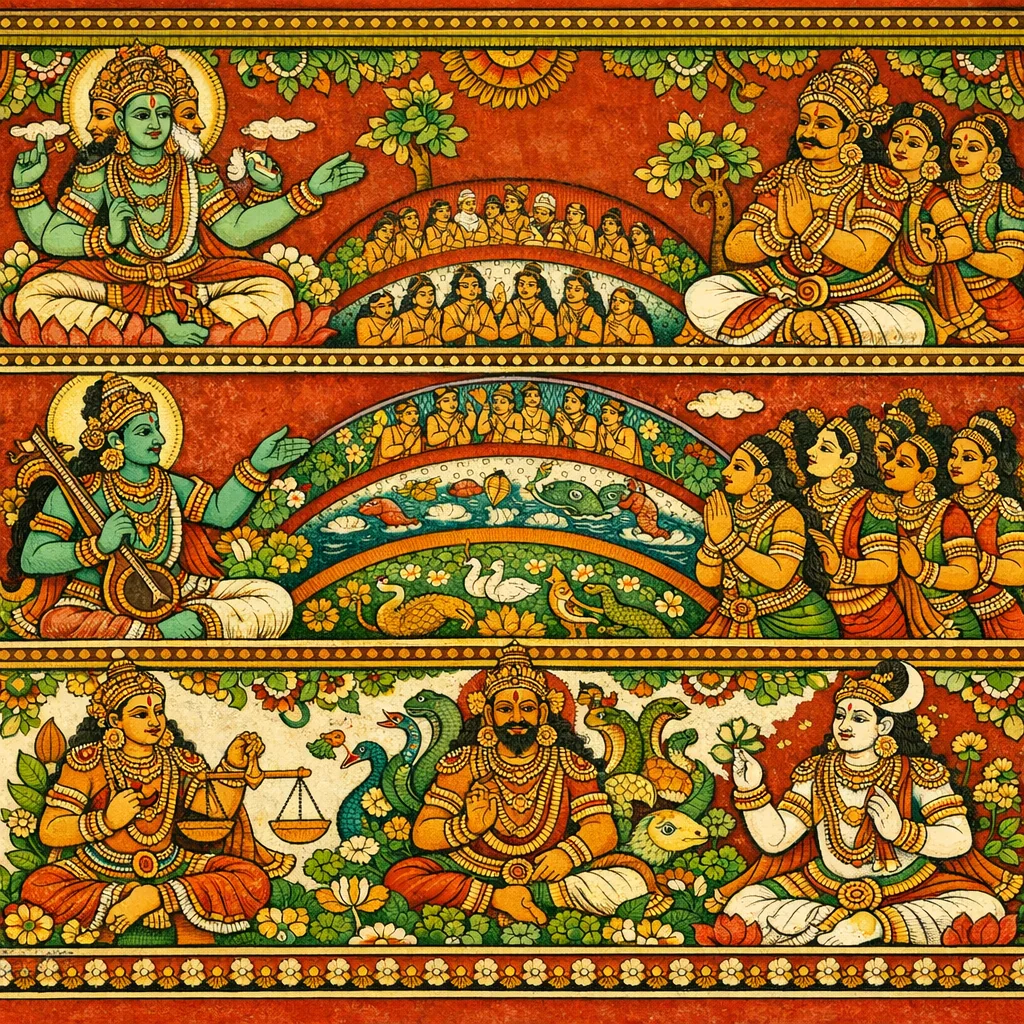
Adhyaya 5: Origins of Gods and Beings: Daksha’s Progeny, Vasus, Rudras, and Viśvakarmā
देवाद्युत्पत्तिवर्णनम् (दक्षप्रजासर्गः)
Speaker: Rishis (Ṛṣayaḥ), Sūta
The sages ask Sūta to explain in detail the origins of many cosmic kinds of beings. Sūta distinguishes the earliest, non-sexual creation from the later sexual generation that begins with Dakṣa. Commanded by Svayambhū Brahmā to create, Dakṣa first produces groups that do not increase the world; he then fathers the Haryaśvas, but Nārada turns them toward measuring and knowing the worlds, and they never return. Dakṣa tries again with the Śabalas; Nārada sends them on the same course, followed by a warning maxim not to trace an elder brother’s path. Dakṣa then begets sixty daughters and gives them to Dharma, Kaśyapa, Soma, Ariṣṭanemi, and others. The chapter elaborates Dharma’s wives and their divine offspring, lists the eight Vasus and their progeny (including Agni’s Kumāra and Kārttikeya), introduces Viśvakarmā as the beneficent divine artisan, and concludes by enumerating Rudra’s forms and his vast mind-born hosts.
Key Concepts
Shlokas in Adhyaya 5
Verse 1
*ऋषय ऊचुः देवानां दानवानां च गन्धर्वोरगरक्षसाम् उत्पत्तिं विस्तरेणैव सूत ब्रूहि यथातथम् //
The sages said: “O Sūta, tell us—truthfully and in full detail—the origin of the gods, the Dānavas, the Gandharvas, the Nāgas, and the Rākṣasas.”
Verse 2
*सूत उवाच संकल्पाद् दर्शनात्स्पर्शात् पूर्वेषां सृष्टिरुच्यते दक्षात्प्राचेतसाद् ऊर्ध्वं सृष्टिर् मैथुनसम्भवा //
Sūta said: The creation of the earlier beings is said to have arisen from mere intention, from sight, and from touch; but from Dakṣa, the son of Pracetā, onward, creation proceeds through sexual union.
Verse 3
प्रजाः सृजेति व्यादिष्टः पूर्वं दक्षः स्वयम्भुवा यथा ससर्ज चैवादौ तथैव शृणुत द्विजाः //
Formerly, Dakṣa was commanded by Svayambhū (Brahmā), “Create the creatures (progeny).” Just as he created them in the beginning, so now listen to it, O twice-born sages.
Verse 4
यदा तु सृजतस्तस्य देवर्षिगणपन्नगान् न वृद्धिम् अगमल्लोकस् तदा मैथुनयोगतः दक्षः पुत्रसहस्राणि पाञ्चजन्यामजीजनत् //
But when, even as he created the hosts of divine seers and the serpent-races, the world did not attain increase, then Dakṣa, through the discipline of procreative union, begot thousands of sons upon Pāñcajanyā.
Verse 5
तांस् तु दृष्ट्वा महाभागः सिसृक्षुर्विविधाः प्रजाः नारदः प्राह हर्यश्वान् दक्षपुत्रान्समागतान् //
Seeing them assembled, the noble sage Nārada—intent on bringing forth diverse progeny—addressed the Haryaśvas, the sons of Dakṣa.
Verse 6
भुवः प्रमाणं सर्वत्र ज्ञात्वोर्ध्वम् अध एव च ततः सृष्टिं विशेषेण कुरुध्वमृषिसत्तमाः //
Having understood everywhere the measured extent of the worlds—both above and below—then, O best of sages, set forth the account of creation in a detailed and specific manner.
Verse 7
ते तु तद्वचनं श्रुत्वा प्रयाताः सर्वतो दिशम् अद्यापि न निवर्तन्ते समुद्रादिव सिन्धवः //
Hearing that command, they set forth in every direction; even now they do not turn back—like rivers that flow onward from the sea.
Verse 8
हर्यश्वेषु प्रनष्टेषु पुनर्दक्षः प्रजापतिः वैरिण्यामेव पुत्राणां सहस्रमसृजत्प्रभुः //
When the Haryaśvas had perished, Dakṣa—the Lordly Prajāpati—once again begot, through Vairiṇī, a thousand sons.
Verse 9
शबला नाम ते विप्राः समेताः सृष्टिहेतवः नारदो ऽनुगतान्प्राह पुनस्तान्पूर्ववत्स तान् //
Those Brahmin sages, known as the Śabalas, assembled together as instruments of creation. Narada, having followed after them, addressed them again, just as before.
Verse 10
भुवः प्रमाणं सर्वत्र ज्ञात्वा भ्रातॄन् अथो पुनः आगत्य चाथ सृष्टिं च करिष्यथ विशेषतः //
Having learned everywhere the measures of the earth/world, and having known your brothers, return again; then you shall carry out the creation—specifically, the special ordering of beings and realms.
Verse 11
ते ऽपि तेनैव मार्गेण जग्मुर्भ्रातृपथा तदा ततः प्रभृति न भ्रातुः कनीयान्मार्गम् इच्छति अन्विष्यन्दुःखमाप्नोति तेन तत्परिवर्जयेत् //
They too then went by that very same route—the path taken by the brother. From that time onward, the younger brother should not seek to take the elder brother’s path; one who pursues it meets with sorrow—therefore one should avoid that course.
Verse 12
ततस्तेषु विनष्टेषु षष्टिं कन्याः प्रजापतिः वैरिण्यां जनयामास दक्षः प्राचेतसस्तथा //
Then, after they had perished, the Prajāpati Dakṣa—son of Prācetas—again begot sixty daughters in Vairiṇī.
Verse 13
प्रादात्स दश धर्माय कश्यपाय त्रयोदश सप्तविंशतिं सोमाय चतस्रो ऽरिष्टनेमये //
He bestowed ten (daughters) upon Dharma, thirteen upon Kaśyapa, twenty-seven upon Soma (the Moon), and four upon Ariṣṭanemi.
Verse 14
द्वे चैव भृगुपुत्राय द्वे कृशाश्वाय धीमते द्वे चैवाङ्गिरसे तद्वत् तासां नामानि विस्तरात् //
Two (daughters) were indeed for the son of Bhṛgu; two for the wise Kṛśāśva; and likewise two for Aṅgiras. Their names are to be stated in detail.
Verse 15
शृणुध्वं देवमातॄणां प्रजाविस्तारम् आदितः मरुत्वती वसुर् यामी लम्बा भानुर् अरुन्धती //
“Hear, from the beginning, the expansion of the progeny of the Divine Mothers: Marutvatī, Vasū, Yāmī, Lambā, Bhānū, and Arundhatī.”
Verse 16
संकल्पा च मुहूर्ता च साध्या विश्वा च भामिनी धर्मपत्न्यः समाख्यातास् तासां पुत्रान् निबोधत //
Saṅkalpā, Muhūrtā, Sādhyā, Viśvā, and Bhāminī are declared to be the righteous wives (of Dharma). Now, learn of their sons.
Verse 17
विश्वे देवास्तु विश्वायाः साध्या साध्यानजीजनत् मरुत्वत्यां मरुत्वन्तो वसोस् तु वसवस्तथा //
From Viśvā were born the Viśvedevas; from Sādhyā were brought forth the Sādhyas. From Marutvatī came the Maruts, and from Vasū likewise arose the Vasus.
Verse 18
भानोस्तु भानवस्तद्वन् मुहूर्तायां मुहूर्तकाः लम्बायां घोषनामानो नागवीथी तु यामिजा //
In the division called Bhānu, the subdivisions are termed Bhānavas; likewise, in the Muhūrta division they are called Muhūrtakas. In the division called Lambā they are known as Ghoṣa-nāmānaḥ; and the Nāgavīthī division is said to be derived from the Yāmas.
Verse 19
पृथिवीतलसम्भूतम् अरुन्धत्याम् अजायत संकल्पायास्तु संकल्पो वसुसृष्टिं निबोधत //
Born upon the surface of the earth, (he) was born of Arundhatī. And from Saṅkalpā was born Saṅkalpa—now understand the creation and lineage of the Vasus.
Verse 20
ज्योतिष्मन्तस्तु ये देवा व्यापकाः सर्वतो दिशम् वसवस्ते समाख्यातास् तेषां सर्गं निबोधत //
Those radiant gods who pervade all directions on every side are known as the Vasus; now understand the account of their creation and origin.
Verse 21
आपो ध्रुवश्च सोमश्च धरश्चैवानिलो ऽनलः प्रत्यूषश्च प्रभासश्च वसवो ऽष्टौ प्रकीर्तिताः //
Āpa, Dhruva, Soma, Dhara, Anila, Anala, Pratyūṣa, and Prabhāsa—these are proclaimed as the eight Vasus.
Verse 22
आपस्य पुत्राश् चत्वारः शान्तो वै दण्ड एव च शाम्बो ऽथ मणिवक्त्रश्च यज्ञरक्षाधिकारिणः //
Āpa had four sons—Śānta, Daṇḍa, Śāmba, and Maṇivaktra—who were appointed as the authorized protectors of sacrificial rites (yajña).
Verse 23
ध्रुवस्य कालः पुत्रस्तु वर्चाः सोमादजायत द्रविणो हव्यवाहश्च धरपुत्राव् उभौ स्मृतौ //
Dhruva’s son was Kāla. From Soma was born Varcas. And Draviṇa and Havyavāha are both remembered as the sons of Dharā.
Verse 24
कल्याणिन्यां ततः प्राणो रमणः शिशिरो ऽपि च मनोहरा धरात्पुत्रान् अवापाथ हरेः सुता //
Thereafter, from Kalyāṇinī were born sons named Prāṇa, Ramaṇa, and also Śiśira; and Manoharā—the daughter of Hari—obtained sons from Dharāt (Dharā’s son).
Verse 25
शिवा मनोजवं पुत्रम् अविज्ञातगतिं तथा अवाप चानलात् पुत्राव् अग्निप्रायगुणौ पुनः //
Śivā bore a son named Manojava, and also another named Avijñātagati. Again, from Anala she obtained two sons whose qualities were largely like those of fire.
Verse 26
अग्निपुत्रः कुमारस्तु शरस्तम्बे व्यजायत तस्य शाखो विशाखश्च नैगमेयश् च पृष्ठजाः //
Kumāra, the son of Agni, was born in a clump of reeds. From him were born Śākha, Viśākha, and Naigameya—sons said to have arisen from his back.
Verse 27
अपत्यं कृत्तिकानां तु कार्त्तिकेयस् ततः स्मृतः प्रत्यूषस ऋषिः पुत्रो विभुर् नाम्नाथ देवलः विश्वकर्मा प्रभासस्य पुत्रः शिल्पी प्रजापतिः //
The offspring of the Kṛttikās is remembered as Kārttikeya. Pratyūṣa had a son, the ṛṣi Vibhu, also known as Devala. Viśvakarmā—Prajāpati, the divine artisan—was the son of Prabhāsa.
Verse 28
प्रासादभवनोद्यानप्रतिमाभूषणादिषु तडागारामकूपेषु स्मृतः सो ऽमरवर्धकिः //
He is remembered as an “increaser of the immortals (the gods)”, promoting divine welfare by building and endowing palaces, houses, gardens, sacred images, ornaments and the like, as well as tanks, pleasure-groves, and wells.
Verse 29
अजैकपादहिर्बुध्न्यो विरूपाक्षो ऽथ रैवतः हरश्च बहुरूपश्च त्र्यम्बकश्च सुरेश्वरः //
Ajaikapāda, Ahirbudhnya, Virūpākṣa, and Raivata; also Hara, Bahurūpa, Tryambaka, and Sureśvara—these are the revered names and forms of Rudra.
Verse 30
सावित्रश्च जयन्तश्च पिनाकी चापराजितः एते रुद्राः समाख्याता एकादश गणेश्वराः //
Sāvitra, Jayanta, Pinākī, and Aparājita—these are declared to be Rudras, the eleven lords of the divine hosts (gaṇas).
Verse 31
एतेषां मानसानां तु त्रिशूलवरधारिणाम् कोटयश्चतुरशीतिस् तत्पुत्राश् चाक्षया मताः //
Of these mind-born beings—bearers of the trident and the boon—there are said to be eighty-four crores (koṭis); and their sons, too, are regarded as imperishable, inexhaustible in number.
Verse 32
दिक्षु सर्वासु ये रक्षां प्रकुर्वन्ति गणेश्वराः पुत्रपौत्रसुताश्चैते सुरभीगर्भसम्भवाः //
Those chiefs of the divine hosts (Gaṇeśvaras) who provide protection in all directions—these are the sons, grandsons, and descendants born from Surabhī’s womb.
Frequently Asked Questions
The chapter’s primary instruction is genealogical-cosmological: it explains how creation transitions from early non-sexual emanation (by intention, sight, touch) to sexual generation from Dakṣa onward, and how divine lineages are ordered through Dakṣa’s progeny. It also embeds a practical dharma maxim—after Nārada leads the elder brothers away, the text warns that a younger brother should not follow an elder brother’s path, because imitation without discernment leads to sorrow.
Genealogy and creation dominate: Dakṣa’s sons (Haryaśvas, Śabalas), Dakṣa’s sixty daughters and their distributions, Dharma’s wives and the births of the Viśvedevas, Sādhyas, Maruts, and Vasus, plus the eight Vasus and their descendants. Dharma appears as the organizing principle behind marriage-alliance cosmology and the cautionary ethical maxim. Vastu appears indirectly through Viśvakarmā—presented as the divine artisan who benefits the gods via palaces, houses, gardens, images, ornaments, tanks, pleasure-groves, and wells—linking cosmology to sacred/royal patronage of building works.
The eight Vasus named are: Āpa, Dhruva, Soma, Dhara, Anila, Anala, Pratyūṣa, and Prabhāsa.
It introduces Viśvakarmā (son of Prabhāsa) as a śilpī-prajāpati who “increases the immortals” through constructed works—palaces, houses, gardens, images, ornaments, tanks, groves, and wells—providing a theological foundation for later Vastu/śilpa discussions where building and endowment are treated as dharmic, world-sustaining acts.