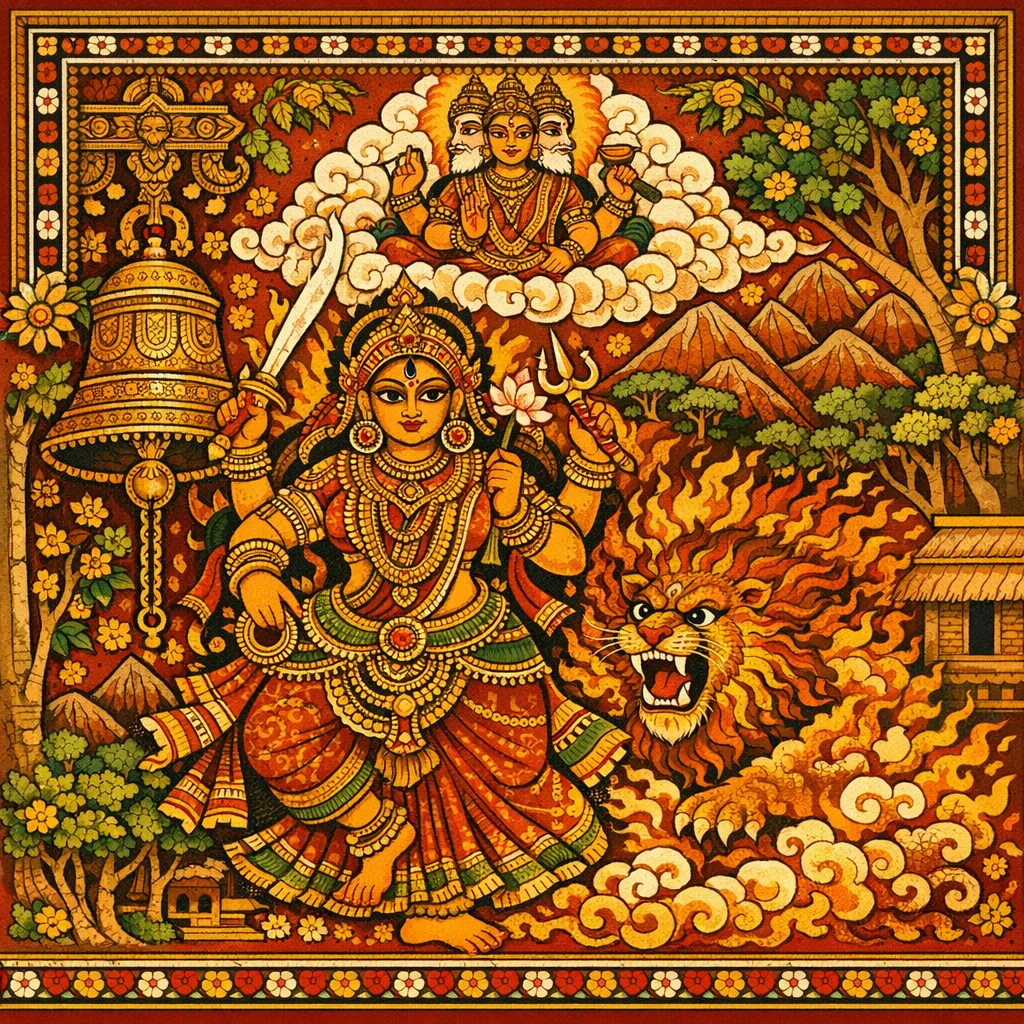
Adhyaya 157: Manifestation of Kauśikī, the Lion-born-from-Wrath, and Vīraka’s Gatekeeping Episode
कौशिकी-प्रादुर्भावः, क्रोधसिंह-उत्पत्तिः, वीरक-द्वारपाल-वृत्तान्तः
Speaker: देवी (गिरिजा/उमा/सती), ब्रह्मा (चतुरानन/कमलासन), वीरक (द्वारपाल)
Within the Purāṇic samvāda frame, the account moves from the Goddess’s admonition and a curse-linked outcome to a fierce surge of wrath that bursts forth as a lion. Sensing her resolve, Brahmā comes to the hermitage, grants a boon, and urges her to end excessive tapas. Girijā states her cause: though she won Śaṅkara by austerity, she is still called “śyāmala-varṇā,” so she casts off the dark, bee-like form and reappears radiant, bearing the Devi-lakṣaṇas. Brahmā affirms her reintegration as Śiva’s half and commissions Kauśikī for a divine mission to Vindhya, giving Ketu as her vehicle and the Yakṣa Pañcāla as attendant. The scene then shifts to Śiva’s doorway, where Vīraka—mindful of an earlier Daitya impersonation and Śiva’s order against lax vigilance—forcefully bars Umā from entry and commands her to depart for many years.
Key Concepts
Shlokas in Adhyaya 157
Verse 1
*देव्युवाच मातरं मा परित्यज्य यस्मात्त्वं स्नेहविक्लवाम् विहितावसरः स्त्रीणां शंकरस्य रहोविधौ //
The Goddess said: “Do not abandon your mother, for you are overcome with affection. In Śaṅkara’s private rite, the proper occasion has been ordained for women.”
Verse 2
तस्मात्ते परुषा रूक्षा जडा हृदयवर्जिता गणेश क्षारसदृशी शिला माता भविष्यति //
Therefore, O Gaṇeśa, for you the mother will become harsh and rough, dry in temperament, dull-witted and devoid of tenderness; she will be like an alkaline, caustic stone.
Verse 3
निमित्तमेतद्विख्यातं वीरकस्य शिलोदये सो ऽभवत्प्रक्रमेणैव विचित्राख्यानसंश्रयः //
This well-known incident became the determining cause for Vīraka in the matter of Śilodaya; and, in due course, it grew into the basis of a wondrous narrative episode.
Verse 4
एवमुत्सृष्टशपाया गिरिपुत्र्यास्त्वनन्तरम् निर्जगाम मुखात्क्रोधः सिंहरूपी महाबलः //
Thus, immediately after the mountain-born goddess had released her curse, her wrath sprang forth from her mouth—taking the form of a powerful lion.
Verse 5
स तु सिंहः करालास्यो जटाजटिलकंधरः प्रोद्धूतलम्बलाङ्गूलो दंष्ट्रोत्कटमुखातटः //
That lion should be portrayed with a gaping, fearsome mouth; with a neck thickly matted with tawny mane; with a long tail flung upward in a vigorous sweep; and with cheeks and jaws made formidable by protruding fangs.
Verse 6
व्यादितास्यो ललज्जिह्वः क्षामकुक्षिश्चिखादिषुः तस्याशु वर्तितुं देवी व्यवस्यत सती तदा //
With his mouth gaping open and his tongue lolling, his belly wasted and hollow, he raged about as if to devour. Seeing him, the Goddess—Satī—then swiftly resolved to intervene against him.
Verse 7
ज्ञात्वा मनोगतं तस्या भगवांश्चतुराननः आजगामाश्रमपदं संपदामाश्रयं तदा आगम्योवाच देवेशो गिरिजां स्पष्टया गिरा //
Knowing what was in her mind, the blessed Four‑faced Lord (Brahmā) then came to that hermitage—an abode and refuge of prosperity. Having arrived, the Lord of the gods addressed Girijā (Pārvatī) in clear and direct words.
Verse 8
*ब्रह्मोवाच किं पुत्रि प्राप्तुकामासि किमलभ्यं ददामि ते विरम्यताम् अतिक्लेशात् तपसो ऽस्मान्मदाज्ञया //
Brahmā said: “What is it, dear daughter, that you desire to obtain? What is unattainable (to you)? I shall grant it to you. Desist from this austerity that brings excessive hardship—by my command, cease this severe tapas.”
Verse 9
तच्छ्रुत्वोवाच गिरिजा गुरोर्गौरत्वगर्भितम् वाक्यं वाचा चिरोद्गीर्णवर्णनिर्णीतवाञ्छितम् //
Having heard that, Girijā (Pārvatī) spoke—her speech bearing the Guru’s profound import—uttering in well-formed words, long held within, what she had resolved and desired.
Verse 10
*देव्युवाच तपसा दुष्करेणाप्तः पतित्वे शंकरो मया स मां श्यामलवर्णेति बहुशः प्रोक्तवान्भवः //
The Goddess said: “By arduous austerities (tapas) I obtained Śaṅkara as my husband; and then Bhava (Śiva) repeatedly addressed me as ‘the dark-complexioned one’ (Śyāmalavarṇā).”
Verse 11
स्यामहं काञ्चनाकारा वाल्लभ्येन च संयुता भर्तुर्भूतपतेरङ्गम् एकतो निर्विशे ऽङ्गवत् //
“I was dark-complexioned, yet golden in form, and endowed with belovedness. From one side, I entered the body of my husband—Bhūtapati, Lord of beings—as though becoming a limb of his.”
Verse 12
तस्यास्तद्भाषितं श्रुत्वा प्रोवाच कमलासनः एवं भव त्वं भूयश्च भर्तृदेहार्धधारिणी //
Hearing her words, the Lotus-seated (Brahmā) spoke: “So be it. Become once again the bearer of half of your husband’s body.”
Verse 13
ततस्तत्याज भृङ्गाङ्गं फुल्लनीलोत्पलत्वचम् //
Then he cast off that bee-like body, whose skin bore the hue of a fully blossomed blue lotus.
Verse 14
त्वचा सा चाभवद्दीप्ता घण्टाहस्ता त्रिलोचना नानाभरणपूर्णाङ्गी पीतकौशेयधारिणी //
Her skin became radiant; she held a bell in her hand, was three-eyed, her whole body adorned with many ornaments, and she wore yellow silk.
Verse 15
तामब्रवीत्ततो ब्रह्मा देवीं नीलाम्बुजत्विषम् निशे भूधरजादेहसम्पर्कात् त्वं ममाज्ञया //
Then Brahmā spoke to that goddess, whose complexion shone like a blue lotus: “O Niśā, by my command, you are to arise from the contact of mountain-born dust with the body.”
Verse 16
सम्प्राप्ता कृतकृत्यत्वम् एकानंशा पुरा ह्यसि य एष सिंहः प्रोद्भूतो देव्याः क्रोधाद्वरानने //
O fair-faced one, you have now attained fulfillment—your purpose is accomplished. Indeed, in former times you were a single undivided portion (of the Divine Power); and this very lion has arisen, born from the Goddess’s wrath.
Verse 17
स ते ऽस्तु वाहनं देवि केतौ चास्तु महाबलः गच्छ विन्ध्याचलं तत्र सुरकार्यं करिष्यसि //
O Goddess, let Ketu be your mount, mighty in strength. Go to Mount Vindhya—there you shall accomplish the work of the gods.
Verse 18
पञ्चालो नाम यक्षो ऽयं यक्षलक्षपदानुगः दत्तस्ते किंकरो देवि मया मायाशतैर्युतः //
“O Goddess, this Yakṣa is named Pañcāla—one who commands the ranks of a hundred-thousand Yakṣas. I have bestowed him upon you as an attendant-servant, endowed by me with hundreds of powers of māyā.”
Verse 19
इत्युक्ता कौशिकी देवी विन्ध्यशैलं जगाम ह उमापि प्राप्तसंकल्पा जगाम गिरिशान्तिकम् //
Thus addressed, the goddess Kauśikī departed for the Vindhya mountain-range; and Umā too, having formed her resolve, went into the presence of Girīśa (Śiva).
Verse 20
प्रविशन्तीं तु तां द्वाराद् अपकृष्य समाहितः रुरोध वीरको देवीं हेमवेत्रलताधरः //
But as she was entering through the doorway, the composed Vīraka pulled her back from the threshold and restrained the Devi, holding a golden cane-staff.
Verse 21
तामुवाच स कोपेन रूपात्तु व्यभिचारिणीम् प्रयोजनं न ते ऽस्तीह गच्छ यावन्न भेत्स्यसे //
Then he said to her in anger, “You are an adulteress, straying from the proper conduct. You have no purpose here—go at once, before you are punished.”
Verse 22
देव्या रूपधरो दैत्यो देवं वञ्चयितुं त्विह प्रविष्टो न च दृष्टो ऽसौ स वै देवेन घातितः //
A Daitya, assuming the very form of the Goddess, entered here intending to deceive the god; but he was recognized, and indeed that one was slain by the deity.
Verse 23
घातिते चाहमाज्ञप्तो नीलकण्ठेन कोपिना द्वारेषु नावधानं ते यस्मात्पश्यामि वै ततः //
Moreover, after the slaying, I was commanded by the wrathful Nīlakaṇṭha: “Because I see that you are not vigilant at the gates, therefore (I issue this order).”
Verse 24
भविष्यसि न मद्द्वाःस्थो वर्षपूगान्यनेकशः अतस्ते ऽत्र न दास्यामि प्रवेशं गम्यतां द्रुतम् //
For countless multitudes of years you shall not remain at my threshold. Therefore I will not grant you entry here—go away quickly.
Frequently Asked Questions
The chapter teaches Śākta-Śaiva theology through narrative: Girijā’s tapas and self-manifestation culminate in Brahmā’s boon affirming her as the bearer of half of Śiva’s body, while divine wrath externalizes as a lion—protective power rather than mere anger. It also stresses threshold-dharma: vigilance at sacred/private spaces is mandatory, shown by Vīraka’s strict gatekeeping after a Daitya’s impersonation.
This adhyāya is primarily Devi theology and dharma (conduct, vigilance, and propriety around Śaṅkara’s rahovidhi/private rite). It is not a Vāstu-śāstra or genealogy chapter; instead, it provides mythic-ritual cues (tapas, private rite context) and iconographic description useful for Devi worship and representation.