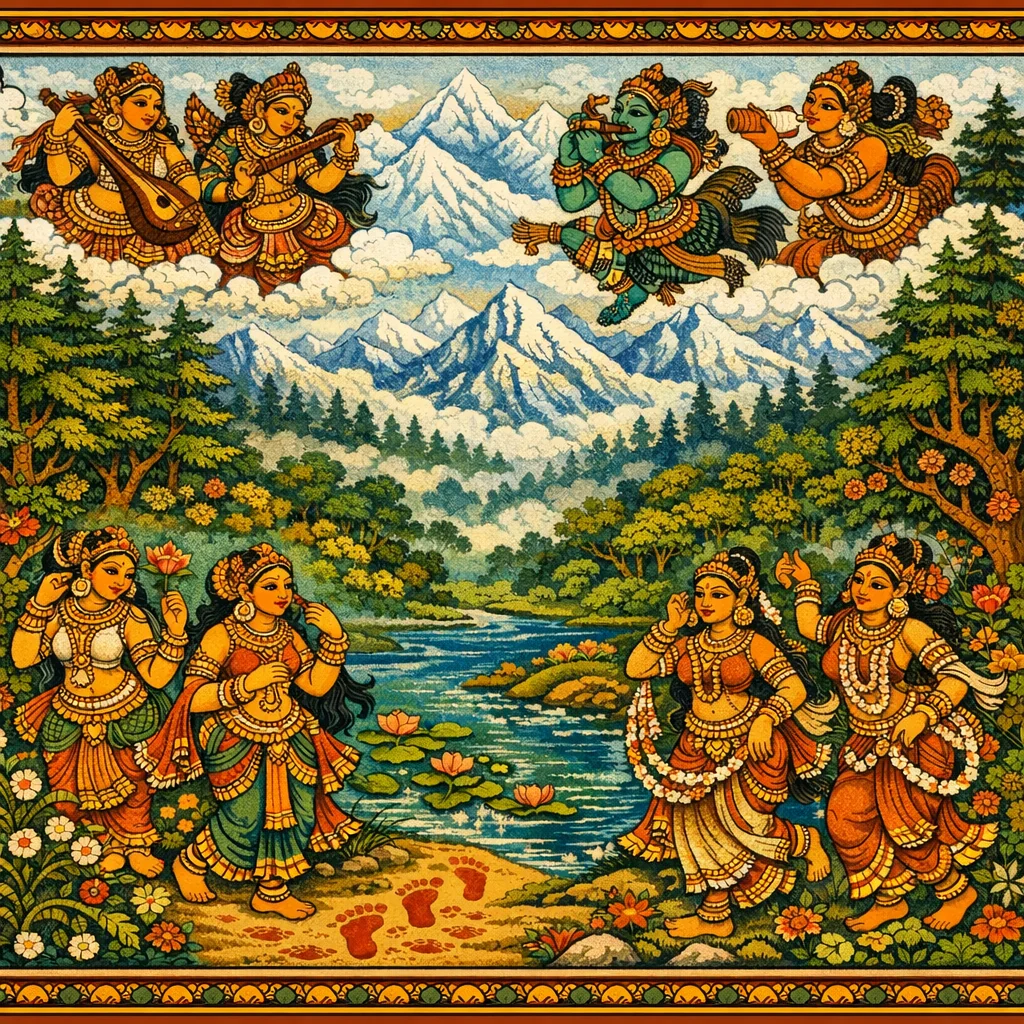
Adhyaya 117: Description of Himavat (Himalaya): Sacred Landscape, Omens, and Divine Inhabitants
हिमवत्पर्वतवर्णनम्
Speaker: Sūta
Sūta relates that a king, refreshed by a holy river and cool breeze, arrives at Himavat. The mountain is portrayed through auspicious and ominous signs: silent pale peaks, rivers roaring like thunder, deodāra forests, cloud-cloaked heights, sandal-scented stones, and tracts that alternate between sunlight and darkness. Celestial beings—Vidyādharas, Kinnaras, Gandharvas, and Apsarases—adorn the land with song, sport, and divine flowers. Himavat is also a refuge of tapas: hard for pleasure-seekers, visited by deer, scarred with elephant-tracks, and feared for lions. Its jewels ornament the three worlds; its darśana destroys sin; ascetics gain siddhi with little austerity. The Madra king, delighted after seeing a maiden, wanders on and reaches a particular spot, leading into the next event.
Key Concepts
Shlokas in Adhyaya 117
Verse 1
*सूत उवाच आलोकयन्नदीं पुण्यां तत्समीरहृतश्रमः स गच्छन्नेव ददृशे हिमवन्तं महागिरिम् //
Sūta said: While gazing upon that holy river, the cool breeze carried away his fatigue; and as he continued on his way, he beheld Himavat, the mighty mountain.
Verse 2
खमुल्लिखद्भिर्बहुभिर् वृतं शृङ्गैस्तु पाण्डुरैः पक्षिणामपि संचारैर् विना सिद्धगतिं शुभाम् //
Enclosed by many pale-white peaks that seem to scratch the sky, and devoid even of the movement of birds—such a place is regarded as having an ominous, ill-accomplishing course, not an auspicious one.
Verse 3
नदीप्रवाहसंजातमहाशब्दैः समन्ततः असंश्रुतान्यशब्दं तं शीततोयं मनोरमम् //
All around, the mighty roar born of the river’s rushing current drowned out every other sound; that cool-water stream was exceedingly delightful.
Verse 4
देवदारुवनैर्नीलैः कृताधोवसनं शुभम् मेघोत्तरीयकं शैलं ददृशे स नराधिपः //
That king beheld a mountain, auspicious in aspect: its lower slopes seemed clothed in dark-blue deodāra forests, and its upper region appeared draped in a mantle of clouds.
Verse 5
श्वेतमेघकृतोष्णीषं चन्द्रार्कमुकुटं क्वचित् हिमानुलिप्तसर्वाङ्गं क्वचिद्धातुविमिश्रितम् //
In some depictions, he is shown wearing a turban-like headdress fashioned like a white cloud; in others, a crown bearing the Moon and the Sun. Sometimes his entire body is portrayed as smeared with snow-like whiteness; at other times it is rendered with blended mineral pigments.
Verse 6
चन्दनेनानुलिप्ताङ्गं दत्तपञ्चाङ्गुलं यथा शीतप्रदं निदाघे ऽपि शिलाविकटसंकटम् सालक्तकैरप्सरसां मुद्रितं चरणैः क्वचित् //
Its surfaces are smeared with sandal paste; and there, as though a five-finger-breadth mark had been set down, the rugged stone—though harsh and difficult—becomes cooling even in the heat of summer. In some places it appears stamped with the feet of Apsarases, marked with red lac-dye.
Verse 7
क्वचित्संस्पृष्टसूर्यांशुं क्वचिच् च तमसावृतम् दरीमुखैः क्वचिद्भीमैः पिबन्तं सलिलं महत् //
In some places it was touched by the sun’s rays; in other places it was veiled in darkness. And in some fearful regions, through cavern-like mouths, it seemed to be drinking up the vast waters.
Verse 8
क्वचिद्विद्याधरगणैः क्रीडद्भिरुपशोभितम् उपगीतं तथा मुख्यैः किंनराणां गणैः क्वचित् //
In some places it was made splendid by hosts of Vidyādharas sporting about; and in other places it was again and again melodiously sung of by the foremost companies of Kinnaras.
Verse 9
आपानभूमौ गलितैर् गन्धर्वाप्सरसां क्वचित् पुष्पैः संतानकादीनां दिव्यैस्तम् उपशोभितम् //
In the drinking-grounds, here and there it was beautified by divine blossoms—such as those of the santānaka tree—fallen down from the Gandharvas and Apsarases.
Verse 10
सुप्तोत्थिताभिः शय्याभिः कुसुमानां तथा क्वचित् मृदिताभिः समाकीर्णं गन्धर्वाणां मनोरमम् //
Here and there it was strewn with flowers, and in places scattered with petals crushed upon couches as lovers rose from sleep—altogether a delightful, enchanting scene belonging to the Gandharvas.
Verse 11
निरुद्धपवनैर्देशैर् नीलशाद्वलमण्डितैः क्वचिच् च कुसुमैर्युक्तम् अत्यन्तरुचिरं शुभम् //
It was a region sheltered from harsh winds, adorned with dark blue-green turf, and in places graced with flowers—exceedingly beautiful and auspicious.
Verse 12
तपस्विशरणं शैलं कामिनामतिदुर्लभम् मृगैर्यथानुचरितं दन्तिभिन्नमहाद्रुमम् //
It was a mountain that served as a refuge for ascetics—exceedingly hard to reach for the pleasure-seeking—frequented as it were by herds of deer, and marked by great trees split and scarred by elephants’ tusks.
Verse 13
यत्र सिंहनिनादेन त्रस्तानां भैरवं रवम् दृश्यते न च संश्रान्तं गजानामाकुलं कुलम् //
There, because of the lion’s roar, one beholds the fearful and dreadful cries of creatures seized by panic; and the herd of elephants finds no rest, remaining agitated and in turmoil.
Verse 14
तटाश्च तापसैर्यत्र कुञ्जदेशैरलंकृताः रत्नैर्यस्य समुत्पन्नैस् त्रैलोक्यं समलंकृतम् //
There, the banks are beautified by ascetics (tapasvins) and by tracts filled with groves; and with the jewels that arise from that place, even the three worlds are adorned.
Verse 15
अहीनशरणं नित्यम् अहीनजनसेवितम् अहीनः पश्यति गिरिम् अहीनं रत्नसम्पदा //
A man who is not destitute—ever having refuge and attended by worthy people—beholds a mountain that is likewise without deficiency, not lacking in the wealth of gems.
Verse 16
अल्पेन तपसा यत्र सिद्धिं प्राप्स्यन्ति तापसाः यस्य दर्शनमात्रेण सर्वकल्मषनाशनम् //
In that place, ascetics attain siddhi (spiritual accomplishment) even with little austerity; and merely by beholding it, all sins and impurities are destroyed.
Verse 17
महाप्रपातसम्पातप्रपातादिगताम्बुभिः वायुनीतैः सदा तृप्तिकृतदेशं क्वचित्क्वचित् //
In some places, the land is ever well-watered and satisfied by waters that have descended from great waterfalls, cascades, and plunging falls—waters continually carried along and dispersed by the wind.
Verse 18
समालब्धजलैः शृङ्गैः क्वचिच् चापि समुच्छ्रितैः नित्यार्कतापविषमैर् अगम्यैर्मनसा युतम् //
It is marked by peaks where water is obtained only scantily, and in places by summits rising high; it is rugged under the constant torment of the sun’s heat, and so inaccessible that even the mind can scarcely reach it in imagination.
Verse 19
देवदारुमहावृक्षव्रजशाखानिरन्तरैः वंशस्तम्बवनाकारैः प्रदेशैरुपशोभितम् //
It is beautified by tracts thickly lined with the continuous branches of great deodāra trees, and by regions that resemble bamboo-pillared groves.
Verse 20
हिमछत्त्रमहाशृङ्गं प्रपातशतनिर्झरम् शब्दलभ्याम्बुविषमं हिमसंरुद्धकन्दरम् //
It has lofty peaks crowned with snowy canopies, and is filled with hundreds of cascading falls and streams—its waters hard to approach except by following their sound, and its caves and ravines blocked in by ice and snow.
Verse 21
दृष्ट्वैव तं चारुनितम्बभूमिं महानुभावः स तु मद्रनाथः बभ्राम तत्रैव मुदा समेतः स्थानं तदा किंचिदथाससाद //
The illustrious lord of Madra, having merely seen that fair-hipped maiden, wandered about there at once, filled with delight; and then he reached a certain spot.
Frequently Asked Questions
The chapter teaches the spiritual potency of sacred landscape: Himavat is not merely a mountain but a tapas-kṣetra where ascetics attain siddhi with little austerity, and a darśana-tīrtha where merely seeing it destroys sins. The vivid natural and celestial imagery frames holiness as something perceived through terrain, sound, climate, and divine presence.
This adhyaya is primarily sacred geography and narrative description, not Vastu-śāstra, Rajadharma, or genealogy. It focuses on Himavat’s auspicious/terrifying features, its role as an ascetic refuge, and its association with celestial beings (Gandharvas, Apsarases, Vidyādharas, Kinnaras) and purificatory darśana.