Adhyaya 45
Aśvatthāman’s Admonition to Karṇa on Boasting, Varṇa-Duties, and the Threat of Arjuna (Virāṭa-parva, Adhyāya 45)
Upa-parva: Gogrāhaṇa (Cattle-Raid) Episode / Go-haraṇa Upākhyāna (Virāṭa Parva context)
Aśvatthāman addresses Karṇa with a pointed critique of premature triumphalism: the cattle are not yet secured, boundaries not crossed, and the return to Hāstinapura not achieved, making boastful speech strategically and ethically unsound (1). He generalizes a norm of valor: even after many victories and wealth, the wise do not advertise “manliness” through talk (2), illustrating the ideal of silent efficacy through images of fire, sun, and earth bearing the world without proclamation (3). He then invokes varṇa-structured duties as articulated by sages: Brahmins study and officiate; kṣatriyas rely on arms and sacrifice without acting as officiants; vaiśyas acquire wealth and support sacred rites (4–5), and the virtuous honor teachers according to śāstra (6). Turning to political legitimacy, he questions satisfaction in a kingdom obtained via gambling and harsh conduct, equating such acquisition to ordinary unscrupulousness (7–8). He challenges Karṇa to name actual single-chariot victories over Arjuna, Nakula, Sahadeva, Yudhiṣṭhira, Bhīma, or a legitimate “conquest” of Draupadī, re-framing her humiliation as wrongdoing rather than valor (9–11). He warns that cutting the Pandavas’ “root” invites consequential retaliation, emphasizing Arjuna’s emergence as a source of distress for the Dhārtarāṣṭras (12–14). Aśvatthāman underscores Arjuna’s fearlessness and overwhelming martial capability, using forceful similes and asserting that few can match him in weapon-skill (15–19). He adds a dharma-based note on the primacy of the disciple after the son, explaining Arjuna’s special status to Droṇa (20). Finally, he issues an ironic directive: fight Arjuna with the same methods used in the dice-game and Draupadī’s public humiliation, and suggests Śakuni—expert in deceitful play—should take the field, while Aśvatthāman himself declines to fight Arjuna and redirects attention to the Matsya as the immediate adversary (21–26).
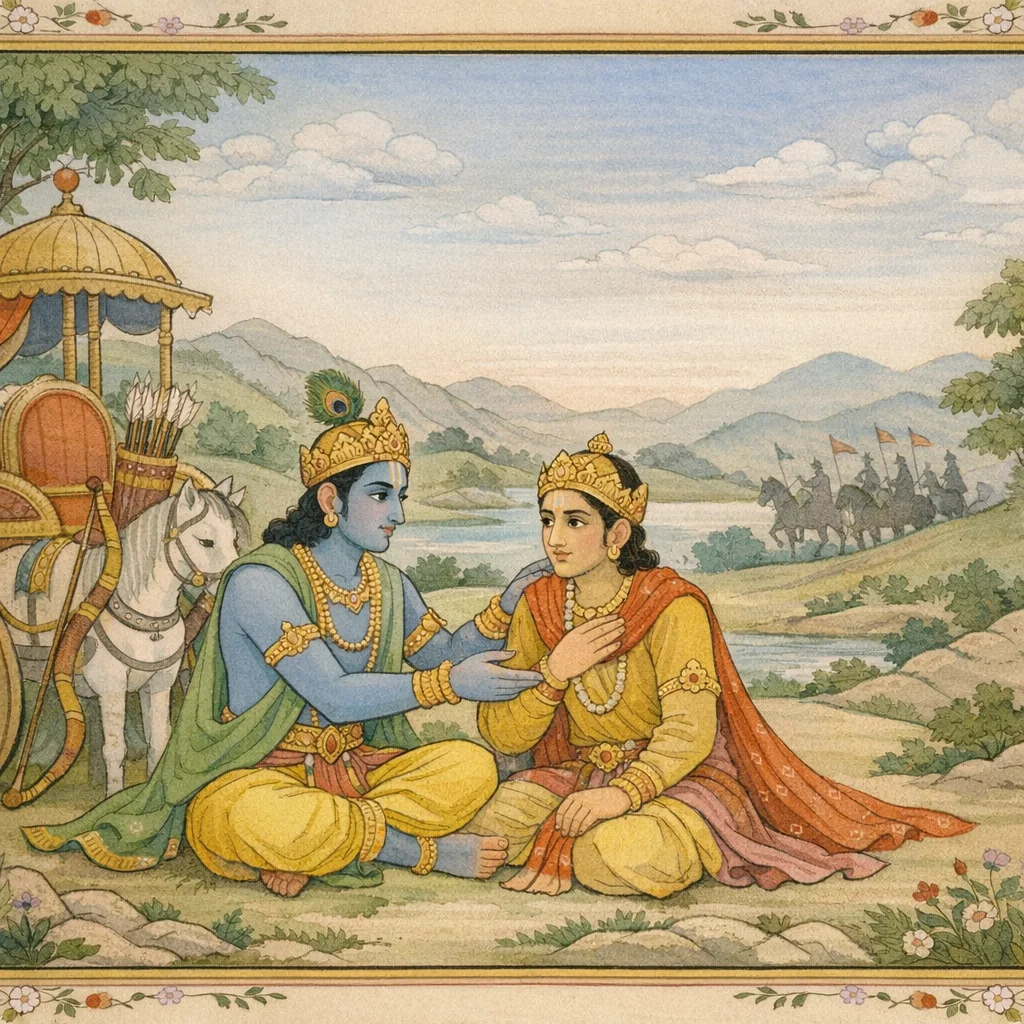
Chapter Arc: उत्तर के भय-ग्रस्त हृदय को अर्जुन का आश्वासन मिलता है—रणविशारद पार्थ कहता है कि अब किसी शत्रु का भय शेष नहीं; वह अकेला ही सबको रणभूमि से खदेड़ देगा। → उत्तर स्वयं को सारथि के रूप में प्रस्तुत करता है—घोड़ों को साधने और रथ हाँकने का अभ्यास बताकर वह अर्जुन की सहायता का संकल्प लेता है। अर्जुन, अपने दिव्य-अनुभवों और गुरुओं-देवताओं के आश्रय का स्मरण कर, उत्तर के भीतर उठते ‘मानस-ज्वर’ को शांत करने हेतु उसे शीघ्र रथ चलाने का आदेश देता है। → अर्जुन का आत्मविश्वास चरम पर पहुँचता है—वह निवातकवच और पौलोम दैत्यों के विरुद्ध इन्द्रार्थ युद्ध का उदाहरण देकर बताता है कि तब भी उसे सहायता मिली थी; अब तो द्रोण, देवगण, कृप, कृष्ण-माधव और शंकर (पिनाकपाणि) के आश्रय से वह कौरव-सेना को कैसे न जीतेगा? → उत्तर का भय क्रमशः साहस में ढलता है; वह अर्जुन के वचनों से प्रेरित होकर सारथ्य-कार्य स्वीकार करता है और युद्ध-तैयारी पूर्ण होती है—रथ आगे बढ़ने को तत्पर होता है। → रथ के बढ़ते ही अगला क्षण कौरवों से प्रत्यक्ष सामना और अर्जुन के गुप्त-परिचय के उद्घाटन की दहलीज़ पर आ टिकता है।
Shlokas
Verse 1
(दाक्षिणात्य अधिक पाठके १ ६ श्लोक मिलाकर कुल २६३ “लोक हैं।) हू... “+ (9) #:-ज 2४) पजञज्चचत्वारिशो< ध्याय: अर्जुनद्वारा युद्धकी तैयारी, अस्त्र-शस्त्रोंका स्मरण, उनसे वार्तालाप तथा उत्तरके भयका निवारण उत्तर उवाच आस्थाय रुचिरं वीर रथं सारथिना मया । कतमं॑ यास्यसे5नीकमुक्तो यास्याम्यहं त्वया,उत्तर बोला--वीरवर! आप सुन्दर रथपर आरूढ़ हो मुझ सारथिके साथ किस सेनाकी ओर चलेंगे? आप जहाँ चलनेके लिये आज्ञा देंगे, वहीं मैं आपके साथ चलूँगा
Uttara said: “O hero, having mounted this splendid chariot with me as your charioteer, toward which division of the army will you go? Tell me, and I shall go with you wherever you command.”
Verse 2
अजुन उवाच प्रीतो5स्मि पुरुषव्याप्र न भयं विद्यते तव | सर्वान् नुदामि ते शत्रून् रणे रणविशारद
Arjuna said: “I am pleased, O tiger among men. There is no fear for you. Skilled in battle, I shall drive away all your enemies in the fight.”
Verse 3
अर्जुनने कहा--पुरुषसिंह! अब तुम्हें कोई भय नहीं रहा, यह जानकर मैं बहुत प्रसन्न हूँ। रणकर्ममें कुशल वीर! मैं तुम्हारे सब शत्रुओंको अभी मार भगाता हूँ ।। स्वस्थो भव महाबाहो पश्य मां शत्रुभि: सह । युध्यमान विमर्देडस्मिन् कुर्वाणं भैरवं महत्,महाबाहो! तुम स्वस्थचित्त (निश्चिन्त) हो जाओ और इस संग्राममें मुझे शत्रुओंके साथ युद्ध तथा अत्यन्त भयंकर पराक्रम करते देखो
Arjuna said: “Be calm and untroubled, O mighty-armed hero. Watch me here, amid this clash, fighting together with your enemies and performing a great and fearsome feat of valor.”
Verse 4
एतान् सर्वानुपासड् न् क्षिप्रं बध्नीहि मे रथे । एकं चाहर निस्त्रिंशं जातरूपपरिष्कृतम्,मेरे इन सब तरकसोंको शीघ्र रथमें बाँध दो और एक सुवर्णभूषित खड़्ग भी ले आओ
Arjuna said: “Quickly fasten all these quivers onto my chariot. And bring me one sword as well—its hilt and fittings adorned with gold.”
Verse 5
वैशम्पायन उवाच अर्जुनस्य वच: श्रुत्वा त्वरावानुत्तरस्तदा । अर्जुनस्यायुधान् गृहा शीघ्रेणावातरत् तत:,वैशम्पायनजी कहते हैं--जनमेजय! अर्जुनका यह कथन सुनकर उत्तर उतावला हो अर्जुनके सब आयुधोंको लेकर शीघ्रतापूर्वक वृक्षसे उतर आया
Vaiśampāyana said: Hearing Arjuna’s words, Uttara at once grew eager and, taking up all of Arjuna’s weapons, quickly climbed down from the tree.
Verse 6
अजुन उवाच अहं वै कुरुभियोत्स्याम्यवजेष्यामि ते पशून्,अर्जुन बोले--मैं कौरवोंसे युद्ध करूँगा और तुम्हारे पशुओंको जीत लूँगा
Arjuna said: “Indeed, I will fight the Kurus, and I will win back your cattle.”
Verse 7
संकल्पपक्षविक्षेपं बाहुप्राकारतोरणम् । त्रिदण्डतूणसम्बाधमनेकध्वजसंकुलम्,मुझसे सुरक्षित होकर रथका यह ऊपरी भाग ही तुम्हारे लिये नगर हो जायगा। इस रथके जो धुरी-पहिये आदि अंग हैं, उनकी सुदृढ़ कल्पना ही नगरकी गलियोंके दोनों भागोंमें बने हुए गृहोंका विस्तार है। मेरी दोनों भुजाएँ ही चहारदीवारी और नगरद्वार हैं। इस रथमें जो त्रिदण्ड (हरिस और उसके अगल-बगलकी लकड़ियाँ) तथा तूणीर आदि हैं, वे किसीको यहाँतक फटकने नहीं देंगे। जैसे नगरमें हाथीसवार, घुड़सवार तथा रथी--इन त्रिविध सेनाओं तथा आयुधोंके कारण उसके भीतर दूसरोंका प्रवेश करना असम्भव होता है। नगरमें जैसे बहुत-सी ध्वजा-पताकाएँ फहराती हैं, उसी प्रकार इस रथमें भी फहरा रही हैं। धनुषकी प्रत्यज्चा ही नगरमें लगी हुई तोपकी नली है, जिसका क्रोधपूर्वक उपयोग होता है और रथके पहियोंकी घर्घराहटको ही नगरमें बजनेवाले नगाड़ोंकी आवाज समझो
Arjuna said: “This chariot, with its swift turns and feints of resolve, shall become for you like a fortified city. My two arms will serve as its encircling rampart and its gate. Crowded with the triple pole and the quivers, and bristling with many banners, it will be so well-defended that none will be able to press in upon you.”
Verse 8
ज्याक्षेपणं क्रोधकृतं नेमीनिनददुन्दुभि | नगर ते मया गुप्तं रथोपस्थं भविष्यति,मुझसे सुरक्षित होकर रथका यह ऊपरी भाग ही तुम्हारे लिये नगर हो जायगा। इस रथके जो धुरी-पहिये आदि अंग हैं, उनकी सुदृढ़ कल्पना ही नगरकी गलियोंके दोनों भागोंमें बने हुए गृहोंका विस्तार है। मेरी दोनों भुजाएँ ही चहारदीवारी और नगरद्वार हैं। इस रथमें जो त्रिदण्ड (हरिस और उसके अगल-बगलकी लकड़ियाँ) तथा तूणीर आदि हैं, वे किसीको यहाँतक फटकने नहीं देंगे। जैसे नगरमें हाथीसवार, घुड़सवार तथा रथी--इन त्रिविध सेनाओं तथा आयुधोंके कारण उसके भीतर दूसरोंका प्रवेश करना असम्भव होता है। नगरमें जैसे बहुत-सी ध्वजा-पताकाएँ फहराती हैं, उसी प्रकार इस रथमें भी फहरा रही हैं। धनुषकी प्रत्यज्चा ही नगरमें लगी हुई तोपकी नली है, जिसका क्रोधपूर्वक उपयोग होता है और रथके पहियोंकी घर्घराहटको ही नगरमें बजनेवाले नगाड़ोंकी आवाज समझो
Arjuna said: “The twang produced by drawing the bowstring in wrath, and the rumbling of the wheel-rims like kettledrums—know this chariot itself will become your fortified city, protected by me. Its upper frame will serve you as a stronghold; its axle, wheels, and fittings will be like streets and rows of houses; my two arms will be your ramparts and gates; and the chariot’s triple pole and quivers will keep all intruders at bay. As a well-defended city cannot be entered when guarded by elephants, cavalry, charioteers, and weapons, so too none will break through while I stand as your protection.”
Verse 9
अधिष्ठितो मया संख्ये रथो गाण्डीवधन्वना । अजेय: शत्रुसैन्यानां वैराटे व्येतु ते भयम्,जब मैं युद्धभूमिमें गाण्डीव धनुष लेकर रथपर सवार होऊँगा, उस समय शत्रुओंकी सेनाएँ मुझे जीत नहीं सकेंगी; अतः विराटनन्दन! तुम्हारा भय अब दूर हो जाना चाहिये
Arjuna said: “When I take my place upon the chariot in the midst of battle, bearing the Gāṇḍīva bow, the enemy’s armies will not be able to overcome me. Therefore, O son of Virāṭa, let your fear depart.”
Verse 10
उत्तर उवाच बिभेमि नाहमेतेषां जानामि त्वां स्थिरं युधि | केशवेनापि संग्रामे साक्षादिन्द्रेण वा समम्
Uttara said: “I am not afraid of them. I know you to be steadfast in battle—equal in combat even to Keśava, or to Indra himself in person.”
Verse 11
उत्तरने कहा--अब मैं उनसे नहीं डरता; क्योंकि मैं अच्छी तरह जानता हूँ कि आप संग्रामभूमिमें भगवान् श्रीकृष्ण और साक्षात् इन्द्रके समान स्थिर रहनेवाले हैं ।। इदं तु चिन्तयन्नेवं परिमुह्यामि केवलम् । निश्चयं चापि दुर्मेधा न गच्छामि कथंचन,केवल इसी एक बातको सोचकर मैं ऐसे मोहमें पड़ जाता हूँ कि बुद्धि अच्छी न होनेके कारण किसी तरह भी किसी निश्चयतक नहीं पहुँच पाता
“Yet, as I keep turning this one thought over in my mind, I fall into sheer confusion. With my poor understanding, I cannot arrive at any firm resolve at all.”
Verse 12
एवं युक्ताड्ररूपस्य लक्षणै: सूचितस्य च । केन कर्मविपाकेन क्लीबत्वमिदमागतम्,(वह चिन्ता इस प्रकार है--) आपका एक-एक अवयव तथा रूप सब प्रकारसे उपयुक्त है। आप लक्षणोंद्वारा भी अलौकिक सूचित हो रहे हैं। ऐसी दशामें भी किस कर्मके परिणामसे आपको यह नपुंसकता प्राप्त हुई है?
“Your every limb and your very form are wholly fitting, and your marks themselves proclaim something beyond the ordinary. Even so, by what ripening of what deed has this condition of eunuchhood come upon you?”
Verse 13
मन्ये त्वां क्लीबवेषेण चरन्तं शूलपाणिनम् । गन्धर्वराजप्रतिमं देवं वापि शतक्रतुम्,मैं तो नपुंसकवेषमें विचरनेवाले आपको शूलपाणि भगवान् शंकरका स्वरूप मानता हूँ अथवा गन्धर्वराजके समान या साक्षात् देवराज इन्द्र समझता हूँ
Uttara said: “As I see you moving about in the guise of a eunuch, I take you to be Śūlapāṇi (Śiva) himself; or else a god like the king of the Gandharvas, or even Śatakratu—Indra in person.”
Verse 14
अर्जुन उवाच (उर्वशीशापसम्भूतं क्लैब्यं मां समुपस्थितम् । पुराहमाज्ञया क्षातुर्ज्येष्टस्यास्मि सुरालयम् ।। प्राप्तवानुर्वशी दृष्टा सुधर्मायां मया तदा । नृत्यन्ती परमं रूप॑ बिभ्रती वज़िसंनिधौ ।। अपश्यंस्तामनिमिषं कूटस्थामन्वयस्य मे । रात्रौ समागता महां शयानं रन्तुमिच्छया ।। अहं तामभिवाद्यैव मातृसत्कारमाचरम् । सा च मामशपत् क्रुद्धा शिखण्डी त्वं भवेरिति ।। श्रुत्वा तमिन्द्रो मामाह मा भैस्त्वं पार्थ षण्ढत: । उपकारो भवेत् तुभ्यमज्ञातवसतौ पुरा ।। इतीन्द्रो मामनुग्राह्म ततः प्रेषितवान् वृषा । तदिदं समनुप्राप्तं ब्रत॑ं तीर्ण मयानघ ।।) अर्जुन बोले--महाबाहो! उर्वशीके शापसे मुझे यह नपुंसकभाव प्राप्त हुआ है। पूर्वकालमें मैं अपने बड़े भाईकी आज्ञासे देवलोकमें गया था। वहाँ सुधर्मा नामक सभामें मैंने उस समय उर्वशी अप्सराको देखा। वह परम सुन्दर रूप धारण करके वज्धारी इन्द्रके समीप नृत्य कर रही थी। मेरे वंशकी मूलहेतु (जननी) होनेके कारण मैं उसे अपलक नेत्रोंसे देखने लगा। तब वह रातमें सोते समय रमणकी इच्छासे मेरे पास आयी, परंतु मैंने उसे प्रणाम करके (उसकी इच्छाकी पूर्ति न करके) उसका माताके समान सत्कार किया। तब उसने कुपित होकर मुझे शाप दे दिया--'तुम नपुंसक हो जाओ।” तब इन्द्रने वह शाप सुनकर मुझसे कहा--'पार्थ! तुम नपुंसक होनेसे डरो मत। यह तुम्हारे लिये अज्ञातवासके समय उपकारक होगा।” इस प्रकार देवराज इन्द्रने मुझपर अनुग्रह करके यह आश्वासन दिया और स्वर्गलोकसे यहाँ भेजा। अनघ! वही यह व्रत प्राप्त हुआ था, जिसको मैंने पूरा किया है। भ्रातुर्नियोगाज्ज्येष्ठस्य संवत्सरमिदं व्रतम् । चरामि व्रतचर्य च सत्यमेतद् ब्रवीमि ते,महाबाहो! मैं बड़े भाईकी आज्ञासे इस वर्ष एक व्रतका पालन कर रहा था। उस व्रतकी जो दिनचर्या है, उसके अनुसार मैं नपुंसक बनकर रहा हूँ। मैं तुमसे यह सच्ची बात कह रहा हूँ। वास्तवमें मैं नपुंसक नहीं हूँ; भाईकी आज्ञाके अधीन होकर धर्मके पालनमें तत्पर रहा हूँ। राजकुमार! तुम्हें मालूम होना चाहिये कि अब मेरा व्रत समाप्त हो गया है; अतः मैं नपुंसकभावके कष्टसे भी मुक्त हो चुका हूँ
Arjuna said: “Mighty-armed one, this condition of eunuchhood has come upon me as the result of Urvaśī’s curse. Long ago, by the command of my eldest brother, I went to the world of the gods. There, in the assembly called Sudharmā, I saw the apsaras Urvaśī—of supremely beautiful form—dancing near Indra, the wielder of the thunderbolt. Since she is regarded as a foremother in my lineage, I looked upon her steadily without blinking. Then, at night, she came to me as I lay down, desiring union. But I bowed to her and treated her with the reverence due to a mother, refusing her desire. Enraged, she cursed me: ‘Become a eunuch—be like Śikhaṇḍī.’ Hearing that curse, Indra said to me, ‘Do not fear, Pārtha, because of this eunuchhood. It will be of help to you during the time of living incognito.’ Thus Indra showed me favor and sent me back. Blameless one, that very vow has now reached its term; I have completed it. By the injunction of my eldest brother, I have observed this vow for a year, living according to its discipline. I tell you the truth: I am not truly impotent—bound by my brother’s command, I have been intent on dharma. Now the vow is finished, and I am released from the hardship of this condition.”
Verse 15
नास्मि क्लीबो महाबाहो परवान् धर्मसंयुतः । समाप्तव्रतमुत्तीर्ण विद्धि मां त्वं नृपात्मज,महाबाहो! मैं बड़े भाईकी आज्ञासे इस वर्ष एक व्रतका पालन कर रहा था। उस व्रतकी जो दिनचर्या है, उसके अनुसार मैं नपुंसक बनकर रहा हूँ। मैं तुमसे यह सच्ची बात कह रहा हूँ। वास्तवमें मैं नपुंसक नहीं हूँ; भाईकी आज्ञाके अधीन होकर धर्मके पालनमें तत्पर रहा हूँ। राजकुमार! तुम्हें मालूम होना चाहिये कि अब मेरा व्रत समाप्त हो गया है; अतः मैं नपुंसकभावके कष्टसे भी मुक्त हो चुका हूँ
Arjuna said: “O mighty-armed prince, I am not an impotent person. Bound by another’s command and committed to dharma, I was observing a vow for this year in the manner prescribed, living in the guise of a eunuch. Know that my vow is now completed and I have come through it; therefore understand me as freed from that assumed condition.”
Verse 16
उत्तर उवाच परमोअनुग्रहो मेडद्य यतस्तकों न मे वृथा । न हीदृशा: क्लीबरूपा भवन्ति तु नरोत्तम,उत्तरने कहा--नरश्रेष्ठ। आज मुझपर आपने बड़ा अनुग्रह किया, जो मुझे सब बात बता दी। ऐसे लक्षणोंवाले पुरुष नपुंसक नहीं होते, इस प्रकार जो मेरे मनमें तर्क उठ रहा था, वह व्यर्थ नहीं था
Uttara said: “O best of men, today you have shown me great favor by telling me everything. A man bearing such marks cannot be a eunuch; thus the reasoning that rose in my mind was not in vain.”
Verse 17
सहायवानस्मि रणे युध्येयममरैरपि । साध्वसं हि प्रणष्टं मे कि करोमि ब्रवीहि मे,अब तो मुझे आपकी सहायता मिल गयी है; अतः युद्धभूमिमें देवताओंका भी सामना कर सकता हूँ। मेरा सारा भय नष्ट हो गया। बताइये, अब मैं क्या करूँ? पुरुषप्रवर! मैंने गुरुसे सारथ्यकर्मकी शिक्षा प्राप्त की है; इसलिये आपके घोड़ोंको, जो शत्रुके रथका नाश करनेवाले हैं, मैं काबूमें रखूँगा
Uttara said: “Now that I have your support, I can fight on the battlefield—even against the gods. My fear has vanished. Tell me what I should do now. O foremost of men, I have learned the duties of a charioteer from my teacher; therefore I will control your horses, those that can shatter the enemy’s chariots.”
Verse 18
अहं ते संग्रहीष्यामि हयान् शत्रुरथारुजान् | शिक्षितो हास्मि सारथ्ये तीर्थत: पुरुषर्षभ,अब तो मुझे आपकी सहायता मिल गयी है; अतः युद्धभूमिमें देवताओंका भी सामना कर सकता हूँ। मेरा सारा भय नष्ट हो गया। बताइये, अब मैं क्या करूँ? पुरुषप्रवर! मैंने गुरुसे सारथ्यकर्मकी शिक्षा प्राप्त की है; इसलिये आपके घोड़ोंको, जो शत्रुके रथका नाश करनेवाले हैं, मैं काबूमें रखूँगा
Uttara said: “I will take charge of your horses—those that can shatter the enemy’s chariots. I have been trained in the duties of a charioteer by my teacher, O bull among men. Now that I have gained your support, my fear is gone; tell me what I should do next, for I feel able to face even the gods on the battlefield.”
Verse 19
दारुको वासुदेवस्य यथा शक्रस्य मातलि: । तथा मां विद्धि सारथ्ये शिक्षितं नरपुड़व,नरपुंगव! जैसे भगवान् वासुदेवका सारथि दारुक और इन्द्रका सारथि मातलि है, उसी प्रकार मुझे भी आप सारथिके कार्यमें पूर्ण शिक्षित मानिये
Uttara said: “Just as Dāruka serves as the charioteer of Vāsudeva, and Mātali serves as the charioteer of Śakra (Indra), so too, O best of men, know me to be fully trained in the duties of a charioteer.”
Verse 20
यस्य याते न पश्यन्ति भूमौ क्षिप्तं पद पदम् | दक्षिणां यो धुरं युक्त: सुग्रीवसदृशो हय:,जो घोड़ा दाहिनी धुरीमें जोता गया है तथा जिसके जाते समय लोग यह नहीं देख पाते कि उसने कब कहाँ पृथ्वीपर पैर रखा या उठाया है, यह (भगवान् श्रीकृष्णके चार अश्रोंमेंसे) सुग्रीव नामक घोड़ेके समान है
Uttara said: “That horse, whose hoof-falls cannot be discerned—so swift that people do not see, step by step, where on the earth its feet were set down or lifted—is the one yoked to the right side of the yoke-pole; it is like the horse named Sugrīva (one of Śrī Kṛṣṇa’s four famed steeds).”
Verse 21
यो<यं धुरं धुर्यवरो वामां वहति शोभन: । त॑ मन्ये मेघपुष्पस्य जवेन सदृशं हयम्,और भार ढोनेवालोंमें श्रेष्ठ जो यह सुन्दर अश्व बाँयीं धुरीका भार वहन करता है, उसे वेगमें मेघपुष्प नामक अश्वके समान मानता हूँ
Uttara said: “This splendid horse—best among those fit to bear the yoke—who carries the load on the left side of the chariot-pole, I judge to be equal in speed to the famed horse Meghapuṣpa.”
Verse 22
यो5यं काञ्चनसंनाह: पार्ष्णि वहति शोभन: । समं॑ शैब्यस्य तं मन््ये जवेन बलवत्तरम्,यह जो सोनेके बख्तरसे सजा हुआ सुन्दर अश्व बाँयीं ओर पिछला जुआ ढो रहा है, इसे वेगमें मैं शैब्य नामक अश्वके समान अत्यन्त बलवान मानता हूँ
Uttara said: “This handsome horse, clad in golden armour and bearing the rear yoke on the left side, I judge to be equal to Śaibya in speed—indeed, even stronger.”
Verse 23
यो<यं वहति मे पार्ष्णि दक्षिणामभित: स्थित: । बलाहकादपि मत: स जवे वीर्यवत्तर:,और यह जो दाहिने भागका पिछला जुआ धारण करके खड़ा है, वह वेगमें बलाहक नामवाले अश्वसे भी अधिक समझा गया है
Uttara said: “This one who stands on my right, bearing the rear yoke-piece at the chariot’s heel, is regarded as swifter even than the horse named Balāhaka—and stronger in prowess as well.”
Verse 24
त्वामेवायं रथो वोदढुं संग्रामे<हति धन्विनम् । त्वं चेमं रथमास्थाय योद्धुमहों मतो मम,यह रथ आप-जैसे धनुर्धर वीरको ही वहन करने योग्य है और मेरी रायमें आप इसी रथपर बैठकर युद्ध करने योग्य हैं
Uttara said: “This chariot is fit to bear you alone in battle, O peerless archer. And in my judgment, you are indeed the one who should mount this chariot and fight.”
Verse 25
वैशम्पायन उवाच ततो विमुच्य बाहुभ्यां वलयानि स वीर्यवान् चित्र काञ्चनसंनाहे प्रत्यमुज्चत् तदा तले,वैशम्पायनजी कहते हैं--जनमेजय! तदनन्तर पराक्रमी अर्जुनने हाथोंसे कड़े और चूड़ियाँ उतार दीं और हथेलियोंमें सोनेके बने हुए विचित्र कवच धारण कर लिये
Vaiśampāyana said: Then that mighty hero, having removed the bracelets and bangles from his arms, fastened on his palms a wondrous golden protective gear—signaling a deliberate return from concealment to readiness and disciplined action.
Verse 26
कृष्णान् भड्लिमत: केशान् श्वैतेनोद्ग्रथ्य वाससा । अथासौ प्राड्मुखो भूत्वा शुचि: प्रयतमानस: । अभिदध्यौ महाबाहु: सर्वास्त्राणि रथोत्तमे,फिर उन्होंने काले-काले घुँघराले केशोंको श्वेत वस्त्रसे बाँध दिया और पूर्वकी ओर मुँह करके पवित्र एवं एकाग्रचित्त हो महाबाहु धनंजयने उस श्रेष्ठ रथपर सम्पूर्ण अस्त्रोंका ध्यान किया
Vaiśampāyana said: Having bound up his dark, curly hair with a white cloth, he then faced east. Pure and with a disciplined, concentrated mind, the mighty-armed Dhanañjaya, seated upon that excellent chariot, meditated upon (and inwardly invoked) all his weapons.
Verse 27
ऊचुश्न पार्थ सर्वाणि प्राउज्जलीनि नृपात्मजम् । इमे सम परमोदारा: किंकरा: पाण्डुनन्दन,तब वे सब अस्त्र प्रकट होकर राजकुमार अर्जुनसे हाथ जोड़कर बोले--'पाण्डुनन्दन! ये हमलोग तुम्हारे परम उदार किंकर हैं"
Vaiśampāyana said: Then all those divine weapons, manifest before the prince Arjuna, stood with folded hands and spoke: “O son of Pāṇḍu, we are your most devoted and generous attendants, ready to serve your command.”
Verse 28
प्रणिपत्य तत: पार्थ: समालभ्य च पाणिना । सर्वाणि मानसानीह भवतेत्यभ्यभाषत,तब अर्जुनने उन्हें प्रणाम करके अपने हाथसे उनका स्पर्श किया और कहा--'आप सब लोग मेरे मनमें निवास करें"
Vaiśampāyana said: Then Pārtha (Arjuna), having bowed down and touched them with his hand, addressed them, saying, “May all of you abide here within my mind.”
Verse 29
प्रतिगृह्म ततो<स्त्राणि प्रह्ृष्टटदनो 5 भवत् । अधिज्यं तरसा कृत्वा गाण्डीवं व्याक्षिपद् धनु:,इस प्रकार अपने अस्त्र-शस्त्रोंकी अनुकूल करके अर्जुनका मुखारविन्द प्रसन्नतासे खिल उठा। उन्होंने बड़े वेगसे गाण्डीव धनुषपर प्रत्यंचा चढ़ाकर उसकी टंकार की
Vaiśampāyana said: Thus, having taken up his weapons in proper accord, Arjuna’s face blossomed with gladness. With swift force he strung the Gāṇḍīva bow and made it resound with a ringing twang.
Verse 30
तस्य विक्षिप्यमाणस्य धनुषो5भून्महाध्वनि: । यथा शैलस्य महत: शैलेनैवावजघ्नत:,उस धनुषकी टंकारके समय बड़े जोरका शब्द हुआ, मानो किसी महान पर्वतको पर्वतसे ही टक्कर लगी हो
Vaiśampāyana said: As he brandished and set that bow in motion, a tremendous reverberation arose from it—like the crash when a mighty mountain is struck by another mountain.
Verse 31
स निर्घातो5भवद् भूभिद् दिक्षु वायुर्ववी भृशम् । पपात महती चोल्का दिशो न प्रचकाशिरे । भ्रान्तध्वजं खं तदासीत् प्रकम्पितमहाद्रुमम्,वह भयानक शब्द पृथ्वीको विदीर्ण करता-सा गूँज उठा। सम्पूर्ण दिशाओंमें प्रचण्ड आँधी चलने लगी, महान् उल्कापात होने लगा और दिशाओंमें अन्धकार छा गया। शत्रुसेनाके ध्वज आकाशमें अकारण हिलने लगे। बड़े-बड़े वृक्ष भी हिलने लगे। अर्जुनने अपने दोनों हाथोंसे रथपर बैठे-बैठे जो अपने श्रेष्ठ धनुषकी टंकार-ध्वनि की, उसे सुनकर कौरवोंने समझा, कहींसे बिजली टूट पड़ी है
Vaiśampāyana said: A dreadful crash arose, as though the earth itself were being split. In every direction a fierce wind blew; a great meteor fell, and the quarters no longer shone—darkness spread. The sky appeared with banners wavering in confusion, and even mighty trees trembled.
Verse 32
तं शब्द कुरवो&जानन् विस्फोटमशनेरिव । यदर्जुनो धनुःश्रेष्ठ बाहुभ्यामाक्षिपद् रथे,वह भयानक शब्द पृथ्वीको विदीर्ण करता-सा गूँज उठा। सम्पूर्ण दिशाओंमें प्रचण्ड आँधी चलने लगी, महान् उल्कापात होने लगा और दिशाओंमें अन्धकार छा गया। शत्रुसेनाके ध्वज आकाशमें अकारण हिलने लगे। बड़े-बड़े वृक्ष भी हिलने लगे। अर्जुनने अपने दोनों हाथोंसे रथपर बैठे-बैठे जो अपने श्रेष्ठ धनुषकी टंकार-ध्वनि की, उसे सुनकर कौरवोंने समझा, कहींसे बिजली टूट पड़ी है
Vaiśampāyana said: Hearing that sound, the Kauravas understood it to be like the sudden crack of a thunderbolt. For when Arjuna, seated upon the chariot, drew and snapped his supreme bow with both arms, a dreadful reverberation arose—like the earth being split. Violent winds seemed to seize the quarters; meteors fell in great numbers; darkness spread; the enemy host’s banners trembled in the sky without cause; and even mighty trees shook. Thus the Kauravas thought lightning had struck nearby—an omen of the warrior’s irresistible might and the impending rout of unrighteous aggression.
Verse 33
उत्तर उवाच एकस्त्वं पाण्डवश्रेष्ठ बहूनेतान् महारथान् । कथं जेष्यसि संग्रामे सर्वशस्त्रास्त्रपारगान्,उस समय उत्तर बोला--पाण्डवश्रेष्ठ] आप तो अकेले हैं, इन सम्पूर्ण अस्त्र-शस्त्रोंके पारगामी बहुसंख्यक महारथियोंको युद्धमें कैसे जीत सकेंगे?
Uttara said: “O best of the Pāṇḍavas, you are but one, while these are many great chariot-warriors, all fully accomplished in weapons and missiles. How will you defeat them in battle?”
Verse 34
असहायो<5सि कौन्तेय ससहायाश्ष कौरवा: । अतएव महाबाहो भीतस्तिष्ठामि तेडग्रत:,कुन्तीनन्दन! आप असहाय हैं और कौरवोंके साथ बहुतेरे सहायक हैं। महाबाहो! यह सोचकर मैं आपके सामने भयभीत हो रहा हूँ
Uttara said: “O son of Kuntī, you stand without support, while the Kauravas are backed by many allies. Therefore, O mighty-armed one, thinking thus, I remain before you in fear.”
Verse 35
उवाच पार्थो मा भैषी: प्रहस्य स्वनवत् तदा,यह सुनकर अर्जुन खिलखिलाकर हँस पड़े और बोले--“वीर! डरो मत! कौरवोंकी घोषयात्राके समय जब मैंने महाबली गन्धर्वोंके साथ युद्ध किया था, उस समय मेरा सखा या सहायक कौन था? जब देवताओं और दानवोंसे भरे हुए उस अत्यन्त भयंकर खाण्डववनमें मैं युद्ध कर रहा था, उस समय मेरा साथी कौन था?
Then Pārtha (Arjuna), laughing aloud, said: “Do not be afraid, hero. When I fought the mighty Gandharvas during the Kauravas’ Ghoṣayātrā (cattle-raid expedition), who was my companion and helper then? And when I battled in the exceedingly dreadful Khāṇḍava forest, filled with gods and Dānavas, who was my ally then?”
Verse 36
युध्यमानस्य मे वीर गन्धर्व: सुमहाबलै: । सहायो घोषयात्रायां कस्तदा55सीत् सखा मम,यह सुनकर अर्जुन खिलखिलाकर हँस पड़े और बोले--“वीर! डरो मत! कौरवोंकी घोषयात्राके समय जब मैंने महाबली गन्धर्वोंके साथ युद्ध किया था, उस समय मेरा सखा या सहायक कौन था? जब देवताओं और दानवोंसे भरे हुए उस अत्यन्त भयंकर खाण्डववनमें मैं युद्ध कर रहा था, उस समय मेरा साथी कौन था?
“O hero, when I was fighting the exceedingly mighty Gandharvas during the Kauravas’ Ghoṣayātrā (cattle-raid expedition), who then was my companion and helper? Who stood by me as my friend?”
Verse 37
अर्जुनका शड्खनाद देवदानवसंकुले । सर तथा प्रतिभये तस्मिन खाण्डवे युध्यमानस्य कस्तदा55सीतू सखा मम,यह सुनकर अर्जुन खिलखिलाकर हँस पड़े और बोले--“वीर! डरो मत! कौरवोंकी घोषयात्राके समय जब मैंने महाबली गन्धर्वोंके साथ युद्ध किया था, उस समय मेरा सखा या सहायक कौन था? जब देवताओं और दानवोंसे भरे हुए उस अत्यन्त भयंकर खाण्डववनमें मैं युद्ध कर रहा था, उस समय मेरा साथी कौन था?
“When Arjuna’s conch resounded in that dreadful Khāṇḍava forest—thronged with gods and Dānavas—while I was fighting there amid showers of arrows and terror, who, at that time, was my friend and helper?”
Verse 38
निवातकवचै: सार्ध पौलोमैश्न महाबलै: । युध्यतो देवराजार्थे कः सहायस्तदाभवत्,देवराज इन्द्रके लिये महाबली निवातकवच और पौलोम दैत्योंके साथ युद्ध करते समय मेरा कौन सहायक था?
“When I fought for the sake of the Lord of the gods, Indra, against the mighty Nivātakavaca and Pauloma demons, who was my ally at that time?”
Verse 39
स्वयंवरे तु पाउ्चाल्या राजभि: सह संयुगे । युध्यतो बहुभिस्तात क: सहायस्तदाभवत्,तात! द्रौपदीके स्वयंवरमें जब मुझे अनेक राजाओंके साथ युद्ध करना पड़ा था, उस समय किसने मेरी सहायता की थी?
“But at Draupadī’s svayaṃvara, when I had to fight in battle against many kings, dear one—who was my helper then?”
Verse 40
उपजीव्य गुरु द्रोणं शक्रं वैश्रवणं यमम् । वरुणं पावकं चैव कृपं कृष्णं च माधवम्
Uttara said: “Having relied upon (and learned under) the revered Droṇa, and also upon Śakra (Indra), Vaiśravaṇa (Kubera), Yama, Varuṇa, and Pāvaka (Agni)—and likewise upon Kṛpa, Kṛṣṇa, and Mādhava—(one gains the strength and skill needed).”
Verse 41
पिनाकपाणिनं चैव कथमेतान् न योधये । रथं वाहय मे शीघ्र व्येतु ते मानसो ज्वर:
Uttara said: “And how could I not fight these men—especially when (you are) Pināka-bearing Śiva himself? Drive my chariot quickly; let your fever of the mind be dispelled.”
Verse 44
इस प्रकार श्रीमहाभारत विराटप्वके अन्तर्गत गोहदरणपर्वमें उत्तरगोग्रहके अवसरपर अजुनिपरिचयसम्बन्धी चौवालीसवाँ अध्याय पूरा हुआ
Thus, in the Śrī Mahābhārata, within the Virāṭa Parva, in the episode known as the Cattle-Raid (Goharaṇa Parvan), on the occasion of the capture of the northern cattle, the forty-fourth chapter—concerning the recognition and revelation of Arjuna’s identity—comes to an end.
Verse 45
मैं गुरुवर द्रोणाचार्य, इन्द्र, कुबेर, यमराज, वरुण, अग्निदेव, कृपाचार्य, लक्ष्मीपति श्रीकृष्ण तथा पिनाकपाणि भगवान् शंकर--इन सबका आश्रय पा चुका हूँ; फिर भला, इन महारथियोंसे युद्ध क्यों नहीं कर सकूँगा? शीघ्र मेरा रथ हाँको; तुम्हारी मानसिक चिन्ता दूर हो जानी चाहिये ।। इति श्रीमहाभारते विराटपर्वणि गोहरणपर्वणि उत्तरगोग्रहे उत्तरार्जुनयोर्वाक्यं नाम पज्चचत्वारिंशो5 ध्याय:,इस प्रकार श्रीमह्याभारत विराटपर्वके अन्तर्गत गोहरणपर्वमें उत्तरयोग्रहके अवसरपर विराटकुमार उत्तर और अर्जुनकी बातचीतविषयक पैंतालीसवाँ अध्याय पूरा हुआ
Uttara said: “I have already taken refuge in the foremost teacher Droṇa, in Indra, Kubera, Yama, Varuṇa, Agni, in Kṛpa, in Śrī Kṛṣṇa the Lord of Lakṣmī, and in Lord Śaṅkara who bears the Pināka bow. Having such protectors, why should I not be able to fight these great chariot-warriors? Drive my chariot quickly; your anxiety should be dispelled.”
Frequently Asked Questions
The dilemma concerns legitimacy and honor: whether confidence and status can be claimed through rhetoric and gains obtained via deceptive mechanisms (the dice-game), versus the dharmic requirement that authority be grounded in just means and demonstrable, accountable action.
Excellence is validated by disciplined conduct rather than self-advertisement; ethical speech, adherence to role-duties, and realism about consequences are presented as superior to performative bravado and opportunistic claims of victory.
No explicit phalaśruti is stated. The chapter functions as internal normative commentary: it re-anchors the narrative in dharma-criteria (means, speech, duty, and consequence) and frames Arjuna’s reappearance as a structural turning point in the exile-to-war transition.