Adhyaya 16
Śalya–Yudhiṣṭhira Duel and the Discharge of the Śakti (शल्यवधप्रसङ्गः)
Upa-parva: Śalya-vadha (The Slaying of Śalya) Episode
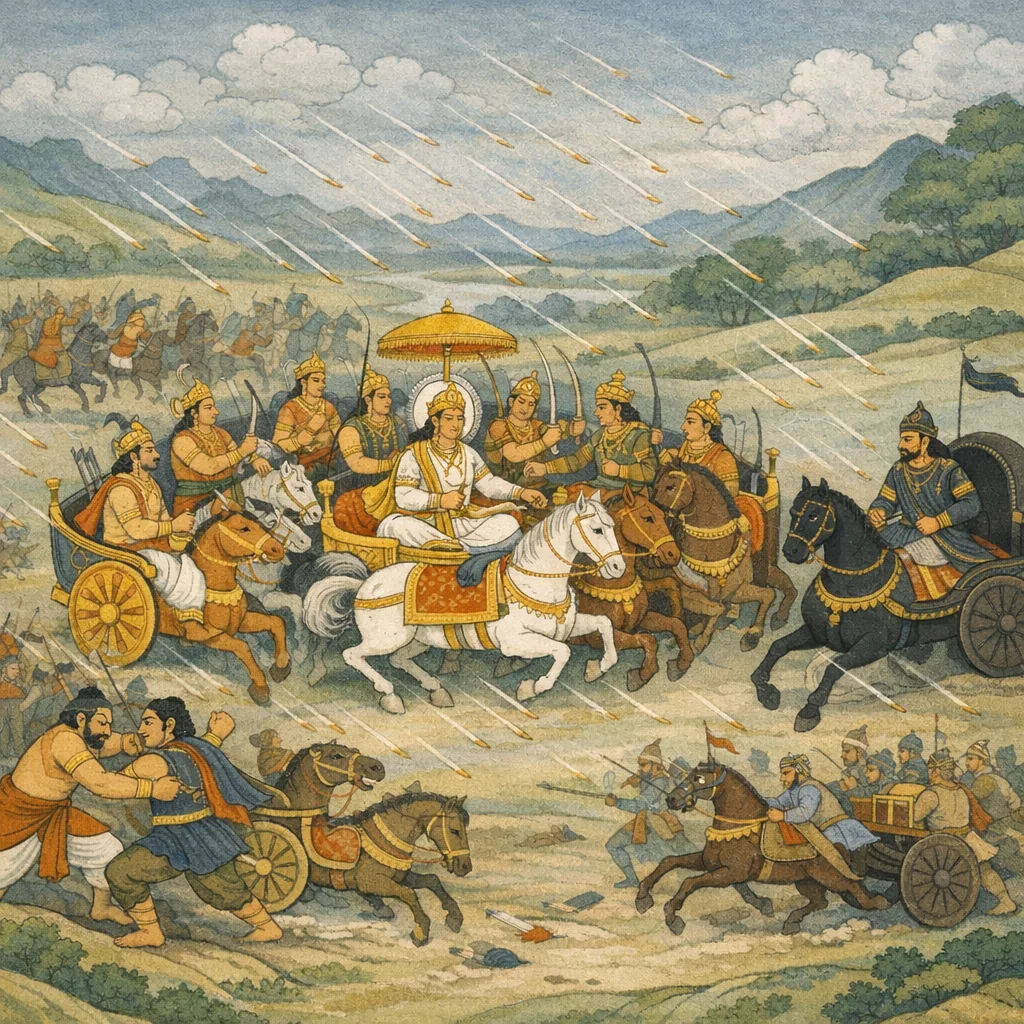
Saṃjaya reports an escalation in Śalya’s assault: he wounds Yudhiṣṭhira and presses the Pāṇḍavas with dense missile-fire, disrupting arms, standards, and chariot elements. Multiple Pāṇḍava-aligned warriors converge to contain Śalya, while the duel between Śalya and Yudhiṣṭhira intensifies through reciprocal volleys described with storm and thunder imagery. Śalya repeatedly damages Yudhiṣṭhira’s equipment and support (including horses and charioteer-related vulnerabilities), prompting protective actions by Bhīma and others. Yudhiṣṭhira, recalling Govinda’s counsel, resolves upon Śalya’s destruction and takes up a gem-and-gold-shafted śakti. The spear is depicted as ritually empowered and irresistibly forceful; Śalya attempts to receive it, but it pierces vital points, tears armor, and causes his collapse from the chariot. The narrative then records immediate battlefield effects: Pāṇḍava forces express coordinated acclaim, Kaurava ranks show distress and disarray, Śalya’s younger brother attacks and is swiftly neutralized, and secondary duels (notably Sātyaki and Hārdikya/Kṛtavarman) continue amid the shifting tactical landscape.
Chapter Arc: संजय धृतराष्ट्र को बताता है कि रणभूमि में दण्डयुद्ध का कोलाहल उठ खड़ा हुआ—पीड़ित होकर भी कौरव-सेना उन्मत्त वेग से दौड़ती है, और पाण्डव-सेना अपनी संख्या-बल व संकल्प से उसे क्षण-क्षण दबाने लगती है। → कौरव योद्धा पाण्डवों के प्रहार से विचलित होकर टिक नहीं पाते; भीम के रोके जाने पर भी वे छूटकर भागने लगते हैं। उसी उथल-पुथल में दो निर्णायक केंद्र बनते हैं—भीमसेन दुर्योधन को गदा लेकर रोकते हैं, और युधिष्ठिर अपनी सेना सहित शल्य को घेरकर सामने लेते हैं। शल्य का युधिष्ठिर के निकट आना ऐसा दीखता है जैसे चन्द्र के पास शनैश्चर—भय और अशुभ छाया का संकेत। युधिष्ठिर अपने रथ-चक्र की रक्षा-व्यवस्था बाँधते हैं: दाहिने सात्यकि, बाएँ धृष्टद्युम्न, पृष्ठभाग में अर्जुन। → शल्य धर्मराज पर इन्द्र की भाँति शरवर्षा करता है; दोनों सेनाएँ ठहरकर उनके द्वंद्व का परिणाम नहीं बाँध पातीं—दो पलाश-वृक्षों की तरह दोनों की शोभा और पराक्रम एक साथ चमकते हैं। इसी बीच भीमसेन दुर्योधन को रोकते हुए उसके पक्ष को तोड़ते हैं; मूर्च्छित होने पर भी भीम क्षुरप्र से उसके सारथि का सिर काट देते हैं, जिससे दुर्योधन का रथ हय सहित दिशाओं में भटकता/भागता है। युधिष्ठिर के लिए युद्ध ‘प्रदक्षिण’ होता जाता है; शल्य के सौ बाणों के प्रहार के बाद भी धर्मराज की स्थिति अनुकूल बनी रहती है और शल्य की बढ़त टूटती है। → दिन के इस खंड में दो स्तरों पर परिणाम स्पष्ट होता है—भीम के प्रचंड आघात से दुर्योधन की गति रुकती और उसका रथ-तंत्र (सारथि) नष्ट होकर कौरव पक्ष में अव्यवस्था फैलती है; दूसरी ओर युधिष्ठिर शल्य के शरवर्ष को सहकर, रथ-रक्षा-व्यवस्था और स्थैर्य से शल्य को दबाते हुए उसे पराजय की ओर ढकेलते हैं। → शल्य अभी भी रणभूमि में उपस्थित है और शरवर्षा की क्षमता रखता है—अगले क्षणों में यह द्वंद्व निर्णायक वध तक पहुँचेगा या कोई नया व्यवधान युद्ध की दिशा मोड़ेगा, यह अनिश्चित रहता है।
Shlokas
Verse 1
अपना बछ। है २ २4 घोडशो< ध्याय: पाण्डव-सैनिकों और कौरव-सैनिकोंका दन्डयुद्ध, भीमसेनद्वारा दुर्योधनकी तथा युधिष्ठिरद्वारा शल्यकी पराजय संजय उवाच ततः सैन्यास्तव विभो मद्रराजपुरस्कृता: । पुनरभ्यद्रवन् पार्थान् वेगेन महता रणे,संजय कहते हैं--प्रभो! तदनन्तर आपके सभी सैनिक रणभूमिमें मद्रराजको आगे करके पुनः बड़े वेगसे पाण्डवोंपर टूट पड़े
Sañjaya said: “O Lord, thereafter your forces—placing the king of Madra at their head—once again surged against the sons of Pṛthā on the battlefield, charging with great speed.”
Verse 2
पीडितास्तावका: सर्वे प्रधावन्तो रणोत्कटा: । क्षणेन चैव पार्थास्ति बहुत्वातू समलोडयन्,युद्धके लिये उन्मत्त रहनेवाले आपके सभी योद्धा यद्यपि पीड़ित हो रहे थे, तथापि संख्यामें अधिक होनेके कारण उन सबने धावा बोलकर क्षणभरमें पाण्डव-योद्धाओंको मथ डाला
Sañjaya said: Though your warriors were hard-pressed and suffering, they—fierce and battle-maddened—charged forward; and by sheer superiority of numbers they quickly overwhelmed the Pāṇḍava fighters.
Verse 3
ते वध्यमाना: समरे पाण्डवा नावतस्थिरे । निवार्यमाणा भीमेन पश्यतो: कृष्णयोस्तदा,समरांगणमें कौरवोंकी मार खाकर पाण्डवयोद्धा श्रीकृष्ण और अर्जुनके देखते-देखते भीमसेनके रोकनेपर भी वहाँ ठहर न सके
Sañjaya said: Struck down in the thick of battle, the Pāṇḍava warriors could not hold their ground. Even as Kṛṣṇa and Arjuna looked on, and even though Bhīma tried to restrain them, they were unable to remain there—overwhelmed by the Kauravas’ assault on the battlefield.
Verse 4
ततो धनंजय: क्रुद्ध: कृपं सह पदानुगै: । अवाकिरच्छरौचेण कृतवर्माणमेव च,तदनन्तर दूसरी ओर क्रोधमें भरे हुए अर्जुनने सेवकोंसहित कृपाचार्य और कृतवर्माको अपने बाण-समूहोंसे ढक दिया
Sañjaya said: Then Dhanañjaya (Arjuna), inflamed with anger, showered Kr̥pa together with his attendants—and also Kr̥tavarmā—with a dense flood of arrows, covering them over.
Verse 5
शकुनिं सहदेवस्तु सहसैन्यमवाकिरत् । नकुल: पार्श्वतः स्थित्वा मद्रराजमवैक्षत,सहदेवने सेनासहित शकुनिको बाणोंसे आच्छादित कर दिया। नकुल पास ही खड़े होकर मद्रराजकी ओर देख रहे थे
Sañjaya said: Sahadeva showered Śakuni—together with his troops—with a dense hail of arrows, covering him over. Nakula, standing close by, kept his gaze fixed on the king of Madra.
Verse 6
द्रौपदेया नरेन्द्रांश्ष भूयिष्ठानू समवारयन् । द्रोणपुत्रं च पाउ्चाल्य: शिखण्डी समवारयत्,द्रौपदीके पुत्रोंने बहुत-से राजाओंको आगे बढ़नेसे रोक रखा था। पांचालराजकुमार शिखण्डीने द्रोणपुत्र अश्वत्थामाको रोक दिया
Sañjaya said: The sons of Draupadī held back many kings from advancing. And Śikhaṇḍī, the Pāñcāla prince, checked Droṇa’s son Aśvatthāmā.
Verse 7
भीमसेनस्तु राजानं गदापाणिरवारयत् | शल्यं तु सह सैन्येन कुन्तीपुत्रो युधिष्ठिर:
Sañjaya said: Bhīmasena, mace in hand, checked the king’s advance. And Kuntī’s son Yudhiṣṭhira, for his part, held back Śalya along with his forces.
Verse 8
भीमसेनने हाथमें गदा लेकर राजा दुर्योधनको रोका और सेनासहित कदुन्तीपुत्र युधिष्ठिरने शल्यको ।। ततः समभवत् सैन्यं संसक्त तत्र तत्र ह । तावकानां परेषां च संग्रामेष्वनिवर्तिनाम्,तत्पश्चात् संग्राममें पीठ न दिखानेवाले आपके और शत्रुपक्षके योद्धाओंकी वह सेना जहाँ-तहाँ परस्पर युद्ध करने लगी
Sañjaya said: Bhīmasena, taking his mace in hand, checked King Duryodhana; and Kuntī’s son Yudhiṣṭhira, supported by his troops, checked Śalya. Thereupon the armies of both sides—unyielding in battle and refusing to turn their backs—became locked in combat in many places, each engaging the other wherever they met.
Verse 9
तत्र पश्याम्यहं कर्म शल्यस्यातिमहद्रणे । यदेक: सर्वसैन्यानि पाण्डवानामयोधयत्,वहाँ रणभूमिमें मैंने राजा शल्यका बहुत बड़ा पराक्रम यह देखा कि वे अकेले ही पाण्डवोंकी सम्पूर्ण सेनाओंके साथ युद्ध कर रहे थे
Sañjaya said: “There, on that battlefield, I beheld Śalya’s exceedingly great feat of arms—how, standing alone, he fought against the entire forces of the Pāṇḍavas.”
Verse 10
व्यदृश्यत तदा शल्यो युधिष्ठिरसमीपत: । रणे चन्द्रमसो< भ्याशे शनैश्षर इव ग्रह:,उस समय शल्य युधिष्ठिरके समीप रणभूमिमें ऐसे दिखायी दे रहे थे, मानो चन्द्रमाके समीप शनैश्वर नामक ग्रह हो
Sañjaya said: Then Śalya was seen close to Yudhiṣṭhira on the battlefield—like the planet Śanaiścara (Saturn) drawing near the moon.
Verse 11
पीडयित्वा तु राजानं शरैराशीविषोपमै: । अभ्यधावत् पुनर्भीम शरवर्षैरवाकिरत्
Sañjaya said: Having tormented the king with arrows like venomous serpents, Bhīma again rushed forward and showered him with a rain of shafts.
Verse 12
वे विषधर सर्पोंके समान भयंकर बाणोंद्वारा राजा युधिष्ठिरको पीड़ित करके पुनः भीमसेनकी ओर दौड़े और उन्हें अपने बाणोंकी वर्षासे आच्छादित करने लगे ।। तस्य तल्लाघवं दृष्टवा तथैव च कृतास्त्रताम् । अपूजयन्ननीकानि परेषां तावकानि च,उनकी वह फुर्ती और अस्त्रविद्याका ज्ञान देखकर आपके और शत्रुपक्षके सैनिकोंने भी उनकी भूरि-भूरि प्रशंसा की
Sañjaya said: With dreadful arrows like venomous serpents, they tormented King Yudhiṣṭhira; then they rushed again toward Bhīmasena and began to cover him on all sides with a shower of arrows. Seeing his swiftness and his mastery of weapons, the troops—both yours and those of the opposing side—praised him greatly.
Verse 13
पीड्यमानास्तु शल्येन पाण्डवा भृशविक्षता: । प्राद्रवन्त रणं हित्वा क्रोशमाने युधिष्ठिरे,शल्यके द्वारा पीड़ित एवं अत्यन्त घायल हुए पाण्डव-सैनिक युधिष्ठिरके पुकारनेपर भी युद्ध छोड़कर भाग चले
Sañjaya said: Tormented by Śalya and grievously wounded, the Pāṇḍava troops abandoned the battlefield and fled—even as Yudhiṣṭhira cried out to them.
Verse 14
वध्यमानेष्वनीकेषु मद्रराजेन पाण्डव: । अमर्षवशमापन्नो धर्मराजो युधिष्िर:,जब मद्रराजके द्वारा इस प्रकार पाण्डव-सैनिकोंका संहार होने लगा, तब पाण्डुपुत्र धर्मराज युधिष्ठिर अमर्षके वशीभूत हो गये
Sañjaya said: As the Pāṇḍava battalions were being cut down by the king of Madra, Dharmarāja Yudhiṣṭhira, the son of Pāṇḍu, was seized by righteous indignation—his forbearance giving way before the slaughter of his men.
Verse 15
तत: पौरुषमास्थाय मद्रराजमताडयत् | जयो वास्तु वधो वास्तु कृतबुद्धिर्महारथ:,तदनन्तर उन्होंने अपने पुरुषार्थका आश्रय ले मद्रराजपर प्रहार आरम्भ किया। महारथी युधिष्ठिरने यह निश्चय कर लिया कि आज या तो मेरी विजय होगी अथवा मेरा वध हो जायगा
Sañjaya said: Then, taking refuge in his own resolve and exertion, he began to strike at the king of Madra. The great chariot-warrior had fixed his mind on a single outcome: let there be victory today, or let there be death.
Verse 16
समाहूयाब्रवीत् सर्वान् भ्रातृन् कृष्णं च माधवम् | भीष्मो द्रोणश्व॒ कर्णश्न ये चान्ये पृथिवीक्षित:,उन्होंने अपने समस्त भाइयों तथा श्रीकृष्ण और सात्यकिको बुलाकर इस प्रकार कहा --“बन्धुओ! भीष्म, द्रोण, कर्ण तथा अन्य जो-जो राजा दुर्योधनके लिये पराक्रम दिखाते थे, वे सब-के-सब संग्राममें मारे गये। तुमलोगोंने पुरुषार्थ करके उत्साहपूर्वक अपने-अपने हिस्सेका कार्य पूरा कर लिया इति श्रीमहा भारते शल्यपर्वणि शल्ययुधिष्ठिरयुद्धे षोडशो 5 ध्याय: इस प्रकार श्रीमह्माभारत शल्यपर्वमें शल्य और युथिष्ठिरका युद्धाविषयक सोलहवाँ अध्याय पूरा हुआ
Sañjaya said: Having summoned all his brothers, and also Kṛṣṇa Mādhava, he spoke: “Bhīṣma, Droṇa, Karṇa, and the other kings who displayed their valor for Duryodhana have all been slain in battle. And you—each according to your share and your zeal—have fulfilled your allotted duty through steadfast effort.”
Verse 17
कौरवार्थे पराक्रान्ता: संग्रामे निधनं गता: । यथाभागं यथोत्साहं भवन्त: कृतपौरुषा:,उन्होंने अपने समस्त भाइयों तथा श्रीकृष्ण और सात्यकिको बुलाकर इस प्रकार कहा --“बन्धुओ! भीष्म, द्रोण, कर्ण तथा अन्य जो-जो राजा दुर्योधनके लिये पराक्रम दिखाते थे, वे सब-के-सब संग्राममें मारे गये। तुमलोगोंने पुरुषार्थ करके उत्साहपूर्वक अपने-अपने हिस्सेका कार्य पूरा कर लिया
Sañjaya said: “Those who exerted their valor for the Kauravas have met their end upon the battlefield. Each of you, according to your allotted share and according to your zeal, has fulfilled your manly effort.”
Verse 18
भागो<5वशिष्ट एको<5यं मम शल्यो महारथ: । सो5हमद्य युधा जेतुमाशंसे मद्रकाधिपम्,“अब एकमात्र महारथी शल्य शेष रह गये हैं, जो मेरे हिस्सेमें पड़ गये हैं। अत: आज मैं इन मद्रराज शल्यको युद्धमें जीतनेकी आशा करता हूँ
Sañjaya said: “Only one share remains to me—Śalya, the great chariot-warrior. Therefore, today I hope to defeat in battle Śalya, the lord of the Madras.”
Verse 19
तत्र यन्मानसं महां तत् सर्व निगदामि व: । चक्ररक्षाविमौ वीरौ मम माद्रवतीसुती
Sañjaya said: “There, I shall relate to you in full that great resolve which arose in their minds. These two heroes—sons of Mādravatī—stood as the protectors of the chariot-wheel, guarding it with steadfast courage amid the press of battle.”
Verse 20
साथ्विमौ मातुल युद्धे क्षत्रधर्मपुरस्कृती,'क्षत्रिय-धर्मको सामने रखते हुए ये सम्मान पानेके योग्य सत्यप्रतिज्ञ नकुल और सहदेव मेरे लिये समरांगणमें अपने मामाके साथ अच्छी तरह युद्ध करें। फिर या तो शल्य रणभूमिमें मुझे मार डालें या मैं उनका वध कर डालूँ। आप लोगोंका कल्याण हो
“Keeping the kṣatriya code before them, let Nakula and Sahadeva—worthy of honor and steadfast in their vow—fight well for my sake on the battlefield against their maternal uncle. Then either Śalya will slay me in combat, or I shall kill him. May welfare be yours.”
Verse 21
मदर्थे प्रतियुद्धयेतां मानाहौँ सत्यसड्रौ । मां वा शल्यो रणे हन्ता त॑ वाहं भद्गमस्तु व:,'क्षत्रिय-धर्मको सामने रखते हुए ये सम्मान पानेके योग्य सत्यप्रतिज्ञ नकुल और सहदेव मेरे लिये समरांगणमें अपने मामाके साथ अच्छी तरह युद्ध करें। फिर या तो शल्य रणभूमिमें मुझे मार डालें या मैं उनका वध कर डालूँ। आप लोगोंका कल्याण हो
Sañjaya said: “For my sake, let Nakula and Sahadeva—worthy of honor and steadfast in their pledged resolve—fight their maternal uncle in the battlefield, keeping the kṣatriya code before them. Then either Śalya will slay me in combat, or I shall kill him. May welfare be yours.”
Verse 22
इति सत्यामिमां वाणी लोकवीरा निबोधत । योत्स्ये5हं मातुलेनाद्य क्षात्रधर्मेण पार्थिवा:
Sañjaya said: “Thus, hear this truthful declaration, O heroes renowned among the people: Today I shall fight with my maternal uncle, in accordance with the warrior’s code, O kings.”
Verse 23
स्वमंशमभिसंधाय विजयायेतराय च । “विश्वविख्यात वीरो! तुमलोग मेरा यह सत्य वचन सुन लो। राजाओ! मैं क्षत्रियधर्मके अनुसार अपने हिस्सेका कार्य पूर्ण करनेका संकल्प लेकर अपनी विजय अथवा वधके लिये मामा शल्यके साथ आज युद्ध करूँगा ।। तस्य मे<5प्यधिकं शस्त्र सर्वोपकरणानि च
Fixing his own allotted part—whether for victory or for death—“O heroes famed throughout the world, hear my truthful word. O kings, resolved to fulfill the duty that falls to my share in keeping with the kṣatriya code, today I shall fight my maternal uncle Śalya, either to win or to be slain. And for my part, I too possess superior weapons and all the needed equipment.”
Verse 24
शैनेयो दक्षिणं चक्र धृष्टद्युम्नस्तथोत्तरम्
Sañjaya said: Śaineya took the southern position, and Dhṛṣṭadyumna likewise assumed the northern—each arranging his station in the battle formation with deliberate intent amid the unfolding war.
Verse 25
पृष्ठगोपो भवत्वद्य मम पार्थो धनंजय: । पुरःसरो ममाद्यास्तु भीम: शस्त्रभृतां वर:
Sañjaya said: “Let my Pārtha, Dhanañjaya (Arjuna), be my rear-guard today, protecting from behind. And let Bhīma—the foremost among weapon-bearers—go before me today as my vanguard.”
Verse 26
“(नकुल-सहदेवके अतिरिक्त) सात्यकि मेरे दाहिने चक्रकी रक्षा करें और धृष्टद्युम्न बायें चक्रकी। आज कुन्तीकुमार अर्जुन मेरे पृष्ठभागकी रक्षामें तत्पर रहें और शस्त्रधारियोंमें श्रेष्ठ भीमसेन मेरे आगे-आगे चलें ।। एवमभ्यधिक: शल्याद् भविष्यामि महामृधे | एवमुक्तास्तथा चक्रुस्तदा राज्ञ: प्रियेषिण:,“ऐसी व्यवस्था होनेपर मैं इस महायुद्धमें शल्यसे अधिक शक्तिशाली हो जाऊँगा।' उनके ऐसा कहनेपर राजाका प्रिय करनेकी इच्छावाले भाइयोंने उस समय वैसा ही किया
Sañjaya said: “(Apart from Nakula and Sahadeva,) let Sātyaki guard my right wing, and Dhṛṣṭadyumna the left. Today let Arjuna, the son of Kuntī, be intent on protecting my rear, and let Bhīmasena—foremost among weapon-bearers—move in front of me. With such an arrangement, in this great battle I shall become stronger than Śalya.” When he spoke thus, those brothers, eager to do what was pleasing to their king, carried out the plan accordingly.
Verse 27
ततः प्रहर्ष: सैन्यानां पुनरासीत् तदा मृथे । पज्चालानां सोमकानां मत्स्यानां च विशेषत:,तदनन्तर उस युद्धस्थलमें पुनः पाण्डव-सैनिकों विशेषतः पांचालों, सोमकों और मत्स्यदेशीय योद्धाओंके मनमें महान् हर्षोल्लास छा गया
Sañjaya said: Then, in that battle once again, a surge of exhilaration arose among the armies—especially among the Pāṇḍava forces, most notably the Pāñcālas, the Somakas, and the warriors of Matsya.
Verse 28
प्रतिज्ञां तां तदा राजा कृत्वा मद्रेशमभ्ययात् | ततः शड्खांश्व भेरीश्व शतशश्वैव पुष्कलान्
Sañjaya said: Having then made that vow, the king advanced toward the lord of Madra. Thereupon, in great abundance, conches and kettle-drums were sounded—by the hundreds—proclaiming resolve and rallying the warriors for the grim duties of war.
Verse 29
तेडभ्यधावन्त संरब्धा मद्रराजं तरस्विनम्
Sañjaya said: Enraged and fully roused to action, they rushed straight at the mighty king of Madra.
Verse 30
महता हर्षजेनाथ नादेन कुरुपुड्रवा: | उन कुरुकुलके श्रेष्ठ वीरोंने रोषमें भरकर महान् हर्षनादके साथ वेगशाली वीर मद्रराज शल्यपर धावा किया ।। ह्वादेन गजघण्टानां शड्खानां निनदेन च
Sañjaya said: Then the foremost of the Kurus, raising a mighty, joy-born roar, surged forward. Filling those best of Kuru warriors with wrath, the swift heroes charged upon Śalya, the king of Madra, with a great cry of exultation—amid the booming of elephant-bells and the blare of conches.
Verse 31
तान् प्रत्यगृह्नात् पुत्रस्ते मद्रराजश्न वीर्यवान्
Sañjaya said: Your son, and the mighty king of Madra as well, received them in return—accepting what was offered back in the course of the war’s exchanges.
Verse 32
शल्यस्तु समरश्लाघी धर्मराजमरिंदमम्
Sañjaya said: Śalya, proud of his prowess in battle, addressed Dharmarāja Yudhiṣṭhira—the crusher of foes.
Verse 33
तथैव कुरुराजो5पि प्रगृह्मु रुचिरं धनु:
Sañjaya said: “In the same manner, the king of the Kurus too took up his splendid bow.”
Verse 34
द्रोणोपदेशान् विविधान् दर्शयानो महामना: । ववर्ष शरवर्षाणि चित्र लघु च सुष्ठ च
Sañjaya said: Displaying in action the many kinds of martial instructions he had received from Droṇa, that great-souled warrior poured forth showers of arrows—varied in pattern, swift in flight, and perfectly executed—revealing disciplined skill even amid the violence of battle.
Verse 35
इसी प्रकार महामना कुरुराज युधिष्ठिरने भी सुन्दर धनुष हाथमें लेकर द्रोणाचार्यके दिये हुए नाना प्रकारके उपदेशोंका प्रदर्शन करते हुए शीघ्रतापूर्वक सुन्दर एवं विचित्र रीतिसे बाणोंकी वर्षा प्रारम्भ कर दी ।। न चास्य विवरं कश्चिद् ददर्श चरतो रणे । तावुभौ विविधैर्बाणैस्ततक्षाते परस्परम्
In this manner, the high-minded Kuru king Yudhiṣṭhira too, taking up his splendid bow, began to display the many kinds of instructions once given by Droṇācārya. Swiftly, and in a beautiful yet astonishing style, he commenced a shower of arrows. No one could discern any opening in him as he moved about on the battlefield; and the two of them struck at each other again and again with arrows of many kinds.
Verse 36
शार्दूलावामिषप्रेप्सू पराक्रान्ताविवाहवे । रणमें विचरते हुए युधिष्ठिरकी कोई भी त्रुटि किसीने नहीं देखी। मांसके लोभसे पराक्रम प्रकट करनेवाले दो सिंहोंके समान वे दोनों वीर युद्धस्थलमें नाना प्रकारके बाणोंद्वारा एक- दूसरेको घायल करने लगे ।। भीमस्तु तव पुत्रेण युद्धशौण्डेन संगत:,राजन्! भीमसेन तो आपके युद्धकुशल पुत्र दुर्योधनके साथ भिड़ गये और धुृष्टद्युम्न, सात्यकि तथा पाण्डुपुत्र माद्रीकुमार नकुल-सहदेव सब ओरसे शकुनि आदि वीरोंका सामना करने लगे
Sañjaya said: Like two tigers eager for flesh, the two champions, having rushed into battle, ranged about the field. As Yudhiṣṭhira moved through the fray, no one could detect any fault in him—his conduct remained beyond reproach even amid slaughter. Like two lions displaying their prowess out of hunger for meat, those heroes on the battlefield began to wound one another with many kinds of arrows. Meanwhile Bhīma engaged your son Duryodhana, a master of combat, O King; and Dhṛṣṭadyumna, Sātyaki, and the Pāṇḍava brothers Nakula and Sahadeva, the sons of Mādrī, fought on all sides against Śakuni and the other warriors.
Verse 37
पाज्चाल्य: सात्यकिश्जैव माद्रीपुत्रो च पाण्डवौ । शकुनिप्रमुखान् वीरानू् प्रत्यगृह्लन् समन््तत:,राजन्! भीमसेन तो आपके युद्धकुशल पुत्र दुर्योधनके साथ भिड़ गये और धुृष्टद्युम्न, सात्यकि तथा पाण्डुपुत्र माद्रीकुमार नकुल-सहदेव सब ओरसे शकुनि आदि वीरोंका सामना करने लगे
Sañjaya said: “O King, the Pāñcāla commander Dhṛṣṭadyumna, Sātyaki, and the two Pāṇḍava sons of Mādrī (Nakula and Sahadeva) closed in on the heroes led by Śakuni from every side.”
Verse 38
तदा<5<सीत् तुमुल॑ युद्ध पुनरेव जयैषिणाम् । तावकानां परेषां च राजन दुर्मन्त्रिते तव,नरेश्वरर फिर विजयकी अभिलाषा रखनेवाले आपके और शत्रुपक्षके योद्धाओंमें उस समय घोर संग्राम छिड़ गया, जो आपकी कुमन्त्रणाका परिणाम था
Sañjaya said: Then, O King, a tumultuous battle flared up once again between your warriors and those of the opposing side, all eager for victory—an outbreak of war that was the bitter consequence of your misguided counsel.
Verse 39
दुर्योधनस्तु भीमस्य शरेणानतपर्वणा । चिच्छेदादिश्य संग्रामे ध्वजं हेमपरिष्कृतम्,दुर्योधनने घोषणा करके झुकी हुई गाँठवाले बाणसे संग्राममें भीमसेनके सुवर्णभूषित ध्वजको काट डाला
Sañjaya said: In the thick of battle, Duryodhana, aiming at Bhīma, severed with a barbed arrow Bhīmasena’s standard, richly adorned with gold. The act signals not only a tactical strike but a symbolic attempt to break an opponent’s pride and morale by striking his emblem rather than his body.
Verse 40
स किड्किणीकजालेन महता चारुदर्शन: । पपात रुचिर: संख्ये भीमसेनस्थ पश्यत:,वह देखनेमें मनोहर और सुन्दर ध्वज भीमसेनके देखते-देखते छोटी-छोटी घंटियोंके महान् समूहके साथ युद्धस्थलमें गिर पड़ा
Sañjaya said: That lovely, splendid banner—beautiful to behold—fell upon the battlefield, along with its great net of tiny bells, even as Bhīmasena watched. The moment marks a visible collapse of martial pride and a turning of fortune amid the harsh ethics of war, where signs and standards fall as swiftly as lives.
Verse 41
पुनश्चास्य धनुश्चित्रं गजराजकरोपमम् । क्षुरेण शितधारेण प्रचकर्त नराधिप:,तत्पश्चात् राजा दुर्योधनने तीखी धारवाले क्षुरसे भीमसेनके विचित्र धनुषको भी, जो हाथीकी सूँड़के समान था, काट डाला
Sañjaya said: Then again the king (Duryodhana), with a razor-edged weapon of keen, sharp blade, cut apart Bhīmasena’s wondrous bow—shaped like the trunk of a lordly elephant—thus intensifying the ruthless momentum of the duel and displaying the war’s grim ethic of disabling an opponent’s means of combat rather than sparing him.
Verse 42
स च्छिन्नधन्वा तेजस्वी रथशक्त्या सुतं तव । बिभेदोरसि विक्रम्प स रथोपस्थ आविशत्,धनुष कट जानेपर तेजस्वी भीमसेनने पराक्रमपूर्वक आपके पुत्रकी छातीमें रथशक्तिका प्रहार किया। उसकी चोट खाकर दुर्योधन रथके पिछले भागमें मूर्च्छित होकर बैठ गया
Sañjaya said: Though his bow had been cut, the radiant Bhīmasena, advancing with force, struck your son on the chest with a spear meant for chariots. Stunned by the blow, Duryodhana collapsed and sank down upon the rear part of his chariot-seat. The scene underscores how, in the fury of war, prowess and resolve continue even after a warrior’s primary weapon is lost, and how the consequences of adharma-driven conflict culminate in bodily and moral ruin.
Verse 43
तस्मिन् मोहमनुप्राप्ते पुनरेव वृकोदर: । यन्तुरेव शिर: कायात् क्षुरप्रेणाहरत् तदा
Sañjaya said: When that man had fallen into a stupor, Vṛkodara once again struck—then and there he severed the charioteer’s head from his body with a razor-edged shaft. The scene underscores the ruthless momentum of battle, where a moment’s disorientation becomes fatal and violence proceeds without pause.
Verse 44
उसके मूर्च्छित हो जानेपर भीमसेनने फिर क्षुरप्रके द्वारा उसके सारथिका ही सिर धड़से अलग कर दिया ।। हतसूता हयास्तस्य रथमादाय भारत । व्यद्रवन्त दिशो राजन् हाहाकारस्तदाभवत्,भरतवंशी नरेश! सारथिके मारे जानेपर उसके घोड़े रथ लिये चारों दिशाओंमें दौड़ लगाने लगे। उस समय आपकी सेनामें हाहाकार मच गया
Sañjaya said: When his charioteer had been slain, his horses—still yoked to the chariot—bolted in all directions, O descendant of Bharata. At that moment, O King, a great cry of alarm and confusion arose in your army.
Verse 45
तमभ्यधावत् त्राणार्थ द्रोणपुत्रो महारथ: । कृपश्च कृतवर्मा च पुत्र तेडपि परीप्सव:,तब महारथी द्रोणपुत्र दुर्योधनकी रक्षाके लिये दौड़ा। कृपाचार्य और कृतवर्मा भी आपके पुत्रको बचानेके लिये आ पहुँचे
Sañjaya said: For the sake of protection, the great chariot-warrior Aśvatthāmā, son of Droṇa, rushed forward. Kṛpa and Kṛtavarmā too—intent on saving your son—came there as well.
Verse 46
तस्मिन् विलुलिते सैन्ये त्रस्तास्तस्य पदानुगा: । गाण्डीवधन्वा विस्फार्य धनुस्तानहनच्छरै:,इस प्रकार जब सारी सेनामें हलचल मच गयी, तब दुर्योधनके पीछे चलनेवाले सैनिक भयसे थर्रा उठे। उस समय गाण्डीवधारी अर्जुनने अपने धनुषको खींचकर छोड़े हुए बाणोंद्वारा उन सबको मार डाला
When the army was thrown into confusion, the warriors who followed in his wake were seized with fear. Then Arjuna, bearer of the Gāṇḍīva, twanged and drew his bow and struck them down with his arrows.
Verse 47
युधिष्ठिरस्तु मद्रेशमभ्यधावदमर्षित: । स्वयं संनोदयजन्नश्वान् दन्तवर्णान् मनोजवान्,तत्पश्चात् राजा युधिष्ठिरने अमर्षमें भरकर दाँतोंके समान श्वेतवर्णवाले और मनके तुल्य वेगशाली घोड़ोंको स्वयं ही हाँकते हुए मद्रराज शल्यपर धावा किया
Sañjaya said: Enraged, Yudhiṣṭhira charged straight at Śalya, the lord of Madra, himself urging on his horses—white as teeth and swift as the mind.
Verse 48
तत्राश्चर्यमपश्याम कुन्तीपुत्रे युथिष्ठिरे । पुरा भूत्वा मृदुर्दान्तो यत् तदा दारुणो5भवत्,वहाँ हमने कुन्तीपुत्र युधिष्ठिरमें एक आश्वर्यकी बात देखी। वे पहलेसे जितेन्द्रिय और कोमल स्वभावके होकर भी उस समय कठोर हो गये
There we witnessed something astonishing in Kuntī’s son Yudhiṣṭhira: though formerly gentle and self-restrained, he became fierce and severe at that moment.
Verse 49
विवृताक्षश्व कौन्तेयो वेपमानश्व मन्युना । चिच्छेद योधान् निशितै: शरै: शतसहसत्रश:,क्रोधसे काँपते तथा आँखें फाड़-फाड़कर देखते हुए कुन्तीकुमारने अपने पैने बाणोंद्वारा सैकड़ों और हजारों शत्रुसैनिकोंका संहार कर डाला
Sañjaya said: Kuntī’s son, his eyes flung wide with fierce intensity and his body trembling with wrath, cut down the warriors with razor-sharp arrows—slaying them by the hundreds and the thousands. The scene reveals the terrible momentum of battle, where anger becomes a driving force that multiplies destruction and tests the bounds of dharma amid war.
Verse 50
यां यां प्रत्युद्ययौ सेनां तां तां ज्येष्ठ: स पाण्डव: । शरैरपातयद् राजन गिरीन् वजेैौरिवोत्तमै:,राजन! जैसे इन्द्रने उत्तम वज्ञोंके प्रहारसे पर्वतोंको धराशयी कर दिया था, उसी प्रकार वे ज्येष्ठ पाण्डकव जिस-जिस सेनाकी ओर अग्रसर हुए, उसी-उसीको अपने बाणोंद्वारा मार गिराया
O king, whichever host the eldest Pāṇḍava advanced to meet, that very host he struck down with his arrows—just as Indra, with the blow of his finest Vajra, lays mountains low.
Verse 51
साश्व॒सूतध्वजरथान् रथिन: पातयन् बहून् अक्रीडदेको बलवान् पवनस्तोयदानिव,जैसे प्रबल वायु मेघोंको छिन्न-भिन्न करती हुई उनके साथ खेलती है, उसी प्रकार बलवान युधिष्ठिर अकेले ही घोड़े, सारथि, ध्वज और रथोंसहित बहुत-से रथियोंको धराशायी करते हुए उनके साथ खेल-सा करने लगे
He felled many chariot-warriors—horses, charioteers, standards, and chariots all together—and mighty Yudhiṣṭhira, though alone, seemed to sport with them, as a strong wind rends the clouds and plays among them.
Verse 52
साश्षारोहांश्व तुरगान् पत्तींश्वैव सहस्रधा । व्यपोथयत संग्रामे क्रुद्धों रुद्रः पशूनिव
Sañjaya said: In the thick of battle he shattered horsemen mounted on their steeds, and the foot-soldiers as well, breaking them apart in countless ways—like an enraged Rudra striking down beasts. The verse underscores how wrath in war can turn human combatants into objects of indiscriminate destruction, evoking awe and moral unease at violence unrestrained by discernment.
Verse 53
जैसे क्रोधमें भरे हुए रुद्रदेव पशुओंका संहार करते हैं, उसी प्रकार युधिष्ठिरने इस संग्राममें कुपित हो घुड़सवारों, घोड़ों और पैदलोंके सहस्रों टुकड़े कर डाले ।। शून्यमायो धन॑ कृत्वा शरवर्षै: समन्तत: । अभ्यद्रवत मद्रेशं तिष्ठ शल्येति चाब्रवीत्,उन्होंने अपने बाणोंकी वर्षद्वारा चारों ओरसे युद्धस्थलको सूना करके मद्रराजपर धावा किया और कहा--'शल्य! खड़े रहो, खड़े रहो”
As Rudra, filled with wrath, slaughters beasts, so Yudhiṣṭhira, angered in this battle, hacked horsemen, horses, and foot-soldiers into thousands of pieces. Then, emptying the field on every side with showers of arrows, he charged the lord of Madra and cried, “Stand your ground, Śalya—stand!”
Verse 54
तस्य तच्चरितं दृष्ट्वा संग्रामे भीमकर्मण: । वित्रेसुस्तावका: सर्वे शल्यस्त्वेनं समभ्ययात्,भयंकर कर्म करनेवाले युधिष्ठिरका युद्धमें वह पराक्रम देखकर आपके सारे सौनिक थर्रा उठे; परंतु शल्यने इनपर आक्रमण कर दिया
Sañjaya said: Seeing that mighty feat of his in the battle—of the doer of dreadful deeds—your entire host was struck with terror; but Śalya advanced straight against him and launched his assault.
Verse 55
ततस्तौ भृशसंक्रुद्धौ प्रध्माय सलिलोद्धवौ । समाहूय तदान्योन्यं भर्त्सयन्ती समीयतु:,फिर वे दोनों वीर अत्यन्त कुपित हो शंख बजाकर एक-दूसरेको ललकारते और फटकारते हुए परस्पर भिड़ गये
Then those two heroes, fiercely enraged, blew their conches—born of the waters—and, calling each other out, hurling taunts and rebukes, closed in and engaged one another in combat.
Verse 56
शल्यस्तु शरवर्षेण पीडयामास पाण्डवम् | मद्रराजं तु कौन्तेय: शरवर्षैरवाकिरत्,शल्यने बाणोंकी वर्षा करके पाण्डुपुत्र युधिष्ठिरको पीड़ित कर दिया तथा कुन्तीकुमार युधिष्ठिरने भी बाणोंकी वर्षद्वारा मद्रराज शल्यको आच्छादित कर दिया
Sañjaya said: Śalya, by a shower of arrows, harassed the Pāṇḍava (Yudhiṣṭhira). And the son of Kuntī, in return, covered King Śalya of Madra with torrents of arrows.
Verse 57
अदृश्येतां तदा राजन् कड़कपत्रिभिराचितौ । उद्धिन्नरुधिरी शूरौ मद्रराजयुधिष्ठिरो,राजन! उस समय शूरवीर मद्रराज और युधिष्छिर दोनों कंकपत्रयुक्त बाणोंसे व्याप्त हो खून बहाते दिखायी देते थे
Sañjaya said: O King, at that time the two heroes—the king of Madra and Yudhiṣṭhira—were seen covered with arrows fitted with sharp, hard-edged heads, their bodies streaming with blood.
Verse 58
पुष्पिती शुशुभाते वै वसन्ते किंशुकौ यथा । दीप्यमानौ महात्मानौ प्राणद्यूतेन दुर्मदौ
Sañjaya said: “Those two great-souled warriors shone forth like blossoming kiṃśuka trees in the spring. Yet, inflamed by the reckless ‘wager of lives’—the deadly gamble of battle—they were intoxicated with pride.”
Verse 59
हत्वा मद्राधिपं पार्थों भोक्ष्यतेड्द्य वसुन्धराम्,भरतनन्दन! “आज कुन्तीकुमार युधिष्छिर मद्रराजको मारकर इस भूतलका राज्य भोगेंगे अथवा शल्य ही पाण्डुकुमार युधिष्ठिरको मारकर दुर्योधनको भूमण्डलका राज्य सौंप देंगे।। इस बातका निश्चय वहाँ योद्धाओंको नहीं हो पाता था
“Having slain the lord of Madra, Pārtha will today enjoy the earth, O delight of the Bharatas!”—yet among the warriors there no certainty could be reached: whether this day Kuntī’s son Yudhiṣṭhira would kill the king of Madra and rule the world, or whether Śalya would slay Pāṇḍu’s son Yudhiṣṭhira and hand the sovereignty of the earth to Duryodhana.
Verse 60
शल्यो वा पाण्डवं हत्वा दद्याद् दुर्योधनाय गाम् | इतीव निश्चयो नाभूद् योधानां तत्र भारत,भरतनन्दन! “आज कुन्तीकुमार युधिष्छिर मद्रराजको मारकर इस भूतलका राज्य भोगेंगे अथवा शल्य ही पाण्डुकुमार युधिष्ठिरको मारकर दुर्योधनको भूमण्डलका राज्य सौंप देंगे।। इस बातका निश्चय वहाँ योद्धाओंको नहीं हो पाता था
Sañjaya said: “Or else Śalya, having slain the Pāṇḍava, would give the earth to Duryodhana”—such was the thought. Yet, O Bhārata, O delight of the Bhāratas, no firm certainty arose among the warriors there. The battlefield hung between two outcomes, and the fighters could not discern which killing would decide the fate of sovereignty.
Verse 61
प्रदक्षिणमभूत् सर्व धर्मराजस्य युध्यत: । ततः शरशतं शल्यो मुमोचाथ युधिष्ठिरे
Sañjaya said: As Dharmarāja Yudhiṣṭhira fought on, everything turned to his right—an auspicious sign in his favor. Then Śalya loosed a hundred arrows at Yudhiṣṭhira.
Verse 62
सोअन्यत् कार्मुकमादाय शल्यं शरशतैस्त्रिभि:
Sañjaya said: Taking up another bow, he struck Śalya with three hundred arrows.
Verse 63
अविध्यत् कार्मुकं चास्य क्षुरेण निरकृन्तत । अथास्य निजघानाश्रांश्वतुरो नतपर्वभि:
Sañjaya said: He struck his opponent’s bow, and with a razor-edged blade he cut it down. Then, with arrows whose joints were bent, he felled four of his enemy’s horses.
Verse 64
द्वाभ्यामतिशिताग्राभ्यामुभौ तत् पार्ष्णिसारथी । ततोअस्य दीप्यमानेन पीतेन निशितेन च
Sañjaya said: Then Pārṣṇi’s charioteer struck at both of them with two exceedingly sharp-pointed weapons; and thereafter he assailed him again with a blazing, yellow-hued, keen-edged missile—intensifying the violence of the combat in the midst of the war’s relentless momentum.
Verse 65
प्रमुखे वर्तमानस्य भल्लेनापाहरद् ध्वजम् | ततः प्रभग्नं तत् सैन्यं दौर्योधनमरिंदम
Sañjaya said: While he stood at the very front, his banner was struck off with a sharp arrow. At that, Duryodhana’s army—its pride shaken—broke and fell into disorder, though Duryodhana himself was a subduer of foes.
Verse 66
तब युधिष्ठिरने दूसरा धनुष लेकर शल्यको तीन सौ बाणोंसे घायल कर दिया और एक क्षुके द्वारा उनके धनुषके भी दो टुकड़े कर दिये। इसके बाद झुकी हुई गाँठवाले बाणोंसे उनके चारों घोड़ोंको मार डाला। फिर दो अत्यन्त तीखे बाणोंसे दोनों पार्श्वरक्षकोंको यमलोक भेज दिया। तदनन्तर एक चमकते हुए पानीदार पैने भल्लसे सामने खड़े हुए शल्यके ध्वजको भी काट गिराया। शत्रुदमन नरेश! फिर तो दुर्योधनकी वह सेना वहाँसे भाग खड़ी हुई ।। ततो मद्राधिपं द्रौणिरभ्यधावत् तथा कृतम् । आरोप्य चैनं स्वरथे त्वरमाण: प्रदुद्रुवे,उस समय मद्रराज शल्यकी ऐसी अवस्था हुई देख अश्वत्थामा दौड़ा और उन्हें अपने रथपर बिठाकर तुरंत वहाँ-से भाग गया
Sañjaya said: Seeing the king of Madra, Śalya, brought to such a condition, Aśvatthāmā (son of Droṇa) rushed toward him. Having lifted him onto his own chariot, he sped away in haste.
Verse 67
मुहूर्तमिव तौ गत्वा नर्दमाने युधिष्ठिरे । स्मित्वा ततो मद्रपतिरन्यं स्यन्दनमास्थित:,युधिष्ठिर दो घड़ीतक उनका पीछा करके सिंहके समान दहाड़ते रहे। तत्पश्चात् मद्रराज शल्य मुसकराकर दूसरे रथपर जा बैठे। उनका वह उज्ज्वल रथ विधिपूर्वक सजाया गया था। उससे महान् मेघके समान गम्भीर ध्वनि होती थी। उसमें यन्त्र आदि आवश्यक उपकरण सजाकर रख दिये गये थे और वह रथ शत्रुओंके रोंगटे खड़े कर देनेवाला था
Sañjaya said: For a brief while, as Yudhiṣṭhira pressed on in pursuit, roaring like a lion, the lord of Madra (Śalya) merely smiled and then mounted another chariot.
Verse 68
विधिवत् कल्पितं शुभ्र॑ महाम्बुदनिनादिनम् । सज्जयन्त्रोपकरणं द्विषतां लोमहर्षणम्,युधिष्ठिर दो घड़ीतक उनका पीछा करके सिंहके समान दहाड़ते रहे। तत्पश्चात् मद्रराज शल्य मुसकराकर दूसरे रथपर जा बैठे। उनका वह उज्ज्वल रथ विधिपूर्वक सजाया गया था। उससे महान् मेघके समान गम्भीर ध्वनि होती थी। उसमें यन्त्र आदि आवश्यक उपकरण सजाकर रख दिये गये थे और वह रथ शत्रुओंके रोंगटे खड़े कर देनेवाला था
Sañjaya said: Then the king of Madra, Śalya, smiling, mounted another chariot. That radiant chariot had been duly prepared according to rule; it rumbled with a deep sound like a great cloud, was fully fitted with the necessary engines and equipment, and was such as to make the enemy’s hair stand on end.
Verse 193
अजेयौ वासवेनापि समरे शूरसम्मतौ । “इसके सम्बन्धमें मेरे मनमें जो संकल्प है, वह सब तुम लोगोंसे बता रहा हूँ, सुनो। जो समरांगणमें इन्द्रके लिये भी अजेय तथा शूरवीरोंद्वारा सम्मानित हैं, वे दोनों माद्रीकुमार वीर नकुल और सहदेव मेरे रथके पहियोंकी रक्षा करें
Sañjaya said: “Those two—Nakula and Sahadeva, the valiant sons of Mādrī—are deemed unconquerable in battle even by Vāsava (Indra) and are honored by heroes. Let them guard the wheels of my chariot.”
Verse 236
संसज्जन्तु रथे क्षिप्रं शास्त्रवद् रथयोजका: । “अतः रथ जोतनेवाले लोग शीघ्र ही मेरे रथपर शास्त्रीय विधिके अनुसार अधिक-से- अधिक शस्त्र तथा अन्य सब आवश्यक सामग्री सजाकर रख दें
Sañjaya said: “Let the charioteers quickly make my chariot ready in accordance with the prescribed rules—fitting it out with the proper equipment and all necessary implements.”
Verse 283
अवादयन्त पज्चाला: सिंहनादांश्व नेदिरे । राजा युधिष्ठिरने उस समय पूर्वोक्त प्रतिज्ञा करके मद्रराज शल्यपर चढ़ाई की। फिर तो पांचाल योद्धा शंख, भेरी आदि सैकड़ों प्रकारके प्रचुर रणवाद्य बजाने और सिंहनाद करने लगे
Sañjaya said: The Pañcālas struck up their many battle-instruments and raised lion-like roars. At that moment King Yudhiṣṭhira, having renewed the vow he had declared earlier, advanced to attack Śalya, the king of Madra.
Verse 303
तूर्यशब्देन महता नादयन्तश्न मेदिनीम् । वे हाथियोंके घण्टोंकी आवाज, शंखोंकी ध्वनि तथा वाद्योंके महान् घोषसे पृथ्वीको गुँजा रहे थे
Sañjaya said: With a mighty blare of martial instruments, they made the earth resound—mingling the clang of bells on elephants, the call of conches, and the thunderous roar of war-drums and other music.
Verse 316
महामेघानिव बहून् शैलावस्तोदयावुभौ । उस समय आपके पुत्र दुर्योधन तथा पराक्रमी मद्रराज शल्यने उन सबको आगे बढ़नेसे रोका। ठीक उसी तरह, जैसे अस्ताचल और उदयाचल दोनों बहुसंख्यक महामेघोंको रोक देते हैं
Sañjaya said: Duryodhana, your son, and Śalya, the valiant king of Madra, checked the advance of those many warriors—just as the two mountain-ranges, the western (setting) and the eastern (rising), hold back vast masses of great clouds.
Verse 323
ववर्षे शरवर्षेण शम्बरं मघवा इव । युद्धकी स्पृहा रखनेवाले शल्य शत्रुदमन धर्मराज युधिष्ठिरपर उसी प्रकार बाणोंकी वर्षा करने लगे, जैसे शम्बरासुरपर इन्द्र
Sañjaya said: Yudhiṣṭhira, the righteous king and subduer of foes, rained a torrent of arrows upon Śalya—just as Maghavān (Indra) once poured down his shafts upon the demon Śambara. The simile casts Yudhiṣṭhira’s resolve as disciplined and duty-bound under dharma, not merely wrathful, amid the grim economy of righteous war.
Verse 583
दृष्टवा सर्वाणि सैन्यानि नाध्यवस्यंस्तयोर्जयम् । जैसे वसनन््त-ऋतुमें फ़ूले हुए दो पलाशके वृक्ष शोभा पाते हों, वैसे ही उन दोनोंकी शोभा हो रही थी। प्राणोंकी बाजी लगाकर युद्धका जूआ खेलते हुए उन मदमत्त महामनस्वी एवं दीप्तिमान् वीरोंको देखकर सारी सेनाएँ यह निश्चय नहीं कर पाती थीं कि इन दोनोंमें किसकी विजय होगी
Sañjaya said: Seeing all the armies, none could determine which of the two would win. Like two palāśa trees in spring, laden with blossoms, so did those two appear in splendor. Watching those radiant, high-souled heroes—intoxicated with martial ardor—who staked their very lives and played the grim game of war, the assembled forces could not decide to whom victory would belong.
Verse 616
धनुश्लास्य शिताग्रेण बाणेन निरकृन्तत । युद्ध करते समय युधिष्ठिरके लिये सब कुछ प्रदक्षिण (अनुकूल) हो रहा था। तदनन्तर शल्यने युधिष्ठिरपर सौ बाणोंका प्रहार किया तथा तीखी धारवाले बाणसे उनके धनुषको भी काट दिया
Sañjaya said: With a sharp-pointed arrow he severed the bow-string and cut the bow. At that moment, everything seemed to turn favorable for Yudhiṣṭhira in the press of battle; yet immediately Śalya struck Yudhiṣṭhira with a hundred arrows and, with a keen-edged shaft, also cut down his bow—showing how swiftly fortune shifts in war and how steadfastness must endure even when advantage appears.
Frequently Asked Questions
The tension lies in balancing kṣātra-duty (ending a high-risk commander’s threat decisively) with the epic’s broader concern for proportionality and responsibility: the chapter frames lethal resolution as a choice made to prevent further systemic harm in an already destabilized field.
Decisive action is presented as ethically intelligible when grounded in clarity of intent, counsel, and collective protection—suggesting that moral agency in crisis requires both inner resolve and coordinated social duty rather than impulsive violence.
No formal phalaśruti is stated here; the chapter’s meta-commentary operates narratively through cause-and-effect: the commander’s fall produces immediate psychological and strategic consequences, reinforcing the epic’s karmic logic within political-military events.