Adhyaya 13
Book 9 (Śalya-parva), Adhyāya 13 — Arjuna’s Arrow-storm and the Drauṇi Confrontation
Upa-parva: Drauṇi–Arjuna Saṃśaptaka-vṛta Yuddha (Episode: Arrow-storm engagement and escalation)
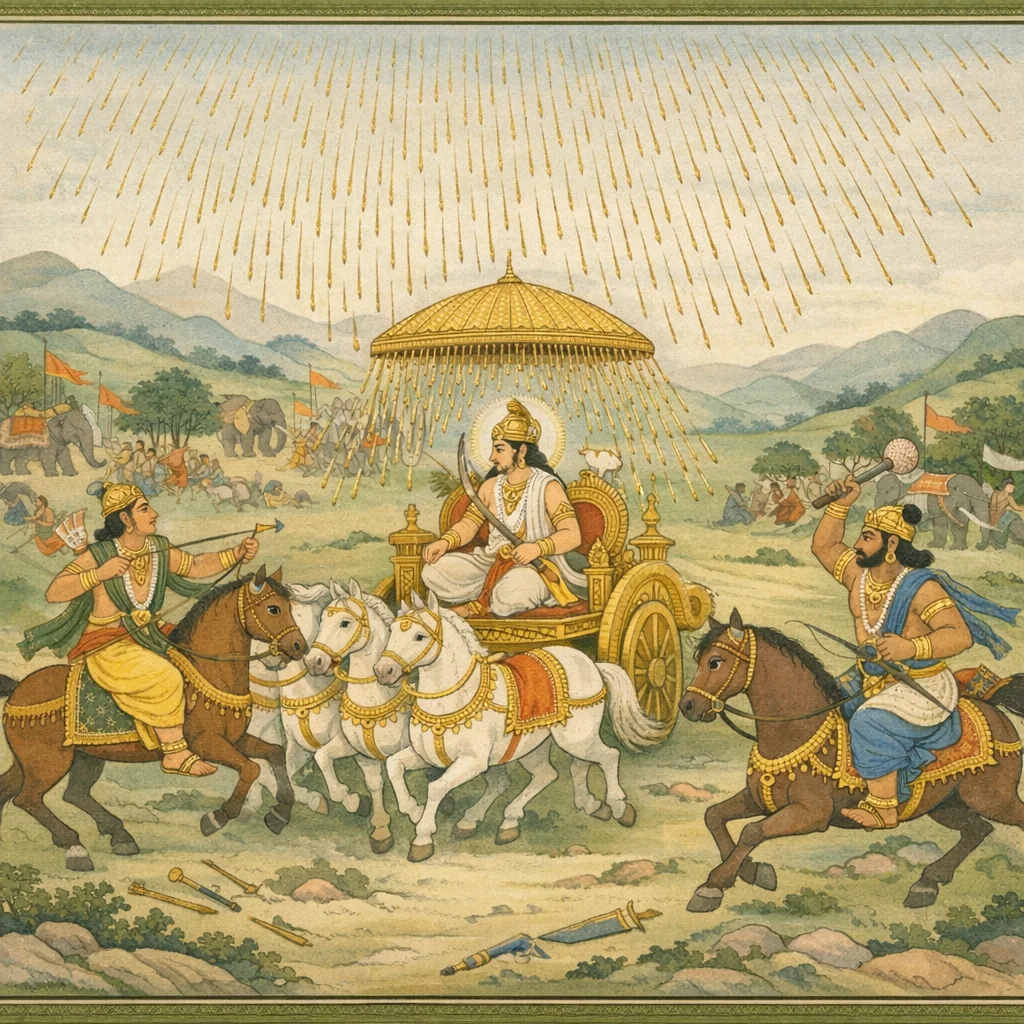
Sañjaya reports that Arjuna, struck by Drauṇi and supported by Trigarta mahārathas, answers with controlled precision—wounding Drauṇi with three arrows and distributing paired shots among other bowmen before unleashing dense volleys. The opposing force, though pierced, maintains pressure and surrounds Arjuna; the ratha-space fills with ornamented arrows, and the scene is rendered through elemental similes: the chariot shines like a ground-bound vimāna lit by meteors, and Arjuna’s shafts fall like rain from a cloud. The battlefield becomes cluttered with broken chariot components and fallen insignia; the ground is described as impassable, blood-and-flesh mire, likened to Rudra’s arena—an image that functions as moral-psychological framing rather than instruction. Arjuna is said to destroy large numbers of chariots, appearing like smokeless fire after burning. Drauṇi then checks him directly; a sustained exchange follows in which Drauṇi wounds Arjuna and Vāsudeva, Arjuna disables Drauṇi’s chariot team, and Drauṇi escalates to throwing a musala and then a parigha—both neutralized mid-flight by Arjuna’s arrows. Arjuna continues to wound Drauṇi without shaking his resolve. A secondary engagement occurs when Suratha attacks Drauṇi; Drauṇi kills Suratha with a nārāca to the heart, remounts swiftly, and resumes the Arjuna engagement, now framed as a large midday battle where Arjuna alone contends with many—an observation underscoring endurance and tactical concentration under extreme conditions.
Chapter Arc: संजय धृतराष्ट्र से कहता है—जब मद्रराज शल्य ने धर्मराज युधिष्ठिर को रण में पीड़ित करना आरम्भ किया, तब पाण्डव-पक्ष के प्रमुख महारथी एक साथ उसकी ओर टूट पड़े। → सात्यकि, भीमसेन और माद्रीपुत्र (नकुल/सहदेव) रथों से शल्य को घेरकर दबाते हैं; पर शल्य अकेला होते हुए भी अद्भुत वेग से प्रत्युत्तर देता है, अनेक धनुर्धरों को एक-एक करके पाँच-पाँच बाणों से घायल करता है। सिद्ध, मुनि और दर्शक ‘आश्चर्य’ कहकर साधुवाद करते हैं; आकाश शल्य के सुवर्ण-भूषित बाणों से भर-सा जाता है। → क्रुद्ध शल्य धर्मराज को लक्ष्य कर निरन्तर शर-वर्षा करता है—युधिष्ठिर को बाणों से आच्छादित कर सिंह-नाद करता है; पाण्डवों के महारथी उस क्षण शल्य की ओर बढ़ने में असमर्थ-से हो जाते हैं, और रणभूमि पर शल्य का पराक्रम सर्वाधिक प्रखर दिखता है। → पाण्डव-पक्ष पुनः साहस बटोरता है—भीमसेन, सात्यकि और स्वयं धर्मराज शल्य पर तीव्र प्रतिशर-वर्षा करते हैं; भीम सत्तर, सात्यकि नौ और युधिष्ठिर साठ बाणों से शल्य के शरीर को विद्ध करते हैं, जिससे शल्य की बढ़त क्षणिक रूप से थमती है और संघर्ष बराबरी की ओर लौटता है। → दोनों पक्षों के महारथी आमने-सामने टिके हैं—अगला क्षण यह तय करेगा कि शल्य की प्रचण्ड धारा फिर उठेगी या धर्मराज का धैर्य निर्णायक प्रहार में बदलेगा।
Shlokas
Verse 1
नशा (0) उस औअन+- त्रयोदशो 5 ध्याय: मद्रराज शल्यका अद्भुत पराक्रम संजय उवाच पीडिते धर्मराजे तु मद्रराजेन मारिष | सात्यकिर्भीमसेनश्व माद्रीपुत्री च पाण्डवी
Sanjaya said: When King Dharmaraja (Yudhishthira) was being hard-pressed by the king of Madra, Shalya, O revered one, Satyaki and Bhimasena, and the Pandava princess—the daughter of Madri—also came forward in response.
Verse 2
परिवार्य रथै: शल्यं पीडयामासुराहवे । संजय कहते हैं--आर्य! जब मद्रराज शल्य धर्मराज युधिष्ठिरको पीड़ा देने लगे, तब सात्यकि, भीमसेन और माद्रीपुत्र पाण्डव नकुल-सहदेवने युद्धस्थलमें शल्यको रथोंद्वारा घेरकर उन्हें पीड़ा देना प्रारम्भ किया ।। तमेकं बहुभिद्दृष्टया पीड्यमानं महारथै:,अकेले शल्यको अनेक महारथियोंद्वारा पीड़ित होते देख उनको सब ओरसे महान् साधुवाद प्राप्त होने लगा। वहाँ एकत्र हुए सिद्ध और महर्षि भी हर्षमें भरकर बोल उठे --आश्चर्य है!
Sañjaya said: In the midst of battle they surrounded Śalya with their chariots and began to press him hard. Seeing Śalya alone, harried by many great chariot-warriors, loud acclaim rose from every side; and the gathered Siddhas and great seers, filled with joy, cried, “Wonderful!”
Verse 3
साधुवादो महाउ्जज्ञे सिद्धाश्चासन् प्रहर्षिता: । आश्षर्यमित्यभाषन्त मुनयश्लञापि सड्रता:,अकेले शल्यको अनेक महारथियोंद्वारा पीड़ित होते देख उनको सब ओरसे महान् साधुवाद प्राप्त होने लगा। वहाँ एकत्र हुए सिद्ध और महर्षि भी हर्षमें भरकर बोल उठे --आश्चर्य है!
Sañjaya said: As Śalya stood alone, harried and wounded by many great chariot-warriors, a mighty chorus of acclaim rose from all sides. The Siddhas and the assembled sages, filled with exhilaration, cried out, “How wondrous!”
Verse 4
भीमसेनो रणे शल्यं शल्यभूतं पराक्रमे । एकेन विद्ध्वा बाणेन पुनर्विव्याध सप्तभि:,भीमसेनने रणभूमिमें अपने पराक्रमके लिये कण्टकरूप शल्यको पहले एक बाणसे घायल करके फिर सात बाणोंसे बींध डाला
Sañjaya said: In the thick of battle, Bhīmasena struck Śalya—who had become a thorn to his prowess—with a single arrow, and then pierced him again with seven more.
Verse 5
सात्यकिश्न शतेनैनं धर्मपुत्रपरीप्सया । मद्रेश्वरमवाकीर्य सिंहनादमथानदत्,सात्यकि भी धर्मपुत्र युधिष्ठिरकी रक्षाके लिये मद्रराजको सौ बाणोंसे आच्छादित करके सिंहके समान दहाड़ने लगे
Sañjaya said: Seeking to protect Dharmaputra (Yudhiṣṭhira), Sātyaki showered the lord of Madra with a hundred arrows, and then roared a lion-like battle-cry.
Verse 6
नकुल: पज्चभिश्लैनं सहदेवश्व॒ पञ्चभि: । विद्ध्वा तं तु पुनस्तूर्ण ततो विव्याध सप्तभि:
Sañjaya said: Nakula struck him with five arrows, and Sahadeva too with five. Having thus pierced him, they again, in swift succession, wounded him further—then with seven more arrows—pressing the attack without pause amid the fury of battle.
Verse 7
नकुल और सहदेवने पाँच-पाँच बाणोंसे शल्यको घायल करके फिर सात बाणोंसे उन्हें तुरंत ही बींध डाला ।। स तु शूरो रणे यत्त: पीडितस्तैर्महारथै: । विकृष्य कार्मुकं घोरं वेगघ्नं भारसाधनम्
Sañjaya said: Nakula and Sahadeva wounded Śalya with five arrows each; then, with seven more shafts, they swiftly pierced him again. Yet that heroic warrior, intent upon the fight and hard-pressed by those great chariot-champions, drew his dreadful bow—an instrument that checks the enemy’s onrush and bears the heavy strain of war—ready to answer their assault.
Verse 8
सात्यकिं पञ्चविंशत्या शल्यो विव्याध मारिष । भीमसेनं तु सप्तत्या नकुलं सप्तभिस्तथा
Sañjaya said: O revered one, Śalya struck Sātyaki with twenty-five arrows; Bhīmasena with seventy; and Nakula likewise with seven.
Verse 9
माननीय नरेश! समरांगणमें शूरवीर शल्यने उन महारथियोंद्वारा पीड़ित होनेपर भी विजयके लिये यत्नशील हो भार सहन करनेमें समर्थ और शत्रुके वेगका नाश करनेवाले एक भयंकर धनुषको खींचकर सात्यकिको पचीस, भीमसेनको सत्तर और नकुलको सात बाण मारे ।। ततः सविशिखं चापं सहदेवस्य धन्विन: । छित्त्वा भल्लेन समरे विव्याधैनं त्रिसप्तभि:,तत्पश्चात् समरभूमिमें एक भल्लके द्वारा धनुर्धर सहदेवके बाणसहित धनुषको काटकर शल्यने उन्हें इक्कीस बाणोंसे घायल कर दिया
Sañjaya said: O venerable king, on the battlefield the heroic Śalya, though hard-pressed by those great chariot-warriors, strove for victory. Able to endure the burden and to break the enemy’s momentum, he drew his dreadful bow and struck Sātyaki with twenty-five arrows, Bhīmasena with seventy, and Nakula with seven. Then, in that fight, cutting with a bhalla-arrow the bow of the archer Sahadeva together with its fitted arrow, Śalya pierced him with twenty-one shafts.
Verse 10
सहदेवस्तु समरे मातुल॑ भूरिवर्चसम् | सज्यमन्यद् धनु: कृत्वा पजचभि: समताडयत्
Sañjaya said: In the thick of battle, Sahadeva confronted his maternal uncle, the radiant and formidable warrior Śalya. Stringing another bow, he struck him repeatedly with five well-aimed arrows.
Verse 11
सारथिं चास्य समरे शरेणानतपर्वणा
Sañjaya reports: In the midst of battle, his charioteer too was struck by an arrow whose joints were unheated.
Verse 12
इस प्रकार श्रीमह्या भारत शल्यपर्वमें संकुलयुद्धाविषयक बारहवाँ अध्याय पूरा हुआ,भीमसेनस्तु सप्तत्या सात्यकिर्नवभि: शरै:
Thus, in the revered Mahābhārata, within the Śalya Parva, the twelfth chapter concerning the confusion and tumult of battle comes to its close. In that same clash, Bhīmasena was struck with seventy arrows, and Sātyaki with nine—an image of the war’s relentless violence, where even the foremost warriors endure suffering amid the moral darkness of fratricidal conflict.
Verse 13
तत: शल्यो महाराज निर्विद्धस्तैर्महारथै:,इति श्रीमहाभारते शल्यपर्वणि शल्ययुद्धे त्रयोदशो5ध्याय:
Sañjaya said: Then Śalya, O great king, was pierced and struck by those great chariot-warriors. Thus ends the thirteenth chapter of the Śalya Parva of the Śrī Mahābhārata, in the section describing the battle with Śalya—marking a grim turn in the war where even the foremost heroes are brought down by concentrated martial force.
Verse 14
सुस्त्राव रुधिरं गात्रैगैरिकं पर्वतो यथा । महाराज! उन महारथियोंद्वारा अत्यन्त घायल कर दिये जानेपर राजा शल्य अपने अंगोंसे रक्तकी धारा बहाने लगे, मानो पर्वत गेरु-मिश्रित जलका झरना बहा रहा हो ।। १३ * तांश्व॒ सर्वान् महेष्वासान् पञ्चभि: पञ्चभि: शरै:
Sañjaya said: “O great king, when those mighty chariot-warriors had grievously wounded him, King Śalya began to pour forth streams of blood from his limbs—like a mountain releasing a cascade of water tinged with red ochre.” The image underscores the brutal cost of war: prowess and rank do not shield one from the bodily consequence of violence, and the battlefield reduces even kings to suffering flesh.
Verse 15
विव्याध तरसा राजंस्तदद्भुतमिवाभवत् । राजन! उन्होंने उन सभी महाधनुर्धरोंको पाँच-पाँच बाणोंसे वेगपूर्वक घायल कर दिया। वह उनके द्वारा अद्भुत-सा कार्य हुआ ।। १४ * ततो<5परेण भल्ल्लेन धर्मपुत्रस्य मारिष
Sañjaya said: “O King, with swift force he pierced them; it seemed almost wondrous. In the very midst of battle he struck those great bowmen, five arrows to each, with surging speed—an act that appeared extraordinary.”
Verse 16
अथान्यद् धनुरादाय धर्मपुत्रो युधिष्ठिर:
Sañjaya said: Then Dharmaputra Yudhiṣṭhira, taking up another bow, prepared to continue the fight—signaling steadfast resolve to uphold his duty even amid the strain and reversals of war.
Verse 17
स च्छाद्यमान: समरे धर्मपुत्रस्य सायकै:
And in the midst of battle, he was being covered—overwhelmed on every side—by the arrows of Dharmaputra (Yudhiṣṭhira).
Verse 18
सात्यकिस्तु ततः क्रुद्धो धर्मपुत्रे शरारदिते
Sañjaya said: Then Sātyaki, enraged, saw Dharmaputra (Yudhiṣṭhira) struck by arrows and writhing in pain.
Verse 19
स सात्यके: प्रचिच्छेद क्षुरप्रेण महद् धनु:
Sañjaya said: With a razor-edged arrow, he cut down Sātyaki’s great bow.
Verse 20
तस्य क्रुद्धो महाराज सात्यकि: सत्यविक्रम:
Sañjaya said: O King, Sātyaki—true in valor—became enraged at him.
Verse 21
भीमसेनो<5थ नाराचं ज्वलन्तमिव पन्नगम्,भीमसेनने प्रज्वलित सर्पके समान नाराच चलाया, नकुलने संग्रामभूमिमें शल्यपर शक्ति छोड़ी, सहदेवने सुन्दर गदा चलायी और धर्मराज युधिष्ठिरने रणक्षेत्रमें शल्यको मार डालनेकी इच्छासे उनपर शतघ्नीका प्रहार किया
Sañjaya said: Then Bhīmasena launched a barbed arrow, blazing like a serpent of fire. Nakula, on the battlefield, hurled a spear at Śalya. Sahadeva sent forth a splendid mace. And King Yudhiṣṭhira, intent on slaying Śalya, struck at him in the field with a shataghnī.
Verse 22
नकुल: समरे शक्ति सहदेवो गदां शुभाम् | धर्मराज: शतघ्नीं च जिघांसु: शल्यमाहवे,भीमसेनने प्रज्वलित सर्पके समान नाराच चलाया, नकुलने संग्रामभूमिमें शल्यपर शक्ति छोड़ी, सहदेवने सुन्दर गदा चलायी और धर्मराज युधिष्ठिरने रणक्षेत्रमें शल्यको मार डालनेकी इच्छासे उनपर शतघ्नीका प्रहार किया
Sañjaya said: In the thick of battle, Nakula hurled a spear; Sahadeva launched a splendid mace; and Dharmarāja Yudhiṣṭhira, intent on slaying Śalya in the fight, struck at him with a śataghnī. Bhīmasena, like a blazing serpent, sent forth sharp arrows. Thus the Pāṇḍavas, each with his chosen weapon, pressed their righteous resolve into action amid the harsh demands of war.
Verse 23
तानापतत एवाशु पज्चानां वै भुजच्युतान् । वारयामास समरे शस्त्रसड्घै: स मद्रराट्,परंतु मद्रराज शल्यने समरांगणमें अपने शस्त्रसमूहों द्वारा उन पाँचों वीरोंके हाथोंसे छूटे हुए उक्त सभी अस्त्रोंका शीघ्र ही निवारण कर दिया
Sañjaya said: As those missiles, released from the hands of the five warriors, came rushing in, the king of Madra, Śalya, swiftly checked them on the battlefield with volleys of his own weapons—showing the hard discipline of war where alertness and countermeasure decide life and death.
Verse 24
सात्यकिप्रहितं शल्यो भल््लैश्वचिच्छेद तोमरम् । प्रहितं भीमसेनेन शरं कनकभूषणम्
Sañjaya said: Śalya, with sharp barbed arrows, cut down the javelin that had been hurled by Sātyaki; and he also severed the gold-adorned arrow that had been shot by Bhīmasena. The scene underscores the relentless skill of warriors in battle—where courage must be matched by alertness and mastery, and where intent alone does not guarantee success amid the chaos of war.
Verse 25
नकुलप्रेषितां शक्ति हेमदण्डां भयावहाम्
Sañjaya said: “The dreadful spear, with its golden shaft, which had been hurled by Nakula…”
Verse 26
गदां च सहदेवेन शरौघै: समवारयत् | इसी प्रकार उन्होंने नकुलकी चलायी हुई स्वर्ण-दण्ड-विभूषित भयंकर शक्तिका तथा सहदेवकी फेंकी हुई गदाका भी अपने बाणसमूहोंद्वारा निवारण कर दिया ।। शराभ्यां च शतध्नीं तां राज्ञश्चिच्छेद भारत
Sañjaya said: With a dense volley of arrows he checked even the mace hurled by Sahadeva. And with two arrows, O Bhārata, he cut down that śataghnī weapon belonging to the king—thus displaying the ruthless precision of battle where skill and resolve decide the fate of even the most fearsome missiles.
Verse 27
नामृष्यत्तत्र शैनेय: शत्रोर्विजयमाहवे,युद्धमें शत्रुकी इस विजयको शिनिपौत्र सात्यकि नहीं सहन कर सके। उन्होंने दूसरा धनुष हाथमें लेकर क्रोधसे आतुर हो दो बाणोंसे मद्रराजको घायल करके तीनसे उनके सारथिको भी बींध डाला
Sañjaya said: There, Śaineya (Sātyaki) could not endure the enemy’s triumph in the battle. Seized by anger, he took up another bow; with two arrows he wounded the king of Madra, and with three more he pierced the king’s charioteer.
Verse 28
अथान्यद् धनुरादाय सात्यकि: क्रोधमूर्च्छित: । द्वाभ्यां मद्रेश्वरं विदृध्वा सारथिं च त्रिभि: शरै:,युद्धमें शत्रुकी इस विजयको शिनिपौत्र सात्यकि नहीं सहन कर सके। उन्होंने दूसरा धनुष हाथमें लेकर क्रोधसे आतुर हो दो बाणोंसे मद्रराजको घायल करके तीनसे उनके सारथिको भी बींध डाला
Sañjaya said: Then Sātyaki, overcome by a surge of wrath, took up another bow. With two arrows he struck the lord of Madra, and with three more shafts he pierced the charioteer as well—unable to endure the enemy’s momentary triumph in the battle.
Verse 29
ततः शल्यो रणे राजन् सर्वास्तान् दशभि: शरै: | विव्याध भृशसंक्रुद्धस्तोत्रिरिव महाद्विपान्,राजन्! तब राजा शल्य रणभूमिमें अत्यन्त कुपित हो उठे और जैसे महावत अंकुशोंसे बड़े-बड़े हाथियोंको चोट पहुँचाते हैं, उसी प्रकार उन्होंने उन सब योद्धाओंको दस बाणोंसे घायल कर दिया
Sañjaya said: Then, O King, Śalya—fiercely enraged in the midst of battle—pierced all those warriors with ten arrows each, like a mahout striking great elephants with a goad.
Verse 30
ते वार्यमाणा: समरे मद्रराज्ञा महारथा: । न शेकुः सम्मुखे स्थातुं तस्य शत्रुनिष्दना:
Sañjaya said: Though those great chariot-warriors were being checked on the battlefield by the king of Madra, they could not stand facing him; for he was a destroyer of foes.
Verse 31
समरांगणमें मद्रराज शल्यके द्वारा इस प्रकार रोके जाते हुए शत्रुसूदन पाण्डव-महारथी उनके सामने ठहर न सके ।। ततो दुर्योधनो राजा दृष्टवा शल्यस्य विक्रमम् । निहतान् पाण्डवान् मेने पड्चालानथ सृञ्जयान्,उस समय राजा दुर्योधन शल्यका वह पराक्रम देखकर ऐसा समझने लगा कि अब पाण्डव, पांचाल और सूंजय अवश्य मार डाले जायँगे
Sañjaya said: Thus, checked in this way on the battlefield by Śalya, the king of Madra, the Pāṇḍava great chariot-warriors—slayers of foes—could not stand before him. Then King Duryodhana, seeing Śalya’s prowess, persuaded himself that the Pāṇḍavas, along with the Pāñcālas and the Sṛñjayas, had been slain.
Verse 32
ततो राजन् महाबाहुर्भीमसेन: प्रतापवान् | संत्यज्य मनसा प्राणान् मद्राधिपमयोधयत्
Sañjaya said: Then, O King, the mighty-armed and valiant Bhīmasena—having in his mind renounced even his own life—engaged the lord of Madra in battle.
Verse 33
राजन! तदनन्तर प्रतापी महाबाहु भीमसेन मनसे प्राणोंका मोह छोड़कर मद्रराज शल्यके साथ युद्ध करने लगे ।। नकुलः सहदेवश्व सात्यकिश्न महारथ: । परिवार्य तदा शल्यं समनन््ताद् व्यकिरन् शरै:,नकुल, सहदेव और महारथी सात्यकिने भी उस समय शल्यको घेरकर उनके ऊपर चारों ओरसे बाणोंकी वर्षा प्रारम्भ कर दी
Sañjaya said: O King, thereafter the mighty, great-armed Bhīmasena—casting off the delusion that had seized his very life-breath—engaged in battle with Śalya, the king of Madra. Nakula, Sahadeva, and the great chariot-warrior Satyaki also surrounded Śalya then and began to shower him with arrows from all sides.
Verse 34
स चतुर्भिमिहेष्वासै: पाण्डवानां महारथै: । वृतस्तान् योधयामास मद्रराज: प्रतापवान्,इन चार महाधनुर्धर पाण्डवपक्षके महारथियोंसे घिरे हुए प्रतापी मद्रराज शल्य उन सबके साथ युद्ध कर रहे थे
Sañjaya said: Surrounded here by four great bowmen—mighty chariot-warriors of the Pāṇḍavas—the valiant king of Madra, Śalya, engaged them all in battle.
Verse 35
तस्य धर्मसुतो राजन क्षुरप्रेण महाहवे | चक्ररक्ष॑ं जघानाशु मद्रराजस्य पार्थिव:,राजन! उन महासमरमें धर्मपुत्र राजा युधिष्ठिरने एक क्षुरप्रद्वारा मद्रराज शल्यके चक्ररक्षकको शीघ्र ही मार डाला
Sañjaya said: O King, in that great battle Dharmasuta Yudhiṣṭhira swiftly struck down, with a razor-edged arrow, the wheel-guard of Śalya, the king of Madra.
Verse 36
तस्मिंस्तु निहते शूरे चक्ररक्षे महारथे । मद्रराजो5पि बलवान् सैनिकानावृणोच्छरै:,अपने महारथी शूरवीर चक्ररक्षकके मारे जानेपर बलवान मद्रराजने भी बाणोंद्वारा शत्रुपक्षके समस्त योद्धाओंको आच्छादित कर दिया
Sañjaya said: When that heroic great chariot-warrior—the protector of the wheel-formation—had been slain, the mighty king of Madra, too, covered the opposing host of warriors with a dense shower of arrows.
Verse 37
समावृतांस्ततस्तांस्तु राजन् वीक्ष्य स्वसैनिकान् | चिन्तयामास समरे धर्मपुत्रो युधिष्ठिर:,राजन! समरांगणमें अपने समस्त सैनिकोंको बाणोंसे ढका हुआ देख धर्मपुत्र युधिष्ठिर मन-ही-मन इस प्रकार चिन्ता करने लगे---
Sañjaya said: Then, O King, seeing his own troops on the battlefield covered over with arrows, Yudhiṣṭhira—the son of Dharma—began to reflect inwardly, weighed down by concern amid the clash of war.
Verse 38
कथं नु समरे शक््यं तन््माधववचो महत् | न हि क्रुद्धो रणे राजा क्षपयेत बल॑ मम,“इस युद्धस्थलमें भगवान् श्रीकृष्णकी कही हुई वह महत्त्वपूर्ण बात कैसे सिद्ध हो सकेगी? कहीं ऐसा न हो कि रणभूमिमें कुपित हुए महाराज शल्य मेरी सारी सेनाका संहार कर डालें
Sañjaya said: “How, in the midst of battle, can that great pronouncement spoken by Mādhava (Śrī Kṛṣṇa) be brought to fulfillment? For if King Śalya, enraged on the battlefield, were to strike without restraint, he could annihilate my entire force.”
Verse 39
(अहं मद्भ्रातरश्नैव सात्यकिश्न महारथ: । पज्चाला: सृञ्जयाश्वैव न शक्ता: सम हि मद्रपम् ।। निहनिष्यति चैवाद्य मातुलो5स्मान् महाबल: । गोविन्दवचनं सत्यं कथं भवति कि त्विदम् ।।) मैं, मेरे भाई, महारथी सात्यकि तथा पांचाल और सूंजय योद्धा सब मिलकर भी मद्रराज शल्यको पराजित करनेमें समर्थ नहीं हो रहे हैं। जान पड़ता है ये महाबली मामा आज हमलोगोंका वध कर डालेंगे। फिर भगवान् श्रीकृष्णकी यह बात (कि शल्य मेरे हाथसे मारे जायँगे) कैसे सिद्ध होगी?'। ततः सरथनागाश्चा: पाण्डवा: पाण्डुपूर्वज । मद्रराजं समासेदु: पीडयन्त: समन्ततः
Sañjaya said: “I, my brothers, and the great chariot-warrior Sātyaki—together with the Pāñcālas and the Sṛñjayas—are not able to match the king of Madra in battle. It seems this mighty maternal uncle will slay us today. Then how will Govinda’s statement—‘Śalya will be slain by my hand’—prove true? What is this?” Thereupon the Pāṇḍavas, with their chariots and elephants, closed in upon the king of Madra, pressing him from every side.
Verse 40
पाण्डुके बड़े भाई महाराज धुृतराष्ट्र! तदनन्तर रथ, हाथी और घोड़ोंसहित समस्त पाण्डवयोद्धा मद्रराज शल्यको सब ओरसे पीड़ा देते हुए उनपर चढ़ आये ।। नानाशस्त्रौघबहुलां शस्त्रवृष्टिं समुद्यताम् । व्यधमत् समरे राजा महाभ्राणीव मारुत:
Sañjaya said: “O great king Dhṛtarāṣṭra, elder brother of Pāṇḍu! Thereafter all the Pāṇḍava warriors—together with chariots, elephants, and horses—closed in on Śalya, the king of Madra, pressing him from every side. In the battle the king (Śalya) scattered the rising storm of weapons—dense with torrents of varied arms—like a powerful wind dispersing a mass of clouds.”
Verse 41
जैसे वायु बड़े-बड़े बादलोंको उड़ा देती है, उसी प्रकार समरांगणमें राजा शल्यने अनेक प्रकारके अस्त्र-शस्त्रोंसे परिपूर्ण उस उमड़ी हुई शस्त्रवर्षाको छिन्न-भिन्न कर डाला ।। ततः कनकपुड्खां तां शल्यक्षिप्तां वियद्गताम् । शरवृष्टिमपश्याम शलभानामिवायतिम्,तत्पश्चात् शल्यके चलाये हुए सुनहरे पंखवाले बाणोंकी वर्षा आकाशमें टिड्डीदलोंके समान छा गयी, जिसे हमने अपनी आँखों देखा था
Sañjaya said: Thereafter we beheld the shower of arrows—golden-feathered and hurled by King Śalya—rising into the sky and spreading out like a vast swarm of locusts.
Verse 42
ते शरा मद्रराजेन प्रेषिता रणमूर्थनि । सम्पतन्तः सम दृश्यन्ते शलभानां व्रजा इव,युद्धके मुहानेपर मद्रराजके चलाये हुए वे बाण शलभसमूहोंके समान गिरते दिखायी देते थे
Sañjaya said: On the very forefront of the battlefield, the arrows loosed by the king of Madra fell in such dense succession that they looked like swarms of locusts.
Verse 43
मद्रराजधनुर्मुक्ता: शरै: कनकभूषणै: । निरन्तरमिवाकाशं सम्बभूव जनाधिप,नरेश्वर! मद्रराज शल्यके धनुषसे छूटे हुए उन सुवर्णभूषित बाणोंसे आकाश ठसाठस भर गया था
Sañjaya said: O lord of men, O king, as Śalya, the king of Madra, loosed an unbroken stream of gold-adorned arrows from his bow, the sky seemed to be filled without pause.
Verse 44
न पाण्डवानां नास्माकं तत्र किज्चिद् व्यदृश्यत | बाणान्धकारे महति कृते तत्र महाहवे,उस महायुद्धमें बाणोंद्वारा महान् अन्धकार छा गया, जिससे वहाँ हमारी और पाण्डवोंकी कोई भी वस्तु दिखायी नहीं देती थी
Sañjaya said: In that great battle, when a vast darkness was created by the shower of arrows, nothing at all could be seen there—neither the Pāṇḍavas’ forces nor ours.
Verse 45
मद्रराजेन बलिना लाघवाच्छरवृश्टिभि: । चाल्यमान तु तं॑ दृष्टवा पाण्डवानां बलार्णवम्
Sañjaya said: Seeing that vast ocean of the Pāṇḍavas’ forces being shaken by the mighty king of Madra—who, with swift skill, poured down showers of arrows—
Verse 46
स तु तान् सर्वतो यत्तान् शरै: संछाद्य मारिष
Sañjaya said: But he, O venerable one, covered them—who were pressed in from every side—with a shower of arrows.
Verse 47
ते च्छन्ना: समरे तेन पाण्डवानां महारथा:
Sañjaya said: In that battle, those great chariot-warriors of the Pāṇḍavas were overwhelmed and covered over by him—pressed hard amid the clash of arms, as the tide of war turned under his assault.
Verse 48
धर्मराजपुरोगास्तु भीमसेनमुखा रथा: । न जहु: समरे शूरं शल्यमाहवशोभिनम्,तो भी धर्मराजको आगे रखकर भीमसेन आदि रथी संग्राममें शोभा पानेवाले शूरवीर शल्यको वहाँ छोड़कर पीछे न हटे
Sañjaya said: With Dharmarāja placed at their head, and with Bhīmasena foremost among them, the chariot-warriors did not abandon in the battle that heroic Śalya, who shone in the clash of arms. Even under the pressure of war, they did not turn back leaving him behind—steadfast in resolve and duty amid the turmoil of combat.
Verse 103
शरैराशीविषाकारैज्वलज्ज्वलनसंनिभै: । तब सहदेवने संग्राममें दूसरे धनुषपर प्रत्यंचा चढ़ाकर अपने अत्यन्त तेजस्वी मामाको विषधर सर्पोंके समान भयंकर और जलती हुई आगके समान प्रज्वलित पाँच बाणोंद्वारा घायल कर दिया
Sanjaya said: Then, in the thick of battle, Sahadeva—stringing the bow anew—struck my exceedingly valiant warrior with five arrows, dreadful like venomous serpents and blazing like fire.
Verse 116
विव्याध भृशसंक्रुद्धस्तं वै भूयस्त्रिभि: शरै: । साथ ही अत्यन्त कुपित होकर उन्होंने झुकी हुई गाँठवाले बाणसे उनके सारथिको भी पीट दिया और उन्हें भी पुनः तीन बाणोंसे घायल किया
Sañjaya said: In fierce anger, he pierced that man again with three arrows. In the same surge of wrath, he also struck the opponent’s charioteer with bent-knotted shafts and wounded him too once more with three arrows.
Verse 153
धनुश्विच्छेद समरे सज्यं स सुमहारथ: । मान्यवर! तदनन्तर उन श्रेष्ठ महारथी शल्यने समरांगणमें एक दूसरे भल्लके द्वारा धर्मपुत्र युधिष्ठिरके प्रत्यंचासहित धनुषको काट डाला
Sanjaya said: In that battle of severing bows, the great chariot-warrior kept his bow strung. Then, O revered one, immediately afterward the foremost warrior Shalya, on the battlefield, with another sharp arrow, cut down Dharmaputra Yudhishthira’s bow together with its bowstring.
Verse 166
साश्व॒सूतध्वजरथं शल्यं प्राच्छादयच्छरै: । तब धर्मपुत्र युधिष्ठिरने दूसरा धनुष हाथमें लेकर घोड़े, सारथि, ध्वज और रथसहित शल्यको अपने बाणोंसे आच्छादित कर दिया
Sañjaya said: Then Dharmaputra Yudhiṣṭhira, taking up another bow, covered Śalya with a shower of arrows—along with his horses, charioteer, banner, and chariot—pressing the battle in a manner befitting a king who must uphold duty even amid the harsh necessities of war.
Verse 173
युधिष्ठिरमथाविध्यद् दशभिर्निशितै: शरै: । समरांगणमें धर्मपुत्रके बाणोंसे आच्छादित होते हुए शल्यने युधिष्ठिरको दस पैने बाणोंसे बींध डाला
Sañjaya said: Then Śalya struck Yudhiṣṭhira with ten keen arrows. Even as the son of Dharma was covering the battlefield with his own shafts, Śalya pierced him—an image of relentless martial resolve where righteous kingship must endure injury without abandoning steadiness or duty.
Verse 186
मद्राणामधिपं शूरं शरैर्विव्याध पञ्चभि: । जब धर्मपुत्र युधिष्ठिर शल्यके बाणोंसे पीड़ित हो गये, तब क्रोधमें भरे हुए सात्यकिने शूरवीर मद्रराजपर पाँच बाणोंका प्रहार किया
Sañjaya said: Then Sātyaki, inflamed with wrath when Yudhiṣṭhira, the son of Dharma, had been tormented by Śalya’s arrows, struck the heroic lord of the Madrakas with five shafts. The episode underscores how, amid the chaos of war, loyalty to one’s ally and the impulse to protect the righteous can surge into anger, driving swift retaliatory action.
Verse 196
भीमसेनमुखांस्तांश्न त्रिभिस्त्रेभिरताडयत् । यह देख शल्यने एक क्षुरप्रसे सात्यकिके विशाल धनुषको काट दिया और भीमसेन आदिको भी तीन-तीन बाणोंसे चोट पहुँचायी
Sañjaya said: Seeing this, Śalya struck Bhīmasena and the other foremost warriors, each with three arrows. In the same exchange he also severed Sātyaki’s broad bow with a razor-headed shaft—an act that displays the ruthless precision of battlefield skill, where disabling an opponent’s weapon is as decisive as wounding the warrior himself.
Verse 206
तोमर प्रेषयामास स्वर्णदण्डं महाधनम् । महाराज! तब सत्यपराक्रमी सात्यकिने कुपित हो शल्यपर सुवर्णमय दण्डसे विभूषित एक बहुमूल्य तोमरका प्रहार किया
Sañjaya said: O King, then Śalyaputra, famed for true valor, enraged at Sātyaki, hurled a highly valuable javelin whose shaft was of gold. The episode underscores how wrath on the battlefield drives men to ever more lethal acts, eclipsing restraint and ethical deliberation amid the compulsions of war.
Verse 243
द्विधा चिच्छेद समरे कृतहस्त: प्रतापवान् | सिद्धहस्त एवं प्रतापी वीर शल्यने अपने भल्लोंद्वारा सात्यकिके चलाये हुए तोमरके टुकड़े-टुकड़े कर डाले और भीमसेनके छोड़े हुए सुवर्णभूषित बाणके दो खण्ड कर डाले
Sanjaya said: In the thick of battle, the mighty and unfailingly skilled hero Shalya cut it in two. With well-aimed shafts he shattered into fragments the javelin hurled by Satyaki, and he also split in two the gold-adorned arrow released by Bhimasena.
Verse 263
पश्यतां पाण्डुपुत्राणां सिंहनादं ननाद च । भारत! फिर शल्यने दो बाणोंसे राजा युधिष्ठिरकी उस शतघ्नीको भी पाण्डवोंके देखते-देखते काट डाला और सिंहके समान दहाड़ना आरम्भ किया
Sanjaya said: While the sons of Pandu looked on, he let out a lion-like roar, proclaiming his dominance and striking fear into the opposing warriors amid the battle.
Verse 456
विस्मयं परमं जम्मुर्देवगन्धर्वदानवा: । बलवान मद्रराजके द्वारा शीघ्रतापूर्वक की जानेवाली उस बाण-वर्षसि पाण्डवोंके उस सैन्यसमुद्रको विचलित होते देख देवता, गन्धर्व और दानव अत्यन्त आश्चर्यमें पड़ गये
Sanjaya said: The gods, Gandharvas, and Danavas were struck with the greatest amazement when they saw the vast ocean-like army of the Pandavas thrown into confusion by the mighty king of Madra, who unleashed a swift and relentless shower of arrows.
Verse 463
धर्मराजमवच्छाद्य सिंहवद् व्यनदन्मुहु: । मान्यवर! विजयके लिये प्रयत्न करनेवाले उन समस्त योद्धाओंको सब ओरसे बाणोंद्वारा आच्छादित करके शल्य धर्मराज युधिष्ठिरको भी ढककर बारंबार सिंहके समान गर्जना करने लगे
Sanjaya said: Having covered Dharmaraja (Yudhishthira) on all sides with a shower of arrows, Shalya—striving for victory along with the warriors engaged in that effort—repeatedly roared like a lion.
Verse 476
नाशवनुवंस्तदा युद्धे प्रत्युद्यातुं महारथम् । समरांगणमें उनके बाणोंसे आच्छादित हुए पाण्डवोंके महारथी उस युद्धमें महारथी शल्यकी ओर आगे बढ़नेमें समर्थ न हो सके
Sanjaya said: Then, in that battle, the great chariot-warriors of the Pandavas—covered and overwhelmed by Shalya’s arrows on the field of combat—were unable to advance to meet that great warrior.
Verse 1236
धर्मराजस्तथा षष्ट्या गात्रे शल्यं समार्पयत् । तत्पश्चात् भीमसेनने सत्तर, सात्यकिने नौ और धर्मराज युधिष्ठिरने साठ बाणोंसे शल्यके शरीरको चोट पहुँचायी
Sanjaya said: King Yudhiṣṭhira struck Śalya’s body with sixty arrows. After that, Bhīmasena wounded him with seventy, Sātyaki with nine, and Yudhiṣṭhira again with sixty. In the grim discipline of battle, the Pāṇḍavas pressed their assault with measured resolve, subordinating personal feeling to the harsh demands of duty in war.
Frequently Asked Questions
The implicit dilemma is proportionality under encirclement: how a kṣatriya maintains duty and self-control while employing overwhelming force against many opponents, especially as the engagement escalates beyond arrows to heavier weapons.
The chapter conveys that endurance and composure, paired with discriminating skill, can stabilize chaotic conditions; the elemental similes frame human agency as powerful yet morally weighty within a larger order.
No explicit phalaśruti is presented here; the meta-layer operates through Sañjaya’s reportorial framing and similes, positioning the episode as a case study in kṣatra-duty and the psychological cost of late-war escalation.