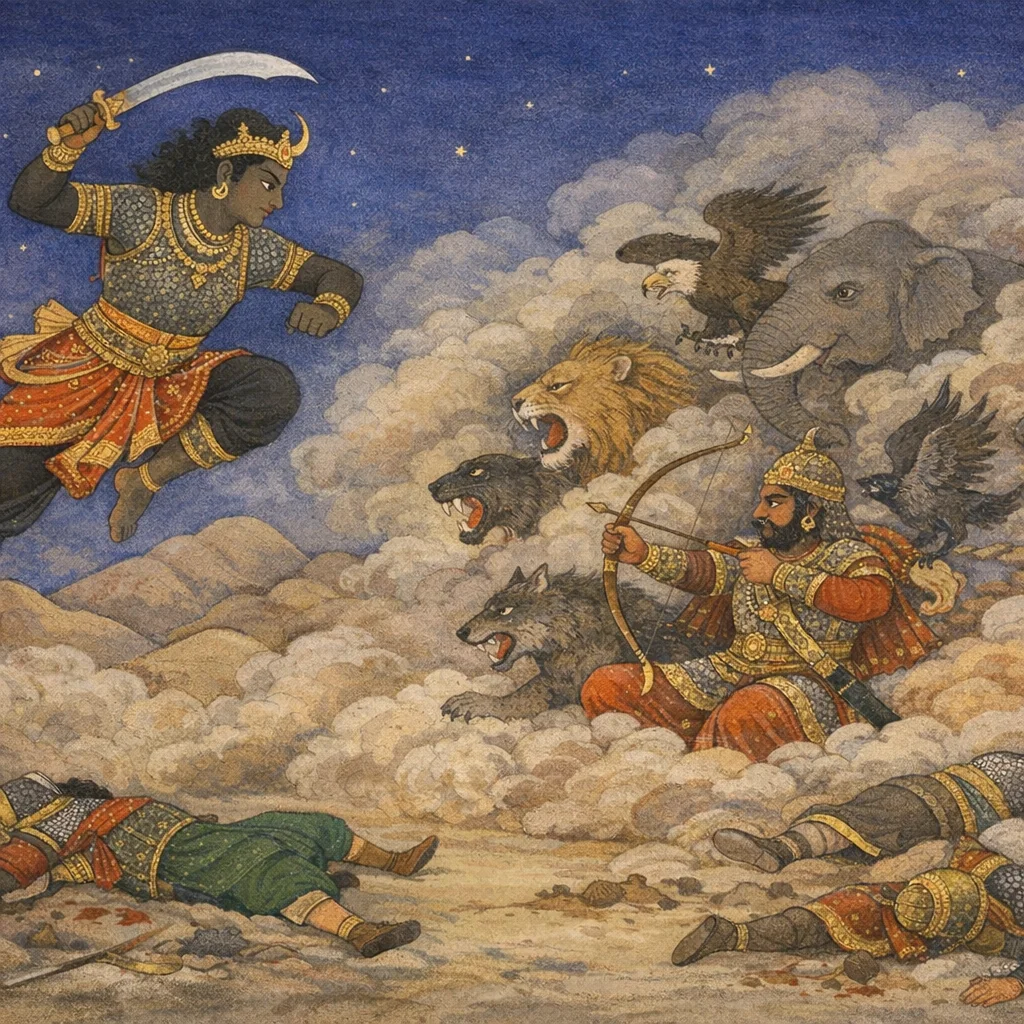
Adhyaya 176
Chapter Arc: निशीथ के अंधकार में कर्ण का विक्रम पाण्डव-सेना को तितर-बितर कर देता है; संजय धृतराष्ट्र से कहता है कि कर्ण को रोकने हेतु एक महाबली राक्षस-योद्धा को आगे बढ़ाया जा रहा है। → दुर्योधन-पक्ष में यह चिंता फैलती है कि कर्ण पर घटोत्कच का धावा निर्णायक हो सकता है; उसी घोर रात्रि-युद्ध में जटासुर-पुत्र अलम्बुष क्रुद्ध होकर भीमसेन-पुत्र घटोत्कच को ललकारता है। दोनों महामायावी राक्षस अपनी-अपनी माया से हाथी-घोड़े-रथ-सेनाओं के रूप बदलते, भ्रम रचते और एक-दूसरे को घेरते हैं; पाण्डव-सेना कर्ण के प्रहारों से ‘वात-नुन्न घनों’ की भाँति बिखरती जाती है। → अलम्बुष बंधन से छूटकर पुनः वेग से घटोत्कच पर टूट पड़ता है; फिर दोनों ‘मायाशतसृज’ राक्षस-प्रवर घोर संग्राम में आमने-सामने आ जाते हैं—क्षण-क्षण में रूपांतरण, अदृश्य प्रहार, और भीषण गर्जना के बीच घटोत्कच अपनी तलवार उठाकर शत्रु पर अमित पराक्रम से निर्णायक वार करता है। → घटोत्कच के प्रचंड प्रतिघात से अलम्बुष की माया-योजना टूटती है और कौरव-पक्ष की रात्रि-रणनीति को बड़ा धक्का लगता है; फिर भी कर्ण का भय और रात्रि का अराजक प्रवाह युद्धभूमि को स्थिर नहीं होने देता। → रात्रि-युद्ध की उन्मत्त धारा में संकेत मिलता है कि कर्ण और घटोत्कच का टकराव और भी प्राणघातक रूप लेने वाला है—धर्म, नीति और अस्त्र-सीमा की रेखाएँ और धुँधली पड़ेंगी।
Shlokas
Verse 1
(दाक्षिणात्य अधिक पाठका १ श्लोक मिलाकर कुल ६९ “लोक हैं।) ऑपन--माजल छा | अकाल चतुःसप्तरत्यांधेिकशततमो< ध्याय: घटोत्कच और जटासुरके पुत्र अलम्बुषका घोर युद्ध तथा अलम्बुषका वध संजय उवाच दृष्टवा घटोत्कचं राजन् सूतपुत्रर॒थं प्रति । आयान्तं तु तथा युक्त जिघांसुं कर्णमाहवे,अभियाति द्रुतं कर्ण तद् वारय महारथम् । संजय कहते हैं--राजन! युद्धस्थलमें इस प्रकार कर्णका वध करनेकी इच्छासे उद्यत हुए घटोत्कचको सूतपुत्रके रथकी ओर आते देख आपके पुत्र दुर्योधनने दःशासनसे इस प्रकार कहा--'भाई! यह राक्षस रणभूमिमें कर्णका वेगपूर्वक पराक्रम देखकर तीव्र गतिसे उसपर आक्रमण कर रहा है; अतः उस महारथी घटोत्कचको रोको
Sañjaya said: “O King, seeing Ghaṭotkaca advancing toward the charioteer’s son Karṇa’s chariot—fully prepared and intent on slaying Karṇa in battle—Duryodhana, alarmed for his chief support, urged: ‘Ghaṭotkaca is rushing straight at Karṇa; stop that great warrior.’”
Verse 2
अब्रवीत् तत्र पुत्रस्ते द:शासनमिदं वच: । एतदू रक्षो रणे तूर्ण दृष्टवा कर्णस्य विक्रमम्,अभियाति द्रुतं कर्ण तद् वारय महारथम् । संजय कहते हैं--राजन! युद्धस्थलमें इस प्रकार कर्णका वध करनेकी इच्छासे उद्यत हुए घटोत्कचको सूतपुत्रके रथकी ओर आते देख आपके पुत्र दुर्योधनने दःशासनसे इस प्रकार कहा--'भाई! यह राक्षस रणभूमिमें कर्णका वेगपूर्वक पराक्रम देखकर तीव्र गतिसे उसपर आक्रमण कर रहा है; अतः उस महारथी घटोत्कचको रोको
Sañjaya said: “Thereupon, O King, your son addressed Duḥśāsana with these words: ‘This rākṣasa, having seen Karṇa’s swift prowess on the battlefield, is rushing quickly to attack him. Therefore, restrain that great chariot-warrior, Ghaṭotkaca.’”
Verse 3
वृतः सैन्येन महता याहि यत्र महाबल:,अभियाति द्रुतं कर्ण तद् वारय महारथम् । संजय कहते हैं--राजन! युद्धस्थलमें इस प्रकार कर्णका वध करनेकी इच्छासे उद्यत हुए घटोत्कचको सूतपुत्रके रथकी ओर आते देख आपके पुत्र दुर्योधनने दःशासनसे इस प्रकार कहा--'भाई! यह राक्षस रणभूमिमें कर्णका वेगपूर्वक पराक्रम देखकर तीव्र गतिसे उसपर आक्रमण कर रहा है; अतः उस महारथी घटोत्कचको रोको
Sañjaya said: “Surrounded by a great host, go to the place where that mighty warrior is rushing swiftly toward Karṇa. Restrain that great chariot-fighter.”
Verse 4
रक्ष कर्ण रणे यत्तो वृतः सैन्येन मानद,अभियाति द्रुतं कर्ण तद् वारय महारथम् । संजय कहते हैं--राजन! युद्धस्थलमें इस प्रकार कर्णका वध करनेकी इच्छासे उद्यत हुए घटोत्कचको सूतपुत्रके रथकी ओर आते देख आपके पुत्र दुर्योधनने दःशासनसे इस प्रकार कहा--'भाई! यह राक्षस रणभूमिमें कर्णका वेगपूर्वक पराक्रम देखकर तीव्र गतिसे उसपर आक्रमण कर रहा है; अतः उस महारथी घटोत्कचको रोको
Sañjaya said: “O King, protect Karṇa in the battle. That mighty warrior—Ghaṭotkaca—surrounded by his troops and intent on slaying Karṇa, is rushing swiftly toward the charioteer’s son. Therefore, restrain that great chariot-fighter.”
Verse 5
एतस्मिन्नन्तरे राजन् जटासुरसुतो बली,अभियाति द्रुतं कर्ण तद् वारय महारथम् । संजय कहते हैं--राजन! युद्धस्थलमें इस प्रकार कर्णका वध करनेकी इच्छासे उद्यत हुए घटोत्कचको सूतपुत्रके रथकी ओर आते देख आपके पुत्र दुर्योधनने दःशासनसे इस प्रकार कहा--'भाई! यह राक्षस रणभूमिमें कर्णका वेगपूर्वक पराक्रम देखकर तीव्र गतिसे उसपर आक्रमण कर रहा है; अतः उस महारथी घटोत्कचको रोको
Sañjaya said: “O King, meanwhile the mighty son of Jaṭāsura advances swiftly toward Karṇa; therefore, restrain that great chariot-warrior.”
Verse 6
दुर्योधन तवामित्रान् प्रख्यातान् युद्धदुर्मदान्,अभियाति द्रुतं कर्ण तद् वारय महारथम् । संजय कहते हैं--राजन! युद्धस्थलमें इस प्रकार कर्णका वध करनेकी इच्छासे उद्यत हुए घटोत्कचको सूतपुत्रके रथकी ओर आते देख आपके पुत्र दुर्योधनने दःशासनसे इस प्रकार कहा--'भाई! यह राक्षस रणभूमिमें कर्णका वेगपूर्वक पराक्रम देखकर तीव्र गतिसे उसपर आक्रमण कर रहा है; अतः उस महारथी घटोत्कचको रोको
Sañjaya said: “O King, Ghaṭotkaca—intent on killing Karṇa in this manner—has set out and is swiftly advancing toward the charioteer’s son’s chariot. Seeing him rush in with fierce speed, your son Duryodhana spoke to Duḥśāsana: ‘Brother, this rākṣasa, having witnessed Karṇa’s forceful prowess on the battlefield, is charging rapidly to attack him; therefore, restrain that great chariot-warrior, Ghaṭotkaca.’”
Verse 7
जटासुरो मम पिता रक्षसां ग्रामणी: पुरा,अभियाति द्रुतं कर्ण तद् वारय महारथम् । संजय कहते हैं--राजन! युद्धस्थलमें इस प्रकार कर्णका वध करनेकी इच्छासे उद्यत हुए घटोत्कचको सूतपुत्रके रथकी ओर आते देख आपके पुत्र दुर्योधनने दःशासनसे इस प्रकार कहा--'भाई! यह राक्षस रणभूमिमें कर्णका वेगपूर्वक पराक्रम देखकर तीव्र गतिसे उसपर आक्रमण कर रहा है; अतः उस महारथी घटोत्कचको रोको
Sanjaya said: “O King, Jaṭāsura—my father in former times, a leader among the rākṣasas—used to charge swiftly. In the same way, Ghaṭotkaca, intent on killing Karṇa, is now rushing at great speed toward the charioteer’s son. Seeing him advance to strike Karṇa after witnessing his fierce prowess, your son Duryodhana spoke to Duḥśāsana: ‘Brother, stop that great chariot-warrior Ghaṭotkaca.’”
Verse 8
तस्यापचितिमिच्छामि शत्रुशोणितपूजया । शत्रुमांसैश्न राजेन्द्र मामनुज्ञातुमहसि,अभियाति द्रुतं कर्ण तद् वारय महारथम् । संजय कहते हैं--राजन! युद्धस्थलमें इस प्रकार कर्णका वध करनेकी इच्छासे उद्यत हुए घटोत्कचको सूतपुत्रके रथकी ओर आते देख आपके पुत्र दुर्योधनने दःशासनसे इस प्रकार कहा--'भाई! यह राक्षस रणभूमिमें कर्णका वेगपूर्वक पराक्रम देखकर तीव्र गतिसे उसपर आक्रमण कर रहा है; अतः उस महारथी घटोत्कचको रोको राजेन्द्र! मैं शत्रुओंके रक्त और मांसद्वारा पिताकी पूजा करके उनके वधका बदला लेना चाहता हूँ। आप इसके लिये मुझे आज्ञा दें”
Sanjaya said: “O king, I seek to render him due honor by an offering of the enemy’s blood. Grant me leave, O lord of kings, to make a rite of vengeance with the flesh of foes. Karna is being swiftly assailed—stop that great chariot-warrior!”
Verse 9
तमब्रवीत् ततो राजा प्रीयमाण: पुनः पुनः । द्रोणकर्णादिभि: सार्ध पर्याप्तो5हं द्विषद्वधे,अभियाति द्रुतं कर्ण तद् वारय महारथम् । संजय कहते हैं--राजन! युद्धस्थलमें इस प्रकार कर्णका वध करनेकी इच्छासे उद्यत हुए घटोत्कचको सूतपुत्रके रथकी ओर आते देख आपके पुत्र दुर्योधनने दःशासनसे इस प्रकार कहा--'भाई! यह राक्षस रणभूमिमें कर्णका वेगपूर्वक पराक्रम देखकर तीव्र गतिसे उसपर आक्रमण कर रहा है; अतः उस महारथी घटोत्कचको रोको तब राजा दुर्योधनने अत्यन्त प्रसन्न होकर बार-बार उससे कहा--“वीरवर! द्रोणाचार्य और कर्ण आदिके साथ मिलकर मैं स्वयं ही तुम्हारे शत्रुओंका वध करनेमें समर्थ हूँ। तुम तो मेरी आज्ञासे घटोत्कवके पास जाओ और युद्धमें उसे मार डालो। वह क्रूरकर्मा निशाचर मनुष्य और राक्षस दोनोंके अंशसे उत्पन्न हुआ है
Sañjaya said: Then the king (Duryodhana), delighted again and again, spoke to him: “Together with Droṇa, Karṇa, and the others, I am sufficient to bring about the slaughter of our foes. But that great chariot-warrior is rushing swiftly toward Karṇa—go and check him.”
Verse 10
त्वं तु गच्छ मया5ज्ञप्तो जहि युद्धे घटोत्कचम् । राक्षसं क्रूरकर्माणं रक्षोमानुषसम्भवम्,अभियाति द्रुतं कर्ण तद् वारय महारथम् । संजय कहते हैं--राजन! युद्धस्थलमें इस प्रकार कर्णका वध करनेकी इच्छासे उद्यत हुए घटोत्कचको सूतपुत्रके रथकी ओर आते देख आपके पुत्र दुर्योधनने दःशासनसे इस प्रकार कहा--'भाई! यह राक्षस रणभूमिमें कर्णका वेगपूर्वक पराक्रम देखकर तीव्र गतिसे उसपर आक्रमण कर रहा है; अतः उस महारथी घटोत्कचको रोको तब राजा दुर्योधनने अत्यन्त प्रसन्न होकर बार-बार उससे कहा--“वीरवर! द्रोणाचार्य और कर्ण आदिके साथ मिलकर मैं स्वयं ही तुम्हारे शत्रुओंका वध करनेमें समर्थ हूँ। तुम तो मेरी आज्ञासे घटोत्कवके पास जाओ और युद्धमें उसे मार डालो। वह क्रूरकर्मा निशाचर मनुष्य और राक्षस दोनोंके अंशसे उत्पन्न हुआ है
Sañjaya said: “But you—go, as commanded by me, and slay Ghaṭotkaca in battle: that rākṣasa of cruel deeds, born of both rākṣasa and human stock. He is swiftly advancing against Karṇa; therefore, check that great chariot-warrior.” The passage frames a stark wartime ethic: the Kaurava leadership treats the battlefield as a space of urgent command and counter-command, where the immediate protection of a key fighter (Karṇa) overrides all other considerations, and the opponent is morally marked as ‘cruel’ and ‘non-human’ to justify extreme measures.
Verse 11
पाण्डवानां हित॑ नित्यं हस्त्यश्वरथघातिनम् । वैहायसगतं युद्धे प्रेषयेर्यमसादनम्,अभियाति द्रुतं कर्ण तद् वारय महारथम् । संजय कहते हैं--राजन! युद्धस्थलमें इस प्रकार कर्णका वध करनेकी इच्छासे उद्यत हुए घटोत्कचको सूतपुत्रके रथकी ओर आते देख आपके पुत्र दुर्योधनने दःशासनसे इस प्रकार कहा--'भाई! यह राक्षस रणभूमिमें कर्णका वेगपूर्वक पराक्रम देखकर तीव्र गतिसे उसपर आक्रमण कर रहा है; अतः उस महारथी घटोत्कचको रोको “हाथियों, घोड़ों तथा रथोंका विनाश करनेवाला आकाशचारी राक्षस घटोत्कच सदा पाण्डवोंके हितमें तत्पर रहता है। तुम युद्धमें उसे मारकर यमलोक भेज दो”
Sañjaya said: “O King, (this Ghaṭotkaca) is ever intent on the welfare of the Pāṇḍavas, a slayer of elephants, horses, and chariots, moving through the sky. In battle, send him to Yama’s abode (i.e., kill him). He is swiftly charging at Karṇa—therefore, restrain that great chariot-warrior.”
Verse 12
तथेत्युक्त्वा महाकाय: समाहूय घटोत्कचम् । जाटासुरिभैमसेनिं नानाशस्त्रैरवाकिरत्,अभियाति द्रुतं कर्ण तद् वारय महारथम् । संजय कहते हैं--राजन! युद्धस्थलमें इस प्रकार कर्णका वध करनेकी इच्छासे उद्यत हुए घटोत्कचको सूतपुत्रके रथकी ओर आते देख आपके पुत्र दुर्योधनने दःशासनसे इस प्रकार कहा--'भाई! यह राक्षस रणभूमिमें कर्णका वेगपूर्वक पराक्रम देखकर तीव्र गतिसे उसपर आक्रमण कर रहा है; अतः उस महारथी घटोत्कचको रोको
Sañjaya said: “So be it.” Having spoken thus, the mighty one summoned Ghaṭotkaca and showered him with many kinds of weapons. “Karna—he is rushing swiftly to attack; therefore, restrain that great chariot-warrior.” In the press of war, the Kaurava side urgently seeks to protect Karṇa from Ghaṭotkaca’s onslaught, revealing how strategy and loyalty can override hesitation when a key champion is threatened.
Verse 13
जटासुरके पुत्रका नाम अलम्बुष था। उस विशालकाय राक्षसने दुर्योधनसे “तथास्तु/ कहकर भीमसेनपुत्र घटोत्कचको ललकारा और उसके ऊपर नाना प्रकारके अस्त्र-शस्त्रोंकी वर्षा आरम्भ कर दी ।। अलनम्बुषं च कर्ण च कुरुसैन्यं च दुस्तरम् । हैडिम्बि: प्रममाथैको महावातो<म्बुदानिव,अभियाति द्रुतं कर्ण तद् वारय महारथम् । संजय कहते हैं--राजन! युद्धस्थलमें इस प्रकार कर्णका वध करनेकी इच्छासे उद्यत हुए घटोत्कचको सूतपुत्रके रथकी ओर आते देख आपके पुत्र दुर्योधनने दःशासनसे इस प्रकार कहा--'भाई! यह राक्षस रणभूमिमें कर्णका वेगपूर्वक पराक्रम देखकर तीव्र गतिसे उसपर आक्रमण कर रहा है; अतः उस महारथी घटोत्कचको रोको
Sañjaya said: The huge-bodied rākṣasa Alambuṣa, son of Jaṭāsura, having answered Duryodhana with “So be it,” challenged Ghaṭotkaca, the son of Bhīmasena, and began to shower him with many kinds of weapons. Ghaṭotkaca, like a mighty wind scattering clouds, struck down Alambuṣa, Karṇa, and the hard-to-cross Kuru host. Seeing Ghaṭotkaca rushing swiftly toward Karṇa with the intent to kill him, Duryodhana said to Duḥśāsana: “Brother, this rākṣasa is charging at Karṇa with great speed; therefore restrain that great chariot-warrior.”
Verse 14
जैसे आँधी बादलोंको छित्न-भिन्न कर देती है, उसी प्रकार अकेले हिडिम्बाकुमार घटोत्कचने अलम्बुष, कर्ण तथा उस दुर्लड्घ्य कौरव-सेनाको भी मथ डाला ।। ततो मायाबल दृष्ट्वा रक्षस्तूर्णमलम्बुष: । घटोत्कचं शख्रातैर्नानालिज्जैः समार्पयत्,अभियाति द्रुतं कर्ण तद् वारय महारथम् । संजय कहते हैं--राजन! युद्धस्थलमें इस प्रकार कर्णका वध करनेकी इच्छासे उद्यत हुए घटोत्कचको सूतपुत्रके रथकी ओर आते देख आपके पुत्र दुर्योधनने दःशासनसे इस प्रकार कहा--'भाई! यह राक्षस रणभूमिमें कर्णका वेगपूर्वक पराक्रम देखकर तीव्र गतिसे उसपर आक्रमण कर रहा है; अतः उस महारथी घटोत्कचको रोको राक्षस अलम्बुषने घटोत्कचका मायाबल देखकर उसके ऊपर तुरंत ही नाना प्रकारके बाणसमूहोंकी वर्षा प्रारम्भ कर दी
Sañjaya said: Then, seeing the wondrous, illusory power of the rākṣasa Ghaṭotkaca, Alambuṣa quickly assailed him, showering him with dense volleys of arrows of many kinds. In the moral atmosphere of the war, this marks the clash between extraordinary, non-human force and the Kuru champions’ desperate countermeasures—where fear of a single warrior’s momentum drives immediate, forceful resistance rather than deliberation.
Verse 15
विद्ध्वा च बहुभिर्बाणैरभैमसेनिं महाबल: । व्यद्रावयच्छरव्रातै: पाण्डवानामनीकिनीम्,अभियाति द्रुतं कर्ण तद् वारय महारथम् । संजय कहते हैं--राजन! युद्धस्थलमें इस प्रकार कर्णका वध करनेकी इच्छासे उद्यत हुए घटोत्कचको सूतपुत्रके रथकी ओर आते देख आपके पुत्र दुर्योधनने दःशासनसे इस प्रकार कहा--'भाई! यह राक्षस रणभूमिमें कर्णका वेगपूर्वक पराक्रम देखकर तीव्र गतिसे उसपर आक्रमण कर रहा है; अतः उस महारथी घटोत्कचको रोको उस महाबली निशाचरने भीमसेनकुमारको बहुत-से बाणोंद्वारा घायल करके अपने बाणसमूहोंसे पाण्डव-सेनाको खदेड़ना आरम्भ किया
Sañjaya said: “O King, that mighty warrior, having pierced Abhaimasenī (Ghaṭotkaca) with many arrows, began to drive back the Pāṇḍava host with volleys of shafts. ‘Karna is being swiftly assailed—check that great chariot-warrior!’” The scene underscores the ruthless momentum of battle: prowess is met with counter-prowess, and commanders urgently seek to protect key champions, even as the wider army is thrown into disorder.
Verse 16
तेन विद्राव्यमाणानि पाण्डुसैन्यानि भारत । निशीथे विप्रकीर्यन्ते वातनुन्ना घना इव,अभियाति द्रुतं कर्ण तद् वारय महारथम् । संजय कहते हैं--राजन! युद्धस्थलमें इस प्रकार कर्णका वध करनेकी इच्छासे उद्यत हुए घटोत्कचको सूतपुत्रके रथकी ओर आते देख आपके पुत्र दुर्योधनने दःशासनसे इस प्रकार कहा--'भाई! यह राक्षस रणभूमिमें कर्णका वेगपूर्वक पराक्रम देखकर तीव्र गतिसे उसपर आक्रमण कर रहा है; अतः उस महारथी घटोत्कचको रोको भारत! उसके खदेड़े हुए पाण्डवसैनिक हवाके उड़ाये हुए बादलोंके समान उस निशीथकालमें चारों ओर बिखर गये
Sañjaya said: “O Bhārata (Dhṛtarāṣṭra), as the Pāṇḍava forces were being routed by him, they scattered in the midnight darkness like clouds driven apart by the wind. ‘Karna—he is rushing swiftly (toward you); therefore, restrain that great chariot-warrior!’”
Verse 17
घटोत्कचशरैनुन्ना तथैव तव वाहिनी । निशीथे प्राद्रवद् राजन्नुत्सूज्योल्का: सहस्रश:,अभियाति द्रुतं कर्ण तद् वारय महारथम् । संजय कहते हैं--राजन! युद्धस्थलमें इस प्रकार कर्णका वध करनेकी इच्छासे उद्यत हुए घटोत्कचको सूतपुत्रके रथकी ओर आते देख आपके पुत्र दुर्योधनने दःशासनसे इस प्रकार कहा--'भाई! यह राक्षस रणभूमिमें कर्णका वेगपूर्वक पराक्रम देखकर तीव्र गतिसे उसपर आक्रमण कर रहा है; अतः उस महारथी घटोत्कचको रोको राजन! इसी प्रकार घटोत्कचके बाणोंसे छिन्न-भिन्न हुई आपकी सेना भी सहसौरों मशालें फेंककर आधी रातके समय सब ओर भाग चली
Sañjaya said: “O King, struck and driven into disorder by Ghaṭotkaca’s arrows, your army likewise fled in the dead of night, casting away thousands of blazing torches. Seeing Ghaṭotkaca rushing swiftly toward Karṇa with the intent to slay him, Duryodhana urged Duḥśāsana: ‘Stop that great chariot-warrior at once.’”
Verse 18
अलम्बुषस्तत: क्रुद्धो भैमसेनिं महामृधे । आजसणघ्ने दशभिरन्बाणैस्तोत्रैरिव महाद्विपम्,अभियाति द्रुतं कर्ण तद् वारय महारथम् । संजय कहते हैं--राजन! युद्धस्थलमें इस प्रकार कर्णका वध करनेकी इच्छासे उद्यत हुए घटोत्कचको सूतपुत्रके रथकी ओर आते देख आपके पुत्र दुर्योधनने दःशासनसे इस प्रकार कहा--'भाई! यह राक्षस रणभूमिमें कर्णका वेगपूर्वक पराक्रम देखकर तीव्र गतिसे उसपर आक्रमण कर रहा है; अतः उस महारथी घटोत्कचको रोको
Sañjaya said: “Then Alambuṣa, enraged in that great battle, struck Bhīmasena’s son with ten arrows—like a great elephant goaded with a hook. ‘He rushed swiftly toward Karṇa; restrain that mighty chariot-warrior.’”
Verse 19
तब क्रोधमें भरे हुए अलम्बुषने उस महासमरमें भीमसेनकुमार घटोत्कचको दस बाणोंसे घायल कर दिया, मानो महावतने महान् गजराजको अंकुशोंसे मार दिया हो ।। तिलशस्तस्य संवाहं सूतं सर्वायुधानि च । घटोत्कच: प्रचिच्छेद प्रणदंश्वातिदारुणम्,अभियाति द्रुतं कर्ण तद् वारय महारथम् । संजय कहते हैं--राजन! युद्धस्थलमें इस प्रकार कर्णका वध करनेकी इच्छासे उद्यत हुए घटोत्कचको सूतपुत्रके रथकी ओर आते देख आपके पुत्र दुर्योधनने दःशासनसे इस प्रकार कहा--'भाई! यह राक्षस रणभूमिमें कर्णका वेगपूर्वक पराक्रम देखकर तीव्र गतिसे उसपर आक्रमण कर रहा है; अतः उस महारथी घटोत्कचको रोको यह देख अत्यन्त भयंकर गर्जना करते हुए घटोत्कचने अलम्बुषके सारथि, घोड़ों और सम्पूर्ण अस्त्र-शस्त्रोंकी तिल-तिल करके काट डाला
Sanjaya said: Inflamed with rage, Alambusha, even amid that great battle, pierced Ghatotkacha—the son of Bhimasena—with ten arrows, as a skilled elephant-driver strikes a mighty lord of elephants with goads. Then Ghatotkacha, roaring terribly, cut to pieces—bit by bit—the charioteer, the horses, and all the weapons of Alambusha. And as he rushed swiftly to attack Karna, Duryodhana urged Duhshasana: “Stop that great chariot-warrior!”
Verse 20
ततः कर्ण शरबव्रातै: कुरूनन्यान् सहस्रश: । अलम्बुषं चाभ्यवर्षन्मेघो मेर॒मिवाचलम्,अभियाति द्रुतं कर्ण तद् वारय महारथम् । संजय कहते हैं--राजन! युद्धस्थलमें इस प्रकार कर्णका वध करनेकी इच्छासे उद्यत हुए घटोत्कचको सूतपुत्रके रथकी ओर आते देख आपके पुत्र दुर्योधनने दःशासनसे इस प्रकार कहा--'भाई! यह राक्षस रणभूमिमें कर्णका वेगपूर्वक पराक्रम देखकर तीव्र गतिसे उसपर आक्रमण कर रहा है; अतः उस महारथी घटोत्कचको रोको तत्पश्चात् जैसे मेघ मेरुपर्वतपर जलकी वर्षा करता है, उसी प्रकार उसने भी कर्णपर, अन्यान्य सहस्रों कौरवयोद्धाओंपर तथा अलम्बुषपर भी बाण-समूहोंकी वर्षा प्रारम्भ कर दी
Sanjaya said: “Then, with torrents of arrows, he rained upon Karna and upon thousands of other Kuru warriors, and also upon Alambusha—like a cloud pouring down upon the immovable Mount Meru. ‘Karna is being swiftly charged,’ (they cried); ‘check that great chariot-warrior!’”
Verse 21
ततः संचुक्षुभे सैन्यं कुरूणां राक्षसार्दितम् । उपर्युपरि चान्योन्यं चतुरडूं ममर्द ह,अभियाति द्रुतं कर्ण तद् वारय महारथम् । संजय कहते हैं--राजन! युद्धस्थलमें इस प्रकार कर्णका वध करनेकी इच्छासे उद्यत हुए घटोत्कचको सूतपुत्रके रथकी ओर आते देख आपके पुत्र दुर्योधनने दःशासनसे इस प्रकार कहा--'भाई! यह राक्षस रणभूमिमें कर्णका वेगपूर्वक पराक्रम देखकर तीव्र गतिसे उसपर आक्रमण कर रहा है; अतः उस महारथी घटोत्कचको रोको उस राक्षससे पीड़ित हुई सम्पूर्ण चतुरंगिणी कौरव-सेना विक्षुब्ध हो उठी और आपसमें ही एक-दूसरेको नष्ट करने लगी
Sanjaya said: Then the Kuru army, harried by the rākṣasa, was thrown into turmoil. Pressing upon one another from above and all around, the fourfold host began to crush itself in confusion. “Karna is being charged at swiftly—stop that great chariot-warrior!”
Verse 22
जाटासुरिर्महाराज विरथो हतसारथि: । घटोत्कचं रणे क्रुद्धो मुष्टिनाभ्यहनद् दृढम्,अभियाति द्रुतं कर्ण तद् वारय महारथम् । संजय कहते हैं--राजन! युद्धस्थलमें इस प्रकार कर्णका वध करनेकी इच्छासे उद्यत हुए घटोत्कचको सूतपुत्रके रथकी ओर आते देख आपके पुत्र दुर्योधनने दःशासनसे इस प्रकार कहा--'भाई! यह राक्षस रणभूमिमें कर्णका वेगपूर्वक पराक्रम देखकर तीव्र गतिसे उसपर आक्रमण कर रहा है; अतः उस महारथी घटोत्कचको रोको महाराज! उस समय सारथिके मारे जानेपर रथहीन हुए अलम्बुषने रणभूमिमें कुपित हो घटोत्कचको बड़े जोरसे मुक्का मारा
Sanjaya said: O King, Jāṭāsuri—his charioteer slain and thus left without a chariot—became enraged on the battlefield and struck Ghaṭotkaca hard with his fist. Meanwhile Ghaṭotkaca, intent on bringing about Karṇa’s death, was rushing swiftly toward the Sūta’s son; therefore, restrain that great chariot-warrior.
Verse 23
मुष्टिनाभ्याहतस्तेन प्रचचाल घटोत्कच: । क्षितिकम्पे यथा शैल: सवृक्षस्तृणगुल्मवान्,अभियाति द्रुतं कर्ण तद् वारय महारथम् । संजय कहते हैं--राजन! युद्धस्थलमें इस प्रकार कर्णका वध करनेकी इच्छासे उद्यत हुए घटोत्कचको सूतपुत्रके रथकी ओर आते देख आपके पुत्र दुर्योधनने दःशासनसे इस प्रकार कहा--'भाई! यह राक्षस रणभूमिमें कर्णका वेगपूर्वक पराक्रम देखकर तीव्र गतिसे उसपर आक्रमण कर रहा है; अतः उस महारथी घटोत्कचको रोको उसके मुक्केकी मार खाकर घटोत्कच उसी प्रकार काँप उठा, जैसे भूकम्प होनेपर वृक्ष, तृण और गुल्मोंसहित पर्वत हिलने लगता है
Sañjaya said: Struck by him with a fist, Ghaṭotkaca reeled, like a mountain—bearing trees, grass, and shrubs—shuddering when the earth quakes. “O Karṇa, he is rushing in swiftly; check that great chariot-warrior!”
Verse 24
ततः स परिघाभेन द्विट्संघघ्नेन बाहुना । जाटासुरिं भैमसेनिरवधीन्मुष्टिना भूशम्,तत्पश्चात् भीमसेनपुत्र घटोत्कचने शत्रुसमूहोंका नाश करनेवाली अपनी परिघ-जैसी मोटी बाँहके मुक्केसे जटासुरके पुत्रको बहुत मारा
Sañjaya said: Then Bhīma’s son (Ghaṭotkaca), with his arm like an iron club—an arm that could crush masses of foes—struck down Jāṭāsuri with a powerful fist, beating him severely.
Verse 25
त॑ प्रमथ्य ततः क्रुद्धस्तूर्ण हैडिम्बिराक्षिपत् । दोभ्यामिन्द्रध्वजाभाभ्यां निष्पिपेष च भूतले,क्रोधमें भरे हुए हिडिम्बाकुमारने उसे अच्छी तरह मथकर तुरंत ही धरतीपर दे मारा और इन्द्र-ध्वजके समान अपनी दोनों भुजाओंद्वारा उसे भूतलपर रगड़ना आरम्भ किया
Sañjaya said: Enraged, the son of Hiḍimba first crushed his foe in his grip and then swiftly hurled him down to the earth. With both arms—mighty like Indra’s banner—he ground him upon the ground, driven by wrath. The scene shows how, in the fury of battle, strength unrestrained by self-control becomes sheer destruction.
Verse 26
जाटासुरिमोक्षयित्वा आत्मानं च घटोत्कचात् | पुनरुत्थाय वेगेन घटोत्कचमुपाद्रवत्,तब जटासुरका पुत्र अपने-आपको घटोत्कचके बन्धनसे छुड़ाकर पुनः उठ गया और बड़े वेगसे उसकी ओर झपटा
Sañjaya said: Having freed himself from Ghaṭotkaca’s restraint, the son of Jāṭāsura rose again and, gathering speed, rushed straight at Ghaṭotkaca. The moment highlights a warrior’s refusal to yield—persistence and counter-attack born of survival instinct and the code of combat, even amid overwhelming force.
Verse 27
अलम्बुषो5पि विक्षिप्य समुत्क्षिप्प च राक्षसम् घटोत्कचं रणे रोषान्निष्पिपेष च भूतले,अलम्बुषने भी झटका देकर रणभूमिमें राक्षस घटोत्कवचको उठाकर पटक दिया और रोषपूर्वक वह उसे पृथ्वीपर रगड़ने लगा
Sañjaya said: Alambuṣa, in the fury of battle, struck and hurled the rākṣasa Ghaṭotkaca, then lifted him up and violently crushed and ground him down upon the earth. The scene shows how wrath in war drives combatants toward extreme, dehumanizing force, where victory is pursued through sheer physical domination rather than restraint.
Verse 28
तयो: समभवद् युद्ध गर्जतोरतिकाययो: । घटोत्कचालम्बुषयोस्तुमुलं लोमहर्षणम्,गरजते हुए उन दोनों विशालकाय राक्षस घटोत्कच और अलम्बुषका वह युद्ध बड़ा ही भयंकर और रोमांचकारी था
Sañjaya said: Between those two colossal warriors, roaring like thunder, a battle arose—between Ghaṭotkaca and Alambuṣa—fierce, tumultuous, and hair-raising in its terror. The scene shows how war, once unleashed, magnifies wrath and spectacle, drawing even the mighty into a spiral of violence that tests resolve and restraint.
Verse 29
विशेषयन्तावन्योन्यं मायाभिरतिमायिनौ । युयुधाते महावीर्याविन्द्रवरोचनाविव
Sañjaya said: The two exceedingly crafty warriors, each trying to outdo the other with feats of illusion and stratagem, fought on—both of great might—shining like Indra in splendor. The verse shows how, in the fury of war, brilliance and power can be joined to deception, turning the battlefield into a contest of cunning as much as courage.
Verse 30
इन्द्र और बलिके समान महापराक्रमी वे दोनों अत्यन्त मायावी राक्षस अपनी मायाओंद्वारा एक-दूसरेसे बढ़ जानेकी चेष्टा करते हुए परस्पर युद्ध कर रहे थे ।। पावकाम्बुनिधी भूत्वा पुनर्गरुडतक्षकौ । पुनर्मेघमहावातौ पुनर्वज़महाचलौ,एकने आग बनकर आक्रमण किया तो दूसरेने महासागर बनकर उसे बुझा दिया। इसी प्रकार एक तक्षक नाग बना तो दूसरा गरुड़।| फिर एक मेघ बना तो दूसरा प्रचण्ड वायु। तत्पश्चात् एक महान् पर्वत बनकर खड़ा हुआ तो दूसरा वज् बनकर उसपर टूट पड़ा
Sañjaya said: Those two exceedingly powerful and highly illusory rākṣasas, like Indra and Bali in might, fought one another while striving to outdo each other through their māyā. Again and again they assumed opposing forms: one became blazing fire and the other the ocean to quench it; one became Takṣaka the serpent and the other Garuḍa; one became a rain-cloud and the other a violent wind; then one stood as a great mountain and the other struck it as a thunderbolt. The scene displays how, in war, power without restraint turns into a contest of domination rather than a pursuit of dharma.
Verse 31
पुन: कुञ्जरशार्दूलौ पुन: स्वर्भानुभास्करौ । एवं मायाशतसृजावन्योन्यवधकाड्क्षिणौ
Sañjaya said: Once again they became like a mighty elephant and a tiger; once again like Rāhu (Svarbhānu) and the Sun—thus those two, skilled in casting hundreds of stratagems, confronted one another, each intent on the other’s death.
Verse 32
परिधघैश्न गदाभिश्न प्रासमुद्गरपट्टिशै:
Sañjaya said: “They fought on, striking with heavy iron clubs and maces, with spears, with war-hammers, and with sharp battle-axes—each weapon chosen to break the other’s strength in the ruthless press of war.”
Verse 33
हयाभ्यां च गजाभ्यां च रथाभ्यां च पदातिभि:
Sañjaya said: “With horses and elephants, with chariots, and with foot-soldiers…”—a compressed battlefield description indicating the full spectrum of the army’s arms and the overwhelming press of war.
Verse 34
ततो घटोत्कचो राजन्नलम्बुषवधेप्सया
Sañjaya said: Then, O King, Ghaṭotkaca advanced, intent on slaying Alambuṣa—driven by the resolve to remove a dangerous foe amid the turmoil of battle.
Verse 35
उत्पपात भृशं क्रुद्ध: श्येनवन्निपपात च । राजन्! तदनन्तर घटोत्कच अलम्बुषके वधकी इच्छासे अत्यन्त कुपित होकर ऊपर उछला और जैसे बाज (चिड़ियापर) झपटता है, उसी प्रकार उसके ऊपर टूट पड़ा ।। ३४३ || गृहीत्वा च महाकायं राक्षसेन्द्रमलम्बुषम्
Sañjaya said: Enraged beyond measure, he sprang up and then swooped down like a hawk. O King, immediately after that, Ghaṭotkaca—burning with the desire to slay Alambuṣa—leapt upward in fierce wrath and fell upon him as a hawk pounces on a bird. And seizing the huge-bodied Alambuṣa, the lord of the Rākṣasas, he closed in for the kill.
Verse 36
कर्णो वैकर्तनो युद्धे राक्षसेन युयुत्सति । “तुम विशाल सेनासे घिरकर वहीं जाओ, जहाँ महाबली वैकर्तन कर्ण रणभूमिमें उस राक्षसके साथ युद्ध करना चाहता है,उद्यम्य न्यवधीद् भूमौ मयं विष्णुरिवाहवे । विशालकाय राक्षसराज अलम्बुषको दोनों हाथोंसे पकड़कर घटोत्कचने युद्धस्थलमें उसे उठाकर धरतीपर दे मारा, मानो भगवान् विष्णुने मयासुरको पछाड़ दिया हो ।। ततो घटोत्कच: खड्गमुद्धृत्याद्भुतदर्शनम् निचकर्त महाराज शत्रोरमितविक्रम: । महाराज! तब अमितपराक्रमी घटोत्कचने हि त दिखायी देनेवाली अपनी तलवार उठाकर समरांगणमें अत्यन्त भयंकर गर्जना करते और उछल-कूद मचाते हुए शत्रु अलम्बुषके भयंकर एवं विकराल मस्तकको उस भयानक राक्षसकी कायासे काटकर अलग कर दिया
Sañjaya said: In the thick of battle, Karṇa—son of the charioteer (Vaikartana)—was eager to engage a rākṣasa in combat. The line underscores the relentless escalation of the war: even the foremost human heroes are drawn into clashes with non-human, fearsome opponents, where prowess and resolve are tested beyond ordinary limits.
Verse 37
रौद्रस्थ कायाद्धि शिरो भीम॑ विकृतदर्शनम् | स्फुरतस्तस्य समरे नदतश्नातिभैरवम्
Sañjaya said: From that body, fixed in a fierce and wrathful stance, Bhīma’s head appeared—its look distorted with rage. On the battlefield it quivered with intensity, and his roar rang out, exceedingly terrifying. The verse underscores how unrestrained fury manifests outwardly in war, turning a warrior’s very presence into a force of fear, and hints at the moral cost of violence even when driven by duty and vengeance.
Verse 38
शिरस्तच्चापि संगृहा केशेषु रुधिरोक्षितम्
Sañjaya said: Having also taken up that severed head—its hair drenched with blood—he held it as a grim token of the war’s brutality, a moment that underscores how victory in battle often arrives entwined with horror and moral cost.
Verse 39
ययौ घटोत्कचस्तूर्ण दुर्योधनरथं प्रति । अभ्येत्य च महाबाहु: स्मयमान: स राक्षस:
Sañjaya said: Ghaṭotkaca swiftly advanced toward Duryodhana’s chariot. Drawing near, that mighty-armed Rākṣasa approached with a confident, almost mocking smile—signaling the fierce resolve with which he meant to strike at the Kaurava leader in the thick of battle.
Verse 40
शिरो रथे<स्य निक्षिप्प विकृताननमूर्थजम् । प्राणदद् भैरवं नादं प्रावषीव बलाहक:ः
Sañjaya said: Having cast his head upon the chariot—its face and hair grotesquely distorted—he let out a terrifying cry, like a rain-cloud thundering at the onset of the monsoon. The scene lays bare the war’s moral horror: even a warrior’s fall becomes a spectacle of dread, where fear and violence drown restraint and compassion.
Verse 41
खूनसे भीगे हुए उस मस्तकके केश पकड़कर महाबाहु राक्षस घटोत्कच दुर्योधनके रथकी ओर चल दिया और पास जाकर मुसकराते हुए उसने विकराल मुख एवं केशवाले उस सिरको उसके रथपर फेंककर वर्षाकालके मेघकी भाँति भयंकर गर्जना की | ३८-- ४० || अब्रवीच्च ततो राजन् दुर्योधनमिदं वच: । एष ते निहतो बन्धुस्त्वया दृष्टोडस्य विक्रम:,राजन! तत्पश्चात् वह दुर्योधनसे इस प्रकार बोला--“यह है तेरा सहायक बन्धु, इसे मैंने मार डाला। तूने देख लिया न इसका पराक्रम?
Sañjaya said: Then he addressed King Duryodhana with these words: “O King, here is your kinsman and ally—slain by me. You have now seen his prowess.” It was a grim, taunting proclamation on the battlefield, meant to break morale and to show how, in war, kinship and loyalty are turned into weapons of the mind.
Verse 42
पुनर्द्रष्टासि कर्णस्य निष्ठामेतां तथा55त्मन: । स्वधर्ममर्थ काम॑ च त्रितयं योडभिवाउछति
Sañjaya said: You will again behold this steadfast resolve of Karṇa—and of his own self as well—of one who seeks the threefold aim: dharma (duty), artha (worldly gain), and kāma (desire).
Verse 43
तिष्ठस्व तावत् सुप्रीतो यावत् कर्ण वधाम्यहम्,'तू तबतक यहाँ प्रसन्नतापूर्वक खड़ा रह, जबतक कि मैं कर्णका वध नहीं कर लेता।' नरेश्वर! ऐसा कहकर क्रोधमें भरा हुआ घटोत्कच तीखे बाणसमूहोंकी वर्षा करता हुआ युद्धके मुहानेपर कर्णके पास चला गया
Sañjaya said: “Stand here for the moment, pleased and untroubled, until I slay Karṇa.” Having spoken thus, O king, Ghaṭotkaca—swollen with wrath—advanced toward Karṇa at the very front of the battle, showering him with volleys of sharp arrows.
Verse 44
एवमुक्क्त्वा ततः प्रायात् कर्ण प्रति नरेश्वर । किरन् शरगणांस्तीक्ष्णान् रुषितो रणमूर्थनि,'तू तबतक यहाँ प्रसन्नतापूर्वक खड़ा रह, जबतक कि मैं कर्णका वध नहीं कर लेता।' नरेश्वर! ऐसा कहकर क्रोधमें भरा हुआ घटोत्कच तीखे बाणसमूहोंकी वर्षा करता हुआ युद्धके मुहानेपर कर्णके पास चला गया
Sañjaya said: Having spoken thus, O king, Ghaṭotkaca advanced toward Karṇa. Enraged at the very forefront of the battle, he moved against him while showering volleys of sharp arrows.
Verse 45
तत: समभवद् युद्ध घोररूपं भयानकम् | विस्मापनं महाराज नरराक्षसयोर्मुधे,महाराज! तदनन्तर रणभूमिमें सबको विस्मयमें डालनेवाला मनुष्य और राक्षसका वह घोर एवं भयानक युद्ध आरम्भ हो गया
Sañjaya said: “Then, O King, there arose a battle of dreadful form, terrifying to behold—an encounter between a man and a rākṣasa in the thick of combat—one that cast the whole field into astonishment. In that moment, the war’s brutal nature stood revealed, as extraordinary prowess and inhuman ferocity collided before all.”
Verse 46
मा कर्ण राक्षसो घोर: प्रमादान्नाशयिष्यति । “मानद! तुम सेनाके साथ सावधान होकर रणभूमिमें कर्णकी रक्षा करो। कहीं ऐसा न हो कि हमलोगोंके प्रमादवश वह भयंकर राक्षस कर्णका विनाश कर डाले”
Sañjaya said: “O Karṇa, let not that dreadful rākṣasa destroy you because of our negligence. Therefore, with the army, remain vigilant on the battlefield and protect Karṇa—lest, through our carelessness, that terrible demon bring about Karṇa’s ruin.”
Verse 53
दुर्योधनमुपागम्य प्राह प्रहरतां वर: । राजन्! इसी समय जटासुरका बलवान पुत्र योद्धाओंमें श्रेष्ठ एक राक्षस दुर्योधनके पास आकर इस प्रकार बोला--
Sañjaya said: Approaching Duryodhana, the foremost among fighters spoke. “O King, at this very moment the mighty son of Jaṭāsura—a rākṣasa, best among warriors—has come to Duryodhana and spoke in this manner.”
Verse 66
पाण्डवान् हन्तुमिच्छामि त्वया$5ज्ञप्त: सहानुगान् । “दुर्योधन! यदि तुम्हारी आज्ञा हो तो मैं तुम्हारे विख्यात शत्रु रणदुर्मद पाण्डवोंका उनके सेवकोंसहित वध करना चाहता हूँ
Sañjaya said: “Commanded by you, I wish to slay the Pāṇḍavas—those famed, battle-maddened foes—together with their followers.”
Verse 73
प्रयुज्य कर्म रक्षोघ्न क्षुद्रै: पार्थर्निपातित: । “मेरे पिता जटासुर राक्षसोंके अगुआ थे। उन्हें पूर्वकालमें इन नीच कुन्तीकुमारोंने राक्षस-विनाशक कर्म करके मार गिराया
Sañjaya said: “By undertaking deeds meant to destroy the rākṣasas, those base sons of Pṛthā struck down my father, Jaṭāsura, who had been the leader of the rākṣasas in former times.”
Verse 173
इस प्रकार श्रीमहाभारत द्रोणपर्वके अन्तर्गत घटोत्कचवधपर्वमें रात्रियुद्धके समय 'घटोत्कचको भगवान्का प्रोत्साहन देना' विषयक एक सौ तिहतत्तरवाँ अध्याय पूरा हुआ
Sanjaya said: Thus, in the Śrī Mahābhārata, within the Droṇa Parva—specifically in the section on the slaying of Ghaṭotkaca—during the night battle, the one-hundred-and-seventy-third chapter, whose theme is “the Lord’s encouragement of Ghaṭotkaca,” is concluded. The closing formula frames the episode as a morally charged moment in war: divine encouragement is presented as a decisive force amid the chaos and ethical strain of nocturnal combat.
Verse 174
इति श्रीमहा भारते द्रोणपर्वणि घटोत्कचवधपर्वणि रात्रियुद्धे अलम्बुषवधे चतु:सप्तत्यधिकशततमो<थध्याय:
Thus, in the Śrī Mahābhārata, within the Droṇa Parva—specifically in the section on the slaying of Ghaṭotkaca—this concludes the one-hundred-and-seventy-sixth chapter, concerning the night-battle and the killing of Alambuṣa. The colophon marks a transition in the war narrative, underscoring how the conflict has moved into morally fraught nocturnal combat, where extraordinary beings and unconventional tactics intensify the ethical strain of warfare.
Verse 313
भृशं चित्रमयुध्येतामलम्बुषघटोत्कचौ । फिर वे क्रमश: हाथी और सिंह तथा सूर्य और राहु बन गये। इस प्रकार वे अलम्बुष और घटोत्कच एक-दूसरेके वधकी इच्छासे सैकड़ों मायाओंकी सृष्टि करते हुए परस्पर अत्यन्त विचित्र युद्ध करने लगे
Sañjaya said: Alambuṣa and Ghaṭotkaca fought with extreme ferocity in a wondrous, uncanny manner. Driven by the desire to slay one another, they repeatedly conjured hundreds of deceptive forms—appearing in succession as elephant and lion, and even as the sun and Rāhu—so that their combat became astonishing and bewildering on the battlefield.
Verse 326
मुसलै: पर्वताग्रैश्न तावन्योन्यं विजघ्नतु: । वे दोनों निशाचर परिघ, गदा, प्रास, मुद्गर, पट्टिश, मुसल तथा पर्वतशिखरोंसे एक- दूसरेपर चोट करने लगे
Sanjaya said: Those two struck each other repeatedly, using clubs and even the very peaks of mountains as weapons—an image of unrestrained, brutal combat where strength and fury eclipse restraint and humane conduct.
Verse 333
युयुधाते महामायौ राक्षसप्रवरौ युधि । उस युद्धस्थलमें वे महामायावी श्रेष्ठ राक्षस अपने हाथियों, घोड़ों, रथों और पैदल सैनिकोंके द्वारा एक-दूसरेपर प्रहार करते हुए युद्ध कर रहे थे
Sañjaya said: On that battlefield, the two foremost Rākṣasas—masters of great illusion—fought on, striking at one another amid the chaos of war. Their prowess lay not only in brute force but in deceptive, māyā-driven combat, intensifying the moral darkness and confusion that war can unleash.
Verse 373
निचकर्त महाराज शत्रोरमितविक्रम: । महाराज! तब अमितपराक्रमी घटोत्कचने हि त दिखायी देनेवाली अपनी तलवार उठाकर समरांगणमें अत्यन्त भयंकर गर्जना करते और उछल-कूद मचाते हुए शत्रु अलम्बुषके भयंकर एवं विकराल मस्तकको उस भयानक राक्षसकी कायासे काटकर अलग कर दिया
Sañjaya said: O King, then the mighty Ghaṭotkaca—of immeasurable prowess—lifted his sword high on the battlefield. Roaring with terrifying force and leaping about to confound his foe, he struck down the enemy Alambuṣa, severing that dreadful rākṣasa’s fierce and grotesque head from his body. In the brutal economy of war, this act displays the rākṣasa-warrior’s overwhelming martial power, where victory is secured not by persuasion but by decisive, fearsome force.
Verse 426
रिक्तपाणिरन पश्येत राजान ब्राह्म॒णं स्त्रियम् । “अब तू कर्णकी तथा अपनी भी फिर ऐसी ही अवस्था देखेगा। जो अपने धर्म, अर्थ और काम तीनोंकी इच्छा रखता है, उसे राजा, ब्राह्मण और स्त्रीसे खाली हाथ नहीं मिलना चाहिये (इसीलिये तेरे मित्रका यह मस्तक मैं भेंटके तौरपर लाया हूँ)
“Now you shall see the same plight—both for Karṇa and for yourself. Whoever seeks the three aims—dharma, artha, and kāma—should not meet a king, a brāhmaṇa, or a woman with empty hands (therefore I have brought your friend’s head as an offering-gift).”