Adhyaya 121
जयद्रथवधः — The Slaying of Jayadratha (Sunset Vow and Curse-Condition)
Upa-parva: Jayadratha-vadha Upaparva (Episode of Jayadratha’s Slaying)
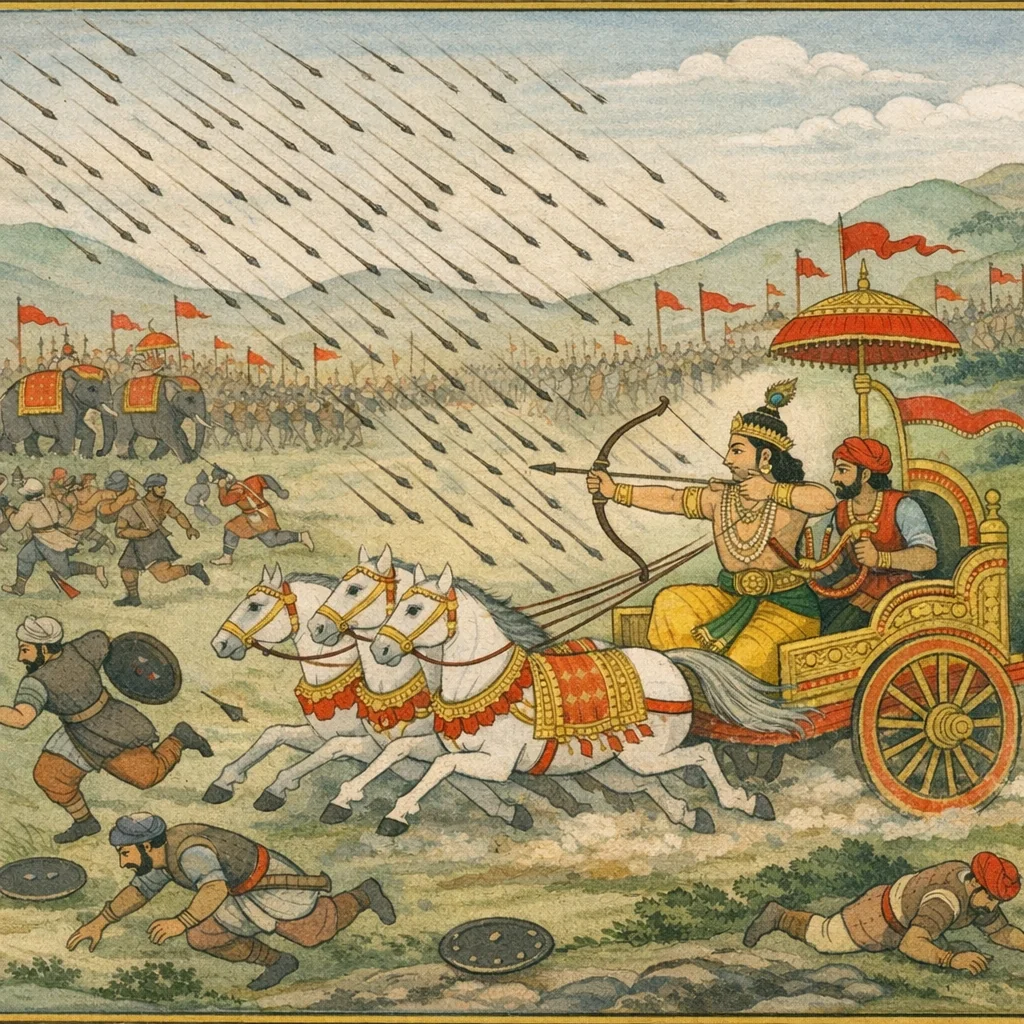
Sañjaya depicts Arjuna as visually overwhelming in motion, projecting simultaneous missile-displays across directions (1–8), likened to the midday sun’s brilliance and to aerial rows of swans formed by arrow-flights. Arjuna drives toward Jayadratha, disrupting multiple chariot-warriors while pursuing the vow-bound target (9). Jayadratha counters with sharpened shafts, striking Gāṇḍīva and Arjuna, and attacking horses and standard; Arjuna neutralizes the incoming missiles and severs elements of Jayadratha’s chariot system, including the charioteer and the emblem (11–14). As the sun hastens toward setting, Kṛṣṇa urgently instructs Arjuna to decapitate Jayadratha but to prevent the head from falling to the ground because of Vṛddhakṣatra’s curse: whoever causes Jayadratha’s head to touch earth would have his own head split into a hundred parts (15–28). Kṛṣṇa explains the origin of the curse and provides the operational solution—use a divine, mantra-empowered missile to carry the head beyond Samantapañcaka and drop it into Vṛddhakṣatra’s lap (17–36). Arjuna releases the consecrated arrow; it removes Jayadratha’s head and deposits it as instructed, and when Vṛddhakṣatra rises, the head falls to earth, triggering the curse upon him (30–39). The battlefield registers astonishment; Kṛṣṇa commends Arjuna, the Pāṇḍavas infer success, and the engagement pivots back toward renewed combat against Droṇa as sunset approaches (40–49).
Chapter Arc: संजय धृतराष्ट्र से कहते हैं—द्रोणाचार्य की सेना रथ-घोड़े-हाथियों से भरी, शर-शक्ति की लहरों वाली महासागर-सी उमड़ती है; उसी के सामने सात्यकि अपने सारथि से युद्ध-मार्ग और लक्ष्य पर तीखा संवाद करता है। → सात्यकि द्रोण की व्यूहबद्ध भीड़ को ‘आयुधों का समुद्र’ मानकर भी भय नहीं मानता; वह घोषणा करता है कि आज कौरव-दल (दुर्योधन सहित) उसका पराक्रम देखेगा—वह चुन-चुनकर श्रेष्ठ वीरों को गिराएगा। यवन-काम्बोज आदि तेज़ हाथ चलाने वाले योद्धा उस पर शरवर्षा करते हैं, और रणभूमि वाद्यों के उग्र नाद से कांपती है। → सात्यकि क्रुद्ध-रूप धारण कर रथों, अश्वों, गजों और पैदल दलों के बीच घुसकर यवन-काम्बोजों की पंक्तियाँ तोड़ देता है; उसके प्रहारों से शिरस्त्राणयुक्त मुण्डित मस्तक और लंबी दाढ़ियों वाले शत्रु-शिर रणभूमि पर बिखरते हैं—भूमि ‘पंखहीन पक्षियों’ की तरह पड़े सिरों से ढँक जाती है। → यवनों का बड़ा भाग मारा जाता है; जो थोड़े शेष बचते हैं वे भय से चारों ओर भागते हैं, अपने समुदाय से टूटकर प्राण बचाने की चेष्टा करते हैं। सात्यकि की धावा-धार से कौरव-सेना में विराव और संताप फैलता है। → सात्यकि की विजय-धारा आगे किस बड़े कौरव-वीर से टकराएगी—और द्रोण की महासागर-सी सेना इस छेद को कैसे भरेगी—यह अगले प्रसंग में तीव्र होता है।
Shlokas
Verse 1
ऑपन--माज छा जि: एकोनविशर्त्याधिकशततमो< ध्याय: सात्यकि और उनके सारथिका संवाद तथा सात्यकिद्धारा काम्बोजों और यवन आदिकी सेनाकी पराजय संजय उवाच ततः स सात्यकिर्धीमान् महात्मा वृष्णिपुड्भव: । सुदर्शन निहत्याजौ यन्तारं पुनरब्रवीत्,संजय कहते हैं--राजन्! तदनन्तर वृष्णिवंशावतंस बुद्धिमान् महामनस्वी सात्यकिने युद्धमें सुदर्शनको मारकर सारथिसे फिर इस प्रकार कहा--
Sañjaya said: Then the wise Satyaki—great-souled, foremost of the Vrishnis—having slain Sudarshana in the battle, spoke once more to his charioteer.
Verse 2
रथाश्वनागकलिलं शरशक्त्यूमिमालिनम् । खड्गमत्स्यं गदाग्राहं शूरायुधभहास्वनम्,“तात! रथ, घोड़े और हाथियोंसे भरी हुई द्रोणाचार्यकी सेना महासागरके समान थी। उसमें बाण और शक्ति आदि अस्त्र-शस्त्र तरंगमालाओंके समान प्रतीत होते थे। खड़्ग मत्स्यके समान और गदा ग्राहके तुल्य थी। शूरवीरोंके आयुधोंके प्रहारसे जो महान् शब्द होता था, वही मानो महासागरका भयानक गर्जन था। बाजे बजानेकी ध्वनि और वीरोंके ललकारनेकी आवाजसे उस गर्जनका स्वर और भी बढ़ा हुआ था। योद्धाओंके लिये उसका स्पर्श अत्यन्त दुःखदायक था। जो विजयकी अभिलाषा नहीं रखते, ऐसे लोगोंके लिये वह प्राणनाशक भयंकर सैन्य-समुद्र दुर्धर्ष था। युद्धस्थलमें खड़ी हुई जलसंधकी सेनाने उसे राक्षसोंके समान घेर रखा था। उस दुस्तर सेना-सागरसे हमलोग पार हो गये हैं
Sañjaya said: “Dear one, Droṇa’s army stood like a vast ocean, crowded with chariots, horses, and elephants. Its waves seemed to be arrows and spears; its fish were swords, and its grasping crocodiles were maces. The tremendous roar produced by the blows of heroes’ weapons was like the ocean’s dreadful thunder.”
Verse 3
प्राणापहारिणं रौद्रं वादित्रोत्क़ुष्टनादितम् । योधानामसुखस्पर्श दुर्धर्षमजयैषिणाम्,“तात! रथ, घोड़े और हाथियोंसे भरी हुई द्रोणाचार्यकी सेना महासागरके समान थी। उसमें बाण और शक्ति आदि अस्त्र-शस्त्र तरंगमालाओंके समान प्रतीत होते थे। खड़्ग मत्स्यके समान और गदा ग्राहके तुल्य थी। शूरवीरोंके आयुधोंके प्रहारसे जो महान् शब्द होता था, वही मानो महासागरका भयानक गर्जन था। बाजे बजानेकी ध्वनि और वीरोंके ललकारनेकी आवाजसे उस गर्जनका स्वर और भी बढ़ा हुआ था। योद्धाओंके लिये उसका स्पर्श अत्यन्त दुःखदायक था। जो विजयकी अभिलाषा नहीं रखते, ऐसे लोगोंके लिये वह प्राणनाशक भयंकर सैन्य-समुद्र दुर्धर्ष था। युद्धस्थलमें खड़ी हुई जलसंधकी सेनाने उसे राक्षसोंके समान घेर रखा था। उस दुस्तर सेना-सागरसे हमलोग पार हो गये हैं
Sañjaya said: “It was life-snatching and fierce—its roar heightened by the blare of instruments and the warriors’ triumphant shouts. For fighters it was a touch of misery, and for those who did not seek victory it was an unassailable terror.”
Verse 4
तीर्णा: सम दुस्तरं तात द्रोणानीकमहार्णवम् । जलसंधबलेनाजोौ पुरुषादैरिवावृतम्,“तात! रथ, घोड़े और हाथियोंसे भरी हुई द्रोणाचार्यकी सेना महासागरके समान थी। उसमें बाण और शक्ति आदि अस्त्र-शस्त्र तरंगमालाओंके समान प्रतीत होते थे। खड़्ग मत्स्यके समान और गदा ग्राहके तुल्य थी। शूरवीरोंके आयुधोंके प्रहारसे जो महान् शब्द होता था, वही मानो महासागरका भयानक गर्जन था। बाजे बजानेकी ध्वनि और वीरोंके ललकारनेकी आवाजसे उस गर्जनका स्वर और भी बढ़ा हुआ था। योद्धाओंके लिये उसका स्पर्श अत्यन्त दुःखदायक था। जो विजयकी अभिलाषा नहीं रखते, ऐसे लोगोंके लिये वह प्राणनाशक भयंकर सैन्य-समुद्र दुर्धर्ष था। युद्धस्थलमें खड़ी हुई जलसंधकी सेनाने उसे राक्षसोंके समान घेर रखा था। उस दुस्तर सेना-सागरसे हमलोग पार हो गये हैं
Sañjaya said: O dear one, we have crossed that hard-to-pass ocean-like host of Droṇa. In the battle it was encircled, as it were, by the forces of Jalasandha—by mighty warriors—making that formidable array seem all the more impassable.
Verse 5
अतोथचन््यत् पृतनाशेषं मन्ये कुनदिकामिव । तर्तव्यामल्पसलिलां चोदयाश्वानसम्भ्रमम्,“उससे भिन्न जो शेष सेना है, उसे मैं सुगमता-पूर्वक लाँघनेयोग्य थोड़े जलवाली छोटी नदीके समान समझता हूँ। अतः तुम निर्भय होकर घोड़ोंको आगे बढ़ाओ
Sañjaya said: “As for the remainder of the army apart from him, I deem it easy to cross—like a small stream with little water. Therefore, without panic, urge the horses forward.”
Verse 6
हस्तप्राप्तमहं मन्ये साम्प्रतं सव्यसाचिनम् । निर्जित्य दुर्धरं द्रोणं सपदानुगमाहवे,'सेवकोंसहित दुर्धर्ष वीर द्रोणाचार्यको युद्धस्थलमें जीतकर मैं ऐसा मानता हूँ कि इस समय सव्यसाची अर्जुन हमारे हाथमें ही आ गये हैं
Sañjaya said: “I deem that Arjuna, the ambidextrous archer, is now as good as in our grasp; for, having overcome the hard-to-subdue Droṇa on the battlefield, he has at once pressed on in pursuit.”
Verse 7
हार्दिक्यं योधवर्य च मन्ये प्राप्त धनंजयम् । न हि मे जायते त्रासो दृष्टवा सैन्यान्यनेकश:
Sañjaya said: “I judge that Hārdikya and that foremost of warriors have now come upon Dhanañjaya. Yet, even on seeing the armies gathered in so many divisions, fear does not arise in me.”
Verse 8
वल्लेरिव प्रदीप्तस्य वने शुष्कतृणोलपे । 'योद्धाओंमें श्रेष्ठ कृतवर्माको पराजित करके मैं ऐसा समझता हूँ कि अर्जुन मुझे मिल गये। जैसे सूखे तृण और लतावाले वनमें प्रज्वलित हुई अग्निके लिये कहीं कोई बाधा नहीं रहती, उसी प्रकार मुझे इन अनेक सेनाओंको देखकर तनिक भी त्रास नहीं हो रहा है ।। पश्य पाण्डवमुख्येन यातां भूमिं किरीटिना
Sañjaya said: “Having overpowered Kṛtavarmā—foremost among warriors—I take it that Arjuna has now come within my reach. Just as a blazing fire meets no obstruction in a forest of dry grass and creepers, so too, even on seeing these many armies, I feel not the slightest fear. Behold the ground traversed by the diadem-wearing chief of the Pāṇḍavas.”
Verse 9
द्रवते तद् यथा सैन्यं तेन भग्नं महात्मना,'सारथे! उन्हीं महात्मा अर्जुनकी खदेड़ी हुई वह सेना इधर-उधर भाग रही है। दौड़ते हुए रथों, हाथियों और घोड़ोंसे लाल रेशमके समान यह धूल ऊपरको उठ रही है
Sanjaya said: “O charioteer! Just as a routed host breaks and scatters, so that army—shattered by the great-souled one—now flees in all directions, driven back by the noble Arjuna. From the rushing chariots, elephants, and horses, dust rises upward, glowing like red silk.”
Verse 10
रथैरविंपरिधावद्धिर्गजैरश्वैश्न॒ सारथे | कौशेयारुणसंकाशमेतदुद्धूयते रज:,'सारथे! उन्हीं महात्मा अर्जुनकी खदेड़ी हुई वह सेना इधर-उधर भाग रही है। दौड़ते हुए रथों, हाथियों और घोड़ोंसे लाल रेशमके समान यह धूल ऊपरको उठ रही है
Sañjaya said: “O charioteer, as chariots, elephants, and horses race about, a cloud of dust is hurled upward, its hue like reddish silk. Thus the army, driven hard by the great-souled Arjuna, is scattering and fleeing in all directions.”
Verse 11
अभ्याशस्थमहं मन्ये श्वेताश्वं कृष्णसारथिम् | स एष श्रुयते शब्दो गाण्डीवस्पामितौजस:,“इससे मैं समझता हूँ कि श्रीकृष्ण जिनके सारथि हैं, वे श्वेतवाहन अर्जुन हमारे निकट ही हैं, तभी यह अमित शक्तिशाली गाण्डीव धनुषकी टंकार सुनायी दे रही है
Sañjaya said: “I judge that Arjuna—he whose chariot is driven by Kṛṣṇa and whose steeds are white—has come very near. For this very sound is being heard: the thunderous twang of the Gāṇḍīva bow, wielded by one of immeasurable might.”
Verse 12
यादृशानि निमित्तानि मम प्रादुर्भवन्ति वै अनस्तंगत आदित्ये हन्ता सैन्धवर्मर्जुन:,“इस समय मेरे सामने जैसे शुभ शकुन प्रकट हो रहे हैं, उनसे जान पड़ता है अर्जुन सूर्यास्त होनेके पहले ही जयद्रथको मार डालेंगे
Sañjaya said: “From the auspicious omens that are manifesting before me, it appears that Arjuna will indeed slay Jayadratha (the Sindhu prince) before the sun has set.”
Verse 13
शनैर्विश्रम्भयन्नश्चान् याहि यत्रारिवाहिनी । यत्रैते सतलत्राणा: सुयोधनपुरोगमा:,'सूत! धीरे-धीरे घोड़ोंको आराम देते हुए उस ओर चलो, जहाँ वह शत्रुसेना खड़ी है, जहाँ ये तलत्राण धारण किये दुर्योधन आदि योद्धा उपस्थित हैं
Sañjaya said: “Proceed slowly, easing and steadying the horses, and go to the place where the enemy host is drawn up—where those warriors, protected with foot-guards (greaves), stand with Suyodhana (Duryodhana) at their head.”
Verse 14
४ 5 ६ ९ ऐ । दंशिता: क्रूरकर्माण: काम्बोजा युद्धदुर्मदा: । शरबाणासनधरा यवनाश्ष प्रहारिण:,“जहाँ कवच धारण किये रणदुर्मद क्रूरकर्मा काम्बोज, धनुष-बाण धारण किये प्रहारकुशल यवन, शक, किरात, दरद, बर्बर, ताम्रलिप्त तथा हाथोंमें भाँति-भाँतिके आयुध धारण किये अन्य बहुत-से म्लेच्छ--ये सब-के-सब जहाँ दुर्योधनको अगुआ बनाकर दस्ताने पहने युद्धकी इच्छासे मेरी ओर मुँह करके खड़े हैं, वहीं चलो
Sañjaya said: “Armoured and fierce in deed, the Kāmbojas—arrogant with the intoxication of battle—stood ready. The Yavanas too, bearing bows and arrows, skilled in striking, were drawn up for combat. Go there, where the war has gathered even hard-fighting frontier peoples under Duryodhana’s lead.”
Verse 15
शका: किराता दरदा बर्बरास्ताम्रलिप्तका: | अन्ये च बहवो म्लेच्छा विविधायुधपाणय:,“जहाँ कवच धारण किये रणदुर्मद क्रूरकर्मा काम्बोज, धनुष-बाण धारण किये प्रहारकुशल यवन, शक, किरात, दरद, बर्बर, ताम्रलिप्त तथा हाथोंमें भाँति-भाँतिके आयुध धारण किये अन्य बहुत-से म्लेच्छ--ये सब-के-सब जहाँ दुर्योधनको अगुआ बनाकर दस्ताने पहने युद्धकी इच्छासे मेरी ओर मुँह करके खड़े हैं, वहीं चलो
Sañjaya said: “Śakas, Kirātas, Daradas, Barbaras, and the Tāmrāliptakas—and many other mleccha warriors as well—stand there with diverse weapons in their hands. They are fierce in battle, harsh in deed, and, with Duryodhana at their head, they have turned to face us, eager for war.”
Verse 16
यत्रैते सतलत्राणा: सुयोधनपुरोगमा: । मामेवाभिमुखा: सर्वे तिष्ठन्ति समरार्थिन:,“जहाँ कवच धारण किये रणदुर्मद क्रूरकर्मा काम्बोज, धनुष-बाण धारण किये प्रहारकुशल यवन, शक, किरात, दरद, बर्बर, ताम्रलिप्त तथा हाथोंमें भाँति-भाँतिके आयुध धारण किये अन्य बहुत-से म्लेच्छ--ये सब-के-सब जहाँ दुर्योधनको अगुआ बनाकर दस्ताने पहने युद्धकी इच्छासे मेरी ओर मुँह करके खड़े हैं, वहीं चलो
Sañjaya said: “There, where all these warriors—armoured and protected, with Suyodhana (Duryodhana) at their head—stand facing me, all intent on battle, to that very place (go).”
Verse 17
एतान् सरथनागाश्चान् निहत्याजौ सपत्तिन: । इदं दुर्ग महाघोरं तीर्णमेवोपधारय,“इन सबको युद्धस्थलमें रथ, हाथी, घोड़े और पैदलोंसहित मार लेनेपर निश्चितरूपसे समझ लो कि हमलोग इस अत्यन्त भयंकर दुर्गम संकटसे पार हो गये”
Sañjaya said: “When these foes—together with their chariots, elephants, horses, and foot-soldiers—have been slain on the battlefield, then know for certain that this most dreadful and hard-to-cross crisis has indeed been passed.”
Verse 18
सूत उवाच न सम्भ्रमो मे वार्ष्णेय विद्यते सत्यविक्रम । यद्यपि स्यात् तव क्रुद्धो जामदग्न्योडग्रत: स्थित:,सारथिने कहा--सत्यपराक्रमी वृष्णिनन्दग! आपके सामने क्रोधमें भरे हुए जमदग्निनन्दन परशुराम भी खड़े हो जायेँ तो मुझे भय नहीं होगा
Sūta said: “O Vārṣṇeya, O truly valorous one, I feel no agitation or fear. Even if the son of Jamadagni—Paraśurāma himself—were to stand before you in wrath, I would still not be afraid.”
Verse 19
द्रोणो वा रथिनां श्रेष्ठ: कृपो मद्रेश्वरो 5पि वा । तथापि सम्भ्रमो न स्यात् त्वामाश्रित्य महाभुज,महाबाहो! रथियोंमें श्रेष्ठ द्रोणाचार्य, कृपाचार्य अथवा मद्रराज शल्य ही क्यों न खड़े हों, तथापि आपके आश्रित रहकर मुझे कदापि भय नहीं हो सकता
Even if Droṇa—the foremost among chariot-warriors—were to stand against us, or Kṛpa, or even Śalya, the king of Madra, still no panic should arise. Relying on you, O mighty-armed one, fear cannot take hold of me.
Verse 20
त्वया सुबहवो युद्धे निर्जिता: शत्रुसूदन । दंशिता: क्रूरकर्माण: काम्बोजा युद्धदुर्मदा:
Sūta said: “By you, O slayer of foes, many have been overcome in battle—those Kāmbojas, fierce in deed and maddened by the arrogance of war, have been checked and subdued.”
Verse 21
शरबाणासनधरा यवनाश्ष प्रहारिण: । शका: किराता दरदा बर्बरास्ताम्रलिप्तका:
Sūta said: “There were warriors bearing bows and arrows—Yavanas, fierce in assault; Śakas, Kirātas, Daradas, Barbarians, and the people of Tāmrālipta.” The verse underscores how the war drew in many frontier and foreign groups, emphasizing the vast, multi-ethnic scale of the conflict and the moral weight of a battle that engulfed all directions.
Verse 22
अन्ये च बहवो म्लेच्छा विविधायुधपाणय: । न च मे सम्भ्रम: कश्चिद् भूतपूर्व: कथंचन
Sūta said: “And there were many others too—foreign tribesmen (mlecchas), their hands bearing weapons of many kinds. Yet never before, in any way, had I felt such agitation and alarm as I do now.”
Verse 23
किमुतैतत् समासाद्य धीरसंयुगगोष्पदम् | आयुष्मन् कतरेण त्वां प्रापपामि धनंजयम्
Sūta said: “What is this, that you have come upon a battlefield made so small—like a mere cow’s hoofprint—for the steadfast and heroic? O long-lived one, by which course may I reach you, Dhanañjaya (Arjuna)?”
Verse 24
शत्रुसूदन! आपने पहले भी युद्धमें बहुतेरे कवचधारी, क्रूरकर्मा रणदुर्मद काम्बोजोंको परास्त किया है। धनुष-बाण धारण करनेवाले प्रहारकुशल यवनोंको जीता है। शकों, किरातों, दरदों, बर्बरों, ताम्रलिप्तों तथा हाथोंमें नाना प्रकारके आयुध लिये अन्य बहुत-से मलेच्छोंको पराजित किया है। इन अवसरोंपर पहले कभी कोई किसी प्रकारका भय नहीं हुआ था। फिर इस गायकी खुरके समान तुच्छ युद्धस्थलमें आकर क्या भय हो सकता है? आयुष्मन्! बताइये, इन दो मार्गोर्मेंसे किसके द्वारा आपको अर्जुनके पास पहुँचाऊँ || २० --२३ || केषां क्रुद्धो$सि वार्ष्णेय केषां मृत्युरुपस्थित: । केषां संयमनीमद्य गन्तुमुत्सहते मन:,वार्ष्णेय! आप किनके ऊपर क़ुद्ध हैं, किनकी मौत आ गयी है और किनका मन आज यमपुरीमें जानेके लिये उत्साहित हो रहा है?
Sūta said: “O Slayer of foes! In earlier wars you have already overthrown many mail-clad Kambojas—fierce in deed and maddened for battle. You have conquered the Yavanas, skilled in striking and bearing bow and arrows. You have also defeated the Śakas, Kirātas, Daradas, Barbarians, the people of Tāmralipta, and many other mlecchas carrying diverse weapons in their hands. On those occasions no fear ever arose in anyone. How, then, could there be fear upon coming to this paltry battlefield—trifling as a cow’s hoofprint? Tell me, noble one: by which of these two routes shall I bring you to Arjuna? O Vārṣṇeya, against whom are you enraged? For whom has death drawn near? Whose mind today is eager to go to Yama’s city?”
Verse 25
के त्वां युधि पराक्रान्तं कालान्तकयमोपमम् | दृष्टवा विक्रमसम्पन्नं विद्रविष्यन्ति संयुगे
Sūta said: “Who, seeing you on the battlefield—bold in onset, like Yama, the finisher of time—endowed with irresistible prowess, would not flee in the clash of arms?”
Verse 26
सात्यकिरुवाच मुण्डानेतान् हनिष्यामि दानवानिव वासव:,सात्यकि बोले--सूत! जैसे इन्द्र दानवोंका वध करते हैं, उसी प्रकार आज मैं इन मथमुंडे काम्बोजोंका ही वध करूँगा और ऐसा करके अपनी प्रतिज्ञा पूर्ण कर लूँगा। अतः तुम उनन््हींकी ओर मुझे ले चलो। इन सबका संहार करके ही आज मैं अपने प्रिय सुहृद् पाण्डुनन्दन अर्जुनके पास चलूँगा
Sūta said. Sātyaki declared: “I shall strike down these shaven-headed Kāmbojas, just as Vāsava (Indra) slays the Dānavas. By doing so I will fulfill my vow. Therefore, drive me straight toward them. Only after destroying them today will I go to my beloved friend, Arjuna, the son of Pāṇḍu.”
Verse 27
प्रतिज्ञां पारयिष्यामि काम्बोजानेव मां वह । अद्यैषां कदनं कृत्वा प्रियं यास्यामि पाण्डवम्,सात्यकि बोले--सूत! जैसे इन्द्र दानवोंका वध करते हैं, उसी प्रकार आज मैं इन मथमुंडे काम्बोजोंका ही वध करूँगा और ऐसा करके अपनी प्रतिज्ञा पूर्ण कर लूँगा। अतः तुम उनन््हींकी ओर मुझे ले चलो। इन सबका संहार करके ही आज मैं अपने प्रिय सुहृद् पाण्डुनन्दन अर्जुनके पास चलूँगा
Sātyaki said: “I will fulfill my vow. Drive me straight toward the Kāmbojas. Today, after cutting them down in battle, I will go to my beloved Pāṇḍava—Arjuna.”
Verse 28
अद्य द्रक्ष्यन्ति मे वीर्य कौरवा: ससुयोधना: । मुण्डानीके हते सूत सर्वसैन्येषु चासकृत्,आज दुर्योधनसहित समस्त कौरव मेरा पराक्रम देखेंगे। सूत! आज इन सिरमुण्डोंके मारे जाने तथा अन्य सारी सेनाओंका बारंबार विनाश होनेपर युद्धस्थलमें छिन्न-भिन्न होती हुई कौरव-सेनाका नाना प्रकारसे आर्तनाद सुनकर दुर्योधनको बड़ा संताप होगा
Sūta said: “Today the Kauravas, together with Suyodhana (Duryodhana), shall witness my prowess. O charioteer, when Muṇḍānīka is slain and when, again and again, destruction is wrought among all the armies, the Kaurava host will be torn apart on the battlefield; hearing its many kinds of cries of anguish, Duryodhana will be seized by intense grief.”
Verse 29
अद्य कौरवसैन्यस्य दीर्यमाणस्य संयुगे । श्र॒त्वा विरावं बहुधा संतप्स्यति सुयोधन:,आज दुर्योधनसहित समस्त कौरव मेरा पराक्रम देखेंगे। सूत! आज इन सिरमुण्डोंके मारे जाने तथा अन्य सारी सेनाओंका बारंबार विनाश होनेपर युद्धस्थलमें छिन्न-भिन्न होती हुई कौरव-सेनाका नाना प्रकारसे आर्तनाद सुनकर दुर्योधनको बड़ा संताप होगा
Sūta said: “Today, as the Kaurava host is being torn apart in battle, Duryodhana will be consumed with anguish when he hears, again and again, the many kinds of cries and tumult rising from his shattered army.”
Verse 30
अद्य पाण्डवमुख्यस्य श्वेता श्वस्प महात्मन: । आचार्यस्य कृतं मार्ग दर्शयिष्यामि संयुगे,आज रणक्षेत्रमें मैं अपने आचार्य पाण्डवप्रवर श्वेतवाहन महात्मा अर्जुनके प्रकट किये हुए मार्गको दिखाऊँगा
Sūta said: “Today, on the battlefield, I shall point out the path carved out by the noble one with the white horses—Arjuna, foremost among the Pāṇḍavas—showing how the Teacher’s (Droṇa’s) course and strategy have been met and revealed in combat.”
Verse 31
अद्य मद्बाणनिहतान् योधमुख्यान् सहस्रश: । दृष्टवा दुर्योधनो राजा पश्चात्तापं गमिष्यति,आज मेरे बाणोंसे अपने सहस्रों प्रमुख योद्धाओंको मारा गया देखकर राजा दुर्योधन अत्यन्त पश्चात्ताप करेगा
Sūta said: “Today, when King Duryodhana sees that thousands of his foremost warriors have been struck down by my arrows, he will be driven into bitter remorse.”
Verse 32
अद्य मे क्षिप्रहस्तस्य क्षिपत: सायकोत्तमान् | अलातचक्रप्रतिमं धनुर्द्रक्ष्यन्ति कौरवा:,आज शीतघ्रतापूर्वक हाथ चलाकर उत्तम बाणोंका प्रहार करते हुए मेरे धनुषको कौरवलोग अलातचक्रके समान देखेंगे
Sūta said: “Today the Kauravas will behold my bow—while I, swift of hand, hurl forth the finest arrows—whirling like a blazing firebrand’s circle.”
Verse 33
मत्सायकचिताड्रानां रुधिरं स्रवतां मुहुः । सैनिकानां वध दृष्टवा संतप्स्यति सुयोधन:,मैं अपने बाणोंसे सारे कौरव-सैनिकोंका शरीर व्याप्त कर दूँगा और वे बारंबार रक्त बहाते हुए प्राण त्याग देंगे। इस प्रकार अपने सैनिकोंका संहार देखकर सुयोधन संतप्त हो उठेगा
Sūta said: “Again and again, blood will stream from those warriors, their bodies drenched and pierced by my fish-shaped arrows. Seeing the slaughter of his own troops, Suyodhana (Duryodhana) will be consumed with anguish.”
Verse 34
अद्य मे क्रुद्धरूपस्य निघ्नतश्न वरान् वरान् | द्विरर्जुनमिमं लोकं मंस्यतेड्द्य सुयोधन:,आज क्रोधमें भरकर मैं कौरव-सेनाके उत्तमोत्तम वीरोंको चुन-चुनकर मारूँगा, जिससे दुर्योधनको यह मालूम होगा कि अब संसारमें दो अर्जुन प्रकट हो गये हैं
Sūta said: “Today, assuming a wrathful form, I shall strike down—one after another—the finest of warriors. Then Suyodhana (Duryodhana) will realize today that in this world there are now two Arjunas.”
Verse 35
अद्य राजसहस्राणि निहतानि मया रणे । दृष्टवा दुर्योधनो राजा संतप्स्यति महामृथे,आज महासमरमें मेरे द्वारा सहस्नों राजाओंका विनाश देखकर राजा दुर्योधनको बड़ा संताप होगा
Today, in the battle, I have slain thousands of kings. Seeing this, King Duryodhana will be consumed with grief and burning anguish amid this great and terrible fight.
Verse 36
अद्य स्नेहं च भक्ति च पाण्डवेषु महात्मसु । हत्वा राजसहस््राणि दर्शयिष्यामि राजसु
Today I shall demonstrate my affection and devotion toward the great-souled Pāṇḍavas: by slaying thousands of kings, I will make it evident among the rulers.
Verse 37
संजय उवाच एवमुक्तस्तदा सूत: शिक्षितान् साधुवाहिन:
Sañjaya said: Thus addressed at that time, the charioteer—well-trained and skilled in proper conduct—prepared to act accordingly.
Verse 38
ते पिबन्त इवाकाशं युयुधानं हयोत्तमा:
Sañjaya said: The finest horses, as if drinking in the very sky, bore Yuyudhāna onward—so swift and forceful was their charge that it seemed to swallow up the space before them.
Verse 39
सात्यकिं ते समासाद्य पृतनास्वनिवर्तिनम्
Sañjaya said: Having encountered Sātyaki—unyielding in the battle-lines and one who does not turn back—your warriors were forced to face a steadfast opponent whose resolve in war would not waver.
Verse 40
तेषामिषूनथास्त्राणि वेगवान् नतपर्वभि:
Sañjaya said: With swift force, he met their arrows and weapon-launches, bending (or deflecting) them by means of his own shafts—checking the onrush of their attack in the thick of battle.
Verse 41
अच्छिनत् सात्यकी राजन नैनं ते प्राप्तुवत् शरा: । राजन! वेगशाली सात्यकिने झुकी हुई गाँठवाले अपने बाणोंद्वारा उन सबके बाणों तथा अन्य अस्त्रोंको काट गिराया। वे बाण उनके पासतक पहुँच न सके ।। रुक्मपुड्खै: सुनिशितैर्गार्ध्रपत्रैरजिह्मुगैः,उन भयंकर वीरने सब ओर घूम-घूमकर सोनेके पुंख और गीधकी पाँखवाले तीखे बाणोंसे यवनोंके मस्तक, भुजाएँ तथा लाल लोहे एवं काँसेके बने हुए कवच भी काट डाले
Sañjaya said: O King, Sātyaki cut down their missiles; none of those arrows could reach him. With swift, well-aimed shafts—knotted and forceful—he severed and brought down all their arrows and other weapons before they could come near. Then that dreadful warrior, wheeling in every direction, with razor-sharp arrows tipped with gold and fletched with vulture-feathers, struck down the Yavanas—cleaving heads and arms, and even slicing through their iron and bronze armor. The passage underscores disciplined martial skill used as protective counter-force in battle: not reckless slaughter, but mastery that neutralizes incoming harm and breaks the enemy’s capacity to strike.
Verse 42
उच्चकर्त शिरांस्युग्रो यवनानां भुजानपि । शैक्यायसानि वर्माणि कांस्थानि च समन्ततः,उन भयंकर वीरने सब ओर घूम-घूमकर सोनेके पुंख और गीधकी पाँखवाले तीखे बाणोंसे यवनोंके मस्तक, भुजाएँ तथा लाल लोहे एवं काँसेके बने हुए कवच भी काट डाले
Sañjaya said: The fierce warrior, wheeling about on every side, hewed off the Yavanas’ heads and arms, and even cut through their armour made of red iron and of bronze. The scene underscores the ruthless momentum of battle, where prowess and weapon-skill overwhelm bodily protection, and violence spreads indiscriminately across the field.
Verse 43
भित्त्वा देहांस्तथा तेषां शरा जम्मुर्महीतलम् | ते हन्यमाना वीरेण म्लेच्छा: सात्यकिना रणे
Sañjaya said: Having pierced their bodies, the arrows then fell upon the earth. Those Mleccha warriors, being struck down in battle by the heroic Sātyaki, were slain—showing the relentless, consequence-laden momentum of war where valor and duty manifest through uncompromising violence.
Verse 44
शतशो< भ्यपतंस्तत्र व्यसवो वसुधातले । वे बाण उनके शरीरोंको विदीर्ण करके पृथ्वीमें घुस गये। वीर सात्यकिके द्वारा रणभूमिमें आहत होकर सैकड़ों म्लेच्छ प्राण त्यागकर धराशायी हो गये ।। ४३ $ ।। सुपूर्णायतमुक्तैस्तानव्यवच्छिन्नपिण्डितै:
Sañjaya said: There, by the hundreds, lifeless bodies fell upon the earth. The arrows, having torn through their bodies, plunged into the ground. Struck on the battlefield by the hero Sātyaki, hundreds of the mleccha warriors gave up their lives and collapsed. The scene underscores the grim, impersonal momentum of war—where prowess and duty drive action, yet the cost is measured in lives abruptly ended.
Verse 45
पज्च षट् सप्त चाष्टौ च बिभेद यवनान् शरै: । वे कानतक खींचकर छोड़े हुए और अविच्छिन्न गतिसे परस्पर सटकर निकलते हुए बाणोंद्वारा पाँच, छ, सात और आठ यवनोंको एक ही साथ विदीर्ण कर डालते थे || ४४३ || काम्बोजानां सहसैश्न शकानां च विशाम्पते,कृतवांस्तत्र शैनेय: क्षपयंस्तावकं॑ बलम् | प्रजानाथ! सात्यकिने आपकी सेनाका संहार करते हुए वहाँकी भूमिको सहस्रों काम्बोजों, शकों, शबरों, किरातों और बर्बरोंकी लाशोंसे पाटकर अगम्य बना दिया था। वहाँ मांस और रक्तकी कीच जम गयी थी
Sañjaya said: Drawing his bow and releasing his arrows in an unbroken stream, Sātyaki split apart five, six, seven—indeed even eight—Yavanas at once. O lord of men, as he destroyed your forces there, the son of Śini made the ground impassable by strewing it with the bodies of thousands of Kāmbojas and Śakas. The field became a mire of flesh and blood—an image of war’s ruthless efficiency and its terrible moral cost.
Verse 46
शबराणां किरातानां बर्बराणां तथैव च । अगम्यरूपां पृथिवीं मांसशोणितकर्दमाम्
Sañjaya said: “(It appeared) a land of Śabaras, Kirātas, and Barbaras—indeed of such wild peoples—an earth rendered unapproachable in aspect, turned into mire of flesh and blood.”
Verse 47
दस्यूनां सशिरस्त्राणै: शिरोभिलूनमूर्थजै:
Sañjaya said: The field was strewn with the heads of marauding fighters—some still bearing their helmets, others shorn of hair—an image that underscores how war strips men of dignity and identity, reducing even the proud to lifeless remnants. The narration implicitly warns that violence, once unleashed, consumes all distinctions of status and conduct.
Verse 48
रुधिरोक्षितसवरज़िस्तैस्तदायोधनं बभौ
Sañjaya said: Then that battlefield, stained and darkened by blood, appeared grim and dreadful—its very color transformed by the slaughter, reflecting the terrible moral cost of war.
Verse 49
कबन्न्धै: संवृतं सर्व ताम्रा भ्रे: खमिवावृतम् | जिनके सारे अंग खूनसे लथपथ हो रहे थे, उन कबन्धोंसे भरा हुआ वह सारा रफक्षेत्र लाल रंगके बादलोंसे ढके हुए आकाशके समान जान पड़ता था ।। वज्राशनिसमस्पर्श: सुपर्वभिरजिद्वागै:
Sañjaya said: The entire battlefield was covered with headless trunks, their limbs smeared and streaming with blood; it looked like the sky veiled by copper-red clouds. The image underscores the moral cost of war—how violence, once unleashed, turns the field of duty into a landscape of horror that demands sober reflection on dharma and restraint.
Verse 50
ते सात्वतेन निहता: समावत्रुर्वसुंधराम् । वज्र और विद्युतकें समान कठोर स्पर्शवाले सुन्दर पर्वयुक्त बाणोंद्वारा सात्यकिके हाथसे मारे गये उन यवनोंने वहाँकी भूमिको अपनी लाशोंसे ढक लिया ।। अल्पावशिष्टा: सम्भग्ना: कृच्छुप्राणा विचेतस:,जवमुनत्तममास्थाय सर्वतः प्राद्रवन् भयात् । महाराज! थोड़े-से यवन शेष रह गये थे, जो बड़ी कठिनाईसे अपने प्राण बचाये हुए थे। वे अपने समुदायसे भ्रष्ट होकर अचेत-से हो रहे थे। उन सभी कवचधारी यवनोंको युयुधानने युद्धस्थलमें जीत लिया था। वे हाथों और कोड़ोंसे अपने घोड़ोंको पीटते हुए उत्तम वेगका आश्रय ले चारों ओर भयके मारे भाग गये
Sañjaya said: Struck down by the Sātvata hero, those Yavanas covered the earth with their bodies. Slain by Sātyaki’s hand with arrows whose touch was hard like thunderbolt and lightning—beautiful shafts fitted with sharp joints—they fell there in heaps. A few Yavanas remained, broken and scattered, barely clinging to life and almost senseless. Having been overcome on the battlefield by Yuyudhāna, they lashed their horses with hands and whips, took to the greatest speed, and fled in fear in every direction.
Verse 51
जिता: संख्ये महाराज युयुधानेन दंशिता: । पाण्णिशिश्व कशाभिश्च ताडयन्तस्तुरज्रमान्
Sañjaya said: O King, in the crush of battle those warriors were overcome by Yuyudhāna. Stung by his assault, they lashed their horses with reins and whips, driving their mounts on in desperation.
Verse 52
काम्बोजसैन्यं विद्राव्य दुर्जयं युधि भारत
Sañjaya said: Having routed the Kāmboja forces—formidable and hard to overcome in battle—(he advanced further), O Bhārata.
Verse 53
यवनानां च तत् सैन्यं शकानां च महद्बलम् | ततः स पुरुषव्यात्र: सात्यकि: सत्यविक्रम:
Sañjaya said: “There was also that army of the Yavanas, and the great and powerful force of the Śakas. Then Sātyaki—lion among men, whose valor never fails—advanced in response.”
Verse 54
प्रविष्टस्तावकान् जित्वा सूतं याहीत्यचोदयत् । भरतनन्दन! उस रफणक्षेत्रमें दुर्जय काम्बोज-सेनाको, यवन-सेनाको तथा शकोंकी विशाल वाहिनीको खदेड़कर सत्यपराक्रमी पुरुषसिंह सात्यकि आपके सैनिकोंपर विजयी हो कौरव-सेनामें घुस गये और सारथिको आदेश देते हुए बोले--“आगे बढ़ो” || ५२-५३ ई || तत् तस्य समरे कर्म दृष्ट्वान्यैरकृतं पुरा
Sañjaya said: Having forced his way into your ranks and overcome them, he urged his charioteer, “Drive on!” Seeing his deed in the battle—something that others had not accomplished before—(the warriors looked on in astonishment).
Verse 55
चारणा: सहगन्धर्वा: पूजयाज्चक्रिरे भृशम् । जिसे पहले दूसरोंने नहीं किया था, समरांगणमें सात्यकिके उस पराक्रमको देखकर चारणों और ग्रन्धवोंने उनकी भूरि-भूरि प्रशंसा की ।। ५४ $ ।। त॑ यान्तं पृष्ठगोप्तारमर्जुनस्य विशाम्पते । चारणा: प्रेक्ष्य संहृष्टास्त्वदीयाश्वा भ्यपूजयन्,प्रजानाथ! अर्जुनके पृष्ठरक्षक सात्यकिको जाते देख चारणोंको बड़ा हर्ष हुआ और आपके सैनिकोंने भी उनकी बड़ी सराहना की
Sañjaya said: The Cāraṇas, together with the Gandharvas, honored him greatly. Seeing Sātyaki’s prowess on the battlefield—deeds that others had not accomplished before—they praised him again and again. And as Sātyaki, the rear-guard protector of Arjuna, moved on, the Cāraṇas rejoiced at the sight; even your own troops, O lord of men, expressed admiration and paid him honor.
Verse 86
पत्त्यश्वरथनागौघै: पतितैर्विषमीकृताम् । “देखो, पाण्डवप्रवर किरीटधारी अर्जुन जिस मार्गसे गये हैं, वहाँकी भूमि धराशायी हुए पैदलों, घोड़ों, रथों और हाथियोंके समुदायसे विषम एवं दुर्लड्घ्य हो गयी है
Sañjaya said: “Look—where Arjuna, the foremost of the Pāṇḍavas, the diadem-wearing hero, has passed, the ground has been made uneven and hard to cross, choked with heaps of fallen foot-soldiers, horses, chariots, and elephants.”
Verse 119
इति श्रीमहाभारते द्रोणपर्वणि जयद्रथवधपर्वणि सात्यकिप्रवेशे यवनपराजये एकोनविंशत्यधिकशततमो<ध्याय:
Thus, in the Śrī Mahābhārata, within the Droṇa Parva—specifically in the section concerning the slaying of Jayadratha—this concludes the chapter on Sātyaki’s entry and the defeat of the Yavanas, being the one-hundred-and-nineteenth chapter.
Verse 256
केषां वैवस्वतो राजा स्मरतेड्द्य महाभुज । युद्धमें काल, अन्तक और यमके समान पराक्रम दिखानेवाले आप-जैसे बल- विक्रमसम्पन्न वीरको देखकर आज कौन-कौन-से योद्धा मैदान छोड़कर भागनेवाले हैं? महाबाहो! आज राजा यम किनका स्मरण कर रहे हैं?
Sūta said: “O mighty-armed one, whose names is Vaivasvata—the king Yama—calling to mind today? Seeing a hero like you, endowed with strength and prowess and displaying in battle a valor like Time, the Slayer, and Yama himself, which warriors will abandon the field and flee today? O strong-armed one, whom does King Yama remember today?”
Verse 366
बल॑ वीर्य कृतज्ञत्वं मम ज्ञास्यन्ति कौरवा: । आज सहस्रों राजाओंका संहार करके मैं इन राजाओंके समाजमें महात्मा पाण्डवोंके प्रति अपने स्नेह और भक्तिका प्रदर्शन करूँगा। अब कौरवोंको मेरे बल, पराक्रम और कृतज्ञताका परिचय मिल जायगा
“The Kauravas shall come to know my strength, my valor, and my gratitude. Today, after slaying thousands of kings, I will display—before this assembly of rulers—my affection and devotion toward the great-souled Pāṇḍavas. Now the Kauravas will receive proof of my power, heroism, and thankful loyalty.”
Verse 373
शशाड्कसंनिकाशान् वै वाजिनो व्यनुदद् भृशम् | संजय कहते हैं--राजन्! सात्यकिके ऐसा कहनेपर सारथिने चन्द्रमाके समान श्वेत वर्णवाले उन घोड़ोंको, जो सुशिक्षित और अच्छी प्रकार सवारीका काम देनेवाले थे, बड़े वेगसे हाँका
Sañjaya said: O King, when Sātyaki had spoken thus, the charioteer drove on with great force those well-trained horses, white and radiant like the moon—fit for swift and steady riding—pressing them forward into the press of battle.
Verse 386
प्रापपन् यवनान् शीघ्र॑ं मन:ःपवनरंहस: । मन और वायुके समान वेगवाले उन उत्तम घोड़ोंने आकाशको पीते हुए-से चलकर युयुधानको शीघ्र ही यवनोंके पास पहुँचा दिया
Sañjaya said: The excellent horses, swift as thought and as the wind, seemed to drink the very sky as they sped along, and they quickly carried Yuyudhāna to the Yavanas. The verse heightens the war’s urgency by portraying speed and resolve as decisive forces that propel a warrior into the thick of battle.
Verse 466
कृतवांस्तत्र शैनेय: क्षपयंस्तावकं॑ बलम् | प्रजानाथ! सात्यकिने आपकी सेनाका संहार करते हुए वहाँकी भूमिको सहस्रों काम्बोजों, शकों, शबरों, किरातों और बर्बरोंकी लाशोंसे पाटकर अगम्य बना दिया था। वहाँ मांस और रक्तकी कीच जम गयी थी
Sanjaya said: There, Śaineya (Sātyaki), while destroying your army, wrought a fearful slaughter. The ground was heaped with the corpses of thousands—Kāmbojas, Śakas, Śabaras, Kirātas, and other frontier peoples—so that the field became impassable; and a mire of flesh and blood formed there. The passage underscores the moral horror of war even amid heroic prowess: victory is purchased through devastation that stains the earth and the conscience alike.
Verse 476
दीर्घकूचैर्मही कीर्णा विबर्हैरण्डजैरिव । उन लुटेरोंके लंबी दाढ़ीवाले शिरस्त्राणयुक्त मुण्डित मस्तकोंसे आच्छादित हुई रणभूमि पंखहीन पक्षियोंसे व्याप्त हुई-सी जान पड़ती थी
Sañjaya said: The earth was strewn with long-crested helmets, as though it were covered with featherless birds. The battlefield, blanketed by shaven heads fitted with helmets and marked by long beards, appeared like a ground overrun by wingless creatures—an image that underscores the dehumanizing aftermath of war and the moral cost of violence.
Verse 513
जवमुनत्तममास्थाय सर्वतः प्राद्रवन् भयात् । महाराज! थोड़े-से यवन शेष रह गये थे, जो बड़ी कठिनाईसे अपने प्राण बचाये हुए थे। वे अपने समुदायसे भ्रष्ट होकर अचेत-से हो रहे थे। उन सभी कवचधारी यवनोंको युयुधानने युद्धस्थलमें जीत लिया था। वे हाथों और कोड़ोंसे अपने घोड़ोंको पीटते हुए उत्तम वेगका आश्रय ले चारों ओर भयके मारे भाग गये
Sañjaya said: “O King, taking refuge in the utmost speed, they fled in all directions out of fear. Only a few Yavanas remained—men who had saved their lives with great difficulty. Separated from their own company, they were becoming as if senseless. Yuyudhāna had overcome all those mail-clad Yavanas on the battlefield; striking their horses with hands and whips, they resorted to swift flight and ran away on every side, driven by terror.”
Verse 3936
बहवो लघुहस्ताश्न॒ शरवर्षरवाकिरन् । युद्धमें कभी पीछे न हटनेवाले सात्यकिको अपनी सेनाओंके बीच पाकर शीघ्रतापूर्वक हाथ चलानेवाले बहुतेरे यवनोंने उनके ऊपर बाणोंकी वर्षा आरम्भ कर दी
Sañjaya said: Many warriors, swift of hand, filled the field with the roar of a rain of arrows. Finding Sātyaki—renowned for never turning back in battle—standing amid his own forces, numerous Yavana fighters quickly began to shower him with shafts. The scene underscores the relentless pressure of war: courage is tested not by ease, but by being targeted and yet refusing to yield.
Frequently Asked Questions
The dilemma concerns achieving a vow-bound objective under a lethal constraint: Arjuna must complete the act before sunset yet avoid triggering the curse that would punish the agent if Jayadratha’s head touches the ground.
The chapter emphasizes disciplined agency: pledged responsibility requires not only intent but precise knowledge of constraints, counsel, and method—showing how outcomes in the epic are shaped by both resolve and technical discernment.
No explicit phalaśruti is stated; the meta-commentary functions narratively through communal astonishment and Kṛṣṇa’s commendation, marking the episode as exemplary of vow-fulfillment and constraint-aware action within the war’s ethical frame.