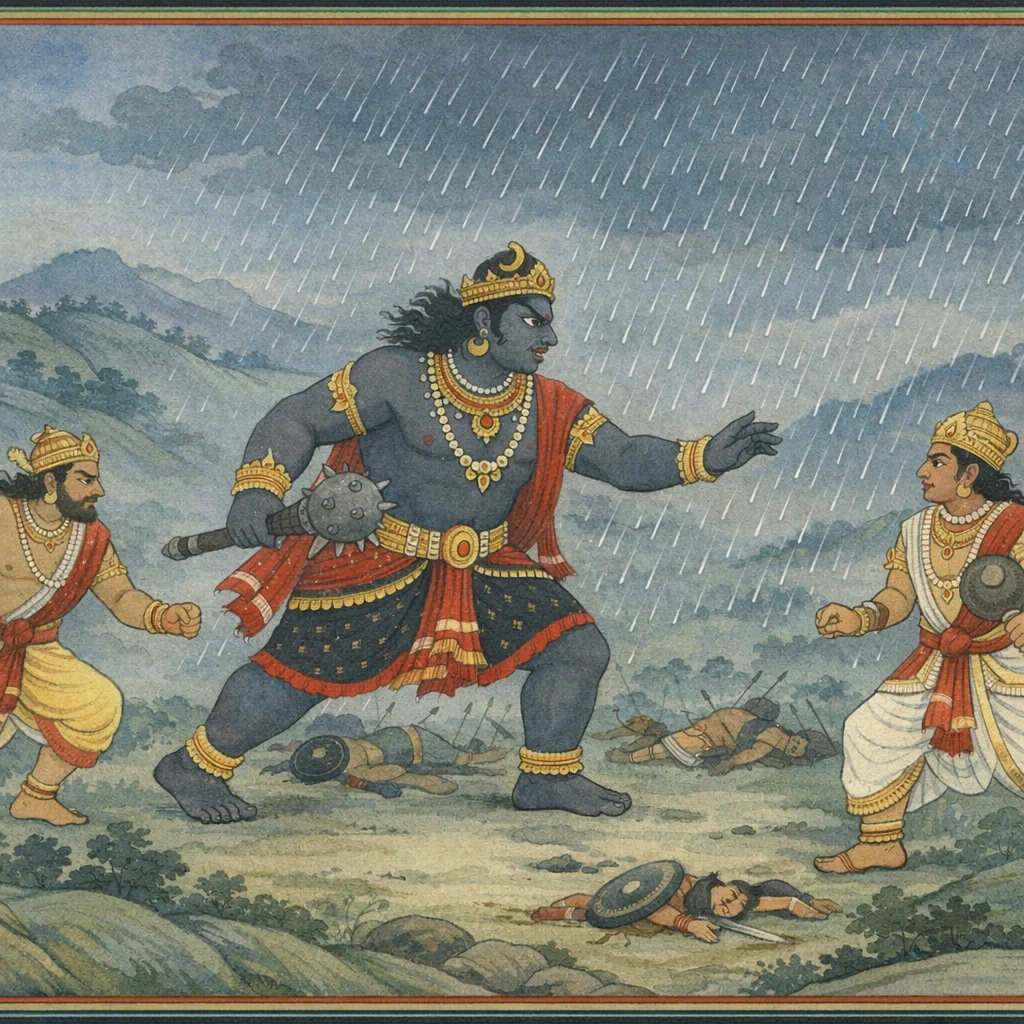
Adhyaya 96
भीष्मपर्व — अध्याय ९६: सौभद्रस्य आक्रमणम्, अलम्बुसस्य प्रतिविधानम् (Abhimanyu’s assault; Alambusa’s counter-engagement)
Upa-parva: Bhīṣma-parva (Kurukṣetra-vṛttānta: Abhimanyu’s assault and Alambusa’s counter-engagement)
Saṃjaya reports that Abhimanyu, mounted on a splendid chariot, charges into Duryodhana’s forces while releasing dense volleys of arrows like rain from a cloud. The Kaurava champions are described as unable to restrain his advance as he cuts down multiple combat arms—charioteers, cavalry, and elephant-riders—producing widespread dispersal and panic. Abhimanyu’s mobility and archery are rendered through visibility and sound imagery: his bow appears radiant, his arrows stream like swarms, and his chariot’s roar obscures clear sight of him. Observers interpret his feats as comparable to Arjuna’s, and the Kaurava line emits a collective distress-cry. Duryodhana, hearing the tumult, identifies Abhimanyu as a ‘second Phalguna’ and declares that only the rākṣasa Alambusa (Ārśyaśṛṅgi), skilled across arts, can serve as an effective remedy in battle. Alambusa advances with a thunderous roar, frightening many; Abhimanyu moves to meet him with readiness. Alambusa then drives back Pāṇḍava forces, drawing the five Draupadeyas into attack; they wound him heavily, after which Alambusa regains composure and disables their standards, bows, horses, and charioteers, seeking to finish them. Seeing them distressed, Arjuna’s son (Abhimanyu) engages Alambusa directly; the chapter closes on their fierce encounter, compared to mythic duels (Vṛtra–Vāsava; Śakra–Śambara), signaling a climactic tactical contest between champions.
Chapter Arc: घटोत्कच की राक्षसी गर्जना और उसकी धूमकेतु-सी गति से रणभूमि काँप उठती है; कौरव-पक्ष उसे दुर्योधन की ओर बढ़ता देख एक साथ टूट पड़ता है। → कौरव महारथी सिंह-समूह की भाँति नाद करते हुए अपने दीर्घ धनुष खींचते हैं और घटोत्कच पर चारों ओर से शर-वर्षा करते हैं—मानो शरद्-ऋतु के बादल पर्वत पर धाराएँ बरसा रहे हों। उधर युधिष्ठिर उस गर्जना को सुनकर भीमसेन को निर्देश देते हैं कि राक्षस-रक्षक के लिए सहायता पहुँचे। → युद्ध ‘वैशस’—मर्यादा-शून्य संहार—का रूप ले लेता है: पिता-पुत्र एक-दूसरे को पहचान नहीं पाते; सिर-विहीन मनुष्य, कटे अंगों वाले गज, विदीर्ण अश्वों से पृथ्वी भर जाती है। घटोत्कच के चारों ओर घेरा कसता है और दोनों पक्ष के अनिवर्तनीय योद्धा घोर संग्राम में भिड़ते हैं। → युधिष्ठिर की आज्ञा मानकर भीमसेन सिंहनाद करते हुए, समस्त नरेशों को त्रस्त करते, उतावली से घटोत्कच की ओर प्रस्थान करते हैं; रण में घुड़सवार, गजसवार, रथी और पदाति धीरे-धीरे एक अत्यन्त भयंकर युद्ध में समा जाते हैं। → घटोत्कच को चारों ओर से घेर कर कौरव-वीर उसे दुर्योधन तक पहुँचने से रोकेंगे या भीम समय पर पहुँचकर राक्षस-पुत्र को बचा लेगा?
Shlokas
Verse 1
[दाक्षिणात्य अधिक पाठका श्लोक मिलाकर कुल ४३ ३ “लोक हैं] मा हि (७ त्रिनववतितमो<्थ्याय: घटोत्कचकी रक्षाके लिये आये हुए भीम आदि शूरवीरोंके साथ कौरवोंका युद्ध और उनका पलायन संजय उवाच विमुखीकृत्य सर्वास्तु तावकान् युधि राक्षस: । जिधघांसुर्भरतश्रेष्ठ दुर्योधनमुपाद्रवत्,संजय कहते हैं--भरतश्रेष्ठ! वह राक्षस युद्धस्थलमें आपके समस्त सैनिकोंको संग्रामसे विमुख करके दुर्योधनको मार डालनेकी इच्छा रखकर उसकी ओर दौड़ा
Sañjaya said: O best of the Bharatas, that rākṣasa, having turned all your troops away from the fight on the battlefield, rushed toward Duryodhana with the intent to kill him.
Verse 2
तमापतत्तं सम्प्रेक्ष्य राजानं प्रति वेगितम् । अभ्यधावज्जिघांसन्तस्तावका युद्धदुर्मदा:,उसे राजा दुर्योधनकी ओर बड़े वेगसे आते देख आपके रणदुर्मद पुत्र और सैनिक मार डालनेकी इच्छासे उसकी ओर दौड़े
Sañjaya said: Seeing the king rushing swiftly toward Duryodhana, your warriors—intoxicated with the frenzy of battle—ran forward at him, intent on killing.
Verse 3
तालमात्राणि चापानि विकर्षन्तो महारथा: । तमेकमभ्यधावन्त नदन्तः सिंहसंघवत्,उन सभी महारथियोंने चार-चार हाथके धनुष खींचते और सिंहोंके समुदायकी भाँति गर्जना करते हुए उस एकमात्र योद्धा घटोत्कचपर धावा किया
Sañjaya said: Drawing their bows to the full—each like a tāla-tree in measure—the great chariot-warriors rushed together against that single fighter, roaring like a pride of lions. The scene underscores the ferocity of battle and the moral tension of many assailing one, even as it reflects the battlefield’s relentless logic where prowess and threat determine collective response.
Verse 4
अथैनं शरवर्षेण समन्तात् पर्यवाकिरन् । पर्वतं वारिधाराभि: शरदीव बलाहका:
Sañjaya said: Then, from every side, they showered him with a rain of arrows, covering him all around—just as autumn clouds drench a mountain with streaming sheets of water. The verse underscores the impersonal, overwhelming force of battle, where skill and resolve are tested amid relentless violence.
Verse 5
जैसे शरदऋतुमें बादल पर्वतके शिखरपर जलकी धाराएँ गिराते हैं, उसी प्रकार उन सब कौरव वीरोंने चारों ओरसे घटोत्कचपर बाणोंकी वर्षा प्रारम्भ कर दी ।। स गाढविद्धो व्यथितत्तोत्रार्दित इव द्विप: । उत्पपात तदा55काशं समन्ताद् वैनतेयवत्
As autumn clouds pour streaming sheets of water upon a mountain peak, so did all the Kaurava heroes begin, from every side, to rain arrows upon Ghaṭotkaca. Deeply pierced, he writhed in pain like an elephant tormented by the driver’s hook; and then he sprang up into the sky on all sides, like Vainateya—Garuḍa himself.
Verse 6
उस समय उन बाणोंके गहरे आघातसे वह अंकुशकी मार खाये हुए हाथीकी भाँति व्यथित हो उठा और तुरंत ही गरुड़के समान आकाशमें सब ओर उड़ने लगा ।। व्यनदत् सुमहानादं जीमूत इव शारद: । दिश: खं विदिशश्वैव नादयन् भैरवस्वन:,आकाशमें स्थित होकर शरदऋतुके बादलकी भाँति वह अपने भयंकर स्वरसे अन्तरिक्ष, दिशाओं तथा विदिशाओंको गुँजाता हुआ जोर-जोरसे गर्जना करने लगा
Sañjaya said: Struck deeply by those arrows, he was shaken like an elephant goaded by the driver’s hook. Then, rising into the sky like Garuḍa, he let out a tremendous roar; poised in the air like an autumn cloud, with a fearsome sound he made the firmament, the directions, and the intermediate quarters resound.
Verse 7
राक्षसस्य तु त॑ शब्दं श्रुत्वा राजा युधिष्ठिर: । उवाच भरतश्रेष्ठ भीमसेनमरिंदमम्,भरतश्रेष्ठ! राक्षस घटोत्कचकी उस गर्जनाको सुनकर राजा युधिष्ठिरने शत्रुदमन भीमसेनसे इस प्रकार कहा--
Sañjaya said: Hearing that roar of the rākṣasa, King Yudhiṣṭhira—best of the Bharatas—addressed Bhīmasena, the subduer of foes. The scene underscores a leader’s duty to respond to danger with steadiness and to direct strength toward the protection of one’s side in the midst of war.
Verse 8
युध्यते राक्षसो नून॑ धार्तराष्ट्रमहारथै: । यथास्य श्रूयते शब्दो नदतो भैरवं स्वनम्,'राक्षस घटोत्कच कौरव महारथियोंसे निश्चय ही युद्ध कर रहा है। भैरवनाद करते हुए उस राक्षसका जैसा शब्द सुनायी देता है, उससे यही जान पड़ता है
Sañjaya said: “Surely that Rākṣasa is fighting with the great chariot-warriors of the Dhārtarāṣṭras. From the terrifying roar that is heard as he bellows, it is evident that a fierce combat is underway.”
Verse 9
आकाशमें स्थित हुए घटोत्कचकी गर्जना और दुर्योधनके साथ उसका युद्ध अतिभारं च पश्यामि तस्मिन् राक्षसपुड्वे | पितामहमश्न संक्रुद्ध: पज्चालान् हन्तुमुद्यत:,“मैं उस राक्षसशिरोमणिपर बहुत बड़ा भार देख रहा हूँ। उधर पितामह भीष्म भी अत्यन्त क्रोधमें भरकर पांचालोंको मार डालनेके लिये उद्यत हैं
Sañjaya said: “I see a tremendous burden resting upon that foremost of rākṣasas. And Grandfather Bhīṣma too, inflamed with anger, is poised to strike down the Pāñcālas.”
Verse 10
तेषां च रक्षणार्थाय युध्यते फाल्गुन: परै: । एतज्ज्ञात्वा महाबाहो कार्यद्वयमुपस्थितम्
Sañjaya said: “And for their protection, Phālguna (Arjuna) is fighting against the others. Knowing this, O mighty-armed one, you now face a twofold duty—what must be done has presented itself in two competing claims.”
Verse 11
गच्छ रक्षस्व हैडिम्बं संशयं परमं गतम् । “उनकी रक्षाके लिये अर्जुन शत्रुओंसे युद्ध करते हैं। महाबाहो! अपने ऊपर दो कार्य उपस्थित हैं, ऐसा जानकर तुम जाओ और अत्यन्त संशयमें पड़े हुए हिडिम्बाकुमारकी रक्षा करो” ।।१० है ।। भ्रातुर्वचनमाज्ञाय त्वरमाणो वृकोदर:
Sañjaya said: “Go—protect the son of Hiḍimbā, who has fallen into the gravest doubt. Mighty-armed one, knowing that two duties now confront you, depart at once and safeguard the Hiḍimba prince, overwhelmed by uncertainty.” Hearing his brother’s command, Vṛkodara hurried to act.
Verse 12
वेगेन महता राजन् पर्वकाले यथोदध्ि:,राजन! जैसे पूर्णिमाको समुद्र बड़े वेगसे बढ़ता है, उसी प्रकार भीमसेन अत्यन्त वेगसे आगे बढ़े। उनके पीछे सत्यधृति, रणदुर्मद सौचित्ति, श्रेणिमानू, वसुदान, काशिराजके पुत्र अभिभू, अभिमन्यु आदि योद्धा, द्रौपदीके पाँचों महारथी पुत्र, पराक्रमी क्षत्रदेव, क्षत्रधर्मा, अनूपदेशके राजा नील, जिन्हें अपने बलका पूरा भरोसा था--इन सब वीरोंने विशाल रथसेनाके साथ हिडिम्बाकुमार घटोत्कचको सब ओरसे घेर लिया
Sañjaya said: “O King, just as the ocean swells with great force at the time of the full moon, so Bhimasena surged forward with tremendous speed. Close behind him came Satyadhriti, Ranadurmad, Sauchitti, Shreniman, Vasudana, Abhibhu the son of the king of Kashi, Abhimanyu, the five great chariot-warrior sons of Draupadi, the valiant Kshatradeva and Kshatradharma, and Nila, king of the Anupa region—heroes fully confident in their own strength. With a vast host of chariots, all these warriors surrounded Hidimba’s son Ghatotkacha on every side.”
Verse 13
तमन्वगात् सत्यधृतिः सौचित्तिययुद्धदुर्मद: । श्रेणिमान् वसुदानश्च पुत्र: काश्यस्य चाभिभू:,राजन! जैसे पूर्णिमाको समुद्र बड़े वेगसे बढ़ता है, उसी प्रकार भीमसेन अत्यन्त वेगसे आगे बढ़े। उनके पीछे सत्यधृति, रणदुर्मद सौचित्ति, श्रेणिमानू, वसुदान, काशिराजके पुत्र अभिभू, अभिमन्यु आदि योद्धा, द्रौपदीके पाँचों महारथी पुत्र, पराक्रमी क्षत्रदेव, क्षत्रधर्मा, अनूपदेशके राजा नील, जिन्हें अपने बलका पूरा भरोसा था--इन सब वीरोंने विशाल रथसेनाके साथ हिडिम्बाकुमार घटोत्कचको सब ओरसे घेर लिया
Sañjaya said: Following him advanced Satyadhṛti, the Sauciṭṭi warrior Raṇadurmada, Śreṇimān, Vasudāna, and Abhibhū—the son of Kāśya. In the unfolding battle-line, these named heroes pressed forward in disciplined succession, exemplifying the Kṣatriya ethic of standing behind a leading champion and reinforcing the collective duty of the host in war.
Verse 14
अभिमन्युमुखाश्रैव द्रौपदेया महारथा: । क्षत्रदेवश्न विक्रान्त: क्षत्रधर्मा तथैव च,राजन! जैसे पूर्णिमाको समुद्र बड़े वेगसे बढ़ता है, उसी प्रकार भीमसेन अत्यन्त वेगसे आगे बढ़े। उनके पीछे सत्यधृति, रणदुर्मद सौचित्ति, श्रेणिमानू, वसुदान, काशिराजके पुत्र अभिभू, अभिमन्यु आदि योद्धा, द्रौपदीके पाँचों महारथी पुत्र, पराक्रमी क्षत्रदेव, क्षत्रधर्मा, अनूपदेशके राजा नील, जिन्हें अपने बलका पूरा भरोसा था--इन सब वीरोंने विशाल रथसेनाके साथ हिडिम्बाकुमार घटोत्कचको सब ओरसे घेर लिया
Sanjaya said: Along with Abhimanyu at their head, the five Draupadeya princes—mighty chariot-warriors—advanced. So too did the valiant Kṣatradeva and likewise Kṣatradharmā. The passage situates the unfolding battle as a collective surge of duty-bound kṣatriyas, where courage and loyalty to one’s side are displayed through coordinated advance and protection of their formation.
Verse 15
अनूपाधिपतिश्वैव नील: स्वबलमास्थित: । महता रथवंशेन हैडिम्बं पर्यवारयन्,राजन! जैसे पूर्णिमाको समुद्र बड़े वेगसे बढ़ता है, उसी प्रकार भीमसेन अत्यन्त वेगसे आगे बढ़े। उनके पीछे सत्यधृति, रणदुर्मद सौचित्ति, श्रेणिमानू, वसुदान, काशिराजके पुत्र अभिभू, अभिमन्यु आदि योद्धा, द्रौपदीके पाँचों महारथी पुत्र, पराक्रमी क्षत्रदेव, क्षत्रधर्मा, अनूपदेशके राजा नील, जिन्हें अपने बलका पूरा भरोसा था--इन सब वीरोंने विशाल रथसेनाके साथ हिडिम्बाकुमार घटोत्कचको सब ओरसे घेर लिया
Sañjaya said: “And Nīla, the king of Anūpa, relying fully on his own strength, together with a great mass of chariots, surrounded the Haiḍimba (Ghaṭotkaca) on all sides.”
Verse 16
कुण्जरैश्व सदा मत्तै: षपट्सहस्रैः प्रहारिभि: । अभ्यरक्षन्त सहिता राक्षसेन्द्रं घटोत्कचम्,सदा उन्मत्त रहनेवाले, प्रहारकुशल छ: हजार गजराजोंके साथ आकर उपर्युक्त वीरोंने एक साथ ही राक्षसराज घटोत्कचकी रक्षा की
Sañjaya said: Together, those warriors formed a protective screen around Ghaṭotkaca, the lord of the Rākṣasas, supported by six thousand war-elephants—ever in musth and trained for striking. The scene underscores how, in the ethics of battle, even a fearsome champion is sustained by coordinated protection and disciplined force rather than solitary prowess alone.
Verse 17
सिंहनादेन महता नेमिघोषेण चैव ह । खुरशब्दनिपातैश्व कम्पयन्तो वसुन्धराम्,वे महान् सिंहनाद, रथके पहियोंकी घरघराहट और घोड़ोंकी टाप पड़नेसे होनेवाले महान् शब्दके द्वारा वसुधाको कम्पित कर रहे थे
Sañjaya said: With a mighty lion-roar, with the rumbling of chariot-wheels, and with the pounding sounds of horses’ hooves, they made the very earth tremble—an awe-inspiring surge of martial power as the armies pressed forward into battle.
Verse 18
तेषामापततां श्रुत्वा शब्दं तं तावकं बलम् | भीमसेनभयोेद्िग्नं विवर्णवदनं तथा,उन सबके आनेसे जो कोलाहल हुआ, उसे सुनकर भीमसेनके भयसे उद्दिग्न हुए आपके सैनिकोंका मुख उदास हो गया
Sañjaya said: Hearing the tumultuous roar as they charged in, your army was shaken with fear of Bhīmasena; their faces grew pale and downcast, betraying their inner alarm on the battlefield.
Verse 19
परिवृत्तं महाराज परित्यज्य घटोत्कचम् । ततः प्रववृते युद्ध तत्र तेषां महात्मनाम्
Sañjaya said: O King, leaving Ghaṭotkaca behind after turning away, the battle then surged forth there among those great-souled warriors—its momentum shifting as the fighters re-formed and pressed on with renewed force.
Verse 20
नानारूपाणि शस्त्राणि विसृजन्तो महारथा:
Sañjaya said: “The great chariot-warriors, hurling weapons of many kinds, pressed the battle forward.”
Verse 21
अन्योन्यमभिधावन्त: सम्प्रहारं प्रचक्रिरे । नाना प्रकारके अस्त्र-शस्त्रोंकोी छोड़ते और एक-दूसरेकी ओर दौड़ते हुए उभय पक्षके महारथी भीषण युद्ध करने लगे ।। २० ई ।। व्यतिषक्तं महारौद्रं युद्ध भीरुभयावहम्
Sañjaya said: Rushing at one another, they began a fierce exchange of blows. The battle became tangled and exceedingly dreadful, bringing terror to both sides—an image of war’s consuming momentum, where valor and duty are asserted amid the ethical cost of mutual destruction.
Verse 22
अन्योन्यं समरे राजन् प्रार्थयाना: समभ्ययु:
Sañjaya said: O King, in the thick of battle they advanced toward one another, each calling out and challenging the other—an image of warriors driven by rivalry and resolve as the clash of arms tightened into direct confrontation.
Verse 23
सहसा चाभववत् तीव्रं संनिपातान्महद् रज: । गजाश्वरथपत्तीनां पदनेमिसमुद्धतम्
Sañjaya said: Suddenly, from the fierce clash, a vast cloud of dust arose—thick and violent—kicked up by the feet of elephants, the hooves of horses, the rolling rims of chariot wheels, and the trampling of foot-soldiers.
Verse 24
राजन! वे समरांगणमें एक-दूसरेको ललकारते हुए जूझ रहे थे। उस समय उस भीषण संघर्षमे सहसा बड़े जोरकी धूल उठी, जो हाथी, घोड़े और पैदलोंके पैरों तथा रथके पहियोंके धक्केसे उठायी गयी थी ।। धूम्रारुणं रजस्तीव्रं रणभूमिं समावृणोत् । नैव स्वे न परे राजन् समजानम् परस्परम्,महाराज! काले और लाल रंगकी उस दुःसह धूलने समस्त रणभूमिको ढक लिया। उस समय अपने और शत्रुपक्षके योद्धा एक-दूसरेको पहचान नहीं पाते थे
Sañjaya said: O King, as the warriors challenged one another and grappled on the field, a sudden, violent cloud of dust rose in that dreadful clash—thrown up by the pounding feet of elephants, horses, and infantry, and by the battering wheels of chariots. That thick dust, smoky and reddish, blanketed the entire battlefield; in it, O King, neither side could clearly recognize its own men or the enemy.
Verse 25
पिता पुत्र न जानीते पुत्रो वा पितरं तथा । निर्मयदि तथाभूते वैशसे लोमहर्षणे,उस मर्यादाशून्य रोमांचकारी जनसंहारमें पिता पुत्रको और पुत्र पिताको नहीं पहचान पाता था
Sañjaya said: In that boundaryless, horrifying slaughter, a father could not recognize his own son, nor could a son recognize his father.
Verse 26
शस्त्राणां भरतश्रेष्ठ मनुष्याणां च गर्जताम् | सुमहानभवच्छब्द: प्रेतानामिव भारत,भरतश्रेष्ठ! शस्त्रोंके आघात और मनुष्योंकी गर्जनाका महान् शब्द भूत-प्रेतोंकी गर्जनाके समान जान पड़ता था
Sañjaya said: O best of the Bharatas, as weapons struck and men roared, a tremendous din arose—like the howling of spirits among the dead.
Verse 27
गजवाजिमनुष्याणां शोणितान्त्रतरड्रिणी । प्रावर्तत नदी तत्र केशशैवलशाद्धला,हाथी, घोड़े और मनुष्योंके रक्त और आँतोंकी एक भयंकर नदी बह चली, जिसमें केश सेवार और घासके समान जान पड़ते थे
Sañjaya said: There, a dreadful river began to flow—its current made of the blood and entrails of elephants, horses, and men. In that ghastly stream, clumps of hair appeared like water-weeds and grass.
Verse 28
नराणां चैव कायेभ्य: शिरसां पततां रणे | शुश्रुवे सुमहाउ्छब्द: पततामश्मनामिव,मनुष्योंके शरीरोंसे रणभूमिमें कटकर गिरते हुए मस्तकोंका महान् शब्द पत्थरोंकी वर्षके समान जान पड़ता था
Sañjaya said: As men’s heads, severed from their bodies, fell upon the battlefield, there arose a tremendous sound—like the crash of stones raining down. The narration underscores the brutal cost of war, where the pursuit of victory is inseparable from widespread suffering and the moral weight of violence.
Verse 29
विशिरस्कैर्मनुष्यैश्व च्छिन्नगात्रैश्न वारणै: । अश्वैः सम्भिन्नदेहैश्व संकीर्णाभूद् वसुन्धरा,बिना सिरके मनुष्यों, कटे हुए अंगोंवाले हाथियों तथा छिलन्न-भिन्न शरीरवाले घोड़ोंसे वहाँकी सारी भूमि पट गयी थी
Sanjaya said: The earth there became strewn and choked with the horrors of battle—headless men, elephants with limbs hewn away, and horses with bodies mangled and shattered—so that the very ground was carpeted with the wreckage of violence, revealing the grave ethical cost of war even amid claims of duty.
Verse 30
नानाविधानि शस्त्राणि विसृजन्तो महारथा: । अन्योन्यमभिधावन्त: सम्प्रहारार्थमुद्यता:
Sañjaya said: The great chariot-warriors, hurling weapons of many kinds, rushed at one another, fully intent on closing in for direct combat. The scene underscores how, once battle is joined, prowess and resolve drive men toward violent encounter, even as the larger question of righteous conduct (dharma) remains the unseen measure of their acts.
Verse 31
नाना प्रकारके शस्त्रोंकोी चलाते और एक-दूसरेकी ओर दौड़ते हुए महारथी सर्वथा युद्धके लिये उद्यत थे ।। हया हयान् समासाद्य प्रेषिता हपसादिभि: । समाहत्य रणे<न्योन्यं निपेतुर्गतजीविता:,घुड़सवारोंद्वारा प्रेरित हुए घोड़े घोड़ोंसे भिड़कर आपसमें टक्कर लेकर प्राणशून्य हो रणक्षेत्रमें गिर पड़ते थे
Sañjaya said: Urged on by their riders and drivers, the horses rushed upon other horses; colliding and striking one another in the thick of battle, they fell upon the battlefield bereft of life. The scene underscores how, in the fury of war, even noble animals—drawn into human conflict—meet a violent end, intensifying the moral weight of the carnage.
Verse 32
नरा नरान् समासाद्य क्रोधरक्तेक्षणा भृशम् | उरांस्युरोभिरन्योन्यं समाश्लिष्य निजष्निरे,मनुष्य मनुष्योंपर आक्रमण करके अत्यन्त क्रोधसे लाल आँखें किये छातीसे छाती भिड़ाकर एक-दूसरेको मारने लगे
Sañjaya said: Men closed in upon men; their eyes were fiercely reddened with anger. Pressing chest against chest and grappling one another at close quarters, they began to strike down their own fellow men—war’s fury collapsing all restraint and turning human beings into each other’s destroyers.
Verse 33
प्रेषिताश्न महामात्रैवरिणा: परवारणै:। अभ्यघ्नन्त विषाणाग्रैरवारिणानेव संयुगे,महावतोंके द्वारा आगे बढ़ाने हुए हाथी विपक्षी हाथियोंसे टक्कर लेकर युद्धस्थलमें अपने दाँतोंके अग्रभागसे हाथियोंपर ही चोट करते थे
Sañjaya said: Driven forward by their great commanders, the enemy’s elephants met the opposing elephants head-on and, in the thick of battle, struck them with the sharp tips of their tusks.
Verse 34
ते जातरुधिरोत्पीडा: पताकाभिरलंकृता: । संसक्ता: प्रत्यदृश्यन्त मेघा इव सविद्युत:,उस समय उनके मस्तकसे रक्तकी धारा बहने लगती थी। परस्पर भिड़े हुए वे हाथी पताकाओंसे अलंकृत होनेके कारण विद्युत्सहित मेघोंके समान दिखायी देते थे
Sañjaya said: As the elephants’ heads were pressed and struck, streams of blood began to flow. Locked together in close combat and adorned with fluttering banners, they appeared like thunderclouds shot through with lightning.
Verse 35
केचिद् भिन्ना विषाणाग्रै्िन्नकुम्भाश्न तोमरै: । विनदन्तो<5 भ्यधावन्त गर्जमाना घना इव,कितने ही हाथी दाँतोंके अग्रभागसे विदीर्ण हो रहे थे। कितनोंके कुम्भस्थल तोमरोंकी मारसे फट गये थे और वे गर्जते हुए बादलोंके समान चीत्कार करते हुए इधर-उधर भाग रहे थे
Sañjaya said: Some elephants had their tusk-tips shattered; others had their frontal globes split open by the blows of spears. Crying out and trumpeting, they rushed about in confusion, roaring like thunderclouds.
Verse 36
केचिट्धस्तैर्द्धिधा च्छिन्नैश्छिन्नगात्रास्तथापरे | निपेतुस्तुमुले तस्मिंश्छिन्नपक्षा इवाद्रय:,किन्हींकी सूँड्रोंक दो टुकड़े हो गये थे, किन्हींके सभी अंग छिन्न-भिन्न हो गये थे, ऐसे हाथी पंख कटे पर्वतोंके समान उस भयानक युद्धमें धड़ाधड़ गिर रहे थे
Sañjaya said: In that dreadful and tumultuous battle, some elephants fell with their trunks cut in two, while others—having their limbs hewn apart—collapsed in heaps, like mountains whose wings have been shorn.
Verse 37
पार्श्वैस्तु दारितैरन्ये वारणैर्वरवारणा: । मुमुचु: शोणितं भूरि धातूनिव महीधरा:,बहुत-से श्रेष्ठ हाथी हाथियोंके आघातसे ही अपना पार्श्वभाग विदीर्ण हो जानेके कारण उसी प्रकार प्रचुरमात्रामें अपना रक्त बहा रहे थे, जैसे पर्वत गेरु आदि धातुओंसे मिश्रित झरने बहाते हों
Sañjaya said: Many noble elephants, their flanks torn open by the impact of other elephants, poured forth blood in abundance—like mountains sending down streams mingled with red ochre and other minerals.
Verse 38
नाराचनिहतास्त्वन्ये तथा विद्धाश्ष तोमरै: । विनदन्तो< भ्यधावन्त विशूंगा इव पर्वता:
Sañjaya said: Some were struck down by iron arrows (nārāca), and others were pierced by spears (tomara). Roaring, they surged forward—like mountains shorn of their peaks—pressing on in the battle’s fury even as weapons broke their bodies.
Verse 39
कुछ हाथी नाराचोंसे घायल किये गये थे, कितनोंके शरीरोंमें तोमर धँसे हुए थे और वे सब-के-सब घोर चीत्कार करते हुए इधर-उधर दौड़ रहे थे। उस समय वे शुंगहीन पर्वतोंके समान जान पड़ते थे ।। केचित् क्रोधसमाविष्टा मदान्धा निरवग्रहा: । रथान् हयान् पदातींश्व ममृदुः शतशो रणे,कितने ही मदान्ध गजराज क्रोधमें भरे होनेके कारण काबूमें नहीं आते थे। उन्होंने रणभूमिमें सैकड़ों रथों, घोड़ों और पैदल सिपाहियोंको पैरों तले रौंद डाला
Sañjaya said: Some elephants were struck by iron arrows (nārāca); in the bodies of others, javelins (tomara) were lodged. All of them, crying out terribly, ran here and there, appearing like mountains bereft of their peaks. And some great elephants, blinded by rut and seized by rage, beyond all restraint, trampled down in the battle hundreds of chariots, horses, and foot-soldiers.
Verse 40
तथा हया हयारोहैस्ताडिता: प्रासतोमरै: । तेन तेनाभ्यवर्तन्त कुर्वन्तो व्याकुला दिश:,इसी प्रकार घुड़सवारोंद्वारा प्रास और तोमरोंकी मारसे घायल किये हुए घोड़े सम्पूर्ण दिशाओंको व्याकुल करते हुए इधर-उधर भाग रहे थे
Sañjaya said: In the same way, the horses—wounded by the thrusts of lances and javelins (prāsa and tomara) hurled by mounted warriors—rushed about in this direction and that, throwing the quarters into confusion.
Verse 41
रथिनो रथिभश्रि: सार्ध कुलपुत्रास्तनुत्यज: । परां शक्ति समास्थाय चक्कु: कर्माण्यभीतवत्
Sañjaya said: The chariot-warriors, radiant with martial splendor, together with the noble-born youths ready to lay down their bodies, took their stand upon supreme resolve and carried out their duties without fear.
Verse 42
कितने ही कुलीन रथी अपने शरीरोंको निछावर करके भारी-से-भारी शक्ति लगाकर विपक्षी रथियोंके साथ निर्भयकी भाँति महान् पराक्रम प्रकट कर रहे थे ।। स्वयंवर इवामर्दे प्रजहुरितरेतरम् प्रार्थयाना यशो राजन् स्वर्ग वा युद्धेशालिन:,राजन! युद्धमें शोभा पानेवाले वीर स्वर्ग अथवा यश पानेकी इच्छा रखकर स्वयंवरकी भाँति उस युद्धमें एक-दूसरेपर प्रहार कर रहे थे
Sañjaya said: O King, the warriors who shone in battle struck one another down as though in a svayaṃvara—each seeking either glory or heaven. With fearless resolve and utmost exertion, many noble chariot-fighters offered up their very bodies and displayed great valor against opposing chariot-warriors.
Verse 43
तस्मिंस्तथा वर्तमाने संग्रामे लोमहर्षणे । धार्तराष्ट्र महत् सैन्यं प्रायशो विमुखीकृतम्
Sañjaya said: As that battle—so dreadful as to make the hair stand on end—unfolded in this manner, the great army of the Dhārtarāṣṭras was for the most part driven back and turned away from the fight.
Verse 93
इस प्रकार चलनेवाले उस रोमांचकारी संग्राममें दुर्योधनकी विशाल सेना प्राय: युद्धसे विमुख होकर भाग गयी ।। इति श्रीमहा भारते भीष्मपर्वणि भीष्मवधपर्वणि संकुलयुद्धे त्रिनवतितमो<ध्याय: ।। १३ ।। इस प्रकार श्रीमह्ाभारत भीष्मपर्वके अन्तर्गत भीष्मवधपर्वमें संकुलयुद्धविषयक तिरानबेवाँ अध्याय पूरा हुआ
Sañjaya said: As the battle surged on in this hair-raising clash, Duryodhana’s vast host—losing heart—turned away from the fight and for the most part fled. Thus ends the ninety-sixth chapter, “The Confused Battle,” in the Bhīṣma Parva of the Mahābhārata, within the section concerning the slaying of Bhīṣma.
Verse 116
प्रययौ सिंहनादेन त्रासयन् सर्वपार्थिवान् | भाईकी यह आज्ञा मानकर भीमसेन सिंहनादसे सम्पूर्ण नरेशोंको भयभीत करते हुए बड़ी उतावलीके साथ वहाँसे चल दिये
Sañjaya said: With a lion-like roar he set forth, striking fear into all the kings. Obeying Bhīma’s command, Bhīmasena departed in great haste, and by his thunderous roar he intimidated the assembled rulers.
Verse 196
तावकानां परेषां च संग्रामेष्वनिवर्तिनाम् | महाराज! उस समय रक्षकोंद्वारा सब ओरसे घिरे हुए घटोत्कचको छोड़कर संग्राममें कभी पीठ न दिखानेवाले आपके तथा शत्रुपक्षेके उन महामनस्वी योद्धाओंमें भारी युद्ध छिड़ गया
Sañjaya said: O great king, at that time—leaving aside Ghaṭotkaca, who was surrounded on all sides by his protectors—a fierce battle erupted between your warriors and those of the enemy, all high-souled fighters who never turn their backs in war.
Verse 216
हया गजै: समाजग्मु: पादाता रथिभि: सह । धीरे-धीरे अत्यन्त भयंकर युद्ध छिड़ गया, जो भीरु मनुष्योंको डरानेवाला था। घुड़सवार हाथीसवारोंके और पैदल रथियोंके साथ भिड़ गये
Sañjaya said: The horsemen closed in upon the elephant-corps, and the foot-soldiers advanced together with the chariot-warriors. Gradually, a most dreadful battle flared up—one that struck terror into the hearts of the timid—as the armies collided in full force.
Frequently Asked Questions
The chapter implies the tension between individual excellence used to destabilize mass formations and the leadership duty to contain disruption through escalation, raising questions about proportional response within kṣātra conduct.
The narrative models how morale and cohesion can shift rapidly: concentrated skill can rout larger bodies, but organized command response and targeted counter-engagement can re-stabilize a collapsing line.
No explicit phalaśruti appears in this chapter; its meta-function is descriptive-archival, using comparative similes and command dialogue to position the episode within the larger causal chain of the war.