Adhyaya 95
भीष्मरक्षण-उद्योगः, शिखण्डि-विवर्जनं, सर्वतोभद्र-व्यूहः (Protection of Bhīṣma, Exemption of Śikhaṇḍin, and the Sarvatobhadra Array)
Upa-parva: Bhīṣma-vyūha-nirmāṇa and Śikhaṇḍin-vivarga (Battle Array Formation and the Śikhaṇḍin Exemption Motif)
Saṃjaya reports the dawn mobilization: the king’s forces are ordered to harness and deploy, anticipating Bhīṣma’s intensified engagement. Duryodhana interprets Bhīṣma’s reflective demeanor and directs Duḥśāsana to expedite chariot readiness and activate the thirty-two divisions, emphasizing Bhīṣma’s protection as the condition for stable advantage. Bhīṣma then states an explicit ethical constraint: he will not strike Śikhaṇḍin in battle, citing Śikhaṇḍin’s prior female identity and Bhīṣma’s known commitment to such restraint; he nonetheless commits to engage other combatants within range. Duryodhana, to prevent exploitation of this constraint, assigns protective measures and designates counter-guards. Duḥśāsana advances with the army placing Bhīṣma at the forefront. Observing Bhīṣma surrounded, Arjuna instructs Dhṛṣṭadyumna to position Śikhaṇḍin before Bhīṣma with Arjuna as protector, indicating a tactical plan aligned with Bhīṣma’s stated limitation. Bhīṣma deploys a major formation described as Sarvatobhadra; Kaurava commanders are placed across front, wings, center, and rear, while the Pāṇḍavas form a corresponding counter-array with named leaders. As both sides surge forward, the text records intense martial acoustics and a sequence of ominous portents—winds, cries, dust and bone-rain imagery, animal distress, and atmospheric dimming—marking the psychological and cosmological register of impending mass violence.
Chapter Arc: Sanjaya opens upon a dreadful rain of arrows—so fierce that even daityas would find it hard to endure—announcing the terror of Ghatotkacha’s onset against Duryodhana and the foremost Kaurava heroes. → Duryodhana’s side, stung by the Rakshasa’s audacity, surges in wrath: warriors loose sharp narachas in volleys, elephants reel, and kings leap down from falling mounts to continue the fight, choosing kshatra-dharma over retreat. Ghatotkacha blocks the Kaurava advance, turning the battlefield into a nightmarish press of missiles and close combat. → Ghatotkacha, eyes reddened with anger, uses his elephant and sheer force to obstruct and seize the initiative—checking Duryodhana’s movement and throwing the Kaurava formation into alarm as leading fighters converge with bows, shulas, and mudgaras for a decisive clash. → The chapter closes with the battle still raging: Kaurava champions regroup around their leaders, striking back in coordinated volleys and weapon-play, while Ghatotkacha remains an unyielding obstacle, keeping Duryodhana’s path contested and the field in turmoil. → With the Rakshasa’s blockade holding and the foremost Kaurava warriors closing in, the next turn hinges on whether Duryodhana’s champions can break through—or whether Ghatotkacha will escalate his terrifying warfare further.
Shlokas
Verse 1
ऑपन-आक्राा बछ। अर: द्विनवतितमो< ध्याय: घटोत्कचका दुर्योधन एवं द्रोण आदि प्रमुख वीरोंके साथ भयकर युद्ध संजय उवाच ततस्तद् बाणवर्ष तु दुः:सहं दानवैरपि । दधार युधि राजेन्द्रो यथा वर्ष महाद्विप:,संजय कहते हैं--राजन्! दानवोंके लिये भी दुःसह उस बाण-वर्षाको राजाधिराज दुर्योधनने युद्धमें उसी प्रकार धारण किया, जैसे महान् गजराज जलकी वर्षाको अपने ऊपर धारण करता है
Sañjaya said: “O King, that shower of arrows—unbearable even to the Dānavas—was endured in battle by the king of kings, Duryodhana, just as a mighty lordly elephant bears the falling rain upon its body.”
Verse 2
ततः क्रोधसमाविष्टो निः:श्वसन्निव पन्नग: । संशयं परम॑ प्राप्त: पुत्रस्ते भरतर्षभ,भरतश्रेष्ठ] उस समय क्रोधमें भरकर फुफकारते हुए सर्पके समान लंबी साँस खींचता हुआ आपका पुत्र दुर्योधन जीवन-रक्षाको लेकर भारी संशयमें पड़ गया
Sañjaya said: “Then, seized by anger, your son—breathing hard like a hissing serpent—fell into the gravest doubt, O bull among the Bharatas, about preserving his own life.”
Verse 3
मुमोच निशितांस्तीक्ष्णान् नाराचान् पज्चविंशतिम् । तेडपतन् सहसा राजंस्तस्मिन् राक्षसपुज़रवे
Sañjaya said: “He released twenty-five sharp, keen-pointed nārāca arrows. O King, they fell all at once upon that foremost of the Rākṣasas.”
Verse 4
स तैर्विद्ध: स्रवन् रक्त प्रभिन्न इव कुज्जर:
Sañjaya said: “Struck by those weapons, he bled profusely, like a great elephant whose temples have been split open.”
Verse 5
दश्ने मतिं विनाशाय राज्ञ: स पिशिताशन: । उन बाणोंसे घायल होकर वह राक्षस कुम्भ-स्थलसे मदकी धारा बहानेवाले गजराजकी भाँति अपने शरीरसे रक्तकी धारा प्रवाहित करने लगा। उसने राजा दुर्योधनका विनाश करनेके लिये दृढ़ निश्चय कर लिया ।। ४ ई || जग्राह च महाशक्तिं गिरीणामपि दारिणीम्
Sañjaya said: Struck by arrows, the flesh-eating rākṣasa began to pour forth a stream of blood from his body, like a great elephant in must pouring a rutting flow from its temples. Fixing his mind with grim resolve, he determined upon the destruction of King Duryodhana. Then he seized a mighty spear, capable of rending even mountains.
Verse 6
समुद्यच्छन् महाबाहुर्जिघांसुस्तनयं तव
Sañjaya said: “Raising himself to strike, the mighty-armed warrior—intent on killing—advanced against your son.”
Verse 7
तामुद्यतामभिप्रेक्ष्य वड्रानामधिपस्त्वरन् । कुण्जरं गिरिसंकाशं राक्षसं प्रत्यचोदयत्
Sañjaya said: Seeing him thus poised and ready, the lord of those who strike like thunderbolts hurriedly urged forward the rākṣasa elephant—mountain-like in bulk—against him.
Verse 8
महाबाहु घटोत्कच आपके पुत्रको मार डालनेकी इच्छासे वह शक्ति ऊपरको उठा रहा था। उसे उठी हुई देख वंगदेशके राजाने बड़ी उतावलीके साथ अपने पर्वताकार गजराजको उस राक्षसकी ओर बढ़ाया ।। स नागप्रवरेणाजौ बलिना शीघ्रगामिना । यतो दुर्योधनरथस्तं मार्ग प्रत्यवर्तत,वे वंगनरेश उस शीघ्रगामी महाबली गजराजपर आरूढ़ हो युद्धके मैदानमें उसी मार्गपर चले जहाँ दुर्योधनका रथ खड़ा था
Sañjaya said: Mounted upon that foremost of elephants—mighty and swift in the press of battle—the king of Vaṅga turned back along the very route where Duryodhana’s chariot stood.
Verse 9
रथं च वारयामास कुज्जरेण सुतस्य ते । मार्गमावारितं दृष्टवा राज्ञा वड्भरेन धीमता
Sañjaya said: The wise king Vaḍbhara, seeing that the way had been blocked, halted your son’s chariot by means of a kujjara (a goad/implement).
Verse 10
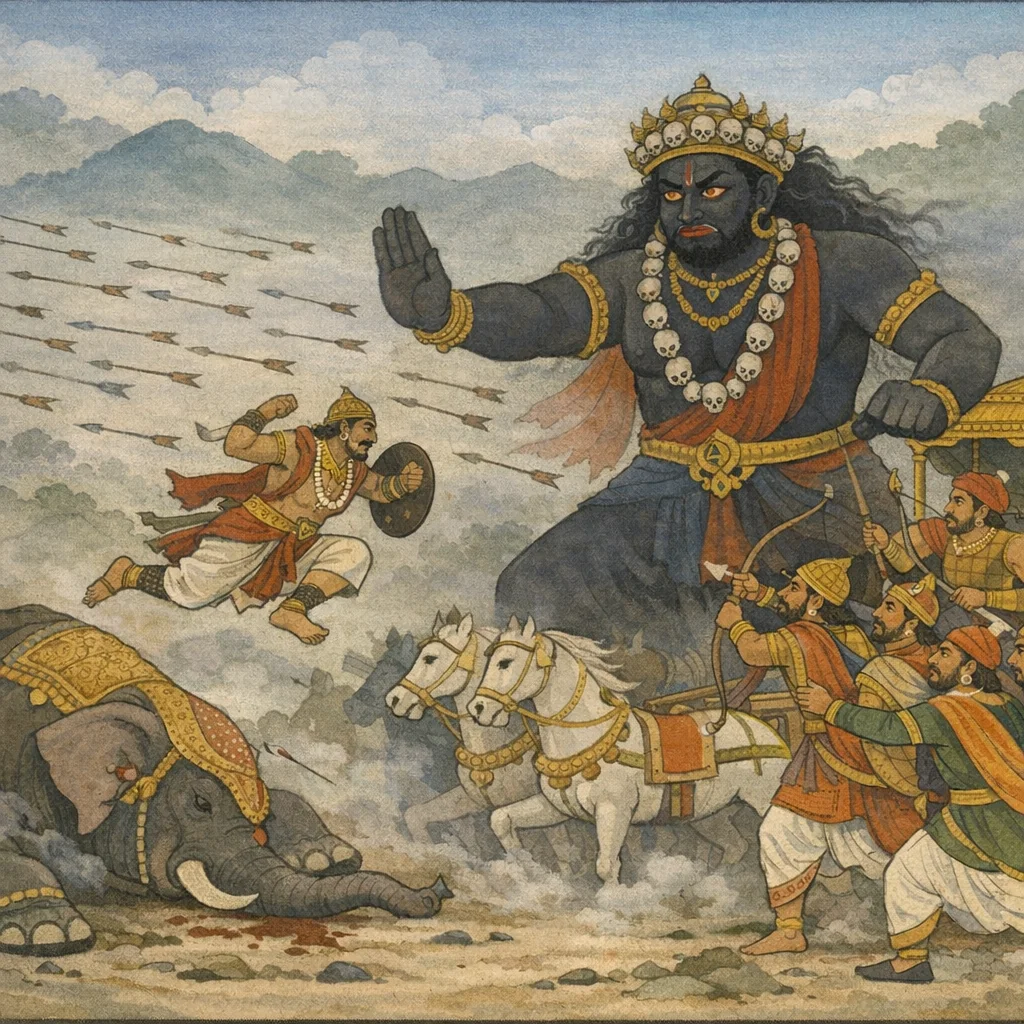
उद्यतां तां महाशक्ति तम्मिंक्षिक्षेप वारणे,उसने उस उठायी हुई महाशक्तिको उस हाथीपर ही चला दिया। राजन्! घटोत्कचकी भुजाओंसे छूटी हुई उस शक्तिके आघातसे हाथीका कुम्भस्थल फट गया और उससे रक्तका स्रोत बहने लगा। फिर वह तत्काल ही भूमिपर गिरा और मर गया
Sanjaya said: Raising that mighty śakti-weapon, he hurled it at the elephant. O King, struck by the force of that śakti released from Ghaṭotkaca’s arms, the elephant’s frontal globes split open and a stream of blood poured forth. It fell at once to the ground and died.
Verse 11
स तयाभिहतो राजंस्तेन बाहुप्रमुक्तया । संजातरुधिरोत्पीड: पपात च ममार च,उसने उस उठायी हुई महाशक्तिको उस हाथीपर ही चला दिया। राजन्! घटोत्कचकी भुजाओंसे छूटी हुई उस शक्तिके आघातसे हाथीका कुम्भस्थल फट गया और उससे रक्तका स्रोत बहने लगा। फिर वह तत्काल ही भूमिपर गिरा और मर गया
Sanjaya said: O King, struck by that mighty weapon hurled from the arm, the elephant’s temples burst and a gush of blood poured forth. It collapsed to the ground at once and died.
Verse 12
पतत्यथ गजे चापि वड्भानामीश्वरो बली । जवेन समभिद्रुत्य जगाम धरणीतलम्,हाथीके गिरते समय बलवान वंगनरेश उसकी पीठसे वेगपूर्वक कूदकर धरतीपर आ गये
Sanjaya said: As the elephant fell, the mighty lord of the Vāṅgas swiftly sprang away with speed and came down to the ground.
Verse 13
दुर्योधनो5पि सम्प्रेक्ष्य पतितं वरवारणम् । प्रभग्नं च बल॑ दृष्टवा जगाम परमां व्यथाम्,उस श्रेष्ठ गजराजको गिरा हुआ देख सारी कौरवसेना भाग खड़ी हुई। यह सब देखकर दुर्योधनके मनमें बड़ी व्यथा हुई
Sanjaya said: Even Duryodhana, seeing that excellent elephant fallen and beholding his forces shattered, was seized by intense anguish.
Verse 14
(अशक्त: प्रतियोदधुं वै दृष्टवा तस्य पराक्रमम् ।) क्षत्रधर्म पुरस्कृत्य आत्मनश्वाभिमानिताम् | प्राप्तेडपक्रमणे राजा तस्थौ गिरिरिवाचल:,वह घटोत्कचके पराक्रमपर दृष्टिपात करके उसका सामना करनेमें असमर्थ हो गया। क्षत्रियधर्म तथा अपने अभिमानको सामने रखकर पलायनका अवसर प्राप्त होनेपर भी राजा दुर्योधन पर्वतकी भाँति अविचलभावसे खड़ा रहा
Sanjaya said: Seeing that warrior’s might, he found himself unable to face him in combat. Yet, placing the kṣatriya code of honor in the forefront—and driven by his own pride—though he had the chance to withdraw, King Duryodhana stood firm, unmoving like a mountain.
Verse 15
संधाय च शितं बाणं कालाग्निसमतेजसम् | मुमोच परमक्रुद्धस्तस्मिन् घोरे निशाचरे,तत्पश्चात् उसने प्रलयकालकी अग्निके समान तेजस्वी एवं तीखे बाणको धनुषपर रखकर उसे अत्यन्त क्रोधपूर्वक उस घोर निशाचरपर छोड़ दिया
Sañjaya said: Setting a keen arrow upon the bow—blazing like the fire that rises at the end of time—he, seized by utmost wrath, loosed it against that dreadful night-roaming foe.
Verse 16
तमापततन्तं सम्प्रेक्ष्य बाणमिन्द्राशनिप्रभम् । लाघवान्मोचयामास महात्मा वै घटोत्कच:,इन्द्रके वज़के समान प्रकाशित होनेवाले उस बाणको अपनी ओर आता देख महामना राक्षस घटोत्कचने अपनी फुर्तीके कारण अपने-आपको उससे बचा लिया
Sañjaya said: Seeing that arrow—radiant like Indra’s thunderbolt—hurtling toward him, the great-souled Ghaṭotkaca, by sheer swiftness, freed himself from its strike.
Verse 17
भूयश्व विननादोग्र॑ क्रोधसंरक्तलोचन: । त्रासयामास सैन्यानि युगान्ते जलदो यथा,इसके बाद क्रोधसे आँखें लाल करके वह पुनः भयंकर गर्जना करने लगा। जैसे प्रलयकालमें संवर्तक मेघकी गर्जना होती है, वैसी ही गर्जना करके उसने सारी कौरवसेनाको दहला दिया
Sañjaya said: Once again, with eyes reddened by anger, he let out a fierce roar. Like the thunder of a world-ending cloud at the close of an age, his cry struck terror into the armies, shaking the Kaurava host with dread.
Verse 18
त॑ श्रुत्वा निनदं घोरं तस्य भीमस्य रक्षस: | आचार्यमुपसड्ञम्य भीष्म: शान्तनवोडब्रवीत्,उस भयानक राक्षसकी वह घोर गर्जना सुनकर शान्तनुनन्दन भीष्मने द्रोणाचार्यके पास जाकर इस प्रकार कहा--'आचार्य! यह राक्षसके मुखसे निकली हुई जैसी घोर गर्जना सुनायी दे रही है, उससे अनुमान होता है कि अवश्य ही हिडिम्बाका पुत्र घटोत्कच राजा दुर्योधनके साथ जूझ रहा है
Sañjaya said: Hearing that dreadful roar of the mighty rākṣasa, Bhīṣma, the son of Śāntanu, approached the preceptor Droṇa and spoke: “Teacher, from this terrifying cry it is clear that Ghaṭotkaca, the son of Hiḍimbā, is surely locked in combat with King Duryodhana.”
Verse 19
यथैष निनदो घोर: श्रूयते राक्षसेरित: । हैडिम्बो युध्यते नून॑ राज्ञा दुर्योधनेन ह,उस भयानक राक्षसकी वह घोर गर्जना सुनकर शान्तनुनन्दन भीष्मने द्रोणाचार्यके पास जाकर इस प्रकार कहा--'आचार्य! यह राक्षसके मुखसे निकली हुई जैसी घोर गर्जना सुनायी दे रही है, उससे अनुमान होता है कि अवश्य ही हिडिम्बाका पुत्र घटोत्कच राजा दुर्योधनके साथ जूझ रहा है
Sañjaya said: “Just as this dreadful roar is being heard—uttered by a rākṣasa—it surely means that Haiḍimba’s son, Ghaṭotkaca, is now engaged in combat with King Duryodhana.”
Verse 20
नैष शक््यो हि संग्रामे जेतुं भूतेन केनचित् । तत्र गच्छत भद्रंं वो राजानं परिरक्षत,“इसे कोई भी प्राणी संग्राममें जीत नहीं सकता, अतः आपका कल्याण हो, वहाँ जाइये और राजा दुर्योधनकी रक्षा कीजिये
Sanjaya said: “In this battle he cannot be conquered by any being whatsoever. Therefore, may good befall you—go there at once and protect the king (Duryodhana).”
Verse 21
अभिद्रुतों महाभागो राक्षसेन महात्मना । एतद्धि व: परं कृत्यं सर्वेषां न: परंतपा:,“जान पड़ता है महाभाग दुर्योधन उस महाकाय राक्षसके आक्रमणका शिकार हो रहा है। शत्रुओंको संताप देनेवाले वीरो! आपके तथा हम सब लोगोंके लिये यही सर्वोत्तम कृत्य है!
Sañjaya said: “The illustrious Duryodhana is being fiercely assailed by that great-souled, formidable Rākṣasa. O tormentors of foes, for you—and indeed for all of us—this is the highest duty at this moment: to act decisively in response.”
Verse 22
पितामहवच: श्रुत्वा त्वरमाणा महारथा: । उत्तमं जवमास्थाय प्रययुर्यत्र कौरव:,भीष्मकी यह बात सुनकर सब महारथी उत्तम वेगका आश्रय ले बड़ी उतावलीके साथ उस स्थानपर गये, जहाँ कुरुराज दुर्योधन मौजूद था
Sañjaya said: Hearing the words of the Grandsire Bhīṣma, the great chariot-warriors, filled with urgency, took up their swiftest pace and hastened to the place where the Kaurava king Duryodhana was present.
Verse 23
द्रोणश्न॒ सोमदत्तश्न बाह्लीको5थ जयद्रथ: । कृपो भूरिश्रवा: शल्य आवन्त्य: सबृहदूबल:,द्रोणाचार्य, सोमदत्त, बाह्नलीक, जयद्रथ, कृपाचार्य, भूरिश्रवा, शल्य, अवन्तीका राजकुमार, बृहदबल, अअश्रवत्थामा, विकर्ण, चित्रसेन, विविंशति तथा उनके अनुयायी अनेक सहस्र रथी--ये सब लोग राक्षसके द्वारा आक्रान्त हुए आपके पुत्र दुर्योधनकी रक्षा करनेके लिये गये। उन महारथियोंसे पालित होकर वह सेना अजेय हो गयी
Sanjaya said: Drona, Somadatta, the Bahlika king, and Jayadratha; Kripa, Bhurishravas, Shalya, the prince of Avanti, and also Brihadbala—these renowned warriors (and, as the narrative continues, others with their followers) advanced to protect Duryodhana, who was being assailed by a fierce, rākṣasa-like onslaught. Guarded and supported by such great chariot-fighters, the Kaurava host became exceedingly difficult to overcome.
Verse 24
अश्रत्थामा विकर्णशक्ष चित्रसेनो विविंशति: । रथाश्चानेकसाहस्रा ये तेषामनुयायिन:,द्रोणाचार्य, सोमदत्त, बाह्नलीक, जयद्रथ, कृपाचार्य, भूरिश्रवा, शल्य, अवन्तीका राजकुमार, बृहदबल, अअश्रवत्थामा, विकर्ण, चित्रसेन, विविंशति तथा उनके अनुयायी अनेक सहस्र रथी--ये सब लोग राक्षसके द्वारा आक्रान्त हुए आपके पुत्र दुर्योधनकी रक्षा करनेके लिये गये। उन महारथियोंसे पालित होकर वह सेना अजेय हो गयी
Sañjaya said: Aśvatthāmā, Vikarṇa, Citrasena, and Viviṁśati—along with many thousands of chariots that followed them—advanced as a protective force. Their purpose was to safeguard your son Duryodhana when he was assailed by a fierce, rākṣasa-like onslaught; supported by such great chariot-warriors, that host became exceedingly hard to overcome.
Verse 25
अभिवद्रुतं परीप्सन्तः पुत्र दुर्योधनं तव । तदनीकमनाधृष्यं पालितं तु महारथै:,द्रोणाचार्य, सोमदत्त, बाह्नलीक, जयद्रथ, कृपाचार्य, भूरिश्रवा, शल्य, अवन्तीका राजकुमार, बृहदबल, अअश्रवत्थामा, विकर्ण, चित्रसेन, विविंशति तथा उनके अनुयायी अनेक सहस्र रथी--ये सब लोग राक्षसके द्वारा आक्रान्त हुए आपके पुत्र दुर्योधनकी रक्षा करनेके लिये गये। उन महारथियोंसे पालित होकर वह सेना अजेय हो गयी
Sanjaya said: Eager to rush to his aid, they hastened to protect your son Duryodhana. That battle-formation, guarded by great chariot-warriors—Drona, Somadatta, Bahlika, Jayadratha, Kripa, Bhurishravas, Shalya, the prince of Avanti, Brihadbala, Ashvatthama, Vikarna, Chitrasena, Vivimshati, and many thousands of chariot-fighters who followed them—went forth to rescue Duryodhana when he was assailed by a rakshasa. Shielded by such foremost warriors, that army became hard to overcome.
Verse 26
आततायिनमायान्तं प्रेक्ष्य राक्षससत्तम: । नाकम्पत महाबाहुर्मैनाक इव पर्वत:,युद्धमें आततायी दुर्योधनको आते देख राक्षसशिरोमणि महाबाहु घटोत्कच मैनाक पर्वतकी भाँति अविचलभावसे खड़ा रहा
Sanjaya said: Seeing the aggressor Duryodhana advancing in battle, the foremost of the rākṣasas—mighty-armed Ghaṭotkaca—did not tremble at all, standing firm like Mount Maināka.
Verse 27
प्रगृह्य विपुलं चाप॑ं ज्ञातिभि: परिवारित: । शूलमुद्गरहस्तैश्न नानाप्रहरणैरपि,उसके जाति-बन्धु हाथोंमें शूल, मुद्गर आदि नाना प्रकारके अस्त्र-शस्त्र लेकर उसे सब ओरसे घेरे हुए थे और उसने एक विशाल धनुष ले रखा था
Sanjaya said: Surrounded on all sides by his kinsmen—some bearing spears and maces and others equipped with various weapons—he held aloft a great bow.
Verse 28
ततः: समभवद् युद्ध तुमुलं लोमहर्षणम् । राक्षसानां च मुख्यस्य दुर्योधनबलस्य च,तदनन्तर राक्षसशिरोमणि घटोत्कच तथा दुर्योधनकी सेनामें रोमांचकारी एवं भयंकर युद्ध होने लगा
Sanjaya said: Then there arose a tumultuous battle, thrilling and hair-raising—between the foremost of the Rākṣasas and the army of Duryodhana.
Verse 29
धनुषां कूजतां शब्द: सर्वतस्तुमुलो रणे । अश्रवूयत महाराज वंशानां दहतामिव,महाराज! रणभूमिमें सब ओर बाँसोंके दग्ध होनेके समान धनुषोंकी टंकारका भयंकर शब्द सुनायी देने लगा
Sanjaya said: “O King, on the battlefield a dreadful, tumultuous sound arose on every side—the twang and creak of bows—like the crackling of bamboos as they burn.”
Verse 30
अस्त्राणां पात्यमानानां कवचेषु शरीरिणाम् | शब्द: समभवद् राजन् गिरीणामिव भिद्यताम्,राजन! देहधारियोंके कवचोंपर पड़नेवाले अस्त्रोंका ऐसा शब्द होता था, मानो पर्वत विदीर्ण हो रहे हों
Sañjaya said: O King, as the weapons fell upon the armor of the embodied warriors, a tremendous clang arose—like the rending of mountains.
Verse 31
वीरबाहुविसृष्टानां तोमराणां विशाम्पते । रूपमासीद् वियत्स्थानां सर्पाणामिव सर्पताम्,प्रजानाथ! वीरोंकी भुजाओंसे छोड़े गये तोमर जब आकाशमें आते, उस समय उनका स्वरूप तीव्र गतिसे उड़नेवाले सर्पोंके समान जान पड़ता था
Sañjaya said: O lord of the people, those javelins hurled from the mighty arms of heroes, as they coursed through the open sky, appeared like swiftly gliding serpents—their very motion seeming serpentine.
Verse 32
ततः परमसंक्रुद्धो विस्फार्य सुमहद् धनु: । राक्षसेन्द्रो महाबाहुर्विनदन् भैरवं रवम्,तदनन्तर महाबाहु राक्षसराज घटोत्कचने अत्यन्त क़ुद्ध हो भैरव गर्जना करते हुए अपने विशाल धनुषको खींचकर अर्धचन्द्राकार बाणसे द्रोणाचार्यके धनुषको काट डाला। फिर एक भल््लके द्वारा सोमदत्तके धवजको खण्डित करके सिंहनाद किया
Sañjaya said: Then, seized with extreme fury, the mighty-armed lord of the Rākṣasas drew his enormous bow to its full stretch and roared a terrifying cry.
Verse 33
आशीविषा इव क्रुद्धा: पर्वते गन्धमादने । उसने अत्यन्त तीखे पचीस नाराच छोड़े। महाराज! वे सब सहसा उस राक्षसराज घटोत्कचपर जाकर गिरे, मानो गन्धमादन पर्वतपर क्रोधमें भरे हुए विषधर सर्प कहींसे आ पड़े हों,आचार्यस्यार्धचन्द्रेण क्रुद्धश्चिच्छेद कार्मुकम् । सोमदत्तस्य भल्लेन ध्वजं चोन्मथ्य चानदत् तदनन्तर महाबाहु राक्षसराज घटोत्कचने अत्यन्त क़ुद्ध हो भैरव गर्जना करते हुए अपने विशाल धनुषको खींचकर अर्धचन्द्राकार बाणसे द्रोणाचार्यके धनुषको काट डाला। फिर एक भल््लके द्वारा सोमदत्तके धवजको खण्डित करके सिंहनाद किया
Sañjaya said: Like enraged venomous serpents on Mount Gandhamādana, the arrows fell with sudden, deadly force. Then the mighty Ghaṭotkaca, blazing with wrath and roaring fiercely, drew his great bow and with a crescent-headed shaft cut down Droṇācārya’s bow. With another broad-headed arrow he struck down Somadatta’s banner, and then he let out a lion-like shout.
Verse 34
बाह्लीकं च त्रिभिणि: प्रत्यविध्यत् स्तनान्तरे । कृपमेकेन विव्याध चित्रसेनं त्रिभि: शरै:,तत्पश्चात् तीन बाणोंसे बाह्नीककी छातीमें गहरी चोट पहुँचायी। एक बाणसे कृपाचार्यको और तीनसे चित्रसेनको भी बींध डाला
Sañjaya said: He struck Bāhlīka with three arrows in the region of the chest, piercing him deeply. Then, with a single arrow he wounded Kṛpa, and with three arrows he also pierced Citrasena—an unbroken sequence of precise blows amid the chaos of battle.
Verse 35
पूर्णायतविसृष्टेन सम्यक् प्रणिहितेन च । जन्नुदेशे समासाद्य विकर्ण समताडयत्,इसके बाद उसने धनुषको पूर्णरूपसे खींचकर उसपर उत्तम रीतिसे बाणोंका संधान करके विकर्णके गलेकी हँसलीमें गहरी चोट पहुँचायी
Sañjaya said: Drawing the bow to its full stretch and releasing a well-aimed arrow with steady intent, he struck Vikarṇa hard at the region of the neck.
Verse 36
न्यषीदत् स्वरथोपस्थे शोणितेन परिप्लुत: । ततः पुनरमेयात्मा नाराचान् दश पठ्च च
Sañjaya said: He sank down upon the seat of his own chariot, drenched in blood. Then again, that immeasurable-souled warrior took up fifteen nārāca arrows.
Verse 37
ते वर्म भित्त्वा तस्याशु विविशुर्धरणीतलम्,वे नाराच उसके कवचको कछिज्न-भिन्न करके शीघ्र ही धरतीमें समा गये। साथ ही घटोत्कचने विविंशति और अभश्व॒त्थामाके सारथियोंपर गहरा आघात किया। वे दोनों घोड़ोंकी बागडोर छोड़कर रथकी बैठकमें गिर पड़े
Sañjaya said: Having shattered his armour, those arrows quickly sank into the earth. At the same time, Ghaṭotkaca struck a heavy blow upon the charioteers of Vivimśati and Aśvatthāmā; both men let go of the reins and collapsed onto the chariot-seat.
Verse 38
विविंशतेश्व दौणेश्व यन्तारी समताडयत् | तौ पेततू रथोपस्थे रश्मीनुत्सूज्य वाजिनाम्,वे नाराच उसके कवचको कछिज्न-भिन्न करके शीघ्र ही धरतीमें समा गये। साथ ही घटोत्कचने विविंशति और अभश्व॒त्थामाके सारथियोंपर गहरा आघात किया। वे दोनों घोड़ोंकी बागडोर छोड़कर रथकी बैठकमें गिर पड़े
Sañjaya said: Ghaṭotkaca struck down the charioteers of both Viviṁśati and the son of Droṇa (Aśvatthāman). Releasing the reins of their horses, the two drivers collapsed onto the chariot-platform.
Verse 39
सिंधुराज्ञो<र्धचन्द्रेण वाराहं स्वर्णभूषितम् । उनन््ममाथ महाराज द्वितीयेनाच्छिनद् धनु:,महाराज! उसने एक अर्धचन्द्राकार बाणसे सिन्धुराज जयद्रथकी वाराहचिह्नसे युक्त सुवर्णभूषित ध्वजा काट डाली और दूसरे बाणसे उसके धनुषके दो टुकड़े कर दिये
Sañjaya said: O King, with a crescent-headed arrow he cut down the Sindhu king Jayadratha’s boar-emblemed, gold-adorned banner; and with a second arrow he severed his bow.
Verse 40
चतुर्भिरथ नाराचैरावन्त्यस्य महात्मन: । जघान चतुरो वाहान् क्रोधसंरक्तलोचन:,इसके बाद क्रोधसे लाल आँखें करके घटोत्कचने चार नाराचोंद्वारा महामना अवन्न्तीनरेशके चारों घोड़ोंको मार डाला
Sanjaya said: Then, with four iron-shafted arrows, the fierce warrior—his eyes reddened with anger—struck down the four horses of the noble king of Avanti.
Verse 41
पूर्णायतविसृष्टेन पीतेन निशितेन च । निर्बिभेद महाराज राजपुत्रं बृहदबलम्,राजेन्द्र! तदनन्तर धनुषको पूर्णरूपसे खींचकर छोड़े गये पानीदार तीखे बाणसे उसने राजकुमार बृहदूबलको विदीर्ण कर दिया
Sanjaya said: O great king, with a keen arrow, fully drawn and then released, he pierced the prince Bṛhadbala, mighty in strength.
Verse 42
स गाढविद्धो व्यथितो रथोपस्थ उपाविशत् | भृशं क्रोधेन चाविष्टो रथस्थो राक्षसाधिप:
Sanjaya said: Deeply pierced and shaken by pain, he sank down upon the seat of his chariot. Yet, even while remaining on the chariot, the lord of the Rākṣasas was fiercely seized by anger.
Verse 43
उस बाणसे वह गहराईतक बिंध गया और व्यथित होकर रथके पिछले भागमें जा बैठा। इधर राक्षसराज घटोत्कच अत्यन्त क्रोधसे आविष्ट हो रथपर बैठा रहा ।। चिक्षेप निशितांस्तीक्ष्णा्छरनाशीविषोपमान् । बिभिदुस्ते महाराज शल्यं युद्धविशारदम्,महाराज! रथपर बैठे-ही-बैठे उसने विषधर सर्पोके समान अत्यन्त तीखे बाण चलाये। उन बाणोंने युद्धविशारद राजा शल्यको पूर्णरूपसे घायल कर दिया
Sanjaya said: Seated upon his chariot and seized by fierce wrath, the rākṣasa-king Ghaṭotkaca hurled razor-sharp arrows, like venomous serpents. Those shafts, O King, struck and grievously wounded Śalya, the seasoned master of war.
Verse 56
सम्प्रदीप्तां महोल्काभामशनिं ज्वलितामिव । तत्पश्चात् उसने पर्वतोंको भी विदीर्ण कर डालनेवाली प्रज्वलित उल्का एवं वज्रके समान प्रकाशित होनेवाली एक महाशक्ति हाथमें ली
Sanjaya said: Thereafter he took into his hand a great spear, blazing fiercely—like a huge meteor and like a flaming thunderbolt—radiant and terrible, capable of rending even mountains.
Verse 92
इति श्रीमहाभारते भीष्मपर्वणि भीष्मवधपर्वणि हैडिम्बयुद्थे द्विनवतितमो<ध्याय: ।। ९२ || इस प्रकार श्रीमह्याभारत भीष्मपर्वके अन्तर्गत भीष्मवधपर्वरमें घटोत्कचका युद्धविषयक बानबेवाँ अध्याय पूरा हुआ
Sanjaya said: “Thus, in the Śrī Mahābhārata, within the Bhīṣma Parva, in the section concerning the slaying of Bhīṣma, in the episode of the battle involving the Haiḍimba (Ghaṭotkaca), the ninety-second chapter is concluded.” This closing formula frames the war narrative as a morally weighty record: the violence of the battlefield is presented within an ordered textual structure, reminding the listener that even chaotic conflict is being witnessed, remembered, and judged through the lens of dharma and consequence.
Verse 96
घटोत्कचो महाराज क्रोधसंरक्तलोचन: । उन्होंने अपने हाथीके द्वारा आपके पुत्रका मार्ग रोक दिया। महाराज! बुद्धिमान् वंगनरेशके द्वारा दुर्योधनके रथका मार्ग रुका हुआ देख घटोत्कचके नेत्र क्रोधसे लाल हो गये
Sanjaya said: O King, Ghaṭotkaca’s eyes turned red with anger. Seeing that Duryodhana’s chariot-route had been blocked—checked by the wise king of Vanga—he flared up in wrath, as the battle’s codes of protection and obstruction tightened around the Kaurava leader.
Verse 366
भूरिश्रवसि संक़ुद्ध: प्राहिणोद् भरतर्षभ । इससे विकर्ण अपने रथके पिछले भागमें व्याकुल होकर बैठ गया, उसका सारा शरीर रक्तसे नहा उठा था। भरतश्रेष्ठ! तत्पश्चात् अमेय आत्मबलसे सम्पन्न घटोत्कचने क़ुद्ध होकर भूरिश्रवापर पंद्रह नाराच चलाये
Sanjaya said: O bull among the Bharatas, enraged at Bhūrishravas, he discharged his weapon. Vikarna, distressed, sank down on the rear of his chariot; his whole body was drenched in blood. Then, O best of the Bharatas, Ghaṭotkaca—endowed with immeasurable strength of spirit—became wrathful and shot fifteen iron arrows (nārāca) at Bhūrishravas.
Frequently Asked Questions
Bhīṣma faces a conflict between battlefield efficacy and ethical restraint: he commits to full engagement yet refuses to directly strike Śikhaṇḍin due to a principle against targeting one with prior female identity, even if that restraint creates tactical vulnerability.
The passage illustrates that action in high-stakes contexts is bounded by self-chosen norms and social dharma; strategic planning must account for ethical constraints as real operational variables rather than abstract ideals.
No explicit phalaśruti is stated here; instead, the chapter functions as contextual meta-framing through omens and array descriptions, emphasizing consequence-awareness and the interpretive weight of restraint and strategy within the epic’s moral economy.