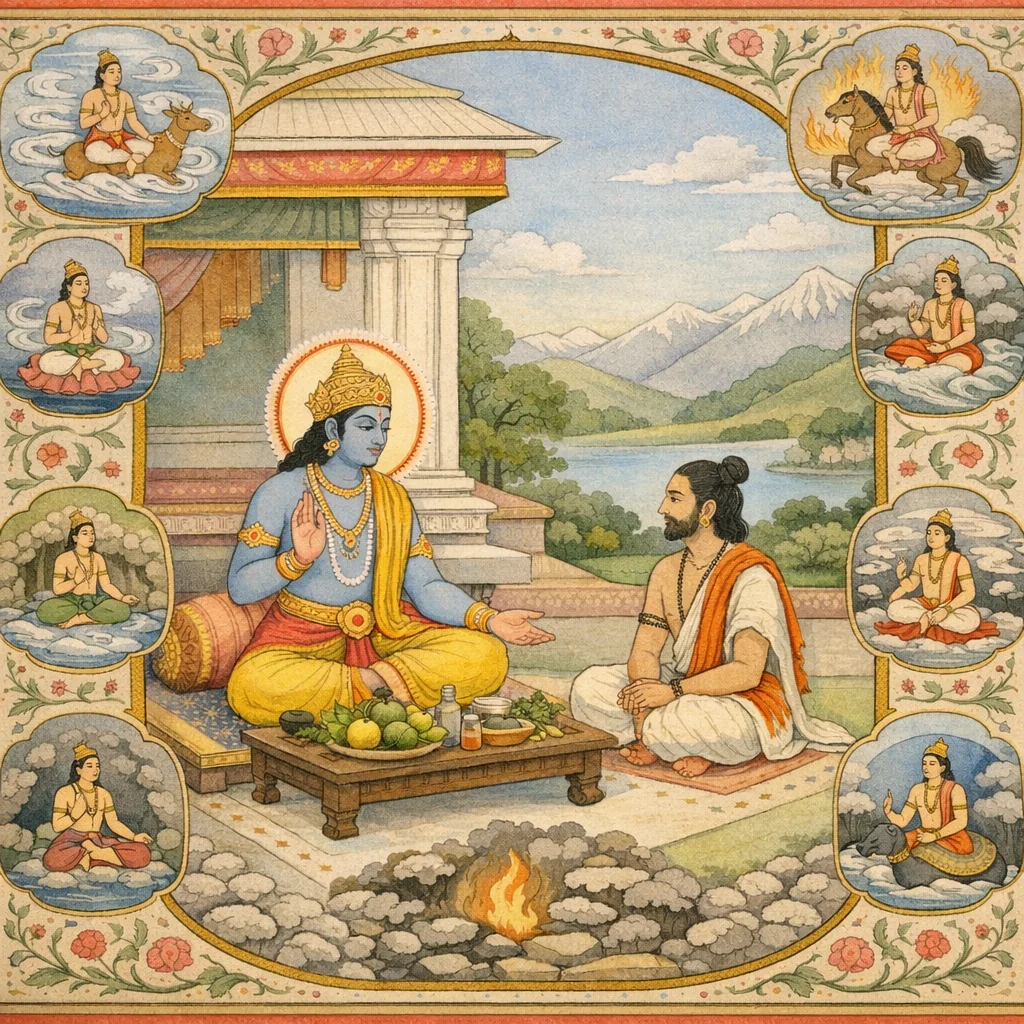
Adhyaya 167
Nidāna of Vātarakta and Āvaraṇa of Vāyu; Doṣa-wise Lakṣaṇas and Triphalā-Yoga Remedies
Continuing the Brahma-khaṇḍa’s medical and ethical teaching, Dhanvantari instructs Suśruta on the nidāna of vātarakta: incompatible and irregular diet, emotional agitation, and disturbed sleep weaken agni and vitiate rakta, driving vāta along abnormal pathways. The disease is traced from early stiffness and spreading pain to deeper dhātu involvement, joint localization, discoloration, suppuration, and possible lameness. A doṣa-wise differential (vāta, rakta, pitta, kapha) and prognosis rules follow: single-doṣa is easier; tridoṣa is to be avoided; raktapitta is most dreadful. The chapter then sets out the five vāyus (prāṇa, vyāna, samāna, udāna, apāna), their causes of derangement and resulting disorders, and the doctrine of āvaraṇa—mutual obstruction among vāyus, doṣas, and dhātus—with its signs and complications if neglected. Concluding, Dhanvantari turns to treatment, recommending Triphalā-based preparations with supportive herbs and flexible dosage forms, preparing for further therapeutic detail.
Shlokas
Verse 1
नाम षटूषष्ट्यधिकशततमो ऽध्यायः धन्वन्तरीरुवाच / वातरक्तनिदानं ते वक्ष्ये सुश्रुत तच्छृणु / विरुद्धाध्यशनक्रोधदिवास्वप्नप्रजागरैः
This is Chapter One-Hundred and Sixty-Seven. Dhanvantari said: “O Suśruta, I shall declare to you the causes of vātarakta (the disorder of vāta and blood); listen. It arises from incompatible foods, overeating or eating at improper times, anger, sleeping by day, and wakefulness at night.”
Verse 2
प्रायशः सुकुमाराणां मिथ्याहारविहारिणाम् / स्थूलानां सुखिनां चापि कुप्यते वातशोणितम्
For the most part, vātarakta becomes aggravated in delicate persons who follow improper diet and habits—and also in those who are obese and pleasure-seeking, living in comfort.
Verse 3
अग्निघातादशुद्धेश्च नृणामसृजि दूषिते / वातलैः शीतलैर्वायुर्वृद्धः क्रुद्धो विमार्गगः
When the digestive fire (agni) is impaired and impurity arises, a person’s blood becomes tainted; then vāyu—stirred by vāta‑increasing and cold influences—swells, grows wrathful, and moves along abnormal pathways.
Verse 4
तादृशैवासृजा रुद्धः प्राक्तदैव प्रदूषयेत् / तथा वातो गुदे पीडां बलासं वातशोणितम्
When the bodily channels are blocked by such vitiated blood, the former latent condition is further defiled. Likewise, deranged vāta brings pain in the anal/rectal region and disturbs kapha (balāsa) and the vāta–blood complex.
Verse 5
संस्तभ्य जनयेत्पूर्वं पश्चात्सर्वत्र धावति / विशेषाद्वमनाद्यैश्च प्रलम्बस्तस्य लक्षणम्
First it causes stiffness and obstruction; afterward it runs and spreads throughout the body. Notably, vomiting and related symptoms are the characteristic signs of the condition called pralamba.
Verse 6
भविष्यतः कुष्ठसमं तथा साम्बुदसंज्ञकम् / जानुजङ्घोरुकट्यंसहस्तपादाङ्गसन्धिषु
In its later course it becomes comparable to kuṣṭha (a leprosy-like skin disorder) and is known as sāmbuda. It appears especially in the joints and limbs—knees, shanks, thighs, hips/waist, shoulders, hands, feet, and other articulations.
Verse 7
कण्डूस्फुरणनिस्तोदभेदगौरवसुप्तताः / भूत्वा भूत्वा प्रशाम्यन्ति मुहुराविर्भवन्ति च
Itching, twitching, pricking pain, splitting sensations, heaviness, and numbness arise again and again; they subside for a while, and then repeatedly manifest once more.
Verse 8
पादयोर्मूलमास्थाय कदाचिद्धस्तयोरपि / आखोरिव विलं क्रुद्धः कृत्स्नं देहं बिधावति
Sometimes it seizes the very roots of the feet, and at other times even the hands; like an angry rat rushing into its hole, it races through the entire body.
Verse 9
त्वङ्मांसाश्रयमत्तानं तत्पूर्वं जायते ततः / कालान्तरेण गम्भीरं सर्वधातूनभिद्रवेत्
First it arises as a wasting affliction lodged in the skin and flesh; then, as time passes, it becomes deep-seated and assails all the bodily dhātus (tissues).
Verse 10
कट्यादिसंयतस्थाने त्वक्ताम्रश्यावलोहिताः / श्वयथुर्ग्रथितः पाकः स वायुश्चास्थिमज्जसु
When vāta is constrained in places such as the waist and related regions, the skin turns coppery, dusky, and reddish. A hard, knotted swelling arises with suppuration, and that vāyu penetrates even into the bones and marrow.
Verse 11
छिन्दन्निव चरत्यन्तश्चकीकुर्वंश्च वेगवान् / करोति खञ्जं पङ्गुं वा शरीरं सर्वतश्चरन्
Moving within as though cutting the body and making cracking sounds with great force, vāyu, roaming everywhere, can render the body lame—limping or even crippled.
Verse 12
वाताधिके ऽधिकं तत्र शूलस्फुरणभञ्जनम् / शोथस्य रौक्ष्यं कृष्णत्वं श्यावतावृद्धिहानयः
When vāta is predominant, there is an excess of colic-like pain, twitching or pulsation, and a sense of breaking. The swelling becomes dry and turns dark—blackish or dusky—waxing and waning over time.
Verse 13
धमन्यङ्गुलिसन्धीनां संकोचोङ्गग्रहो तिरुक् / शीतद्वेषानुपशयौ स्तम्भवेपथुसुप्तयः
There is constriction of the veins and the joints of the fingers; the limbs grow stiff and seize as if gripping, with piercing pain. One recoils from cold yet finds relief through it, and there arise rigidity, tremors, and numbness.
Verse 14
रक्ते शोथो ऽतिरुक्तोदस्ताम्राश्चिमिचिमायते / स्निग्धरूक्षैः समं नैति कण्डुक्लेदसमन्वितः
When the blood (rakta) is afflicted, there is swelling and excessive pricking pain; it turns coppery red and throbs or tingles. It is not calmed equally by oily or dry measures, and it is attended by itching and moist oozing.
Verse 15
पित्ते विदाहः संमोहः स्वादो मूर्छा मदस्तृषा / स्पर्शासहत्वं रुग्रावः शोषः पाको भृशोष्मता
When pitta is aggravated, there is burning and bewilderment; a strange taste in the mouth, fainting, distress like intoxication, and thirst. Touch becomes intolerable; pain breaks forth with a burning cry, with wasting, suppuration/inflammation, and fierce heat.
Verse 16
कफे स्तैमित्यगुरुता सुप्तिस्निग्धत्वशीतता / कण्डूर्मन्दा च रुग्द्बन्द्वं सर्वलिङ्गञ्च संकरात्
When kapha predominates, there arise torpor and heaviness, stiffness, drowsiness, oiliness, and coldness. The itching is mild, and pains appear in mixed pairings—indeed, through the mingling of the doṣas, all signs may manifest together.
Verse 17
एकदोषञ्च संसाध्यं याप्यञ्चैव द्विदोषजम् / त्रिदोषजन्त्यजेदाशु रक्तपित्तं सुदारुणम्
A disorder arising from a single doṣa is curable; one born of two doṣas is manageable, yet lingering. But a tridoṣa condition should be relinquished quickly as hard to cure; and raktapitta, exceedingly dreadful, is to be regarded as the most severe.
Verse 18
रक्तमङ्गे निहन्त्याशु शाखासन्धिषु मारुतः / निवेश्यान्योन्यमावार्य वेदनाभिर्हरत्यसून्
When Vāta (the Wind) lodges in the joints of the limbs, it swiftly strikes the blood within the body; settling there and obstructing the channels in mutual opposition, it carries away the life-breaths through intense pain.
Verse 19
वायौ पञ्चात्मके प्राणे रौक्ष्याच्चापल्यलङ्घनैः / अत्याहाराभिघाताच्च वेगोदीरणचारणैः
When the fivefold vital wind (Prāṇa/Vāyu) is disturbed—by dryness, restlessness, excessive fasting or transgressing proper limits, overeating, injury, and by forcibly arousing or wrongly restraining the body’s natural urges—its motion becomes aggravated and turbulent.
Verse 20
कुपितश्चक्षुरादीनामुपघातं प्रकल्पयेत् / पीनसो दाहतृट्कासश्वासादिश्चैव जायते
When it is aggravated, it brings affliction to the eyes and the other sense-organs; and ailments such as nasal catarrh, burning sensation, excessive thirst, cough, breathlessness, and the like arise.
Verse 21
कण्ठरोधोमलभ्रंशच्छर्द्यरोचकपीनसान् / कुर्याच्च गलगण्डदींस्तञ्जत्रुमूर्ध्वसंश्रयः
Settling in the upper region (throat, neck, and head), it produces obstruction of the throat, loss of normal clarity or strength, vomiting, loss of appetite, and nasal catarrh; it also gives rise to swellings of the throat (goitre-like) and related disorders.
Verse 22
व्यानो ऽतिगमनस्नानक्रीडाविषयचोष्टितैः / विरुद्धरूक्षभीहर्षविषादाद्यैश्च दूषितः
Vyāna, an aspect of the vital wind, becomes vitiated by excessive walking, bathing, play, and indulgence in sense-objects; and also by incompatible foods, dryness, fear, excitement, depression, and similar causes.
Verse 23
पुंस्त्वोत्साहबलभ्रंशशोकचित्तप्लवज्वरान् / सर्वाकारादिनिस्तोदरोमहर्षं सुषुप्तताम्
From that derangement arise loss of virility, decline of zeal and strength, grief, wavering of the mind, fever, manifold stabbing pains, horripilation, and excessive drowsiness.
Verse 24
कुष्ठं विसर्पमन्यच्च कुर्यात् सर्वाङ्गसादनम् / समानो विषमाजीर्णशीतसङ्कीर्णभोजनैः
Likewise, Samāna—the vital wind that governs digestion—is disturbed by irregular, undigested, cold, and discordantly mixed foods; it then gives rise to kuṣṭha (leprosy), visarpa (spreading skin disease), other ailments, and a general wasting or heaviness of the whole body.
Verse 25
करोत्यकालशयनजागराद्यैश्च दूषितः / शूलगुल्मग्रहण्यादीन्यकृत्कामाश्रयान्गदान्
When vāta, the bodily air, is vitiated by untimely sleep, untimely wakefulness, and similar irregular habits, it brings forth ailments such as śūla (colic), gulma (abdominal masses), disorders of grahaṇī (the digestive tract), and diseases rooted in the liver and in the organ of desire (kāma).
Verse 26
अपानो रूक्षगुर्वन्नवेगाघातातिवाहनैः / यानपानसमुत्थानचङ्क्रमैश्चातिसेवितैः
Apāna-vāyu becomes disturbed by dry and heavy foods, by suppressing natural urges (vega), by excessive riding and travel, and by overindulgence in acts such as riding, drinking, repeated rising, and prolonged walking.
Verse 27
कुपितः कुरुते रोगान्कृत्स्नान् पक्वाशयाश्रयान् / मूत्रसुक्रप्रदोषार्शोगुदभ्रंशादिकान्बहून्
When thus aggravated, it produces many diseases wholly seated in the large intestine: disorders of urine and semen, hemorrhoids, prolapse of the rectum, and numerous related ailments.
Verse 28
सर्वाङ्गमाततं सामं तन्द्रास्तैमित्यगौरवैः / स्निग्धत्वाद्बोध कालस्य शैत्यशोथाग्निहानयः
When the whole body is pervaded evenly by a dull heaviness—marked by drowsiness, torpor, and languor—and, through excess unctuousness, wakefulness is delayed, then coldness, swelling, and a weakening of the digestive fire (agni) arise.
Verse 29
कण्डूरूक्षातिनाशेन तद्विधोपशमेन च / मुक्तिं विद्यान्निरामं तं तन्द्रादीनां विपर्ययात्
By the disappearance of itching and excessive dryness, and by the calming of similar disturbances, one should know there is release into a disease-free state—recognized by the reversal of drowsiness and related symptoms.
Verse 30
वायोरावरणं वातो बहुभेदं प्रचक्षते / पित्तलिङ्गावृते दाहस्तृष्णा शूलं भ्रमस्तमः
The obstruction (āvaraṇa) of Vāyu is taught as having many varieties. When Vāta is covered by the signs of Pitta, there arise burning sensation, thirst, pain, dizziness, and darkness of perception.
Verse 31
कटुकोष्णाम्ललवणैर्विदाहशीतकामता / शैत्यगौरवशूलाग्निकट्वाज्यपयसो ऽधिकम्
When the bodily channels are obstructed, pungent, hot, sour, and salty things cause burning, and a craving for cold arises. Coldness, heaviness, colicky pain, and disturbance of the digestive fire become prominent; and there is excessive desire for pungent taste, ghee, and milk.
Verse 32
लङ्घनायासरूक्षोष्णकामता च कफावृते / कफावृते ऽङ्गमर्दः स्याद्धृल्लासो गुरुतारुचिः
When the system is covered/obstructed by kapha, there arises a desire for lightening measures such as fasting, as well as for exertion, dryness, and warmth. In kapha-obstruction there occur body-aches, nausea, heaviness, and loss of appetite.
Verse 33
रक्तवृते सदाहार्तिस्तवङ्मांसाश्रयजा भृशम् / भवेत्सरागः श्वयथुर्जायन्ते मण्डलानि च
When the blood is obstructed, intense burning pain arises, rooted in the skin and flesh. Redness appears, swelling develops, and circular patches or eruptions also arise.
Verse 34
शोथो मांसेन कठिनो हृल्लासपिटिकास्तथा / हर्षः पिपीलिकानां च संचार इव जायते / चललग्रनो मृदुः शीतः शोथो गात्रेषु रोचकः
When swelling (śotha) involves the muscle tissue, it becomes hard; nausea and small eruptions also arise, and there is a sensation like ants moving about (tingling/crawling). The moving nodules are soft and cool, and swelling in the limbs is accompanied by a strange, noticeable sensation.
Verse 35
आढ्यवात इव ज्ञेयः स कृच्छ्रो मेदसावतः / स्पर्श आच्छादितेत्युष्णशीतलश्च त्वनावृते / मज्जावृते तु विषमं जृम्भणं परिवेष्टनम्
When swelling involves fat tissue (medas), it should be understood as resembling āḍhyavāta and is difficult to treat. If the skin is not obstructed, the touch alternates as hot and cold. But when the marrow (majjā) is involved, there is irregular yawning and a wrapping, constricting sensation.
Verse 36
शूलञ्च पड्यिमानश्च पाणिभ्यां लभते सुखम् / शुक्रावृते तु शोथे वै चातिवेगो न विद्यते
There is pain (śūla) and a heavy, pressing discomfort (paḍyimāna); relief is obtained by rubbing or pressing with the hands. But in swelling that involves śukra, the reproductive essence, there is indeed no excessively rapid aggravation.
Verse 37
भुक्ते कुक्षौ रुजा जीर्णे निकृत्तिर्भवति ध्रुवम् / मूत्राप्रवृत्तिराध्मानं बस्तेर्मूत्रावृते भवेत्
After eating, if there is pain in the belly with indigestion, a cutting, colicky distress certainly arises. And when the bladder is obstructed by retained urine, urination stops and abdominal distension occurs.
Verse 38
छिद्रावृते विबन्धो ऽथ स्वस्थानं परिकृन्त ति / पतत्याशु ज्वराक्रान्तो मूर्छां च लभते नरः
When the bodily channels and openings are obstructed, constipation and blockage arise; then the force cuts into its own proper seat. Quickly the man falls down, seized by fever, and he also lapses into fainting.
Verse 39
सकृत् पीडितमन्येन दुष्टं शुक्रं चिरात्सृजेत् / सर्वधात्वावृते वायौ श्रोणिवङ्क्षणपृष्ठरुक्
If pressed even once by another obstructing factor, a man may discharge vitiated semen only after a long time. When vāyu is obstructed by all the bodily tissues, pain arises in the hips, groins, and back.
Verse 40
विलोमे मारुते चैव हृदयं परिपीड्यते / भ्रमो मूर्छा रुजा दाहः पित्तेन प्राण आवृते
When the wind (vāyu) moves in a contrary direction, the heart is oppressed. When prāṇa is obstructed by pitta, there arise giddiness, fainting, pain, and burning heat.
Verse 41
रुजा तन्द्रा स्वरभ्रंशो दाहो व्याने तु सर्वशः / क्रमों गचेष्टाभङ्गश्च सन्तापः सहवेदनः
When vyāna is afflicted on all sides, there occur pain, drowsiness, loss or distortion of voice, and burning. There is also disturbance of gait and a breaking-down of movements, along with distress accompanied by suffering.
Verse 42
समान ऊष्मोपहतिः सस्वेदोपरतिः सुतृट् / दाहश्च स्यादपाने तु मले हारिद्रवर्णता
When samāna is afflicted, the digestive heat is impaired, sweating ceases, and intense thirst arises. When apāna is disturbed, there is burning, and the excreta take on a turmeric-yellow coloration.
Verse 43
रजोवृद्धिस्तापनञ्च तथा चानाहमेहनम् / श्लेष्मणा प्रावृते प्राणे नादः स्नोतो ऽवरोधनम्
When rajas increases, burning heat arises, with obstruction in the belly (distension/constipation) and disorder of urine. When prāṇa is covered by kapha (śleṣman), a humming or hoarse sound appears, and the bodily channels (srotas) become obstructed.
Verse 44
ष्ठीवनञ्चैव सस्वेदश्वासनिः श्वाससंग्रहः / उदाने गुरुगात्रत्वमरुचिर्वाक्स्वरग्रहः
There is spitting and excess expectoration, sweating, labored breathing, and retention or obstruction of the breath. When udāna is disturbed, the limbs grow heavy, taste and appetite are lost, and speech and voice become constricted and impaired.
Verse 45
बलवर्णप्रणाशश्चा पाने पर्वास्थिसंग्रहः / गुरुताङ्गेषु सर्वेषु स्थूलत्वञ्चागतं भृशम्
Strength and complexion are lost. When apāna is disturbed, there is stiffness or constriction in joints and bones; heaviness arises in all the limbs, and excessive corpulence—dense, solid heaviness—manifests strongly.
Verse 46
समाने ऽतिक्रियाज्ञत्वमस्वेदो मन्दवह्निता / अपाने सकलं मूत्रं शकृतः स्यात्प्रवर्तनम्?
When samāna is obstructed, there arises excessive activity with confused judgment, lack of sweating, and a weakening of the digestive fire (agni). When apāna is obstructed, the proper discharge of urine and feces becomes difficult.
Verse 47
प्राणादयस्तथान्यो ऽन्यं समाक्रान्ता यथाक्रमम्
Prāṇa and the other vital winds, in their proper sequence, mutually overtake and overpower one another.
Verse 48
सर्वे ऽपि विंशतिविधं विद्यादावरणञ्च यत् / हृल्लासोच्छ्वाससंरोधः प्रतिश्यायः शिरोग्रहः
One should know that āvaraṇa, obstruction, is of twenty kinds in all. Its signs are nausea, restraint of the breath, coryza (cold/rhinitis), and heaviness or constriction of the head.
Verse 49
हृद्रोगो मुखशोषश्च प्राणेनापान आवृते / उदानेनावृते प्राणे भवेद्धै बलसंक्षयः
When apāna is obstructed by prāṇa, heart-disease and dryness of the mouth arise. And when prāṇa is obstructed by udāna, there occurs depletion of bodily strength.
Verse 50
विचारणेन विभजेत्सर्वमावरणं भिषक् / स्थानान्यपेक्ष्य वातानां वृर्धिहानिं च कर्मणाम्
By careful examination, the physician should distinguish every case of āvaraṇa, considering the seats of the vāyus and the increase or decline of their functions.
Verse 51
प्राणादीनाञ्च पञ्चानां पित्तमावरणं मिथः / पित्तादीनामावसतिर्मिश्राणां मिश्रितैश्च तैः
Among the five vital winds beginning with prāṇa, pitta can mutually produce āvaraṇa. Likewise, in combined disorders, pitta and the other doṣas reside together, mixed with one another.
Verse 52
मिश्रैः पित्तादिभिस्तद्वन्मिश्राण्यपित्वनेकधा / तांल्लक्षयेदवहितो यथास्वं लक्षणोदयात्
Likewise, when conditions are mixed with pitta and the other doṣas, they become mixed in many different ways. A careful physician should recognize each of them according to the particular signs as they arise.
Verse 53
शनैः शनैश्चोपशयान्दृढानपि मुहुर्मुहुः / विशेषाज्जीवितं प्राण उदानो बलमुच्यते / स्यात्तयोः पीडनाद्धनिरायुषञ्च बलस्य च
Even disorders firmly established may subside again and again, little by little. In particular, prāṇa is spoken of as life itself, and udāna is called strength. When these two are afflicted, both lifespan and strength diminish.
Verse 54
आवृता वायवो ऽज्ञाता ज्ञाता वा स्थानविच्युताः / प्रयत्नेनापि दुः साध्या भवेयुर्वानुपद्रवाः
When the vital airs are obstructed—whether the obstruction is not recognized, or even if recognized but the airs have been displaced from their proper seats—such complications become difficult to cure, even with great effort.
Verse 55
विद्रधिप्लीहहृद्रोगगुल्माग्निसदनादयः / भवन्त्युपद्रवास्तेषामावृतानामुपेक्षया
Abscesses, disorders of the spleen, heart-diseases, abdominal tumours, decline of digestive fire, and the like arise as complications for those whose condition is obstructed, when it is neglected.
Verse 56
निदानं सुश्रुत ! मया आत्रेयोक्तं समीरितम् / सर्वरोगविवेकाय नराद्यायुः प्रवृद्धये
O Suśruta! I have explained the nidāna—etiology and diagnostic discernment—as taught by Ātreya, for clear understanding of all diseases and for the increase of lifespan for humans and other beings.
Verse 57
एवं विज्ञाय रोगादींश्चिकित्सामथ वै चरेत् / त्रिफला सर्वरोगघ्नी मध्वाज्यगुडसंयुता
Having thus understood diseases and related factors, one should then undertake treatment. Triphalā, combined with honey, ghee, and jaggery, is said to destroy all diseases.
Verse 58
सव्योषा त्रिफला वापि सर्वरोगप्रमर्दिनी / शतावरीगुडूच्यग्निविडङ्गेन युताथवा
Triphala, combined with sa‑vyoṣa (the pungent triad), destroys all diseases; or Triphala may be taken mixed with śatāvarī, guḍūcī, agni (citraka), and viḍaṅga.
Verse 59
शतावरी गुडूच्यग्निः शुण्ठीमूषलिका बला / पुनर्नवा च बृहती निर्गुण्डी निम्बपत्रकम्
Śatāvarī, guḍūcī, agni (citraka), dry ginger, mūṣalikā, balā; and also punarnavā, bṛhatī, nirguṇḍī, and neem leaves—these are the herbs prescribed in this regimen.
Verse 60
भृङ्गराजश्चामलकं वासकस्तद्रसेन वा / भाविता त्रिफला सप्तवारमेखमथापिवा
Bhṛṅgarāja and āmalaka, and vāsaka; or Triphala may be impregnated (triturated) with their juice. Having been so processed seven times—or even once—it is to be used as a remedy.
Verse 61
पूर्वोक्तश्च यथालाभयुक्तैश्चूर्णञ्च मोदकः / वटिका घृततैलं वा कषायो शोषरोगनुत् / पलं पलार्धकं वापि कर्षं कर्षार्धमेव वा
Using the ingredients already stated, and according to what is available, it may be prepared as a powder or as sweet modaka boluses; it may also be made into pills (vaṭikā), or administered with ghee or oil, or as a decoction (kaṣāya). This remedy alleviates wasting disease (śoṣa). The dose may be one pala, half a pala, one karṣa, or half a karṣa.
Frequently Asked Questions
The chapter highlights recurrent, migrating symptoms centered in joints and extremities—knees, shanks, thighs, hips, shoulders, hands, and feet—with itching, pricking/splitting pain, heaviness, numbness, waxing-and-waning episodes, and at times discoloration and suppuration as the disease deepens.
Vāta-predominant states show severe colicky pain, dryness, dark discoloration, stiffness, tremors, and numbness; rakta involvement shows coppery-red swelling with pricking pain, itching and oozing; pitta aggravation emphasizes burning, thirst, fainting/confusion, heat and suppuration; kapha predominance emphasizes heaviness, coldness, drowsiness, oiliness, and milder itching—while mixed doṣas can blend signs.
The physician is instructed to examine the specific seats and functions of each vāyu and discern which entity is obstructing which, using the pattern of increased/declined functions and characteristic symptom clusters; misrecognized or displaced vāyus lead to difficult-to-cure complications.
Triphalā is recommended with honey, ghee, and jaggery; with sa-vyoṣa (pungent trio); and also in combinations including śatāvarī, guḍūcī, citraka (agni), viḍaṅga, dry ginger, mūṣalikā, balā, punarnavā, bṛhatī, nirguṇḍī, neem leaves, and processed with juices of bhṛṅgarāja, āmalaka, and vāsaka—prepared as powder, bolus, pills, with ghee/oil, or decoction, with dose ranges stated.