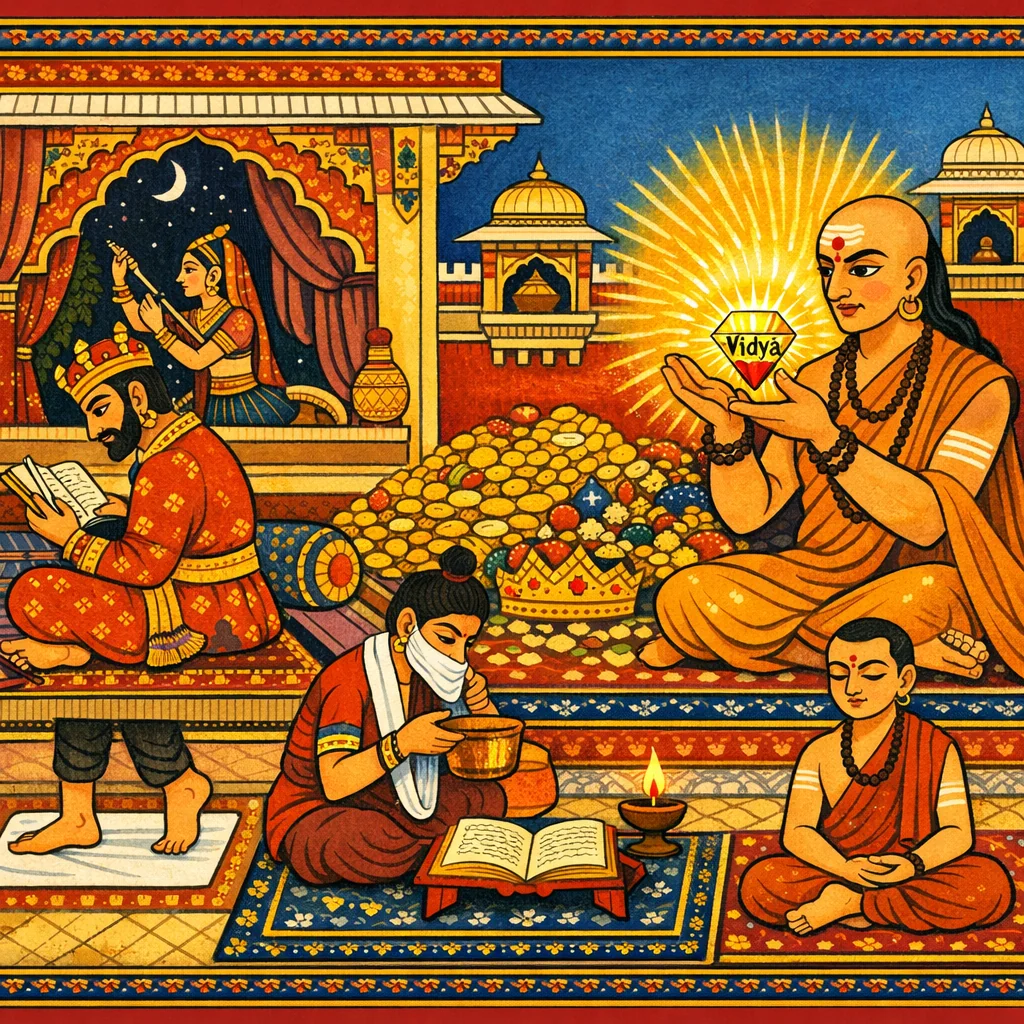
Chapter 10: On Learning, Discernment, and Social Conduct
Adhyaya 10
Judging Character and Making Sound Decisions
Adhyaya 10 presents a clustered set of didactic aphorisms typical of Sanskrit subhāṣita-style Nīti literature, emphasizing how learning (vidyā), discernment (prajñā/buddhi), and inner character are framed as primary measures of human worth and social efficacy. The verses juxtapose material wealth with “jewel-like” knowledge, and describe norms of careful conduct—purifying action through sight, clothing, scripture, and mind—reflecting a historical ethic of self-regulation. Several stanzas articulate trade-offs between study and pleasure, and offer archetypal social observations about speech, desire, and intoxication as forces that loosen restraint. The chapter also includes fate/contingency (vidhi) as a social leveler, a typology of antagonisms (e.g., beggar vs. miser, husband vs. adulterer), and a pessimistic claim about reforming the “wicked,” presented through stark metaphors. Devotional and cosmological notes appear alongside pragmatic counsel, while dietary/medical claims on food and vitality reflect premodern Indian ideas of nourishment. Overall, the chapter functions as an archival window into classical ethical psychology, social ranking, and strategic prudence.
Key Concepts
Key Principles
Strategic Themes
Shlokas in Chapter 10
Verse 1
धनहीनो न हीनश्च धनिकः स सुनिश्चयः । विद्यारत्नेन हीनो यः स हीनः सर्ववस्तुषु ॥
Lack of wealth does not make a person inferior, nor does wealth alone make one certainly superior. He who lacks the “jewel of learning” is deficient in all things.
Verse 2
दृष्टिपूतं न्यसेत्पादं वस्त्रपूतं पिबेज्जलम् । शास्त्रपूतं वदेद्वाक्यः मनःपूतं समाचरेत् ॥
Place your step only after the eye has examined it; drink water only after it has been strained through cloth. Speak only after testing your words by śāstra; act only after the mind has purified the intent.
Verse 3
सुखार्थी चेत्त्यजेद्विद्यां विद्यार्थी चेत्त्यजेत्सुखम् । सुखार्थिनः कुतो विद्या सुखं विद्यार्थिनः कुतः ॥
If you seek comfort, you will abandon learning; if you seek learning, you will abandon comfort. How can the comfort-seeker gain knowledge? How can the knowledge-seeker gain comfort?
Verse 4
कवयः किं न पश्यन्ति किं न भक्षन्ति वायसाः । मद्यपाः किं न जल्पन्ति किं न कुर्वन्ति योषितः ॥
What do poets not see? What do crows not eat? What do drunkards not babble? What do women not do?
Verse 5
रङ्कं करोति राजानं राजानं रङ्कमेव च । धनिनं निर्धनं चैव निर्धनं धनिनं विधिः ॥
Fate can make a pauper a king and a king a pauper; it can make the wealthy destitute and the destitute wealthy.
Verse 6
लुब्धानां याचकः शत्रुर्मूर्खानां बोधको रिपुः । जारस्त्रीणां पतिः शत्रुश्चौराणां चन्द्रमा रिपुः ॥
The verse describes a traditional set of antagonisms: for the greedy, a petitioner is treated as an enemy; for the foolish, an instructor is regarded as a foe; for women engaged in adultery, the husband is characterized as an adversary; and for thieves, the moon is portrayed as an enemy.
Verse 7
येषां न विद्या न तपो न दानं ज्ञानं न शीलां न गुणो न धर्मः । ते मर्त्यलोके भुवि भारभूता मनुष्यरूपेण मृगाश्चरन्ति ॥
The verse describes that those in whom there is neither learning (vidyā), nor disciplined practice (tapas), nor generosity (dāna), nor knowledge (jñāna), nor good conduct (śīla), nor virtue/merit (guṇa), nor dharma are portrayed as burdens upon the earth in the human world, moving about like animals while bearing human form.
Verse 8
अन्तःसारविहीनानामुपदेशो न जायते । मलयाचलसंसर्गान्न वेणुश्चन्दनायते ॥
The text describes that instruction does not take root in those lacking inner substance. By analogy, it notes that even through contact with the Malaya mountain (associated with sandalwood), a bamboo does not become sandalwood.
Verse 9
यस्य नास्ति स्वयं प्रज्ञा शास्त्रं तस्य करोति किम् । लोचनाभ्यां विहीनस्य दर्पणः किं करिष्यति ॥
The verse depicts a traditional view that for a person who lacks innate discernment (prajñā), learned treatises (śāstra) accomplish little; it illustrates this through the analogy that a mirror is of no use to one who is without eyes.
Verse 10
दुर्जनं सज्जनं कर्तुमुपायो नहि भूतले । अपानं शातधा धौतं न श्रेष्ठमिन्द्रियं भवेत् ॥
The verse describes a traditional view that, in the world, there is no effective means to transform a wicked person into a virtuous one; it illustrates this through a metaphor that even if a base vessel is washed a hundred times, it does not become a superior object.
Verse 11
आप्तद्वेषाद्भवेन्मृत्युः परद्वेषाद्धनक्षयः । राजद्वेषाद्भवेन्नाशो ब्रह्मद्वेषात्कुलक्षयः ॥
Hostility toward trusted allies brings death; hostility toward others brings loss of wealth; hostility toward the king brings ruin; hostility toward Brahmins brings the decline of one’s lineage.
Verse 12
वरं वनं व्याघ्रगजेन्द्रसेवितं द्रुमालयं पत्रफलाम्बुसेवनम् । तृणेषु शय्या शतजीर्णवल्कलं न बन्धुमध्ये धनहीनजीवनम् ॥
Better to dwell in a forest roamed by tigers and lordly elephants, among trees, living on leaves, fruits, and water—grass for a bed and long-worn bark for clothing—than to live among kinsmen in poverty.
Verse 13
विप्रो वृक्षस्तस्य मूलं च सन्ध्या वेदः शाखा धर्मकर्माणि पत्रम् । तस्मान्मूलं यत्नतो रक्षणीयं छिन्ने मूले नैव शाखा न पत्रम् ॥
A Brahmin is like a tree: the sandhyā rites are its root, the Veda its branches, and deeds of dharma its leaves. Therefore guard the root with care; when the root is cut, there are neither branches nor leaves.
Verse 14
माता च कमला देवी पिता देवो जनार्दनः । बान्धवा विष्णुभक्ताश्च स्वदेशो भुवनत्रयम् ॥
My mother is the goddess Kamalā, my father is Janārdana; my kinsmen are devotees of Viṣṇu, and my homeland is the three worlds.
Verse 15
एकवृक्षसमारूढा नानावर्णा विहङ्गमाः । प्रभाते दिक्षु दशसु यान्ति का तत्र वेदना ॥
Birds of many colors gather on a single tree; at dawn they fly off in the ten directions—what is there to lament in that?
Verse 16
बुद्धिर्यस्य बलं तस्य निर्बुद्धेश्च कुतो बलम् । वने सिंहो यदोन्मत्तः मशकेन निपातितः ॥
Intellect is the strength of the intelligent; for the witless, whence could strength arise? In the forest, even a frenzied lion can be brought down by a mosquito.
Verse 17
का चिन्ता मम जीवने यदि हरिर्विश्वम्भरो गीयते नो चेदर्भकजीवनाय जननीस्तन्यं कथं निर्ममे । इत्यालोच्य मुहुर्मुहुर्यदुपते लक्ष्मीपते केवलं त्वत्पादाम्बुजसेवनेन सततं कालो मया नीयते ॥
What need have I to worry for my life, if Hari—the sustainer of the world—is sung? Were that sustaining power absent, how would a mother’s milk arise to keep an infant alive? Reflecting thus again and again, O Yadupati, O Lakṣmīpati, I spend my time always in service at your lotus-feet.
Verse 18
गीर्वाणवाणीषु विशिष्टबुद्धि- स्तथापि भाषान्तरलोलुपोऽहम् । यथा सुधायाममरेषु सत्यां स्वर्गाङ्गनानामधरासवे रुचिः ॥
Though my intellect is distinguished in the language of the gods, I still yearn for other tongues—just as heavenly maidens, though ambrosia exists among the immortals, delight in the nectar of lips.
Verse 19
अन्नाद्दशगुणं पिष्टं पिष्टाद्दशगुणं पयः । पयसोऽष्टगुणं मांसां मांसाद्दशगुणं घृतम् ॥
Compared with grain, flour is tenfold; compared with flour, milk is tenfold; compared with milk, meat is eightfold; compared with meat, ghee is tenfold.
Verse 20
शोकेन रोगा वर्धन्ते पयसा वर्धते तनुः । घृतेन वर्धते वीर्यं मांसान्मांसं प्रवर्धते ॥
Grief makes diseases grow; milk makes the body grow. Ghee increases vigor; meat increases flesh.
Frequently Asked Questions
The text foregrounds a historical Nīti principle that inner capacity—especially learning (vidyā) and discernment (prajñā/buddhi)—is treated as a decisive marker of human value and practical strength, often surpassing wealth. It frames disciplined conduct as a form of “purification” of action and speech, and presents character and judgment as prerequisites for benefiting from instruction or scripture.
The chapter uses schematic pairings to describe antagonistic relationships: the beggar is described as an adversary to the miser; the instructor to the fool; the husband to the adulterer; and the moon to thieves. It also maps social harm through forms of “hatred” (toward intimates, outsiders, rulers, and Brahmins), treating these as categories with distinct consequences in the text’s moral-social vocabulary.
As a subhāṣita-style compilation, the chapter parallels broader South Asian strategic-ethical literature by linking governance-relevant prudence to personal discipline and discernment. Its typologies of enmity and emphasis on intelligence as “strength” resonate with pragmatic strands seen in the Arthashastra’s attention to human motives and risk, while its moralized social observations and illustrative metaphors align with the Panchatantra’s didactic method of teaching political and interpersonal realism through compact, memorable statements.