Adhyaya 22
Āditya-vyūha-kīrtana (Praise/Account of the Solar Array and Celestial Motions)
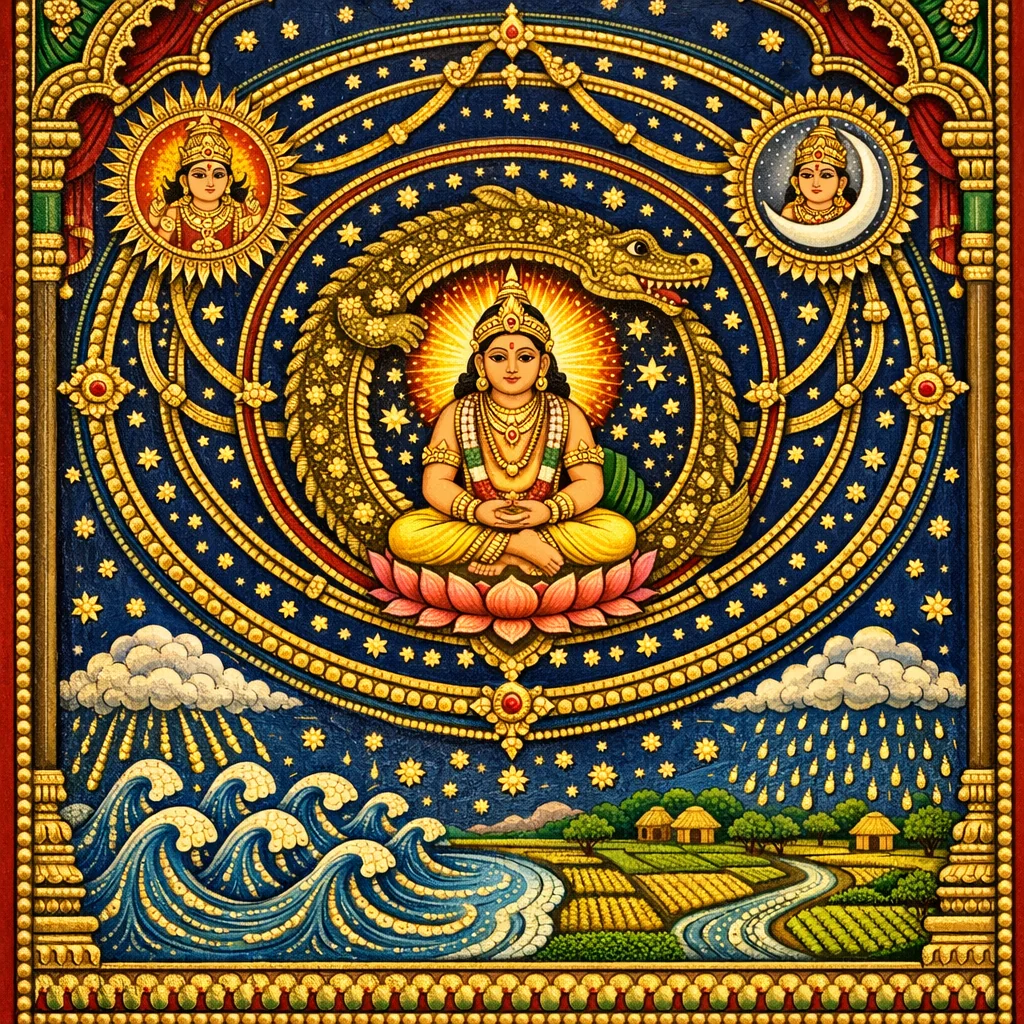
Sūta (Lomaharṣaṇa/Romaharṣaṇa) begins by promising an ordered account of cosmic sequences tied to Svāyambhuva creation and the unfolding of time. The sages ask about the “cāra” (courses) of the Sun, Moon, and planets—how they move without collision and whether they are self-driven or impelled by an external power. Sūta explains that celestial regulation rests on Dhruva (the Pole Star), fixed in the Śiśumāra formation and serving as a pivot (meḍhī) around which the luminaries revolve. Stars, nakṣatras, Sun, Moon, and grahas follow Dhruva’s motion “like a wheel,” bound by vātānīka-like wind-bands, and from this Dhruva-centered order arise rising and setting, omens, solstices, equinoxes, seasons, day and night, and auspicious or inauspicious results. The teaching then links solar action to the waters: the Sun draws up water, and Soma (the Moon) conveys or releases moisture that circulates through nāḍī-like channels to sustain rain and food, joining astronomy with a cosmic ecology.
Shlokas
Verse 1
इति श्रीब्रह्माण्डे महापुराणे वायुप्रोक्ते पूर्वभागे द्वितीये ऽनुषङ्गपादे आदित्यव्यूहकीर्त्तनं नामैकविंशतितमो ऽध्यायः सूत उवाच स्वायंभूवनिसर्गे तु व्याख्यातान्यन्तराणि च / भविष्याणि च सर्वाणि तेषां वक्ष्याम्यनुक्रमम्
Thus, in the Śrī Brahmāṇḍa Mahāpurāṇa, in the former section spoken by Vāyu, in the second Anuṣaṅgapāda, is the twenty-first chapter called “The Praise of the Āditya Formations.” Sūta said: In the creation of Svāyaṃbhuva, the Manvantaras that have been explained, and all those yet to come—I shall declare their sequence in due order.
Verse 2
एतच्छ्रुतवा तु मुनयः पप्रच्छू रोमहर्षणम् / सूर्याचन्द्रमसोश्चारं ग्रहाणां चैव सर्वशः
Hearing this, the sages questioned Romaharṣaṇa: how do the Sun and Moon proceed in their courses, and how do all the planets move in every respect?
Verse 3
ऋषय ऋचुः / भ्रमन्ति कथमेतानि ज्योतीषि दिवमण्डलम् / अव्यूहेन च सर्वाणि तथैवासंकरेण वा
The seers said: how do these luminaries revolve within the circle of heaven? Do they all move without any ordered formation, or do they proceed without intermingling and confusion?
Verse 4
कश्चिद्भामयते तानि भ्रमन्ते यदि वा स्वयम् / एतद्वेदितुमिच्छामस्तन्नो निगद सत्तम
Does someone set these in motion, or do they revolve of themselves? We wish to know this; O best of men, declare the truth to us.
Verse 5
सूत उवाच भूतसंमोहनं ह्येतद्वदतो मे निबोधत / प्रत्यक्षमपि दृश्यं च संमोहयति यत्प्रजाः
Sūta said: This indeed is a bewitchment of beings; heed my words. Even what is plainly visible can delude the peoples.
Verse 6
यो ऽयं चतुर्द्दिशं पुच्छे शैशुमारे व्यवस्थितः / उत्तानपादपुत्रो ऽसौ मेढीभूतो ध्रुवो दिवि
He who is set upon the tail of the Śaiśumāra, facing the four quarters, is Dhruva, son of Uttānapāda; in heaven he stands fixed like a pivot.
Verse 7
स वै भ्रामयते नित्यं चन्द्रादित्यौ ग्रहैः सह / भ्रमन्तमनुगच्छन्ति नक्षत्राणि च चक्रवत्
He it is who ever causes the Moon and the Sun, together with the planets, to revolve; and the constellations follow him as he turns, like a wheel.
Verse 8
ध्रुवस्य मनसा चासौ सर्वते ज्योतिषां गणः / सूर्याचन्द्रमसौ तारा नक्षत्राणि ग्रहैः सह
By the power of Dhruva’s will, the entire host of heavenly lights—Sun and Moon, stars, constellations, and the planets—moves in its circling course.
Verse 9
वातानीकमयैर्बन्धैर्ध्रुवे बद्धानि तानि वै / तेषां योगश्च भेदश्च कालश्चारस्तथैव च
All these are bound to Dhruva by bonds formed of the hosts of wind. Their conjunction and separation, time, and their course of motion are likewise ordained.
Verse 10
अस्तोदयौ तथोत्पाता अयने दक्षणोत्तरे / विषुवद्ग्रहवर्णाश्च द्रुवात्सर्वं प्रवर्त्तते
Setting and rising, and also portents; the southern and northern courses; the equinox and the hues of the planets—all of this proceeds from Dhruva.
Verse 11
वर्षा घर्मो हिमं रात्रिः संध्या चैव दिनं तथा / शुभाशुभं प्रजानां च ध्रुवात्सर्वं प्रवर्त्तते
Rain, heat, cold of snow, night, twilight, and day; and the auspicious and inauspicious for beings—all of it proceeds from Dhruva.
Verse 12
ध्रुवेणाधिष्टितश्चैव सूर्यो ऽपो गृह्य वर्षति / तदेष दीप्त किरणः स कालग्निर्दिवाकरः
Presided over by Dhruva, the Sun gathers up the waters and pours them down as rain. That radiant-beamed Divākara is like the fire of Time, kālāgni.
Verse 13
परिवर्त्तक्रमाद्विप्रा भाभिरालोकयन् दिशः / सूर्यः किरमजालेन वायुयुक्तेन सर्वशः
O vipras, in the order of its revolution the Sun illumines the quarters with its splendors, everywhere, by a net of rays conjoined with the wind.
Verse 14
जगतो जलमादत्ते कृत्स्नस्य द्विजसत्तमाः / आदित्यपीतं सकलं सोमः संक्रमते जलम्
O best of the twice-born, Aditya (the Sun) draws up the water of the entire world; and all that water drunk by the Sun, Soma (the Moon) transforms again into water.
Verse 15
नाडीभिर्वायुयुक्ताभिर्लोकधारा प्रवर्त्तते / यत्सोमात्स्रवते ह्यंबु तदन्नेष्वेव तिष्ठति
Through the nāḍīs joined with the wind, the world’s current proceeds; the water that drips from Soma abides indeed within food.
Verse 16
मेघा वायुविघातेन विसृजन्ति जलं भूवि / एवमुत्क्षिप्यते चैव पतते चासकृज्जलम्
Clouds, checked by the force of the winds, release water upon the earth; thus water is lifted up and falls again and again.
Verse 17
न नाश उदकस्यास्ति तदेव परिवर्त्तते / संधारणार्थं लोकानां मायैषा विश्वनिर्मिता
There is no destruction of water; it only changes its form. For the sustaining of the worlds, this is the māyā fashioned by the universe.
Verse 18
अन्या मायया व्याप्तं त्रैलोक्यं सचराचरम् / विश्वेशो लोककृद्देवः सहस्राक्षः प्रजापतिः
By this māyā the three worlds, with all that moves and does not move, are pervaded; he is Viśveśa, the god who fashions the worlds, the thousand-eyed Prajāpati (Indra).
Verse 19
धाता कृत्स्नस्य लोकस्य प्रभविष्णुर्दिवाकरः / सार्वलोकिकमंभो यत्तत्सोमान्नभसश्व्युतम्
Divākara, the Sun, is the mighty ordainer of the entire world; and the water common to all realms is said to descend from Soma, fallen from the sky.
Verse 20
सोमाधारं जगत्सर्वमेतत्तथ्यं प्रकीर्तितम् / सूर्यादुष्णं निस्रवते सोमाच्छीतं प्रवर्त्तते
It is proclaimed as truth that the whole universe rests upon Soma; from the Sun flows heat, and from Soma proceeds coolness.
Verse 21
शीतोष्णवीर्यौं द्वावेतौ युक्त्या धारयतो जगत् / सोमाधारा नदी गङ्गा पवित्रा विमलोदका
Two powers—coolness and heat—uphold the world in fitting balance; the river Gaṅgā, founded upon Soma, is holy, with waters pure and clear.
Verse 22
भद्रसोमपुरोगाश्च महानद्यो द्विजोत्तमाः / सर्वभूतशरीरेषु ह्यापो ह्यनुसृताश्च याः
O best of the twice-born, the great rivers—Bhadrasoma and the rest—go foremost; and the waters have permeated and spread through the bodies of all beings.
Verse 23
तेषु संदह्यमानेषु जङ्गमस्थावरेषु च / धूमभूतास्तु ता ह्यापो निष्कामन्तीह सर्वशः
When moving and unmoving beings are burned, those waters become smoke and, in every way, depart from here.
Verse 24
तेन चाभ्राणि जायन्ते स्थानमभ्रमयं स्मृतम् / तेजोर्ऽकः सर्वभूतेभ्य आदत्ते रश्मिभिर्जलम्
From that, clouds are born; that region is remembered as “abhramaya.” The radiant Sun, by his rays, draws up the waters from all beings.
Verse 25
समुद्राद्वायुसंयोगाद्वहन्त्यापो गभस्तयः / संजीवनं च सस्यानामंभस्तदमृतोपमम्
From the ocean, through union with the wind, the Sun’s rays bear the waters aloft. That water is the life of crops, like unto amṛta.
Verse 26
ततस्त्वृतुवशात्काले परिवत्य दिवाकरः / यच्छत्यापो हि मेघेभ्यः घुक्लाशुक्लैर्गभस्तिभिः
Then, as the seasons turn and the time arrives, the Sun transforms and, with bright and dark rays, bestows the waters upon the clouds.
Verse 27
अभ्रस्थाः प्रपतन्त्यापो वायुना समुदीरिताः / सर्वभूतहितार्थाय वायुमिश्राः समन्ततः
The waters abiding in the clouds fall down, driven by the wind; mingled with the wind, they rain on every side for the welfare of all beings.
Verse 28
ततो वर्षति षण्मासान्सर्वभूतविवृद्धये / वायव्यं स्तनितं चैव वैद्युतं चाग्निसंभवम्
Thereupon it rains for six months for the increase of all beings; the wind-born thunder resounds, lightning flashes, and a fiery radiance arises.
Verse 29
मेहनाच्च मिहेधातोमघत्वं व्यजयन्ति हि / न भ्रश्यन्ति यतश्चापस्तदभं कवयो विदुः
From mehanā and mihedhātu they indeed attain the state of cloud; and that from which the waters never fall away, the seers among poets know as ‘abha’.
Verse 30
मेघानां पुनरुत्पत्तिश्त्रिविधा योनिरुच्यते / आग्नेया ब्रह्मजाश्चैव पक्षजाश्च पृथग्विधाः
The re-arising of clouds is said to have a threefold womb: those born of fire, those born of Brahmā, and those born of wings—each of a distinct kind.
Verse 31
त्रिधा मेघाः समाख्यातास्तेषां वक्ष्यामि संभवम् / आग्नेया स्तूष्णजाः प्रोक्तास्तेषां धूमप्रवर्त्तनम्
Clouds are declared to be threefold; now I shall tell their origin. The fiery ones are called stūṣṇajā, and their arising is set in motion by smoke.
Verse 32
शीतदुर्दिनवाता ये स्वगुणास्ते व्यवस्थिताः / महिषाश्च वाराहाश्च मत्तमातङ्गरूपिणः
Cold, gloomy days, and winds—these are their own established qualities; they assume the forms of buffalo, boar, and the elephant maddened in musth.
Verse 33
भूत्वा धरणिमभ्येत्य रमन्ते विचरन्ति च / जीमूता नाम ते मेघा ह्येतेभ्यो जीवसंभवः
Having thus come to be, they draw near the earth, delighting and roaming. Those clouds are called jīmūtas; from them arises the birth of living beings.
Verse 34
विद्युद्गुणविहीनाश्च जलधारा विलंबिनः / मूकमेघा महाकाया आवहस्य वशानुगाः
Clouds devoid of the nature of lightning, with water-streams that fall slowly—mute, vast-bodied clouds that move under the sway of Āvaha.
Verse 35
क्रोशमात्राच्च वर्षन्ति क्रोशार्द्धादपि वा पुनः / पर्वताग्र नितंबेषु वर्षति च रसंति च
They pour rain from a distance of a krośa, and again even from half a krośa; upon mountain peaks and slopes they rain, and they resound with thunder.
Verse 36
बलाकागर्भदाश्चैव बलाकागर्भधारिणः / ब्रह्मजा नाम ते मेघा ब्रह्मनिश्वाससंभवाः
They bestow and bear the ‘womb of the balākā’ (the heron); those clouds are called Brahmajā, born from the very breath of Brahmā.
Verse 37
ते हि विद्युद्गुणोपेतास्तनयित्नुप्रियस्वनाः / तेषां शश्र्वत्प्रणादेन भूमिः स्वाङ्गरूहोद्भवा
For they are endowed with the nature of lightning and with thunder’s beloved sound; by their ceaseless reverberation the earth brings forth sprouts from her own limbs.
Verse 38
राज्ञी राज्याभिषिक्तेव पुनर्यौंवनमश्नुते / तेष्वियं प्रावृडासक्ता भूतानां जीवितोद्भवा
As a queen anointed to sovereignty regains her youth anew, so this Prāvṛṭ—the rainy season cleaving to those clouds—becomes the wellspring of life for all beings.
Verse 39
द्वितीयं प्रवहं वायुं मेघास्ते तु समाश्रिताः / एतं योजनमात्राच्च साध्यर्द्धा निष्कृतादपि
The second is the wind called Pravaha, upon which the clouds take their support. Passing beyond the measure of one yojana, it flows up to half the circuit of the realm of the Sādhyas, even beyond the boundary of Niṣkṛti.
Verse 40
वृष्टिर्गर्भस्त्रिधा तेषां धारासारः प्रकीर्त्तितः / पुष्करावर्त्तका नाम ते मेघाः पक्षसंभवाः
The rain-womb of those clouds is said to be threefold, and is proclaimed as Dhārāsāra. Those clouds are called Puṣkarāvarttakas, born from wings.
Verse 41
शक्रेण पक्षच्छिन्ना ये पर्वतानां महौजसाम् / कामागानां प्रवृद्धानां भूतानां शिवमिच्छता
Those mighty mountains that bore wings were shorn of their wings by Śakra (Indra). They were beings that moved at will, grown rampant as bhūtas—this was done from Śiva’s wish for auspicious good.
Verse 42
पुष्करा नाम ते मेघा बृंहन्तस्तोयमत्सराः / पुष्करावर्त्तकास्तेन कारणेनेह शब्दिताः
They are clouds called Puṣkara, swelling and roaring, laden with water. For that very reason they are here spoken of as Puṣkarāvarttakas.
Verse 43
नानारूपधराश्चैव महाघोरस्वनाश्च ते / कल्पान्तवृष्टेः स्रष्टारः संवर्ताग्ने र्नियामकाः
They assume many forms and thunder with dreadsome sound. They are the makers of the rain at the end of a kalpa, and the governors of the Saṃvarta fire.
Verse 44
वर्षन्त्येते युगान्तेषु तृतीयास्ते प्रकीर्त्तिताः / अनेकरूपसंस्थानाः पूरयन्तो महीतलम्
At the end of the yugas, these clouds—called the third—pour down rain; taking many forms, they fill the face of the earth.
Verse 45
वायुं पुरा वहन्तः स्युराश्रिताः कल्पसाधकाः / यान्यण्डस्य तु भिन्नस्य प्राकृतस्याभवंस्तदा
In former times they bore Vāyu, abiding as supports that bring a kalpa to fulfillment; then they came to be the parts of the primal, natural cosmic egg when it split.
Verse 46
यस्मिन्ब्रह्मा समुत्पन्नश्चतुर्वक्त्रः स्वयंप्रभुः / तान्येवाण्डकपालानि सर्वे मेघाः प्रकीर्त्तिताः
In that cosmic egg wherein Brahmā arose—self-luminous, four-faced—those very shards of the egg-shell are declared to be all the clouds.
Verse 47
तेषामाप्यायनं धूमः सर्वेषामविशेषतः / तेषां श्रेष्ठस्तु पर्जन्यश्चत्वारश्चैव दिग्गजाः
All of them are nourished alike by dhūma (mist-vapor); among them the foremost is Parjanya, and there are also the four Diggajas, the elephants of the quarters.
Verse 48
गजानां पर्वतानां च मेघानां भोगिभिः सह / कुलमेकं पृथग्भूतं योनिरेका जलं स्मृतम्
Elephants, mountains, and clouds—together with the Bhogins (Nāgas)—are of one lineage though manifested apart; their single womb is remembered to be water.
Verse 49
पर्जन्यो दिग्गजा श्चैव हेमन्ते शीतसंभवाः / तुषारवृष्टिं वर्षन्ति शिष्टः सस्यप्रवृद्धये
In Hemanta, Parjanya and the elephants of the quarters, born of the cold, pour down frosty showers for the increase of the crops.
Verse 50
षष्ठः परिवहो नाम तेषां वायुरपाश्रयः / यो ऽसौ बिबर्त्ति भगवान्गङ्गामाकाशगोचराम्
The sixth is the wind called Parivaha, the support of the waters; that Blessed Lord upholds the Ganga as she moves through the sky.
Verse 51
दिव्यामृतजला पुण्यां त्रिधास्वातिपथे स्थिताम् / तस्या निष्यन्दतोयानि दिग्गजाः पृथुभिः करैः
The holy Ganga, filled with divine amrita-waters, abides on the Svati path in threefold form; the waters that stream from her are guided by the elephants of the quarters with their broad trunks.
Verse 52
शीकरं संप्रमुञ्चन्ति नीहार इति स स्मृतः / दक्षिणेन गिरिर्यो ऽसौ हेमकूट इति स्मृतः
They release fine spray of water—this is remembered as nihara; and the mountain to the south is known as Hemakuta.
Verse 53
उदग्घिमवतः शैल उत्तरप्रायदक्षिणे / पुण्ड्रं नाम समाख्यातं नगरं तत्र विस्तृतम्
North of Mount Himavat, in that mountainous region facing southward, there lies a wide-spread city renowned as Pundra.
Verse 54
तस्मिन्निपतितं वर्षं तत्तुषारसमुद्भवम् / ततस्तदा वहो वायुर्हेमवन्तं समुद्वहन्
There fell the rain born of frost; then the flowing wind lifted it up and bore it toward Mount Himavān.
Verse 55
आनयत्यात्मयोगेन सिंचमानो महागिरिम् / हिमवन्तमतिक्रम्य वृष्टिशेषं ततः परम्
By his own yogic power he brings it, watering the great mountain; passing beyond Himavān, he then carries the remaining rain farther on.
Verse 56
इहाभ्येति ततः पश्चादपरान्तविवृद्धये / वर्षद्वयं समाख्यातं सस्यद्वयविवृद्धये
After that it comes here, for the increase of the western region; two kinds of rain are spoken of, for the growth of two kinds of crops.
Verse 57
मेघाश्चाप्यायनं चैव सर्वमेतत्प्रकीर्त्तितम् / सूर्य एव तु वृष्टीनां स्रष्टा समुपदिश्यते
Clouds and their replenishment—all this has been set forth; yet it is taught that the Sun alone is the creator of the rains.
Verse 58
सूर्यमूला च वै वृष्टिर्जलं सूर्यात्प्रवर्तते / ध्रुवेणाधिष्ठितः सूर्यस्तस्यां वृष्टौ प्रवर्त्तते
The root of rain is the Sun; water proceeds from the Sun. The Sun, upheld by Dhruva, moves and works within that very outpouring of rain.
Verse 59
ध्रुवेणाधिष्टितो वायुर्वृष्टिं संहरते पुनः / ग्रहो निःसृत्य सूर्यात्तु कृत्स्ने नक्षत्रमण्डले
Under Dhruva’s governance, Vāyu again withdraws the rain. And the planet, issuing forth from the Sun, moves through the entire circle of the constellations.
Verse 60
चरित्वान्ते विशत्यर्कं ध्रुवेण समाधिष्ठितम् / ततः सूर्यरथस्याथ सन्निवेशं निबोधत
At the end of its course it enters Arka, the Sun upheld by Dhruva. Now learn the arrangement of the Sun’s chariot.
Verse 61
संस्थितेनैकचक्रेण पञ्चारेण त्रिनाभिना / हिरण्मयेन भगवांस्तथैव हरिदर्वणा
The Blessed Sun abides upon a single wheel with five spokes and three hubs, golden in splendor and tinged with a greenish radiance.
Verse 62
अष्टापदनिबद्धेन षट्प्रकारैकनेमिना / चक्रेण भास्वता सूर्यः स्यन्दनेन प्रसर्पति
With a radiant wheel bound by eight supports, having a single rim of sixfold kind, the Sun moves onward in his chariot.
Verse 63
दशयोजनसाहस्रो विस्तारायामतः स्मृतः / द्विगुणो ऽस्य रथोपस्थादीषादण्डः प्रमाणतः
Its breadth and length are said to be ten thousand yojanas. From the chariot’s platform, its pole (īṣā-daṇḍa) is, by measure, twice as long.
Verse 64
स तस्य ब्रह्मणा सृष्टो रथो ह्यर्थवशेन तु / असंगः काञ्चनो दिव्यो युक्तः पवनगैर्हयैः
For him, Brahmā created a chariot as the need required. It was divine, golden, unattached, and yoked to horses swift as the wind.
Verse 65
छन्दोभिर्वाजिरूपैस्तु यतश्चक्रं ततः स्थितैः / वारुणस्यन्दनस्येह लक्षणैः सदृशस्तु सः
With the sacred metres taking the form of horses, and the wheel set in its proper place, this chariot here resembled, in its marks, the chariot of Varuṇa.
Verse 66
तेनासौ सर्वते व्योम्नि भास्वता तु दिवाकरः / अथैतानि तु सूर्यस्य प्रत्यङ्गानि रथस्य ह
By that chariot the radiant Divākara moves throughout the sky. Now are declared the limbs and parts of Sūrya’s chariot.
Verse 67
संवत्सरस्यावयवैः कल्पि तस्य यथाक्रमम् / अहस्तु नाभिः सौरस्य एकचक्रस्य वै स्मृतः
Its structure was fashioned in due order from the parts of the year. ‘Ahaḥ’—the day—is remembered as the hub of the Sun’s single-wheeled chariot.
Verse 68
अराः पञ्चार्त्तवांस्तस्य नेमिः षडृतवः स्मृतः / रथनीडः स्मृतो ह्येष चायने कूबरावुभौ
Its spokes are held to be the five seasonal periods (ārtava), and its rim (nemi) is remembered as the six ṛtus. This is the rathanīḍa, the seat; and the two ayanas are its twin axles (kūbara).
Verse 69
मुहूर्त्ता बन्धुरास्तस्य रम्याश्चास्य कलाः स्मृताः / तस्य काष्ठा स्मृता घोणा अक्षदण्डः क्षणस्तु वै
His muhūrtas are remembered as splendid, and his kalās as delightful. For him, the kāṣṭhā is known as “ghoṇā”, and “akṣadaṇḍa” is indeed the kṣaṇa.
Verse 70
निमेषश्चानुकर्षो ऽस्य हीषा चास्य लवाःस्मृताः / रात्रिर्वरूथो धर्मो ऽस्य ध्वज ऊर्द्ध्व समुच्छ्रितः
His nimeṣa is called “anukarṣa”, and “hīṣā” is remembered as his lavas. Night is his armor, and dharma is his banner raised aloft.
Verse 71
युगाक्षकोडी ते तस्य अर्थकामावुभौ स्मृतौ / सप्ताश्वरूपाश्छन्दासि वहन्तो वामतो धुरम्
For him, yugākṣa and koḍī are remembered as artha and kāma. The chandas, taking the form of seven horses, bear the yoke on the left side.
Verse 72
गायत्री चैव त्रिष्टुप्य ह्यनुष्टुब्जगती तथा / पङ्क्तिश्च बृहती चैव ह्युष्णिक्चैव तु सप्तमी
Gāyatrī, Triṣṭubh, Anuṣṭubh, and Jagatī; also Paṅkti, Bṛhatī, and Uṣṇik—these are remembered as the seven chandas.
Verse 73
चक्रमक्षे निबद्धं तु ध्रुवे चाक्षः समर्पितः / सहचक्रो भ्रमत्यक्षः सहक्षो भ्रमते ध्रुवः
The wheel is fastened to the axle, and the axle is set upon Dhruva. With the wheel the axle turns, and with the axle Dhruva too revolves.
Verse 74
अक्षेण सह चक्रेशो भ्रमते ऽसौ ध्रुवेरितः / एवमर्थवशात्तस्य सन्निवेशो रथस्य तु
Urged by Dhruva, the lord of the wheels revolves together with the axle. Thus, by the necessity of that purpose, the very arrangement of his chariot is set in that manner.
Verse 75
तथा संयोगभावेन संसिद्धो भासुरो रथः / तेनासौ तरणिर्देवो भास्वता सर्पते दिवि
So too, by the state of conjunction, the radiant chariot is fully accomplished. By it the god Taraṇi, the Sun, gleaming with splendor, glides across the heavens.
Verse 76
युगाक्षकोटिसन्नद्धौ द्वौ रश्मी स्यन्दनस्य तु / ध्रुवे तौ भ्राम्यते रश्मी च चक्रयुगयोस्तु वै
Two radiant reins of that chariot are fastened to the ends of the yoke-axle. Those two revolve about Dhruva, and the reins indeed turn along with the pair of wheels.
Verse 77
भ्रमतो मण्डलान्यस्य खेचरस्य रथस्य तु / युगाक्षकोटी ते तस्य दक्षिणे स्यन्दनस्य हि
Within the circling courses of that sky-roaming chariot, the ends of its yoke-axle are indeed situated on the chariot’s southern side.
Verse 78
ध्रुवेण प्रगृहीते वै विचक्रम तुरक्षवत् / भ्रमन्तमनुगच्छेतां ध्रुवं रश्मी तु तावुभौ
When held by Dhruva, it becomes—though wheel-less—like a chariot yoked to steeds. And those two radiant reins follow Dhruva as he turns in his course.
Verse 79
युगाक्षकोटिस्तत्तस्य रश्मिभिः स्यन्दनस्य तु / कीलासक्ता यथा रज्जुर्भ्रंमते सर्वतो दिशम्
By the rays fastened to the tip of that chariot’s yoke-axle, it turns in every direction, like a rope caught upon a peg.
Verse 80
ह्रसतस्तस्य रश्मी तु मण्डलेषूत्तरायणे / वर्द्धते दक्षिणे चैव भ्रमतो मण्डलानि तु
In the circuits of Uttarāyaṇa his ray grows shorter; in Dakṣiṇāyaṇa it lengthens, while the circles keep revolving.
Verse 81
युगाक्षकोटिसंबद्धौ रश्मी द्वौ स्यन्दनस्य तु / ध्रुवेण प्रगृहीतौ वै तौ रश्मी नयतो रविम्
Two rays are bound to the tip of the chariot’s yoke-axle; held by Dhruva, those rays guide Ravi, the Sun.
Verse 82
आकृष्येते यदा तौ वै ध्रुवेण सम धिष्ठितौ / तदा सो ऽभ्यन्तरे सूर्यो भ्रमते मण्डलानि तु
When those two rays, held in balance by Dhruva, are drawn in, the Sun then revolves within the inner circles.
Verse 83
अशीतिर्मण्डलशतं काष्ठयोरन्तरं स्मृतम् / ध्रुवेण मुच्यमानाभ्यां रश्मिभ्यां पुनरेव तु
The interval between the two kāṣṭhās is remembered as ‘aśīti-maṇḍala-śata’—eight thousand; and by the two rays released by Dhruva, it comes to pass again.
Verse 84
तथैव बाह्यतः सूर्यो भ्रमते मण्डलानि तु / उद्वेषाटयन्स वेगेन मण्डलानि तु गच्छति
So too, on the outer side, the Sun revolves through the circles; and moving with great speed, as if driven by aversion, it seems to agitate those very spheres.
Frequently Asked Questions
The chapter attributes orderly motion to Dhruva as a fixed pivot in the Śiśumāra formation; luminaries revolve in coordinated circuits ‘like a wheel,’ held in place by vātānīka (wind-like) bonds that preserve non-interference and regularity.
Rising and setting, omens (utpāta), the southern and northern courses (dakṣiṇottara ayana), equinox (viṣuva) conditions, seasonal changes, day-night and twilight, and even auspicious/inauspicious outcomes for beings are framed as Dhruva-governed effects.
It describes a cosmic hydrology where the Sun draws up the world’s waters, Soma mediates their transformation/flow, and moisture circulates through channels (nāḍīs) to become rainfall and ultimately reside in food—linking astronomy to ecological sustenance.