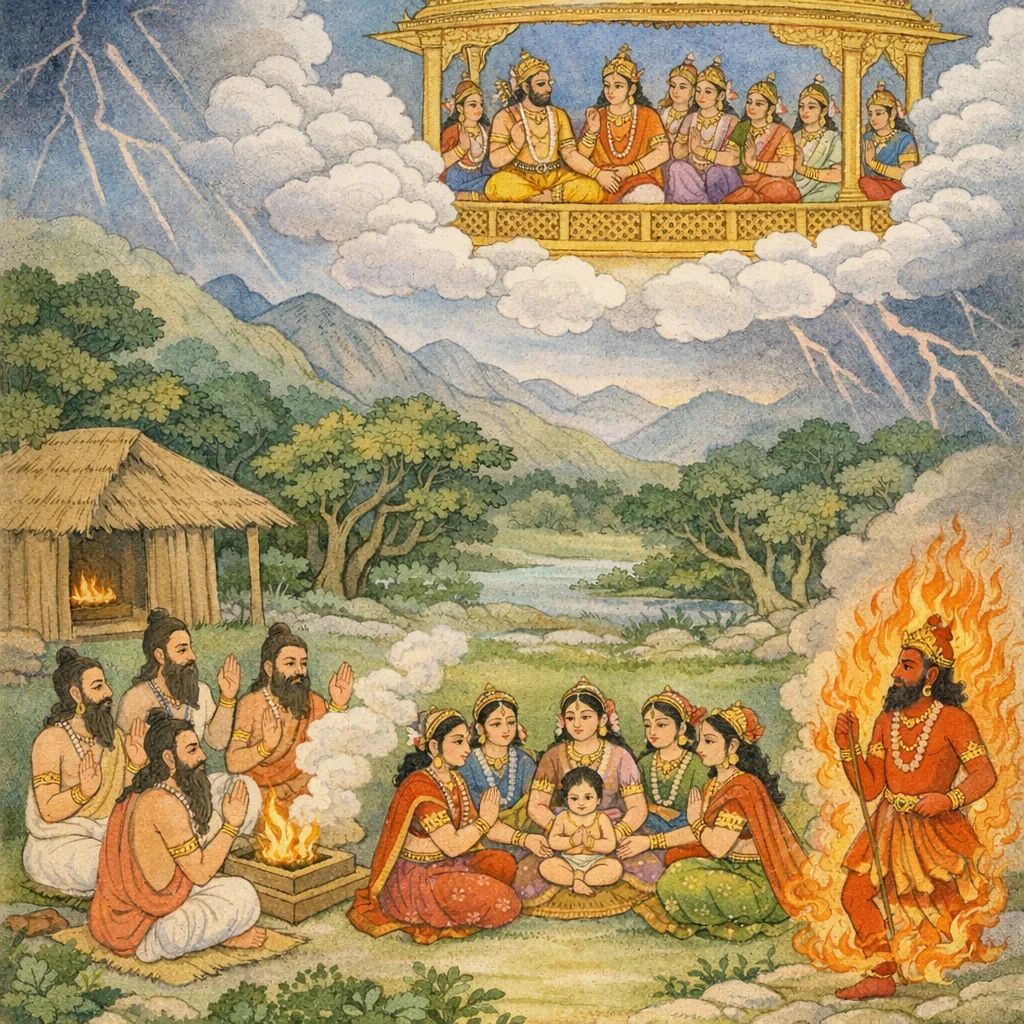
Adhyaya 227
Adhyāya 227: Duryodhana’s Deliberation and the Ghoṣa-yātrā Pretext (Dvaita-vana)
Upa-parva: Ghoṣa-yātrā (Cattle-camp Expedition) Episode in Dvaita-vana
Vaiśaṃpāyana reports Duryodhana’s reaction to Karṇa’s counsel: he is pleased yet constrained by the need for Dhṛtarāṣṭra’s consent to travel where the Pandavas reside. Duryodhana notes the king’s grief for the exiled brothers and his belief that their austerities increase their potency, making permission politically difficult. He admits personal satisfaction at the prospect of seeing Bhīma and Arjuna in hardship and especially Draupadī in ascetic attire, but cannot identify a direct method to secure approval. He instructs Karṇa—along with Śakuni and Duḥśāsana—to devise a refined plan, and indicates he will consult the elders, including Bhīṣma. After night passes, Karṇa approaches Duryodhana with a solution: the Kauravas will undertake an inspection journey to the Dvaita forest cattle camps (ghoṣa-yātrā), a customary activity likely to be sanctioned by Dhṛtarāṣṭra. Śakuni concurs, asserting the plan is safe and will be authorized. The group collectively affirms the decision, marking the transition from intention to operational strategy under a legitimate administrative cover.
Chapter Arc: Markandeya continues the Skanda-origin cycle: across the worlds, ominous inversions erupt—male and female natures reverse, the quarters blaze, the sky roars, and the earth trembles—signaling that a power has been born which even gods cannot easily measure. → The rishis, shaken yet devoted to loka-kalyana, perform pacificatory rites to steady creation. In heaven, Indra and the devas grow anxious: the child is declared immensely strong, capable of challenging even Brahma in battle. The narrative tightens around a single question—who is this balaka, and what force has entered the cosmos? → Indra, distressed, speaks before the assembled gods: the boy’s might is beyond ordinary reckoning. The portents are not random; they are the cosmic echo of a newborn commander—Mahasena—whose very presence bends nature’s order and alarms the guardians of the worlds. → Mahasena honors and satisfies the gathered powers (including the Mothers/Matrikas), and then beholds Agni approaching as a father. Agni, worshipped by the child and surrounded by the Matrikas, stands as protector—stabilizing the moment by acknowledging paternity and placing the newborn within a divine lineage rather than as a rogue catastrophe. → The chapter leaves a lingering uncertainty about the child’s exact genesis—conflicting accounts (six wives, Svaha’s disguises) persist—inviting the next movement of the tale to reconcile origin, name, and destiny.
Shlokas
Verse 1
(दाक्षिणात्य अधिक पाठका ६ “लोक मिलाकर कुल ३९३ श्लोक हैं) ८-० #++० () अत हा षड्विशर्त्याधिकद्विशततमो< ध्याय: विश्वामित्रका स्कन्दके जातकर्मादि तेरह संस्कार करना और विश्वामित्रके समझानेपर भी ऋषियोंका अपनी पत्नियोंको स्वीकार न करना तथा अग्निदेव आदिढके द्वारा बालक स्कन्दकी रक्षा करना मार्कण्डेय उवाच तस्मिज्जाते महासत्त्वे महासेने महाबले । समुन्तस्थुर्महोत्पाता घोररूपा: पृथग्विधा:,मार्कण्डेयजी कहते हैं--राजन्! उन महान् धैर्यशशाली और महाबली महासेनके जन्म लेनेपर भाँति-भाँतिके बड़े भयंकर उत्पात प्रकट होने लगे
Mārkaṇḍeya said: “O King, when that great-souled one was born—Skanda, the mighty commander of hosts, possessed of immense strength—many dreadful portents of diverse kinds arose on all sides.”
Verse 2
स्त्रीपुंसोर्विपरीतं च तथा द्वन्द्धानि यानि च । ग्रहा दीप्ता दिश: खं च ररास च मही भूशम्,स्त्री-पुरुषोंका स्वभाव विपरीत हो गया। सर्दी आदि इन्होंनें भी (अद्भुत) परिवर्तन दिखायी देने लगा। ग्रह, दिशाएँ और आकाश ये सब जलने लगे और पृथ्वी जोर-जोरसे गर्जना-सी करने लगी
Mārkaṇḍeya said: “The natural dispositions of women and men became reversed, and the usual pairs of opposites (such as cold and heat) also appeared in strange alteration. The planets blazed; the directions and the sky seemed to burn; and the earth roared loudly, as if bellowing.”
Verse 3
ऋषयश्न महाघोरान् दृष्टवोत्पातान् समन्ततः । अकुर्वज्छान्तिमुद्धिग्ना लोकानां लोकभावना:,लोकहितकी भावना रखनेवाले महर्षि चारों ओर अत्यन्त भयंकर उत्पात देखकर उद्विग्न हो उठे और जगतमें शान्ति बनाये रखनेके लिये शास्त्रीय कर्मोंका अनुष्ठान करने लगे
Verse 4
निवसन्ति वने ये तु तस्मिंश्वैत्ररथे जना: । तेडब्रुवन्नेष नोडनर्थ: पावकेनाहितो महान्
Markandeya said: “Those people who dwell in that forest at Śvaitraratha spoke up: ‘This is a great calamity for us—set in motion by fire.’”
Verse 5
अपरे गरुडीमाहुस्त्वयानर्थोडयमाहृत:,दूसरे लोगोंने उस गरुडी पक्षिणीसे कहा--“तूने ही यह अनर्थ उपस्थित किया है'। यह उन लोगोंका विचार था, जिन्होंने स्वाहादेवीको गरुडीके रूपमें जाते देखा था। लोग यह नहीं जानते थे कि यह सारा कार्य स्वाहाने किया है
Mārkaṇḍeya said: Others blamed the Garuḍī (the female Garuḍa-bird), saying, “You have brought about this calamity.” This was the judgment of those who had seen Svāhā-devī going in the form of Garuḍī; they did not know that the entire deed had in fact been carried out by Svāhā. The passage highlights how people hastily assign blame based on appearances, missing the true agent behind an act and thereby committing an ethical error in judgment.
Verse 6
यैर्दश्ा सा तदा देवी तस्या रूपेण गच्छती । न तु तत् स्वाहया कर्म कृतं जानाति वै जन:,दूसरे लोगोंने उस गरुडी पक्षिणीसे कहा--“तूने ही यह अनर्थ उपस्थित किया है'। यह उन लोगोंका विचार था, जिन्होंने स्वाहादेवीको गरुडीके रूपमें जाते देखा था। लोग यह नहीं जानते थे कि यह सारा कार्य स्वाहाने किया है
Those who had seen the goddess moving about in that very form (of the Garuḍī-bird) concluded, “It is you who have brought about this calamity.” Yet people did not know that the deed had in fact been carried out by Svāhā. The episode highlights how outward appearances mislead judgment and how blame is often assigned without knowledge of the true agent.
Verse 7
सुपर्णी तु वच: श्रुत्वा ममायं तनयस्त्विति । उपगम्य शनै: स्कन्दमाहाहं जननी तव,गरुडीने लोगोंकी बातें सुनकर कहा--“यह मेरा पुत्र है।। फिर उसने धीरेसे स्कन्दके पास जाकर कहा--*बेटा! मैं तुम्हें जन्म देनेवाली माता हूँ!
Markandeya said: Hearing those words, Suparṇī declared, “This is my son.” Then, approaching Skanda slowly and respectfully, she said, “I am your mother—the one who gave you birth.” The passage highlights the moral force of truthfully acknowledging one’s relationship and responsibility, and the careful, non-confrontational manner in which such a claim is presented in a charged situation.
Verse 8
अथ सप्तर्षय: श्रुत्वा जात॑ पुत्र महौजसम् । तत्यजु: षट् तदा पत्नीर्विना देवीमरुन्धतीम्,इधर सप्तर्षियोंने जब यह सुना कि हमारी छ: पत्नियोंके रंगसे अग्निदेवके एक महातेजस्वी पुत्र उत्पन्न हुआ है, तब उन्होंने अरुन्धती देवीके सिवा अन्य छः पत्नियोंको त्याग दिया
Mārkaṇḍeya said: Then, when the Seven Ṛṣis heard that a son of great splendor had been born from the six wives, they thereupon renounced those six wives—leaving aside only the goddess Arundhatī. The episode underscores how fear of moral blame and anxiety over purity can drive harsh social judgments, even within revered households.
Verse 9
षड्भिरेव तदा जातमाहुस्तद्वनवासिन: । सप्तर्षीनाह च स्वाहा मम पुत्रोडयमित्युत
Mārkaṇḍeya said: “At that time, the forest-dwellers declared that the child had been born from the six (Kṛttikās). And Svāhā, too, addressed the Seven Ṛṣis, saying, ‘Indeed, this is my son.’”
Verse 10
विश्वामित्रस्तु कृत्वेष्टिं सप्तर्षीणां महामुनि:,महामुनि विश्वामित्र जब सप्तर्षियोंकी इष्टि पूर्ण कर चुके, तब वे भी कामपीड़ित अग्निके पीछे-पीछे गुप्तरूपसे चल दिये थे, उस समय कोई उन्हें देख नहीं पाता था। अतः उन्होंने यह सारा वृत्तान्त यथार्थरूपसे जान लिया
Verse 11
पावकं कामसंतप्तमदृष्ट: पृष्ठतो5न्वगात् । तत् तेन निखिल सर्वमवबुद्धं यथातथम्,महामुनि विश्वामित्र जब सप्तर्षियोंकी इष्टि पूर्ण कर चुके, तब वे भी कामपीड़ित अग्निके पीछे-पीछे गुप्तरूपसे चल दिये थे, उस समय कोई उन्हें देख नहीं पाता था। अतः उन्होंने यह सारा वृत्तान्त यथार्थरूपसे जान लिया
Markandeya said: “Invisible, he followed behind Pāvaka (Agni), who was tormented by desire. Therefore he came to know the entire matter completely, exactly as it had occurred.”
Verse 12
विश्वामित्रस्तु प्रथमं कुमारं शरणं गत: । स्तवं दिव्यं सम्प्रचक्रे महासेनस्थ चापि स:,विश्वामित्रजी सबसे पहले कुमार कार्तिकेयकी शरणमें गये तथा उन्होंने महासेनकी दिव्य स्तोत्रोंद्वारा स्तुति भी की
Mārkaṇḍeya said: Viśvāmitra, first of all, sought refuge in Kumāra (Kārttikeya). Having approached him as a protector, he then composed and offered a divine hymn of praise to Mahāsena as well. The episode highlights the ethic of śaraṇāgati—turning to a worthy divine guardian with humility and devotion before undertaking one’s purpose.
Verse 13
मड्लानि च सर्वाणि कौमाराणि त्रयोदश । जातकर्मादिकास्तस्य क्रियाश्षक्रे महामुनि:,उन महामुनिने कुमारके सारे मांगलिक कृत्य सम्पन्न किये। जातकर्म आदि तेरह क्रियाओंका भी अनुष्ठान किया
Mārkaṇḍeya said: The great sage duly performed for the child all the auspicious rites of early life—thirteen in number—beginning with the birth-rite (jātakarma). Thus the boy’s life was set upon a disciplined and dharmic course through sanctifying observances rather than mere worldly celebration.
Verse 14
षड्वक््त्रस्य तु माहात्म्यं कुक्कुटस्य तु साधनम् | शकक््त्या देव्या: साधनं च तथा पारिषदामपि,स्कन्दकी महिमा, उनके द्वारा कुक्कुट पक्षीका धारण, देवीके समान प्रभावशालिनी शक्तिका ग्रहण तथा पार्षदोंका वरण आदि कुमारके सभी कार्योंको विश्वामित्रने लोकहितके लिये आवश्यक सिद्ध किया। अतः विश्वामित्र मुनि कुमारके अधिक प्रिय हो गये
Mārkaṇḍeya said: “(Viśvāmitra) established as necessary for the welfare of the world all the deeds of Kumāra—his greatness as the six-faced one, his adoption of the rooster as his emblem/vehicle, his acceptance of the mighty divine Śakti, and his choosing of attendant companions. Because he thus affirmed and guided Kumāra’s mission for the common good, the sage Viśvāmitra became especially dear to him.”
Verse 15
विश्वामित्रश्नकारैतत् कर्म लोकहिताय वै । तस्मादृषि: कुमारस्य विश्वामित्रो5भवत् प्रिय:,स्कन्दकी महिमा, उनके द्वारा कुक्कुट पक्षीका धारण, देवीके समान प्रभावशालिनी शक्तिका ग्रहण तथा पार्षदोंका वरण आदि कुमारके सभी कार्योंको विश्वामित्रने लोकहितके लिये आवश्यक सिद्ध किया। अतः विश्वामित्र मुनि कुमारके अधिक प्रिय हो गये
Mārkaṇḍeya said: Viśvāmitra did not regard this deed as improper; indeed, he affirmed it to be necessary for the welfare of the world. Therefore, the sage Viśvāmitra became especially dear to Kumāra (Skanda), for he upheld the larger good behind the god’s actions.
Verse 16
अन्वजानाच्च स्वाहाया रूपान्यत्वं महामुनि: । अब्रवीच्च मुनीन् सर्वान् नापराध्यन्ति वै स्त्रिय:
Mārkaṇḍeya said: “And the great sage recognized that those forms belonged to Svāhā. Then he addressed all the assembled sages: ‘Indeed, women are not to be blamed (as offenders) in this matter.’”
Verse 17
मार्कण्डेय उवाच स्कन्दं श्रुत्वा तदा देवा वासवं सहिताडब्रुवन्,त्रैलोक्यं संनिगृह्ास्मांस्त्वां च शक्र महाबल । मार्कण्डेयजी कहते हैं--राजन! उस समय स्कन्दके जन्म और बल-पराक्रमका समाचार सुनकर सब देवताओंने एकत्र हो इन्द्रसे कहा--'देवेश्वर! स्कन्दका बल असहा है। शीघ्र उन्हें मार डालिये; विलम्ब न कीजिये। महाबली इन्द्र! यदि आप इन्हें अभी नहीं मारते हैं तो ये त्रिलोकीको, हम सबको तथा आपको भी अपने वशमें करके “देवेन्द्र” बन बैठेंगे!
Mārkaṇḍeya said: Hearing then of Skanda—of his birth and his mighty prowess—the gods assembled and spoke to Vāsava (Indra): “O Śakra of great strength! If he is not checked, he will subdue the three worlds, and bring us all—along with you—under his control.” The passage frames a moral tension: fear and self-preservation drive the gods toward preemptive violence against a rising power, revealing how even divine councils can be swayed by anxiety over status and sovereignty.
Verse 18
अविषदह्ाबलं स्कन्दं जहि शक्राशु माचिरम् । यदि वा न निहंस्येन देवेन्द्रोडयं भविष्यति
Mārkaṇḍeya said: “O Śakra (Indra), quickly strike down Skanda, whose strength is unbearable—do not delay. For if you do not slay him, this one will become the lord of men (a rival sovereign), eclipsing your own supremacy.”
Verse 19
स तानुवाच व्यथितो बालो5यं सुमहाबल:,तब इन्द्रने व्यथित होकर उन देवताओंसे कहा--“देवताओ! यह बालक बड़ा बलवान् है। यह लोकस्रष्टा ब्रह्माको भी युद्धमें पराक्रम करके मार सकता है। अतः मुझमें इस बालकको मारनेका साहस नहीं है।” इन्द्र बार-बार यही बात दुहराने लगे
Markandeya said: Distressed, he addressed those gods: “O Devas, this child is exceedingly mighty. He could, by prowess in battle, even slay Brahmā, the creator of the worlds. Therefore I do not have the courage to kill this child.” Indra kept repeating this same point again and again, underscoring both the peril of rash violence and the need for restraint before overwhelming power.
Verse 20
स््रष्टारमपि लोकानां युधि विक्रम्य नाशयेत् । न बालमुत्सहे हन्तुमिति शक्र: प्रभाषते,तब इन्द्रने व्यथित होकर उन देवताओंसे कहा--“देवताओ! यह बालक बड़ा बलवान् है। यह लोकस्रष्टा ब्रह्माको भी युद्धमें पराक्रम करके मार सकता है। अतः मुझमें इस बालकको मारनेका साहस नहीं है।” इन्द्र बार-बार यही बात दुहराने लगे
Mārkaṇḍeya said: “He could, by sheer prowess in battle, even destroy Brahmā, the creator of the worlds. Therefore I do not have the heart to kill this child,” thus spoke Śakra (Indra). Distressed, Indra kept repeating this to the gods—acknowledging the child’s extraordinary power and drawing an ethical line against slaying one who is but a child.
Verse 21
तेडब्रुवन् नास्ति ते वीर्य यत एवं प्रभाषसे । स्वस्त्विद्याभिगच्छन्तु स्कन्दं लोकस्य मातर:
Mārkaṇḍeya said: “They spoke thus: ‘There is no true valor in you, since you talk in this manner. Let those Mothers of the worlds—endowed with auspicious powers—go and approach Skanda.’”
Verse 22
तमप्रतिबलं दृष्टवा विषण्णवदनास्तु ता:,परंतु स्कन्दका अप्रतिम बल देखकर उनके मुखपर उदासी छा गयी। वे सोचने लगीं --“इस वीरको पराजित करना असम्भव है।' ऐसा निश्चय होनेपर वे उन्हींकी शरणमें गयीं और बोलीं--“महाबली कुमार! तुम हमारे पुत्र हो जाओ, हमें माता मान लो
Mārkaṇḍeya said: Seeing him as one whom they could not withstand, the women’s faces fell into dejection. When they beheld Skandaka, whose strength was incomparable, they reflected, “It is impossible to defeat this hero.” Having come to that decision, they sought refuge in him and said, “O mighty prince, become our son; accept us as your mothers.” The episode frames surrender not as weakness but as a dharmic choice when violence is futile—turning from hostility to protection through kinship and supplication.
Verse 23
अशक्यो<यं विचिन्त्यैवं तमेव शरणं ययु: । ऊचुश्नैनं त्वमस्माकं पुत्रो भव महाबल,परंतु स्कन्दका अप्रतिम बल देखकर उनके मुखपर उदासी छा गयी। वे सोचने लगीं --“इस वीरको पराजित करना असम्भव है।' ऐसा निश्चय होनेपर वे उन्हींकी शरणमें गयीं और बोलीं--“महाबली कुमार! तुम हमारे पुत्र हो जाओ, हमें माता मान लो
Mārkaṇḍeya said: Reflecting thus, they concluded, “This one cannot be overcome.” Therefore they went to him alone for refuge and said to him, “O mighty one, become our son; accept us as your mothers.” The passage highlights a turn from rivalry to surrender, where recognition of superior strength leads to seeking protection and forming a moral bond of kinship rather than persisting in futile hostility.
Verse 24
अभिनन्दस्व न: सर्वा: प्रस्नुता: स्नेहविक्लवा: । तासां तद् वचन श्र॒ुत्वा पातुकाम: स्तानान् प्रभु:,“देखो, हम पुत्र-स्नेहसे विकल हो रही हैं, हमारे स्तनोंसे दूध झर रहा है इसे पीकर हम सबको सम्मानित और आनन्दित करो।” मातृकाओंकी यह बात सुनकर समर्थ स्कन्दके मनमें उनके स्तनपानकी इच्छा जाग्रत हो गयी
Markandeya said: “Honor and gladden us all. Overcome by motherly affection, our breasts are flowing with milk; drink it and thereby satisfy and bless us.” Hearing the mothers’ words, the mighty Skanda felt the desire to nurse at their breasts. The episode frames maternal love as a sacred, nourishing force and portrays the child’s acceptance as a way of honoring and fulfilling that protective affection.
Verse 25
ता: सम्पूज्य महासेन: कामांश्चासां प्रदाय सः । अपश्यदग्निमायान्तं पितरं बलिनां बली,फिर महासेनने उन सबका समादर करके उनकी मनोवाउ्छा पूर्ण की। तदनन्तर बलवानोंमें बलिष्ठ वीर स्कन्दने अपने पिता अग्निदेवको आते देखा
Having duly honored those women and granted them their desired boons, Mahāsena (Skanda)—himself the mightiest among the mighty—then saw his father Agni approaching. The episode underscores a dharmic ideal: true strength is shown not merely in power, but in reverent conduct, generosity, and the fulfillment of rightful requests before turning to one’s own affairs.
Verse 26
स तु सम्पूजितस्तेन सह मातृगणेन ह । परिवार्य महासेनं रक्षमाण: स्थित: शिव:,कुमार महासेनके द्वारा पूजित हो मंगलकारी अग्निदेव मातृकागणोंके साथ उन्हें घेरकर खड़े हो गये और उनकी रक्षा करने लगे
Mārkaṇḍeya said: Thus honored by him, Śiva—together with the host of Mother-goddesses—stood encircling Mahāsena, remaining as his protector. The scene underscores the ethical power of reverent worship: when devotion is offered rightly, divine guardianship is invoked for the welfare and safety of the worthy.
Verse 27
सर्वासां या तु मातृणां नारी क्रोधसमुद्धवा । धात्री स्वपुत्रवत् स्कन्दं शूलहस्ताभ्यरक्षत,उस समय सम्पूर्ण मातृकाओंके क्रोधसे जो एक नारीमूर्ति प्रकट हुई थी, वह हाथमें त्रिशूल ले धायकी भाँति अपने पुत्रके समान प्रिय स्कन्दकी सब ओरसे रक्षा करने लगी
Mārkaṇḍeya said: From the wrath of all the Mother-goddesses there arose a single female form. Trident in hand, she guarded Skanda on every side, as a nurse protects a child as dear as her own son. The episode frames fierce power as morally directed: anger is not indulged for harm, but harnessed for protection of the worthy and the vulnerable.
Verse 28
लोहितस्योदथे: कन्या क्रूरा लोहितभोजना । परिष्वज्य महासेने पुत्रवत् पर्यरक्षत,लाल सागरकी एक क्रूर स्वभाववाली कन्या थी, जिसका रक्त ही भोजन था। वह महासेनको पुत्रकी भाँति हृदयसे लगाकर सर्वतोभावेन उनकी रक्षा करने लगी
Mārkaṇḍeya said: “In the ocean of Lohita there was a fierce maiden whose very food was blood. Embracing Mahāsena as though he were her own son, she began to guard him on every side with wholehearted care.”
Verse 29
अग्निर्भूत्वा नैगमेयश्छागवक्त्रो बहुप्रज: । रमयामास शैलस्थं बालं॑ क्रीडनकैरिव,वेदप्रतिपादित अग्नि बकरेका-सा मुख बनाकर अनेक संतानोंके साथ उपस्थित हो पर्वतशिखर पर निवास करनेवाले बालक स्कन्दका इस प्रकार मन बहलाने लगे, मानो उन्हें खिलौनोंसे खेला रहे हों
Verse 43
संगम्य षड्भि: पत्नीभि: सप्तर्षीणामिति सम ह | उस चैत्ररथ नामक वनमें जो लोग निवास करते थे, वे कहने लगे, “अग्निने सप्तर्षियोंकी छः पत्नियोंक साथ समागम करके हमलोगोंपर यह बहुत बड़ा अनर्थ लाद दिया है”
Markandeya said: In that forest called Caitraratha, the residents began to speak among themselves: “Agni, having consorted with six of the Seven Sages’ wives, has brought upon us a grave calamity.” The remark frames the act as a moral transgression whose consequences spill beyond the immediate offenders, burdening an entire community with disorder and fear.
Verse 96
अहं जाने नैतदेवमिति राजन् पुनः पुन: । क्योंकि उस वनके निवासियोंने उस समय छः: पत्नियोंके गर्भसे ही उस बालककी उत्पत्ति बतायी थी। राजन! यद्यपि स्वाहाने सप्तर्षियोंसे बार-बार कहा कि “यह मेरा पुत्र है। मैं इसके जन्मका रहस्य जानती हूँ; लोग जैसी बात उड़ा रहे हैं, वैसी नहीं है।” (तो भी वे सहसा उसकी बातपर विश्वास न कर सके)
Markandeya said: “O King, I know this is not so,” he repeated again and again. For the forest-dwellers at that time were spreading the report that the boy had been born from the wombs of six wives. Yet Svāhā kept telling the Seven Sages repeatedly, “He is my son; I know the secret of his birth—things are not as people are rumouring.” Even so, they could not at once bring themselves to believe her words.
Verse 186
त्रैलोक्यं संनिगृह्ास्मांस्त्वां च शक्र महाबल । मार्कण्डेयजी कहते हैं--राजन! उस समय स्कन्दके जन्म और बल-पराक्रमका समाचार सुनकर सब देवताओंने एकत्र हो इन्द्रसे कहा--'देवेश्वर! स्कन्दका बल असहा है। शीघ्र उन्हें मार डालिये; विलम्ब न कीजिये। महाबली इन्द्र! यदि आप इन्हें अभी नहीं मारते हैं तो ये त्रिलोकीको, हम सबको तथा आपको भी अपने वशमें करके “देवेन्द्र” बन बैठेंगे!
Mārkaṇḍeya said: “O mighty Śakra (Indra)! If he is not checked at once, he will subdue the three worlds—us all and even you—and will seat himself as ‘lord of the gods.’”
Verse 216
कामवीर्या घ्नन्तु चैनं तथेत्युक्त्वा च ता ययु: । यह सुनकर देवता बोले--“आपमें अब बल और पराक्रम नहीं रह गया है, इसीलिये ऐसी बातें कहते हैं। हमारी राय है कि सम्पूर्ण लोकमातृकाएँ स्कन्दके पास जायाँ। ये इच्छानुसार पराक्रम प्रकट कर सकती हैं; अतः स्कन्दको मार डालें।” तब “बहुत अच्छा' कहकर वे मातृकाएँ वहाँसे चल दीं
Mārkaṇḍeya said: “Let those endowed with desire-born power strike him down.” Having spoken thus—‘So be it’—the Mothers departed. In the surrounding narrative, the gods interpret the opponent’s words as arising from diminished strength and resolve, and they propose that the Lokamātṛkās, who can manifest prowess at will, should go to Skanda and kill him—revealing a morally tense moment where expediency and fear drive even divine counsel toward violence against a formidable protector-figure.
Verse 225
इस प्रकार श्रीमहाभारत वनपर्वके अन्तर्गत मार्कण्डेयसमास्यापर्वमें आड़िरयोपाख्यानके प्रसंगरें कुमारोत्पत्तिविषयक दो सौ पचीसवाँ अध्याय पूरा हुआ
Thus, in the Śrī Mahābhārata, within the Vana Parva, in the section known as the Mārkaṇḍeya-samāsya Parva, in the context of the Āḍiraya episode, the two-hundred-and-twenty-fifth chapter—dealing with the birth/origin of Kumāra—comes to an end. The colophon signals a completed unit of teaching and narration, marking the closure of a thematic arc rather than advancing the plot through new action.
Verse 226
इति श्रीमहाभारते वनपर्वणि मार्कण्डेयसमास्यापर्वणि आज्धिरसे स्कनन््दोत्पत्तौ षड्विंशत्यधिकद्धिशततमो<ध्याय:
Thus, in the Śrī Mahābhārata, within the Vana Parva—specifically in the section summarizing Mārkaṇḍeya’s discourse—ends the two-hundred-and-twenty-sixth chapter (i.e., the 226th), in the episode concerning the birth/origin of Skanda. This is a colophon marking the close of the chapter rather than a spoken narrative verse.
Verse 1663
श्र॒ुत्वा तु तत्त्वतस्तस्मात् ते पत्नी: सर्वतो5त्यजन् | महामुनि विश्वामित्रने यह जान लिया था कि स्वाहाने अन्य ऋषिपत्नियोंके रूप धारण करके अग्निदेवसे सम्बन्ध स्थापित किया था; इसलिये उन्होंने सब ऋषियोंसे कहा --“आपकी स्त्रियोंका कोई अपराध नहीं है” उनके मुखसे यथार्थ बात जानकर भी ऋषियोंने अपनी पत्नियोंको सर्वथा त्याग ही दिया
Mārkaṇḍeya said: Having heard the truth of the matter from him, those sages nevertheless abandoned their wives completely on all sides—despite knowing from his own mouth what had really happened. The episode highlights how suspicion and wounded honor can override fairness, even when innocence is affirmed.
Frequently Asked Questions
The tension lies between personal impulse to exert pressure on vulnerable rivals and the requirement to act within sanctioned royal procedure, including respect for Dhṛtarāṣṭra’s authority and Bhīṣma’s oversight.
The chapter illustrates how political actors translate intent into action through legitimizing mechanisms—permissions, customary duties, and counsel—showing that strategy often operates through institutional form rather than direct declaration.
No explicit phalaśruti appears in this passage; its significance is contextual, functioning as a narrative hinge that formalizes a pretexted expedition and foreshadows subsequent interactions in the Dvaita-vana setting.