Adhyaya 69
द्रोणेन दुर्योधनस्य कवचबन्धनम् — Drona’s Mantra-Bound Armor for Duryodhana
Upa-parva: Jayadratha-rakṣaṇa (Protecting Jayadratha) Episode
Sañjaya reports that Arjuna, intent on reaching Jayadratha, has penetrated Droṇa’s and the Bhoja contingents and has already neutralized multiple prominent allies, causing widespread disarray. Duryodhana approaches Droṇa in alarm, requesting immediate counsel to prevent Jayadratha’s fall and describing Arjuna as a fast-moving ‘fire’ driven by wrath, aided by Kṛṣṇa’s superior charioteering and swift horses. Duryodhana also accuses Droṇa of divided loyalties and laments that his own reliance on promised protection has endangered Jayadratha. Droṇa replies without resentment, explains the practical difficulty of matching Arjuna’s speed, and states he will not abandon the front because of his vow to seize Yudhiṣṭhira. He urges Duryodhana to personally engage Arjuna with support. To enable this, Droṇa performs a formal kavaca-bonding: he touches water, recites mantras, and binds a radiant armor, narrating its divine pedigree through a mythic transmission associated with Śiva, Indra, Aṅgiras, Bṛhaspati, and Agniveśya. He invokes extensive blessings (svasti) and then dispatches Duryodhana—now armored and accompanied by large allied forces—toward Arjuna’s chariot, as the Kaurava host resounds like a surging sea.
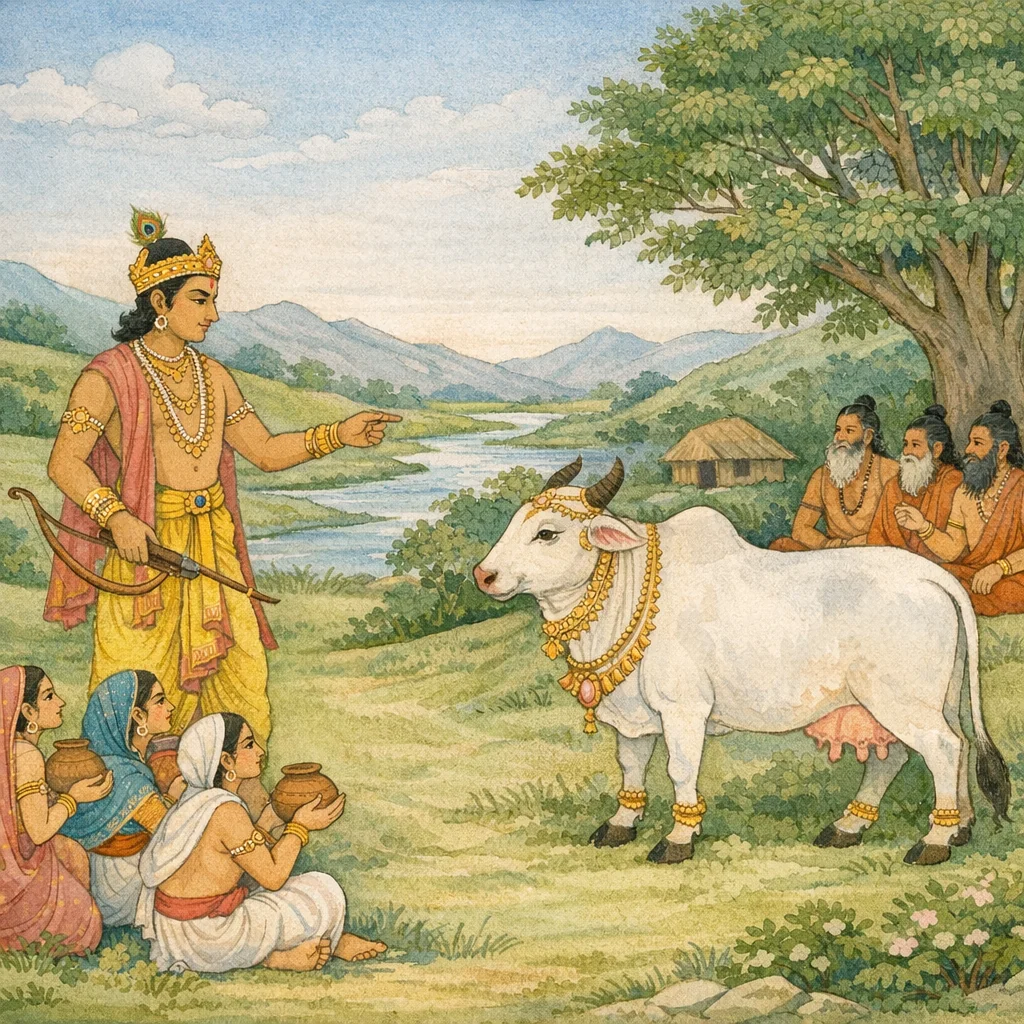
Chapter Arc: Narada begins a luminous digression: he recalls how King Prithu Vainya rose after Vena’s fall, and how the world heard of his consecration and fame—an ancient mirror held up to the present age of war. → The tale turns from coronation to crisis: the people suffer want, and Prithu, as kshatriya, vows to subdue all obstacles. The Earth (Vasudha), withholding her bounty, becomes the silent adversary; Prithu’s resolve hardens into a cosmic confrontation between ruler and realm. → Prithu commands the Earth to yield the long-desired ‘milk’ for the people; the great ‘milking of the Earth’ unfolds—each order of beings draws its chosen essence with its own calf and vessel, while Prithu stands as the sovereign ‘doer’ who makes abundance lawful and organized. → Order is restored: agriculture and produce arise as milk upon the earth’s surface; the people find sustenance and comfort, and Prithu’s kingship is validated as protection-through-provision, not merely conquest. → The narration closes with the image of Earth as a cow—seeking calf, milker, and vessel—leaving the listener poised to return from this exemplary ancient dharma to the harsh immediacy of Abhimanyu’s death and the war’s next turn.
Shlokas
Verse 1
ऑपन--माजल बछ। ःिअ एकोनसप्ततितमो<ध्याय: राजा पृथुका चरित्र नारद उवाच पृथुं वैन्यं च राजानं मृतं सृज्जय शुश्रुम । यमभ्यषिज्चन् साम्राज्ये राजसूये महर्षय:,नारदजी कहते हैं--सूंजय! वेनके पुत्र राजा पृथु भी जीवित नहीं रह सके; यह हमने सुना है। महर्षियोंने राजसूययज्ञमें उन्हें सम्राट्के पदपर अभिषिक्त किया था इस प्रकार श्रीमह्ाभारत द्रोणपर्वके अन्तर्गत अभिमनन््युवधपर्वमें षोडशराजकीयो- पाख्यानविषयक उनहत्तरवाँ अध्याय पूरा हुआ ॥/ ६९ ॥ नआऔशा-<> ड-ण का सप्ततितमो<ध्याय: परशुरामजीका चरित्र नारद उवाच रामो महातपा: शूरो वीरलोकनमस्कृत: । जामदग्न्यो5प्यतियशा अवितृप्तो मरिष्यति
Nārada said: “O Sṛñjaya, we have heard that King Pṛthu, the son of Vena, has also died. It was the great seers who, at the Rājasūya sacrifice, anointed him to imperial sovereignty.”
Verse 2
यत्नतः प्रथितेत्यूचु: सर्वानभिभवन् पृथु: । क्षतान्नस्त्रास्यते सर्वानित्येवं क्षत्त्रियोड$भवत्,“ये समस्त शत्रुओंको पराजित करके अपने प्रयत्नसे प्रथित (विख्यात) होंगेट--ऐसा महर्षियोंने कहा था। इसलिये वे “पृथु” कहलाये। ऋषियोंने यह भी कहा कि “ये क्षतसे हमारा त्राण करेंगे", इसलिये वे क्षत्रिय” इस सार्थक नामसे प्रसिद्ध हुए
Narada said: “The sages declared, ‘By his own effort he will become renowned, overcoming all.’ Therefore he came to be known as Pṛthu (‘the famed one’). They also said, ‘He will protect us all from harm and injury (kṣata),’ and thus he became known by the meaningful title ‘Kṣatriya’—the protector from injury.”
Verse 3
पृथुं वैन्यं प्रजा दृष्टवा रक्ता: स्मेति यदब्रुवन् । ततो राजेति नामास्थ अनुरागादजायत,वेनकुमार पृथुकोी देखकर प्रजाने कहा, हम इनमें अनुरक्त हैं। इसलिये उस प्रजारंजनजनित अनुरागके कारण उनका नाम 'राजा' हुआ
Nārada said: “When the people beheld Pṛthu, son of Vena, they exclaimed, ‘We are devotedly attached to him!’ From that very affection—born of his power to delight and win the hearts of the subjects—there arose for him the name ‘Rājā’ (king), the one who pleases and holds the people in loyal love.”
Verse 4
अकृष्टपच्या पृथिवी आसीदू वैन्यस्य कामधुक् । सर्वा: कामदुघा गाव: पुटके पुटके मधु,वेननन्दन पृथुके लिये यह पृथ्वी कामधेनु हो गयी थी। उनके राज्यमें बिना जोते ही पृथ्वीसे अनाज पैदा होता था। उस समय सभी गौएँ कामधेनुके समान थीं। पत्ते-पत्तेमें मधु भरा रहता था
Narada said: In the reign of Pṛthu, the son of Vena, the earth became like a wish-fulfilling cow. Crops sprang forth without ploughing, and all cows yielded every desired bounty. Even leaf after leaf was found to be filled with honey—an image of a world made prosperous through righteous kingship and the restoration of order.
Verse 5
आसनू् हिरण्मया दर्भा: सुखस्पर्शा: सुखावहा: । तेषां चीराणि संवीता: प्रजास्तेष्वेव शेरते,कुश सुवर्णमय होते थे। उनका स्पर्श कोमल था और वे सुखद जान पड़ते थे। उन्हींके चीर बनाकर प्रजा उनसे अपना शरीर ढकती थी तथा उन कुशोंकी ही चटाइयोंपर सोती थी
Nārada said: “There were darbha-grasses that seemed golden, gentle to the touch and conducive to comfort. From them the people fashioned garments to cover their bodies, and upon those very mats of darbha they would lie down to rest.”
Verse 6
फलान्यमृतकल्पानि स्वादूनि च मधूनि च । तेषामासीत् तदाहारो निराहाराश्च नाभवन्,वृक्षोंक फल अमृतके समान मधुर और स्वादिष्ट होते थे। उन दिनों उन फलोंका ही आहार किया जाता था। कोई भी भूखा नहीं रहता था
Nārada said: The fruits were like nectar—sweet and delicious. In those days people lived on those fruits alone as their sustenance, and no one remained without food; none went hungry. The verse evokes an ethical memory of a time when nature’s abundance supported all, contrasting with later scarcity and conflict.
Verse 7
अरोगा: सर्वसिद्धार्था मनुष्या हुकुतो भया: । न्यवसन्त यथाकामं वृक्षेषु च गुहासु च,सभी मनुष्य नीरोग थे। सबकी सारी इच्छाएँ पूर्ण होती थीं और उन्हें कहींसे भी कोई भय नहीं था। वे अपनी इच्छाके अनुसार वृक्षोंके नीचे और पर्वतोंकी गुफाओंमें निवास करते थे
Nārada said: “People were free from disease; all their aims were fulfilled, and they lived without fear from any quarter. According to their own wish, they dwelt beneath trees and in mountain caves.” The verse evokes an ethical memory of an earlier, more harmonious condition of life—where security, contentment, and simplicity arise not from force but from a world ordered toward well-being.
Verse 8
प्रविभागो न राष्ट्राणां पुराणां चाभवत् तदा । यथासुखं यथाकामं तथैता मुदिता: प्रजा:,उस समय राष्ट्रों और नगरोंका विभाग नहीं था। सबको इच्छानुसार सुख और भोग प्राप्त थे। इससे यह सारी प्रजा प्रसन्न थी
Nārada said: “In that ancient time there was no demarcation of kingdoms or cities. People obtained happiness and enjoyments according to their own wish and inclination; therefore all the populace lived contented.”
Verse 9
तस्य संस्तम्भिता हयाप: समुद्रमभियास्यत: । पर्वताश्न ददुर्मार्ग ध्वजभड़श्च नाभवत्,राजा पृथु जब समुद्रमें यात्रा करते थे, तब पानी थम जाता था और पर्वत उन्हें जानेके लिये मार्ग दे देते थे। उनके रथकी ध्वजा कभी खण्डित नहीं हुई थी
Nārada said: When King Pṛthu set out to cross the ocean, the waters themselves became still and restrained; even the mountains yielded him a passage. The banner upon his chariot was never broken. The verse highlights the moral power of a righteous ruler: when sovereignty is grounded in dharma, nature and obstacles cease to oppose and instead become orderly, reflecting the harmony created by ethical kingship.
Verse 10
त॑ वनस्पतय: शैला देवासुरनरोरगा: । सप्तर्षय: पुण्यजना गन्धर्वाप्सरसोडपि च,एक दिन सुखपूर्वक बैठे हुए राजा पृथुके पास वनस्पति, पर्वत, देवता, असुर, मनुष्य, सर्प, सप्तर्षि, पुण्यजन (यक्ष), गन्धर्व, अप्सरा तथा पितरोंने आकर इस प्रकार कहा --“महाराज! तुम हमारे सम्राट हो, क्षत्रिय हो तथा राजा, रक्षक और पिता हो। तुम हमें अभीष्ट वर दो, जिससे हमलोग अनन्त कालतक तृप्ति और सुखका अनुभव करें। तुम ऐसा करनेमें समर्थ हो”
Nārada said: Then the trees and plants, the mountains, the gods and the asuras, human beings and serpents, the Seven Ṛṣis, the Yakṣas (holy beings), and also the Gandharvas and Apsarases gathered together. Approaching King Pṛthu in a spirit of concord, they addressed him as their sovereign—protector and father—and asked him to grant them a boon by which they might attain lasting satisfaction and well-being, for they believed him capable of securing the welfare of all orders of beings.
Verse 11
पितरश्न॒ सुखासीनमभिगम्येदमन्रुवन् । सम्राडसि क्षत्रियोडसि राजा गोप्ता पितासि न:,एक दिन सुखपूर्वक बैठे हुए राजा पृथुके पास वनस्पति, पर्वत, देवता, असुर, मनुष्य, सर्प, सप्तर्षि, पुण्यजन (यक्ष), गन्धर्व, अप्सरा तथा पितरोंने आकर इस प्रकार कहा --“महाराज! तुम हमारे सम्राट हो, क्षत्रिय हो तथा राजा, रक्षक और पिता हो। तुम हमें अभीष्ट वर दो, जिससे हमलोग अनन्त कालतक तृप्ति और सुखका अनुभव करें। तुम ऐसा करनेमें समर्थ हो”
Nārada said: The Pitṛs approached King Pṛthu as he sat at ease and addressed him thus: “You are our sovereign; you are a kṣatriya; you are our king—our protector and our father. Grant us the boon we desire, by which we may experience lasting satisfaction and well-being. You are capable of doing this.”
Verse 12
देहास्मभ्यं महाराज प्रभु: सन्नीप्सितान् वरान् । यैर्वयं शाश्वतीस्तृप्तीर्वर्तयिष्पामहे सुखम्,एक दिन सुखपूर्वक बैठे हुए राजा पृथुके पास वनस्पति, पर्वत, देवता, असुर, मनुष्य, सर्प, सप्तर्षि, पुण्यजन (यक्ष), गन्धर्व, अप्सरा तथा पितरोंने आकर इस प्रकार कहा --“महाराज! तुम हमारे सम्राट हो, क्षत्रिय हो तथा राजा, रक्षक और पिता हो। तुम हमें अभीष्ट वर दो, जिससे हमलोग अनन्त कालतक तृप्ति और सुखका अनुभव करें। तुम ऐसा करनेमें समर्थ हो”
Nārada said: “O great king, you are our lord. Grant us the boons we desire, by which we may enjoy enduring satisfaction and live in happiness.” In context, the petitioners appeal to the king’s protective, paternal duty: a righteous ruler is expected to secure the welfare and contentment of all orders of beings under his sovereignty.
Verse 13
तथेत्युक्त्वा पृथुर्वैन्यो गृहीत्वा55जगवं धनु: । शरांक्षाप्रतिमान् घोरांश्चिन्तयित्वाब्रवीन्महीम्,“बहुत अच्छा” ऐसा ही होगा, यह कहकर वेनकुमार पृथुने अपना आजगव नामक धनुष और जिनकी कहीं तुलना नहीं थी, ऐसे भयंकर बाण हाथमें ले लिये और कुछ सोचकर पृथ्वीसे कहा--
“So be it,” said Pṛthu, son of Vena. Taking up the bow named Ājagava and grasping terrible arrows without equal, he reflected for a moment and then addressed the Earth—signaling a ruler’s readiness to enforce order when persuasion has been exhausted, yet only after deliberate thought.
Verse 14
एह्ोहि वसुके क्षिप्रं क्षरैभ्य: काड्क्षितं पय: । ततो दास्यामि भद्रं ते अन्नं यस्य यथेप्सितम्,“वसुधे! तुम्हारा कल्याण हो। आओ-आओ., इन प्रजाजनोंके लिये शीघ्र ही मनोवांछित दूधकी धारा बहाओ। तब मैं जिसका जैसा अभीष्ट अन्न है, उसे वैसा दे सकूँगा”
Nārada said: “Come, O Vasuki—quickly let the longed-for stream of milk flow forth for these people. Then, may it be well with you, I shall distribute to each person the food he desires.” The verse highlights compassionate stewardship: a sage invokes abundance not for personal gain but to meet the needs of many, aligning miraculous power with service and welfare.
Verse 15
वसुधोवाच दुहितृत्वेन मां वीर संकल्पयितुमर्हसि । तथेत्युक्त्वा पृथु: सर्व विधानमकरोद् वशी,वसुधा बोली--वीर! तुम मुझे अपनी पुत्री मान लो, तब जितेन्द्रिय राजा पृथुने “तथास्तु' कहकर वहाँ सारी आवश्यक व्यवस्था की
Vasudhā said, “O hero, you should accept and acknowledge me as your daughter.” Having replied, “So be it,” King Pṛthu—self-controlled and master of himself—then arranged all the necessary rites and preparations. The episode underscores a dharmic ordering of relationships: acceptance is not merely emotional but is confirmed through proper intention (saṅkalpa) and fitting conduct (vidhāna).
Verse 16
ततो भूतनिकायास्तां वसुधां दुदुहुस्तदा । तां वनस्पतय: पूर्व समुन्तस्थुर्दूधुक्षव:,तदनन्तर प्राणियोंके समुदायने उस समय वसुधाको दुहना आरम्भ किया। सबसे पहले दूधकी इच्छावाले वनस्पति उठे
Then, at that time, the multitudes of living beings began to milk the Earth. First to rise up—eager to draw her bounty—were the plants and trees. The passage frames the Earth as a moral reservoir of sustenance: when beings approach her with desire and effort, her resources are ‘drawn forth,’ implying both dependence on nature and the ethical responsibility to seek nourishment without violating the order that sustains all.
Verse 17
सातिष्ठद् वत्सला वत्सं दोग्धूपात्राणि चेच्छती । वत्सो5भूत् पुष्पित: शाल: प्लक्षो दोग्धाभवत् तदा
Nārada said: The affectionate cow stood there, longing for her calf and for the vessels used in milking. Then, in that wondrous transformation, the calf became a flowering śāla tree, and a plakṣa tree became the milker. The episode underscores how, when the order of nature is overturned, familiar bonds and duties are redirected into strange new forms—inviting reflection on attachment, duty, and the inscrutable workings of fate.
Verse 18
उदय: पर्वतो वत्सो मेरुदोग्थधा महागिरि:
Nārada said: “Udaya is the mountain-calf, and the great mountain Meru is the milch-cow.” In this figurative statement, Nārada frames a cosmic image of nourishment and support: the world’s stability and prosperity are imagined as arising from the ‘milking’ of a mighty source (Meru), with Udaya as the recipient. The ethical undertone is that sustenance and order come through rightful dependence on a greater foundation, not through disorderly seizure—an implicit contrast to the war’s chaos.
Verse 19
रत्नान्योषधयो दुग्धं पात्रमश्ममयं तथा । पर्वतोंमें उदयाचल बछड़ा, महागिरि मेरु दुहनेवाला, रतन और ओषधि दूध तथा प्रस्तर ही दुग्धपात्र था ।। दोग्धा चासीत् तदा देवो दुग्धमूर्जस्करं प्रियम्,देवताओंमें भी उस समय कोई दुहनेवाला और कोई बछड़ा बन गया। उन्होंने पुष्टिकारक अमृतमय प्रिय दूध दुह लिया
Nārada said: “In that ancient ‘churning’ of the mountains, the Udayācala became the calf, and the great mountain Meru became the milker. The ‘milk’ obtained was jewels and healing herbs, and the vessel for collecting it was made of stone. Likewise among the gods, at that time one became the milker and another the calf; and they drew forth a beloved, strength-giving ‘milk’—nectar-like and nourishing.” Ethically, the passage frames prosperity (gems) and wellbeing (medicinal herbs, nectar) as outcomes of ordered cooperation and right arrangement of roles, rather than mere force—an image of dharmic coordination yielding sustenance for the world.
Verse 20
असुरा दुदुहुर्मायामामपात्रे तु ते तदा । दोग्धा द्विमूर्धा तत्रासीद् वत्सश्चासीद् विरोचन:,असुरोंने कच्चे बर्तनमें मायामय दूधका ही दोहन किया। उस समय द्विमूर्धा दुहनेवाला और विरोचन बछड़ा बना था
Nārada said: The Asuras, at that time, milked out māyā—illusory, deceptive potency—into an unbaked (raw) vessel. There, Dvimūrdhā served as the milker, and Virocana became the calf. The episode underscores how beings of unrighteous bent seek to extract and store illusion itself, using unfit supports, thereby turning nourishment into deception.
Verse 21
कृषिं च सस्यं च नरा दुदुहुः पृथिवीतले । स्वायम्भुवो मनुर्वत्सस्तेषां दोग्धाभवत् पृथु:,भूतलके मनुष्योंने कृषिकर्म और खेतीकी उपजको ही दूधके रूपमें दुह्ा। उनके बछड़ेके स्थानपर स्वायम्भू मनु थे और दुहनेका कार्य पृथुने किया
Nārada said: Upon the surface of the earth, men ‘milked’ agriculture and the produce of crops as though it were nourishment. For them Svāyambhuva Manu served as the calf, and Pṛthu acted as the milker—thus the earth’s bounty was drawn forth in an orderly, dharmic way for human sustenance.
Verse 22
अलाबुपात्रे च तथा विष दुग्धा वसुंधरा । धृतराष्ट्रो5भवद् दोग्धा तेषां वत्सस्तु तक्षक:
Nārada said: “And in a gourd-vessel, the Earth yielded milk that was poison. Dhṛtarāṣṭra became the milker of that baleful ‘milk,’ and their calf was Takṣaka.” The image conveys a moral inversion: when the ruler’s agency is aligned with adharma, even what should nourish becomes toxic, and the forces that ‘draw it out’ are themselves destructive.
Verse 23
सर्पोने तुम्बीके बर्तनमें पृथ्वीसे विषका दोहन किया। उनकी ओरसे दुहनेवाला धृतराष्टर और बछड़ा तक्षक था ।। सप्तर्षिभिव्रह्य दुग्धा तथा चाक्लिष्टकर्मभि: । दोग्धा बृहस्पति: पात्र छन््दो वत्सश्न॒ सोमराट्,अक्लिष्टकर्मा सप्तर्षियोंने ब्रह्म (वेद एवं तप)-का दोहन किया। उनके दोग्धा बृहस्पति, पात्र छन्दर और बछड़ा राजा सोम थे
Nārada said: “The serpents once ‘milked’ poison from the earth, using a gourd-vessel as the container; in that act Dhṛtarāṣṭra served as the milker and Takṣaka was the calf. Likewise, the Seven Ṛṣis—men of unwearied austerity—‘milked’ Brahman, that is, Vedic wisdom and the power of tapas: Bṛhaspati was their milker, the Vedic metres were the vessel, and King Soma was the calf.” In ethical terms, the verse contrasts how the same disciplined act of ‘extraction’ can yield either destructive potency (poison) or sustaining sacred knowledge (Veda and tapas), depending on the agents and the aim.
Verse 24
अन्तर्धान॑ चामपात्रे दुग्धा पुण्यजनैर्विराट् । दोग्धा वैश्रवणस्तेषां वत्सश्चवासीद् वृषध्वज:,यक्षोंने कच्चे बर्तनमें पृथ्वीसे अन्तर्धान विद्याका दोहन किया। उनके दोग्धा कुबेर और बछड़ा महादेवजी थे
Nārada said: “In an earthen vessel, the Yakṣas drew forth the ‘Antardhāna’ (the power of disappearance) from the Earth, as though milking her. For them, Vaiśravaṇa (Kubera) served as the milker, and Vṛṣadhvaja (Śiva) was the calf.” The passage frames supernatural attainments as resources obtained through a disciplined ‘churning/milking’ of nature, under the governance of divine authority—implying that powers are not merely seized, but arise within an ordered cosmic and ethical hierarchy.
Verse 25
पुण्यगन्धान् पद्मपात्रे गन्धर्वाप्सरसो5दुहन् । वत्सश्रित्ररथस्तेषां दोग्धा विश्वरुचि: प्रभु:,गन्धर्वों और अप्सराओंने कमलके पात्रमें पवित्र गन्धको ही दूधके रूपमें दुहा। उनका बछड़ा चित्ररथ और दुहनेवाले गन्धर्वराज विश्वरुचि थे
Nārada said: The Gandharvas and Apsarases milked forth sacred fragrance itself, collecting it in a lotus-cup. Their calf was Citraratha, and the milker was the lordly Gandharva-king Viśvaruci. The passage underscores a cosmic ethic: each class of beings draws from creation what accords with its own nature and duty, without transgressing the order that sustains the worlds.
Verse 26
स्वधां रजततपात्रेषु दुदुहु:ः पितरश्व॒ ताम् । वत्सो वैवस्वतस्तेषां यमो दोग्धान्तकस्तदा,पितरोंने पृथ्वीसे चाँदीके पात्रमें स््वधारूपी दूधका दोहन किया। उस समय उनकी ओरसे वैवस्वत यम बछड़ा और अन्तक दुहनेवाले थे
Nārada said: The Pitṛs milked out the oblation called svadhā into silver vessels. For them, at that time, Vaivasvata Yama served as the calf, and Antaka acted as the milker—an image that frames death and ancestral duty as part of a regulated, dharmic cosmic order rather than mere terror.
Verse 27
एवं निकायैस्तैर्दुग्धा पयो<भीष्ट हि सा विराट् यैर्वर्तयन्ति ते हााद्य पात्रैर्वत्सैशज्ष नित्यश:,सूंजय! इस प्रकार सभी प्राणियोंने बछड़ों और पात्रोंकी कल्पना करके पृथ्वीसे अपने अभीष्ट दूधका दोहन किया था, जिससे वे आजतक निरन्तर जीवन-निर्वाह करते हैं
Nārada said: “Thus, by those various classes of beings, that vast Earth was milked of the desired ‘milk’—each according to its own aim—by imagining suitable calves and vessels. By that provision they continue, even to this day, to sustain their lives.”
Verse 28
यज्जैश्न विविधैरिष्टवा पृथुर्वैन्य: प्रतापवान् | संतर्पयित्वा भूतानि सर्व: कामैर्मन:प्रियै:
Nārada said: “Having performed many kinds of sacrifices, the mighty Pṛthu, son of Vena, satisfied all beings—nourishing them with every desirable and pleasing object. The verse recalls a model of kingship in which power is validated by ritual duty and by the ruler’s responsibility to sustain the world, not merely to conquer it.”
Verse 29
तदनन्तर प्रतापी वेनकुमार पृथुने नाना प्रकारके यज्ञोंद्वारा यजन करके मनको प्रिय लगनेवाले सम्पूर्ण भोगोंकी प्राप्ति कराकर सब प्राणियोंको तृप्त किया ।। हैरण्यानकरोदू राजा ये केचित् पार्थिवा भुवि | तान् ब्राह्मणे भ्य: प्रायच्छदश्वमे थे महामखे,भूतलपर जो कोई भी पार्थिव पदार्थ हैं, उनकी सोनेकी आकृति बनवाकर राजा पृथुने महायज्ञ अश्रमेधमें उन्हें ब्राह्यगोंको दान किया
Then the mighty Pṛthu, son of Vena, performed sacrifices of many kinds. By these rites he secured all desirable enjoyments and brought satisfaction to all living beings. Whatever royal possessions existed on the earth, he had them fashioned in gold and, in the great Aśvamedha sacrifice, bestowed them as gifts upon the Brāhmaṇas—showing that prosperity is to be won through righteous rule and then redistributed through sacred generosity.
Verse 30
+ चर 30“ 6 नी । ६ /३ 8 + की षष्टिनागसहस्राणि षष्टिनागशतानि च । सौवर्णानकरोद् राजा ब्राह्माणेभ्यश्व॒ तान् ददौ,राजाने छाछठ हजार सोनेके हाथी बनवाये और उन्हें ब्राह्मणोंकोी दे दिया
Nārada said: The king had made sixty thousand golden elephants, and also six hundred more; and he bestowed those golden elephants upon the Brāhmaṇas as gifts—an act presented as royal generosity expressed through lavish dāna (charitable giving) toward the priestly community.
Verse 31
इमां च पृथिवीं सर्वा मणिरत्नविभूषिताम् | सौवर्णीमकरोद् राजा ब्राह्मणेभ्यश्ष॒ तां ददौ,राजा पृथुने इस सारी पृथ्वीकी भी मणि तथा रत्नोंसे विभूषित सुवर्णमयी प्रतिमा बनवायी और उसे ब्राह्मणोंको दे दिया
Nārada said: The king had a golden likeness of the entire earth fashioned—adorned with gems and precious stones—and he bestowed that (golden) earth-image upon the brāhmaṇas. The episode highlights royal duty expressed through extraordinary generosity: wealth is treated not as private indulgence but as a means to honor the learned and uphold dharma through giving.
Verse 32
स चेन्ममार सृज्जय चतुर्भद्रतरस्त्वया । पुत्रात् पुण्यतरस्तुभ्यं मा पुत्रमनुतप्यथा: । अयज्वानमदाक्षिण्य- म्ति श्वेत्येत्युदाहरत्,वैत्य संजय! चारों कल्याणकारी गुणोंमें वे तुमसे बहुत बढ़े-चढ़े थे और तुम्हारे पुत्रसे भी अधिक पुण्यात्मा थे। जब वे भी मर गये तब दूसरोंकी क्या गिनती है? अतः तुम यज्ञानुष्ठान और दान-दक्षिणासे रहित अपने पुत्रके लिये शोक न करो। ऐसा नारदजीने कहा
Nārada said: “O Sṛñjaya, even those who were endowed with fourfold auspicious excellence—far superior to you—and more meritorious than your own son, have still met with death. If such men have perished, what then is to be said of others? Therefore do not grieve for your son, who was without sacrificial observance and without the giving of gifts and priestly fees. Thus did Nārada instruct (you), O Sañjaya.”
Verse 69
इति श्रीमहा भारते द्रोणपर्वणि अभिमन्युवधपर्वणि षोडशराजकीये एकोनसप्ततितमो<5 ध्याय:
Thus ends the sixty-ninth chapter in the Droṇa Parva of the Śrī Mahābhārata, within the section concerning the slaying of Abhimanyu, in the sub-section known as the ‘Sixteen Kings’ episode. The colophon marks the close of a narrative unit in which the war’s moral gravity is heightened by the fall of a heroic youth and the ensuing escalation of vengeance and duty on the battlefield.
Verse 176
छिन्नप्ररोहणं दुग्धं पात्रमौदुम्बरं शुभम् । उस समय गोरूपधारिणी पृथ्वी वात्सल्य-स्नेहसे परिपूर्ण हो बछड़े, दुहनेवाले और दुग्धपात्रकी इच्छा करती हुई खड़ी हो गयी। वनस्पतियोंमेंसे खिला हुआ शालवृक्ष बछड़ा हो गया। पाकरका पेड़ दुहनेवाला बन गया। गूलर सुन्दर दुग्धपात्रका काम देने लगा। कटनेपर पुन: पनप जाना यही दूध था
Nārada said: “The milk was that which sprouts again after being cut; and the auspicious vessel for that milk was an udumbara (cluster-fig) bowl.” In the narrative frame, the Earth—taking the form of a cow and filled with maternal affection—stands ready, seeking a calf, a milker, and a vessel, so that her bounty may be drawn in a dharmic way. The ‘milk’ here signifies renewable sustenance: what can be taken without destroying the source, emphasizing restraint and right use of nature’s gifts.
Frequently Asked Questions
Leadership must balance a prior vow (Droṇa’s pledge regarding Yudhiṣṭhira) against an urgent protection duty (safeguarding Jayadratha), showing how competing obligations constrain ethical and tactical choice.
The chapter models crisis governance: assess operational limits, preserve pledged commitments when they anchor legitimacy, and redistribute responsibility by empowering capable agents with appropriate resources.
Yes; the kavaca is justified through a sacred transmission narrative and blessing litany, functioning as legitimizing discourse that aligns military action with authoritative tradition rather than presenting it as mere force.