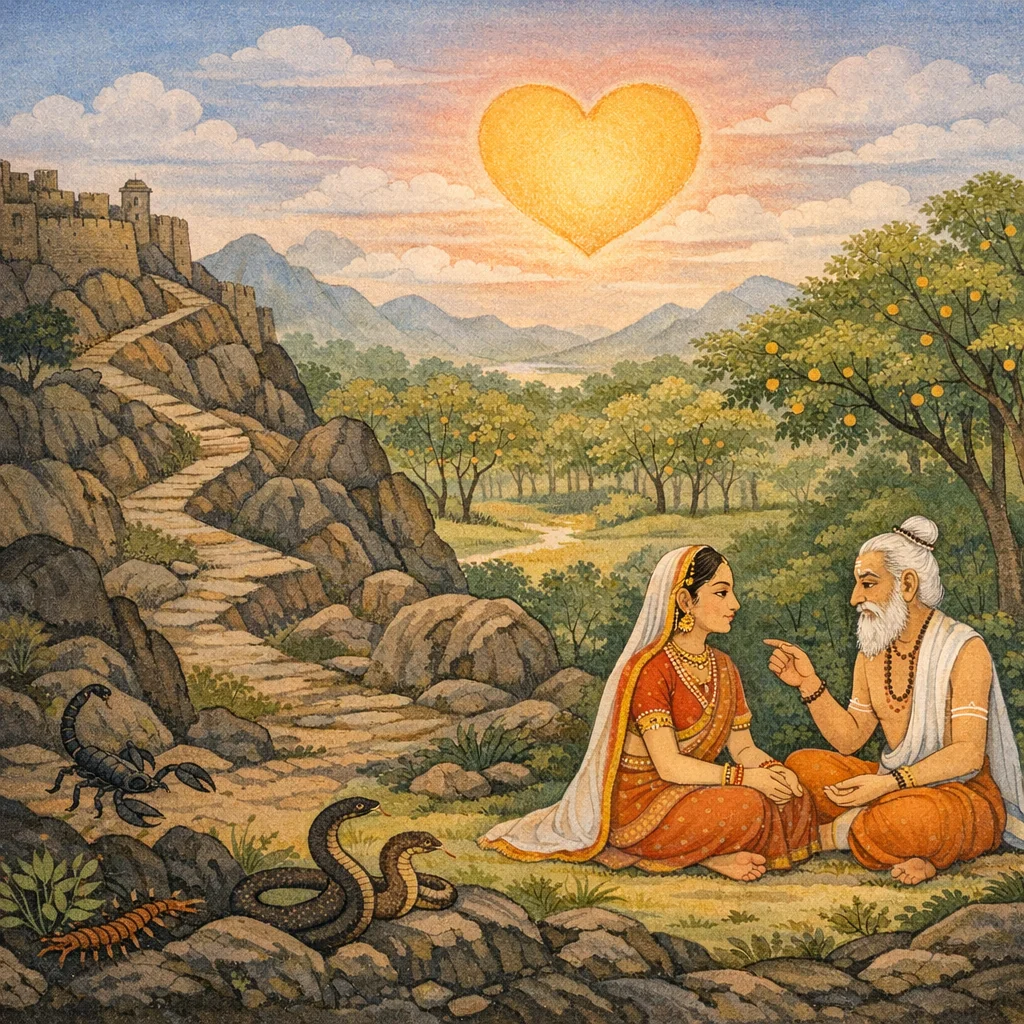
Adhyaya 27
अन्तर्वन-विद्यारण्योपमा (The Allegory of the Inner Forest of Knowledge)
Upa-parva: Āśvamedhika-parva — Adhyāya 27 (Vidyāraṇya/Antaḥ-vana Allegory)
A brāhmaṇa declares he has crossed a dangerous path dominated by sense-objects and the antagonism of desire and anger, entering a ‘great forest’ characterized by afflictive forces (saṅkalpa as biting insects; lobha as serpentine predators; moha as darkness). Questioned about its location and features, he explains paradoxically that it is neither separate nor distant in ordinary terms, and that it exceeds ordinary measures of small/large, sorrow/joy. The discourse then enumerates symbolic structures: seven great trees, seven fruits/guṇas, seven guests, seven āśramas, seven samādhis, and seven dīkṣās—presenting a schematic of disciplined life and contemplative attainments. Multiple trees generate divine flowers and fruits of varying colors, culminating in an image of a single ‘fire’ and the five senses as fuel, from which ‘mokṣas’ are said to arise through dīkṣā and cultivated qualities. Seven seers receive hospitality; a ‘vow-tree’ with the shade of peace and a knowledge-support appears, illuminated by the inner knower (kṣetrajña). Those who reach this domain are described as free from fear; further sevens appear (women/mothers, Saptarṣis, seven lights following the sun), along with mountains and rivers bearing ‘brahma-born’ waters and a confluence leading the self-satisfied disciplined to Pitāmaha (Brahmā). The chapter closes by stating that knowers of the ‘forest of knowledge’ recite an ṛc and abide in what the kṣetrajña indicates—framing liberation as an inwardly verified orientation rather than external travel.
Chapter Arc: ब्राह्मण एक अद्भुत ‘महावन’ का संकेत देता है—जहाँ संकल्प डाँस-मच्छर हैं, शोक-हर्ष, हिम-आतप, मोह का अन्धकार और लोभ की व्याधियाँ सरीसृपों की भाँति रेंगती हैं; यह वन बाहर नहीं, भीतर है। → ब्राह्मणी जिज्ञासा से पूछती है—वह वन कहाँ है, उसके वृक्ष-सरिताएँ-गिरि कौन-से हैं, और वहाँ तक पहुँचने का पथ कितना कठिन है? उत्तर में ब्राह्मण बताता है कि विषयों का एकान्त-आध्वान, काम-क्रोध का विरोध, और ‘महादुर्ग’ को पार करना पड़ता है; साधक को भीतर उतरना होता है, जहाँ भ्रम और आसक्ति मार्ग रोकते हैं। → वन का तेजस्वी रहस्योद्घाटन—वहाँ ‘प्रज्ञा-वृक्ष’ हैं, ‘मोक्ष-फल’ लगते हैं, ‘शान्ति-छाया’ है; ज्ञान आश्रय है, तृप्ति जल है, और अन्तःक्षेत्र में ‘क्षेत्रज्ञ-सूर्य’ प्रकाशित है। उसी गूढ़ हृदयाकाश में नदियों का संगम संक्षेप से होता है; योग-यज्ञ का विस्तार चलता रहता है; और वही साक्षात् पितामह-स्वरूप की ओर ले जाने वाला मार्ग बनता है। → ब्राह्मण निष्कर्ष देता है कि जिनकी आशाएँ कृश हो गई हैं, जो सुव्रत हैं, तप से पाप-दग्ध हैं—वे आत्मा में आत्मा को प्रवेश कर ब्रह्मा/परब्रह्म की उपासना करते हैं। ऐसे गुणों वाला यह पुण्य ‘अरण्य’ ब्राह्मण जानते हैं; तत्त्वदर्शी (क्षेत्रज्ञ) के निर्देश से इसे जानकर आचरण करने पर साधक स्वात्मतृप्त होकर परम लक्ष्य—साक्षात् पितामह—की ओर गमन करता है।
Shlokas
Verse 1
/ है अर ० छा | अ-क्राछ सप्तविशो< ध्याय: अध्यात्मविषयक महान् वनका वर्णन ब्राह्मण उवाच संकल्पदंशमशकं शोकहर्षहिमातपम् । मोहान्धकारतिमिरं लोभव्याधिसरीसूपम्,ब्राह्मणने कहा--प्रिये! जहाँ संकल्परूपी डाँस और मच्छरोंकी अधिकता होती है। शोक और हर्षरूपी गर्मी, सर्दीका कष्ट रहता है, मोहरूपी अन्धकार फैला हुआ है, लोभ तथा व्याधिरूपी सर्प विचरा करते हैं। जहाँ विषयोंका ही मार्ग है, जिसे अकेले ही तै करना पड़ता है तथा जहाँ काम और क्रोधरूपी शत्रु डेरा डाले रहते हैं, उस संसाररूपी दुर्गम पथका उल्लंघन करके अब मैं ब्रह्मरूपी महान् वनमें प्रवेश कर चुका हूँ
The Brahmin said: “Beloved, there is a realm where swarms of mosquitoes and gadflies take the form of restless intentions; where the alternating pains of grief and delight are like cold and heat; where the darkness of delusion spreads like night; and where greed and disease move about like serpents. Having crossed that hard-to-traverse path of worldly life—where one must go alone and where desire and anger lie encamped as enemies—I have now entered the great forest of Brahman, the inner domain of spiritual reality.”
Verse 2
विषयैकात्ययाध्वानं कामक्रोधविरोधकम् | तदतीत्य महादुर्ग प्रविष्टोडस्मि महद् वनम्,ब्राह्मणने कहा--प्रिये! जहाँ संकल्परूपी डाँस और मच्छरोंकी अधिकता होती है। शोक और हर्षरूपी गर्मी, सर्दीका कष्ट रहता है, मोहरूपी अन्धकार फैला हुआ है, लोभ तथा व्याधिरूपी सर्प विचरा करते हैं। जहाँ विषयोंका ही मार्ग है, जिसे अकेले ही तै करना पड़ता है तथा जहाँ काम और क्रोधरूपी शत्रु डेरा डाले रहते हैं, उस संसाररूपी दुर्गम पथका उल्लंघन करके अब मैं ब्रह्मरूपी महान् वनमें प्रवेश कर चुका हूँ
The Brahmin said: “Having crossed that great, fortress-like hardship—the lonely road that runs only toward sense-objects, where desire and anger stand as hostile opponents—I have now entered the vast forest of Brahman.”
Verse 3
ब्राह्मण्युवाच क्व तद् वन महाप्राज्ञ के वृक्षा: सरितश्न॒ का: । गिरय: पर्वताश्चैव कियत्यध्वनि तद् वनम्,ब्राह्मणीने पूछा--महाप्राज्ञ! वह वन कहाँ है? उसमें कौन-कौनसे वृक्ष, गिरि, पर्वत और नदियाँ हैं तथा वह कितनी दूरीपर है
The Brahmin woman said: “O greatly wise one, where is that forest? What kinds of trees are there, and what rivers flow there? What mountains and peaks are found there as well? And how far away is that forest along the road?”
Verse 4
ब्राह्मण उवाच नैतदस्ति पृथग्भाव: किंचिदन््यत् ततः सुखम् | नैतदस्त्यपृथग्भाव: किंचिद् दुःखतरं ततः,ब्राह्मणने कहा--प्रिये! उस वनमें न भेद है न अभेद, वह इन दोनोंसे अतीत है। वहाँ लौकिक सुख और दु:ख दोनोंका अभाव है
The Brahmin said: “There is no separate, divided state there—nor is there any other happiness beyond that. Nor is there a state of non-separation there—nor is there any suffering more intense than that.” In context, he points beyond ordinary oppositions (difference and non-difference) and indicates a transcendent condition where worldly pleasure and pain do not apply.
Verse 5
तस्माद् हस्वतरं नास्ति न ततो$स्ति महत्तरम् | नास्ति तस्मात् सूक्ष्मतरं नास्त्यन्यत् तत्समं सुखम्,उससे अधिक छोटी, उससे अधिक बड़ी और उससे अधिक सूक्ष्म भी दूसरी कोई वस्तु नहीं है। उसके समान सुखरूप भी कोई नहीं है
The Brāhmaṇa said: “Therefore, nothing exists that is smaller than That, nor is there anything greater than That. Nothing is subtler than That; and no other happiness exists that is equal to That.”
Verse 6
न तत्राविश्य शोचन्ति न प्रहृष्यन्ति च द्विजा: । न च बिभ्यति केषांचित् तेभ्यो बिभ्यति केचन,उस वनमें प्रवष्टि हो जानेपर द्विजातियोंको न हर्ष होता है, न शोक। न तो वे स्वयं किन्हीं प्राणियोंसे डरते हैं और न उन्हींसे दूसरे कोई प्राणी भय मानते हैं
Having entered that forest, the twice-born feel neither grief nor elation. They themselves fear no creature at all, and no other beings fear them. The scene presents an ideal of inner steadiness and harmlessness: a life so disciplined and nonviolent that it neither agitates the mind with sorrow or excitement, nor provokes fear in others.
Verse 7
तस्मिन् वने सप्त महाद्रुमाश्न फलानि सप्तातिथयश्न सप्त । सप्ताश्रमा: सप्त समाधयश्नव दीक्षाश्न सप्तैतदरण्यरूपम्,वहाँ सात बड़े-बड़े वृक्ष हैं, सात उन वृक्षोंके फल हैं तथा सात ही उन फलोंके भोक्ता अतिथि हैं। सात आश्रम हैं। वहाँ सात प्रकारकी समाधि और सात प्रकारकी दीक्षाएँ हैं। यही उस वनका स्वरूप है
The brāhmaṇa said: “In that forest there are seven mighty trees; there are seven fruits upon them, and seven guests who partake of those fruits. There are seven hermitages as well—together with seven modes of meditative absorption and seven forms of consecratory discipline. Such is the very nature of that wilderness.”
Verse 8
पज्चवर्णानि दिव्यानि पुष्पाणि च फलानि च | सृजन्तः पादपास्तत्र व्याप्य तिष्ठन्ति तद् वनम्,वहाँके वृक्ष पाँच प्रकारके रंगोंके दिव्य पुष्पों और फलोंकी सृष्टि करते हुए सब ओरसे वनको व्याप्त करके स्थित हैं
The brāhmaṇa said: “There, the trees, spreading throughout that forest, stand filling it on every side, continually producing divine flowers and fruits of five different colors.”
Verse 9
सुवर्णानि द्विवर्णानि पुष्पाणि च फलानि च । सृजन्तः पादपास्तत्र व्याप्य तिष्ठन्ति तद् वनम्,वहाँ दूसरे वृक्षोंने सुन्दर दो रंगवाले पुष्प और फल उत्पन्न करते हुए उस वनको सब ओरसे व्याप्त कर रखा है
The trees there, spreading throughout that forest, stand filling it on every side, producing golden-hued, two-coloured blossoms and fruits—an image of abundance and auspiciousness that frames the scene with wonder and moral uplift.
Verse 10
सुरभीणि द्विवर्णानि पुष्पाणि च फलानि च । सृजन्तः पादपास्तत्र व्याप्य तिष्ठन्ति तद् वनम्,तीसरे वृक्ष वहाँ सुगन्धयुक्त दो रंगवाले पुष्प और फल प्रदान करते हुए उस वनको व्याप्त करके स्थित हैं
The brāhmaṇa said: “There, the trees pervade the whole forest, standing spread throughout it, continually producing fragrant flowers of two colours, and fruits as well.”
Verse 11
सुरभीण्येकवर्णानि पुष्पाणि च फलानि च | सृजन्तः पादपास्तत्र व्याप्य तिष्ठन्ति तद् वनम्,चौथे वृक्ष सुगन्धयुक्त केवल एक रंगवाले पुष्प और फलोंकी सृष्टि करते हुए उस वनके सब ओर फैले हैं
There, the trees spread throughout that forest, continually producing fragrant flowers and fruits of a single hue. The scene conveys a quiet, ordered abundance—nature’s steadiness and purity standing as a moral contrast to human restlessness and conflict.
Verse 12
बहुन्यव्यक्तवर्णानि पुष्पाणि च फलानि च । विसृजन्तौ महावृक्षौ तद् वन॑ व्याप्य तिषछत:,वहाँ दो महावृक्ष बहुत-से अव्यक्त रंगवाले पुष्प और फलोंकी रचना करते हुए उस वनको व्याप्त करके स्थित हैं
The brāhmaṇa said: “Two great trees stand there, spreading through and filling that forest, continually producing many flowers and fruits whose colors are indistinct.”
Verse 13
एको वह्ि: सुमना ब्राह्मणोउत्र पज्चेन्द्रियाणि समिथधश्चात्र सन्ति । तेभ्यो मोक्षा: सप्त फलन्ति दीक्षा गुणा: फलान्यतिथय: फलाशा:,उस वनमें एक ही अग्नि है, जीव शुद्धचेता ब्राह्मण है, पाँच इन्द्रियाँ समिधाएँ हैं। उनसे जो मोक्ष प्राप्त होता है, वह सात प्रकारका है। इस यज्ञकी दीक्षाका फल अवश्य होता है। गुण ही फल है। सात अतिथि ही फलोंके भोक्ता हैं
The Brāhmaṇa said: “In this forest there is a single fire; the living self, pure in intention, is the Brāhmaṇa. The five senses are the fuel-sticks laid into that fire. From that inner sacrifice arise seven kinds of liberation. The consecration for this sacrifice is never fruitless: virtue itself is the fruit, and the seven ‘guests’ are the enjoyers of those fruits.”
Verse 14
आतिथयं प्रतिगृह्नन्ति तत्र तत्र महर्षय: । अचितेषु प्रलीनेषु तेष्वन्यद् रोचते वनम्,वे महर्षिगण इस यज्ञमें आतिथ्य ग्रहण करते हैं और पूजा स्वीकार करते ही उनका लय हो जाता है। तत्पश्चात् वह ब्रह्मरूप वन विलक्षणरूपसे प्रकाशित होता है
The great seers, appearing here and there, accept the offered hospitality. When those unperceived sages have merged back into invisibility, the forest then shines forth in another, wondrous aspect—as though revealing a subtler, brahman-like radiance. The passage underscores the ethic of honoring guests and holy persons: service rendered without bargaining for recognition becomes the very condition for a higher, hidden reality to disclose itself.
Verse 15
प्रज्ञावृक्षं मोक्षफलं शान्तिच्छायासमन्वितम् । ज्ञानाश्रयं तृप्तितोयमन्तःक्षेत्रज्रभास्करम्,उसमें प्रज्ञारूपी वृक्ष शोभा पाते हैं, मोक्षरूपी फल लगते हैं और शान्तिमयी छाया फैली रहती है। ज्ञान वहाँका आश्रयस्थान और तृप्ति जल है। उस वनके भीतर आत्मारूपी सूर्यका प्रकाश छाया रहता है
The Brahmin said: “There is a wondrous inner grove: its tree is wisdom, its fruit is liberation, and it is spread over with the cool shade of peace. Knowledge is its refuge, contentment is its water, and within it shines the sun of the Knower of the Field (the Self), illuminating all from inside.”
Verse 16
येडथिगच्छन्ति तं सन्तस्तेषां नास्ति भयं पुनः । ऊर्ध्व॑ चाधश्व तिर्यक् च तस्य नान्तोडथिगम्यते,जो श्रेष्ठ पुछणष उस वनका आश्रय लेते हैं, उन्हें फिर कभी भय नहीं होता। वह वन ऊपर-नीचे तथा इधर-उधर सब ओर व्याप्त है। उसका कहीं भी अन्त नहीं है
The Brahmin said: Those good and wise people who reach and take refuge in That (supreme reality) are never again seized by fear. It pervades above and below and in every direction; its end cannot be reached or comprehended anywhere. The verse emphasizes that true security is not found in worldly supports but in realizing the all-pervading, limitless ground of being, which dissolves fear at its root.
Verse 17
सप्त स्त्रियस्तत्र वसन्ति सद्य- स्त्ववाड्मुखा भानुमत्यो जनित्रय: । ऊर्ध्व रसानाददते प्रजाभ्य: सर्वान् यथा सत्यमनित्यता च,वहाँ सात स्त्रियाँ निवास करती हैं, जो लज्जाके मारे अपना मुँह नीचेकी ओर किये रहती हैं। वे चिन्मय ज्योतिसे प्रकाशित होती हैं। वे सबकी जननी हैं और वे उस वनमें रहनेवाली प्रजासे सब प्रकारके उत्तम रस उसी प्रकार ग्रहण करती हैं, जैसे अनित्यता सत्यको ग्रहण करती है
The brāhmaṇa said: “There dwell seven women there, ever with faces cast downward in modesty. They shine with conscious radiance and are the mothers of all. From the beings who live in that ‘forest’ they draw up every kind of finest essence—just as impermanence, in its own way, lays hold of truth.”
Verse 18
तत्रैव प्रतितिष्ठन्ति पुनस्तत्रोपयन्ति च | सप्त सप्तर्षय: सिद्धा वसिष्ठप्रमुखै:ः सह,सात सिद्ध सप्तर्षि वसिष्ठ आदिके साथ उसी वनमें लीन होते और उसीसे उत्पन्न होते हैं
There itself they abide; and again, to that very place they return. The seven perfected sages—the Saptarṣis—headed by Vasiṣṭha, are said to merge into that forest and to arise again from it, indicating a sacred locus where realized beings cyclically withdraw and re-emerge.
Verse 19
यशो वर्चो भगश्चैव विजय: सिद्धतेजस: । एवमेवानुवर्तन्ते सप्त ज्योतींषि भास्करम्,यश, प्रभा, भग (ऐश्वर्य), विजय, सिद्धि (ओज) और तेज--ये सात ज्योतियाँ उपर्युक्त आत्मारूपी सूर्यका ही अनुसरण करती हैं
The Brahmin said: “Fame, spiritual radiance, prosperity and lordly fortune, victory, accomplishment, and perfected vigor—these seven lights follow the Sun. In the same way, these qualities are not independent possessions; they attend upon the true inner Self, as rays attend upon the sun, and arise when one is aligned with that Self.”
Verse 20
गिरय: पर्वताश्षैव सन्ति तत्र समासत: । नद्यश्न सरितो वारि वहन्त्यो ब्रह्म॒ुसम्भवम्,उस ब्रद्मतत्त्वमें ही गिरि, पर्वत, झरनें, नदी और सरिताएँ स्थित हैं, जो ब्रह्म णनित जल बहाया करती हैं
The Brahmin said: “There, in brief, are found mountains and lofty peaks; and rivers and streams flow on, bearing waters that arise from Brahman.” The statement frames the landscape as sacred and ethically instructive: the natural world is presented not merely as geography, but as a manifestation rooted in the ultimate principle, inviting reverence, restraint, and purity of conduct toward all that sustains life.
Verse 21
नदियोंका संगम भी उसीके अत्यन्त गूढ़ हृदयाकाशमें संक्षेपसे होता है। जहाँ योगरूपी यज्ञका विस्तार होता रहता है। वही साक्षात् पितामहका स्वरूप है। आत्मज्ञानसे तृप्त पुरुष उसीको प्राप्त होते हैं
The confluence of rivers, too, is gathered in brief within that very deep inner sky of the heart. There, the sacrifice that is Yoga continues to unfold in its full expanse. That reality is none other than the manifest form of the Grandfather (Brahmā). Those who are satisfied through knowledge of the Self attain that alone.
Verse 22
कृशाशा: सुव्रताशाश्च॒ तपसा दग्धकिल्बिषा: । आत्मन्यात्मानमाविश्य ब्रह्माणं समुपासते,जिनकी आशा क्षीण हो गयी है, जो उत्तम व्रतके पालनकी इच्छा रखते हैं। तपस्यासे जिनके सारे पाप दग्ध हो गये हैं। वे ही पुरुष अपनी बुद्धिको आत्मनिष्ठ करके परब्रह्मकी उपासना करते हैं
Those whose worldly hopes have withered, who long to uphold noble vows, and whose sins have been burned away by austerity—such persons, turning the mind inward and establishing the self in the self, worship the Supreme Brahman. The verse frames spiritual life as an ethical purification: restraint, disciplined vows, and inner recollection culminate in contemplation of Brahman rather than pursuit of external rewards.
Verse 23
शममप्यत्र शंसन्ति विद्यारण्यविदो जना: । तदारण्यमभिप्रेत्य यथाधीरभिजायत,विद्या (ज्ञान)-के ही प्रभावसे ब्रह्मरूपी वनका स्वरूप समझमें आता है। इस बातको जाननेवाले मनुष्य इस वनमें प्रवेश करनेके उद्देश्यसे शम (मनोनिग्रह)-की ही प्रशंसा करते हैं, जिससे बुद्धि स्थिर होती है
Here, those who truly understand the ‘forest of knowledge’ also praise self-restraint. With the aim of entering that inner forest, one cultivates śama (control of the mind), by which the intellect becomes steady and fit to apprehend the nature of Brahman-like reality.
Verse 24
एतदेवेदृशं पुण्यमरण्यं ब्राह्मणा विदु: । विदित्वा चानुतिष्ठ त्ति क्षेत्रज्ञेनानुदर्शिता,ब्राह्मण ऐसे गुणवाले इस पवित्र वनको जानते हैं और तत्त्वदर्शीके उपदेशसे प्रबुद्ध हुए आत्मज्ञानी पुरुष उस ब्रह्मवनको शास्त्रतटः जानकर शम आदि साधनोंके अनुष्ठानमें लग जाते हैं
Brahmins recognize this very forest—such as it is—as holy. And, having understood it, those who have been shown the truth by a knower of the Field (the Self) set themselves to disciplined practice, living out the teaching through inner restraint and related spiritual means.
Verse 26
इस प्रकार श्रीमह्याभारत आश्वमेधिकपर्वके अन्तर्गत अनुगीतापर्वमें ब्राह्मणगीताविषयक छब्बीसवाँ अध्याय पूरा हुआ
Thus ends the twenty-sixth chapter on the theme of the Brāhmaṇa’s Song within the Anugītā section of the Aśvamedhika Parva of the sacred Mahābhārata. This closing colophon signals the completion of a didactic unit, framing the preceding discourse as a self-contained ethical and spiritual teaching.
Verse 27
इति श्रीमहाभारते आश्वमेधिके पर्वणि अनुगीतापर्वणि ब्राह्मणगीतासु सप्तविंशोडध्याय:
Thus, in the Śrī Mahābhārata, within the Aśvamedhika Parva, in the Anugītā section, in the Brāhmaṇa-gītās, ends the twenty-seventh chapter. This is a colophon marking the close of a unit of teaching attributed to a brāhmaṇa speaker, situating the discourse within the ethical and reflective frame of the Anugītā.
Verse 231
नदीनां सड़मश्नैव वैताने समुपद्लरे । स्वात्मतृप्ता यतो यान्ति साक्षादेव पितामहम्
The Brāhmaṇa said: “In the sacrificial rite, they partake of the saḍa offering; and, being inwardly satisfied in their own self, they proceed from there to Pitāmaha himself—directly.”
Frequently Asked Questions
The speaker frames a practical ethical conflict: how to traverse a life dominated by sensory fixation (viṣaya) while countering the destabilizing forces of desire and anger without being consumed by grief, elation, or fear.
The ‘forest’ signifies the inner field of experience: suffering and safety depend on identification and clarity. Knowledge (jñāna) and recognition of the inner knower (kṣetrajña) reorganize perception, making fearlessness a function of insight and discipline.
Yes. Mokṣa is presented as emerging from disciplined engagement with the senses (five as ‘fuel’) under a unifying inner principle (single ‘fire’), supported by structured practices and qualities (the repeated sapta schema), rather than as a merely external achievement.