Adhyaya 118
पाण्डोः प्रेतकार्य-सम्पादनम् (Pāṇḍu’s Funeral Rites and Public Mourning)
Upa-parva: Pāṇḍu–Mādrī Antyeṣṭi (Funeral Rites Episode)
Dhṛtarāṣṭra instructs Vidura to conduct all funerary rites for Pāṇḍu and to extend special honor to Mādrī, ensuring treatment comparable to Kuntī and emphasizing protective seclusion. Vaiśaṃpāyana narrates how Vidura, assisted by Bhīṣma, arranges the rites in a carefully prepared, secluded place. Fire is brought forth with ghee-offerings; the bier and vehicle are decorated with garlands, garments, and fragrances; officials, relatives, and allies assemble. Gifts—animals, clothing, jewels, and wealth—are distributed as part of the ūrdhva-dehika obligations. The procession proceeds with parasols, fans, instruments, and priests in white performing oblations. Large crowds across social groups follow, lamenting; the body is bathed, anointed with sandal and aromatics, clothed, and then cremated with abundant fragrances. The sight of the bodies triggers collapse and collective weeping; even non-human beings are described as reacting to the sound of lament. After cremation, Bhīṣma, Vidura, the king, and Kuru women perform water rites. The city remains joyless and unsettled for twelve nights, indicating prolonged civic mourning and political fragility after the loss.
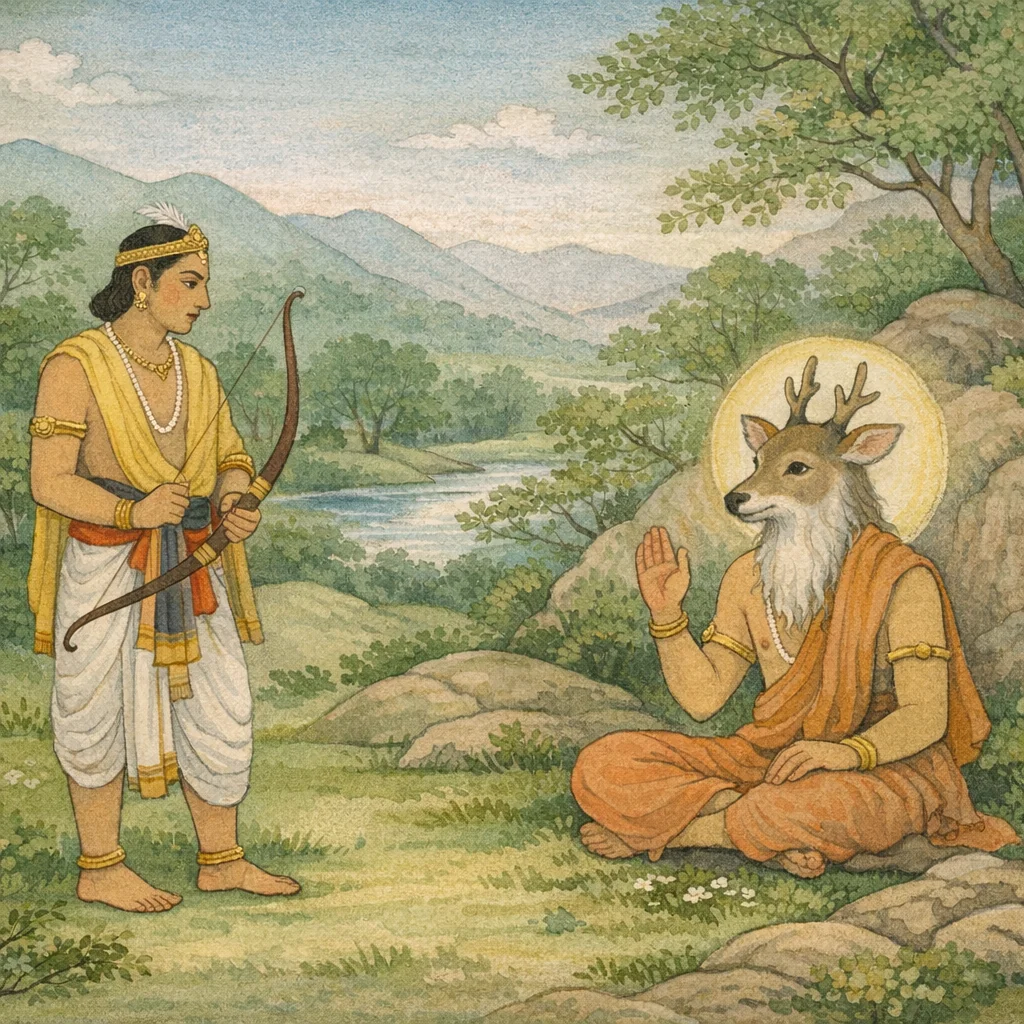
Chapter Arc: जनमेजय के प्रश्नों के बीच वंश-वर्णन की धारा अचानक एक वन-प्रसंग में मुड़ती है—पाण्डु शिकार में प्रवृत्त होकर एक मृग पर बाण चलाते हैं, और वही क्षण उनके भाग्य का द्वार बन जाता है। → घायल मृग मनुष्य-वाणी में बोल उठता है और अपना रहस्य प्रकट करता है—वह तपस्वी है जो मृग-रूप धारण कर मैथुन-क्षण की प्रतीक्षा में था। पाण्डु अपने राजधर्म (शिकार/दण्ड) का तर्क देते हैं, पर मृग-तपस्वी ‘अनार्य हिंसा’ और ‘असमय वध’ का दोष दिखाकर अपराध को और तीखा कर देता है। → मृग-तपस्वी शाप देता है—जिस प्रकार तुमने मुझे सुख के बीच दुःख दिया, उसी प्रकार तुम भी सुख के क्षण में दुःख (मृत्यु) पाओगे; विशेषतः स्त्री-संग के समय प्राणान्त होगा। शापोच्चार के साथ ही तपस्वी जीवन त्याग देता है और पाण्डु क्षण भर में शोक-ग्रस्त हो उठते हैं। → वैशम्पायन के कथनानुसार शाप के बाद मृग-रूपधारी तपस्वी देह त्याग देता है; पाण्डु पर अपराध-बोध, भय और वैराग्य का आवरण छा जाता है—राजसुख और दाम्पत्य-सुख अब मृत्यु-छाया से बँध जाते हैं। → शाप का फल कैसे टलेगा? पाण्डु राज्य और दाम्पत्य के बीच कौन-सा मार्ग चुनेंगे—और वंश-परम्परा आगे कैसे चलेगी?
Shlokas
Verse 1
पाता पा. [धछ। ई>आब :क हे 5 कम नी ्स्स्ॉज ४: - आदिपर्वके सरसठवें अध्यायमें भी धृतराष्ट्रके सौ पुत्रोंके नाम आये हैं। वहाँ जो नाम दिये गये हैं, उनमेंसे अधिकांश नाम इस अध्यायमें भी ज्यों-के-त्यों हैं। कुछ नामोंमें साधारण अन्तर है, जिन्हें यहाँ कोष्ठकमें दे दिया गया है। इस प्रकार यहाँ और वहाँके नामोंकी एकता की गयी है। थोड़े-से नाम ऐसे भी हैं, जिनका मेल नहीं मिलता। नामोंके क्रममें भी दोनों स्थलोंमें अन्तर है। सम्भव है, उनके दो-दो नाम रहे हों और दोनों स्थलोंमें भिन्न-भिन्न नामोंका उल्लेख हो। सप्तदशाधिकशततमो< ध्याय: राजा पाण्डुके द्वारा मृगरूपधारी मुनिका वध तथा उनसे शापकी प्राप्ति जनमेजय उवाच कथितो धार्तराष्ट्राणामार्ष: सम्भव उत्तम: | अमनुष्यो मनुष्याणां भवता ब्रह्मवादिना,जनमेजयने कहा--भगवन्! आपने धृतराष्ट्रके पुत्रोंके जन्मका उत्तम प्रसंग सुनाया है, जो महर्षि व्यासकी कृपासे सम्भव हुआ था। आप ब्रह्मवादी हैं। आपने यद्यपि यह मनुष्योंके जन्मका वृतान्त बताया है, तथापि यह दूसरे मनुष्योंमें कभी नहीं देखा गया
Janamejaya said: “Revered sir, you have recounted the excellent, seer-sanctioned account of the birth of Dhṛtarāṣṭra’s sons—an extraordinary occurrence. Though you are a knower and speaker of Brahman and have described it as a human lineage, such a manner of birth is not something ordinarily seen among people.”
Verse 2
नामथेयानि चाप्येषां कथ्यमानानि भागश: । त्वत्त: श्रुतानि मे ब्रह्म॒न् पाण्डवानां च कीर्तय,ब्रह्मन! इन धृतराष्ट्रपुत्रोंक पृथक्ू-पृथक् नाम भी जो आपने कहे हैं, वे मैंने अच्छी तरह सुन लिये। अब पाण्डवोंके जन्मका वर्णन कीजिये
Janamejaya said: “O Brahmin, I have clearly heard from you the individual names of these sons of Dhṛtarāṣṭra as they were recounted in parts. Now, please relate the account of the Pāṇḍavas as well.”
Verse 3
ते हि सर्वे महात्मानो देवराजपराक्रमा: । त्वयैवांशावतरणे देवभागा: प्रकीर्तिता:,वे सब महात्मा पाण्डव देवराज इन्द्रके समान पराक्रमी थे। आपने ही अंशावतरणके प्रसंगमें उन्हें देवताओंका अंश बताया था
Janamejaya said: “All those great-souled men were possessed of the prowess of the king of the gods (Indra). Indeed, you yourself, while recounting the descent of divine portions into the world, declared them to be shares of the gods.”
Verse 4
एतदिच्छाम्यहं श्रोतुमतिमानुषकर्मणाम् । तेषामाजनन सर्व वैशम्पायन कीर्तय,वैशम्पायनजी! वे ऐसे पराक्रम कर दिखाते थे, जो मनुष्योंकी शक्तिके परे हैं; अतः मैं उनके जन्म-सम्बन्धी वृत्तान्तको सम्पूर्णतासे सुनना चाहता हूँ; कृपा करके कहिये
Janamejaya said: “This is what I wish to hear—how those men, whose deeds surpass ordinary human measure, came to be born. O Vaiśampāyana, recount for me in full the entire account of their births.”
Verse 5
वैशम्पायन उवाच राजा पाण्डुर्महारण्ये मृगव्यालनिषेविते । चरन् मैथुनधर्मस्थं ददर्श मृगयूथपम्,वैशम्पायनजी बोले--जनमेजय! एक समय राजा पाण्डु मृगों और सर्पोंसे सेवित विशाल वनमें विचर रहे थे। उन्होंने मृगोंके एक यूथपतिको देखा, जो मृगीके साथ मैथुन कर रहा था
Verse 6
ततस्तां च मृगीं तं च रुक्मपुड्खै: सुपत्रिभि: । निर्बिभेद शरैस्ती3्ष्णै: पाण्डु: पउचभिराशुगै:,उसे देखते ही राजा पाण्डुने पाँच सुन्दर एवं सुनहरे पंखोंसे युक्त तीखे तथा शीघ्रगामी बाणोंद्वारा, उस मृगी और मृगको भी बींध डाला
Then King Pāṇḍu, seeing both the doe and the stag, pierced them with five swift, sharp arrows, each adorned with golden shafts and fine feathers—an act that, though fitting a hunter’s aim, sets in motion a grave ethical consequence because it strikes at life in a vulnerable moment and without discernment.
Verse 7
सच राजन् महातेजा ऋषिपुत्रस्तपो धन: । भार्यया सह तेजस्वी मृगरूपेण संगत:,राजन! उस मृगके रूपमें एक महातेजस्वी तपोधन ऋषिपुत्र थे, जो अपनी मृगीरूपधारिणी पत्नीके साथ तेजस्वी मृग बनकर समागम कर रहे थे
And, O King, there was a son of a sage—rich in ascetic merit and blazing with spiritual power—who, together with his wife, had assumed the form of a deer. In that deer-form, the radiant pair were engaged in union, setting the scene for the moral tension between uncontrolled impulse, the sanctity of life, and the grave consequences of harming beings in such a state.
Verse 8
संसक्तश्न तया मृग्या मानुषीमीरयन् गिरम् । क्षणेन पतितो भूमौ विललापाकुलेन्द्रिय:,वे उस मृगीसे सटे हुए ही मनुष्योंकी-सी बोली बोलते हुए क्षणभरमें पृथ्वीपर गिर पड़े। उनकी इन्द्रियाँ व्याकुल हो गयीं और वे विलाप करने लगे
Clinging closely to that doe and uttering words in a human-like voice, he suddenly fell to the ground. His senses became agitated, and he began to lament—showing how attachment can swiftly unseat self-control and bring a person to distress.
Verse 9
मृग उवाच काममन्युपरीता हि बुद्धा विरहिता अपि | वर्जयन्ति नृशंसानि पापेष्वपि रता नरा:,मृगने कहा--राजन्! जो मनुष्य काम और क्रोधसे घिरे हुए, बुद्धिशून्य तथा पापोंमें संलग्न रहनेवाले हैं, वे भी ऐसे क्रूरतापूर्ण कर्मको त्याग देते हैं। बुद्धि प्रारब्धको नहीं ग्रसती (नहीं लाँध सकती) प्रारब्ध ही बुद्धिको अपना ग्रास बना लेता है (भ्रष्ट कर देता है)। प्रारब्धसे प्राप्त होनेवाले पदार्थोंको बुद्धिमान् पुरुष भी नहीं जान पाता
The deer said: “O King, even men who are beset by desire and anger, though devoid of sound judgment and even addicted to sinful ways, still refrain from acts of sheer cruelty. Such ruthless deeds are commonly abandoned even by the wicked—so powerful is the natural moral recoil from wanton violence.”
Verse 10
न विधिं ग्रसते प्रज्ञा प्रज्ञां तु ग्रसते विधि: । विधिपर्यागतानर्थान् प्राज्ञो न प्रतिपद्यते,मृगने कहा--राजन्! जो मनुष्य काम और क्रोधसे घिरे हुए, बुद्धिशून्य तथा पापोंमें संलग्न रहनेवाले हैं, वे भी ऐसे क्रूरतापूर्ण कर्मको त्याग देते हैं। बुद्धि प्रारब्धको नहीं ग्रसती (नहीं लाँध सकती) प्रारब्ध ही बुद्धिको अपना ग्रास बना लेता है (भ्रष्ट कर देता है)। प्रारब्धसे प्राप्त होनेवाले पदार्थोंको बुद्धिमान् पुरुष भी नहीं जान पाता
The deer said: “O King, even people hemmed in by desire and anger—bereft of discernment and given to sin—still refrain from certain acts of cruelty. For wisdom cannot overtake what is ordained; rather, destiny overpowers and consumes wisdom itself. Even a truly intelligent person cannot fully anticipate or master the outcomes that arrive through the force of fate.”
Verse 11
शश्वद्धर्मात्मनां मुख्ये कुले जातस्यथ भारत । कामलोभाभिभूतस्य कथं ते चलिता मति:,भारत! सदा धर्ममें मन लगानेवाले क्षत्रियोंके प्रधान कुलमें तुम्हारा जन्म हुआ है, तो भी काम और लोभके वशीभूत होकर तुम्हारी बुद्धि धर्मसे कैसे विचलित हुई?
The deer said: “O Bhārata, you were born in a foremost lineage of kṣatriyas who are ever devoted to dharma. How, then, has your mind strayed from righteousness—overpowered by desire and greed?”
Verse 12
पाण्डुरुवाच शत्रूणां या वधे वृत्ति: सा मृगाणां वधे स्मृता । राज्ञां मृग न मां मोहात् त्वं ग्हयितुमहसि,पाण्डु बोले--शत्रुओंके वधमें राजाओंकी जैसी वृत्ति बतायी गयी है, वैसी ही मृगोंके वधमें भी मानी गयी है; अतः मृग! तुम्हें मोहवश मेरी निन्दा नहीं करनी चाहिये
Pāṇḍu said: “The same sanctioned conduct that is prescribed for kings in the slaying of enemies is also held to apply to the slaying of deer. Therefore, O deer, you should not, out of delusion, condemn or censure me.”
Verse 13
अच्छटदटना मायया च मृगाणां वध इष्यते । स एव धर्मों राज्ञां तु तद्धि त्वं कि नु गर्हसे,प्रकट या अप्रकट रूपसे मृगोंका वध हमारे लिये अभीष्ट है। वह राजाओंके लिये धर्म है, फिर तुम उसकी निन्दा कैसे करते हो?
“Whether by open pursuit or by stealth and stratagem, the killing of deer is considered permissible. Indeed, for kings this is held to be a duty; why then do you condemn it?”
Verse 14
अगस्त्य: सत्रमासीनश्नकार मृगयामृषि: । आरण्यान् सर्वदेवेभ्यो मृगान् प्रेषन् महावने,महर्षि अगस्त्य एक सत्रमें दीक्षित थे, तब उन्होंने भी मृगया की थी। सभी देवताओंके हितके लिये उन्होंने सत्रमें विघ्न करनेवाले पशुओंको महान् वनमें खदेड़ दिया था। अगस्त्य ऋषिके उक्त हिंसाकर्मके अनुसार (मुझ क्षत्रियके लिये तो) तुम्हारा वध करना ही उचित है। मैं प्रमाणसिद्ध धर्मके अनुकूल बर्ताव करता हूँ, तो भी तुम क्यों मेरी निन्दा करते हो?
The deer said: “Even the sage Agastya, while seated in a sacrificial session (sattra), once engaged in hunting. For the welfare of all the gods, he drove the forest-dwelling deer away into the great wilderness, since they were causing obstruction to the rite. Therefore, in keeping with that act of violence performed by Agastya, it is proper for me—a kṣatriya—to kill you. When I act in accordance with dharma established by authoritative precedent, why do you still condemn me?”
Verse 15
प्रमाणदृष्टधर्भेण कथमस्मान् विगर्हसे । अगस्त्यस्याभिचारेण युष्माकं॑ विहितो वध:,महर्षि अगस्त्य एक सत्रमें दीक्षित थे, तब उन्होंने भी मृगया की थी। सभी देवताओंके हितके लिये उन्होंने सत्रमें विघ्न करनेवाले पशुओंको महान् वनमें खदेड़ दिया था। अगस्त्य ऋषिके उक्त हिंसाकर्मके अनुसार (मुझ क्षत्रियके लिये तो) तुम्हारा वध करना ही उचित है। मैं प्रमाणसिद्ध धर्मके अनुकूल बर्ताव करता हूँ, तो भी तुम क्यों मेरी निन्दा करते हो?
The deer said: “How can you condemn us when we act in accordance with a dharma established by valid authority and precedent? By the precedent of Agastya’s own action, your death has been ordained. For the welfare of the gods, the great sage Agastya—though consecrated for a sacrificial session—once engaged in the hunt and drove away the animals that were obstructing the rite into the great forest. In keeping with that sanctioned act of violence, it is proper for me, a kṣatriya, to slay you. If I am behaving in line with a dharma proven by authoritative example, why do you still censure me?”
Verse 16
मगृग उवाच न रिपून् वै समुद्दिश्य विमुड्चन्ति नरा: शरान् | रन्ध्र एषां विशेषेण वध: काले प्रशस्यते,मृगने कहा--मनुष्य अपने शत्रुओंपर भी, विशेषत: जब वे संकटकालनमें हों, बाण नहीं छोड़ते। उपयुक्त अवसर (संग्राम आदि)-में ही शत्रुओंके वधकी प्रशंसा की जाती है
The deer said: “Men do not loose arrows even at their enemies merely by pointing them out. The slaying of foes is praised only when a true opening presents itself—especially when the time is proper, such as in battle. To strike at one who is in distress is not held up as worthy; right action depends on occasion and fairness.”
Verse 17
पाण्डुरुवाच प्रमत्तमप्रमत्तं वा विवृत्तं घ्नन्ति चौजसा । उपायैर्विविधैस्तीक्ष्णपै: कस्मान्मृग विगर्हसे,पाण्डु बोले--मृग! राजालोग नाना प्रकारके तीक्ष्ण उपायोंद्वारा बलपूर्वक खुले-आम मृगका वध करते हैं; चाहे वह सावधान हो या असावधान। फिर तुम मेरी निन्दा क्यों करते हो?
Pāṇḍu said: “Whether a deer is heedless or alert, hunters strike it down openly and by force, using many sharp and varied stratagems. So why, O deer, do you condemn me?”
Verse 18
मृग उवाच नाहं घ्नन्तं मृगान् राजन् विगहें चात्मकारणात् | मैथुन तु प्रतीक्ष्यं मे त्वयेहाद्यानृशंस्यत:,मृगने कहा--राजन्! मैं अपने मारे जानेके कारण इस बातके लिये तुम्हारी निन्दा नहीं करता कि तुम मृगोंको मारते हो। मुझे तो इतना ही कहना है कि तुम्हें दयाभावका आश्रय लेकर मेरे मैथुनकर्मसे निवृत्त होनेतक प्रतीक्षा करनी चाहिये थी
The deer said: “O King, I do not reproach you for killing deer, even though I myself am the cause of this death. Yet, out of compassion, you ought to have waited here until I had finished the act of mating.”
Verse 19
सर्वभूतहिते काले सर्वभूतेप्सिते तथा । को हि विद्वान् मृगं हन्याच्चरन्तं मैथुनं वने,जो सम्पूर्ण भूतोंके लिये हितकर और अभीष्ट है, उस समयमें वनके भीतर मैथुन करनेवाले किसी मृगको कौन विवेकशील पुरुष मार सकता है?
At a time that is beneficial to all beings and desired by all creatures, what wise man would kill a deer in the forest while it is engaged in mating? The speaker appeals to restraint and compassion, implying that even lawful hunting becomes ethically blameworthy when it violates a universally auspicious season and the natural continuance of life.
Verse 20
अस्यां मृग्यां च राजेन्द्र हर्षान्मैथुनमाचरम् । पुरुषार्थफलं कर्तु तत् त्वया विफलीकृतम्,राजेन्द्र! मैं बड़े हर्ष और उललासके साथ अपने कामरूपी पुरुषार्थको सफल करनेके लिये इस मृगीके साथ मैथुन कर रहा था; किंतु तुमने उसे निष्फल कर दिया
“O king, I was, in great delight, engaging in union with this doe in order to fulfill the fruit of my human striving—desire itself. But you have rendered that act fruitless.” In context, the deer’s speech frames the king’s interruption as a violation of natural and ethical boundaries: an act driven by royal power that disrupts another being’s rightful pursuit of its own life-impulse, and thus becomes the seed of moral consequence.
Verse 21
पौरवाणां महाराज तेषामक्लिष्टकर्मणाम् | वंशे जातस्य कौरव्य नानुरूपमिदं तव,महाराज! क्लेशरहित कर्म करनेवाले कुरुवंशियोंके कुलमें जन्म लेकर तुमने जो यह कार्य किया है, यह तुम्हारे अनुरूप नहीं है
The deer said: “O great king, you are born in the lineage of the Pauravas—men whose deeds are not stained by cruelty or hardship inflicted on others. O Kauravya, this act you have done is not fitting for you, O king.”
Verse 22
नृशंसं कर्म सुमहत् सर्वलोकविगर्हितम् | अस्वर्ग्यमयशस्यं चाप्यधर्मिष्ठं च भारत,भारत! अत्यन्त कठोरतापूर्ण कर्म सम्पूर्ण लोकोंमें निन्दित है। वह स्वर्ग और यशको हानि पहुँचानेवाला है। इसके सिवा वह महान् पापकृत्य है
O Bhārata, this is a most cruel deed—grave and condemned by all the world. It destroys one’s claim to heaven and brings only disgrace; indeed, it is thoroughly unrighteous. (Thus the deer warns against a harsh, sinful act that violates dharma and public moral order.)
Verse 23
स्त्रीभोगानां विशेषज्ञ: शास्त्रधर्मार्थतत्त्ववित् नाहस्त्वं सुरसंकाश कर्तुमस्वर्ग्यमीदूशम्,देवतुल्य महाराज! तुम स्त्री-भोगोंके विशेषज्ञ तथा शास्त्रीय धर्म एवं अर्थके तत्त्वको जाननेवाले हो। तुम्हें ऐसा नरकप्रद पापकार्य नहीं करना चाहिये था
The deer said: “You are an expert in the pleasures of women and a knower of the true principles of dharma and artha as taught in the śāstras. O radiant one, you ought not to have done such a deed that leads away from heaven—such a sin. O great king, you are like a god.”
Verse 24
त्वया नृशंसकर्तार: पापाचाराश्न मानवा: । निग्राह्या: पार्थिवश्रेष्ठ त्रिवर्गपरिवर्जिता:,नृूपशिरोमणे! तुम्हारा कर्तव्य तो यह है कि धर्म, अर्थ और कामसे हीन जो पापाचारी मनुष्य कठोरतापूर्ण कर्म करनेवाले हों, उन्हें दण्ड दो
The deer said: “O best of kings, jewel among rulers—your duty is to restrain and punish those sinful men who commit cruel deeds and live by wicked conduct, being devoid of the three aims of life (dharma, artha, and kāma).”
Verse 25
कि कृतं ते नरश्रेष्ठ मामिहानागसं घ्नता । मुनिं मूलफलाहारं मृगवेषधरं नृप,नरश्रेष्ठ! मैं तो फल-मूलका आहार करनेवाला एक मुनि हूँ और मृगका रूप धारण करके शम-दमके पालनमें तत्पर हो सदा जंगलोंमें ही निवास करता हूँ। मुझ निरपराधको मारकर यहाँ तुमने क्या लाभ उठाया? तुमने मेरी हत्या की है, इसलिये बदलेमें मैं भी तुम्हें शाप देता हूँ
The deer said: “O best of men, what have you gained by killing me here though I am without offense? O king, I am an ascetic who lives on roots and fruits, wearing the guise of a deer. By striking down an innocent, you have committed a grave wrong; therefore, in return, I pronounce a curse upon you.”
Verse 26
वसमानमरण्येषु नित्यं शमपरायणम् । त्वयाहं हिंसितो यस्मात् तस्मात् त्वामप्यहं शपे,नरश्रेष्ठ! मैं तो फल-मूलका आहार करनेवाला एक मुनि हूँ और मृगका रूप धारण करके शम-दमके पालनमें तत्पर हो सदा जंगलोंमें ही निवास करता हूँ। मुझ निरपराधको मारकर यहाँ तुमने क्या लाभ उठाया? तुमने मेरी हत्या की है, इसलिये बदलेमें मैं भी तुम्हें शाप देता हूँ
Dwelling always in the forests, ever devoted to tranquility and self-restraint, I have been harmed by you. Since you have injured (and slain) me, therefore I too pronounce a curse upon you, O best of men. Though I lived as an ascetic—sustaining myself on fruits and roots and wearing the form of a deer—you killed me though I was innocent; what gain did you seek by this act? Because you have taken my life, I answer with a curse in return.
Verse 27
द्वयोर्नुशंसकर्तारमवशं काममोहितम् | जीवितान्तकरो भाव एवमेवागमिष्यति,तुमने मैथुन-धर्ममें आसक्त दो स्त्री-पुरुषोंका निष्ठुरता-पूर्वक वध किया है। तुम अजितेन्द्रिय एवं कामसे मोहित हो; अतः इसी प्रकार मैथुनमें आसक्त होनेपर जीवनका अन्त करनेवाली मृत्यु निश्चय ही तुमपर आक्रमण करेगी
The deer said: “You have cruelly slain a pair who were absorbed in the act of union. Overpowered, your senses unconquered and your mind deluded by desire, you have acted without restraint. Therefore, in the same way—when you too are seized by passion—death, the ender of life, will surely come upon you.”
Verse 28
अहं हि किंदमो नाम तपसा भावितो मुनि: । व्यपत्रपन्मनुष्याणां मृग्यां मैथुनमाचरम्,मेरा नाम किंदम है। मैं तपस्यामें संलग्न रहनेवाला मुनि हूँ, अतः मनुष्योंमें--मानव- शरीरसे यह काम करनेमें मुझे लज्जाका अनुभव हो रहा था। इसीलिये मृग बनकर अपनी मृगीके साथ मैथुन कर रहा था। मैं प्रायः इसी रूपमें मृगोंके साथ घने वनमें विचरता रहता हूँ। तुम्हें मुझे मारनेसे ब्रह्महत्या तो नहीं लगेगी; क्योंकि तुम यह बात नहीं जानते थे (कि यह मुनि है)
“I am the sage named Kiṃdama, refined by austerities. Feeling ashamed to engage in sexual union in a human body among people, I assumed the form of a deer and practiced mating with my doe.”
Verse 29
मृगो भूत्वा मृगैः सार्थ चरामि गहने वने । नतुते ब्रह्महत्येयं भविष्यत्यविजानत:,मेरा नाम किंदम है। मैं तपस्यामें संलग्न रहनेवाला मुनि हूँ, अतः मनुष्योंमें--मानव- शरीरसे यह काम करनेमें मुझे लज्जाका अनुभव हो रहा था। इसीलिये मृग बनकर अपनी मृगीके साथ मैथुन कर रहा था। मैं प्रायः इसी रूपमें मृगोंके साथ घने वनमें विचरता रहता हूँ। तुम्हें मुझे मारनेसे ब्रह्महत्या तो नहीं लगेगी; क्योंकि तुम यह बात नहीं जानते थे (कि यह मुनि है)
“Having become a deer, I roam together with other deer in the dense forest. For you, who did not know (my true identity), this will not become the sin of brahma-slaughter (brahmahatyā).”
Verse 30
मृगरूपधरं हत्वा मामेवं काममोहितम् । अस्य तु त्वं फल मूढ प्राप्स्यसीदूशमेव हि,परंतु जब मैं मृगरूप धारण करके कामसे मोहित था, उस अवस्थामें तुमने अत्यन्त क्रूरताके साथ मुझे मारा है; अतः मूढ़! तुम्हें अपने इस कर्मका ऐसा ही फल अवश्य मिलेगा
“Having slain me while I had assumed the form of a deer and was thus deluded by desire, you acted with cruel heedlessness. Therefore, O fool, you shall surely receive a fruit of this deed exactly like it.”
Verse 31
प्रियया सह संवासं प्राप्प कामविमोहित: । त्वमप्यस्यामवस्थायां प्रेतलोक॑ गमिष्यसि,तुम भी जब कामसे सर्वथा मोहित होकर अपनी प्यारी पत्नीके साथ समागम करने लगोगे, तब इस--मेरी अवस्थामें ही यमलोक सिधारोगे
The deer said: “Overpowered and deluded by desire, when you attain intimate union and live together with your beloved wife, you too will go to the world of the dead in this very condition (as I have).” The statement functions as a moral warning: unchecked lust and heedlessness can bring sudden ruin, even amid domestic happiness.
Verse 32
अन्तकाले हि संवासं यया गन्तासि कान्तया । प्रेतराजपुरं प्राप्तं सर्वभूतदुरत्ययम् । भक्त्या मतिमतां श्रेष्ठ सैव त्वानुगमिष्यति,बुद्धिमानोंमें श्रेष्ठ महाराज! अन्तकाल आनेपर तुम जिस प्यारी पत्नीके साथ समागम करोगे, वही समस्त प्राणियोंके लिये दुर्गण यमलोकमें जानेपर भक्तिभावसे तुम्हारा अनुसरण करेगी
For at the final hour, the beloved wife with whom you will be united—when you have reached the city of the Lord of the Departed (Yama), a realm hard for any being to cross—she alone, out of devoted love, will follow after you, O best among the wise. The verse underscores the moral weight of one’s last attachments and the power of faithful companionship that persists even beyond death.
Verse 33
वर्तमान: सुखे दु:खं यथाहं प्रापितस्त्वया । तथा त्वां च सुखं प्राप्त दु:खमभ्यागमिष्यति,मैं सुखमें मग्न था, तथापि तुमने जिस प्रकार मुझे दुःखमें डाल दिया, उसी प्रकार तुम भी जब प्रेयसी पत्नीके संयोग-सुखका अनुभव करोगे, उसी समय तुम्हारे ऊपर दुःख टूट पड़ेगा
The deer said: “Just as I, while living in comfort, was driven by you into suffering, so too will suffering come upon you when you attain happiness—at the very moment you experience the pleasure of union with your beloved wife.”
Verse 34
वैशम्पायन उवाच एवमुकक््त्वा सुदुः:खारतोीं जीवितात् स व्यमुच्यत । मृग: पाण्डुश्व दुःखार्त: क्षणेन समपद्यत,वैशम्पायनजी कहते हैं--यों कहकर वे मृगरूप-धारी मुनि अत्यन्त दुःखसे पीड़ित हो गये और उनका देहान्त हो गया तथा राजा पाण्डु भी क्षणभरमें दुःखसे आतुर हो उठे
Vaiśampāyana said: Having spoken thus, the sage who had assumed the form of a deer, overwhelmed by intense sorrow, was released from life. And King Pāṇḍu too, stricken with grief, was in an instant seized by anguish—marking the immediate moral and emotional consequence of the deed.
Verse 116
इस प्रकार श्रीमह्याभारत आदिपव॑के अन्तर्गत सम्भवपर्वमें धृतराष्ट्रपुत्रनामवर्णणविषयक एक सौ सोलहवाँ अध्याय पूरा हुआ
Thus ends the one hundred and sixteenth chapter of the Sambhava-parvan, within the Ādi-parvan of the sacred Mahābhārata, dealing with the description and enumeration of the names of Dhṛtarāṣṭra’s sons. The narration marks a formal close to this section, emphasizing the careful recording of lineage that underlies later moral and political consequences in the epic.
Verse 117
इति श्रीमहा भारते आदिपर्वणि सम्भवपर्वणि पाण्डुमृगशापे सप्तदशाधिकशततमोड<ध्याय:
Thus, in the Śrī Mahābhārata, within the Ādi Parva and specifically the Sambhava Parva, ends the one-hundred-and-seventeenth chapter, concerning the curse upon Pāṇḍu for killing the deer. The colophon signals a moral turning point: an impulsive act of violence, committed without discernment, brings inevitable consequence and reshapes the destiny of a royal lineage.
Frequently Asked Questions
The chapter frames a governance dilemma: how to uphold dignity, equity, and social stability amid grief—especially by ensuring Mādrī receives honor comparable to Kuntī while maintaining protective seclusion and public protocol.
Ritual duty functions as ethical infrastructure: properly conducted rites, equitable honor, and regulated public mourning are portrayed as instruments for sustaining dharma and civic coherence when leadership and family structures are under strain.
No explicit phalaśruti is stated; the meta-level emphasis is historiographic and institutional—showing how the epic records rites, gifts, and communal response as integral to understanding political continuity and moral causality.