Adhyaya 1
वंशस्मरण-फलम्, वैशालिका-प्रसङ्गः, रेवती-बलदेव-विवाहः, विष्णु-परतत्त्व-स्तुतिः
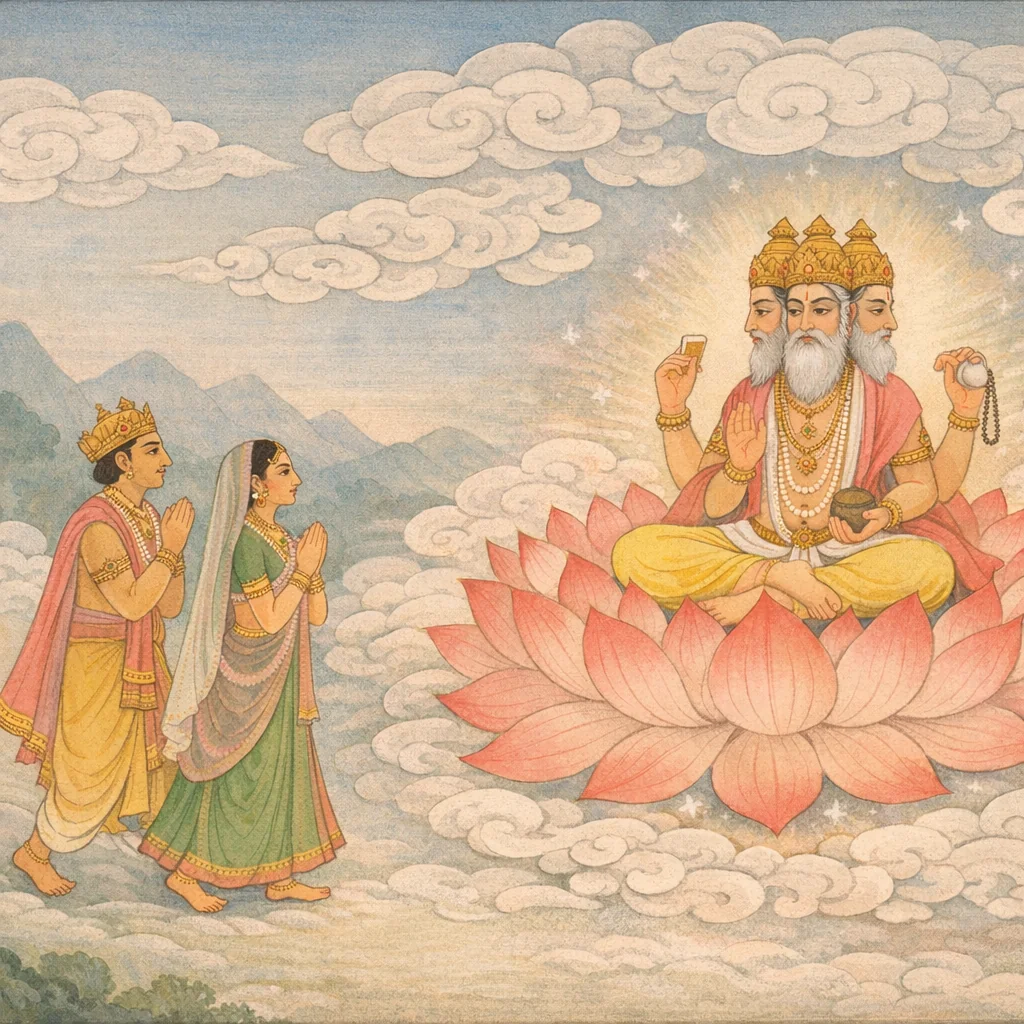
Maitreya, keeping the posture of a disciple, asks about nitya–naimittika duties and then requests Parāśara to recount the dynastic genealogies. Parāśara turns to vaṃśa-kathā and gives the phala-śruti: daily remembrance of Manu’s lineage beginning from Brahmā prevents one’s own family line from being cut off. The narrative moves through select genealogical links (e.g., Nābhāga to Bhalandana) and highlights the royal-sacrificial splendor of Marutta’s golden yajña. It then touches the Vaiśālika rulers and Tṛṇabindu’s boon granting them longevity and increased dharma. The chapter culminates in the Raivata–Revatī episode: Raivata consults Brahmā for a worthy husband; due to a time-shift humans have diminished, so Revatī is given to Baladeva (Keśava’s aṃśa). Baladeva adjusts her stature with the plough-tip, and Raivata departs for tapas. Interwoven is a dense stuti teaching Viṣṇu’s transcendence beyond time and name-form, and His immanence as the power behind Brahmā, Rudra, the devas, and the elements.
Shlokas
Verse 1
भगवन् यन् नरैः कार्यं साधुकर्मण्य् अवस्थितैः तन् मह्यं गुरुणाख्यातं नित्यनैमित्तिकात्मकम्
O Blessed One, please tell me—just as a teacher instructs his disciple—what is to be done by men who are established in righteous conduct: those duties that are to be observed constantly, and those that arise on particular occasions.
Verse 2
वर्णधर्मास् तथाख्याता धर्मा ये चाश्रमेषु वै श्रोतुम् इच्छाम्य् अहं वंशांस् तांस् त्वं प्रब्रूहि मे गुरो
You have already set forth the duties of the social orders, and the dharmas that pertain to the stages of life. Now I wish to hear of the dynastic lineages—tell me those genealogies, O revered teacher.
Verse 4
ब्रह्माद्यं यो मनोर् वंशम् अहन्य् अहनि संस्मरेत् तस्य वंशसमुच्छेदो न कदाचिद् भविष्यति
Whoever, day after day, reverently remembers the lineage of Manu—beginning with Brahmā—of that person the line shall never be cut off; his family succession will not perish at any time.
Verse 20
नाभागो नेदिष्टपुत्रस् तु वैश्यताम् अगमत् । तस्माद् भलन्दनः पुत्रो ऽभवत् ॥
Nābhāga, the son of Nediṣṭha, entered the estate of the Vaiśyas; and from him was born a son named Bhalandana.
Verse 27
मरुत्तस्य यथा यज्ञस् तथा कस्याभवद् भुवि सर्वं हिरण्मयं यस्य यज्ञवस्त्व् अतिशोभनम्
As was the sacrifice of Marutta, so too did another such sacrifice arise upon the earth—one in which everything was fashioned of gold, and whose sacrificial implements were exceedingly splendid.
Verse 28
अमाद्यद् इन्द्रः सोमेन दक्षिणाभिर् द्विजातयः मरुतः परिवेष्टारः सदस्याश् च दिवौकसः
Indra grew exhilarated with the Soma; the twice-born were gladdened by the sacrificial gifts (dakṣiṇās). The Maruts stood encircling as attendants, and the heavenly ones—seated as the ritual assembly—looked on in due order.
Verse 37
सृञ्जयात् सहदेवः । ततः कृशाश्वो नाम पुत्रो ऽभवत् ॥
From Sṛñjaya was born Sahadeva; and from him there arose a son named Kṛśāśva.
Verse 39
तत्पुत्रश् च जनमेजयः । जनमेजयात् सुमतिः । एते वैशालिका भूभृतः ॥
And his son was Janamejaya; from Janamejaya was born Sumati. These were the sovereign rulers of Vaiśālī—kings who upheld the earth’s order.
Verse 40
तृणबिन्दोः प्रसादेन सर्वे वैशालिका नृपाः दीर्घायुषो महात्मानो वीर्यवन्तो ऽतिधार्मिकाः
By the grace of Tṛṇabindu, all the kings of the Vaiśālika line became long-lived, great-souled, valorous, and exceedingly righteous in dharma.
Verse 45
तस्य च रेवती नाम कन्या । ताम् आदाय कस्येयम् अर्हतीति भगवन्तम् अब्जयोनिं प्रष्टुं ब्रह्मलोकं जगाम ॥
He had a daughter named Revatī. Taking her with him, he went to Brahmaloka to ask Bhagavān Brahmā, the lotus-born: “Who is worthy to be her husband?”
Verse 50
पुनश् च प्रणम्य भगवते तस्मै यथाभिमतान् आत्मनः स वरान् कथयाम् आस । क एषां भगवतो ऽभिमतो यस्मै कन्याम् इमां प्रयच्छामीति ॥
And once again, bowing to that Blessed Lord, he spoke of the boons he desired: “Which among these is most pleasing to the Lord, to whom I should give this maiden in marriage?”
Verse 60
न ह्य् आदिमध्यान्तम् अजस्य यस्य विद्मो वयं सर्वमयस्य धातुः न च स्वरूपं न परं स्वभावं न चैव सारं परमेश्वरस्य
For we do not truly know the beginning, the middle, or the end of that Unborn One, the sustaining ground of all. Nor do we fully grasp His form, His highest nature, or the innermost essence of the Supreme Lord.
Verse 61
कलामुहूर्तादिमयश् च कालो न यद्विभूतेः परिणामहेतुः अजन्मनाशस्य समस्तमूर्तेर् अनामरूपस्य सनातनस्य
Even Time—made of measures such as kalās and muhūrtas—cannot cause change in Him whose glory is boundless: the Eternal, unborn and undying, whose form is all forms, and who in truth is beyond name and beyond form.
Verse 62
यस्य प्रसादाद् अहम् अच्युतस्य भूतः प्रजासृष्टिकरो ऽन्तकारी क्रोधाच् च रुद्रः स्थितिहेतुभूतो यस्माच् च मध्ये पुरुषः परस्मात्
By the grace of that Acyuta (the Unfailing Lord), I have become the agent who brings forth beings and who also brings their dissolution. From His wrath arises Rudra, who becomes the cause of stability and continuance; and from that Supreme Person comes, in the middle (between creation and dissolution), the Puruṣa who presides within the cosmos.
Verse 63
मद्रूपम् आस्थाय सृजत्य् अजो यः स्थितौ च यो ऽसौ पुरुषस्वरूपी रुद्रस्वरूपेण च यो ऽत्ति विश्वं धत्ते तथानन्तवपुः समस्तम्
He who, assuming my form, creates—though Himself unborn; He who, in the state of preservation, abides as the cosmic Person; and He who, taking the form of Rudra, consumes the universe—He, of infinite manifestations, upholds the whole of all that exists.
Verse 64
शक्रादिरूपी परिपाति विश्वम् अर्केन्दुरूपश् च तमो हिनस्ति पाकाय यो ऽग्नित्वम् उपेत्य लोकान् बिभर्ति पृथ्वीवपुर् अव्ययात्मा
Assuming the form of Śakra and the other gods, He protects the universe; as Sun and Moon, He dispels darkness. For the ripening of beings, He becomes Fire and sustains the worlds; and taking the very body of Earth, the imperishable Self upholds all that lives.
Verse 65
चेष्टां करोति श्वसनस्वरूपी लोकस्य तृप्तिं च जलान्नरूपी ददाति विश्वस्थितिसंस्थितस् तु सर्वावकाशं च नभःस्वरूपी
As the very form of breath, He enables all activity; as water and food, He grants the world its satisfaction and sustenance. Abiding as the principle by which the universe is maintained, and taking the form of space itself, He provides the boundless room in which all beings and worlds can exist.
Verse 66
यः सृज्यते सर्गकृद् आत्मनैव यः पाल्यते पालयिता च देवः विश्वात्मना संह्रियते ऽन्तकारी पृथक् त्रयस्यास्य च यो ऽव्ययात्मा
He who, by His own Self, becomes the Creator and brings forth creation; He who becomes the Preserver and is Himself the divine Guardian of what is sustained; He who, as the indwelling Soul of the universe, becomes the Dissolver—the End-maker; and yet He who remains distinct from this triad of functions, imperishable in His essential being—He is the unchanging Supreme Reality.
Verse 67
यस्मिञ् जगद् यो जगद् एतद् आद्यो यश् चाश्रितो ऽस्मिञ् जगति स्वयंभूः स सर्वभूतप्रभवो धरित्र्यां स्वांशेन विष्णुर् नृपते ऽवतीर्णः
He in whom the whole universe abides, who is the primordial origin of this world, and who—though the Self-born Lord—yet takes refuge within this very creation: that source of all beings, O King, has descended upon the earth as Viṣṇu by a portion of his own being.
Verse 68
कुशस्थली या तव भूप रम्या पुरी पुराभूद् अमरावतीव सा द्वारका संप्रति तत्र चास्ते स केशवांशो बलदेवनामा
O King, your delightful city Kuśasthalī once shone like Amarāvatī itself. Now it is known as Dvārakā, and there indeed abides Baladeva, famed by that name—an emanated portion of Keśava.
Verse 69
तस्मै त्वम् एनां तनयां नरेन्द्र प्रयच्छ मायामनुजाय जायाम् श्लाघ्यो वरो ऽसौ तनया तवेयं स्त्रीरत्नभूता सदृशो हि योगः
Therefore, O king of men, give this daughter of yours to Māyā’s son as his wife. He is a bridegroom worthy of praise, and your daughter is a jewel among women; truly, this alliance is well-matched and fitting.
Verse 70
इतीरितो ऽसौ कमलोद्भवेन भुवं समासाद्य पतिः प्रजानाम् ददर्श ह्रस्वान् पुरुषान् अशेषान् अल्पौजसः स्वल्पविवेकवीर्यान्
Thus prompted by the Lotus-born (Brahmā), the Lord of creatures came down to the earth and beheld all mankind—diminished in stature, scant in vitality, and weak in discernment and strength.
Verse 71
कुशस्थलीं तां च पुरीम् उपेत्य दृष्ट्वान्यरूपां प्रददौ स्वकन्याम् सीरध्वजाय स्फटिकाचलाभ वक्षःस्थलायातुलधीर् नरेन्द्रः
Having come to the city of Kuśasthalī and beholding the maiden of matchless beauty, the king—of incomparable discernment—gave his own daughter in marriage to Sīradhvaja, whose broad chest shone like a crystal mountain.
Verse 72
उच्चप्रमाणाम् इति ताम् अवेक्ष्य स्वलाङ्गलाग्रेण स तालकेतुः विनामयाम् आस ततश् च सापि बभूव सद्यो वनिता यथान्या
Seeing her, Tālaketu remarked, “She is of lofty stature,” and at once pressed her down with the tip of his plough; immediately she became like any other woman, her form brought to ordinary measure.
Verse 73
तां रेवतीं रैवतभूपकन्यां सीरायुधो ऽसौ विधिनोपयेमे दत्त्वा च कन्यां स नृपो जगाम हिमालयं वै तपसे धृतात्मा
Thus Revati, daughter of King Raivata, was duly wedded by Balarāma, whose weapon is the plough; and having given his daughter away, the king, steadfast in spirit, departed indeed for the Himalayas to practice austerities.
Frequently Asked Questions
The text frames vaṃśa-smaraṇa as sacred remembrance aligned with ṛta/dharma. By honoring the cosmic-human transmission from Brahmā through Manu, one participates in the continuity principle that sustains social and familial order; hence the promised phala is uninterrupted succession.
It anchors history in metaphysics: Brahmā’s creation, Rudra’s destructive force, and the cosmic functions of devas and elements are presented as dependent on Viṣṇu’s grace and manifestations. This keeps the vaṃśa narrative subordinate to Viṣṇu as Jagat-kāraṇa and the supreme reality beyond kāla and nāma-rūpa.
Baladeva is identified as Keśava-aṃśa residing in Dvārakā (formerly Kuśasthalī). His marriage to Revatī is portrayed as a dharmic alliance arranged through Brahmā’s counsel, and his plough (lāṅgala) symbolism marks him as a cosmic upholder who also normalizes Revatī’s extraordinary stature for the current age.