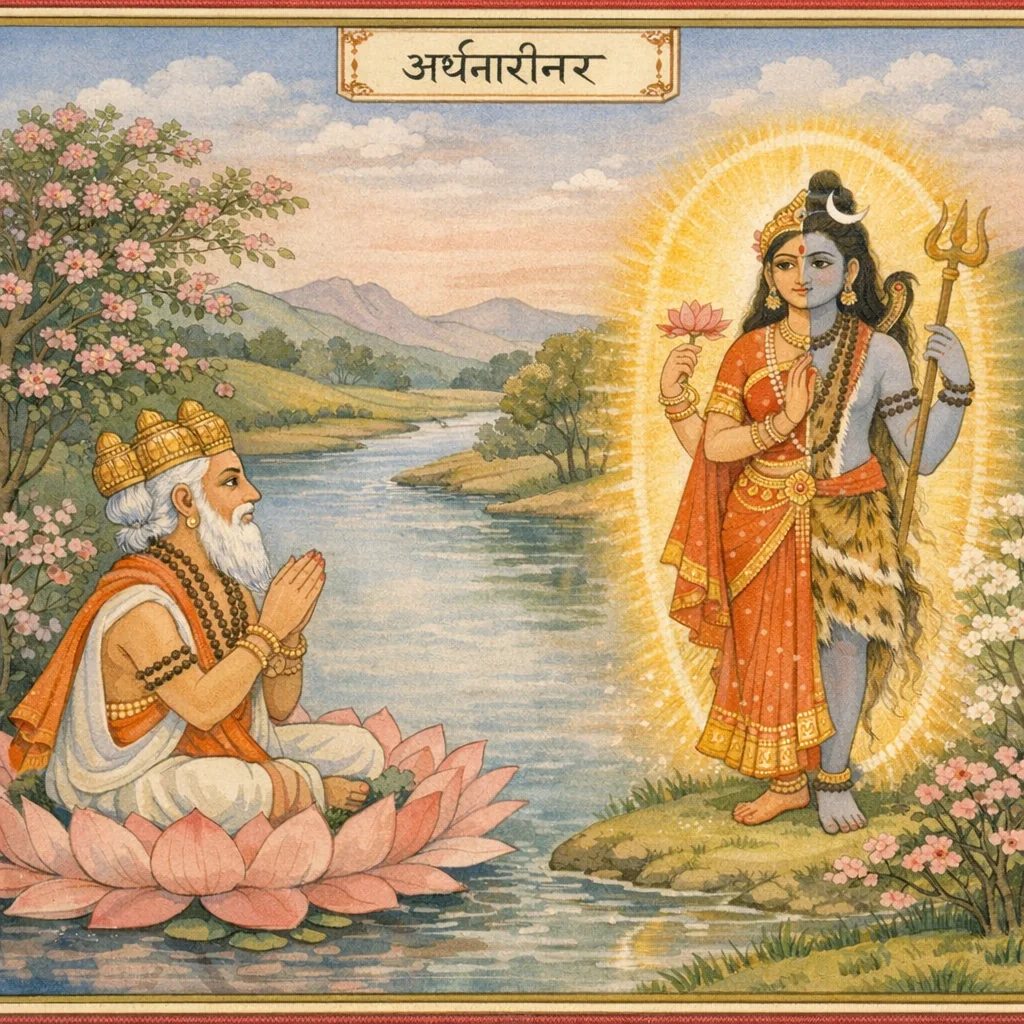
शिवस्यार्द्धनारीनरावतारवर्णनम् (Description of Shiva’s Ardhanārī-nara Manifestation)
This adhyāya, taught by Nandīśvara, reveals Śiva’s unsurpassed (anuttama) form called Ardhanārī-nara, half female and half male. Brahmā creates beings, yet they do not multiply, leaving him distressed and unsettled. A heavenly voice (nabhovāṇī) commands him to establish mithuna-jā sṛṣṭi—creation through the complementary pairing of male and female—but Brahmā cannot produce the female lineage on his own, for it has not manifested from Īśāna. Realizing that progeny is impossible without Śaṃbhu’s prabhāva (effective power), Brahmā performs intense tapas, contemplating Parameśvara united with the supreme Śakti. Śiva is quickly pleased and appears in a wish-fulfilling form as Ardhanārī-nara, approaching Brahmā. Brahmā prostrates and praises him in hymn-like words, conveying the esoteric teaching that cosmic generation and ritual efficacy depend on the inseparable co-presence of Śiva and Śakti, symbolized by the half-female/half-male icon.
Shlokas
Verse 1
नन्दीश्वर उवाच । शृणु तात महाप्राज्ञ विधिकामप्रपूरकम् । अर्द्धनारीनराख्यं हि शिवरूपमनुत्तमम्
Nandīśvara said: “Listen, dear one of great wisdom, to that supreme form of Śiva—known as Ardhanārī-nara—which perfectly fulfills both spiritual injunction (dharma) and sacred desire (kāma).”
Verse 2
यदा सृष्टाः प्रजा सर्वाः न व्यवर्द्धंत वेधसा । तदा चिंताकुलोऽभूत्स तेन दुःखेन दुखितः
When all the created beings did not prosper under the Creator (Brahmā), then he became overwhelmed with worry; afflicted by that sorrow, he was himself distressed.
Verse 3
इति श्रीशिवमहापुराणे तृतीयायां रुद्रसंहितायां शिवस्यार्द्धनारीनरावतारवर्णनं नाम तृतीयोऽध्यायः
Thus, in the Śrī Śiva Mahāpurāṇa—within the third Saṃhitā (Rudrasaṃhitā)—ends the third chapter entitled “The Description of Śiva’s incarnation as Ardhanārī and as Man.”
Verse 4
नारीणां कुलमीशानान्निर्गतं न पुरा यतः । ततो मैथुनजां सृष्टिं कर्तुं शेके न पद्मभूः
Since, in the beginning, the lineage of women had not yet proceeded forth from Īśāna (Lord Śiva), therefore Padmabhū (Brahmā, the Lotus-born) was unable to carry out creation through sexual union.
Verse 5
प्रभावेण विना शंभोर्न जायेरन्निमाः प्रजाः । एवं संचिन्तयन्ब्रह्मा तपः कर्त्तुं प्रचक्रमे
Brahmā reflected: “Without the power and grace of Śambhu, these beings would not come into existence.” Thinking thus, he began to undertake tapas (austerity) to obtain that divine support for creation.
Verse 6
शिवया परया शक्त्या संयुक्तं परमेश्वरम् । संचिंत्य हृदये प्रीत्या तेपे स परमं तपः
With loving devotion, he contemplated in his heart the Supreme Lord united with Śivā—the transcendent Power—and then undertook the highest austerity.
Verse 7
तीव्रेण तपसा तस्य संयुक्तस्य स्वयंभुवः । अचिरेणैव कालेन तुतोष स शिवो द्रुतम्
By his intense austerity—performed with unwavering absorption—the Self-born Lord (Shiva) was quickly pleased with him; indeed, in a very short time, Shiva became satisfied at once.
Verse 8
ततः पूर्णचिदीशस्य मूर्तिमाविश्य कामदाम् । अर्द्धनारीनरो भूत्वा ततो ब्रह्मान्तिकं हरः
Then Hara (Śiva), entering the wish-fulfilling form of the Lord who is Perfect Consciousness, became the Ardhanārī form—half female, half male; thereafter he went to the presence of Brahmā.
Verse 9
तं दृष्ट्वा शंकरं देवं शक्त्या प्ररमयान्वितम् । प्रणम्य दण्डवद्ब्रह्मा स तुष्टाव कृताञ्जलिः
Seeing Lord Śaṅkara, the God united with the Supreme Śakti, Brahmā bowed in daṇḍavat (full prostration) and, with folded hands, praised Him.
Verse 10
अथ देवो महादेवो वाचा मेघगभीरया । संभवाय सुसंप्रीतो विश्वकर्त्ता महेश्वरः
Then Mahādeva—Maheśvara, the great God, Maker of the universe—being greatly pleased with Saṃbhava, spoke to him in a voice deep as thunderclouds.
Verse 11
ईश्वर उवाच । वत्सवत्स महाभाग मम पुत्र पितामह । ज्ञातवानस्मि सर्व तत्तत्त्वतस्ते मनोरथ
Īśvara said: “O dear child—O most fortunate one—O my son, O Grandfather! I have truly understood, in its very essence, the whole intention of your desire.”
Verse 12
प्रजानामेव वृद्ध्यर्थं तपस्तप्तं त्वयाधुना । तपसा तेन तुष्टोऽस्मि ददामि च तवेप्सितम्
“You have now performed austerity solely for the increase and welfare of beings. By that tapas I am pleased; therefore I grant you what you desire.”
Verse 13
इत्युक्त्वा परमोदारं स्वभावमधुरं वचः । पृथक्चकार वपुषो भागाद्देवीं शिवां शिवः
Having spoken those supremely generous words, sweet by His very nature, Lord Śiva separated from a portion of His own body the auspicious Goddess Śivā.
Verse 14
तां दृष्ट्वा परमां शक्तिं पृथग्भूतां शिवागताम् । प्रणिपत्य विनीतात्मा प्रार्थयामास तां विधिः
Seeing that Supreme Power—manifest as a distinct divine presence and come forth from Śiva—Brahmā (Vidhi), with a humbled and disciplined mind, bowed down and began to supplicate Her.
Verse 15
ब्रह्मोवाच । देवदेवेन सृष्टोहमादौ त्वत्पतिना शिवे । प्रजाः सर्वा नियुक्ताश्च शंभुना परमात्मना
Brahmā said: “O Śivā, in the beginning I was created by the God of gods—Śambhu, the Supreme Self, your Lord. And by that same Supreme Śambhu all beings were duly appointed to their respective functions and orders.”
Verse 16
मनसा निर्मिताः सर्वे शिवे देवादयो मया । न वृद्धिमुपगच्छंति सृज्यमानाः पुनःपुनः
“I have fashioned all these—beginning with the gods—by my mind, in dependence upon Śiva. Yet, though they are created again and again, they do not attain true increase or fulfillment.”
Verse 17
मिथुनप्रभवामेव कृत्वा सृष्टिमतः परम् । संवर्द्धयितुमिच्छामि सर्वा एव मम प्रजाः
Having made the supreme creation proceed through paired generation (male and female), I now desire to foster and expand all these beings who are my progeny.
Verse 18
न निर्गतं पुरा त्वत्तो नारीणां कुलमव्ययम् । तेन नारीकुलं श्रेष्ठं मम शक्तिर्न विद्यते
From you, in the beginning, the imperishable lineage of women did not proceed. Therefore the lineage of women is superior; and without it, my own śakti is not manifest.
Verse 19
सर्वासामेव शक्तीनां त्वत्तः खलु समुद्भवः । तस्मात्त्वं परमां शक्तिं प्रार्थयाम्यखिलेश्वरीम्
Indeed, the origin of all śaktis arises from You alone. Therefore I pray to You—the Supreme Power, the Sovereign Lady of all—grant me Your grace.
Verse 20
शिवे नारीकुलं स्रष्टुं शक्तिं देहि नमोऽस्तु ते । चराचरं जगद्विद्धि हेतोर्मातः शिवं प्रिये
O Śivā, grant me the Śakti to create the multitude of women; salutations to you. Know, dear Mother, that this entire moving and unmoving universe arises from Śiva as its cause, O beloved.
Verse 21
अन्यं त्वत्तः प्रार्थयामि वरं च वरदेश्वरि । देहि मे तं कृपां कृत्वा जगन्मातर्नमोऽस्तु ते
O bestower of boons, O sovereign Lady of boons! From you alone I beg yet another boon. Bestow it upon me with compassion, O Mother of the universe—salutations be to you.
Verse 22
चराचरविवृद्ध्यर्थमीशेनैकेन सर्वगे । दक्षस्य मम पुत्रस्य पुत्री भव भवाम्बिके
“O all-pervading Ambikā, for the increase and flourishing of all beings—moving and unmoving—by the will of the one Supreme Lord, become the daughter of Dakṣa, who is my son, O Bhavāmbikā.”
Verse 23
एवं संयाचिता देवी ब्रह्मणा परमेश्वरी । तथास्त्विति वचः प्रोच्य तच्छक्तिं विधये ददौ
Thus entreated by Brahmā, the Supreme Goddess (Parameśvarī) replied, “So be it,” and granted that very power for the accomplishment of the ordained rite and purpose.
Verse 24
तस्माद्धि सा शिवा देवी शिवशक्तिर्जगन्मयी । शक्तिमेकां भ्रुवोर्मध्यात्ससर्जात्मसमप्रभाम्
Therefore the Goddess Śivā—Śiva’s own Power, pervading the whole universe—projected a single Śakti from the space between her eyebrows, radiant with the same splendor as her own Self.
Verse 25
तामाह प्रहसन्प्रेक्ष्य शक्तिं देववरो हरः । कृपासिन्धुर्महेशानो लीलाकारी भवाम्बिकाम्
Gazing upon that Śakti with a gentle smile, Hara—the best among the gods—spoke. Mahēśāna, the ocean of compassion, the Divine who sports in līlā, addressed Bhavāmbikā (Mother Bhavānī).
Verse 26
शिव उवाच । तपसाराधिता देवि ब्रह्मणा परमेष्ठिना । प्रसन्ना भव सुप्रीत्या कुरु तस्याखिलेप्सितम्
Śiva said: “O Goddess, by the austerities of Brahmā, the Parameṣṭhin, you have been propitiated. Be gracious, fully pleased, and in loving kindness grant him all that he desires.”
Verse 27
तामाज्ञां परमेशस्य शिरसा प्रतिगृह्य सा । ब्रह्मणो वचनाद्देवी दक्षस्य दुहिताभवत्
Bowing her head, she received the command of the Supreme Lord, Parameśa; and by Brahmā’s word, that Goddess became the daughter of Dakṣa.
Verse 28
दत्त्वैवमतुलां शक्तिं ब्रह्मणो सा शिवा मुने । विवेश देहं शंभोर्हि शंभुश्चान्तर्दधे प्रभुः
O sage, having thus bestowed upon Brahmā an incomparable power, that Goddess Śivā entered into Śambhu’s body; and the Lord Śambhu, the Supreme Master, became unmanifest (disappeared from view).
Verse 29
तदाप्रभृति लोकेऽस्मिन्स्त्रिया भागः प्रकल्पितः । आनन्दं प्राप स विधिः सृष्टिर्जाता च मैथुनी
From that time onward in this world, the woman’s share (and rightful portion) was duly established. Then that Ordainer (Brahmā, the cosmic regulator) attained satisfaction, and the creation became sexual—arising through the union of male and female.
Verse 30
एतत्ते कथितं तात शिवरूपं महोत्तमम् । अर्द्धनारीनरार्द्धं हि महामंगलदं सताम्
Dear child, I have thus described to you the supremely exalted form of Śiva—Ardhanārīśvara, half woman and half man—which bestows great auspiciousness upon the virtuous.
Verse 31
एतदाख्यानमनघं यः पठ्च्छृणुयादपि । स भुक्त्वा सकलान्भोगान्प्रयाति परमां गतिम्
O sinless one, whoever recites—or even listens to—this stainless sacred narrative, after enjoying all rightful pleasures, attains the supreme state: the highest liberation granted by Lord Śiva.
Frequently Asked Questions
Brahmā’s creation fails to proliferate; instructed to create through paired generation, he realizes feminine lineage cannot arise without Śiva’s power. Through tapas, he gains Śiva’s appearance as Ardhanārī-nara, establishing that cosmogenesis requires Śiva-Śakti co-presence.
Ardhanārī-nara symbolizes non-dual complementarity: consciousness and power (Śiva and Śakti) are not two competing principles but a single integrated reality that makes both creation (sṛṣṭi) and ritual efficacy possible.
Śiva is highlighted in the Ardhanārī-nara form—Śiva visibly united with Parā Śakti—functioning as an iconographic theology of divine completeness and the source-condition for generative creation.